Night Vision vs Thermal for Hunting Which Optic Wins
The whole night vision vs. thermal for hunting debate boils down to one fundamental choice: do you need to find something, or do you need to see it? Night vision amplifies existing light to give you a detailed picture, making it king for positive identification. Thermal, however, detects heat signatures, allowing it to spot targets with incredible speed.
Which one you choose hinges entirely on that distinction. Are you trying to pick a specific boar out of a sounder, or are you just trying to find where the sounder is in the first place?
Seeing in the Dark: Two Different Worlds
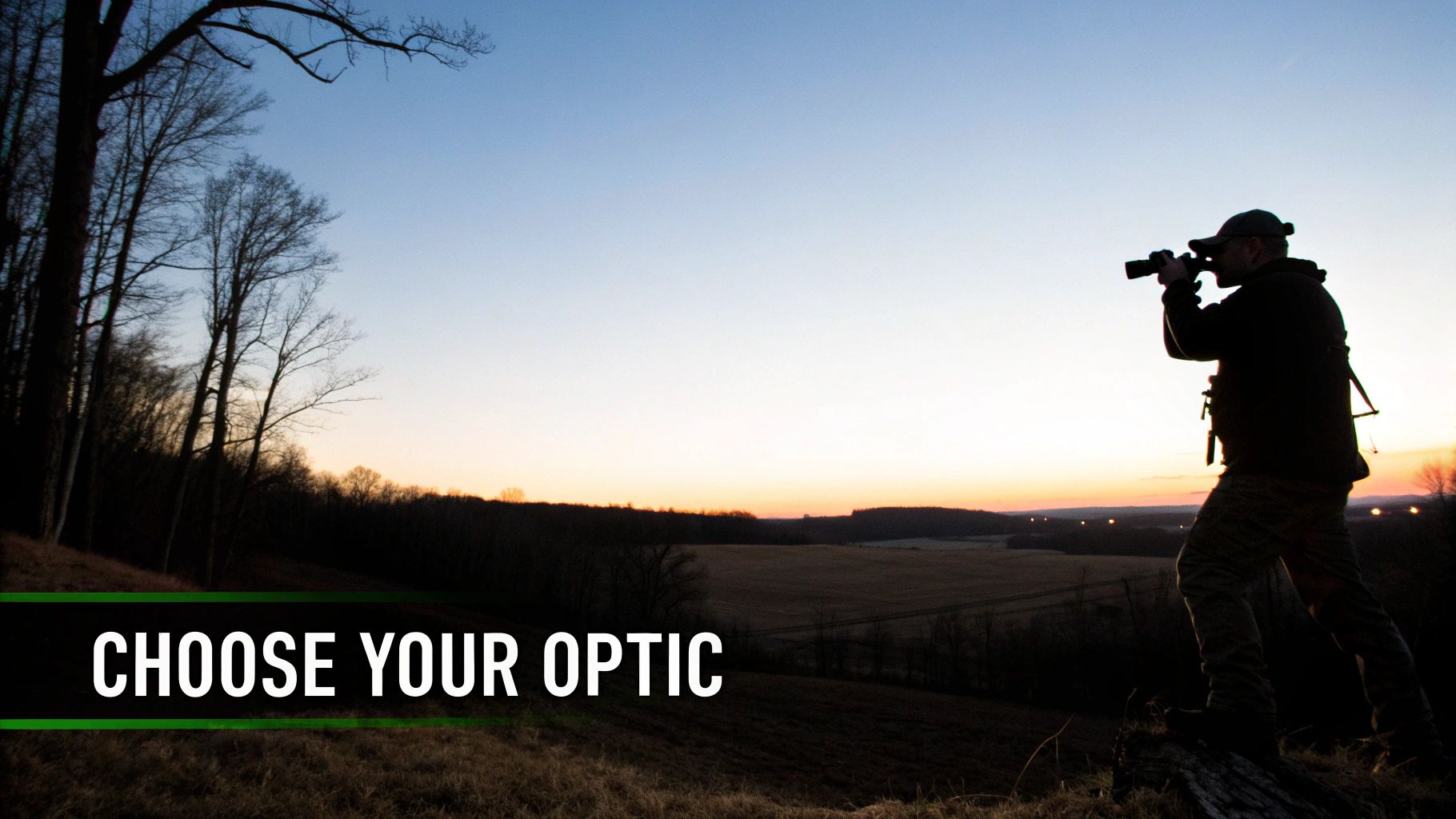
Stepping into the world of night hunting means picking the right tool for the job. It's a decision that goes beyond just budget; it directly affects how effective, and even how safe, you are out there. Both of these technologies are game-changers, but they operate on completely different principles. Getting that difference is the first step to making an investment you won't regret.
Night vision—what most people picture as that classic green-tinted view from the movies—is basically light amplification on steroids. It gathers tiny amounts of ambient light from the moon or stars and intensifies it thousands of times. The result is a surprisingly detailed image that lets you see terrain, identify specific features on an animal, and navigate your surroundings with confidence. It excels at giving you the full picture.
Thermal imaging is a different beast entirely. It doesn't see light; it sees heat. Every object gives off some level of infrared energy, and a thermal optic creates a picture based on those temperature differences. This is why a warm-blooded animal practically glows against a cool hillside, making it pop out from its surroundings. Thermal's biggest strength is pure detection, spotting game through camouflage, light fog, and foliage when your eyes (and even night vision) would see nothing.
A Head-to-Head Look
To make things clearer, let's break down how they stack up in the real world. This isn't just about specs on a box; it's about what you'll actually experience in the field.
| Feature | Thermal Imaging | Night Vision |
|---|---|---|
| How It Works | Detects heat signatures (infrared energy) | Amplifies available light (photons) |
| Best Use Case | Lightning-fast detection, especially at range | Positive identification and navigation |
| What You See | A heat map (white-hot, black-hot, etc.) | A detailed, realistic monochrome image |
| In Bad Weather | Punches through fog, smoke & light brush | Performance drops in rain, fog & thick cover |
| Light Needed | None. Works in pitch-black conditions. | Needs some ambient light or an IR illuminator. |
Here’s the simplest way I can put it: Thermal finds the needle in the haystack. Night vision lets you get close enough to see it’s a needle and not a thorn you’re about to step on.
How This Gear Actually Works
To figure out whether night vision or thermal is the right tool for your hunt, you first have to understand what’s going on under the hood. They both let you own the night, but they get there in completely different ways. It’s not about which one is "better" overall, but which one is the right specialist for the job you need done.
At the most basic level, one sees by amplifying light, while the other sees by detecting heat. That single difference changes everything—from how far you can spot a hog to whether you can see through thick fog.
Night Vision: Seeing by Amplifying Light
Traditional night vision works on a principle called image intensification. Think of it as turning the volume way up on whatever little light is available. Inside every unit, there's a component called an image intensifier tube, and it's the heart of the whole operation.
This tube sucks in the faintest traces of ambient light—moonlight, starlight, you name it—which are made of particles called photons. When these photons hit a special surface (a photocathode), they're converted into electrons. Those electrons are then multiplied thousands of times over before they hit a phosphor screen, which turns them back into a visible image you can see.
The result is that classic green-hued picture. It gives you a surprisingly detailed and natural-looking view of your surroundings, complete with textures, shadows, and depth perception. This is why night vision is fantastic for navigating terrain and getting a positive ID on a target. The catch? It needs some light to work. In total darkness, you’ll need an IR illuminator—basically a flashlight that's invisible to the naked eye but lights things up for your optic.
Want a deeper dive? You can explore the different flavors of night vision in our guide to night vision technology explained: thermal imaging vs digital night vision vs analog night vision.
Thermal Imaging: Seeing the World of Heat
Thermal imaging plays by a completely different set of rules. It doesn't care about visible light at all. Instead, it sees infrared energy—the heat that every object gives off. The magic component here is a sensor called a microbolometer.
This sensor is incredibly sensitive, picking up tiny differences in temperature from one spot to the next. It then translates that heat data into a picture, called a thermogram. This is why a warm-blooded animal like a coyote or hog absolutely pops against the cooler background, glowing like a lightbulb even when it’s hidden in brush or tall grass.
Most thermal optics let you cycle through different color palettes to get the best view for the conditions:
- White-Hot: The go-to for most hunters. Hot objects show up bright white, making detection easy.
- Black-Hot: The inverse of white-hot. Many find it easier on the eyes during long nights of scanning.
- Color Palettes: These use different colors to highlight specific temperature ranges, which can be useful for tracking or identifying downed game.
Here's the bottom line: Night vision works with your eyes, amplifying light to help you see better. Thermal gives you a sixth sense, letting you see the invisible heat signatures all around you.
Because it detects heat, not light, thermal is a game-changer. For pure detection, it’s king. Thermal works day or night, in total darkness, and can see through smoke, fog, and light cover that would blind a night vision device. This unmatched versatility is why its adoption among U.S. hunters has soared by a staggering 62% since 2019.
A quality thermal scope can pick up on heat differences as small as 0.1°C. We're talking about spotting a camouflaged boar at 2,000 yards, a distance where even a high-end night vision scope with an IR illuminator would struggle to reach past 300 yards. For finding game in the first place, nothing beats it. You can see more about these field comparisons and market trends and how they stack up in real-world use.
Field Performance in Key Hunting Scenarios
Forget the spec sheets for a moment. The real test of any optic happens when your boots are on the ground. How do these technologies actually perform during a hunt—from spotting a hog across a soybean field to making a positive ID on a coyote in thick woods? That's what really matters.
The biggest, most immediate difference you'll notice is in detection. Thermal imaging is the undisputed champion here, period. It picks up heat signatures at mind-boggling distances where even the best night vision draws a blank. That’s because thermal isn't looking for reflected light; it’s reading radiated heat, giving you an almost unfair advantage in finding game.
On the flip side, night vision absolutely shines when it comes to identification. It gives you a much more realistic, detailed picture of what you're looking at. You can see texture, judge depth, and pick out specific features on an animal—details that are critical for making an ethical shot.
Detection Range: A Clear Win for Thermal
When it comes to just finding game, especially over long distances, the debate ends quickly. A quality thermal optic will spot the heat from a coyote or hog hundreds, sometimes thousands, of yards away. It turns a vast, dark landscape into a scannable map of animal activity.
Think about it: a hunter scanning a huge Texas ranch with a thermal monocular might see the faint glow of a sounder of hogs over a mile out. That early warning is a massive tactical advantage. It gives you all the time in the world to plan a stalk without ever being noticed. With a high-end Gen 3 night vision unit, you'd have to be much, much closer—often inside 100 to 300 yards—to see that same group, and that's only if they're not in cover.
This incredible reach is exactly why thermal has become the standard for predator and hog hunters in open country. It flips the script from reacting to game to proactively hunting it.
Identification Clarity: Where Night Vision Shines
Thermal finds the target, but night vision tells you exactly what it is. Once you’ve closed the gap, the granular detail from a good night vision device is priceless. It lets you see the animal's true shape, get a real sense of its size, and confidently tell one species from another in a way the glowing blob on a thermal screen just can't match.
Picture this: you're in a dense woodlot and have a predator coming to your call. Through a thermal scope, you see a warm shape slipping between the trees at 75 yards. Is it the coyote you're after? A curious bobcat? Or is it the neighbor's German Shepherd? With thermal alone, it can be tough to say for sure.
Now, switch over to a Gen 3 night vision scope. The scene snaps into focus with incredible clarity. You can make out the animal's posture, the texture of its fur, and its distinct silhouette against the trees. You know, without a doubt, that it’s your target. That level of detail is what separates a safe, ethical shot from a terrible mistake.
This chart really drives home how these technologies stack up across the board for hunters.
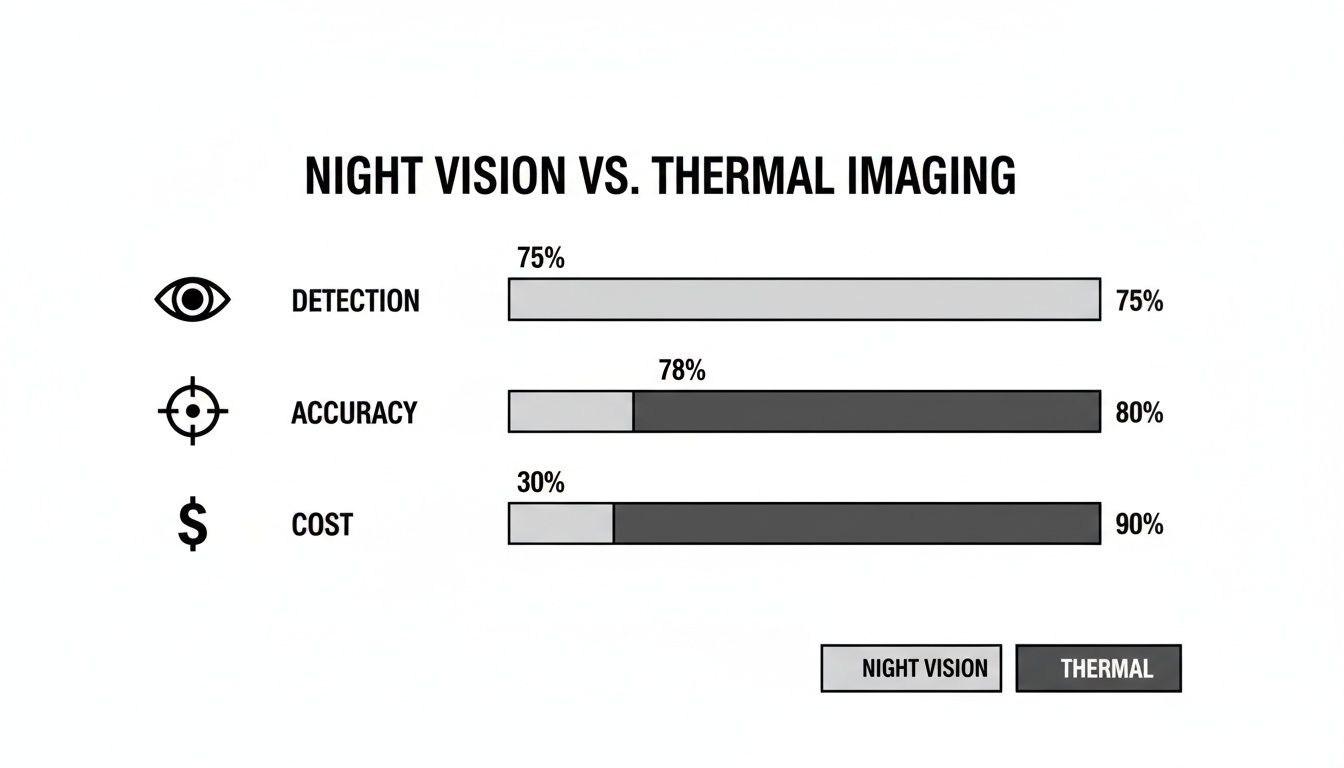
As you can see, thermal runs away with detection, but things get a lot more competitive when you look at accuracy and cost, which really depend on the specific generation and model you're considering.
Performance in Adverse Conditions
Bad weather can make great optics worthless, and this is another area where thermal proves its worth. Since it reads heat instead of light, it’s practically immune to the things that completely shut down night vision.
- Fog and Rain: Thermal cuts right through fog, mist, and rain, picking up heat with very little trouble. Night vision gets "whited out" because it amplifies the light reflecting off all those water droplets in the air, rendering it useless.
- Smoke and Dust: Got a dusty field or smoke from a campfire? Thermal doesn't care and will keep detecting heat. Night vision performance will be drastically reduced.
- Foliage and Brush: Thermal can often spot the body heat of an animal that’s partially hidden behind light brush or tall grass, showing you targets that are completely invisible to the naked eye and night vision.
We've put both technologies through the wringer to see how they truly stack up in the field. Here’s a quick rundown of what we’ve found.
Performance Comparison Thermal vs Night Vision
This table gives you a head-to-head look at how these two technologies perform on the metrics that matter most to a hunter.
| Performance Metric | Thermal Imaging | Night Vision (Gen 3) |
|---|---|---|
| Detection Range | Excellent (500-2,500+ yards) | Fair (100-300 yards) |
| Identification | Fair (Relies on shape/gait) | Excellent (Provides clear detail) |
| Adverse Weather | Excellent (Cuts through fog, rain, smoke) | Poor (Useless in heavy fog/rain) |
| Daytime Use | Yes (With lens cover or specific modes) | No (Can damage the tube) |
| Cover Penetration | Good (Can see through light brush/grass) | Poor (Obscured by any foliage) |
| Power Consumption | High (Often requires external batteries) | Low (Runs long on internal batteries) |
Ultimately, thermal gives you an almost supernatural ability to find animals in the dark, no matter the conditions, while top-tier night vision gives you the confidence to make a clean, ethical shot.
For a lot of serious hunters, the answer isn't "either/or"—it's both. The ultimate setup involves using a handheld thermal monocular to scan wide areas and find targets quickly. Once you spot something, you switch to your rifle-mounted night vision scope for positive identification and the shot. Our comprehensive guide on thermal vision for hunting gets into these hybrid strategies and can help you decide if it's the right approach for you. This "best of both worlds" method gives you the unmatched detection power of thermal and the identification certainty of night vision, creating the most effective night hunting system you can build.
Matching the Optic to Your Hunting Style

The best optic isn't the one with the fanciest specs on paper; it's the one that feels like a natural extension of you in your specific hunting spot. A thermal scope that’s perfect for a wide-open Texas hog field might be the wrong tool entirely for calling coyotes in the thick woods up north. The whole night vision vs thermal for hunting debate comes down to how and where you hunt.
By looking at a few common hunting scenarios, we can see exactly where each technology shines. This isn't about picking an overall "winner"—it's about getting the right tool for the job you need to do.
The Open-Field Hog Hunter
If you're hunting across huge agricultural fields, sprawling ranches, or open prairie, finding your target is 90% of the game. Your biggest challenge is spotting animals from hundreds of yards away, long before they ever know you're there. This is thermal’s playground.
A thermal scope or monocular essentially turns a vast, dark landscape into a video game. The heat signature of a feral hog or coyote pops right out against the cooler ground, making it almost impossible to miss, even at serious distances.
- Primary Advantage: The detection range is incredible. You can spot game from 500 to over 2,000 yards out, which gives you all the time in the world to plan a stalk.
- Key Consideration: While thermal is king for detection, telling a hog from a calf or a deer at those extreme ranges can be tough. You absolutely have to confirm your target as you close the gap.
For the open-field hunter, early detection is everything. Thermal gives you an almost unfair advantage, letting you see heat signatures over the next rise that would be completely invisible to even the best night vision.
The Dense-Woodland Predator Caller
Now, let's flip the script. Imagine you're tucked into thick timber, calling predators where your shots are almost always under 100 yards. The woods are a cluttered mess of trees and brush. Here, identifying your target with 100% certainty is far more important than seeing for a mile.
This is where a good Gen 3 night vision scope really comes into its own. It gives you a crisp, detailed picture of what’s actually there—every branch, rock, and log. Most importantly, you can clearly see the animal coming into your call and know for sure if it’s a coyote, a bobcat, or your neighbor's dog. That's a level of detail a glowing thermal blob can sometimes struggle with up close.
But thermal has a trump card even here. It can see through things that stop light, like fog, smoke, or light foliage. During a 2023 Alabama hog hunt, hunters using thermal optics were spotting hogs hidden in tall grass at over 1,000 yards, while those with night vision saw nothing but grass. This gave the thermal teams a 55% higher success rate. Considering the U.S. Fish and Wildlife Service notes that 75% of the 1.5 million feral swine taken each year are hunted at night, thermal's ability to punch through cover is a game-changer. You can find more real-world examples in Pulsar's field reports on thermal effectiveness.
The Ultimate Hybrid System
For the serious professional or the hunter who wants the absolute best odds no matter the situation, the answer isn't choosing one or the other. It's using both. The "hybrid" system is the peak of night hunting, marrying the strengths of thermal and night vision into a deadly effective process.
Here’s how it works:
- A Handheld Thermal Monocular: This is your spotter. You use it to scan big areas quickly without sweeping your rifle around. It picks up heat signatures from incredible distances.
- A Rifle-Mounted Night Vision Scope: Once your thermal spots a target, you get on your rifle. The night vision scope gives you that crystal-clear image you need to positively identify the animal and make a safe, ethical shot.
This two-part system gives you the best of both worlds. You get the unbelievable detection range of thermal combined with the positive ID and detail of high-quality night vision. It takes all the compromise out of the equation and gives you a massive advantage, no matter where you're hunting.
Navigating Cost, Durability, and Regulations
Beyond what you see in the field, the practical side of owning this kind of gear is often what makes the decision for you. This isn't just about which technology works best, but what makes sense for your bank account, how long your gear will last, and what’s even legal to use. These three things—cost, durability, and regulations—are just as important as sensor resolution or how far you can see.
Getting a handle on the investment is the first hurdle. While the price gap between night vision and thermal has definitely shrunk, you'll still find big differences depending on the quality you're after. A cheaper optic gets you in the game, sure, but a premium unit is a real long-term investment in performance and reliability you can count on.
Breaking Down the Investment
The cost of entry is a big one. For the most part, you can find a usable entry-level digital night vision scope for under $1,000. But for serious hunting, most guys I know are looking at higher-end analog systems. A quality Gen 2+ or Gen 3 night vision setup will start around $2,500 and can easily sail past $10,000 for a top-of-the-line dual-tube unit.
Thermal optics have a similar price range. You can get into an entry-level thermal scope or monocular for as little as $1,500, but their performance is often held back by low-res sensors and choppy refresh rates. A high-performance thermal scope, one with a crisp 640×480 sensor and other key features, is going to run you from $3,500 to over $8,000. With thermal, the more you spend, the clearer your picture and the farther out you can positively ID your target.
Your budget really dictates the tier of technology you can get. With night vision, more money buys a cleaner, brighter image from a better tube (think Gen 3 vs. Gen 1). With thermal, it buys a higher-resolution sensor, which translates directly to a sharper picture and longer identification range.
For a deeper dive into planning this kind of purchase, our guide on budgeting for night vision and finding the right balance will help you match your needs with what you’re willing to spend.
Durability, Maintenance, and Long-Term Value
Modern hunting optics are built to take a beating. Any thermal or night vision unit from a reputable brand is designed to handle recoil, nasty weather, and getting knocked around in the field. They’re almost always housed in rugged, nitrogen-purged bodies that are waterproof and shockproof, so they can stand up to the elements without a problem.
But there are a few key differences in how you care for them.
- Night Vision: The image intensifier tube is the soul of the device. It has a limited lifespan, usually rated for 10,000+ hours of use. The single biggest risk is hitting it with bright light, which can cause permanent burn spots on the tube.
- Thermal Imaging: Thermal units are solid-state and don't really have parts that "wear out" in the same way. They’re also much more forgiving if you accidentally point them at a light source, which makes them a bit easier on beginners.
Both are a serious investment, so you need to look for a solid warranty. A good dealer will stand behind their gear. In fact, many high-end Gen 3 night vision systems come with warranties of up to 10 years, giving you some much-needed peace of mind.
Understanding the Legal and Ethical Landscape
Frankly, this might be the most important factor of all. The legality of hunting at night with thermal or night vision optics changes wildly from one state to another, and sometimes even county by county or by the specific animal you’re hunting. Before you even think about buying, you absolutely have to do your homework.
Some states are fine with night hunting for predators and pests like coyotes and feral hogs but ban it completely for game animals like deer. Others might allow night vision but restrict thermal, or vice versa. And to make it even more complicated, these regulations can change from one season to the next. It is your responsibility as a hunter to know and follow the laws where you hunt.
Always, always check with your state’s wildlife agency for the most current rules. An illegal harvest, even if it's an honest mistake, can lead to massive fines, the loss of your hunting license, and having all your expensive gear confiscated. Ethical hunting starts with knowing the law.
Your Top Questions About Night Hunting Optics
Diving into night vision and thermal can feel like learning a new language. You're not alone. Here, I'll break down the most common questions I hear from hunters trying to decide between these two incredible technologies, giving you the straight-up answers you need.
Can You Use Thermal During the Day?
You absolutely can. In fact, that's one of thermal's biggest strengths. Since a thermal optic sees heat instead of light, it works just as well at high noon as it does at midnight. This makes it an incredibly versatile piece of gear for scouting, blood trailing, or even spotting game bedded down in the shade during a hot day.
Now, it's true that direct, intense sunlight can sometimes reduce the contrast in the image, making it feel a bit "washed out." That's why most good thermal units have specific daytime color palettes and sensor settings to cut through the solar radiation and keep those heat signatures popping.
Which is Better for Positive ID?
This is a big one. For positively identifying your target, night vision has the clear advantage. It works by amplifying ambient light, giving you a detailed, recognizable image that looks much like what you'd see through a regular scope, just in shades of green or white. You can see fur texture, antler points, and the animal's exact silhouette—details that are non-negotiable for making a safe, ethical shot.
Thermal is the undisputed king of detection; it makes a warm body stick out against a cool background like a neon sign. But what you're seeing is a heat signature, not a detailed picture. While experienced hunters get very good at identifying animals by their shape and gait on a thermal, night vision provides the undeniable clarity you need to be 100% sure of your target.
A common pro-level setup says it all: "Find with thermal, identify with night vision." This is why so many serious hunters scan with a thermal monocular but have a night vision scope on their rifle. It's the best of both worlds.
Can Animals See Night Vision or Thermal?
This question gets to the heart of what separates these two technologies in the field. The answer is nuanced, so let's break it down.
-
Thermal Imaging: Nope. Animals cannot see the infrared heat energy that a thermal scope detects. Because thermal is a completely passive system—it only reads heat, it doesn't project anything—it is 100% invisible to game. You can scan all you want without ever spooking an animal.
-
Night Vision: The device itself is also passive and invisible. The catch is the IR illuminator—the infrared flashlight you often need to use when there’s zero ambient light. While that IR beam is invisible to our eyes, many game animals can see it. Turn it on at the wrong time, and they'll bolt just like you hit them with a spotlight.
Bottom line: Thermal is the stealthier choice for scanning in total darkness. With night vision, you have to be smart about when and how you use your illuminator.
What Lasts Longer, Thermal or Night Vision?
Both technologies are built into tough, field-ready housings, but the core components have very different lifespans.
A night vision scope's heart is its image intensifier tube. These tubes have a finite lifespan, usually rated for around 10,000 hours of runtime. While that’s a ton of hunting for most folks, it is a consumable part that will slowly degrade over time. It's also extremely sensitive and can be fried instantly by exposure to bright light.
Thermal imagers, on the other hand, are solid-state devices. Their microbolometer sensors don't have parts that "wear out" with use in the same way a tube does. This gives thermal a much longer theoretical lifespan and makes it far more resistant to damage from accidental light exposure.
Which One is Cheaper?
It used to be that night vision was the more affordable entry point, but that has changed dramatically. Today, the price ranges for both are pretty similar, and what you spend really comes down to the performance you're after.
- Getting Started: You can get into a decent digital night vision or an entry-level thermal scope for under $2,000. These are great for shorter-range setups but will have real limits on image clarity and detection distance.
- Serious Gear: To get top-tier performance, you should plan on investing anywhere from $3,500 to $10,000+. In the night vision world, that buys you a crystal-clear Gen 3 tube. For thermal, that budget gets you a high-resolution (640×480 or better) sensor that delivers a sharp image and lets you identify targets at serious distances.
Instead of asking what's "cheaper," the better question is: which technology gives me the best performance and value for my kind of hunting?
Ready to gear up for your next night hunt? The team at Superior Tactical LLC has over a decade of experience outfitting hunters with the best night vision and thermal optics on the market. Explore our curated selection of mission-ready gear at https://superiortac.com.
