A Complete Guide to Laser Aiming Modules
If you've ever struggled with aligning iron sights under pressure, you know how much can go wrong. Getting that perfect sight picture—front sight, rear sight, target—takes time and a whole lot of practice. A laser aiming module, or LAM, completely short-circuits that process. It slaps a small, precise dot right on your target, showing you exactly where your shot is going to land.
What Are Laser Aiming Modules and Why Do They Matter
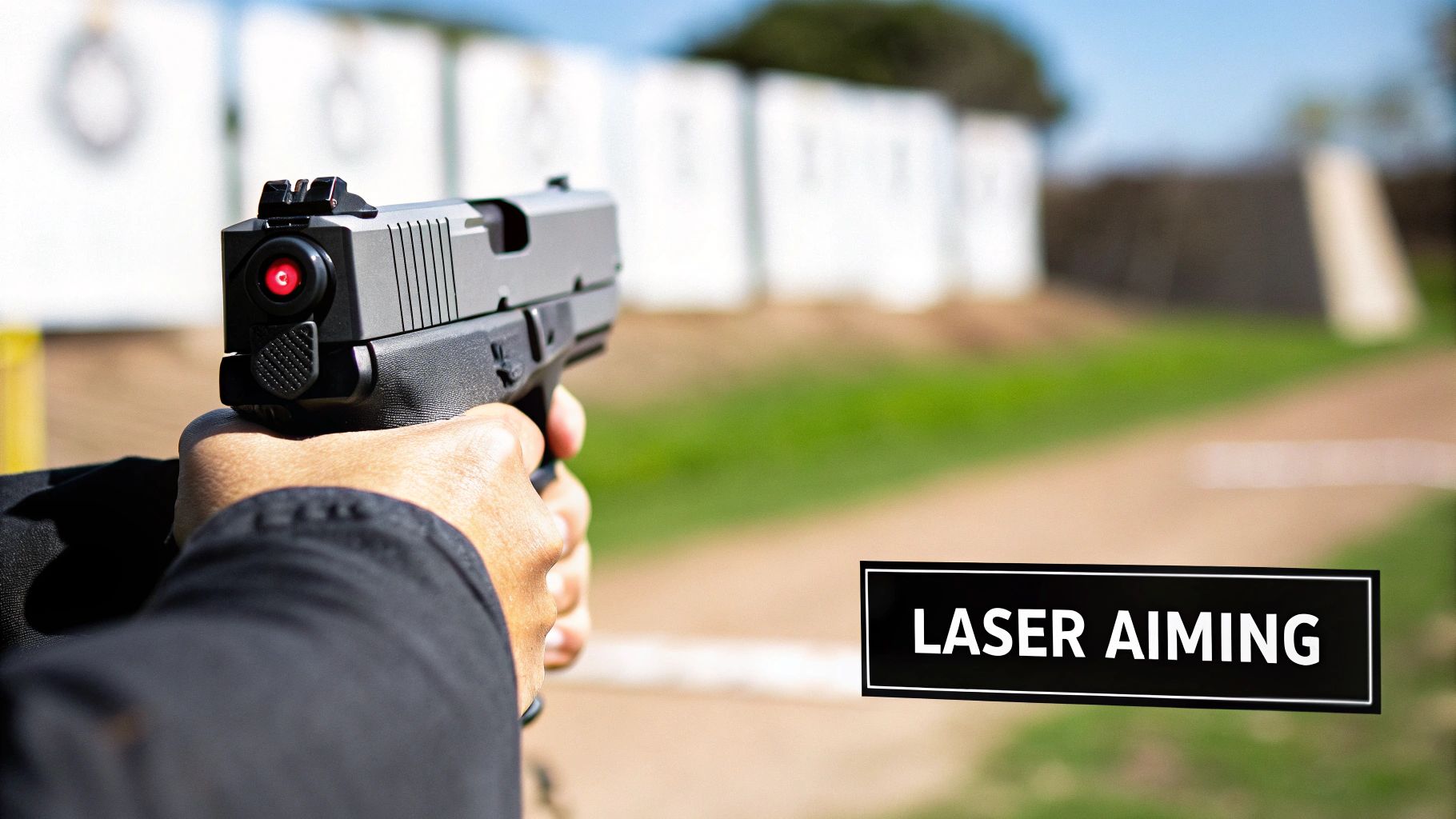
Think of a LAM as the ultimate shortcut for aiming. At its heart, it’s a powerful little diode that shoots a concentrated beam of light. That beam creates a dot on your target, and wherever that dot is, your bullet will follow. Suddenly, the complicated dance of aligning sights is gone. All you have to do is put the dot where you want the hole to be.
This is a game-changer in high-stress situations where every split-second is critical. Aiming becomes intuitive, almost instinctual.
The Real-World Advantage of a LAM
The biggest benefit you get from a LAM is pure speed and confidence. It gives you instant, visual proof of where you're aimed, cutting down on hesitation and getting you on target fast. This is especially helpful when you're forced to shoot from an awkward position, like from behind cover or without being able to get a solid cheek weld on your rifle.
The impact of this technology is huge. It’s become standard gear for a reason. The laser sight market is on track to hit USD 500 million in 2025 and keeps growing. Law enforcement adoption, for example, reached 65% globally by 2024, and it’s mandatory for many elite units because it’s proven to slash engagement times by up to 40%. You can read the full research about these market trends here.
A laser aiming module essentially closes the gap between the shooter's intent and the point of impact. It provides an undeniable reference point that simplifies one of the most challenging aspects of shooting under pressure.
To really grasp why these devices are so much more than just fancy pointers, it helps to break down their core functions. A good LAM is a versatile tool that boosts a shooter's effectiveness in a ton of different situations. If you're curious about what's out there, you can explore a wide range of lights and lasers to fit your specific needs.
Core Functions of a Laser Aiming Module at a Glance
Let's quickly run through what a laser aiming module brings to the table.
| Function | Primary Benefit | Best Use Case |
|---|---|---|
| Rapid Target Acquisition | Places an aiming point on target much faster than traditional sights. | Close-quarters engagements, dynamic shooting competitions. |
| Deterrent Effect | The visible laser dot on a target can act as a powerful de-escalation tool. | Self-defense, law enforcement scenarios. |
| Low-Light Dominance | An infrared (IR) laser allows for precise aiming in total darkness with night vision. | Nighttime hunting, military/LE operations. |
| Improved Training | Provides instant feedback on trigger control and stability to correct bad habits. | New and experienced shooters improving fundamentals. |
Understanding these key jobs is the first step. In this guide, we'll cover everything from the different types of lasers to the critical specs you need to know before you ever think about buying one.
Decoding Visible and Infrared Lasers
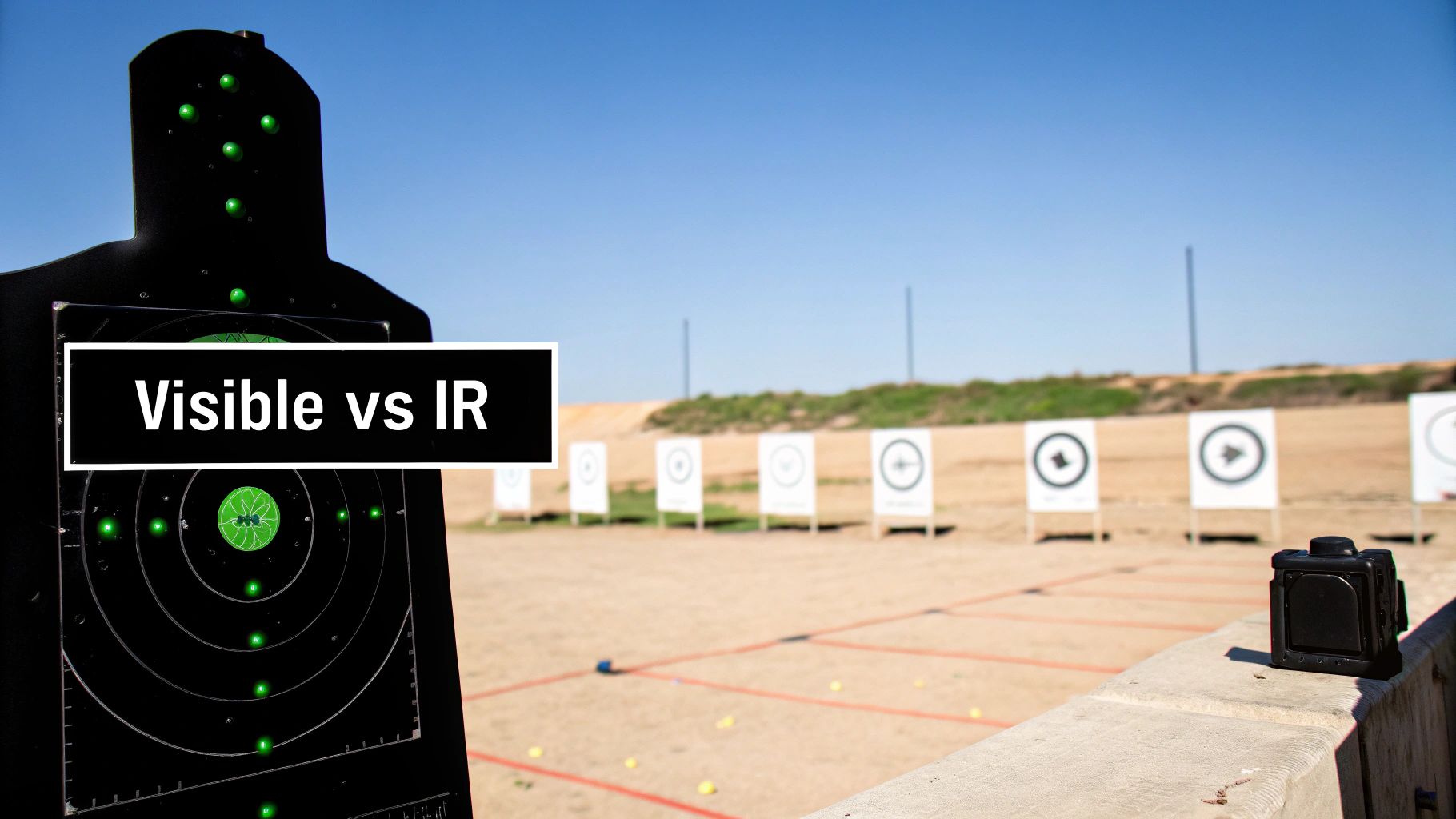
When you're picking out a laser aiming module, the very first fork in the road is deciding between a visible laser and an infrared (IR) one. It's a fundamental choice that dictates everything about how, when, and where you can use the device.
Think of it this way: a visible laser is like pointing with a bright, obvious flashlight beam that anyone can see. An IR laser, on the other hand, is a secret signal. It’s a ghost beam that only someone with the right decoder ring—in this case, a night vision device (NVD)—can even detect. There’s no single "best" option here; it all boils down to your specific mission and environment.
The Overt Advantage of Visible Lasers
Visible lasers, which you'll most often see in red or green, are all about speed and simplicity. The moment you activate it, a bright dot paints your target. It’s direct, intuitive, and gives you instant feedback on your aim. For training purposes, it's an incredible tool for watching how even tiny movements affect where you're pointing.
These lasers really shine in scenarios where stealth isn't a priority. Think home defense, a competitive shooting match, or just a day at the range. In those situations, a visible laser gives you lightning-fast target acquisition. But its greatest strength is also its biggest weakness: that bright beam is a two-way street. It points right back to you, giving away your position in an instant.
A visible laser tells everyone—your target included—exactly where you are. In a tactical situation where staying hidden is life or death, that's a huge liability. But for deterrence or training, that same high visibility becomes a powerful asset.
The color you choose also makes a difference. Green lasers, operating around a 532 nm wavelength, appear significantly brighter to the human eye than red lasers (635-650 nm), especially in broad daylight. This makes green the clear winner for daytime use, though it usually costs more and can be a bit fussier in extreme hot or cold weather.
The Covert Power of Infrared Lasers
This is where things get serious for nighttime operations. Infrared laser aiming modules are the undisputed kings of the dark, projecting a beam in the near-infrared spectrum (typically between 820 nm and 860 nm). To your naked eye, there's absolutely nothing there.
To see an IR laser, you must be looking through a night vision device. The NVD takes in all that invisible IR energy and translates it into a clear, crisp aiming dot on your target. This is the technology that gives operators a massive advantage in low-light and no-light environments, allowing them to aim with precision while remaining completely hidden.
For military, law enforcement, or serious nighttime hunters, the ability to aim without giving off a visible signature isn't just a "nice to have"—it's non-negotiable. Stealth is what keeps them safe and makes them effective. The high-end, military-grade units pushed by groups like USSOCOM often combine these IR aiming lasers with powerful IR illuminators, essentially giving the user total control of the night.
To make this crystal clear, let's put them side-by-side.
Visible Laser vs. Infrared (IR) Laser Comparison
The table below breaks down the key distinctions between these two types of lasers. While one excels in open, daytime scenarios, the other owns the night.
| Feature | Visible Laser (Green/Red) | Infrared (IR) Laser |
|---|---|---|
| Visibility | Seen by the naked eye. | Invisible without night vision. |
| Primary Use Case | Fast aiming in daylight or indoor light. | Covert aiming in total darkness. |
| Stealth | Low; the beam can reveal your position. | High; undetectable to the naked eye. |
| Required Equipment | None. | Night vision device is mandatory. |
| Psychological Impact | High deterrent effect on a target. | None; the target is unaware. |
Of course, the good news is that many of today's advanced laser aiming modules don't make you choose one or the other. These multi-function devices pack both a visible laser for day use and an IR laser for night ops into a single unit, giving you the best of both worlds.
Understanding the Specs That Actually Matter
Diving into the world of laser aiming modules can feel like trying to decipher a foreign language. Spec sheets are jam-packed with terms like milliwatts, milliradians, and IPX ratings. Instead of getting bogged down in the numbers, let's cut through the noise and focus on what these specs actually mean for you out in the field.
Knowing this stuff is the difference between buying a truly capable tool and a very expensive paperweight.
It all starts with power output, which you'll see measured in milliwatts (mW). Think of this as the raw brightness of the laser. A higher mW number means a brighter dot that you can see at greater distances and in brighter conditions. For civilian-legal visible lasers, this is capped at <5mW. While that might not sound like much, a well-made <5mW green laser can still be surprisingly effective well past 100 yards in low light.
But raw power is only half the battle. Its real-world effectiveness is completely dependent on the next spec.
Beam Divergence: The Secret to a Pinpoint Dot
If power is the brightness, then beam divergence is the focus. This is measured in milliradians (mrad), and it tells you how much the laser beam spreads out as it travels. A lower mrad number is always better because it means the beam stays tight and concentrated over distance.
Think of it like this: you have two flashlights. One throws a wide, flood-style beam that lights up a whole wall but looks dim. The other has a tight, focused beam that puts a small, intensely bright spot on that same wall from far away. A laser with low divergence (anything <0.5 mrad is excellent) is like that second flashlight—it gives you a crisp, precise aiming dot that doesn’t morph into a useless, fuzzy blob at 100 yards.
A low-power laser with excellent (low) divergence will often outperform a high-power laser with poor (high) divergence at any real distance. It’s not just about how bright the laser is when it leaves the device, but how well it holds that energy together on its way to the target.
This concept of precise energy delivery is a big deal, and not just for aiming systems. The market for laser gain modules—the engines inside these devices—was valued at USD 1.2 billion in 2023 and is projected to hit USD 2.5 billion by 2032. This growth is driven by all sorts of applications, from medical tools to industrial marking, where fiber laser modules (holding 43.9% of the market) achieve sub-micron accuracy. It's a surprisingly similar challenge to putting a precise aiming dot exactly where you want it. You can explore more data on this expanding market to see just how big this technology has become.
The All-Important Illuminator
Many of the more advanced laser aiming modules, especially those built for night vision, come with an integrated illuminator. While the laser gives you a single aiming point, the illuminator is your target identification tool. It's basically a flashlight that projects light in either the visible white spectrum or, more commonly, the infrared (IR) spectrum.
An IR illuminator is non-negotiable for serious night work. It bathes an area in IR light that’s invisible to the naked eye but lights up like day through a night vision device. This lets you:
-
Positively identify a potential target before you even think about engaging.
-
Navigate through the dark without giving away your position with white light.
-
Assess threats and get a better sense of your surroundings.
The best illuminators even have an adjustable focus, letting you dial the beam from a wide "flood" for scanning an area to a tight "spot" for lighting up targets way out there.
Built to Last: Durability and Weather Resistance
Finally, none of these features matter if the unit dies in the rain or shatters after a few rounds. That’s where durability ratings come in. The most common one you'll see is the IP (Ingress Protection) rating. This two-digit code tells you exactly how well the device is sealed against dust and dirt (the first digit) and water (the second digit).
For example, a rating of IP68 means the device is completely dust-tight (6) and can handle being continuously submerged in water (8). A more typical rating you might see is IPX7, which means it hasn't been tested for dust (X) but can be dropped in 1 meter of water for 30 minutes (7). For any serious use, you want a module that is at least water-resistant (IPX4 or higher) and built from tough materials like aircraft-grade aluminum to handle recoil, bumps, and drops.
Getting Your LAM Mounted and Zeroed
A top-of-the-line laser aiming module is just an expensive, tactical-looking flashlight until it's properly mounted and zeroed. This isn't just a "nice-to-have" step; it's the bedrock that makes the LAM a true precision aiming device. Getting this right is what ensures your point of aim is actually your point of impact.
Start with a Rock-Solid Mount
Everything starts with a solid foundation. Your laser has to be clamped onto a rigid, stable part of your firearm, which almost always means a good quality MIL-STD-1913 Picatinny rail. Don't even think about mounting it on a flimsy polymer handguard that can flex with temperature changes or when you're bracing against cover. Even a millimeter of movement at the mount can translate into a miss of several feet downrange.
Once you have it in place, torque the mounting screws down to the manufacturer's specs. If your LAM can wiggle even slightly, recoil will throw your zero off immediately. When you're done, it should feel like it’s a permanent part of the gun.
Co-Witnessing: The First Step to a Good Zero
Before you burn through a single round of ammo, you can get the laser surprisingly close to zero right at home. We do this by co-witnessing it with your primary optic or iron sights. Think of this as a "rough draft" of your zero that saves you a lot of time and frustration at the range.
The concept is simple: you're just going to make the laser dot sit right on top of your already-zeroed aiming point.
-
Step 1: Unload and Make Safe. This is non-negotiable. Check your chamber, check it again, and remove the magazine. Safety first, always.
-
Step 2: Get a Stable Platform. Lock your firearm into a vise or prop it up solidly on bags. You want it completely still, pointed at a target at least 25 yards away.
-
Step 3: Use Your Primary Sight. Get a perfect sight picture on your target, whether that's with your red dot or your iron sights.
-
Step 4: Align the Laser. While holding that sight picture, turn the laser on. Now, use the windage (left/right) and elevation (up/down) dials on the LAM to move the laser dot until it lines up perfectly with the tip of your front sight post or sits right on top of your red dot.
This initial bore sight gets you on paper, but the real work happens with live ammunition.
Live-Fire Zero: Dialing It in for Real
This is where the magic happens. The final step is to confirm your zero with live fire at a specific distance. For most carbines, a 50-yard zero is an excellent, all-around choice. It gives you a very forgiving "point and shoot" range for most practical situations.
Mechanical Offset: This is the physical gap between the center of your rifle's bore and the center of your laser emitter. Your bullet flies in an arc, but your laser projects in a perfectly straight line. You have to account for this difference, or you will miss—especially up close.
Let's say your LAM is mounted on the top rail, 1.5 inches above the bore. At point-blank range (like inside a room), your shots will hit 1.5 inches below where your laser dot is. Understanding and training with this offset is critical for precision. The same principle applies to your night vision; a wobbly NVG mount can make your whole system feel misaligned. For more on that, our guide comparing the Wilcox G24 vs Argus A4 night vision mounts is a great resource.
To finish your zero, put a target out at your chosen distance. Aim with the laser and fire a slow, careful three-shot group. See where your shots landed. Now, simply use the adjustment dials to "walk" the laser dot from your original aiming point over to the center of your actual bullet impacts. Fire another group to confirm, and repeat if needed. Once your shots are hitting exactly where you place the dot, you’re done. Your LAM is officially zeroed and ready for action.
Navigating Laser Laws and Safety Protocols
Mounting a laser aiming module on your firearm is a serious step. It's not just about getting a tactical advantage; it's about accepting a profound responsibility for every single photon that beam projects. The moment that laser is active, you are accountable for where it points, what it reflects off of, and who sees it. Getting the legal and safety side wrong isn't an option.
In the United States, the big players regulating these devices are the Food and Drug Administration (FDA) and its Center for Devices and Radiological Health (CDRH). They're the ones who classify lasers based on power output and the potential for harm—especially to your eyes. This classification system is the entire reason the market is split between civilian and restricted units.
Understanding FDA Laser Classifications
The most critical distinction you need to grasp is between what you can legally buy as a civilian and what's restricted to military and law enforcement.
Almost every laser aiming module available on the commercial market is a Class 3R device (you might also see the older Class IIIa designation). The key number here is 5 milliwatts (mW); these lasers are capped at a power output just below that. While they can absolutely cause temporary flash blindness, the risk of permanent eye damage from a quick, accidental glance is low.
Full-power units, on the other hand, are a different beast entirely. These are typically Class 3B lasers, with power outputs that are an immediate and severe hazard to unprotected eyes. Getting caught with one without the proper credentials can lead to serious legal trouble.
The entire legal framework boils down to one thing: preventing permanent eye injury. A Class 3B laser doesn't just distract; it can cause irreversible retinal burns in a fraction of a second, even from a stray reflection.
This is exactly why the market for military-grade systems is so tightly controlled. It’s a massive industry—the global military laser systems market was valued at USD 6.52 billion in 2024 and is expected to climb to USD 12.47 billion by 2033. These high-end modules can paint targets with IR beams at ranges up to 25 kilometers. You can dive deeper into the military laser systems market on IMARC Group.
Core Safety Protocols You Must Follow
Beyond the legal red tape, you have to live and breathe operational safety. The cardinal rules of firearm handling apply directly to your laser because, well, it's attached to a firearm.
-
Never Point at Non-Threats: This is the golden rule, and it's non-negotiable. Don't "paint" anything you aren't willing to destroy.
-
Beware of Reflections: Laser beams are light—they bounce. A beam hitting glass, a puddle, or even a polished bumper can retain enough energy to cause serious eye damage downrange. Always be conscious of your backstop and what lies beyond it.
-
NEVER Aim at Aircraft: This isn't just a bad idea; it's a federal crime with life-altering penalties. Even a low-power laser can disorient or blind a pilot, putting hundreds of lives at risk. It’s a line you never, ever cross.
Before you even think about using your laser, you have to ensure it's properly zeroed. This isn't just for accuracy; it's a fundamental part of safe and responsible use.
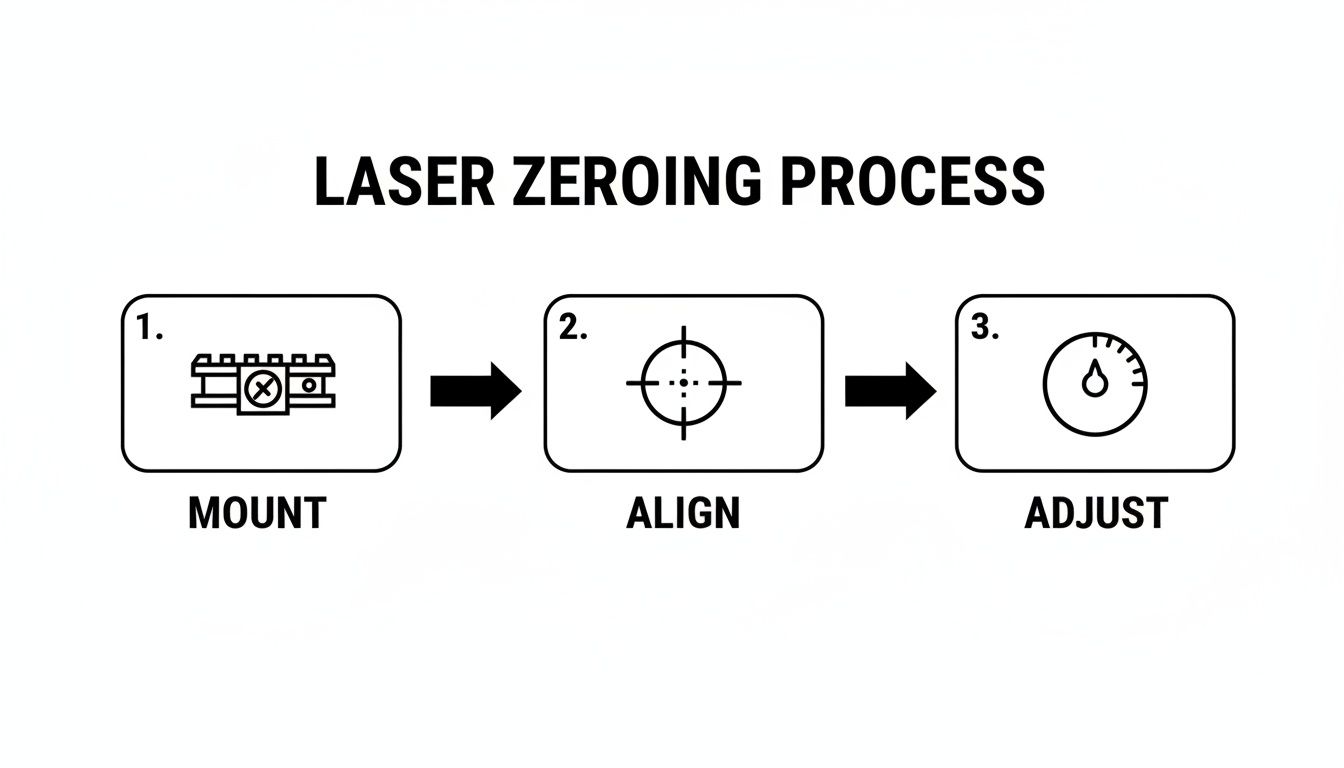
This simple mount, align, and adjust process is the bedrock of using your laser effectively and safely. True ownership means mastering the hardware and embracing the serious safety protocols that come with it.
How to Choose the Right LAM for Your Needs
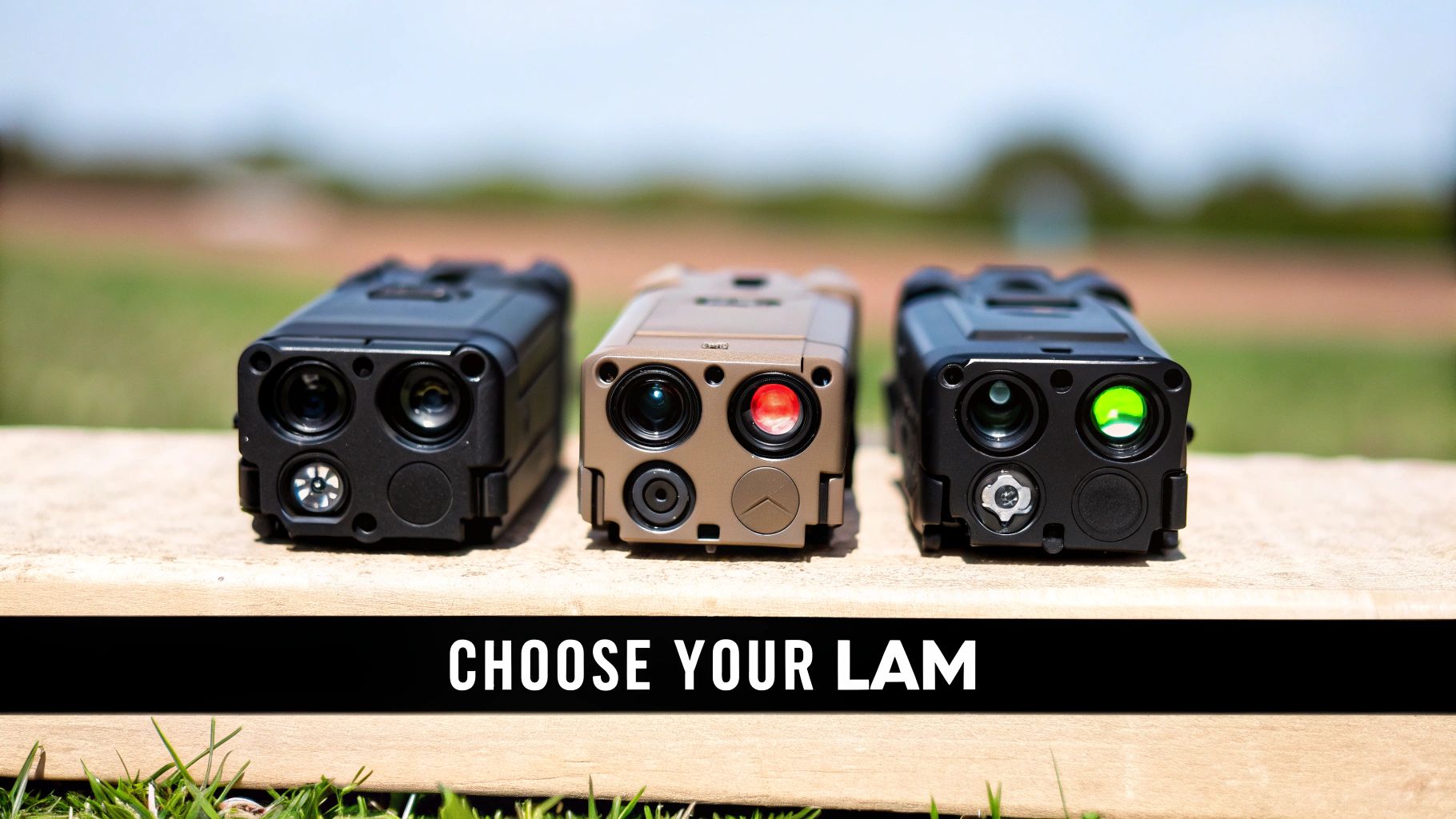
With so many LAMs on the market, picking the right one can feel like a shot in the dark. The trick is to stop hunting for the single "best" unit and start focusing on the best unit for you. Your specific mission should drive the decision.
It all boils down to a practical balance of capability, budget, and the gear you already own. An expensive, full-power military unit is total overkill for a home defense rifle, while a basic visible laser is completely useless to someone running night vision. It’s all about matching the tool to the task at hand.
Let's break down three common user profiles to give you a solid framework for making your choice.
The Home Defender
When your primary concern is protecting your home and family, the needs are clear and direct. You need speed, simplicity, and the absolute certainty that you know what you’re aiming at. A high-stress situation is the worst time to be fumbling with complicated controls.
For this role, look for a compact, lightweight unit that bundles two critical tools:
-
A bright visible laser: A green laser is usually the way to go. Its high visibility across different lighting conditions helps you get on target fast.
-
An integrated white light: This is non-negotiable. Positive target identification isn't just a good idea—it's a critical safety and legal requirement. A powerful weapon light is essential.
Having a single, streamlined device that handles both aiming and illumination cuts down on complexity, which is a massive advantage when every second counts.
The Night Vision Enthusiast
This is where things get interesting. For those who operate after dark—whether for hunting, training, or just owning the night—the entire paradigm shifts. Your equipment needs to be tough, powerful, and built from the ground up to work with your night vision devices.
For the NVD user, the focus moves completely into the infrared spectrum:
-
A powerful IR laser: The aiming laser has to have enough juice to paint targets at practical distances, giving you a sharp, clear dot through your NVD.
-
A focusable IR illuminator: This is arguably even more important than the laser. A good illuminator lights up the darkness, letting you spot and identify targets well beyond the ambient light. It's your personal floodlight that only you can see.
-
Durability and battery life: Field gear gets banged around. It has to be rugged enough to take the abuse and have enough battery power to last through a long night.
Choosing a LAM for night vision is really about building a complete system. Your LAM's performance is directly tied to the quality of your NVD, and vice versa. When they work well together, they enhance each other's capabilities.
The Professional User
For law enforcement and military personnel, laser aiming modules are not accessories; they are mission-critical equipment. In this arena, failure is simply not an option. These professionals need full-power, multi-function devices that deliver maximum capability and rock-solid reliability in the worst conditions imaginable.
These units are built to stringent government contract specs and pack power levels that are restricted from civilian sale for good reason. For those who operate in a professional capacity, a unit like the full-power L3Harris Next Generation Aiming Laser (NGAL) is the top of the food chain, offering unmatched durability and performance.
By figuring out which of these profiles best fits your situation, you can cut through the noise and zero in on a LAM that will get the job done.
Answering Your Top Questions About LAMs
Even after getting a handle on the basics, you'll still have questions when it comes to actually running a laser aiming module. Let's tackle some of the most common ones that pop up.
Do These Things Actually Hold Zero?
Yes, but with a big "if"—if you buy quality. A well-built LAM from a trusted manufacturer is absolutely designed to take a beating from recoil and stay put. Its ability to hold zero comes down to two things: tough internal mechanics and a rock-solid mount.
This is where you see the difference between serious gear and cheap knock-offs. A high-end unit will stay true, but many airsoft-grade clones will get knocked off-kilter by the shock of live fire, sometimes after just a handful of rounds. For anything beyond plinking, stick with the real deal.
What's the Real-World Range of a Civilian Laser?
This is a great question, and the answer almost always depends on the laser's color and the ambient light conditions. It's a game of trade-offs.
-
Green Lasers: These are your best bet for daytime use. A <5mW green laser can be visible out to 100 yards or more in overcast or twilight conditions. But in direct, bright sunlight? You might be lucky to see it at 20-30 yards.
-
Red Lasers: Red lasers are just harder for the human eye to pick up, making their effective range, especially in daylight, noticeably shorter than green.
-
IR Lasers: This is where it gets interesting. Through a night vision device, even a civilian-power IR laser can paint a target several hundred yards away. In the dark, it completely outclasses its visible counterparts.
I Have an IR Laser. Do I Really Need an IR Illuminator Too?
For almost any scenario you can imagine, the answer is a firm yes. The IR illuminator is non-negotiable if you're serious about operating at night.
Think of it like this: the IR laser is your rifle's crosshair, but the illuminator is the flashlight that lets you actually see what you're aiming at. The laser gives you a pinpoint aiming reference, but the illuminator floods the entire scene with infrared light that's invisible to the naked eye but brilliant through your NODs.
Without an illuminator, you can aim at a dark blob, but you can't positively identify it. For making a "go/no-go" decision, assessing a threat, or just figuring out what's going on around you, the IR illuminator is an absolutely critical piece of the puzzle.
At Superior Tactical LLC, we stock the mission-ready gear you need to own the night. We've hand-picked a selection of high-performance lights, lasers, and night vision optics that won't let you down.
Find the right tools for your kit at https://superiortac.com.
