A Complete Guide to Generation 3 Night Vision Binoculars
Picture this: you're moving through a forest on a moonless night, yet you see every branch, every shadow, as if it were twilight. This isn't science fiction. This is the power of Generation 3 night vision binoculars, a technology that lets you truly own the night.
The Quantum Leap to Generation 3
Gen 3 wasn't just another step forward in night vision; it was a total game-changer. Where older generations struggled with fuzzy, grainy images, Gen 3 technology grabs the faintest starlight and turns it into a surprisingly crisp, clear picture. It allows operators to see farther and with more detail than was ever thought possible.
The magic happens inside the image intensifier tube—the heart of the device. The secret ingredient is a gallium arsenide (GaAs) photocathode. The easiest way to think of it is as a super-efficient light collector. It's incredibly sensitive and does a much better job of converting scarce light photons into electrons, which is the first step to making the darkness visible.
How It Achieves Such Stunning Clarity
But converting the light is only half the battle. Those electrons are then shot through a micro-channel plate (MCP), which multiplies them by the thousands. This is what massively brightens the image, but Gen 3 does it without introducing the annoying "snowy" static that plagued older units.
The result is an image that's not just bright, but sharp and loaded with detail. This huge performance jump, which came about in the 1980s, was born from Cold War-era military demands. Gen 3 systems cranked up light amplification to 30,000 to 50,000 times—a staggering increase from Gen 2's 20,000x—giving users a clear edge even under the worst light conditions. You can dig deeper into the history of night vision technology for the full story.
At its core, the leap to Gen 3 was all about efficiency. By capturing and amplifying light with almost no waste, these devices deliver a clean, high-resolution view of the dark, fundamentally changing the rules of nocturnal operations.
For anyone using generation 3 night vision binoculars, this technological superiority translates into very real advantages in the field, whether you're in law enforcement, search and rescue, or just watching wildlife. It gives you:
-
Greater Detection Range: You can spot a potential threat or target from much farther away, giving you more time to react.
-
Improved Image Resolution: The ability to see fine details is critical for positive identification, preventing tragic mistakes.
-
Enhanced Performance in Extreme Darkness: When it's just starlight and nothing else, Gen 3 still performs when other devices have already given up.
How Gen 3 Technology Turns Night into Day
To really get what makes generation 3 night vision binoculars so special, you don’t need a physics degree. At its core, the technology is a super-efficient light-gathering engine. It takes the faintest traces of light—stuff completely invisible to our eyes—and cranks up the volume until you see a bright, sharp image.
The whole process starts the second a single photon of ambient light, maybe from a star millions of miles away, hits the objective lens. This is where the Gen 3 magic really begins.
The Gallium Arsenide Advantage
The heart of any Gen 3 device is a component called the gallium arsenide (GaAs) photocathode. The best way to think of it is as a hyper-sensitive conversion plate. When photons hit it, it kicks out electrons. What makes gallium arsenide so incredible is its efficiency; it converts a huge percentage of those incoming photons into electrons, far more than the materials used in older generations.
This is the secret sauce. Because it wastes so little of the available light, a Gen 3 unit can deliver a surprisingly clear image even when it feels like you're in total darkness. It makes the most of every last drop of light.
This diagram gives you a quick visual of how it all comes together.
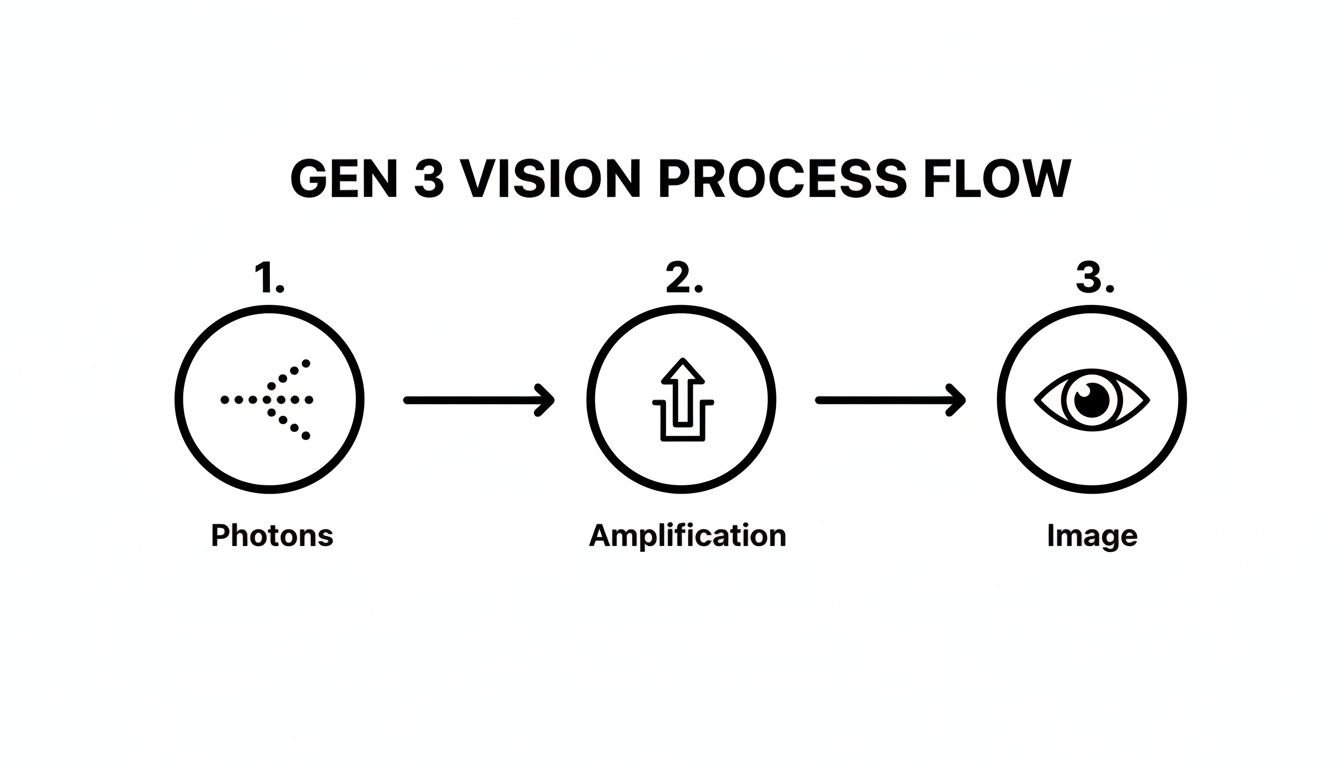
As you can see, it’s a three-step dance: collect the faint light (photons), multiply it massively, and then create the final image you see.
Once that electron is created, the amplification process goes into overdrive. It gets fired into a micro-channel plate (MCP), which is a tiny disc packed with millions of microscopic tubes.
Think of it like this: you drop a single grain of sand into a complex machine, and a waterfall of thousands of grains comes out the other side. The MCP does that with electrons, multiplying them by tens of thousands in an instant.
This massive multiplication factor is what turns a dark scene into a bright, visible one. These supercharged electrons then slam into a phosphor screen, causing it to glow and paint the green (or white) picture you see through the eyepiece. The choice between thin-filmed and unfilmed tubes makes a big difference at this stage, a topic we dive into in our comparison of thin-filmed and unfilmed image intensifier tubes.
Understanding Key Performance Metrics
When you're shopping for generation 3 night vision binoculars, you'll bump into a few key specs. Knowing what they mean is crucial for telling a top-tier unit from a mediocre one.
-
Signal-to-Noise Ratio (SNR): This is arguably the most important number. Think of it like an old FM radio. A high SNR gives you a clean, crisp signal with very little static or hiss. In night vision, that "static" is the grainy, sparkling effect you see in low light. A high SNR means a cleaner, clearer image.
-
Figure of Merit (FOM): This is a quick-and-dirty number to gauge overall tube performance. It's calculated by multiplying the tube's resolution by its SNR. While not the whole story, a higher FOM generally points to a better-performing tube.
-
Autogating: This feature is your tube's self-preservation system. It's like having a set of sunglasses that can react instantly to a sudden bright light. Autogating rapidly throttles the power when exposed to a muzzle flash or a car's headlights, protecting the tube from damage and preventing the image from washing out.
This level of engineering is what made Gen 3 a game-changer for military and professional users. The average tube life jumped to 10,000-15,000 hours, a massive leap from the 3,000-5,000 hours of Gen 2, which drastically cut down on maintenance and replacement costs. Plus, autogated Gen 3 units cut down on blooming (the washout from bright lights) by around 90% and deliver up to 30% better clarity across the image thanks to that superior signal-to-noise ratio.
Comparing Night Vision Generations
To really get why generation 3 night vision binoculars are the top of the food chain, it helps to walk through how the technology has evolved. The jump between generations isn't just a minor tweak—it's a massive leap in what you can actually see and do when the lights go out.
Let's ditch the dry specs for a moment and put ourselves in a real-world scenario.
Generation 1: Dipping Your Toes In
Picture yourself in a wide-open field on a night with just a sliver of a moon. With a Gen 1 device, the view is… interesting. You'll get a picture, but it's often dim, grainy, and suffers from a "fisheye" effect that distorts everything around the edges.
To see anything clearly, you almost always have to hit the button for the built-in infrared (IR) illuminator. Think of it as a flashlight that's invisible to the naked eye, but to anyone else with night vision, you're lighting yourself up like a Christmas tree. Fun for spotting raccoons in the backyard, but not so great for anything serious.
Generation 2: A Major Leap Forward
Now, let's swap that Gen 1 unit for a Gen 2 in the same field. The difference is night and day, literally. The image is dramatically brighter and sharper, and that annoying edge distortion is mostly gone. This is thanks to a key piece of tech called a micro-channel plate (MCP).
You can finally operate "passively," meaning you can leave the IR illuminator off unless it's pitch black. But on a truly dark, moonless night with only starlight to work with, Gen 2 starts to struggle. The image gets noisy and grainy, and making out details at a distance becomes tough. It's a huge improvement, but it has its limits when ambient light is scarce.
This is where Gen 3 changes the game.
Generation 3: The Unmistakable Advantage
Stepping into that same starlit field with a Gen 3 device is a completely different experience. The view is incredibly clean and crisp. The distracting background static, or "scintillation," is minimal, giving you a sharp picture from edge to edge.
You can now easily tell the difference between a deer and a person at 200 yards—a critical capability whether you're a hunter, a law enforcement officer, or securing your property.
The secret sauce is the gallium arsenide photocathode, which is ridiculously efficient at taking the few photons of light available and turning them into a clear, usable image. It’s this core technology that lets Gen 3 devices see in conditions where older generations are effectively blind.
In the world of night vision, think of available light as your currency. Generation 3 technology is simply far more efficient at spending it, turning the faintest starlight into a detailed image where older generations would just show you static.
It's also important to remember that night vision amplifies light, while thermal imaging sees heat. While thermal is king for pure detection (spotting a warm body), generation 3 night vision excels at identification (recognizing exactly what that body is). We break this down further in our guide explaining the differences between thermal imaging and analog night vision.
For a direct, at-a-glance comparison, this table lays out the key differences you'll experience in the field.
Night Vision Generations Performance Comparison
| Feature | Generation 1 | Generation 2 | Generation 3 |
|---|---|---|---|
| Performance | Basic, requires IR illuminator | Good, passive capable | Excellent, excels in extremely low light |
| Image Quality | Distorted edges, grainy image | Clear center, less grain | Sharp edge-to-edge, clean image |
| Tube Lifespan | ~1,500 hours | ~2,500 – 5,000 hours | ~10,000+ hours |
| Primary Use | Hobbyist, casual observation | Hunting, security, serious enthusiasts | Military, professional, and serious users |
As you can see, each generation represents a significant step up in performance, image clarity, and durability, with Gen 3 standing as the undisputed leader for those who depend on their gear when it matters most.
Choosing Your Gen 3 Binoculars for Any Mission
Not all missions are the same, and the same goes for generation 3 night vision binoculars. The real secret to picking the right set isn't chasing the highest specs on a sheet; it's about matching the tool to the job at hand. What works perfectly for a law enforcement officer clearing a building is often overkill for a hunter scouting a treeline.
Figuring out your primary use case is the single most important thing you can do. It’s the difference between making a purchase and making an investment. This practical mindset helps you focus on the features that will actually give you an edge, whether you're scanning a dark alley or a distant, moonlit field.
For Law Enforcement and Search and Rescue
When your life or the lives of others are on the line, your gear needs to be two things above all: dependable and versatile. The operational environment can flip from a pitch-black field to a street washed in emergency lights in a split second.
-
Autogating is Non-Negotiable: For anyone working in urban or dynamic environments, autogating is a mission-critical safety feature. It instantly reacts to bright lights—like headlights, streetlamps, or muzzle flashes—protecting the tubes and preventing the image from whiting out so you never lose situational awareness.
-
Durability and Helmet Mounting: Gear for LE and SAR pros is going to get banged around. That’s just a fact. You need units built with ruggedized housings that can take a drop, handle bad weather, and keep on running. Being able to mount them to a helmet for hands-free operation is just as crucial.
-
Wide Field of View (FOV): A wider FOV is a massive advantage. It lets an operator or rescue team scan a larger area much faster, which is vital when you're clearing rooms or searching for a missing person in the wilderness.
This reliance on top-tier optics has deep roots. The combat debut of generation 3 night vision binoculars during the 1991 Gulf War fundamentally changed modern warfare. U.S. forces, armed with devices like the AN/PVS-7, carried out over 60% of their advances at night, dominating the battlefield with detection ranges up to 300 meters in starlight alone. You can find more details on the evolution of U.S. night vision on peaknano.com.
For Hunters and Wildlife Observers
For those who hunt or observe wildlife, the name of the game is positive identification. You need to be able to tell a buck from a doe, judge its size, and do it from a distance that doesn't spook your target. That all comes down to image clarity.
This is where technical specs like Signal-to-Noise Ratio (SNR) and resolution (lp/mm) really matter. A high SNR gives you a clean, crisp image without distracting "snow" or static. High resolution, in turn, lets you pick out the fine details, like the points on an antler or the unique markings of an animal.
For the serious hunter, clarity is everything. A grainy image can lead to a missed opportunity or, far worse, a misidentified target. High-resolution Gen 3 optics provide the crisp detail needed to make ethical and accurate decisions in the field.
Weight is another huge factor. When you're trekking miles into the backcountry, every ounce on your pack or around your neck counts. Modern, lightweight binocular systems made from advanced composites can make a world of difference in reducing neck strain and fatigue, letting you glass for hours in comfort.
For Preppers and Serious Hobbyists
This group is often looking for that sweet spot between elite performance and practical cost. You might not need a bomb-proof, mil-spec unit, but you absolutely understand the advantage high-quality Gen 3 provides for property security, navigation, or general preparedness.
For many, the biggest decision comes down to the classic green phosphor versus modern white phosphor tubes.
-
Green Phosphor: This is the iconic "night vision" look. It’s a proven, reliable technology that is often more friendly to the wallet. The human eye is very sensitive to green, but some people find it can cause eye fatigue after hours of use.
-
White Phosphor: This newer tech produces a black-and-white image that many find more natural and easier to interpret. It often provides superior contrast and can significantly reduce eye strain during long nights of observation. While it usually comes at a premium, it’s the top choice for those who want the absolute best in image quality.
Ultimately, there is no single "best" choice—only the best choice for you. By defining your mission, you can zero in on the generation 3 night vision binoculars that will truly own the night.
Essential Accessories and Mounting Solutions
Your generation 3 night vision binoculars are an incredible piece of equipment, but they don't work in a vacuum. To really get the most out of them, you need the right support gear. Think of it this way: the binos are the engine, but the accessories are the transmission, suspension, and tires that put the power to the ground.
These add-ons aren't just about looking cool; they're about making the gear work for you. They enhance what you can do, protect your investment, and make the whole system more comfortable and effective, whether you're on a mission or tracking game.
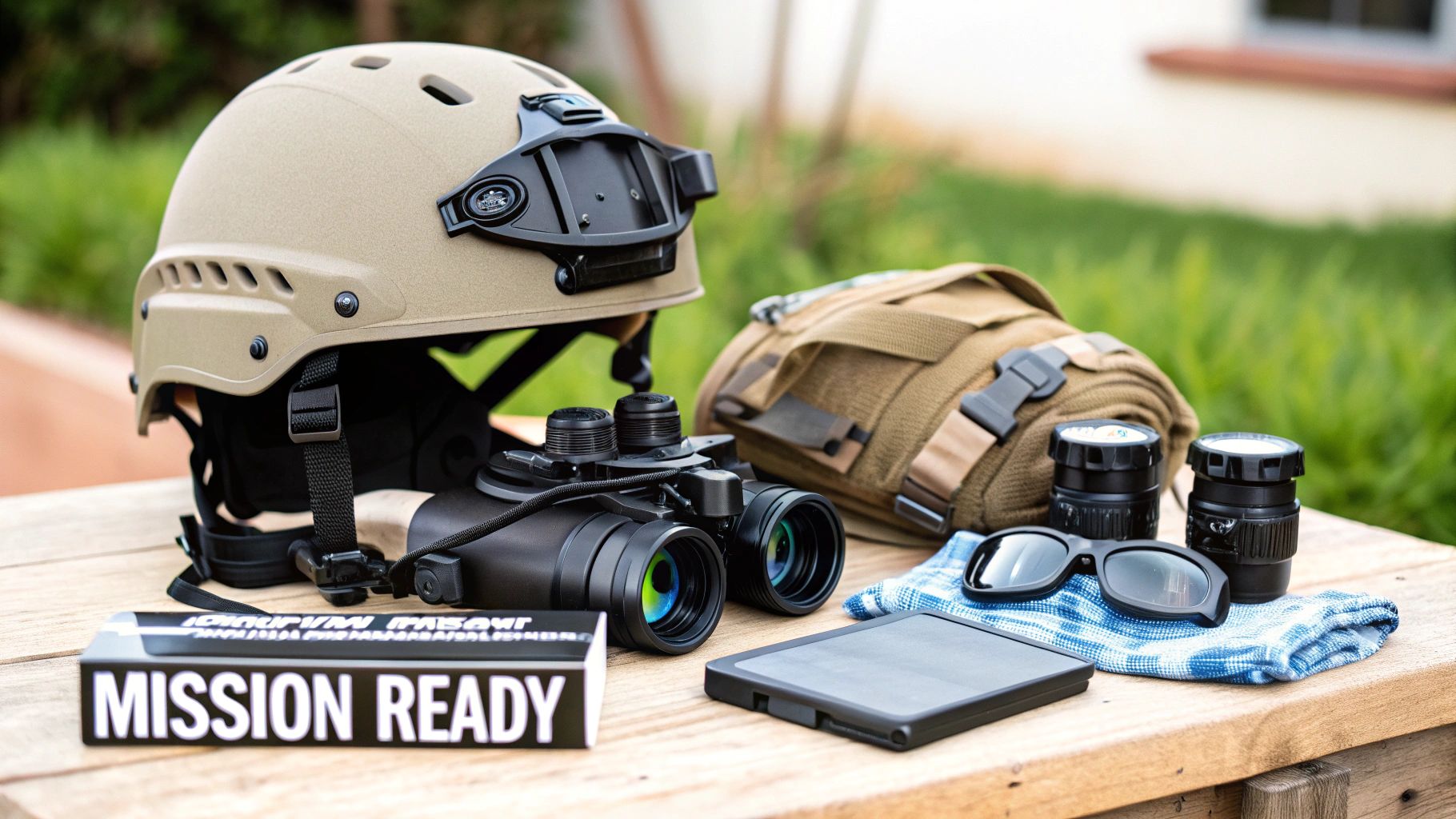
Critical Helmet Mounting Systems
For almost any serious application, you need your hands free. That’s non-negotiable. This is where a quality helmet and mount system becomes the single most important part of your kit, next to the device itself. A solid mount provides a stable platform, letting you move, navigate, and handle your tools without holding onto your optics.
When you're looking at mounts, you'll run into two main industry standards:
-
Dovetail Mounts: This is the modern, professional-grade standard. Dovetail mounts give you a rock-solid, wobble-free connection that's crucial for keeping a stable image while you're on the move.
-
Bayonet Mounts (J-Arm): This is the older style, often found on PVS-7 goggles. While it works, the J-arm interface is just not as secure as a dovetail and is largely being replaced for good reason.
Picking the right mount can feel complicated. If you want a deep dive, check out our guide on choosing the best night vision mount, which breaks down popular choices like the Wilcox G24 and Argus A4.
Essential Performance and Protection Add-Ons
Beyond getting your binos on your head, a few other accessories are must-haves for protecting your gear and boosting its performance. These aren't just nice-to-haves; they are practical necessities for anyone who plans on using their gear in the real world, where things get messy.
Think of accessories as cheap insurance for your optics. A $20 sacrificial lens can save you from a multi-thousand-dollar repair bill if a stray piece of gravel gets kicked up. It’s one of the smartest, highest-value purchases you can make.
Here are the accessories we consider absolutely essential for any setup:
-
Sacrificial Lenses: These are simple, clear covers that screw onto the front of your objective lenses. They take the hit from scratches, dirt, and debris so your expensive primary lenses don't have to.
-
Demist Shields: Nothing is more frustrating than your eyepieces fogging up from your body heat in the cold or humidity. Demist shields snap on and create a small air barrier that stops condensation before it starts, keeping your view crystal clear.
-
Supplemental IR Illuminators: Gen 3 is amazing, but it can't make light out of nothing. In true "no-light" situations like a windowless room or a deep cave, an IR illuminator acts like an invisible flashlight, flooding the area with infrared light that only your binos can see.
-
Magnified Lenses: Need to see a little farther? A 3x or 5x magnifier can be threaded onto your objective lens, turning your binos into a powerful long-range observation tool. This is a game-changer for surveillance or hunting hogs at a distance.
Navigating the Legal Side of Owning Gen 3 Night Vision
Owning a set of generation 3 night vision binoculars is a serious investment, and it comes with some serious responsibilities. This isn't like buying a new pair of hunting binoculars off the shelf; this technology is regulated by the U.S. government because of its military-grade capabilities. Getting a handle on these rules is non-negotiable for any owner.
The big one you need to know is ITAR, the International Traffic in Arms Regulations. This is the framework the U.S. government uses to control the export of defense technology, and yes, your Gen 3 device falls squarely into that category.
What ITAR Really Means for You
In practical terms, ITAR means your Gen 3 night vision can't leave the country. Period. Not without a complex and difficult-to-obtain license from the U.S. Department of State. This isn't just about selling it to someone overseas; you can't even take it with you on a hunting trip to Canada or a vacation to Europe. The penalties for breaking these rules are severe, so it’s something to take very seriously.
Your responsibility doesn't stop at the border, either. You have a legal duty to ensure your Gen 3 gear doesn't end up in the hands of a non-U.S. person, even if they're right here in the States. Think of yourself as the steward of this technology.
ITAR isn't just red tape. It’s a critical part of U.S. national security strategy, designed to keep our military's technological edge from falling into the wrong hands. When you own Gen 3 gear, you're part of that system.
Your Core Responsibilities as an Owner
Your role here is pretty straightforward, but it’s absolutely critical. Sticking to these rules protects you, protects your investment, and ensures you don't find yourself in a world of legal trouble.
Here’s the bottom line for every owner of generation 3 night vision binoculars:
-
No Export. Ever. Don't ship, carry, or mail your Gen 3 device outside of the United States.
-
U.S. Persons Only. You cannot allow non-U.S. citizens to look through, handle, or otherwise access your equipment.
-
Lock It Down. Store your binoculars securely. A gun safe or a sturdy, locked case is a must to prevent theft or unauthorized access.
-
Vet Your Buyer. If you decide to sell your unit down the road, it's on you to verify that the buyer is a U.S. citizen.
By respecting these regulations, you're doing your part. You're being a responsible member of the night vision community and helping ensure this incredible technology remains a protected advantage.
Got Questions About Gen 3 Night Vision? We've Got Answers.
Stepping into the world of high-performance night vision can feel a bit overwhelming. It's a big investment, and you want to get it right. Let's clear up some of the most common questions we hear from customers about Generation 3 night vision binoculars.
Is It Legal for a Civilian to Own Gen 3 Gear?
Absolutely. For any U.S. citizen, buying and owning Gen 3 night vision inside the United States is 100% legal.
The key thing to remember is that this technology falls under ITAR (International Traffic in Arms Regulations). This means you can't export it or hand it over to a non-U.S. person without getting a specific license from the government. So, own it and use it freely within the U.S., but don't plan on taking it abroad.
What's the Real Difference Between Green and White Phosphor?
It all comes down to the color of the image you see through the tube. Green phosphor gives you that classic, iconic green-and-black image that everyone associates with night vision. White phosphor, on the other hand, produces a crisp black-and-white picture, almost like a vintage photograph.
So, which one is better? Many experienced users find that white phosphor offers superior contrast and makes it easier to pick out fine details. This can also lead to less eye fatigue after you've been scanning an area for hours.
While the raw performance is neck-and-neck, that extra bit of contrast you get with white phosphor is a game-changer for a lot of people. It’s why you see it in almost all of today’s top-tier units.
Will I Still Need an IR Illuminator?
Most of the time, no. Gen 3 tubes are incredibly sensitive and can amplify even the tiniest traces of ambient light from the moon or stars to give you a bright, clear image.
But what about total darkness? If you're in a situation with absolutely zero light—think a windowless basement, a sealed shipping container, or deep inside a cave—there's no light for the device to amplify. That’s when you need an external IR illuminator. It acts like an invisible flashlight that only your night vision can see, lighting up the darkness for you.
At Superior Tactical LLC, we don’t just sell gear; we stand behind it. We offer a hand-picked selection of elite night vision systems and provide expert in-house repairs, all backed by a solid 10-year warranty. Ready to see in the dark? Check out our complete lineup of Generation 3 night vision binoculars and find the right setup for your needs.
