Rifle Scope Numbers Meaning Explained
The numbers you see on a rifle scope, like 3-9×40, are more than just a model number. They're a shorthand language that tells you the two most important things about that optic: how much it can magnify your target and how well it can gather light. Getting a handle on what these numbers mean is the first step to understanding exactly how a scope will perform in the field.
Your Quick Guide to Scope Numbers Meaning
That series of numbers etched onto the side of a scope isn't technical gibberish; it's a blueprint of its capabilities. It tells you everything from its ideal engagement distance to how it'll hold up at dusk. Whether you're a seasoned hunter or just getting into precision shooting, knowing this language is what separates a smart purchase from an expensive mistake.
This isn't just about personal preference, either. The global hunting scopes market is on track to hit around USD 756 million by 2025. This growth is fueled by better technology where these very numbers are what define a scope's value. As optics get more advanced, it becomes even more crucial for shooters to understand what they're buying. You can read more about these market trends and their drivers to see where the industry is heading.
Decoding the Essentials
Let's break down the most common numbers you'll see. Each one gives you a critical piece of the performance puzzle.
-
Magnification Range (e.g., 3-9x): This tells you the scope's zoom factor. The first number (3x) is its lowest magnification, and the second number (9x) is its highest.
-
Objective Lens Diameter (e.g., 40): This is the size of the front lens, measured in millimeters. A bigger lens lets in more light.
-
Tube Diameter (e.g., 30mm): This is the diameter of the main tube, which dictates the size of scope rings you'll need. It also impacts the amount of internal adjustment available for dialing elevation and windage.
The Real-World Trade-Off: Think of magnification and the objective lens as being in a constant dance. The more you crank up the magnification, the more light you need to keep the picture bright and clear. This is why scopes built for long-range or low-light shooting almost always have larger objective lenses.
To make things even simpler, here's a quick cheat sheet for the most common numbers you'll encounter on a scope.
Quick Reference Scope Numbers Explained
| Scope Number | What It Means | Impact on Performance |
|---|---|---|
| 3-9x40 | Variable magnification, from 3 times to 9 times the naked eye. | A classic, versatile range perfect for most hunting scenarios. |
| 3-9x40 | The objective (front) lens is 40mm across. | A great all-around size that balances light gathering with a low profile. |
| 1-inch / 30mm | The diameter of the main scope tube body. | Determines which scope rings you need and affects internal adjustment travel. |
This table covers the basics you'll see on almost every scope box, giving you a solid foundation before we dive into the more advanced numbers on the turrets and in the reticle.
Magnification and Objective Lens: What The Numbers Really Mean
When you pick up a rifle scope, the first thing you'll probably notice is a string of numbers like 3-9×40. These aren't just model numbers; they're the optic's vital statistics. They tell you exactly what the scope is built to do, and understanding them is the first step to making a smart choice.
Let's break down that first part, the 3-9x. This is your magnification range. It's the scope's ability to make a distant target appear much closer.
At the lowest setting, 3x, the image you see through the scope is magnified three times larger than what you'd see with your naked eye. This lower power gives you a much wider field of view (FOV)—the total area you can see from edge to edge. A wide FOV is your best friend when you're scanning for game or trying to track a moving target.
When you crank the power ring up to 9x, that same target now appears nine times closer. This is where you get the detail needed for a precise shot at longer distances. A variable power scope like this is incredibly versatile, letting you go from a wide view for close-in shots to a tight, magnified picture for reaching out across a field, all with a quick twist of the wrist.
Why the Objective Lens Size Matters
Now for the second number. In a 3-9×40 scope, that 40 tells you the diameter of the objective lens in millimeters. This is the big lens at the front of the scope, the one pointing downrange. Its main job is simple but crucial: to gather light.
Think of it like a window in a dark room. A tiny peephole lets in a sliver of light, but a big picture window floods the space. That’s exactly how an objective lens works. A larger lens, say 50mm or 56mm, pulls in more available light, which translates to a brighter, clearer picture for you. This is a game-changer during those prime hunting hours at dawn and dusk when light is low, but the animals are moving.
This simple graphic shows how these two core numbers work together.

As you can see, magnification brings the target "closer," while the objective lens dictates how bright and visible that target will be.
Striking the Right Balance
But hold on—bigger isn't always better. A massive objective lens adds noticeable weight and bulk to your rifle. It also sits higher, meaning you'll need taller scope rings to clear the barrel. This can mess with your cheek weld, making it harder to get a consistent and comfortable sight picture.
For this reason, many experienced shooters find that a 40mm or 44mm objective lens hits the sweet spot, offering great light-gathering performance without weighing them down or creating mounting headaches.
The Key Takeaway: There's a direct trade-off between magnification and the light needed to make it useful. High-magnification settings are "thirsty" for light. That's why a scope that can zoom to 25x often needs a huge 56mm objective lens to deliver a usable image, especially when the sun starts to set.
If you're a red dot user, you can achieve similar flexibility by pairing your sight with a flip-to-side magnifier. For a deeper dive into how those systems work, check out our article on the evolution of EOTech magnifiers. Grasping this fundamental balance is the first real step toward picking an optic that perfectly suits how and where you shoot.
Why Your Scope's Tube Diameter Is a Big Deal
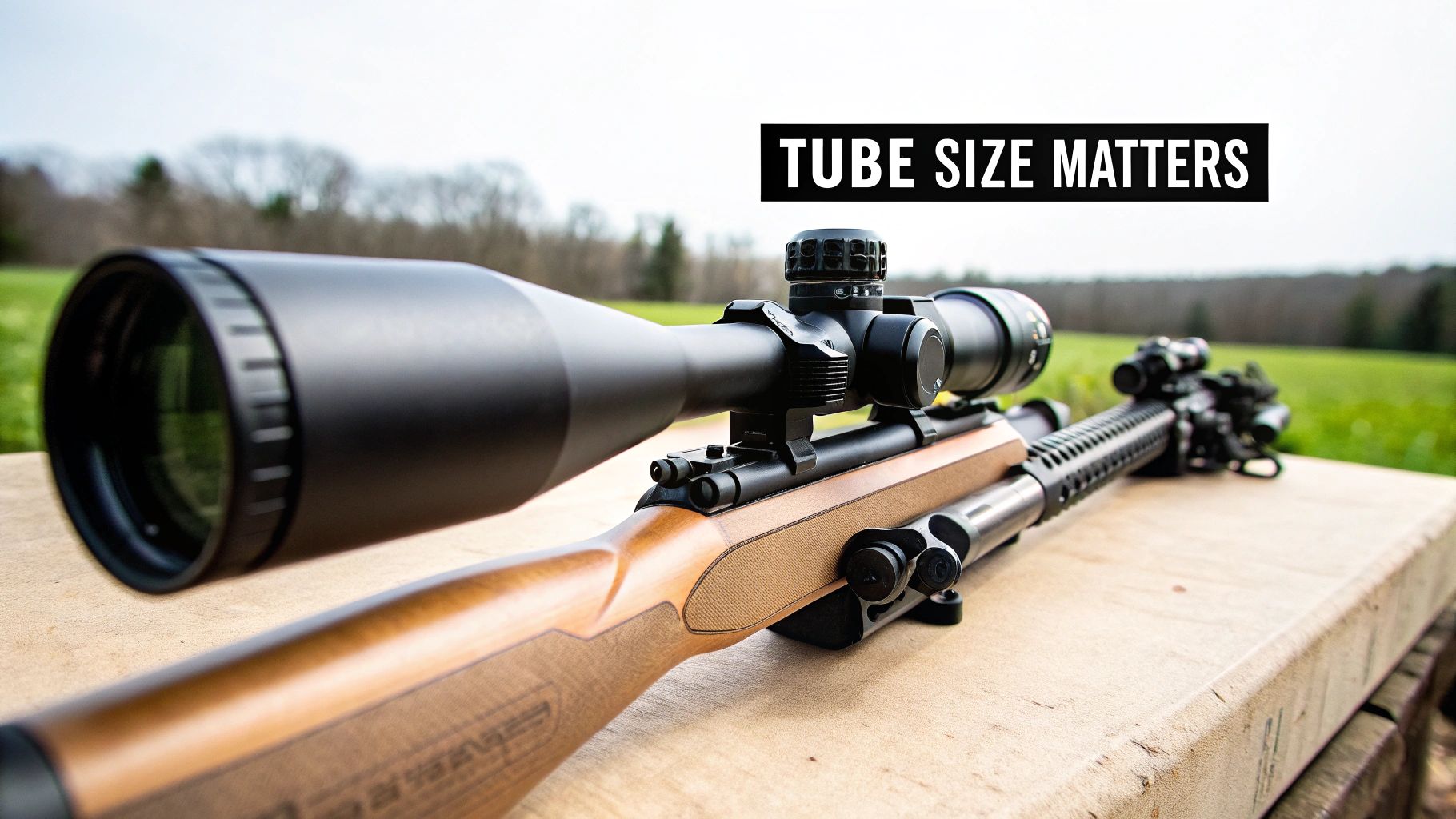
After magnification and the objective lens, the next number you’ll run into is the main tube's diameter. You’ll usually see 1 inch (25.4mm), 30mm, or the beefier 34mm.
There's a persistent myth that a bigger tube lets in more light. It sounds plausible, but it’s just not true. The light-gathering power of a scope is almost entirely determined by the size of the objective lens and the quality of the glass, not the tube itself.
So, what's the tube's real job? It's all about providing room for the mechanics inside the scope to do their work.
More Room for Clicks
Imagine the scope tube is a highway. A two-lane road gets the job done, but a six-lane superhighway allows for a lot more traffic to move freely.
A larger diameter tube—say, a 34mm versus a standard 1-inch—gives the internal erector system much more room to travel up, down, and side to side. That’s the guts of the scope that moves when you crank your elevation and windage turrets.
For anyone serious about long-range shooting, this is absolutely critical. To dial for a shot at 1,000 yards, you need a huge amount of upward travel in your reticle. A skinny 1-inch tube often just doesn't have the internal real estate to get you there.
The Bottom Line: A bigger tube gives you more total adjustment range. You get more "clicks" on your turrets, which means you can dial for bullet drop at extreme distances instead of guessing with complex reticle holdovers.
Just as the scope numbers meaning helps you make an informed choice, the tube diameter is a foundational spec for building a rifle system that matches your goals. This mirrors how numerical data is used in other fields to make sound decisions, a concept you can explore more about the role of numerical scope in decision-making if you're interested in the parallel.
How It Affects Your Scope Rings and Mounts
Your tube diameter directly dictates your mounting hardware. It’s a simple, non-negotiable rule: the rings have to match the tube. You can't squeeze a 30mm scope into 1-inch rings, and a 1-inch scope will just rattle around in 30mm rings. It has to be a perfect fit for a secure, stable platform.
Here's how that breaks down in the real world:
-
1-Inch Tubes: This is the classic size, common on many hunting scopes. They are generally lighter, and you'll find a massive selection of affordable mounting options.
-
30mm Tubes: This has become the modern standard for just about everything. It offers a great balance of increased adjustment range and rugged durability, making it a popular all-around choice.
-
34mm and 35mm Tubes: These are the heavyweights, built for dedicated long-range and precision rifles. They provide the absolute maximum internal adjustment and are typically heavier and more robust.
In the end, it’s about picking the right tool for the job. For most hunters shooting within a few hundred yards, a 1-inch or 30mm tube is more than enough. But if you’re trying to connect with targets way out there, the bigger tubes are essential.
MOA vs. MIL: Learning to Speak Your Scope's Language
When you twist the elevation or windage knobs on your scope, those distinct clicks you feel aren't just for show. They're a precise language, a system of measurement that lets you dial in corrections for bullet drop and wind. Think of it as telling your scope exactly where you want the bullet to go.
The two main "dialects" spoken by modern rifle scopes are Minute of Angle (MOA) and Milliradian (MIL). Choosing between them is a lot like deciding whether you prefer to measure things in inches and yards (imperial) or centimeters and meters (metric). One isn't inherently better than the other, but your choice will shape how you think about and make adjustments in the field.
What is a Minute of Angle (MOA)?
For most shooters in the United States, MOA feels like coming home. It’s an angular measurement that just so happens to line up almost perfectly with the imperial system we use every day.
A "minute" here isn't about time; it's a tiny slice of a circle—specifically, 1/60th of a degree.
The magic number to remember is this: at 100 yards, one MOA equals 1.047 inches. For all practical purposes, we just round it down to 1 inch. This simple relationship makes MOA incredibly intuitive.
Most scopes built on this system use turrets that adjust in 1/4 MOA increments. This means every click you make shifts the bullet's impact by about a quarter of an inch at 100 yards.
Let’s put that into practice. Imagine you’re at the range:
-
You take a shot at a target 100 yards out.
-
Your bullet hits 4 inches low and 2 inches to the right.
-
The math is simple: to come up 4 inches, you'll need 16 clicks (4 / 0.25 = 16). To move 2 inches left, you'll need 8 clicks (2 / 0.25 = 8).
That easy, on-the-fly calculation is exactly why MOA remains a favorite for so many hunters and recreational shooters.
Understanding the Milliradian (MIL) System
Milliradian, usually just called MIL or MRAD, is the metric-based counterpart to MOA. It’s the standard for most military and law enforcement agencies around the world and has a massive following in the precision rifle competition scene.
A MIL is based on a unit of angular measurement called a radian. At 100 meters, one MIL represents exactly 10 centimeters of adjustment. When we bring that over to our side of the pond, one MIL equals roughly 3.6 inches at 100 yards.
This base-10 system makes calculations incredibly clean, especially when communicating with a spotter or ranging targets using a MIL-based reticle. The ability to boil down complex physics into a simple numerical scale is at the core of what makes these systems work so well. It’s the same principle of turning raw data into actionable intelligence that informs major strategic decisions worldwide, from resource management to national security. To get a sense of this broader context, you can explore how numerical analysis aids strategic forecasting.
Most MIL scopes feature turrets that adjust in 0.1 MIL increments. So, one click shifts your impact 1 centimeter at 100 meters, or about 0.36 inches at 100 yards.
Making the Choice: MOA vs. MIL
So, which one is right for you? Honestly, it often boils down to what your brain prefers and what the people you shoot with are using.
The most critical rule is to match your turret units to your reticle units. Trying to use a MIL-based reticle to measure a correction and then dialing it in with MOA turrets is a recipe for a headache. You'll be stuck doing conversion math for every single shot.
To make the decision a little easier, here's a quick side-by-side comparison.
MOA vs MIL at a Glance
Choosing between these two systems is one of the first major decisions a shooter makes when getting into precision. Both are highly effective, but they approach the problem of aiming with a different mathematical "language." The table below breaks down the key differences to help you see which one might be a better fit for you.
| Feature | MOA (Minute of Angle) | MIL (Milliradian) |
|---|---|---|
| Common Adjustment | 1/4 MOA per click | 0.1 MIL per click |
| Value at 100 Yards | ~1 inch per MOA | ~3.6 inches per MIL |
| Math System | Imperial-friendly (inches, yards) | Metric-friendly (centimeters, meters) |
| Best For | Shooters who think in inches and yards | Shooters who prefer base-10 math; tactical and competitive users |
In the end, both MOA and MIL are just tools to get you to the same place: a precise, repeatable hit on target. The best system is the one that clicks with how you think, especially when you're under pressure and the clock is ticking. Pick one, learn it inside and out, and you’ll be well on your way.
Reading the Markings Inside Your Scope
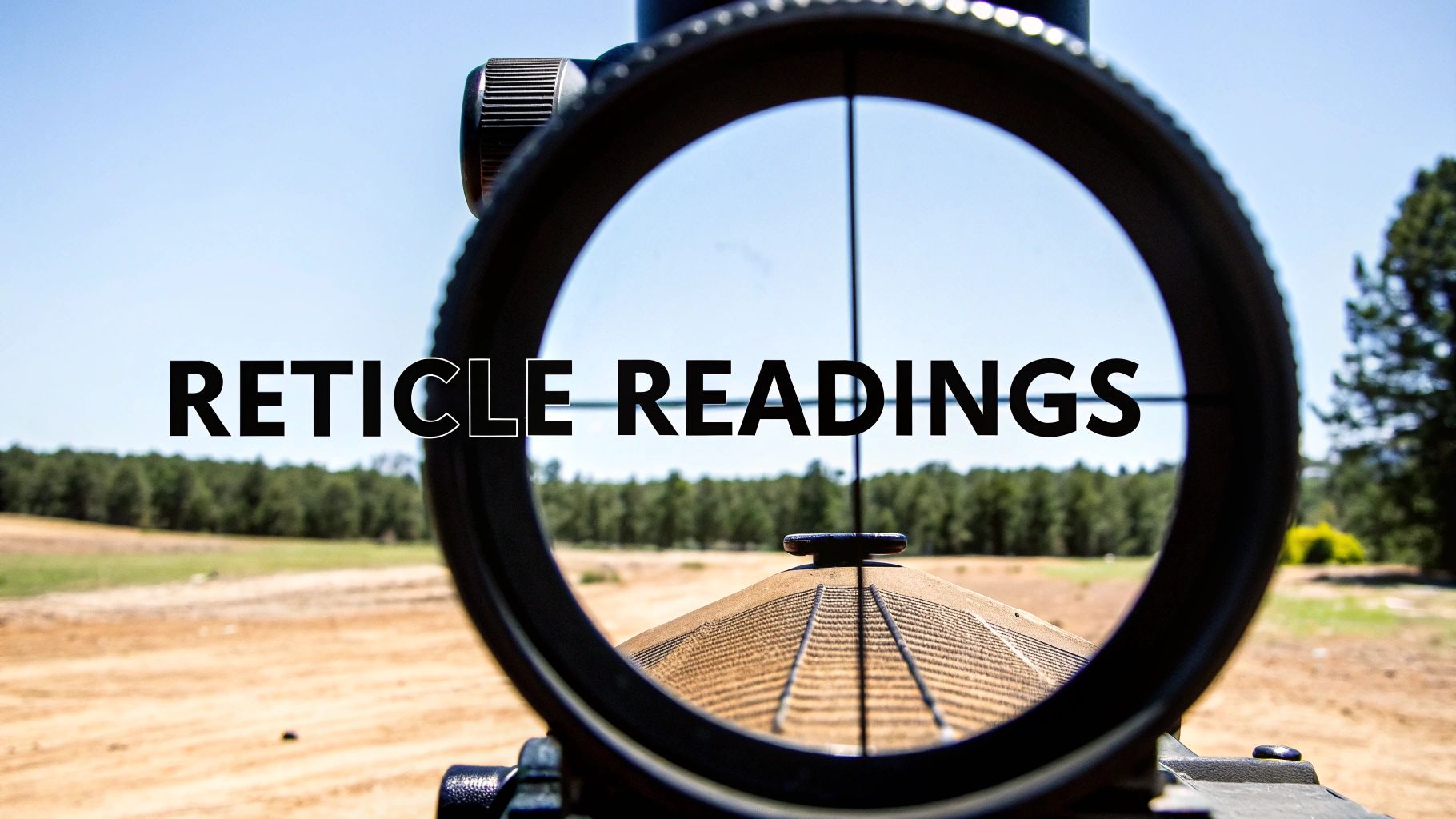
When you look through your scope, you’re seeing much more than just a simple crosshair. All those lines, dots, and numbers etched into the glass are a sophisticated toolkit designed for one thing: precision. Understanding what these internal scope numbers mean unlocks your optic’s real power, turning it from a basic aiming device into a powerful measurement tool.
These markings are called subtensions, and they’re calibrated in either MOA or MIL—the exact same language your turrets speak. That’s the magic. This shared language means you can see how far your shot was off target, and then either hold over with the reticle or dial the exact correction on your turret. No guesswork, no complicated math on the fly.
From Simple Crosshairs to Advanced Grids
Over the years, reticles have evolved from simple aiming points to intricate grids, each with a specific job.
-
Duplex Reticles: Think of the classic hunting scope. It has thick outer posts that get thin toward the center. They're brilliant because they instantly draw your eye to the middle for a quick, clean shot, but they don't offer any way to measure distance or holdover.
-
BDC (Bullet Drop Compensating) Reticles: These are a step up. You’ll see extra hash marks or dots below the main crosshair. Each mark corresponds to your bullet's drop at a specific distance—say, 300, 400, and 500 yards. They’re a fantastic shortcut, but remember they’re calibrated for a very specific cartridge and load.
-
Grid Reticles ("Christmas Tree"): Common in long-range precision scopes, these are grids of MOA or MIL markings. They let you make incredibly precise holdovers for both bullet drop (elevation) and wind, all without ever touching your turrets. It's all about speed and precision under pressure.
These advanced reticles are a game-changer. For example, the detailed information displayed by the Sightmark Wraith HD 4-32×50 digital rifle scope shows just how far this technology has come, integrating measurement tools right into the shooter's view.
Demystifying Parallax Adjustment
Look at the side of most high-power scopes and you’ll find another knob, often marked with distances like 50 yds, 100 yds, and an infinity symbol (∞). That’s your parallax adjustment, and it’s critical.
Parallax is an optical illusion that can throw your shot completely off target. Here’s an easy way to think about it: ever looked at your car’s speedometer from the passenger seat? The needle seems to point to a different speed. The same thing happens in your scope. If your eye isn’t perfectly centered behind the optic, the reticle can look like it’s floating around on the target.
Parallax error happens when the reticle and the target aren't on the same focal plane. Turning the parallax knob brings them both into sharp focus together, effectively "locking" the reticle onto the target, no matter how you move your head.
Fixing it is easy. Just turn that side knob until the target image is perfectly crisp and clear. You can test it by moving your head slightly side-to-side; if the crosshairs stay glued to your aiming point, you’ve nailed it. For any kind of precision shooting, this isn't an optional step—it's the only way to be sure your bullet will land exactly where you're aiming.
Putting It All Together for Your Type of Shooting
Knowing what all the numbers on a scope mean is one thing, but the real art is picking the right combination for what you actually do. The specs on paper don't mean a thing until you put them into a real-world context. A scope that's perfect for one job can be a serious handicap in another.
A deer hunter in the woods has a completely different set of needs than a competitor shooting for points at 1,000 yards. It's no surprise their optics look worlds apart.
The Hunter's All-Rounder
Most hunters crave versatility more than anything else. One minute you might have a deer pop out in thick timber, and the next you could be looking at a shot across a wide-open beanfield. This is exactly why the classic 3-9x40mm and its modern cousins like the 2.5-10x42mm have been best-sellers for decades.
This magnification range gives you a generous field of view on the low end for finding your target quickly, but also enough reach to make a confident, ethical shot at standard hunting distances. For a hunter, a simple duplex or a basic BDC reticle is usually best—they're fast, clean, and don't get in the way when your heart is pounding.
Hunter’s Focus: The goal here is a perfect blend of magnification, light-gathering, and simplicity. You need to be ready for anything without being burdened by features you'll never use.
The Precision Rifle Competitor's Choice
Guys shooting in competitions like the Precision Rifle Series (PRS) live in a different universe. They're dealing with known distances, complex ballistics, and the need for absolute precision. Their gear is purpose-built for wringing out every last drop of performance.
You'll often see scopes like a 5-25x56mm on their rifles. That kind of top-end magnification is critical for seeing small steel targets and, just as importantly, spotting your own impacts way out there.
These scopes are typically built on massive 34mm tubes. That extra diameter isn't just for looks; it provides the internal room needed for the huge amount of elevation adjustment required to dial for shots that can stretch well past 1,000 yards. A complex "Christmas tree" style reticle, usually in MILs, is practically standard issue, giving shooters the ability to make rapid holds for wind and elevation on the fly.
The Tactical and Night Vision User
Tactical operators work in a world of unknowns. An engagement can go from a hallway to a 300-yard street in the blink of an eye. This is where the Low Power Variable Optic, or LPVO, has taken over. A scope in the 1-8x24mm range is the king of this domain.
At its true 1x setting, it functions just like a red dot sight for incredibly fast, both-eyes-open shooting up close. But with a quick throw of a lever, the operator can zoom in to identify threats and make precise shots at several hundred yards. The smaller objective lens keeps the rifle light and nimble.
This is also the realm where specialized optics become mission-critical. For after-dark work, a deep understanding of the science behind thermal rifle scopes is what allows an operator to own the night and maintain a decisive advantage.
Answering Your Top Scope Questions
Once you get the hang of the main numbers on a scope, a few specific questions almost always come up. These are the details that can trip people up, but getting them sorted is the final step to truly understanding your optic and what it can do for you.
Let's dive into the most common questions I hear from shooters. Clearing these up will help you connect the specs on the box to what you actually see and experience behind the rifle.
FFP vs. SFP: What’s the Real Difference?
This is probably the number one point of confusion, and it all comes down to two little acronyms: FFP and SFP. They describe where the reticle sits inside the scope, and that location completely changes how the crosshairs behave when you zoom in and out.
-
FFP (First Focal Plane): In an FFP scope, your reticle grows and shrinks right along with your target as you change magnification. This is a game-changer because it means your hash marks for holdover and wind are accurate and usable at any power setting. For long-range shooters who need to make fast, precise adjustments on the fly, FFP is practically a must-have.
-
SFP (Second Focal Plane): With an SFP scope, the reticle looks exactly the same size whether you're at minimum or maximum power. The catch is that its measurement markings are only accurate at one specific magnification, usually the highest power. SFP scopes are incredibly popular for hunting, where you're often taking a quick shot and can just crank the zoom all the way up if you need to use the reticle for a hold.
Is a Bigger Objective Lens Always Better?
Not by a long shot. It's easy to think bigger is better, and while a massive 56mm objective lens is an absolute photon vacuum—fantastic for low-light visibility—it comes with some serious downsides. First off, it’s heavy and bulky.
That big lens also forces you to use taller scope rings. This can raise the scope so high off the rifle that getting a solid, repeatable cheek weld becomes a real chore. For the vast majority of hunting done in legal shooting light, a 40mm or 44mm objective hits the sweet spot, giving you plenty of brightness without the extra weight or mounting headaches.
How Much Magnification Do I Actually Need?
This is where a lot of people overbuy. The truth is, the right amount of magnification is all about your target and how far away it is. For most big-game hunting scenarios inside 300 yards, a top end of 9x or 10x is more than enough to get the job done cleanly.
Stepping up to varmint hunting or ringing steel out to 600 yards? That’s where magnification in the 12x to 18x range really starts to shine. Those ultra-high magnification ranges—think 25x and beyond—are highly specialized. They're built for precision shooters stretching their legs out to 1,000 yards and farther. Just remember, more power means a smaller field of view and magnifies every little shake, so a rock-solid rest becomes non-negotiable.
At Superior Tactical LLC, we provide the optics and accessories you need to stay mission-ready. Whether you're a hunter, competitor, or tactical professional, find the right gear for your needs at superiortac.com.
