Your Essential Helmet Night Vision Mount Setup Guide
A good helmet night vision mount is far more than just a bracket; it's the critical connection between your helmet and your expensive optics. This single component is responsible for turning a stable helmet into a completely wobble-free image. Honestly, it's one of the most important parts of your entire NVG system, and getting it right means your setup will be comfortable, reliable, and ready when you need it most.
Choosing Your Ideal Helmet Night Vision Mount
Picking the right mount is the true foundation of a solid night vision setup. It’s what keeps everything locked in place, and your choice here will directly affect stability, how the device feels on your head, and even your safety. This isn't just about bolting a PVS-14 to your helmet; it's about creating a seamless, intuitive extension of your own vision in the dark.
This isn't a niche concern, either. The market for military helmets and their integrated displays was projected to hit USD 6.22 billion by 2025. Night vision and other helmet-mounted displays make up more than half of that. That level of investment shows just how crucial a proper mounting interface is for any serious use. You can get a sense of the scale from this military helmet systems market report.
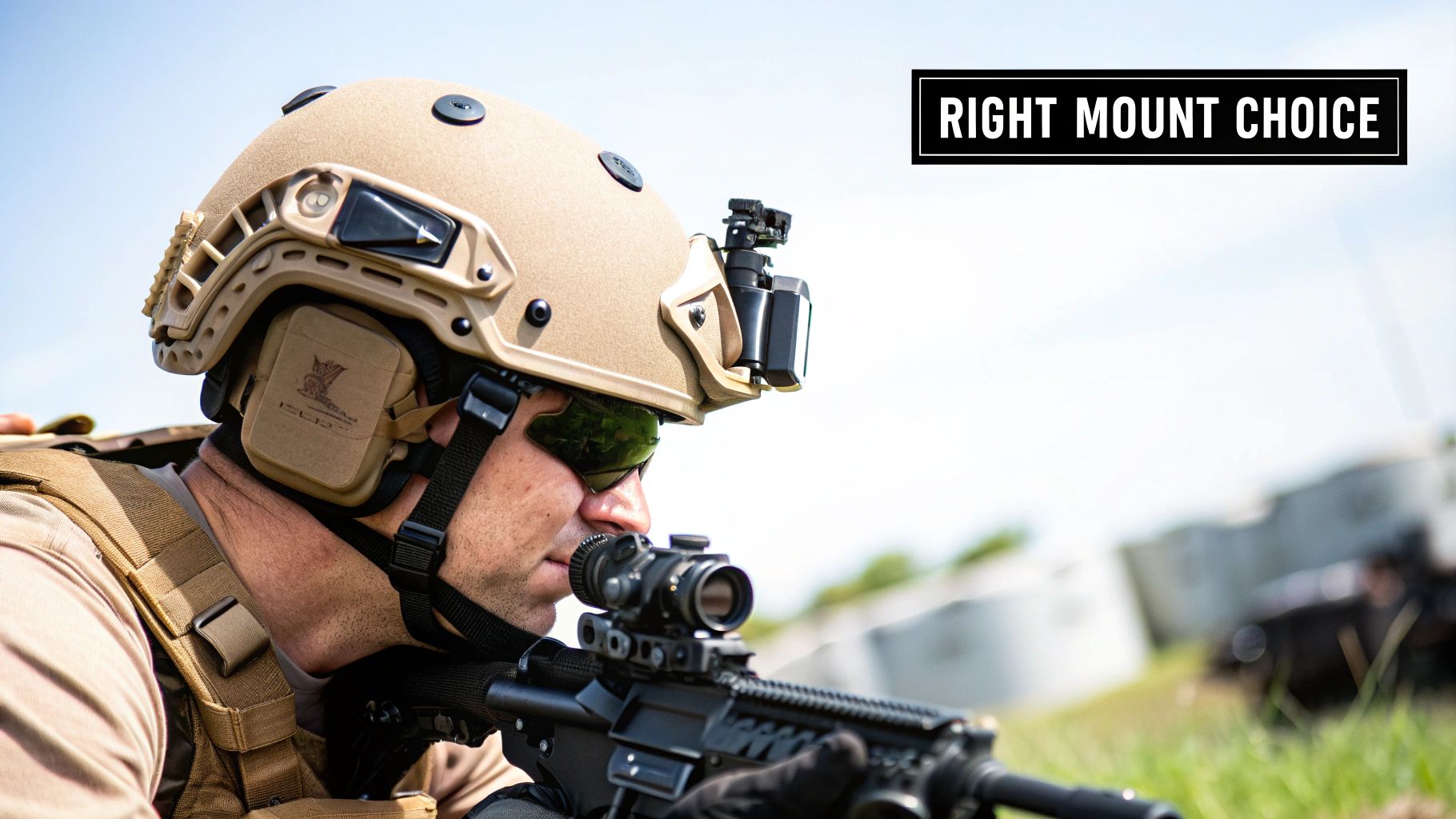
The Great Debate: Dovetail vs. Bayonet
Your first big decision is choosing the interface that connects the NVG to the mount itself. You've got two main options: the dovetail and the bayonet (often called a "J-arm").
-
Bayonet (J-Arm) Mounts: This is the classic horn-style interface you'll find on standard-issue gear like the PVS-14. It gets the job done and is everywhere, with mounts like the Norotos RHNO II being a go-to for a solid, budget-friendly option. The main drawback? Over time, they can develop a noticeable wobble, which is incredibly distracting when you're trying to focus.
-
Dovetail Mounts: Think of this system like a scope rail on a rifle. The NVG arm slides into a channel on the mount for a much more secure and rigid lockup. It's become the gold standard for high-end monoculars and is pretty much required for any dual-tube bino system. Mounts like the Wilcox L4 G24 are legendary for being rock-solid and offering incredibly precise adjustments. If you're looking for top-tier performance, this is the way to go. For a deeper dive, our guide to dovetail mounts for night vision covers all the options and compatibility questions.
To make things clearer, let's break down the key differences.
Comparing Dovetail vs Bayonet NVG Mounts
Here’s a quick reference table to help you weigh the pros and cons of each system based on what's most important for your setup.
| Feature | Dovetail Mount | Bayonet (J-Arm) Mount |
|---|---|---|
| Stability | Excellent; provides a rigid, wobble-free lockup. | Good, but can develop play and wobble over time. |
| Compatibility | Standard for most modern binos and high-end monos. | Standard for USGI-spec devices like the AN/PVS-14. |
| Adjustability | High degree of fine-tuning for height, tilt, and eye relief. | Typically offers basic adjustments; less precise. |
| Cost | Generally more expensive, considered a premium option. | More affordable and widely available. |
| Best For | Professional use, dual-tube systems, demanding users. | Budget-conscious users, hobbyists, standard-issue setups. |
For anyone who relies on their gear professionally, the stability of a dovetail mount is practically a requirement. But if you're a weekend user or hobbyist, a quality bayonet system will still serve you well without the premium price tag.
Materials and Safety Features Matter
Beyond the interface type, the materials used in construction make a huge difference. Mounts machined from aerospace-grade aluminum offer incredible durability and rigidity. They just don't flex, which is what you want for hard use. Polymer mounts, on the other hand, are lighter and cheaper, but they are far more likely to flex or break under stress.
There's one feature I consider non-negotiable, no matter what mount you choose.
A breakaway function is an absolute must-have safety feature. It allows the entire mount arm to detach from the helmet shroud when it's hit with a significant force, like snagging it on a tree branch or a vehicle frame. This simple mechanism can be the difference between a broken mount and a serious neck injury.
In the end, the perfect mount comes down to your specific device, your helmet, and what you plan on doing. Just be sure to prioritize a stable interface, solid materials, and that all-important breakaway feature to build a system you can truly depend on.
Prepping Your Helmet for a Rock-Solid Foundation
Before you get excited and slap that new night vision mount on your helmet, let's talk about the foundation. A wobbly, unreliable setup almost always traces back to one thing, and it's usually not the expensive mount you just bought. The single most common point of failure is the shroud your mount connects to.
Start by giving your existing shroud a good, hard look. Get a small flashlight in there and check for any hairline cracks, paying close attention to the area around the screw holes. Then, grab the shroud and give it a firm wiggle. There should be absolutely no play. None. If you feel any give, try tightening the mounting screws. If it still moves, it’s time to replace it.
Installing a New Shroud Correctly
Putting on a new shroud is pretty straightforward, but the details matter. Most modern ballistic and bump helmets use a standard three-hole pattern, which is a world of difference in stability compared to the old single-hole relics.
When you pull the old one off, make sure to clean the helmet surface underneath. As you bolt the new one on, the single most critical step is using the right length screws. This isn't a "close enough" situation.
-
Screws too short won't get a good bite on the T-nuts inside the helmet. That creates a weak connection that can easily strip out or just fail when you need it most.
-
Screws too long are a real hazard. They can stick out inside the helmet, creating a nasty pressure point against your head or chewing up your helmet's internal pads.
Don't guess on this. Use the hardware that came with your shroud or helmet. You want those screws to seat firmly without bottoming out or leaving any gaps.
A secure shroud is the non-negotiable first step. I’ve seen countless users blame their expensive mount for wobble when the real problem was a loose or cracked shroud that took five minutes to diagnose and fix. Don't skip this inspection.
Taming Your Cables for a Snag-Free Setup
With your foundation solid, the next job is cable management. Do this before you start mounting anything else. If you're running a battery pack for your NODs or have other powered accessories on your lid, routing those wires properly is a game of safety and efficiency.
Loose, unmanaged cables are a massive snag hazard. They catch on everything: tree branches, your own gear, vehicle interiors. A bad snag can violently rip the headset off or, even worse, lead to a serious neck injury.
Use your helmet's built-in cable channels if it has them. Otherwise, rail-mounted clips or even some good industrial-strength Velcro straps will get the job done. The goal is a clean, low-profile setup with no loose loops hanging off. This is especially true for those not using a dedicated skull crusher; for those who are, a well-organized PVS-14 head mount assembly can also benefit from tidy cable management to prevent tangles. Getting this right from the start means your focus stays where it needs to be, not on fighting a rat's nest of wires in the dark.
Installing Your NVG Mount and Device
Alright, your helmet is prepped and your cables are managed. Now comes the satisfying part—marrying the mount to the helmet. This is where you can literally feel the difference between a quality piece of kit and a cheap knock-off. A good installation is all about a rock-solid, wiggle-free lockup.
First things first, connect the mount to the helmet's shroud. It doesn't matter if you're running a top-tier Wilcox L4 G24 or a classic Norotos RHNO II; the concept is identical. Slide the mount's interface into the shroud and listen for the locking mechanism to engage.
Now, give it a good shake. Grab the mount itself and try to force it side-to-side, up and down. If you feel any movement at all, something isn't right. A premium mount should feel like an integral part of the helmet, not an accessory bolted onto it. If you've got some play, take it off and reseat it. Sometimes that locking lever just needs a more authoritative push. On some mounts, you might find a small tensioner screw you can tweak to get a tighter fit. Don't ever settle for "good enough," because a tiny wobble in your hands becomes a nauseating, view-obstructing shake when you're on the move.
Seating the Night Vision Device
With the mount locked down, it's time to get your optic ready. You'll need to attach the correct interface arm to your night vision device—that's typically a J-arm for a standard AN/PVS-14 or a dovetail adapter for most binos and some upgraded monoculars. Make sure the screw connecting the arm to the NVD is snug. You don't need to crank down on it with all your might, but it definitely shouldn't be loose.
This next part is the moment of truth. Line up the J-arm or dovetail with the receiver on your mount and press it straight in. You're waiting for a very specific, very reassuring 'click'. That sound is your confirmation that the locking mechanism is fully engaged and your very expensive optics are secure.
Give the NVD a gentle tug to be absolutely sure. It shouldn't budge.

Running through this quick inspection and installation process is crucial. It ensures every single component is secure before the final, critical piece of gear is added, heading off common problems before they can even start.
Setting Initial Adjustments for Fine-Tuning
Just because the mount is on doesn't mean it's ready to use. Most high-end mounts have several adjustment points, and it's a good idea to get them into a neutral "starting" position before you begin the real fine-tuning.
Here’s a good baseline to set:
-
Fore/Aft Adjustment: This slides the NVD closer to or further from your eye. Find the middle of its travel range and set it there for now.
-
Breakaway Tension: This is a safety feature that dictates how easily the mount will "break away" from the shroud on a hard impact. Set it to a medium tension—you want it tight enough to survive a bump against a doorframe but loose enough to pop off if you seriously snag it on a branch.
-
Vertical Adjustment: For now, just slide the device all the way up so it's high and out of your immediate line of sight. We'll bring it down into position in the next section.
Getting these initial settings dialed in gives you a clean slate. It means your gear is securely attached and ready for the most important step: the final alignment. This is what turns a clunky helmet accessory into a seamless extension of your own vision.
Dialing In Perfect Alignment and Eye Relief
Getting your night vision mount firmly attached to your helmet is just the first step. The real work—and where the magic happens—is in the fine-tuning. This is how you turn a piece of gear into a true extension of your own vision, ensuring you get a clear, usable image that won't give you a headache after an hour.
Proper alignment is non-negotiable. It's what gives you that perfect, round image and makes all-night use comfortable. This is becoming even more critical as the technology gets more complex. The aerospace helmet-mounted display market, a field that often pioneers tech later seen in ground gear, was valued at USD 3.89 billion in 2024 and is expected to reach USD 8.03 billion by 2032. You can learn more about the advancements in aerospace helmet-mounted displays that are pushing these boundaries.

Chasing the Perfect Image Circle
Your primary goal is to see a full, crisp image circle through your optic. You don't want any dark, shadowy crescents on the edges—a frustrating effect known as "scoping." To eliminate this, you’ll be playing with the mount’s main axes of adjustment.
First, put your helmet on and cinch it down exactly how you would in the field. This is important; a loose helmet will shift and throw off all your hard work. Now, flip your NVG down and let's get to it.
-
Vertical Adjustment: This is your up-and-down. Slide the mount until the center of the image lines up naturally with your eye. You shouldn't have to tilt your head or crane your neck to get a good view.
-
Tilt Adjustment: Good mounts let you tilt the NVD forward or backward. You want the device to be perfectly perpendicular to your line of sight. This gets rid of any weird "keystoning" and ensures the whole image is sharp, not just the center.
-
Fore/Aft Adjustment: This moves the whole unit closer to or further away from your face. This is the key to setting your eye relief, which we'll cover next.
Why Eye Relief Is So Important
Eye relief is simply the distance from your eye to the eyepiece lens. It might sound minor, but getting this wrong can ruin your experience.
If the optic is too close, you're asking for it to smack you in the eye socket when you're moving quickly or going prone. It also kills your peripheral awareness.
If it's too far, you'll see that annoying black ring creeping in around the edges of the image, which effectively shrinks your field of view.
The sweet spot is where you have the biggest, cleanest image possible, but with just enough space to be comfortable and safe. For a classic PVS-14, this is usually around 25mm, but let your own comfort be the final judge.
Fine-Tuning a Dual-Tube Setup
Running binos? You've got one more critical setting to nail: interpupillary distance (IPD). This is just the distance between the centers of your pupils, and it's unique to you.
To set it, put the helmet on and power up your unit. Pick a point in the distance and look at it. Now, slowly adjust the pods, either bringing them closer together or moving them apart. You're looking for the exact point where the two separate images merge into a single, cohesive 3D view. There should be no double vision or strain.
Once you have it, a quality mount will hold that IPD setting even as you articulate the pods up and out of your view. Taking a few minutes to get this right is what unlocks the biggest advantage of dual tubes—natural depth perception. It makes moving through terrain at night feel intuitive and dramatically cuts down on mental fatigue.
Keeping Your Gear Running: Maintenance and Troubleshooting
Even the toughest, most expensive night vision mount needs regular attention to stay reliable. Think of it this way: you’ve made a serious investment in your gear, and a little routine maintenance is the best way to protect that investment and ensure it works when you absolutely need it to.
I’ve found that a simple pre-use checklist is the best defense against headaches out in the field. It doesn’t need to be some elaborate, multi-page document. Just a quick, consistent once-over.
Before heading out, I always run through a quick function check. I give all the hardware a twist to make sure it’s tight—paying close attention to the screws holding the shroud to the helmet and the ones on the mount itself. I’ll also work the pivot and adjustment mechanisms to make sure they move smoothly but lock up tight, with no slop or play.
This kind of gear is becoming more and more advanced. In fact, the global helmet-mounted display market, which includes these systems, was valued at USD 2.1 billion in 2024 and is expected to reach USD 2.7 billion by 2030. That growth speaks volumes about how critical this technology has become, and why keeping it in top shape is so important. You can dig deeper into the helmet-mounted display market trends to see where this tech is headed.
Diagnosing Common Problems on the Fly
No matter how meticulous you are, things can and will go wrong. The real skill is learning to diagnose those issues quickly when you’re out there. By far, the most common complaint I hear is wobble.
So, your mount feels loose. The first thing to do is figure out where the movement is coming from.
-
Is it the Shroud? Grab the whole mount and give it a wiggle. If the entire assembly—shroud and all—moves on the helmet, your shroud screws have probably worked themselves loose.
-
Is it the Mount-to-Shroud Interface? If the shroud is rock solid but the mount itself is shifting inside it, the problem is with that connection. Try popping it off and reseating it. Some mounts have tensioners you can adjust to tighten that lockup.
-
Is it the Arm? If the base is solid but the arm holding your NODs has play in it, then the issue is either with the mount’s internal adjustments or the connection to your NVD’s dovetail or J-arm.
Another classic is a flickering device. Before you panic and think your tube is dying, check the easy stuff first. A pencil eraser or a dry cotton swab is perfect for cleaning the battery contacts on your device and the batteries. Also, make sure that battery cap is cranked down tight to maintain a solid connection.
I can’t tell you how many "catastrophic" gear failures I've seen that were actually just minor issues. A five-minute pre-op inspection is the cheapest and most effective insurance policy you can have against your equipment letting you down.
Getting comfortable spotting and solving these small problems on your own will save you from much bigger, more expensive ones later. It not only keeps your setup running right but also builds genuine confidence in your gear. Of course, sometimes a problem is beyond a field fix, and it's just as important to know when to call a pro. For those tougher cases, our guide on common night vision gear issues and repairs can point you in the right direction.
Common Questions About Helmet Night Vision Mounts
Even after you think you've got your setup dialed in, questions pop up. It happens to everyone. Let's run through some of the most common things people ask about their helmet mounts and get you some straight answers.
What's the Real Difference Between Dovetail and Bayonet Mounts?
It really boils down to one word: stability.
The bayonet style, which you’ll often hear called a "J-arm," uses a horn-like piece that snaps into the mount. It’s what comes standard on a lot of gear, like the PVS-14, but frankly, it’s known for developing a ton of wobble and play over time. That slight movement can be a massive distraction when you're trying to focus.
On the other hand, a dovetail mount works more like a scope rail on a rifle. The device slides into a tight-fitting slot and locks down solid. This creates a much more rigid connection, which is why it's the standard for higher-end monoculars and pretty much a must-have for heavier dual-tube binocular setups.
Is a Breakaway Feature Actually Necessary?
If you plan on doing anything more than standing still, my answer is an absolute yes. The breakaway feature is designed to let the entire mount arm pop off the helmet shroud if it gets hit or snagged with enough force—think catching your NVGs on a low-hanging branch or a vehicle door frame.
That simple little mechanism is a critical safety feature. It could easily be the difference between just having to reattach your gear and suffering a serious neck injury. For static observation, it's less of a big deal, but it's non-negotiable for anyone moving around with a helmet on.
How Do I Fix Wobble in My Helmet Setup?
Wobble almost always traces back to one of three culprits. The best way to diagnose it is to start with the foundation—your head—and work your way out to the device.
-
Helmet Fit: This is the #1 cause of a shaky image, hands down. If your helmet isn't snug, nothing else will be stable. Spend time adjusting the internal pads and the suspension system until it's locked firmly onto your head.
-
Counterbalance: Night vision puts a lot of weight on the front of your helmet. You need to balance that out. A simple counterweight pouch on the back makes a world of difference by keeping the helmet from constantly trying to tip forward.
-
Mount Connection: Check where the mount arm connects to the shroud on the front of your helmet. Make sure it's fully seated and locked in tight. Any play at this connection point will be magnified tenfold by the time it gets to your eyes.
Can I Use a PVS-14 on a Dovetail Mount?
You sure can, and it's probably one of the single best upgrades you can make for that monocular. The standard PVS-14 comes with that bayonet-style J-arm, but you can easily find a dovetail adapter.
It's a small part that replaces the standard J-arm and lets you plug your PVS-14 into a much more stable and feature-rich dovetail mount. The improvement in user experience is huge.
At Superior Tactical LLC, we know that having the right gear is only half the battle; knowing how to run it is what gives you the edge. Check out our full lineup of night vision optics, mounts, and tactical accessories to build a setup you can truly depend on.
