The Truth About 4th Generation Night Vision A Complete Guide
Let's get one thing straight right out of the gate: there is no official military designation for 4th generation night vision. It's a term that came out of the industry to describe a major evolution in Gen 3 technology. Think of it less as a whole new generation and more as a "Gen 3 Plus" on steroids.
Specifically, "Gen 4" refers to night vision devices built with two key upgrades: filmless image intensifier tubes and an autogated power supply. This combination created a quantum leap in performance, delivering a noticeably brighter, sharper image that could handle rapidly changing light conditions.
What's Going On Inside a Gen 4 Tube?
To really get what makes this tech tick, you have to look at the heart of the system—the image intensifier tube. This is the engine that takes tiny amounts of ambient light and cranks the brightness up by thousands of times. The so-called "Gen 4" tech introduced two game-changing tweaks to this engine.
The first, and most important, was getting rid of the ion barrier film. In a standard Gen 3 tube, this ultra-thin film acts as a bodyguard for the photocathode, protecting it from being degraded by ion bombardment. But this protection doesn't come for free.
An easy way to think about it is like looking through a screen door. Sure, it keeps the bugs out, but it also dims your view and blocks some of the breeze. By removing that "screen door," filmless tubes let way more light (electrons, really) pass through. The result is a much brighter, higher-fidelity image, especially when you're working in near-total darkness.
The Magic of Autogating
The second piece of the puzzle is the autogated power supply. Ever been in a dark room when someone suddenly turns on the lights? Your eyes get blasted, and for a second, you can't see anything but a bright, blooming spot. Older night vision devices had the same problem.
Autogating fixes this. It's like having a lightning-fast automatic dimmer switch connected directly to the image tube. This system flickers the power on and off thousands of times per second, constantly adjusting to the amount of light coming in. When a bright light source like a car's headlights or a muzzle flash appears, the system instantly throttles down.
This prevents the image from washing out and protects the tube from getting burned. For anyone operating in a city or around vehicles, this is a non-negotiable feature. It allows you to maintain a perfect sight picture even when the environment is throwing all kinds of light at you.
In short, the one-two punch of a filmless tube and an autogated power supply is what sets the performance standard people call "Gen 4." It’s not a brand-new generation from the ground up, but a masterful refinement of Gen 3 architecture.
So, Why Does This Actually Matter?
These two upgrades work in tandem to give the user a real tactical advantage. The filmless tube hoovers up more light for a cleaner view, and the autogating makes sure that view stays crisp and usable when things get bright.
This synergy gives you:
- Better Performance in the Dark: You can see more, with more detail, in darker conditions. This pushes the boundaries of when and where you can operate effectively.
- A Sharper Picture: A higher signal-to-noise ratio means less of that fuzzy "snow" or static in the image. This is crucial for positive target identification.
- Resilience to Light: An operator can move from a pitch-black alley to a lit street without being blinded. Situational awareness is never compromised.
Ultimately, these advancements were a huge step forward, setting the stage for the elite night vision systems used by top-tier professionals today.
The Technological Leap from Gen 3 to Gen 4
To really get why "Gen 4" was such a big deal, you have to understand what it improved upon. For years, the undisputed king of night vision was Generation 3. The magic behind it was a gallium arsenide (GaAs) photocathode, a material incredibly good at turning even the faintest glimmer of light into electrons.
But this powerful photocathode had an Achilles' heel. The process inside the intensifier tube creates positive ions that can fly back and strike the photocathode, basically sandblasting it into an early grave. The fix was an ion barrier film—a super-thin protective layer that acted as a shield.
It worked, but it came at a cost. That little shield blocked some of the electrons from getting through, which meant the final image wasn't quite as bright or crisp as it could be. For a long time, everyone just accepted this compromise to get a tube that would last.
The Push for Uncompromised Performance
By the late 1990s, the game had changed. Elite military units and gear developers were itching for an edge, demanding better performance in the kind of pitch-black conditions where every single photon is precious. This relentless pursuit of a tactical advantage is what drove the innovations that would eventually be called Gen 4.
The solution was simple in theory, but a massive engineering challenge in practice. It boiled down to two key breakthroughs.
- The "Filmless" Tube: The biggest leap was getting rid of the ion barrier film entirely. This was like opening the floodgates, allowing a torrent of electrons to hit the microchannel plate and creating a much brighter, clearer picture.
- The "Gated" Power Supply: To handle this newfound sensitivity and protect the tube from sudden flashes of bright light (like a muzzle flash or a streetlight), engineers developed an autogated power supply. It works by rapidly switching the tube's voltage on and off, thousands of times a second, acting like a super-fast shutter.
These two advancements—filmless technology and autogating—were the heart and soul of this new breed of night vision. Taking away the film unlocked a level of performance that was simply unheard of at the time.
A New Generation or a Major Upgrade?
This was such a significant jump that manufacturers started marketing these devices as a whole new category. The term "Gen 4" really took off around 1998-1999 as companies rolled out these new filmless, gated tubes.
But here’s where things get interesting. While the industry was shouting "Gen 4" from the rooftops, the U.S. military saw it differently. To them, it wasn't a revolutionary new generation, but rather a very, very good Gen 3 tube on steroids.
That’s why, to this day, the U.S. Army doesn't officially recognize a "Generation 4" designation. It’s better to think of it as the absolute pinnacle of Gen 3 technology. If you want to dive deeper into the technical nuts and bolts, our guide on a comparison of thin-filmed and unfilmed image intensifier tubes in night vision is a great place to start. It was a massive leap in capability, but a leap built on the proven foundation of Gen 3 architecture.
How Gen 4 Performance Stacks Up Against Gen 3
Put a top-tier Gen 3 night vision device next to a so-called 4th generation night vision unit, and the difference is obvious—especially when the lights go out for real. We're not just talking about a slightly cleaner picture. We're talking about a genuine operational advantage when visibility hits rock bottom.
These improvements are a direct result of two key pieces of tech: filmless tubes and autogating. Getting rid of the ion barrier film lets these advanced tubes achieve a much higher Signal-to-Noise Ratio (SNR). A good way to think about SNR is like tuning in a radio station. High SNR gives you a crystal-clear broadcast with zero static.
In the world of night vision, that "static" is the grainy snow you see in the image, particularly in deep shadows or on moonless nights. A "Gen 4" tube with a killer SNR cuts right through that visual noise. The result is a crisp, well-defined picture that makes spotting and identifying targets much, much easier.
Thriving in Dynamic Light
The other massive upgrade is autogating. Your standard night vision device absolutely hates sudden, bright lights. Flash a flashlight or catch a car's headlights, and the image will "bloom"—a big, washed-out halo that obliterates your view and can temporarily flash out the user.
Autogating is the solution. It works like an incredibly fast pair of auto-dimming sunglasses, rapidly pulsing the power to the tube thousands of times per second. This prevents bright lights from overwhelming the system. For anyone working in a city or around vehicles, this is a non-negotiable feature. It means you can follow someone from a dark alley onto a lit street without losing your bearings for even a split second.
This chart really drives home the key upgrades that separate these newer systems from their Gen 3 predecessors.
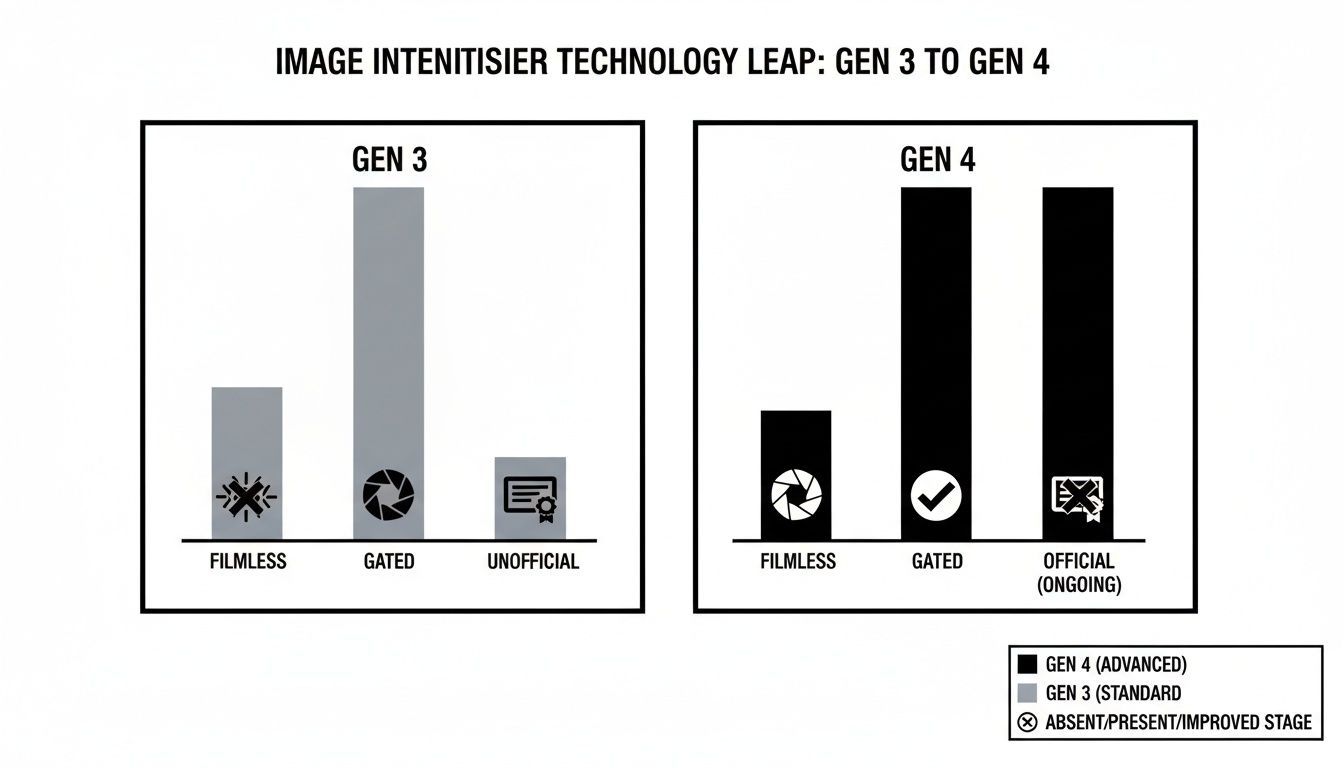
As you can see, the shift to a filmless, gated design is a huge leap forward in capability, even if the "Gen 4" label isn't officially recognized by the U.S. military.
A Head-to-Head Breakdown
To really nail down the comparison, let's put the key performance specs side-by-side. Each of these numbers translates directly into a real-world benefit, whether you're on a two-way range, tracking game, or clearing a building. It's the combination of these improvements that truly sets filmless, gated tubes apart.
Gen 3 vs. Gen 4 Night Vision Performance Comparison
The table below breaks down the essential metrics that define night vision performance, highlighting where filmless/gated technology really shines.
| Performance Metric | Standard Gen 3 (Filmed) | Gen 4 (Filmless/Gated) | Real-World Impact |
|---|---|---|---|
| Signal-to-Noise Ratio (SNR) | Good (Typically 25-30) | Excellent (Often 30+) | A cleaner, less "snowy" image in extreme darkness, improving detection range and clarity. |
| Photosensitivity | High | Very High | Superior ability to gather and amplify faint light, resulting in a brighter image under starlight or overcast skies. |
| Resolution (lp/mm) | High (64-72 lp/mm) | Very High (Often 72+ lp/mm) | Sharper details and better edge definition, making it easier to identify distant objects and individuals. |
| Halo Size | Moderate | Minimal (Typically <0.7mm) | Drastically reduced blooming around bright lights, preserving the view of the surrounding area. |
Simply put, the numbers don't lie. While a quality Gen 3 tube is still highly effective, the filmless/gated systems offer a measurable edge in the most demanding conditions.
These upgrades aren't just minor tweaks; they fundamentally change how you can operate after dark. That boost in resolution and SNR could be the difference between identifying a distant shape as a tree stump or a potential threat.
Image color also plays a big part in perceived clarity and reducing eye strain. Many of today's best systems use white phosphor screens instead of the classic green. Most users find the black-and-white image provides better contrast and makes it easier to judge distances. For a deeper dive, check out our guide on the advantages of white phosphor night vision. When you combine a filmless tube, autogating, and a high-spec phosphor screen, you get a system that gives professionals a decisive edge.
The Hidden Flaw in Early "Gen 4" Night Vision
The initial performance jump with filmless technology felt like the holy grail of night vision. By yanking out the protective ion barrier film, engineers uncorked a level of brightness and image clarity that was simply breathtaking. But this leap forward concealed a fatal, self-destructing flaw that quickly turned into a full-blown crisis.
At its heart, the problem was that the intensifier tube was essentially eating itself alive. The very process that makes night vision work—amplifying light—also creates a stream of damaging positive ions. In a standard Gen 3 tube, that ion barrier acts like a microscopic bodyguard, catching these ions before they can rocket back and smash into the delicate photocathode.
Taking that barrier away was like removing a soldier's body armor to make them run faster. Sure, they're more agile for a moment, but they're left wide open to catastrophic failure.
Ion Feedback: The Achilles' Heel
Without its shield, the photocathode was under constant bombardment from these ions. This relentless assault, known as ion feedback, caused a rapid breakdown of the tube. Dark spots would begin to pepper the image, growing larger and more numerous over time until the device was completely useless. It wasn't uncommon for these early filmless tubes to die after just a few hundred hours of use.
This put everyone in a tough spot. Operators got a taste of incredible performance, but they couldn't trust their gear to survive a single mission, let alone its expected service life. These high failure rates weren't just a nuisance; they were a critical liability for anyone whose life depended on that equipment in a high-stakes situation.
The initial promise of filmless technology was quickly overshadowed by its fragility. For military and law enforcement, equipment that might fail prematurely is not an option, leading to a major reevaluation of the "Gen 4" concept.
The reliability problems got so bad that they forced a major course correction. While removing the ion barrier film in early "Gen 4" designs offered a theoretical edge, it created a practical nightmare. The unacceptably high failure rates torpedoed the technology's credibility, leading the U.S. Army to officially abandon the "Gen 4" designation altogether. This setback, however, paved the way for the development of thin-filmed tubes, a design that kept the barrier but drastically reduced its thickness. This preserved reliability while still delivering a huge performance boost. You can get more of the inside story on the myth surrounding Gen 4 on nightvision.com.au.
A New Solution: The Thin-Filmed Tube
The industry’s response to this crisis was a brilliant piece of engineering. Instead of giving up on better performance, they went back to the drawing board to find a compromise. Going completely filmless was a dead end, but what if they could just make the protective layer much, much thinner?
This line of thinking led directly to the thin-filmed image intensifier tube—the perfect middle ground.
- Rock-Solid Durability: By keeping a super-thin protective barrier in place, it shielded the photocathode and delivered the long-term reliability everyone expects from military-grade hardware.
- Massive Performance Boost: The new film was exponentially thinner than what was used in standard Gen 3 tubes, so way more electrons could pass through, resulting in a much brighter and clearer image.
This new design gave operators performance that was nearly indistinguishable from the original filmless tubes but with a service life that met the toughest standards. It truly was the best of both worlds: elite clarity and brightness without giving up the mission-critical dependability that professionals demand. Today, these advanced thin-filmed autogated tubes are the gold standard, delivering the performance once promised by the 4th generation night vision concept, but with the rugged staying power to be trusted when it counts.
Real-World Applications for Today's Best Night Vision
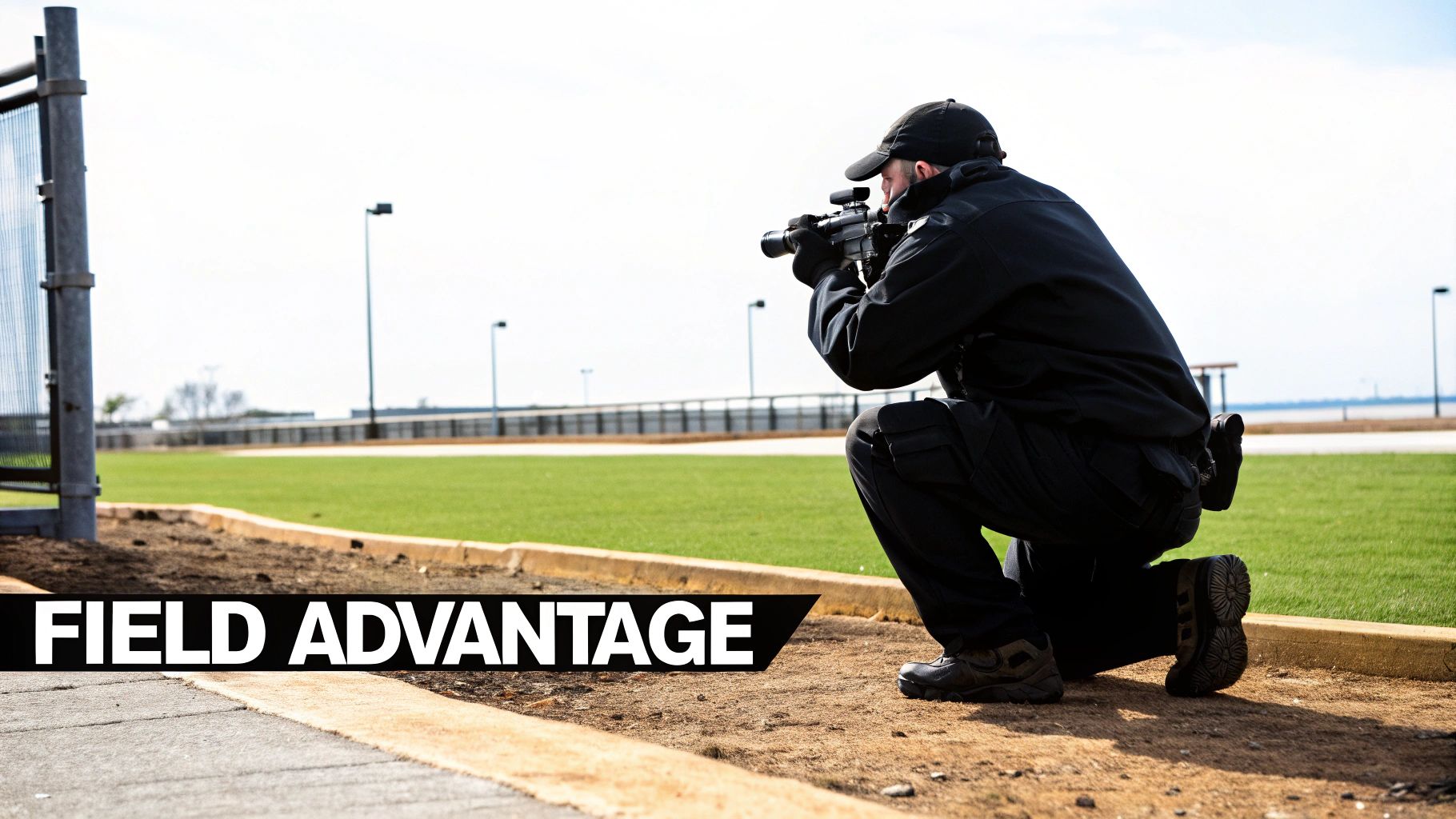
The technical specs for high-performance night vision are impressive on paper, but they only tell you half the story. The real value of a filmless, autogated system—what many call 4th generation night vision—is how those numbers give you a decisive edge in the field. This technology isn't just another piece of gear; it's a force multiplier for anyone whose mission depends on owning the night.
For law enforcement, these advanced optics quite literally make for a safer working environment. Imagine an officer clearing a dark warehouse. When a suspect’s flashlight suddenly sweeps across the room, older night vision would "bloom out," blinding the officer. Not anymore. The autogating feature keeps the sight picture clear, letting the officer stay on target and maintain total situational awareness.
This capability is just as vital for gathering evidence. A high Signal-to-Noise Ratio (SNR) produces a crisp, detailed image, making it possible to identify faces, read license plates, or spot discarded items in near-total darkness. This clarity turns a night vision device from a simple observation tool into a source of hard, actionable intelligence.
Tactical Advantages for Hunters and Security Professionals
The benefits stretch far beyond urban police work. For serious hunters pursuing nocturnal game, positive target identification is non-negotiable—it's about ethics and safety. A filmless tube’s superior light-gathering ability, paired with high resolution, lets a hunter distinguish a target animal from its background at much greater distances, even under a dark, moonless sky.
This means fewer missed opportunities and, more importantly, a dramatically lower risk of misidentifying an animal in tricky terrain. The clean, low-noise image allows for precise shot placement, which is key to a humane and successful hunt.
For security professionals watching over large perimeters, the impact is just as significant.
- Enhanced Perimeter Control: A clean image means security personnel can spot subtle movements along a fence line that would get lost in the "snow" or static of a lower-spec device.
- Reduced False Alarms: Being able to clearly identify the source of a disturbance—whether it's an intruder or just a deer—improves response times and cuts down on costly false alarms.
- Superior Surveillance: Autogating is a game-changer for monitoring areas with mixed lighting, like a parking lot with bright streetlights, without washing out the image.
At its core, advanced night vision is about making better, faster decisions when visibility is at its worst. The technology provides the critical information needed to act with confidence, whether that means engaging a threat, taking an ethical shot, or identifying a security breach.
From Spec Sheet to Mission Success
It’s easy to get bogged down in the technical jargon like FOM (Figure of Merit) or lp/mm (line pairs per millimeter). But for the person on the ground, these numbers translate directly to success. A high FOM score, driven by excellent resolution and SNR, simply means an operator can see farther and with more detail. Autogating ensures that clarity holds up even when the lights flicker on and off.
Think about a SWAT team making a high-risk entry. As they move from a dark street into a lit building, autogated night vision prevents that moment of blindness, giving them a critical edge. For a hunter tracking a predator, the high SNR of a filmless tube allows them to see into deep shadows where an animal might be hiding.
These aren't abstract benefits; they are tangible advantages that save lives and get the job done. Ultimately, the performance of 4th generation night vision provides the clarity and reliability needed to dominate any low-light environment.
How to Choose the Right Night Vision for Your Mission
Walking into the world of night vision can feel like learning a new language. You’ll hear terms like 4th generation night vision thrown around, but honestly, that's more of a marketing buzzword than an official military designation. The real secret to getting the right gear is to look past the sales pitch and dive straight into the numbers that matter.
Your mission dictates your priorities. Are you scanning a field from a fixed position or clearing rooms in a building? The answer changes everything. Don't get caught up in the "Gen 4" hype; instead, focus on the spec sheet that comes with every legitimate image intensifier tube. Think of it as the tube's birth certificate—it tells you exactly what it's capable of.
Prioritizing Key Performance Metrics
When you look at that spec sheet, a few numbers will jump out at you. If you only look at one thing, make it the Figure of Merit (FOM). This is a quick-and-dirty score calculated by multiplying the tube's resolution by its signal-to-noise ratio. A higher FOM generally means a clearer, more capable device.
But the real pros know to look a little deeper. Here's what you should focus on:
- Signal-to-Noise Ratio (SNR): This is the king of all specs. A high SNR, ideally 30 or more, means the image will be clean and crisp, not fuzzy with electronic "snow," especially when it gets really dark. If you're out in the middle of nowhere with no moonlight, a high SNR is your best friend.
- Resolution (lp/mm): This tells you how sharp the image is. Measured in line pairs per millimeter, a higher number (think 64-72 lp/mm or better) means you can pick out fine details, which is critical for identifying a threat from a non-threat at a distance.
- EBI (Equivalent Background Illumination): A low EBI is what you want. This spec measures the tube's own internal glow. The lower the EBI, the darker the black parts of the image will be, giving you much better contrast.
Choosing the right device is always a trade-off. A SWAT officer clearing a dark warehouse needs a wide field of view and lightning-fast autogating more than raw, long-distance resolution. A hunter trying to spot a coyote across a canyon needs that high SNR to cut through the darkness.
Beyond the Spec Sheet
The tube is the heart of the system, but it’s not the whole story. You're making a serious investment, so you need to consider the company behind the gear. A solid warranty, like a 10-year warranty, isn't just a piece of paper; it's a statement from the manufacturer that they build quality equipment and will stand by it.
What about after the sale? If something goes wrong, you want to know there’s someone you can call who will actually help. Good customer support is just as important as a good spec sheet.
If you’re ready for a more detailed breakdown, our complete guide on how to choose the right night vision device for your needs gets into the weeds on every last detail. At the end of the day, the "best" night vision is the one that fits your budget, meets your operational demands, and gives you the confidence to own the night.
Your Top Questions About 4th Gen Night Vision Answered
Diving into high-end optics can feel like learning a new language. To cut through the noise, let's tackle some of the most common questions people have about 4th generation night vision so you can feel confident in your understanding.
Is It Legal for Civilians to Own 4th Generation Night Vision?
Absolutely. Here in the United States, it's perfectly legal for a civilian to buy and own any night vision device on the market, including the top-tier systems often sold as "Gen 4."
The big thing to remember, though, is ITAR, which stands for the International Traffic in Arms Regulations. These are strict federal laws that control where sensitive defense technology can go. That means you can't legally take, ship, or send your high-end night vision unit outside of the U.S. without a specific export license. The easiest way to stay on the right side of the law? Always purchase from a reputable, U.S.-based dealer.
If Gen 4 Isn't an Official Military Term, Why Do Companies Use It?
Honestly? It's a marketing term, but it’s a useful one. "Gen 4" has become a shortcut to signal that a device uses the best commercially available technology: a filmless image intensifier tube paired with an autogated power supply.
While the U.S. military never officially adopted the "Gen 4" designation, the label stuck. It gives buyers a quick way to tell these elite systems apart from standard Gen 3 devices.
Think of "Gen 4" as a signpost pointing you toward top-tier performance. Once you see it, your next move should be to look past the label and dive into the tube’s actual spec sheet. That's where the real story is, in metrics like SNR and resolution.
What's the Difference Between White and Green Phosphor?
The color you see through a night vision device comes from the phosphor screen inside the image intensifier tube. You've got two main choices: green or white.
- Green Phosphor (P43): This is the classic, iconic look you see in movies. It produces a familiar green-and-black image.
- White Phosphor (P45): This is the more modern option, giving you a crisp black-and-white image that many find more natural to look at.
A lot of operators feel that white phosphor delivers better contrast and depth perception, making it easier to pick out fine details in the dark. It also tends to cause less eye fatigue over long nights. Both green and white are available in high-performance tubes, so it really boils down to your personal preference and what feels best for your eyes.
At Superior Tactical LLC, we believe in giving you clear, honest guidance to match you with the right night vision for your needs. We stand behind our gear with a 10-year warranty on Gen 3 systems and expert in-house support. See our hand-picked selection of high-performance optics at https://superiortac.com.
