
Why Is Night Vision Green Uncovering the Science of Low-Light Tech
That iconic, almost eerie, green glow from night vision isn't just for Hollywood special effects. There’s a fascinating reason for it, a perfect blend of human biology and smart engineering. The short version? Our eyes are naturals at seeing green in the dark, and the tech that makes that green image is both reliable and affordable.
Decoding the Signature Green Glow
The distinct green you see through a night vision scope is no accident. It’s the result of a deliberate choice to play to the strengths of both the technology and our own eyes. Think of it as a clever way to get the most visual information out of the darkness with the least amount of eye strain.
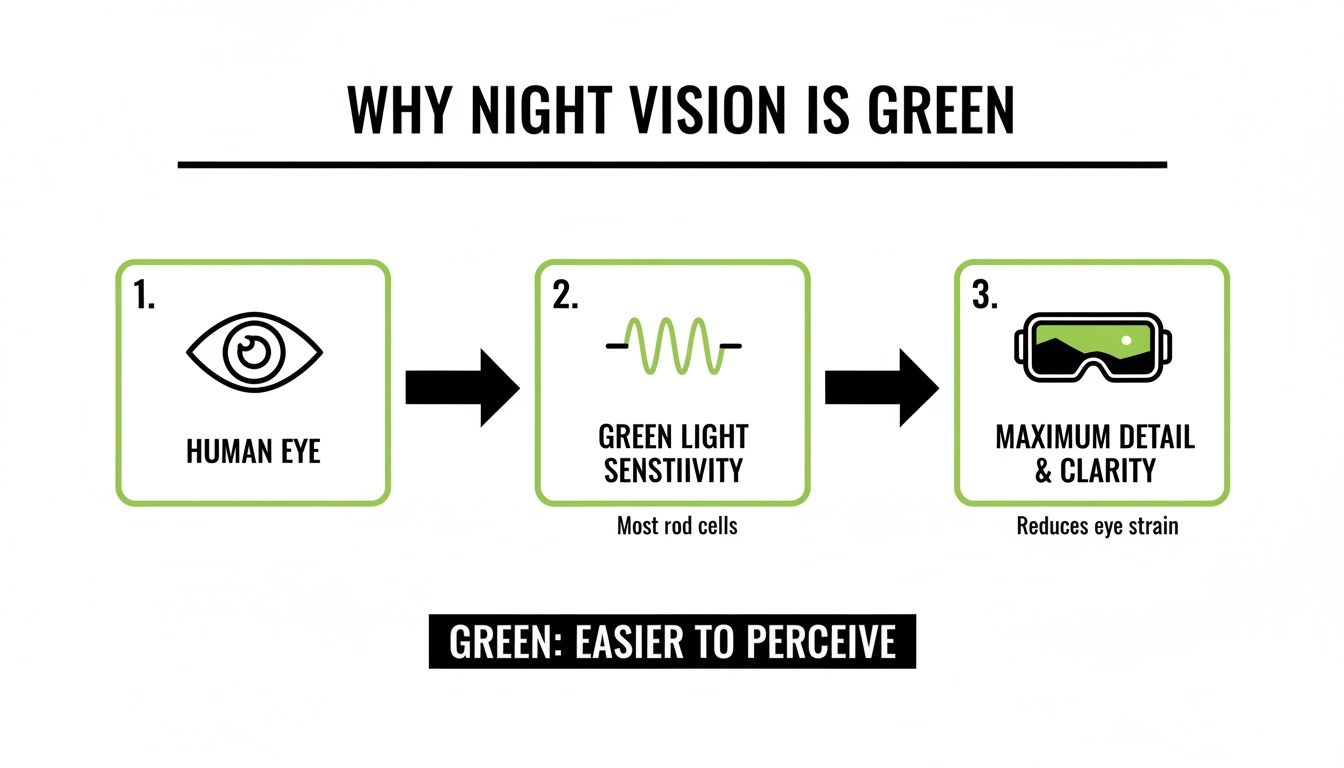
It all starts with how our eyes are built. For night-time vision, we rely on photoreceptor cells called rods. These rods are incredibly sensitive to light, but they don't see color very well. What they are exceptionally good at is detecting light in the green part of the spectrum.
This means our eyes can pick out far more shades of green in low light than any other color. We’re talking about the ability to see more detail, judge distances better, and make out subtle shapes in the shadows. A green image simply looks sharper and is less tiring to look at for hours on end.
The second half of the equation is the technology inside the device. Night vision scopes and goggles use something called a phosphor screen to turn invisible amplified light into an image you can actually see. For decades, green phosphor was the go-to choice.
Efficiency and Effectiveness
Why green phosphor? It's incredibly good at its job. It converts energy into light very efficiently, which means you get a bright, clear picture without draining the battery.
This efficiency, combined with its proven track record and lower manufacturing cost, made green phosphor the industry standard for a long, long time. It’s a classic case of "if it ain't broke, don't fix it."
The specific wavelength of this light is right around 500 nanometers, which is the sweet spot for our rod cells. As a result, you can distinguish up to 100 times more shades of green than you could of red or blue in the dark. If you're curious, you can learn more about how our eyes perceive different light spectrums and how that directly impacts night vision performance.
To wrap up, let's break down these core reasons into a quick summary.
Key Reasons for Green Night Vision at a Glance
| Factor | Brief Explanation |
|---|---|
| Human Biology | Our eyes' rod cells, responsible for low-light vision, are most sensitive to the green spectrum, allowing us to see more detail and shades. |
| Reduced Eye Strain | The sensitivity to green means our eyes don't have to work as hard, reducing fatigue during prolonged use (e.g., long stakeouts or night hunts). |
| Phosphor Technology | The traditional P43 green phosphor used in image intensifier tubes is highly efficient at converting electrons to visible light. |
| Cost & Reliability | Green phosphor technology is mature, cost-effective to manufacture, and has a long-standing reputation for reliability and durability in the field. |
Ultimately, the green glow is a legacy of smart, practical design choices that have served operators well for generations.
How Night Vision Turns Darkness Into Green Light
You might think night vision devices create light out of thin air, but that's not quite right. A better way to think of them is as powerful light amplifiers. They take the tiniest, faintest bits of ambient light—starlight, moonlight, anything—and crank up the volume until you can see a clear picture. The journey from near-total darkness to that classic green glow is a fascinating, multi-stage process that happens in a flash.
It all starts at the objective lens, the front glass that gathers whatever light is available. This light is made of photons, which are basically tiny particles of light energy.
From there, the collected photons travel into the heart of the device: the image intensifier tube. Inside, they slam into a special surface called a photocathode. The photocathode's job is to pull off a neat physics trick, converting the light energy from those photons into electrical energy—specifically, electrons.
The Electron Multiplication Engine
Now that the photons have been swapped for a handful of electrons, the real magic happens. These electrons are shot into a component that's the true engine of the whole system: the Microchannel Plate (MCP). It’s an incredible piece of engineering, a tiny disc packed with millions of microscopic channels.
When a single electron enters one of these channels, it bounces off the wall, knocking several more electrons loose. This chain reaction continues down the channel, turning one electron into thousands in a massive cascade.
This multiplication effect is what makes the technology so powerful. If you were to tear apart a night vision device, you'd find the MCP is the unsung hero. This little disc, packed with 10 to 40 million microscopic channels, multiplies the initial electrons by a staggering amount—often achieving 50,000-70,000x amplification in modern Gen 3 tubes. To get a closer look at all the components, you can find a full breakdown in our guide on how night vision works.
Finally, this supercharged flood of electrons exits the MCP and speeds toward the end of the tube, where it strikes a phosphor screen. This screen is coated with a material that lights up when hit by electrons. In most traditional night vision devices, that material glows green.
This is the key step where the image gets its color and becomes visible to our eyes.
The image you see through the device is a direct result of this energy conversion. The color isn't inherent to the night itself; it's determined entirely by the type of phosphor used on that final screen.
An eyepiece lens at the very back of the device then magnifies this glowing green image, presenting your eye with a crisp, detailed view of the scene. This whole chain of events happens almost instantly, turning an impossibly dark landscape into something you can navigate and observe, all painted in those familiar shades of green.
The Perfect Match: How Your Eyes See Green Light at Night
The iconic green glow of night vision isn't just for Hollywood effect—it's a clever bit of engineering that works with your biology, not against it. To really get why, we have to talk about how your eyes are built to handle the dark. It’s a fantastic example of technology giving our natural abilities a serious upgrade.
Inside your eyes, you have two kinds of light-detecting cells: cones and rods. Think of cones as your daytime crew; they handle bright light, sharp details, and all the vibrant colors of the world. But once the lights go down, they check out, and the night shift—the rods—takes over.
Rods are the heroes of your low-light vision. They aren't great with color, which is why everything looks like shades of gray in the moonlight, but they are incredibly sensitive to even the faintest glimmer of light. This is what lets you find your way around a dark room. And here's the crucial part: they have a favorite color.
Why Green is the Go-To Color
As it turns out, your rods are most sensitive to light with a wavelength around 555 nanometers. That specific wavelength just happens to be smack in the middle of the green part of the spectrum. This isn't random; it's a feature baked into our DNA through evolution.
So, by making the night vision image green, the device is essentially speaking the language our eyes understand best in the dark. This perfect pairing offers some huge advantages for anyone out in the field.
- You See More Detail: Our eyes can distinguish between thousands of shades of green, far more than any other color. This means an operator can pick out subtle textures, spot the outline of a figure, or notice slight movements that would be completely invisible in another color.
- It’s Easier on the Eyes: Staring at a bright screen for hours is exhausting. A green display causes significantly less eye strain, which is a game-changer for a soldier on a long watch, a police officer on a stakeout, or a hunter patiently waiting for their target. It keeps you alert and focused, not fatigued.
Engineers essentially figured out how to align the device's output with the peak sensitivity of the human eye. The result is a system that gives you maximum clarity while making it biologically easier to stare into a display for hours on end. It's a perfect synergy of science and nature.
The Real-World Impact of Green
This isn't just cool science; it has a direct impact on performance. An operator can more reliably tell the difference between a harmless shadow and a hidden threat. A hunter can more easily separate an animal from the dense foliage behind it. The green image simply delivers a level of detail and endurance that other colors can't provide.
Choosing green phosphor wasn't just the most practical option from a manufacturing perspective; it was, and still is, the most effective choice for the user. It plays to the natural strengths of our own vision, making the technology feel less like a clunky tool and more like a true extension of your senses. That smart engineering is exactly why green remains the trusted standard for professionals who need to own the night.
Choosing Between Green and White Phosphor
While that classic glowing green image is what everyone pictures when they think of night vision, it’s not the only game in town anymore. The arrival of white phosphor (WP) technology kicked off a huge debate in the community: which one is actually better?
The truth is, there's no simple answer. It's less about one being superior and more about picking the right tool for your specific mission, environment, and, of course, your budget.
Green Phosphor: The Tried-and-True Original
Traditional green phosphor (GP) is the battle-tested standard. It's been around for decades, it’s incredibly reliable, and it's generally easier on the wallet.
But its biggest advantage is how well it works with our own biology. Our eyes are naturally most sensitive to shades of green in low light, which means GP displays tend to cause less eye strain over long periods. That’s a massive deal for anyone pulling a long surveillance shift or spending hours on a nighttime hunt.
White Phosphor: The Modern Contender
On the other hand, white phosphor gives you a black-and-white image that a lot of people find more natural and intuitive—almost like looking at a high-contrast monochrome photo.
This can make it much easier to read a scene at a glance, especially in urban environments or snowy landscapes where contrast is everything. The sharp difference between light and dark helps pop targets and potential threats out from their background.
Comparing Green and White Phosphor
Ultimately, the choice between green and white often boils down to a mix of personal preference and what you'll be doing with it. Someone who has spent years behind a green tube might find white jarring, while a newcomer might instantly prefer the black-and-white view. It’s all about understanding the trade-offs.
A ton of research actually backs up green phosphor's reputation for long-duration use. Believe it or not, the human eye can distinguish over 10 million shades of green, which is a huge benefit when you’re trying to pick out subtle details in deep woods or shadows. This biological advantage means operators can stay focused longer without their eyes getting tired.
In fact, a 2015 study with U.S. Special Forces found that soldiers using green phosphor NVGs had 25% longer effective observation times before their vision started to degrade. The green screens fatigued the eye's rod cells two times slower than other colors.
White phosphor, however, often gives the perception of better sharpness and contrast. Even though the underlying tube technology is very similar, the black-and-white image can provide starker outlines and better depth perception for some users, making it easier to identify targets and navigate tricky terrain.
For those wanting to dive deeper into this, you can learn more about the advantages of white phosphor night vision and see where it really shines.
To help lay it all out, here’s a straightforward comparison of the two technologies.
Comparison Green Phosphor vs White Phosphor
This table breaks down the key characteristics and common applications for both green and white phosphor night vision systems, giving you a quick side-by-side look.
| Feature | Green Phosphor (GP) | White Phosphor (WP) |
|---|---|---|
| Image Color | Monochrome Green | Monochrome Black & White |
| Eye Strain | Lower during extended use | Can be higher for some users |
| Contrast | Excellent in natural environments | Perceived as higher, excels in urban/snow |
| Cost | Generally more affordable | Typically a premium option |
| Availability | Widely available, mature tech | High-end systems, becoming more common |
| Best For | Long surveillance, hunting, general use | Tactical operations, high-contrast scenes |
As you can see, the "best" choice really depends on what you value most—reduced eye fatigue and cost-effectiveness, or perceived clarity and modern performance.
Making the Right Choice for Your Needs
So, how do you decide what’s right for you? Stop thinking "which is better" and start asking "which is better for me?"
Here are a few pointers to guide your decision:
- For Long Nights: If you know you'll be staring through your device for hours on end—think law enforcement surveillance or patient varmint hunting—green phosphor's proven ability to reduce eye strain is a major plus.
- For High-Contrast Environments: If you operate mostly in cities with lots of artificial light or out in snowy conditions, the crisp, high-contrast image of white phosphor might give you a real tactical edge.
- If Budget is a Factor: Green phosphor units are almost always more budget-friendly. The technology has been perfected over decades, making it a much more accessible entry point into quality night vision.
- Trust Your Own Eyes: At the end of the day, nothing beats hands-on experience. What looks good on a spec sheet might not feel right in the field. If you get the chance, look through both types of devices and see which image your brain processes more cleanly.
What This Means for Hunters and Tactical Operators

It’s one thing to understand the science of green night vision, but it's another thing entirely to use that knowledge to gain a real-world advantage. For professionals in the field, the choice between phosphor colors can directly impact mission success, safety, and your ability to last the night. The biological reasons we prefer green aren't just trivia—they give you a tangible edge when it counts.
Imagine a law enforcement officer on a surveillance operation for hours on end. Staring intently into any kind of display for that long is a recipe for serious eye fatigue, which can quickly lead to headaches and a dangerous loss of focus. Because the classic green phosphor image is much easier on our eyes in the dark, it helps keep that strain at bay. The officer stays sharp, alert, and ready, ensuring they don't miss that one critical moment.
Hunters see similar benefits. When you're scanning a dark tree line or peering into thick underbrush, the ability to see thousands of shades of green is a game-changer. That enhanced detail can be the difference between making out the subtle silhouette of a hog against the foliage and going home empty-handed.
Tactical Application in the Field
The real-world value of green phosphor truly shines in specific scenarios. Whether you're navigating rough terrain or tracking a target, the image you see through your device informs every single decision.
- Target Identification: Our brains are wired to interpret more shades of green, which makes it easier to separate a potential threat from its background. An operator can more reliably spot a partially hidden figure in the shadows or tell the difference between a firearm and a fallen branch.
- Tracking and Navigation: When you’re following a faint trail of footprints or disturbed ground, the subtle tonal shifts in a green image can make the path pop. This is especially true in wooded areas where the background is already a wash of natural green hues.
- Sustained Operations: For any mission lasting longer than an hour, minimizing eye fatigue isn't just about comfort—it's about performance. Green phosphor has a long and proven history of helping users maintain peak visual sharpness for extended periods, a critical factor for both safety and effectiveness.
The bottom line is this: the green image isn't an accident or a stylistic choice. It's a highly functional design that works with the peak sensitivity of your eyes' rod cells. The result is a detailed, clear picture that you can observe for long stretches, giving you superior situational awareness.
Maximizing Your Advantage
Ultimately, the entire point of night vision is to give you a decisive edge when the lights go out. That classic green display accomplishes this by perfectly syncing up with our own biology. It’s this powerful synergy that allows operators to see more clearly, stay focused longer, and perform better.
Hunters, especially, can see a huge leap in their nighttime success. Understanding how the technology works with your own vision helps you use it more effectively, from spotting elusive game to navigating safely back to camp. For a closer look, check out our guide on how night vision goggles can improve your hunt and get the most from your equipment.
Knowing why night vision is green isn’t just interesting—it helps you choose the right gear and use it to its full potential when you need it most.
Got Questions? We've Got Answers
After digging into the science behind that classic green glow, the tech packed into these devices, and the different phosphor options out there, a few common questions always seem to pop up. Let's tackle them head-on and clear up any confusion you might still have about night vision.
Is All Night Vision Green?
Not anymore, though for decades, that was the case. The iconic emerald image comes from green phosphor (GP), which became the industry standard because it’s incredibly efficient and works beautifully with the human eye's natural abilities in the dark.
But today, you have another excellent choice: white phosphor (WP). These units are extremely popular, delivering a sharp black-and-white picture that many people find more intuitive. While researchers have played around with other colors over the years, green and white are really the only two that have proven their mettle in the real world.
So, Is Green or White Phosphor Better?
Honestly, there's no single "best" answer. The right choice really comes down to you, your environment, and what you’re using it for. Green phosphor is the time-tested, reliable workhorse. It’s generally easier on the wallet and, scientifically, it’s known to cause less eye strain over long nights of observation.
White phosphor, on the other hand, often gives a sense of greater clarity and contrast, which can be a real advantage in urban settings or snowy landscapes. Many operators feel the black-and-white view helps them identify threats faster. It’s a trade-off between your budget, your mission, and what just feels right to your eyes.
Can You See in Complete, Pitch-Black Darkness?
This is probably the biggest myth out there. The kind of night vision we've been talking about—image intensification—needs some light to work. It's an incredible amplifier, taking tiny amounts of ambient light from the moon, stars, or even a distant streetlight and multiplying it thousands of times.
But if you’re in a place with zero light, like a sealed-off room or a deep cave, an image intensifier won't see a thing. For true "total darkness" visibility, you'd need a thermal imaging device. That's a whole different technology that sees heat signatures, not light.
Why Does Night Vision in Movies and Games Look So Different?
Hollywood loves to get creative. The blue, gray, or other weirdly colored filters you see in movies and video games are just for show. Directors and game developers use them to create a certain vibe—maybe something more futuristic or dramatic for the scene.
Out in the field, it's all about what works. Real-world, professional-grade night vision sticks to green or white phosphor for a reason. These colors weren't picked to look cool; they were chosen after decades of research into human biology to give operators the clearest possible picture with the least amount of eye fatigue. When it comes to real-world use, performance always trumps cinematic flair.
Ready to see the night in a new light? The experts at Superior Tactical LLC can help you choose the perfect night vision or thermal system for your needs. Explore our curated selection of top-tier optics and tactical gear at https://superiortac.com.
