
What Is Diopter Adjustment and How Does It Work?
Picture this: you're lining up a crucial shot, but the reticle in your scope is blurry, almost a ghost. This all-too-common frustration is exactly what diopter adjustment solves. It's not about bringing a distant target into focus; it's about calibrating the optic’s internal reticle perfectly to your unique eye.
Your Guide to Pinpoint Optical Clarity
Think of the diopter adjustment as a built-in pair of prescription glasses for your scope, thermal, or night vision. Just like with eyewear, no two people see exactly the same. Your eyes might be a little nearsighted or farsighted, and the diopter compensates for that, making the aiming reticle or digital display tack-sharp.
This is a totally different job from the main focus knob, which is for adjusting to target distance. Nailing your diopter setting is the first and most critical step for any shooter. A perfectly set diopter means less eye strain, better accuracy, and a clear, crisp sight picture every single time.
Diopter Adjustment vs. Objective Focus
It's easy to get these two adjustments mixed up, but they have completely different roles. One is about your eye, and the other is about the target. Understanding the difference is key to getting the most out of your optic.
To put it simply, here’s how they stack up.
Diopter Adjustment vs Objective Focus At a Glance
| Feature | Diopter Adjustment (Eyepiece) | Objective Focus (Front Lens) |
|---|---|---|
| Purpose | Focuses the reticle to your specific eye. | Focuses the image of the target. |
| When to Set | Set once for your vision and leave it. | Adjust frequently for different target distances. |
| Analogy | Like putting on your prescription glasses. | Like focusing a camera on a subject. |
So, you set the diopter first to get the reticle sharp for your vision. Once that's done, you use the objective focus to make the target clear at whatever distance it happens to be. It's a two-step process that guarantees a perfect image.
The Science of a Perfectly Focused Reticle
So, how does twisting that little ring on your eyepiece work its magic? Think of your optic's reticle as a tiny image projector and your retina as the screen. The diopter adjustment is the focus knob for that projector, and its job is to make sure the image it throws onto your specific screen is perfectly sharp.
No two sets of eyes are the same. Some of us are nearsighted, others are farsighted. The diopter exists to compensate for these individual quirks. Essentially, you're telling the optic to behave as if your eye has perfect 20/20 vision, even if you wear glasses. This simple calibration is the secret to a crisp reticle and a strain-free sight picture.
Your Eye and the Diopter Unit
If the term "diopter" sounds familiar, it's because it's the same unit of measurement on your eyeglass prescription. It’s a measure of optical power. For context, the human eye has a focusing power of about 60 diopters when looking at something far away, but our ability to adjust that focus changes as we get older.
On devices like thermal imagers or red dots from brands like EOTech and Sightmark, the diopter adjustment is what saves you from eye strain during long nights on patrol or in the hunting blind. It’s all about compensating for your eye’s natural focus.
When we're young, our eyes can adjust their focus by 11 to 16 diopters on the fly. By the time we hit 60, that ability can drop to just a single diopter. This is exactly why a seasoned hunter or tactical pro absolutely depends on an adjustable eyepiece to get a sharp sight picture. You can get a deeper dive into how diopters work in vision correction on Wikipedia.
Ultimately, this adjustment makes sure the reticle—whether it's an old-school crosshair, a holographic dot, or a digital overlay—is focused on the same exact plane as the target downrange. For a closer look at the different aiming points out there, check out our guide on the various types of scope reticles.
When your reticle and target are both perfectly sharp, you’ve not only reduced eye fatigue, but you've also eliminated parallax error, which is a massive step toward nailing that perfect shot.
How to Set Your Diopter for Crystal-Clear Viewing
Getting your diopter set correctly is one of those fundamental skills that completely changes your relationship with a high-quality optic. It’s not hard, but doing it right is the difference between a tack-sharp reticle and constant, nagging eye strain. This is the first thing you should do, long before you ever think about zeroing your rifle.
We’re going to walk through a simple, foolproof method to dial it in perfectly for your eye. Once you learn this, you'll get it right every time.
The Foolproof Method for Perfect Clarity
First things first, find a clean, empty background. Point your scope or night vision at a blank wall, an overcast sky, or anything without detail. This is the most important step because it stops your eye from automatically trying to focus on something downrange, which would throw off the whole process.
Now, look through the eyepiece and start turning the diopter adjustment ring slowly. Your goal is to get the reticle, heads-up display, or even the faint "chicken wire" pattern in a night vision tube as sharp as possible. You want razor-crisp edges on every line and number.
Once it looks sharp, look away for a few seconds. Let your eye relax completely. Then, snap a quick glance back through the optic. If the reticle is instantly in focus without your eye having to work for it, you've nailed it.
This simple procedure ensures the reticle is perfectly focused on your retina. Think of the diopter as a personal calibrator for your unique vision.
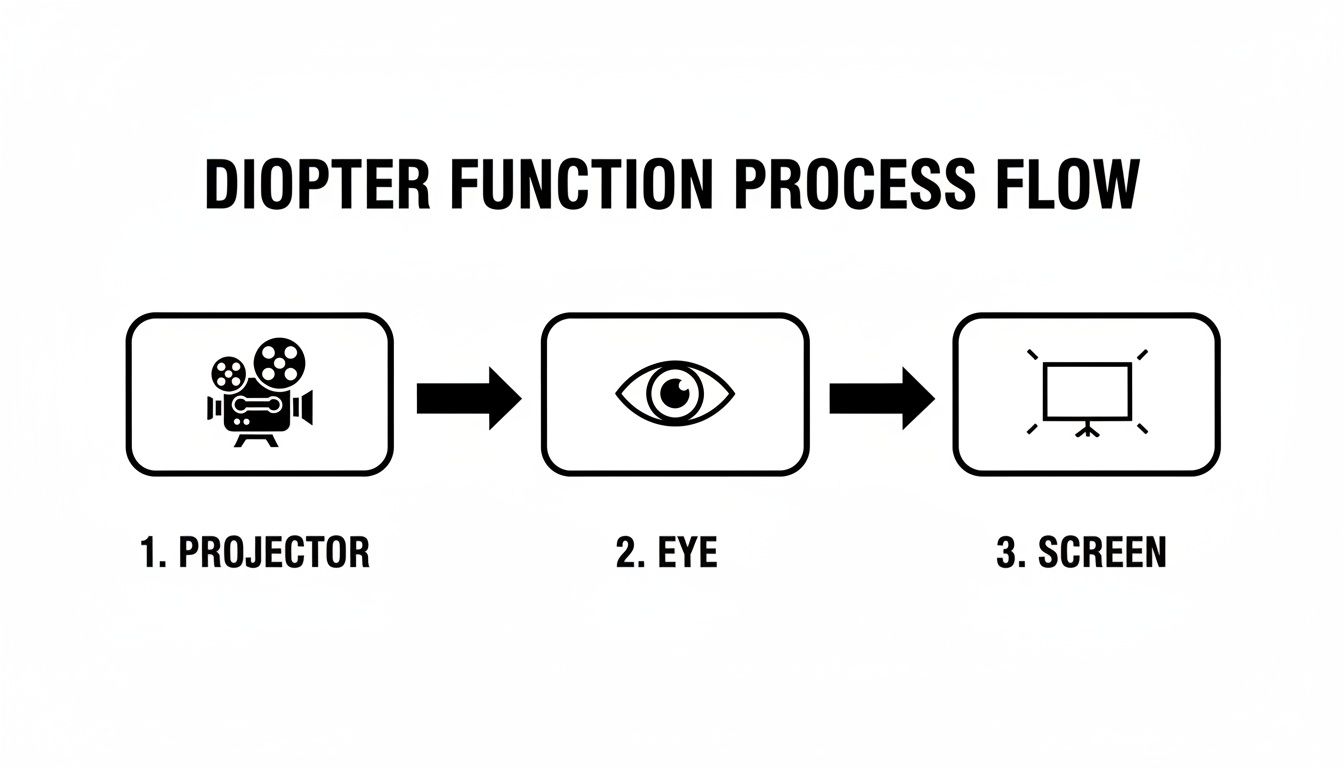
This graphic shows exactly what's happening: the optic's internal display (the projector) is focused by the diopter to match your eye, which creates a flawless image on your retina (the screen).
Final Checks and Best Practices
Once you’ve set the diopter, it’s a "set it and forget it" adjustment. You shouldn't have to touch it again unless your vision changes or someone else uses your gear. A few final tips will lock in the best results:
- Do It When You're Fresh: Your eyes get tired. Set your diopter when they're rested, not after a long day at the range when fatigue can mess with your perception of focus.
- Wear Your Glasses (If You Normally Do): If you always shoot with prescription glasses, set the diopter while wearing them. You want to match your real-world setup.
- Use Quick Glances, Not Long Stares: When you're making the adjustment, avoid staring through the optic. Your eye will try to compensate and "fix" a blurry image. Quick, decisive glances give you the most honest feedback.
Following these steps ensures your optic is truly an extension of your own eye, giving you the clarity and confidence needed for any hunt or tactical scenario.
Why Diopter Is Critical for Night Vision and Thermal Optics
When the sun goes down, your gear has to perform. That's when diopter adjustment goes from a nice-to-have feature to something you absolutely cannot ignore. For night vision and thermal optics, getting that eyepiece dialed in perfectly is non-negotiable for success and safety, whether you're on a late-night hunt or a tactical operation.
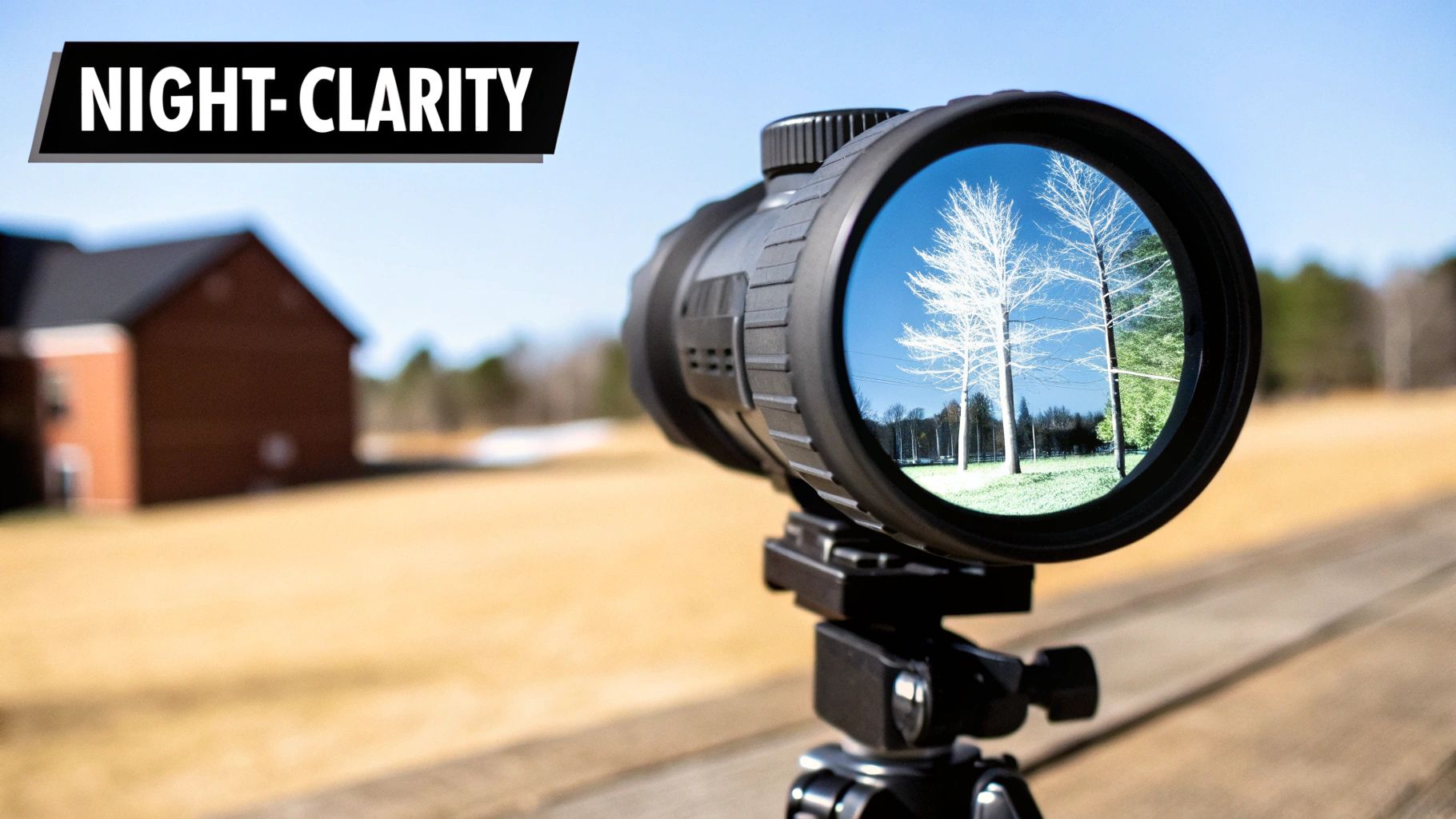
With a night vision device, a tack-sharp diopter setting is what lets you see every last detail the image intensifier tube can pull from the darkness. It means those subtle textures, faint outlines, and even the characteristic grain of the tube itself are crystal clear. This is what helps you spot movement and identify threats when there's virtually no light to work with.
Making Sense of Digital and Analog Displays
This becomes even more crucial with thermal scopes. Since you're looking at a digital screen, a proper diopter setting ensures that your reticle, menus, and rangefinder data are perfectly crisp. When you have to make a split-second decision, you can't afford to second-guess what you're seeing.
An improperly set diopter does more than just blur the image. It's a fast track to eye strain, headaches, and a serious drop in your situational awareness. Over a long night, that fatigue will absolutely degrade your performance.
For those running high-end equipment like a Gen 3 PVS-14, the ability to tune the eyepiece to your specific vision is a massive advantage. Most quality optics offer an adjustment range from about +3 to -4 diopters, which covers the vision needs of roughly 95% of people. Technically speaking, every diopter of adjustment in a standard 28mm eyepiece requires a tiny 0.784 mm of movement internally. You can dig into the nitty-gritty of eyepiece mechanics on SPIE.org.
The Tactical Edge of a Clear Picture
The whole point is to make the optic feel like a natural extension of your own eye. A correctly set diopter dramatically cuts down the time it takes for your eye to refocus when you switch between looking through the device and observing with your naked eye. This helps preserve your natural night vision.
- For Night Vision: It sharpens the subtle details from the image intensifier, helping you pick out a target that would otherwise be lost in the shadows.
- For Thermal Scopes: It guarantees that your digital reticle and on-screen data are razor-sharp, eliminating any chance of misreading your range or aimpoint.
Knowing how these two technologies differ is also a big part of the equation. If you’re still weighing your options, our guide on thermal scopes versus night vision can help you decide. No matter which system you choose, setting the diopter correctly is the first step to unlocking its full potential.
Troubleshooting Common Diopter Problems
Even when you follow the steps perfectly, getting that diopter setting just right can be a bit of a headache. If you're fighting a stubborn blur or can't seem to lock in a sharp reticle, you’ve probably run into one of a few common snags.
The most frequent issue is a reticle that refuses to get sharp. This usually happens because your eye, being the amazing tool that it is, is trying to compensate for the blur by auto-focusing. To beat this, use quick glances instead of staring through the optic. A one- or two-second look is all you need to see if the reticle is sharp. This trick stops your eye from "helping" and gives you a true reading.
Constant Readjustments
Find yourself constantly fiddling with the diopter ring? This is a classic sign of one of two things: either the initial setup was rushed, or the diopter ring itself is loose from wear and tear. Go back to basics—a slow, deliberate setup against a plain, bright background usually solves the first problem. If the ring feels wobbly, it might be time to have a professional take a look.
Another huge question comes from shooters who wear glasses or contacts.
Should you set the diopter with your glasses on or off? Simple: set it up for the way you’ll actually use the optic. If you always shoot with your glasses on, adjust the diopter with them on. If you prefer to shoot without them, set it for your uncorrected vision.
This makes sure the optic is tuned for your real-world use case, not some hypothetical one. When the diopter isn't set correctly for your eye, it can introduce sighting problems that feel a lot like the scope needs to be collimated. You can learn more about that process in our guide explaining what collimation is and why it matters.
Ultimately, a properly set diopter is the foundation for a good shooting experience. It's the key to preventing eye strain and ensuring your aiming point is crisp and reliable the moment you need it.
Answering Your Questions About Diopter
Even after you’ve got the basics down, a few common questions always pop up when you're out in the field. Let's tackle them head-on so you can get this crucial setting dialed in perfectly.
Think of this as the expert Q&A session to clear up any lingering confusion.
Should I Set My Diopter While Wearing Glasses?
Yes, but only if you plan on always using the optic with your glasses on. The whole point is to adjust the scope for how your eye will actually be looking through it. If that means through your prescription lenses, then do the entire setup process with them on.
However, a lot of serious shooters—especially in law enforcement and hunting—deliberately set the diopter for their uncorrected vision. Why? Because glasses can fog, get splattered with rain, or catch a reflection at the worst possible moment. Setting the diopter to your naked eye means you can ditch the glasses and still have a crystal-clear reticle when things get serious. It all comes down to your personal setup and what works for you.
How Often Do I Need to Re-Check My Diopter Setting?
For your personal gear, the diopter is pretty much a "set it and forget it" adjustment. Once you’ve configured it for your eye, it should stay right where you need it.
A quick check once a year is a good habit, just in case your vision has changed slightly. But honestly, unless you start noticing the reticle looks fuzzy or you're getting headaches, your original setting will hold true.
The big exception is shared equipment. If you’re on a team where multiple people might use the same rifle or night vision device, then each operator must set the diopter for their own eye before every single use. No exceptions.
Can a Bad Diopter Setting Mess Up My Zero?
No, the diopter adjustment has absolutely no effect on your rifle’s zero. Your point of impact is controlled by the windage and elevation turrets—they physically shift the reticle inside the scope. The diopter just brings that reticle into focus for your eyeball.
That said, an out-of-focus reticle can absolutely destroy your practical accuracy. When the reticle is blurry, your eye struggles to find its consistent center, which introduces errors that feel a lot like parallax. It won't technically change the rifle's zero, but it will definitely make you miss shots.
At Superior Tactical LLC, we know that clarity is confidence. From night vision to thermal optics, our gear is designed to give you an undeniable edge when it matters most. Equip yourself with the best tactical optics available by visiting us.
