
Weapon mounted laser rangefinder: Precision in Every Shot
At its core, a weapon-mounted laser rangefinder is a compact device that clamps onto your firearm and uses an invisible light beam to measure the exact distance to a target. Think of it less as a complex gadget and more as a high-tech tape measure for your rifle.
This simple tool completely eliminates guesswork, giving hunters and tactical professionals the raw data they need for precise ballistic calculations and first-shot success.
Why Precise Distance Is a Game Changer
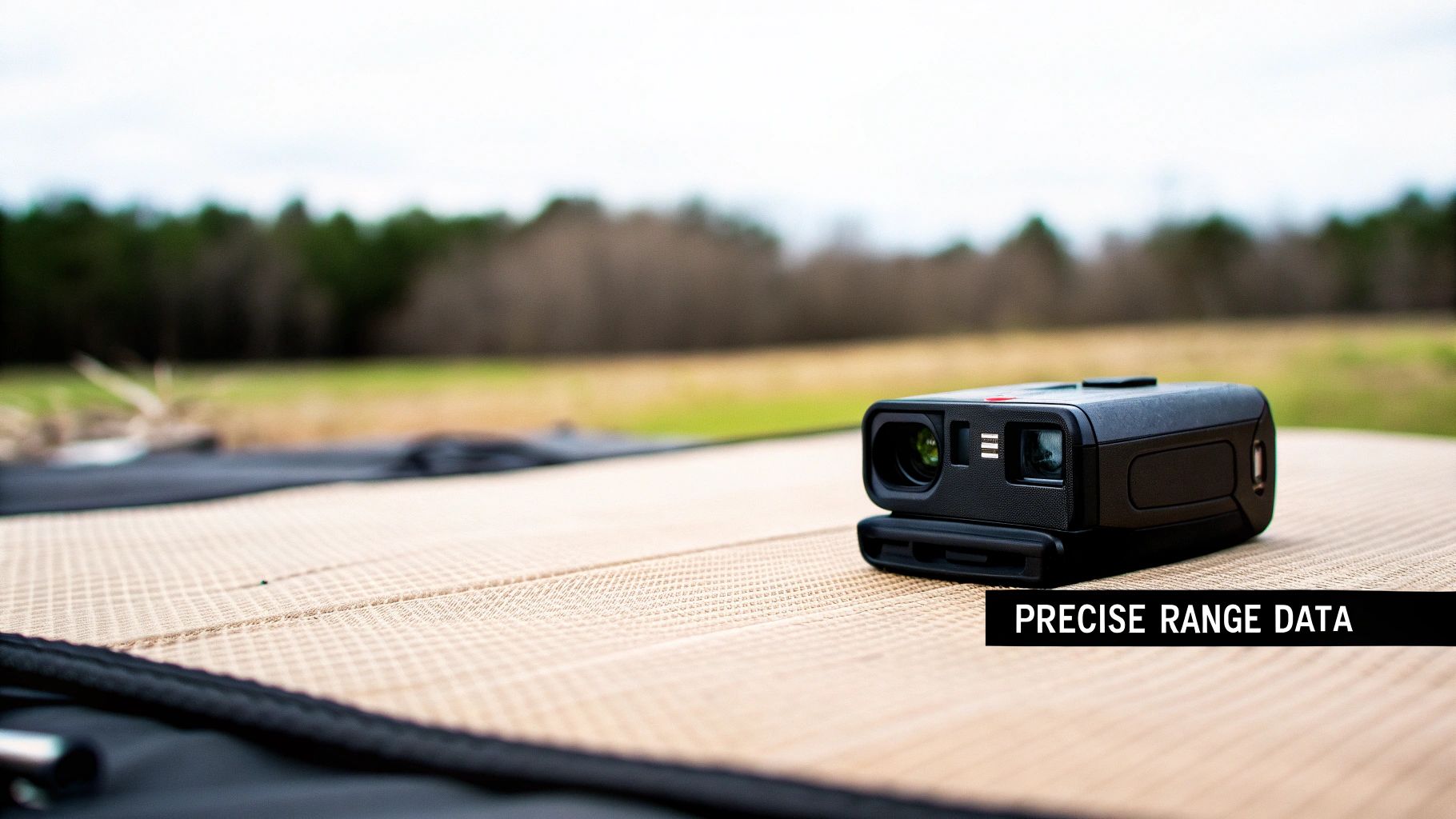
When you're shooting at distance, knowing the exact range to your target is the single most important piece of the puzzle. If you're off by even a few yards, that small error can easily result in a complete miss downrange. A weapon-mounted laser rangefinder solves this by giving you an instant, dead-on accurate distance reading right in your line of sight—all without ever having to break your shooting position.
This capability is a massive advantage no matter who you are. For a hunter stalking game in steep, open country, it's the difference between an ethical harvest and a wounded animal. For a law enforcement sniper, it provides the absolute confidence needed to make a critical shot under immense pressure. The goal is simple: replace doubt with hard data.
The Tactical Advantage in Any Light
The real magic happens when the sun goes down. When you pair a weapon-mounted laser rangefinder with night vision or thermal optics, it becomes an indispensable tool for low-light operations, especially if it's equipped with an infrared (IR) laser.
Because the IR laser is completely invisible to the naked eye, it works perfectly with night vision devices to provide targeting and ranging capabilities in total darkness.
This integration delivers some serious benefits:
- Stealth Operations: You can range targets silently and covertly without giving away your position with a visible beam.
- Enhanced Situational Awareness: It feeds you critical distance information when your vision is already compromised by darkness.
- Improved First-Shot Probability: You get the data needed for an accurate ballistic solution, day or night.
By fusing ranging technology with your primary optic, you create a cohesive system that performs day or night. This setup is the foundation of modern precision shooting, ensuring you have the information needed to act decisively.
There's no overstating the impact these devices have had, especially for professionals. Weapon-mounted laser rangefinders have completely changed the game for precision targeting in military and law enforcement circles where accuracy is non-negotiable. It's no surprise the global military laser rangefinder market was valued at around USD 733.1 million in 2023 and is only expected to grow.
Before we get into the nuts and bolts of how they work, you can get more background by checking out our complete guide to laser aiming modules.
How These Devices Instantly Calculate Distance
Ever shout into a canyon and count the seconds until you hear the echo? The longer the wait, the farther the canyon wall. A laser rangefinder works on that exact same principle, but it uses light instead of sound and measures on a timescale that’s almost impossible to comprehend.
It’s all based on a concept called Time of Flight.
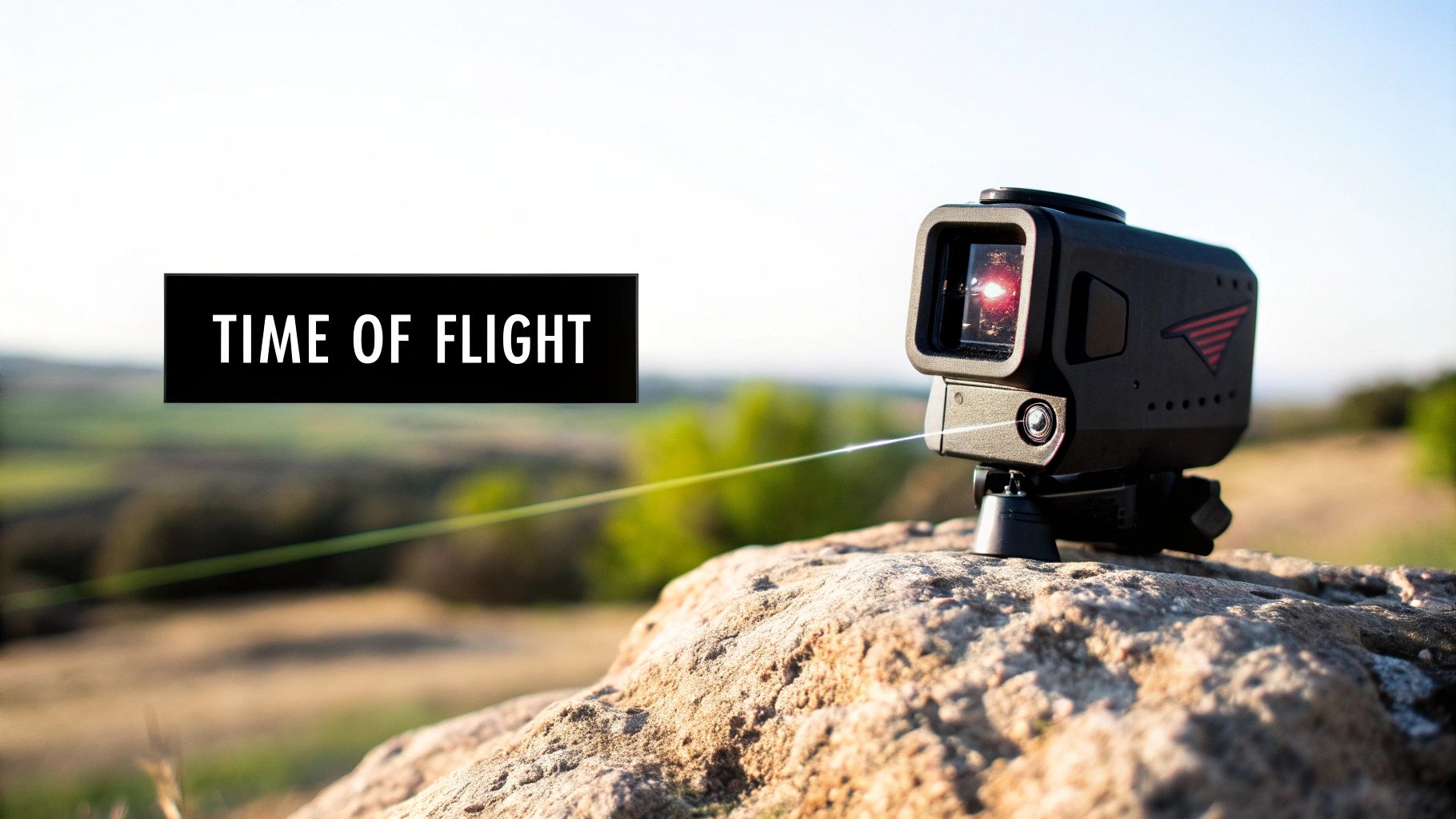
When you press the button, the device fires an invisible pulse of light. This beam travels to your target, bounces off, and returns to a sensor on the unit. Since light travels at a known, constant speed—a blistering 186,282 miles per second—the device can calculate the distance with incredible accuracy just by timing that round trip.
The whole process happens in a literal blink of an eye, giving you the critical data you need to make a perfect shot.
The Step-by-Step Ranging Process
So, what's actually happening inside that little box? Think of it as a microscopic relay race run by light itself.
- The Starting Gun: You hit the button, and the rangefinder's transmitter fires a short, intense pulse of laser light directly at your target.
- Downrange Travel: The laser pulse zips through the air at the speed of light until it impacts whatever you've aimed at—a steel target, a deer, or a distant ridge.
- The Bounce Back: Some of that light energy reflects off the target's surface and scatters, with a portion heading straight back to where it came from. How well it reflects depends on the target's size, angle, and texture.
- The Finish Line: A highly sensitive receiver in the rangefinder catches the returning light. The moment it arrives, an internal clock—which started the instant the laser was fired—stops.
From there, the device does some quick math: it takes the total time, cuts it in half (since the light made a round trip), and multiplies it by the speed of light. The result is a precise distance that flashes on your display.
Understanding Laser Classes and Safety
Not all lasers are created equal, and this is a big deal when it comes to both performance and safety. For weapon-mounted systems, you’ll almost always encounter one of two types.
- Class 1 Lasers: This is the gold standard for civilian use. They are considered "eye-safe" under all normal conditions. The vast majority of rangefinders you can buy for hunting or competition shooting use Class 1 lasers. They have plenty of power to range targets out to hundreds or even thousands of yards, but their energy output is low enough that an accidental, momentary exposure won't harm the human eye.
- Military-Grade Lasers (Class 3B/4): These are the heavy hitters and are restricted to military and law enforcement personnel for a reason. They are significantly more powerful, allowing them to range targets at extreme distances, cut through fog or dust, and even designate targets for guided munitions. This power comes with a serious risk of permanent eye damage, so their use requires strict safety protocols.
For civilian shooters, a Class 1 laser has all the power you need for effective and safe long-range shooting. Don't mistake "eye-safe" for "weak"—it just means it has been intelligently engineered to do its job without being a liability.
The impact of this technology in professional circles is undeniable. Integrating laser rangefinders with precision munitions has boosted military hit rates by 50-60%, enabling sub-meter accuracy beyond 5 km. In 2023, portable weapon-mounted and handheld models were king, making up 55% of sales thanks to their convenience and 99% measurement reliability, even in bad weather. You can dig into more industry data on the military laser rangefinder market on MarketResearchFuture.com.
Decoding Key Features and Specifications
Choosing a weapon-mounted laser rangefinder can feel like you're trying to read a different language. The spec sheets are crammed with numbers and technical jargon, and it's tough to know what actually matters when you're out in the field. Let's cut through the noise and break down what these key features mean for your shooting.
Think of this as a translation guide. We'll turn those abstract numbers into real-world performance, so you can confidently pick the right tool for the job, whether that's a long-range hunt or a high-stakes tactical mission.
Maximum Range: The Whole Story
The first number everyone gravitates to is the maximum range. Seeing a unit rated for 3,000 yards is impressive, but that number almost always comes with a huge asterisk. It's a "best-case scenario" figure, typically measured by bouncing the laser off a big, highly reflective target under perfect weather conditions.
The reality on the ground is a bit more complicated. Performance hinges entirely on what you're trying to range.
- Reflective Targets: This is the easy stuff—steel plates, rock faces, road signs. These surfaces are great at kicking the laser pulse straight back to the sensor, which is how manufacturers get those big, eye-popping range numbers.
- Non-Reflective Targets: Here’s where the rubber meets the road. Targets like deer, trees, or a dirt berm soak up a lot of the laser's energy. This dramatically cuts down the effective ranging distance, often by as much as 30-50%.
So, that 2,000-yard unit might only give you a solid reading on a deer at 1,200 yards. For a hunter, understanding this difference between a steel plate and a real-world target is absolutely critical for making an ethical shot.
Accuracy and Beam Divergence
Once you know how far a unit can reach, you need to know how precise it is. Accuracy is usually listed as something like +/- 1 yard. This means the number you see on the display is guaranteed to be within one yard of the actual distance to your target. For anyone serious about precision shooting, this isn't just a nice feature—it's the bedrock of a trustworthy ballistic solution.
Tied directly to getting an accurate reading is a spec called beam divergence. This simply measures how much the laser beam spreads out as it travels downrange. It's usually measured in milliradians (mrad).
A good analogy for beam divergence is the pattern from a shotgun. A tight choke (low divergence) keeps the shot in a focused, dense pattern. A laser with a tight, low-divergence beam stays on target, making it much easier to isolate a small target from a busy background.
This is huge in practice. A sniper with a low-divergence laser can range a specific window on a building without accidentally getting a reading from the wall next to it. On the other hand, a unit with a wide, sloppy beam might not be able to range a small steel target at 800 yards because the laser "splash" is hitting the ground all around it, confusing the sensor.
Integration with Ballistic Solvers
Today’s best weapon-mounted laser rangefinders are far more than just glorified tape measures. They're the eyes of a sophisticated shooting system. Many top-tier models come with Bluetooth connectivity, letting them talk directly to your other gear.
This integration is a genuine game-changer. It takes what used to be several separate steps and combines them into one fluid motion, from ranging the target to sending the round. A connected rangefinder can sync up with:
- Ballistic Apps on a Smartphone: The rangefinder zaps the distance straight to an app like Applied Ballistics, which instantly crunches the numbers for a perfect holdover.
- Kestrel Weather Meters: You get the distance from the rangefinder and live environmental data—wind, temp, pressure—from a Kestrel. Together, they feed your solver the complete puzzle for a first-round hit.
- "Smart" Scopes: Some of the most advanced optics can take the range data directly from a paired laser and automatically move the reticle to the correct aiming point. It’s about as close to point-and-shoot as long-range shooting gets.
This seamless data flow saves precious seconds and dramatically reduces the chance for human error, especially when you're under pressure.
To help you decide what's most important for your needs, the table below breaks down these essential specs and how they apply to different shooting disciplines.
Essential Weapon Mounted Laser Rangefinder Specifications
| Specification | What It Means | Importance for Hunters | Importance for Tactical Users |
|---|---|---|---|
| Maximum Range | The farthest distance the unit can read on reflective targets. | High: Crucial for long-range hunting, but always evaluate its performance on non-reflective game targets. | Very High: A must-have for extreme long-range engagements and overwatch roles where targets can be at maximum distances. |
| Accuracy (+/- 1 yd) | The margin of error in the distance measurement. | Critical: Non-negotiable. This is the foundation for an ethical shot and a clean harvest. | Critical: The entire firing solution is built on this number. First-shot success in high-stakes situations depends on it. |
| Beam Divergence | How much the laser beam spreads over distance. | Important: A tight beam helps you pick a single animal out of a herd or range game through brush. | Critical: Essential for positive target identification and ranging small, specific targets without ambiguity. |
| Integration | The ability to connect with ballistic calculators or smart scopes. | Helpful: A huge convenience that speeds up the shot process, especially in dynamic hunting scenarios. | Very High: A massive force multiplier that creates a faster, more reliable workflow and reduces cognitive load under stress. |
Ultimately, the "best" rangefinder is the one whose specifications align perfectly with the shots you plan to take. Understanding these core concepts ensures you invest in a tool that won't let you down when it counts.
How to Mount and Zero Your Rangefinder
A weapon-mounted laser rangefinder is only as good as its setup. You can have the most advanced piece of kit on the market, but if it's not mounted solidly and zeroed correctly, it's basically a very expensive paperweight. Getting this part right from the start is non-negotiable—it's the foundation for every accurate shot you'll take.
Think of it this way: your rifle, optic, and rangefinder have to work together as a single, unified system. A wobbly mount or a misaligned laser breaks that system, turning reliable data into a frustrating guessing game. A proper zero ensures the laser is a true extension of your optic, whether that’s a scope, red dot, or a night vision device.
Securing the Foundation: Your Picatinny Rail Mount
Everything starts with a rock-solid connection to your weapon's Picatinny rail. A high-quality mount is absolutely critical for holding zero, which is why most reputable rangefinders come with beefy, integrated mounting systems designed to clamp on and stay put.
The goal here is simple: zero wobble, zero play. When you tighten that mount, it should feel like it’s become a permanent part of the rifle.
Here’s how to get a secure attachment every time:
- Pick Your Spot: Figure out where on the rail the rangefinder makes the most sense. You need to be able to reach the controls easily without it getting in the way of your grip, scope knobs, or charging handle. Forward on the handguard is usually a good bet, but it all comes down to your personal setup.
- Clean the Surfaces: Before you clamp anything down, wipe the rail section and the rangefinder's mount. Get rid of any oil, dirt, or carbon buildup. You want a clean, flush fit for maximum contact.
- Torque It Right: Use a torque wrench and tighten the mounting bolts to the manufacturer's specs. Don't just crank down on it—overtightening can damage the mount or your rail. Too loose, and it'll shift under recoil. Repeatability is everything.
A proper mount ensures that even if you remove the device and reattach it, your zero will remain consistent. This principle, known as "return-to-zero," is a hallmark of high-quality tactical gear. For more details on this, check out our guide on selecting the right Picatinny rail scope mount.
The Zeroing Process: Aligning Your Laser and Optic
Once the rangefinder is locked down tight, it's time to zero the laser. This process, often called "co-witnessing," is all about aligning the laser's aiming point with your primary optic's reticle. When you're finished, the laser dot should land exactly where your crosshairs are aimed at a chosen distance.
Most modern units come with a visible laser (usually green) just for this purpose, which makes the whole process much easier. You can get it done without firing a single shot.
Just follow these steps for a perfect co-witness:
- Get Stable: Lock your firearm into a vise or get it incredibly stable on a bipod and rear bag. The rifle cannot move during this process.
- Choose a Zero Distance: 100 yards is a great all-around choice. It’s far enough to expose any small alignment errors but close enough to see the visible laser clearly.
- Aim Your Optic: Look through your scope or red dot and put the reticle dead center on your 100-yard target.
- Adjust the Laser: Now, turn on the rangefinder's visible laser. You'll see its dot on the target, probably a little off from your reticle. Using the windage and elevation dials on the rangefinder, carefully walk the laser dot until it sits perfectly on top of your optic's crosshairs.
That's it. Your visible laser is now co-witnessed. Because the ranging laser is factory-aligned with the visible one, your rangefinder will now give you the exact distance to whatever your crosshairs are pointed at.
This is what turns your setup into a truly integrated system, allowing you to capitalize on its full potential.
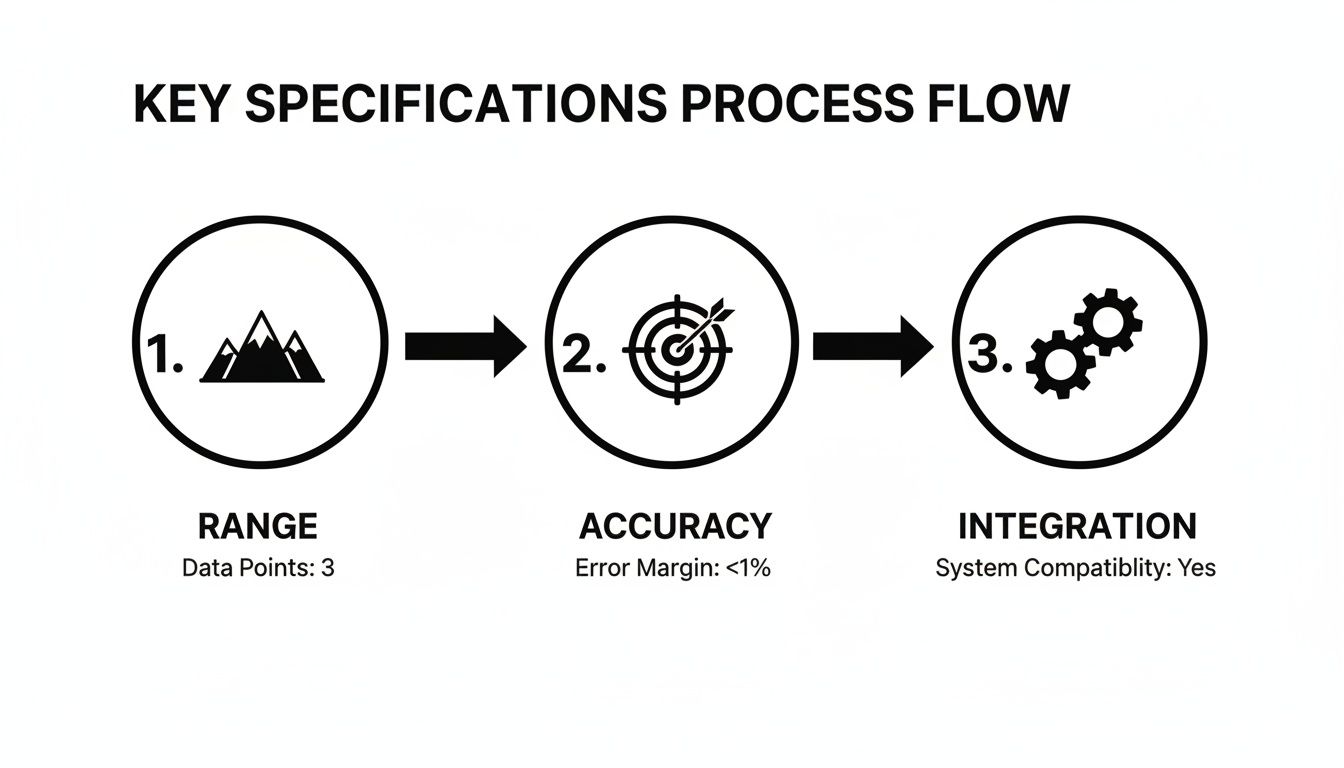
As you can see, hitting maximum range and maintaining accuracy all hinges on that seamless integration, which begins with a perfect mount and zero.
This level of performance has come a long way. The technology's roots go back to early systems like the AN/GVS-5 in the 1960s. By the 1990s, weapon-mounted units like the AN/PEQ-2 were becoming standard issue, capable of ranging targets out to 2,000 meters with 5-meter accuracy. Today, it’s estimated that over 80% of modern infantry rifles in major armies feature integrated rangefinders, which has boosted first-shot hit probabilities from around 30% to over 70% in low-light conditions.
Real-World Applications and Use Cases
A spec sheet can tell you what a weapon-mounted laser rangefinder does, but it can't show you what it means in the field. When a single yard can be the difference between a hit and a miss, this technology proves its worth. These aren't just gadgets for ringing steel at the range; they are critical tools that replace guesswork with hard data under pressure.
Let's move past the theory and look at how this plays out for hunters, law enforcement officers, and security professionals who rely on them when everything is on the line.
The Ethical Long-Range Hunter
Picture this: you're set up on a ridge at dawn, overlooking a vast canyon. You finally spot the bull elk you’ve been tracking for days, but he’s way across the canyon on a steep, angled slope. Your eyes tell you it’s a long shot, but the tricky terrain makes judging the distance a fool's errand.
With a rangefinder on your rifle, you don’t even have to break your shooting position.
- Settle in, get the elk in your crosshairs, and press a button. The display instantly flashes 678 yards.
- More importantly, the built-in sensor calculates the steep downward angle and gives you the true, angle-compensated range to shoot for.
- Your ballistic solver takes that perfect data and gives you the exact holdover.
There's no fumbling for a separate piece of gear, no looking away from the scope. You just have the solid confidence needed to take a clean, ethical shot. This seamless process is the bedrock of responsible long-range hunting. Making sure every piece of your kit is ready is just as crucial. For a full rundown, our detailed hunting gear checklist ensures you don't miss a thing.
In the dynamic world of hunting, speed and efficiency are everything. By building ranging directly into the act of aiming, you can process information and take the shot much faster, giving the animal less time to move and the weather less time to change.
Law Enforcement Overwatch and Tactical Response
Now, let's switch to an urban environment. A police sniper is providing overwatch for a team executing a high-risk warrant. The area is a complex maze of rooftops, windows, and alleys, all at different distances. The officer's job demands absolute precision—there is zero room for error.
A weapon-mounted LRF becomes an essential tool for dominating this complex battlespace. From their final firing position, the officer can quickly and quietly build a "range card" of the entire area.
- Window frame: 112 yards
- Corner of building: 157 yards
- Parked vehicle: 88 yards
- Alley entrance: 135 yards
If a threat suddenly appears, there's no guessing. The officer can instantly range the target, check it against their pre-calculated data, and make an accurate shot if required. This capability removes one of the biggest variables from an incredibly stressful equation.
The use of rangefinders for weapon guidance is set to grow rapidly, especially with advancements in C4ISR (Command, Control, Communications, Computers, Intelligence, Surveillance, and Reconnaissance) technology. In North America, huge defense budgets have pushed this adoption forward. By 2023, the U.S. military had integrated laser rangefinders into over 70% of its precision-guided weapon systems. This integration has reportedly helped cut collateral damage by up to 40% in urban combat situations, as detailed in market trend analyses.
Security and Perimeter Defense
Think about a security team protecting a critical infrastructure site in the dead of night. Their job is to spot a threat from a long way off, well before it becomes a real danger. This is where a rangefinder, paired with thermal or night vision, becomes a game-changer.
An operator in an overwatch tower can scan a dark perimeter with a thermal scope. The moment a heat signature pops up, they can use their co-witnessed IR laser to get an immediate, exact range—all without giving away their position with a visible light.
This lets the team:
- Accurately gauge the threat level based on its distance.
- Communicate with precision to the rest of the team ("Contact, 250 yards, moving left to right.").
- Coordinate a smarter response because they're working with reliable data, not estimates.
In every one of these scenarios, the weapon-mounted laser rangefinder does more than just measure distance. It builds confidence, sharpens situational awareness, and empowers the operator to make faster, better decisions when it counts.
Got Questions? We've Got Answers
Even after you get the hang of how these things work, some real-world questions always pop up. People often wonder about everything from field toughness to legal restrictions, and getting straight answers is crucial before you invest your hard-earned money. This is where we clear up the common "what ifs."
Think of this as the final once-over before you pull the trigger on a purchase. We’re diving into the nitty-gritty details that people often forget to ask, like how long your batteries will really last on a long weekend hunt or if your new gadget can survive a dunk in the creek.
How Long Will My Batteries Last in the Field?
Battery life is a huge deal for any piece of electronic gear, and a weapon-mounted laser rangefinder is no different. The honest answer is, "it depends"—mostly on the model, the batteries you use, and how often you're pinging targets. Most units run on common CR123A or CR2 batteries, which are great because they pack a lot of power and hold a charge for a long time.
As a general benchmark, a single high-quality battery should give you several thousand zaps. A top-tier unit might be rated for 5,000 measurements or more. But if you’re leaning on the "scan mode" that constantly takes readings, you'll chew through a battery much faster, sometimes in just a couple of hours.
Here's a pro tip we live by: for any serious hunt or mission, pop in a fresh lithium battery before you head out and always, always carry at least one spare. Cold weather absolutely kills battery performance, so keeping those spares in a warm inside pocket is a smart move.
Are These Things Actually Waterproof?
The short answer? They'd better be. Any weapon-mounted laser rangefinder worth its salt is built to take a beating from Mother Nature. The key is to look for the IP (Ingress Protection) rating on the spec sheet. It’s a standardized system that tells you exactly how sealed the unit is against dust and water.
Here’s what those numbers mean in the real world:
- IP67: This is a fantastic rating for tactical gear and a very common one. It means the unit is completely sealed against dust and can be dropped in up to a meter of water for 30 minutes without flinching.
- IPX7: This just focuses on water resistance. The "X" is a placeholder for a dust rating, but the "7" means the same thing as above—it's submersible in one meter of water.
- IP68: This is even better. It means the device can handle being submerged deeper and for longer than the IP67 standard, though the exact specs are set by the manufacturer.
Bottom line: If you get a unit with at least an IP67 rating, you can have peace of mind that a surprise downpour or an accidental slip into a stream won't turn your expensive rangefinder into a useless paperweight.
Can a Civilian Legally Own a Military-Grade Laser?
This is a big one for safety and legality, and the answer is a hard no. Lasers are grouped into different classes based on their power output and how dangerous they are to the human eye.
- Class 1 Lasers: These are considered eye-safe under normal conditions. This is the only class you'll find in civilian-legal weapon-mounted laser rangefinders, and they are more than powerful enough for any long-range shooting scenario.
- Class 3R, 3B, and 4 Lasers: These are the high-power lasers used by the military. They are strictly controlled by the FDA and restricted to government and law enforcement use only. They can cause immediate and permanent eye damage, even from a quick, accidental glance.
Be wary of any product marketed to civilians that claims to have "military power." It's either a flat-out lie or it's being sold illegally. Always stick with reputable brands that follow Class 1 safety regulations.
The effectiveness of these tools in professional hands is undeniable. Weapon-mounted units are the standard for ground troops, making up over 60% of the devices deployed on rifles for instant targeting. This adoption skyrocketed after 2001; during operations in Afghanistan and Iraq, U.S. forces saw a 25% reduction in missed engagements when using M4s equipped with rangefinders. You can read more about these military laser rangefinder market trends and their impact.
How Far Can I Really Range a Target?
The "maximum range" printed on the box is a bit like a car's top speed—it was measured under absolutely perfect, best-case-scenario conditions. In the field, your actual performance will be different.
Several things come into play:
- Target Reflectivity: A big, flat, reflective target like a steel plate or a granite rock face will give you a much longer reading than a deer's hide, which is dark and absorbs the laser's energy.
- Weather: Fog, rain, and snow are the enemy. They scatter the laser beam and can slash your effective range dramatically. Even heat mirage on a hot day can mess with the reading.
- Light Conditions: Sometimes, very bright and direct sunlight can "drown out" the faint laser pulse returning to the sensor, making it tough to get a lock.
A good rule of thumb is to expect the effective range on a non-reflective animal to be roughly 50-70% of the advertised max range. So, if a unit is rated for 2,000 yards, you can count on it to reliably range a deer out to 1,000-1,400 yards in clear weather. Knowing this helps you buy a unit with enough oomph for the distances you actually shoot.
At Superior Tactical LLC, we live and breathe this stuff. We focus on professional-grade gear that you can bet your life on. Whether you're looking for a tough-as-nails weapon-mounted laser rangefinder for your next big hunt or outfitting your team for a critical mission, we have the experience and the equipment to make sure you're ready. Check out our hand-picked selection of optics and accessories.
https://superiortac.com
