A Guide to Top Rated Night Vision Gear for Any Mission
When you hear the term "top rated night vision," it’s easy to get lost in brand names and marketing hype. But the real measure of quality isn’t on the housing; it's found in the hard numbers that define what you can actually see in the dark.
To find the best gear, you have to speak the language of optics. Metrics like Generation, Figure of Merit (FOM), and Signal-to-Noise Ratio (SNR) are the true indicators of performance, directly telling you how clear your image will be and how far you'll be able to see.
Decoding the Specs of Top Rated Night Vision
Shopping for high-end night vision can feel like taking a crash course in physics. You're hit with a wall of acronyms and technical jargon. But terms like FOM, SNR, and Generations aren't just for show—they are the core metrics that separate a professional-grade tool from a recreational toy. Getting a handle on them is the single most important step you can take toward a smart investment.
At its heart, analog night vision is all about amplification. The device takes the tiniest amounts of ambient light—from the moon, stars, or even distant city glow—and multiplies it thousands of times to create a usable image. This idea isn't new; it has a rich history going back to the 1930s. A huge leap forward came in 1934, when Dutch scientists developed the first infrared image converter tube, the granddaddy of all modern image intensification. Just a year later, in 1935, the German company AEG kicked off one of the first industrial night vision programs, recognizing its immense strategic value.
The Generations: A Framework for Performance
The first and most common way to classify night vision is by its "Generation," or Gen. Each new generation marks a fundamental leap in the technology inside the image intensifier tube—the heart and soul of the device.
- Gen 1: This is the entry point. It's the most affordable tech, but it needs a fair amount of ambient light (like a bright moon) to give you a decent picture. You'll often notice some image distortion around the edges, a classic "fish-eye" look, along with some visible static or noise.
- Gen 2: A huge improvement over Gen 1. These units provide a much clearer image with less distortion and can perform in lower light conditions. For many users, Gen 2 represents a solid middle ground between cost and capability.
- Gen 3: This is the current gold standard for military, law enforcement, and serious civilian operators. Gen 3 tubes deliver the cleanest, brightest, and most detailed images, working effectively even on dark, overcast nights with minimal starlight. This is where you'll find almost all truly top rated night vision devices.
But just knowing the Generation only gets you halfway there. Two Gen 3 devices can perform worlds apart based on their individual tube specs. That's where we need to dig a little deeper.
SNR and Resolution: The Building Blocks of Clarity
To really understand what you're buying, you have to look at two critical specs: Signal-to-Noise Ratio (SNR) and Resolution, which is measured in line pairs per millimeter (lp/mm).
Think of SNR like the signal strength on an old radio. A high SNR gives you a crisp, clear voice with almost no static. In night vision, a high SNR (think 30 or higher) translates to a clean image with very little "scintillation" or sparkling noise, which is especially important in the darkest conditions.
Resolution (lp/mm) is like the pixel count on a 4K TV. A higher number means the device can resolve finer details at a distance. For example, a tube with 72 lp/mm will let you see sharper edges on a target or more defined textures in the environment than one with 64 lp/mm.
A device with high resolution but a low SNR might show a very detailed but "snowy" or grainy image. On the flip side, a unit with a high SNR but low resolution will produce a super clean, but somewhat blurry, image. Top-rated night vision delivers the best of both worlds.
FOM: The Ultimate Performance Score
This brings us to the king of all specs: Figure of Merit, or FOM. It’s a beautifully simple calculation that gives you a single number to judge a tube's overall performance.
You get it by multiplying the two specs we just discussed: SNR x Resolution (lp/mm) = FOM.
This number has become the industry shorthand for assessing an image intensifier tube's capability. A higher FOM means a better-performing device, period. For context, military and law enforcement contracts often specify minimum FOM requirements, typically falling in the 1800-2200+ range. To go even deeper, you can learn more about the differences between night vision technologies in our detailed guide.
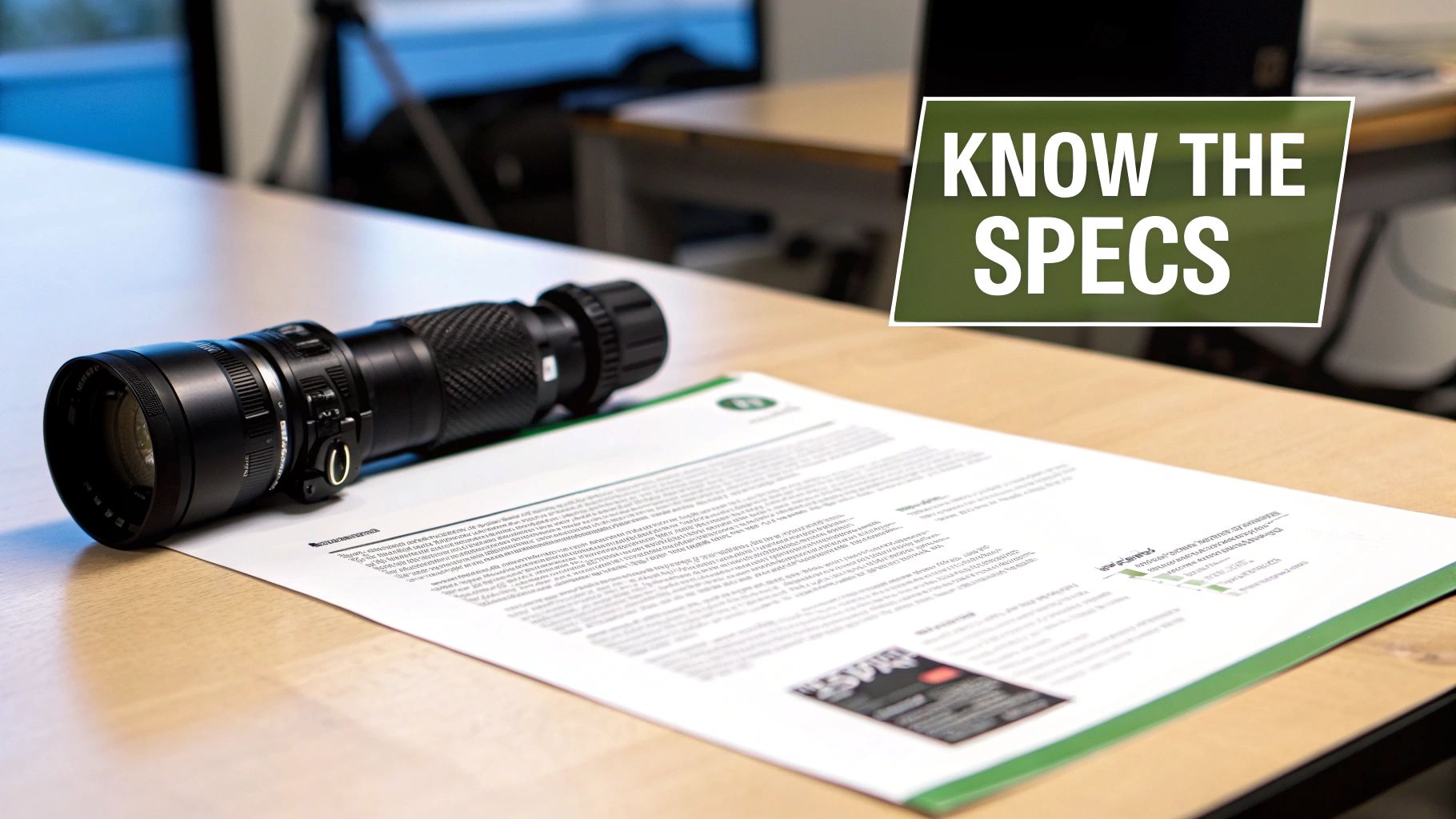
To make this all a bit easier to digest, here's a quick cheat sheet for the key performance metrics.
Key Night Vision Performance Metrics at a Glance
| Metric | What It Measures | Why It Matters (High vs. Low) |
|---|---|---|
| Generation (Gen) | The core technology level of the image intensifier tube. | High (Gen 3): Superior brightness, clarity, and performance in very low light. Low (Gen 1): More affordable but requires more ambient light and has lower image quality. |
| Signal-to-Noise Ratio (SNR) | The ratio of usable image signal to background noise ("static" or "scintillation"). | High: A cleaner, less "snowy" image, especially in near-total darkness. Low: A grainy, static-filled image that makes it hard to see details. |
| Resolution (lp/mm) | The tube's ability to resolve fine details, measured in line pairs per millimeter. | High: A sharper, more detailed image, allowing you to identify targets and objects at greater distances. Low: A blurrier, less-defined image. |
| Figure of Merit (FOM) | The overall performance score, calculated by multiplying SNR by Resolution. | High: A top-tier tube with an excellent balance of clarity and detail. This is the single best number for comparing overall tube quality. Low: A lower-performing tube. |
Understanding these specs is your best defense against buying the wrong gear. Once you know what they mean, you can confidently compare devices and choose the one that truly meets your needs.
Choosing the Right Device: Monoculars, Goggles, and Scopes
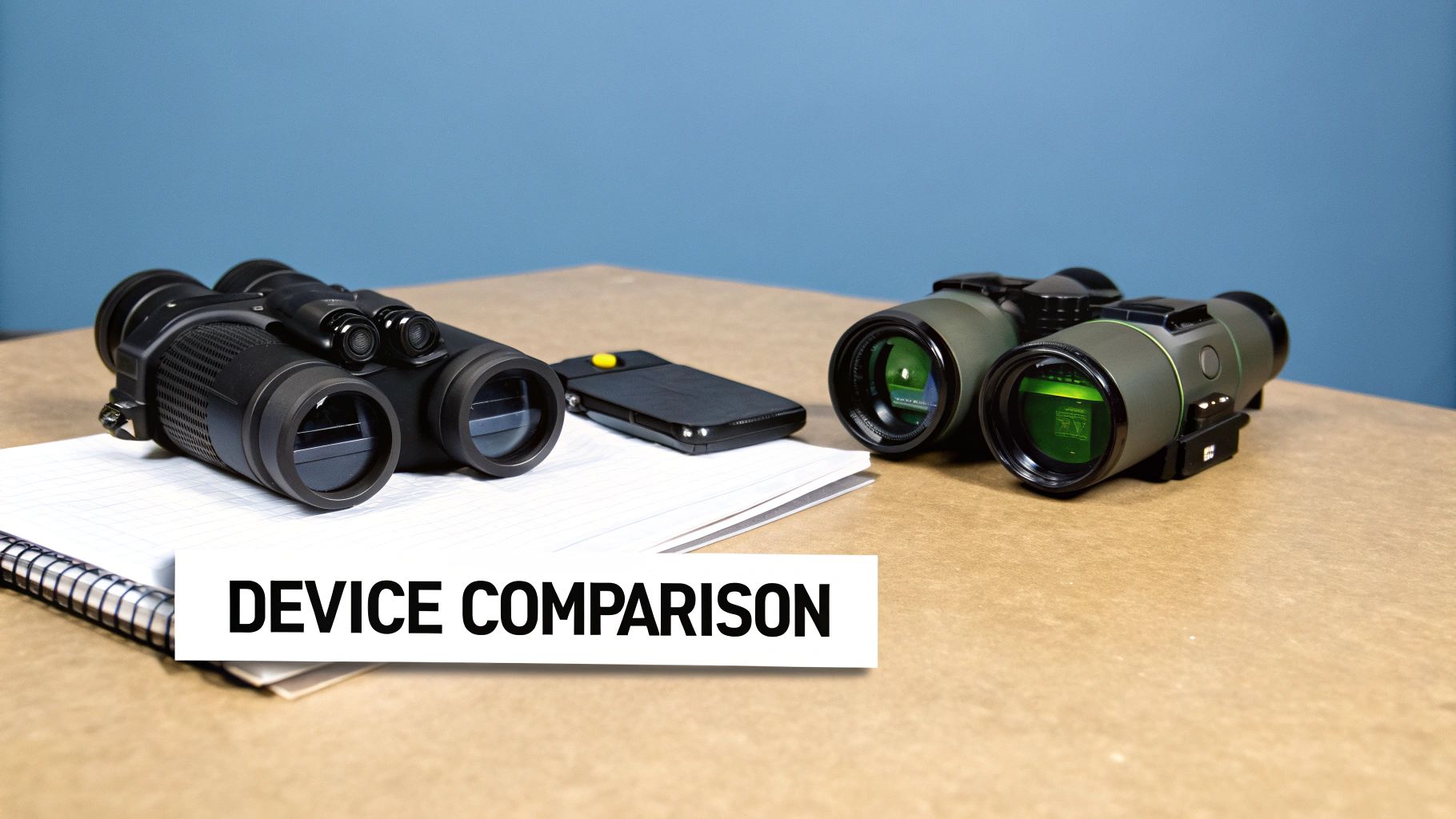
Alright, you've got the tech specs down. Now it’s time to talk about the hardware itself. The form factor of your night vision device—how you actually wear it and look through it—is every bit as important as what's going on inside the intensifier tube. Trust me, the best tube in the world won't do you any good if it's in a housing that fights you every step of the way.
Choosing between monoculars, goggles, and scopes isn't about which one is "best." It’s about matching the right tool to your specific mission. Each design shines in certain situations and makes compromises in others. Let's break it down so you can figure out what’s right for you.
The Monocular: The Versatile Workhorse
A night vision monocular, like the legendary PVS-14, is the quintessential jack-of-all-trades. It's a single-tube unit that gives you an incredible amount of flexibility. You can hold it in your hand to scan an area, mount it on a helmet over one eye, or even stick it behind a red dot sight for some passive aiming.
This single-eye setup is great because it leaves your unaided eye adapted to the ambient light. This is a huge help for situational awareness, especially in places with mixed lighting like urban environments. The biggest trade-off? You get zero depth perception, which can make moving over rough ground or judging distance a real challenge. Still, its light weight and do-it-all nature make it the go-to for countless users.
Best Use Cases for Monoculars:
- Navigation: Perfect for hiking, land nav, or just general observation where you need to keep one eye on your immediate surroundings.
- Rapid Scanning: Nothing beats it for quickly checking a dark field or scanning a perimeter without having to fully kit up.
- Budget-Conscious Users: A single high-quality monocular costs significantly less than a comparable set of dual-tube goggles.
Dual-Tube Goggles: The Gold Standard for Immersion
When you absolutely cannot compromise on performance, dual-tube goggles are the answer. By feeding a clear image to each eye, these systems bring back your brain’s natural binocular vision. This is a complete game-changer for depth perception, which is critical for driving a vehicle, clearing a building, or doing anything that requires you to move quickly and precisely in the dark.
That improved spatial awareness also dramatically cuts down on eye strain and mental fatigue during long nights. Your brain isn't working overtime trying to make sense of a flat image. The main downsides here are pretty obvious: cost and weight. You're basically strapping two complete night vision devices to your head.
For professionals in law enforcement or military roles, the superior situational awareness and depth perception offered by dual tubes are often considered mandatory. The ability to accurately judge distances and navigate obstacles at speed can be a life-saving advantage.
Dedicated and Clip-On Scopes: For Precision at Night
While helmet-mounted systems are all about movement, dedicated night vision scopes are built for one thing: putting rounds on target. These units take the place of your regular daytime scope and are built tough enough to handle recoil. They give you magnified views and specialized reticles designed specifically for nighttime engagements.
A more flexible route is the clip-on night vision device (CNVD). This unit mounts on the rail in front of your daytime scope, instantly converting your familiar setup for night use without losing your zero. This versatility has made clip-ons a favorite among hunters and designated marksmen who need one rifle to do it all, day or night. Want to dive deeper? You can check out our guide on how to choose the right night vision device for your needs.
Advanced Systems: Thermal Fusion and Bridges
Now we’re getting into the really cool stuff. The cutting edge of night vision today is all about fusing image intensification with thermal imaging. Fusion devices actually overlay a thermal heat signature on top of the night vision image. This lets you spot a warm body hiding in the shadows that would be completely invisible to a standard tube, giving you a massive tactical edge.
Another high-end setup is a bridged system. This uses a special mount to pair a standard night vision monocular with a thermal monocular, sending one image to each eye. While it isn't true "fusion," it gives the operator the distinct advantages of both technologies at the same time. These are highly specialized tools for users who demand the absolute peak of detection capability.
Essential Gear: IR Illuminators and Mounts
Even the best night vision device on the market is only half the equation. To truly get your money's worth and unlock its full capability, you need the right supporting gear. Two pieces are absolutely non-negotiable: a quality infrared (IR) illuminator and a rock-solid mounting system. These aren't just accessories; they're force multipliers that take a good setup and make it truly exceptional.
Think of an IR illuminator as a flashlight that's completely invisible to the human eye. Your night vision unit works by amplifying tiny amounts of ambient light, but what happens when there’s no light to amplify? Think deep inside a building with no windows, or on a rural patrol under a moonless, cloud-covered sky. That’s where an IR illuminator comes in, painting the scene with infrared light that your device sees as a bright, clear picture.
This idea isn't new. The earliest night vision systems were "active," meaning they were useless without an illuminator. In fact, U.S. forces in WWII and the Korean War relied entirely on active IR systems. They blasted a target with a beam of near-infrared light, and a scope picked up the reflection. The downside was huge: the enemy could easily spot the IR beam with their own equipment, and the gear was incredibly bulky. The shift to "passive" systems that could operate on ambient light alone was a game-changer during the Vietnam era.
Picking the Right IR Illuminator
Today, many night vision devices come with a small, built-in illuminator. While that's handy for administrative tasks like reading a map up close, it's far too weak for any serious work. For that, you need a dedicated, external illuminator.
- Weapon-Mounted Illuminators: This is the go-to for most shooters. A powerful, weapon-mounted IR beam co-witnesses with your optic, letting you positively identify targets at much greater distances.
- Helmet-Mounted Illuminators: A smaller illuminator on your helmet is perfect for navigation. It lets you see where you're walking without having to point your rifle everywhere you look.
An external IR illuminator is not a "nice-to-have"—it's a must-have for anyone who might find themselves in a true zero-light environment. It’s what separates seeing a shadowy blob from seeing a clear threat.
To really dial in your setup, it pays to understand the finer points of choosing an infrared illuminator for night vision and matching it to your device and mission.
Why Your Mount is Mission-Critical
Just as crucial as what you see is how your gear is connected to you. A cheap, wobbly mount will make even the most expensive night vision optic feel like a frustrating, useless toy. A solid mounting system is the foundation for stability, comfort, and quick, intuitive use.
When it comes to helmet-mounted systems, companies like Unity Tactical have really set the bar. A good helmet mount isn't just a chunk of metal; it’s a piece of precision engineering.
- It must eliminate wobble. Any play or shake in the mount translates directly to an unstable, nauseating image.
- It needs to be adjustable. You have to be able to get the device perfectly aligned with your eye for a clean sight picture.
- It needs smart stowage. The ability to flip the unit up and securely out of the way when not in use is critical for moving between different lighting conditions.
The same logic applies to weapon mounts, which need to be tough enough to hold zero under repeated recoil. Don't skimp here. Investing in a high-quality mount from a reputable brand isn't just a suggestion—it's what ensures your $4,000 optic actually performs like one.
Matching Your Gear to Real-World Missions
Knowing the specs and hardware is one thing, but putting it all together for your specific mission is where the rubber meets the road. A spec sheet won't tell you how a PVS-14 feels on your head after six hours, or which setup is best for scanning a dark, sprawling treeline. This is where theory has to meet practice—building a system that truly works for you out in the field.
Choosing the right top rated night vision isn't about finding the one "best" device. It’s about picking the right tool for the job. The needs of a cop clearing a building are worlds apart from a hunter tracking hogs or a security professional patrolling a massive property. Let's break down how to think about building a system for these very different, real-world scenarios.
This flowchart can help you start sorting through the big-picture decisions, like whether you need something on your helmet or mounted directly on your weapon.
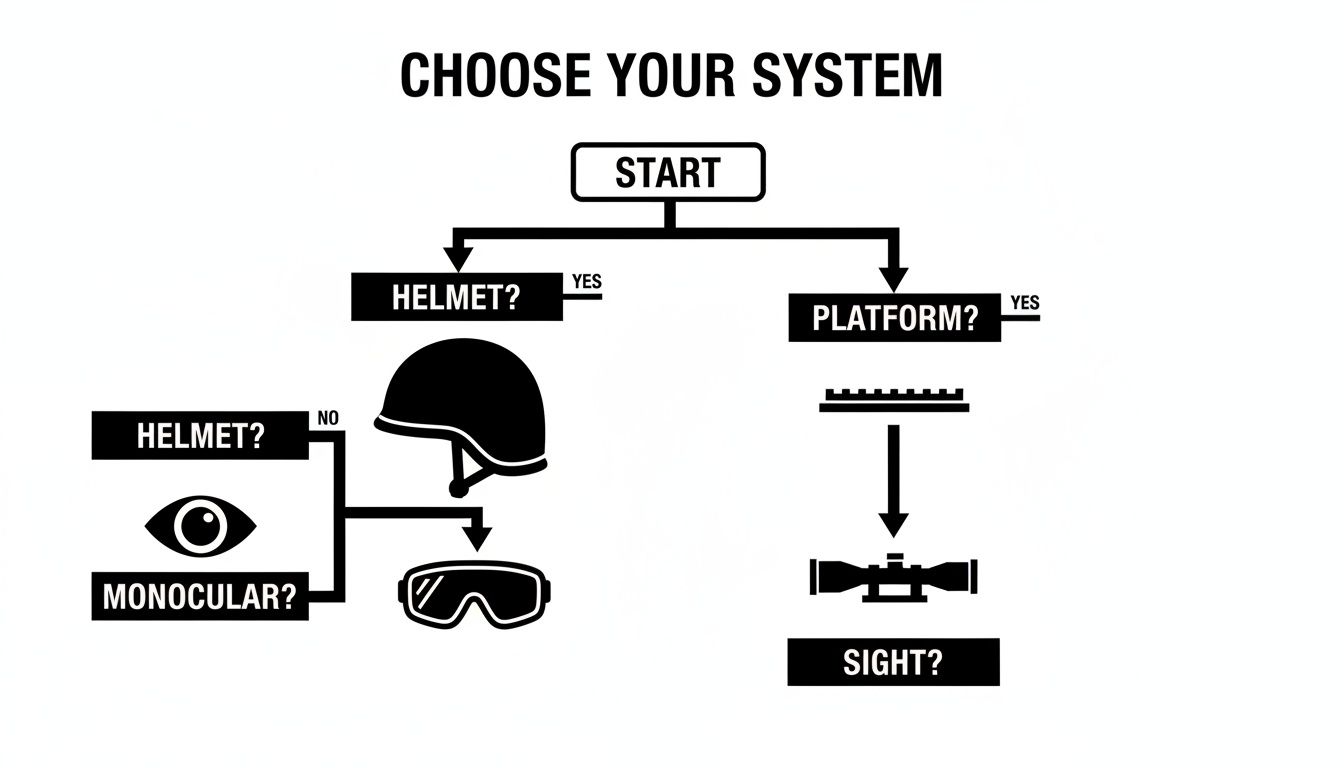
It’s a simple visual guide to point you in the right direction, steering you toward monoculars or goggles for moving around, or dedicated sights if you’re focused on aiming a rifle.
Law Enforcement Urban Operations
For any officer on a SWAT team, situational awareness is everything. Inside a building, being able to judge distances, step over obstacles, and keep your head on a swivel is what keeps you safe. This kind of work demands a high-performance, helmet-mounted solution.
The clear choice here is a set of dual-tube goggles with a high Figure of Merit (FOM), almost always 2000+. That true stereoscopic vision you get from two tubes is absolutely critical for depth perception. It’s what allows an officer to move quickly and confidently through a cluttered room or down a narrow stairwell without fumbling. This is a massive leap from older tech; by the 1980s, Gen 3 tubes could amplify light up to 50,000 times, completely changing the game for these kinds of operations. You can discover more insights about this technological evolution and how it got us to the gear we have today.
A weapon-mounted IR laser/illuminator is the other essential piece of the puzzle. It lets the officer aim passively right through the goggles and can instantly "flood" a dark room with invisible light, wiping out shadows and highlighting any potential threats.
The Modern Hunter Tracking Game
Hunters play a different game. The focus shifts to detection, identification, and carrying your gear for hours on end. You might spend a lot of time scanning fields and woods, followed by moments of total stillness before taking a shot. For that, weight and versatility are king.
A high-quality monocular like a PVS-14 is often the perfect tool for the job. It’s light, which saves your neck on a long trek, and you can quickly pop it off your helmet to use as a handheld scanner. Keeping one eye free also means you can preserve your natural night vision, which is a huge help for checking gear or moving around without the device active.
For hunters, thermal imaging is a game-changer. A thermal monocular or a clip-on unit excels at spotting heat signatures. It can pull an animal out of a cluttered background in a way that even the best I² night vision sometimes struggles with.
A fantastic combination for hunting is a helmet-mounted monocular for walking in and a thermal weapon sight for positive ID and aiming. This dual-system approach really does give you the best of both worlds.
Professional Security and Patrol
Security pros deal with a bit of everything—from watching a huge perimeter fence to doing vehicle patrols and responding to alarms. Their gear has to be adaptable, dead-nuts reliable, and simple to use under pressure.
A rugged Gen 3 monocular is usually the foundation of a great security setup. It's flexible enough to be used on foot patrol, then quickly snapped into a mount behind a red dot sight in a truck for a faster response. For pure surveillance, that same monocular can be put on a tripod for hours of steady observation.
These users also get a huge benefit from a powerful, weapon-mounted IR illuminator. When you’re responsible for a large property, being able to light up and identify something at 150 yards or more is a critical advantage. The whole system needs to be tough enough to handle getting banged around daily in all kinds of weather, so durability is just as important as performance.
Why Where You Buy Matters Just as Much as What You Buy
You've spent hours comparing specs, watching reviews, and finally figuring out the perfect night vision setup. But there's one last, crucial decision to make: where to actually buy it. This isn't like picking up a new scope at a big-box store. Buying top rated night vision is a serious investment in some truly advanced tech, and the support you get after the sale can make all the difference between a great purchase and a very expensive headache.
Going with a specialized, dedicated retailer gives you advantages you just won't find on a massive online marketplace or from a general sporting goods store. You're not just buying a product; you're getting expert guidance and the kind of long-term support that protects your investment. Think of it as starting a relationship with a partner who knows this gear inside and out.
The Real Value of a Rock-Solid Warranty
When you’re dropping serious money on high-end night vision, the warranty is probably the single most important piece of paper that comes with it. Gen 3 image intensifier tubes are the heart of the system—they're incredibly sophisticated, but they're also sensitive. A warranty isn't just a nice little perk; it's your safety net.
This is exactly why we back our Gen 3 systems with a 10-year warranty at Superior Tactical. It's our promise to you. It means that five, seven, or even nine years from now, if something goes wrong with the core of your device, you're not left holding the bag. That kind of protection turns your gear into a reliable, long-term asset, not a potential liability.
Your purchase should be the start of a partnership, not the end of a transaction. A robust warranty and accessible expert support are what turn a high-end product into a truly dependable, long-term capability.
In-House Experts and Real Technical Support
So, what happens when you have a weird issue with your device's performance, or you need a repair? If you bought from a general retailer, get ready for a frustrating maze of automated phone menus and manufacturer hotlines. A dedicated expert like Superior Tactical offers something much better: actual, in-house technical support.
When you call us, you won't get a script-reading call center agent. You’ll be talking to people who actually use this equipment. We can help you troubleshoot a problem on the spot, recommend the exact right mount from a brand like Unity Tactical for your specific setup, or just give you clear advice on proper maintenance. We'll even provide free in-house diagnostics to figure out what's wrong and get you back up and running fast.
A Hand-Picked Selection of Brands You Can Trust
Finally, a good specialized retailer does the legwork for you. We don't believe in overwhelming you with a massive, confusing catalog of unproven gear. Instead, we carefully select and offer equipment only from brands that are known for being reliable and field-tested.
- EOTech: Their holographic sights are legendary for a reason and pair beautifully with night vision.
- Unity Tactical: They're the go-to for smart, ergonomic mounting solutions that just work.
- Nitecore: When you need powerful and dependable illumination, Nitecore is a top choice.
We only stock gear that meets our own high standards. This focused approach saves you the hassle of sifting through junk and ensures that whatever you buy from us is ready for the real world, right out of the box.
Your Top Rated Night Vision Questions Answered
Alright, you've waded through the technical specs, compared different types of devices, and thought about your specific mission. Now it's time to tackle those last few nagging questions that pop up right before you pull the trigger.
Let's clear the air on some of the most common things we get asked. Think of this as the final check before you commit, making sure you're moving forward with total confidence in your choice.
Green Phosphor or White Phosphor: Which Is Better?
This is easily one of the biggest debates in the night vision community, and the honest-to-goodness answer is: it’s all about personal preference and where you’ll be using it. One isn't technically "better" than the other, they just deliver a different visual experience.
Green phosphor is the classic look—the one you see in movies and video games. There's a reason it was the standard for so long: the human eye is exceptionally good at distinguishing between different shades of green, which can make it easier to pick out fine details and textures in the dark. It’s a battle-proven workhorse.
White phosphor is the newer kid on the block. It produces a black-and-white image that many operators find more natural and less straining on the eyes, especially during long nights. The crisp grayscale can provide what feels like better contrast, helping you separate a target from a shadowy background. In snowy or urban environments, it just feels more intuitive to a lot of users.
- Green Phosphor: The classic. Great for detail recognition and a cost-effective, time-tested option.
- White Phosphor: A high-contrast, black-and-white view that many find more comfortable for extended use.
If you ever get the chance, look through both. But honestly, with a high-quality Gen 3 unit, you can't make a wrong choice here. It really comes down to which "flavor" you prefer.
Is It Legal for Civilians to Own Gen 3 Night Vision?
Yes, absolutely. It is 100% legal for any U.S. citizen to purchase, own, and use Gen 3 night vision inside the United States. You don't need a special permit, a federal license, or any kind of background check. This is a huge misconception, probably because this is the same level of gear our military uses.
The one major string attached is export. High-performance night vision is controlled under the International Traffic in Arms Regulations (ITAR).
ITAR strictly forbids you from taking, shipping, or mailing a Gen 3 device (and even some high-end Gen 2+) outside of the U.S. without an export license from the Department of State. These are not easy to get.
So, as long as you're a U.S. citizen and the gear stays on U.S. soil, you are completely in the clear to own the best night vision on the market.
How Do I Properly Maintain My Night Vision Device?
Great question. You’re making a serious investment, and you want it to last. The good news is that taking care of your gear is pretty simple, and a quality Gen 3 tube can run for over 10,000 hours if you treat it right.
The number one rule: protect the tube from bright light. Never, ever turn the unit on in daylight without the protective day cap on. A sudden blast of intense light can permanently damage the tube, leaving a nasty "burn-in" spot that you'll have to look at forever.
Beyond that golden rule, it's just basic good housekeeping:
- Keep the Lenses Clean: Dust and fingerprints on the lenses will ruin your image. Use a proper lens cloth and a little bit of cleaning solution to gently wipe them down. Clear glass means a clear picture.
- Pull the Batteries for Storage: If you're putting the device away for a month or more, take the batteries out. Leaky batteries can create a corrosive mess that will destroy the electronics.
- Store It Safely: When you're not using it, keep your NVD in a padded case. This protects it from getting banged around, dropped, or exposed to moisture.
Follow those simple steps, and your top-rated night vision will be ready to perform for years to come.
When Should I Choose Thermal Imaging Instead?
This is a fantastic question because it cuts right to the core of what these two technologies are for. Night vision and thermal aren't really competitors—they're teammates that are great at different things.
Image intensification (I²), or standard night vision, works by gathering and amplifying tiny amounts of ambient light. It paints a detailed picture, letting you see well enough to navigate rough terrain, identify a person's face, or even read a sign. Its weakness? It can be fooled by good camouflage and is useless in absolute, total darkness (like a sealed room with no light).
Thermal imaging, on the other hand, sees heat. It reads the infrared energy that all objects give off and builds an image from their temperature differences. It is the undisputed king of detection. A person hiding in a bush will glow like a lightbulb against the cool background, no matter how dark it is or how well they're camouflaged. Its weakness is a lack of detail; you see a heat-based shape, not a clear photograph.
So, how do you decide? It's simple:
- Choose night vision when your mission is to identify and navigate.
- Choose thermal when your mission is to detect.
For the pros who need it all, "fusion" systems blend both images together, giving you the detection power of thermal overlaid with the identification detail of night vision. It's truly the best of both worlds.
Choosing the right high-performance optics is more than a transaction; it's about finding a partner you can trust. At Superior Tactical, we provide the expertise, support, and curated gear to ensure your investment serves you well. Explore our collection of mission-ready night vision and thermal gear today.
