Your Complete Guide to the Team Wendy Helmet
When you talk about top-tier protective headgear, the name Team Wendy helmet inevitably comes up. It’s the kind of gear trusted by people whose lives depend on it—military operators, law enforcement officers, and even serious adventurers who push the limits. This isn't just a helmet; it's a meticulously engineered system for safety, comfort, and adaptability, built around the core mission of preventing traumatic brain injuries.
Why Professionals Trust Team Wendy Helmets
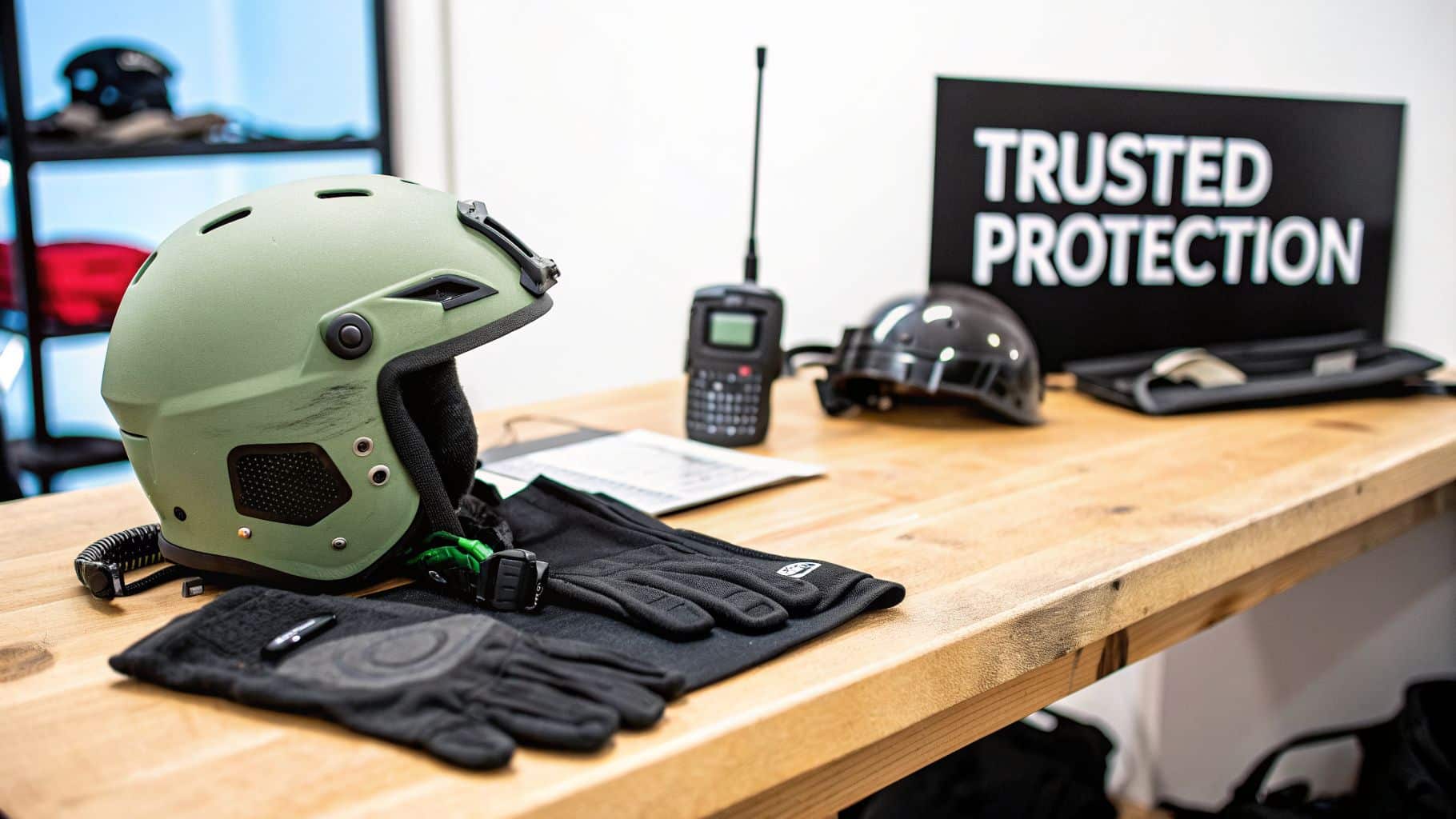
For a professional gearing up, every single piece of kit is there for a reason. It has to be reliable and perform flawlessly when everything is on the line. A Team Wendy helmet is often considered a non-negotiable part of that loadout, and for good reason. The brand’s entire reputation is built on preventing injuries and a constant drive for innovation, born from a commitment to protect users from real-world threats.
This guide will walk you through everything that sets this headgear apart. Whether you need ballistic protection from projectiles or a stable, lightweight platform for your night vision gear, you’ll see exactly why Team Wendy has become the gold standard.
A Legacy of Protection and Innovation
Team Wendy does more than just check the boxes for industry standards—they help write them. Their focus has always been less about just stopping a hit and more about managing the complex forces that lead to serious brain injuries. That dedication shows in every detail, from the advanced materials in the shell to the sophisticated engineering of the liner and retention systems.
This commitment has solidified their place in a rapidly growing market. The global demand for advanced personal protective equipment was valued at $420 million in 2024 and is expected to climb to $735 million by 2033. With North America accounting for over 38% of global revenue thanks to strong defense spending, Team Wendy is a major player. You can get a better sense of this growth by reading these personal protective equipment market findings.
What You Will Learn in This Guide
Choosing the right helmet can feel overwhelming with all the technical jargon out there. This guide is your roadmap to making a smart, informed decision.
Here's what we'll cover:
- Ballistic vs. Bump: We'll break down the critical differences so you know exactly which type of protection you actually need.
- Materials & Ratings: A deep dive into the science behind the shells and what NIJ ratings mean for your personal safety.
- Sizing & Fit: You’ll learn how to measure and adjust your helmet for rock-solid stability and all-day comfort, especially when it's loaded with gear.
- Accessories & Modularity: Discover how to build out your helmet with shrouds, rails, counterweights, and other mission-critical accessories.
By the time you're done, you'll have a solid grasp of the entire Team Wendy helmet lineup and feel confident choosing the perfect model for your needs.
Ballistic Versus Bump Helmets Explained
When you start looking at a Team Wendy helmet, you'll immediately face the most important question: ballistic or bump? Getting this right is the first and most critical step. This isn't about which helmet is "better"—it's about which one is built for the world you operate in.
Think of it like this. A ballistic helmet is a bulletproof vest for your head, designed to stop bullets and shrapnel. A bump helmet, on the other hand, is more like a pro-grade hard hat on steroids. It's made for dynamic environments where you might hit your head, but you aren't expecting to get shot at.
What Is a Ballistic Helmet?
A ballistic helmet is, first and foremost, armor. The shell is a complex piece of engineering made from advanced composite materials, and its entire reason for being is to defeat threats—specifically handgun rounds and fragmentation from explosives. This is the level of protection needed by soldiers on the battlefield and law enforcement officers serving high-risk warrants.
The real secret sauce is in the materials. Team Wendy’s ballistic line, like the EXFIL Ballistic, is built from a hybrid of composites, with Ultra-High-Molecular-Weight Polyethylene (UHMWPE) being a key player.
- UHMWPE: Don't let the name intimidate you. This is a super-polymer that, pound for pound, is significantly stronger than steel. When its fibers are woven into sheets and pressed under incredible heat and pressure, they form a shell that can catch and delaminate an incoming round, spreading its energy out across the surface.
Stopping the bullet is only half the job, though. Once the shell catches the projectile, the helmet's internal liner system has to absorb the leftover energy to prevent a fatal blunt force injury to the skull, even if the round never penetrated.
The real measure of a ballistic helmet isn't just stopping a bullet. It's about managing the kinetic energy so the force transferred to your head stays survivable. A "successful" stop that still causes a severe brain injury is a complete failure.
When to Choose a Bump Helmet
If ballistic helmets are so good at stopping threats, why would anyone ever pick a bump helmet? It all boils down to a constant trade-off in the gear world: weight versus threat level.
A Team Wendy bump helmet, like the EXFIL LTP or Carbon, uses a shell made of much lighter materials like polycarbonate or carbon fiber. These materials are fantastic at protecting your head from the bumps, falls, and falling debris you’d encounter in training, search and rescue, or while fast-roping. They offer impact protection that blows a standard recreational helmet out of the water.
Let's be crystal clear, however: they offer zero ballistic protection. A bump helmet is not designed to stop a bullet or shrapnel, and it won't.
So, what's the upside? A massive reduction in weight. For anyone who spends hours with night vision goggles (NVGs) strapped to their head or runs a full suite of comms gear, every single ounce makes a difference. A lighter helmet means less neck strain and fatigue, which directly translates to better performance and awareness over long missions or training events.
Think about these real-world examples:
- A SWAT officer making a dynamic entry on a high-risk warrant absolutely needs a ballistic helmet.
- A civilian taking a weekend-long night vision course would be much better off with a lightweight bump helmet.
- A backcountry skier or climber who needs head protection and a solid platform for mounting lights and cameras should go for a bump helmet.
Ultimately, you have to be honest about the threats you are likely to face. If gunfire or shrapnel is a real possibility in your line of work, a ballistic helmet is the only responsible option. For every other use case where top-tier impact protection and a stable gear platform are the main goals, a Team Wendy bump helmet is the perfect lightweight solution.
The Science of Advanced Helmet Protection
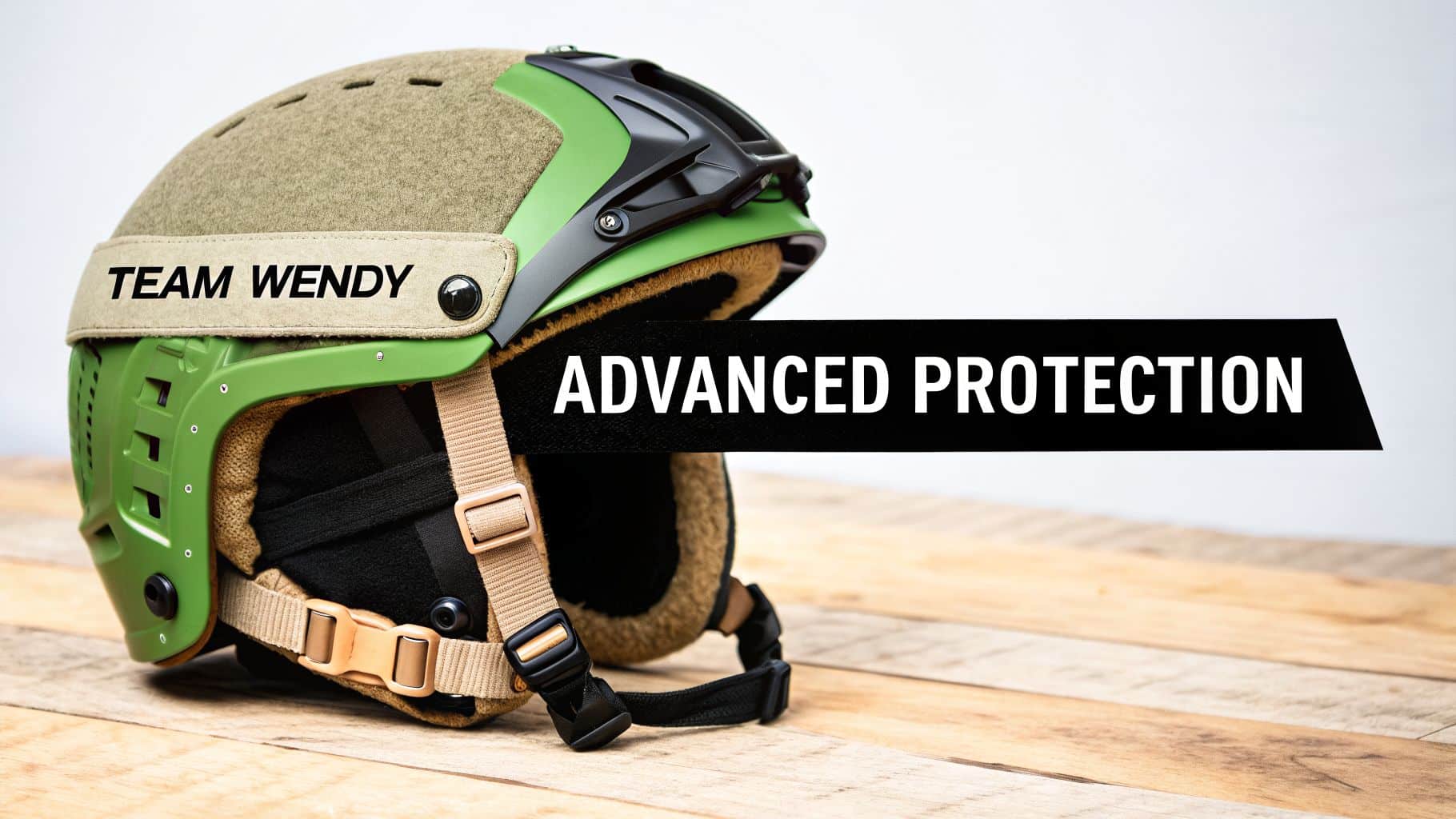
When you pull on a Team Wendy helmet, you're not just wearing a hard hat. You're trusting a sophisticated piece of engineering designed to save your life. To really appreciate what makes these helmets a go-to choice for professionals, it helps to look at the science behind them. It's a system designed not just to stop a threat, but to manage the violent forces that can cause devastating brain injuries.
Most modern ballistic helmets, including the Team Wendy EXFIL lineup, are built to meet NIJ Level IIIA standards. This is the industry benchmark for protection against common handgun rounds up to a .44 Magnum, as well as shrapnel from explosions. For anyone in law enforcement or the military, this rating is the baseline for handling the most probable threats you'll face on the job.
But here’s the thing: stopping a round is only half the battle. What happens in the milliseconds after impact is just as important.
Beyond the Stop with Backface Deformation
Imagine a bullet hitting your helmet. The shell’s job is to absorb and spread that energy, which causes it to flex inward. That temporary dent on the inside is called Backface Deformation (BFD). If that dent is too deep, the helmet itself smashes into your skull with enough force to cause a massive, potentially fatal injury—even though the bullet never got through.
Because of this, the National Institute of Justice has a hard limit for BFD during testing. If the deformation is more than 44mm (about 1.73 inches), the helmet fails. Plain and simple. This single metric is a huge differentiator between a top-tier helmet and one that just barely meets the "ballistic" label.
A ballistic helmet's job isn't finished when the bullet stops. Its most important task is to manage the energy transfer and minimize Backface Deformation to protect the user from a potentially fatal blunt-force impact caused by the helmet itself.
Team Wendy’s hybrid composite shells, which use materials like UHMWPE, are masterpieces of material science. They're engineered to be incredibly rigid to stop the projectile, but also have just enough give to delaminate and spread the force over the widest possible area. It's this delicate balance that keeps that dangerous BFD well within safe limits.
Preventing Brain Injury with Advanced Liner Systems
Ballistic impacts are one thing, but what about the slips, falls, and blasts that happen in the real world? Most of these incidents involve rotational forces—the violent, sudden twisting of the head that is a primary cause of Traumatic Brain Injury (TBI). This is where Team Wendy’s obsessive focus on R&D really shines.
Using a highly advanced test dummy called DREW (Dummy for Rotational Evaluation of Wearables), the company gets a clear picture of how the head and neck react to these dynamic hits. At the 2024 Personal Armour Systems Symposium (PASS), they presented data showing their standard EXFIL Ballistic liner system was worlds better at mitigating these forces than more basic, rigid foam pads. The research proved it reduced both linear and angular acceleration, which are the direct culprits behind TBI. You can dig deeper into Team Wendy is revolutionizing helmet safety standards with this data.
Think of the liner as more than just a comfort pad; it's a suspension system for your brain. It creates a small, controlled gap that allows the helmet shell to move independently from your head during an impact. This "decoupling" is what isolates your skull from the brutal rotational energy. It’s the same principle as the suspension on a trophy truck—the frame and wheels take the beating so the driver inside stays protected.
This is the one-two punch that makes a Team Wendy helmet so effective:
- The advanced shell stops the immediate threat.
- The scientifically-tuned liner system manages the aftermath to protect what matters most.
Choosing Your Perfect Team Wendy Model
Picking the right Team Wendy helmet isn’t about grabbing the most expensive one off the shelf. It’s a mission-driven decision. The brand has built its entire lineup around modularity and specific user needs, splitting their helmets primarily into the EXFIL and EPIC series. Each one is built for a different operator in a different environment.
Think of the EXFIL series as the top-tier, specialized lineup. This is where you find the latest materials and designs for operators who need every ounce of advantage, whether that’s shaving weight for long missions or getting maximum ballistic protection in a high-threat situation. The EPIC series, on the other hand, is a more streamlined, cost-effective option for agencies or individuals who need proven, reliable head protection without all the bells and whistles.
The EXFIL Series: High-Performance Protection
The EXFIL line is Team Wendy’s flagship, representing the very best of their engineering and material science. These helmets are purpose-built to give you a distinct edge through weight savings, ballistic performance, or a perfect blend of both.
Here’s a breakdown of the heavy hitters:
- EXFIL Ballistic SL: The "SL" means SuperLight, and they aren't kidding. This helmet uses an advanced hybrid composite shell to deliver NIJ Level IIIA protection while weighing 15% less than the standard EXFIL Ballistic. For SOF guys or SWAT officers on long call-outs, that weight savings is a game-changer for reducing neck fatigue.
- EXFIL LTP (Lightweight, Tactical, Polymer): This is one of the most popular bump helmets out there for a reason. Its polycarbonate shell gives you excellent impact protection for training, search and rescue, or even just hitting the range. If your main goal is a rock-solid platform for mounting night vision and other accessories without needing ballistic armor, the LTP is an incredible choice. You can get a closer look at the Team Wendy EXFIL LTP 3.0 Bump Helmet on our product page.
- EXFIL Carbon: This model is the perfect middle ground between the polymer LTP and the ballistic versions. The lightweight carbon fiber shell provides a noticeable step up in rigidity and impact protection over the LTP, making it a go-to for guys who run heavier NVGs and need absolute stability from their helmet platform.
Every helmet in the EXFIL series shares that signature high-cut geometry, which is essential for compatibility with modern communications headsets, along with their versatile rail and shroud systems.
The EPIC Series: Practical and Proven
The EPIC series is all about delivering Team Wendy's core protective tech in a rugged, no-nonsense package. These helmets are perfect for large agency purchases or for individuals who just need battle-proven gear that works.
The EPIC Protector is a total workhorse. It was designed to meet the huge demand for a scalable solution that gives reliable impact protection to law enforcement, SAR teams, and first responders. The focus here is on durability and affordability for widespread use.
This no-frills approach makes the EPIC a tough competitor for anyone needing a solid bump helmet without the premium cost of the EXFIL Carbon. It’s built to take a beating day in and day out, giving you a dependable foundation for essential accessories like lights and cameras.
Team Wendy Helmet Model Comparison
To help you see the differences at a glance, we've put together a quick comparison of the most popular models. This table breaks down the key specs that matter most when you're making a decision.
| Model Name | Protection Level | Shell Material | Weight (Size 1, M/L) | Primary Use Case |
|---|---|---|---|---|
| EXFIL Ballistic SL | NIJ Level IIIA | Hybrid Composite | ~2.2 lbs | Special Operations, High-Threat Law Enforcement |
| EXFIL Carbon | Impact Protection | Carbon Fiber | ~1.59 lbs | Mounting Heavy Accessories, Advanced Training |
| EXFIL LTP 3.0 | Impact Protection | Polycarbonate | ~1.59 lbs | General Training, SAR, Night Vision Platform |
| EPIC Protector | Impact Protection | Glass-Reinforced Polymer | ~1.7 lbs | Agency/Department Issue, Rugged General Purpose |
Ultimately, the right helmet comes down to a realistic assessment of your needs. Whether you're facing ballistic threats or just need a stable mount for your gear, this table should point you in the right direction.
Team Wendy is also scaling up to meet this demand. The company is wrapping up a massive expansion in Cleveland, Ohio—a project backed by a $15 million investment that doubled its workforce. By 2026, all production will be consolidated in this new facility, drastically increasing their ability to supply military, law enforcement, and civilian markets. This strategic growth is a key part of the expanding global bulletproof helmet market, ensuring these advanced systems get into the hands of those who need them.
Achieving the Perfect Fit and Stability
A helmet with the best ballistic rating in the world is useless if it doesn't fit right. An improperly sized Team Wendy helmet isn't just uncomfortable; it's a liability. It can wobble at the worst possible moment, throwing off your night vision or, even worse, failing to protect you properly during an impact.
Think of your helmet as the foundation for your entire headborne system. If that foundation is unstable, everything you mount on it—from NODs to comms—is compromised. Getting the fit locked in is just as crucial as the helmet’s protective qualities, ensuring the liner system can absorb impacts and preventing those agonizing "hot spots" that build up over long hours.
Measuring for Your Team Wendy Helmet
First things first, you have to get an accurate measurement of your head. Don't eyeball it or guess based on your hat size. Taking a minute to do this right will save you a world of hurt and hassle down the road.
- Grab a soft measuring tape. A flexible tailor’s tape is perfect for this. If you don't have one, a simple piece of string or a phone charging cable and a ruler will get the job done.
- Wrap it around the widest part of your head. You want the tape to sit about one inch above your eyebrows and ears, circling the largest point on the back of your skull. This ensures the helmet shell can accommodate the full circumference.
- Take the reading. Pull the tape snug, but not tight enough to be uncomfortable. Note the measurement in both inches and centimeters, and check it against Team Wendy’s official sizing chart to find your match (e.g., Size 1 for M/L or Size 2 for XL).
This flowchart is a great tool for zeroing in on the right helmet model based on your operational needs and anticipated threats.
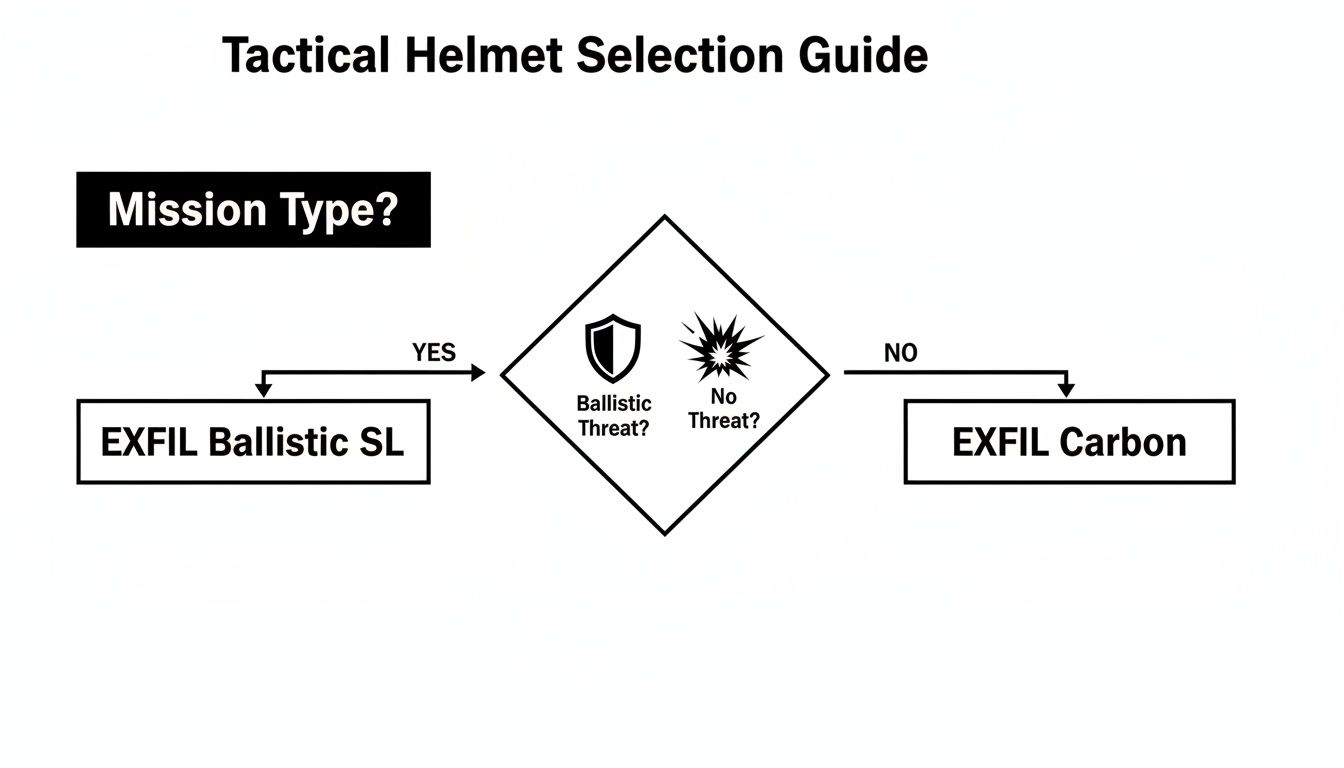
As you can see, if ballistic protection is a concern, you’re looking at something like the EXFIL Ballistic. For high-speed, low-threat environments where impact is the main worry, a bump helmet like the EXFIL Carbon makes more sense.
Customizing Your Fit with Liner Systems
With the correct shell size in hand, the real fine-tuning begins inside the helmet. Team Wendy's liner systems are where you customize the fit for maximum comfort and stability.
- ZAP 7-Pad System: This is a classic, no-nonsense setup. It uses a series of repositionable Zorbium foam pads that you can move around to eliminate pressure points and get a perfectly snug feel. It's simple, reliable, and highly effective.
- EPIC Air Fit Liner: For those who want the next level of custom fit, the EPIC Air system is the answer. It combines the impact protection of Zorbium pads with an integrated air bladder that inflates to conform precisely to the unique contours of your head.
The Genius of the CAM FIT Retention System
The last piece of the stability puzzle is the retention system—the harness that truly locks the helmet in place. The Team Wendy CAM FIT system, which uses the Boa Fit System dial, is a game-changer.
Think of the Boa dial like the lacing on a high-end snowboard boot. You can make tiny, precise adjustments with a simple twist of one hand. It cinches the helmet down for a rock-solid fit that simply does not move. This is absolutely critical for anyone running night vision, where even a millimeter of helmet slop can completely ruin your sight picture.
The CAM FIT system distributes tension evenly across your head, giving you a secure fit without creating painful pressure points. To further dial in your setup for your specific needs, check out our guide to ballistic helmet accessories and see what's possible.
Accessorizing Your Helmet for Mission Success
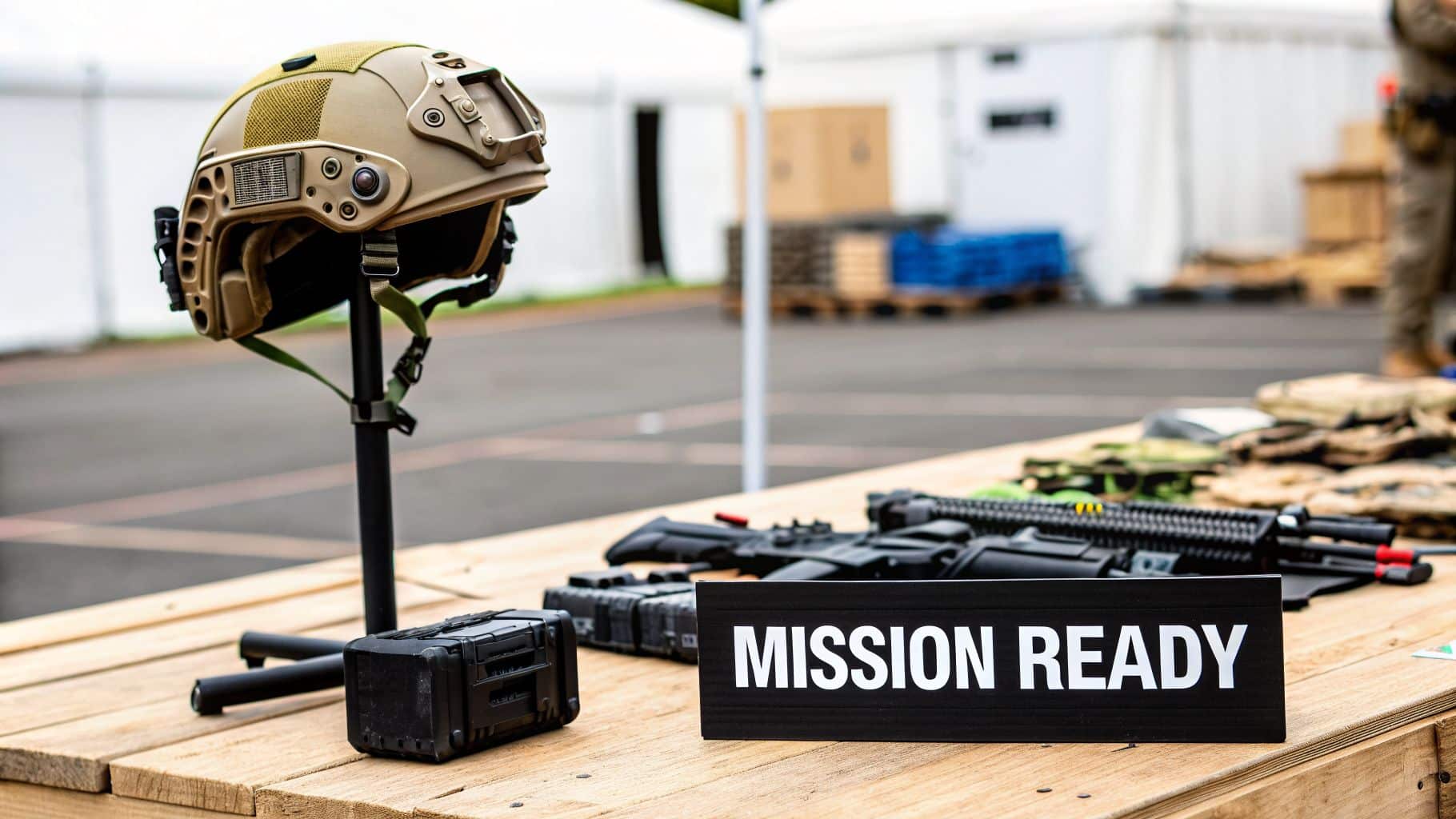
A Team Wendy helmet right out of the box is just the beginning. Think of the shell as the receiver of a rifle; its true potential isn't unlocked until you build out the complete system. The right accessories transform it from simple head protection into a fully integrated platform that enhances your awareness and capability.
It all starts with the built-in mounting hardware. Up front, you'll find a high-performance Wilcox shroud, which is far more than just a bracket. This is engineered to be a rock-solid foundation for your Night Vision Goggles (NVGs), preventing wobble and ensuring a consistent sight picture. It’s designed to accept standard dovetail or bayonet-style mounts, so you can directly attach anything from a PVS-14 to dual-tube systems from top brands like EOTech.
Building Out Your Helmet with Rails
The real customization powerhouse is the EXFIL rail system. These polymer rails running along the helmet's sides are essentially Picatinny rails for your head, opening up a massive world of mission-critical attachments.
Their main job is to give you a secure place to mount gear that would otherwise be awkward or unstable. This is where you’ll add the tools that improve your communication and ability to see in the dark.
- Illumination: Mount a high-output light from a brand like Nitecore for hands-free task lighting or to light up a search area.
- Communications: Use rail adapters to mount your headset, like Peltors, directly to the helmet. This gets rid of the uncomfortable headband and creates a much more stable, integrated setup.
- Video Recording: Attach a camera to capture evidence, training footage, or after-action review content from a true first-person perspective.
These rails adhere to a universal standard, giving you a huge selection of mounts and adapters from companies like Unity Tactical. This means you can piece together the exact loadout your mission demands.
The ability to seamlessly integrate different systems is what makes a modern tactical helmet so powerful. It acts as a central hub, connecting your vision, communication, and lighting into one cohesive unit that moves with you.
Essential Accessories for Peak Performance
Beyond the rails and shroud, a few other key pieces of gear can make a world of difference in comfort and effectiveness, especially during long-duration operations. These accessories solve common headaches that come with running a fully loaded helmet.
First on the list should be a counterweight kit. When you hang a pair of NVGs off the front of your helmet, the forward-leaning weight creates constant neck strain. A counterweight attaches to the rear, perfectly balancing the load. The difference is night and day; it makes the whole system feel lighter and more a part of you.
Helmet covers are another must-have. They do a few things really well:
- They add camouflage, breaking up the helmet's iconic silhouette so you can blend into your surroundings.
- They provide a layer of protection against scuffs, scratches, and dings to the helmet's finish.
- Most come with Velcro panels for attaching IR strobes, patches, and other identifiers.
If you want to add a protective layer or need a new camo pattern, check out the options in our guide to Team Wendy helmet covers.
Finally, you can add visors and mandibles for an extra degree of facial protection against debris or fragments, effectively turning your helmet into a more comprehensive defensive system. By carefully choosing your accessories, you can tailor your Team Wendy for any scenario, making it a true force multiplier.
Frequently Asked Questions About Team Wendy Helmets
Alright, we've gone deep on the different models and the tech behind them. But what about the day-to-day realities of owning and running one of these helmets? Let's tackle some of the most common questions we hear from our customers.
How Do I Properly Maintain My Team Wendy Helmet?
Taking care of your helmet isn't complicated, but it's a critical habit for ensuring it takes care of you. Before you head out, give the shell a quick once-over. You're looking for any deep gouges, cracks, or spots where the layers might be separating (delamination). Also, give the liner pads a squeeze to make sure they're still firm, and check your retention straps and buckles for any fraying or wear.
When it comes to cleaning, keep it simple. A soft cloth with a bit of mild soap and water is all you need. Never use harsh chemical solvents like brake cleaner or acetone. That stuff can eat away at the advanced composites and kill the helmet’s structural integrity without you even realizing it. When you're not using it, store it in a cool, dry place out of direct sunlight to prevent UV degradation.
What Is the Lifespan of a Team Wendy Ballistic Helmet?
This is a big one. While Team Wendy offers a warranty, the actual protective lifespan of a ballistic helmet isn't forever. Most manufacturers, along with military and law enforcement agencies, set a replacement guideline of every 5-10 years. The reason is that the materials, as advanced as they are, can slowly degrade over time from exposure to heat, UV rays, and humidity—even if the helmet just sits on a shelf.
Now, this is crucial: any helmet, whether it's a ballistic or a non-ballistic bump model, that takes a hard knock from being dropped or in an impact needs to be replaced immediately. Even if you don't see any damage. If it takes a ballistic hit, its job is done. Replacement is mandatory and non-negotiable because its protective integrity is gone.
Can I Mount Any Night Vision Device on These Helmets?
The short answer is yes, absolutely. Team Wendy helmets come with integrated shrouds, usually from Wilcox, which are the gold standard for mounting night vision and thermal optics. These shrouds are built to accept the most common NVG mounts out there, like the workhorse Wilcox G24, giving you a rock-solid platform.
This universal compatibility means you can confidently run just about any modern system, including:
- Monoculars like the ubiquitous PVS-14
- Binocular "dual-tube" setups
- Advanced fusion systems that bridge thermal and night vision
As long as your device uses a standard dovetail or bayonet-style mount, you'll be good to go.
Are Team Wendy Helmets Compatible With Hearing Protection?
They're designed from the ground up for it. The high-cut, "shooter's cut" shape you see on models like the EXFIL Ballistic is there for a reason—it creates the perfect amount of space for over-the-ear hearing protection. You won't have your helmet fighting with your comms headset.
This design ensures you can comfortably wear popular systems like Peltors or Sordins. Even better, the EXFIL accessory rails are made to work with adapters that let you mount your headset directly to the helmet. Doing this gets rid of the headband, which makes the whole setup more stable, way more comfortable for long-term wear, and fully integrated.
At Superior Tactical, we know that choosing the right helmet is a serious decision. Our team has the real-world experience to help you select and set up the perfect Team Wendy system for your specific mission.
Explore our full range of tactical gear and night vision optics at Superior Tactical
