2026 Tactical Flashlight Reviews Comparing Top Models
When you're looking for honest tactical flashlight reviews, you quickly realize it's not about finding the single "best" light. It's about finding the right tool for your specific needs. The best tactical flashlight is always a trade-off between raw brightness (lumens), beam intensity (candela), rock-solid durability, and controls you can actually use under pressure. Forget the marketing hype—we’re here to talk about what works in the real world.
The 2026 Tactical Flashlight Showdown
Picking a flashlight used to be simple. Not anymore. True performance isn't just about the biggest lumen number on the box; it's a careful balance of output, throw, toughness, and intuitive design. These in-depth tactical flashlight reviews are built for law enforcement, security pros, and anyone who demands reliability from their gear.
The tactical flashlight market is exploding for a reason. Valued at USD 2.45 billion in 2024, it's expected to hit USD 4.11 billion by 2033. That's not just growth; it's a reflection of how critical these tools have become for both professional duty and personal safety. The technology is advancing at a breakneck pace, and we're seeing huge leaps in what's possible.
Understanding the Contenders
To get started, let's look at the top contenders from trusted names like Nitecore, SureFire, and Streamlight. This table gives you a quick, at-a-glance summary of their core specs so you can see where each light really shines.
Top Tactical Flashlights for 2026 At a Glance
Here’s a high-level breakdown of our top-rated models. Think of this as the starting line for figuring out which light aligns with your primary mission.
| Model | Max Lumens | Max Candela | Primary Use Case | Power Source |
|---|---|---|---|---|
| Nitecore P20iX | 4,000 | 12,200 cd | High-Lumen Situational Awareness | 21700 Rechargeable |
| SureFire G2X Pro | 600 | 8,700 cd | General Duty & Everyday Carry (EDC) | 2x CR123A |
| Streamlight TLR-1 HL | 1,000 | 20,000 cd | Long-Range Weapon-Mounted Identification | 2x CR123A |
| Nitecore SRT7i | 3,000 | 87,500 cd | Search & Rescue, Long-Distance Spotting | 21700 Rechargeable |
| SureFire Stiletto Pro | 1,000 | 1,525 cd | Covert Operations & Administrative Tasks | Integrated Rechargeable |
See how different the numbers are? Each one tells a story about how the light is meant to be used.
Key Insight: Look at the Nitecore P20iX versus the Streamlight TLR-1 HL. The P20iX boasts a massive 4,000 lumens for overwhelming floodlight, but the TLR-1 HL’s 20,000 candela gives it a much more focused beam for identifying threats at a distance. This is the kind of nuance we’ll dig into.
We're going way beyond the spec sheet here. We'll break down how a light feels in your hand, how it mounts to a weapon, and whether you can operate it with gloves on in the dark. For those focused on personal protection, our guide on selecting a tactical flashlight for self-defense is a must-read. The goal is simple: to help you choose a flashlight you can bet your life on.
Breaking Down the Numbers: Lumens, Candela, and What Really Matters
If you’ve ever shopped for a tactical flashlight, you’ve been hit with a wall of technical specs. Lumens, candela, throw, IPX8 ratings… it's easy to get lost in the jargon. Let's cut through the marketing hype and focus on what these numbers actually mean for you out in the field.
The first thing to get straight is the difference between lumens and candela. They’re the two most critical—and most misunderstood—specs on any flashlight. Getting this right is the key to picking a tool that works for you, not against you.
Lumens: The Measure of Raw Brightness
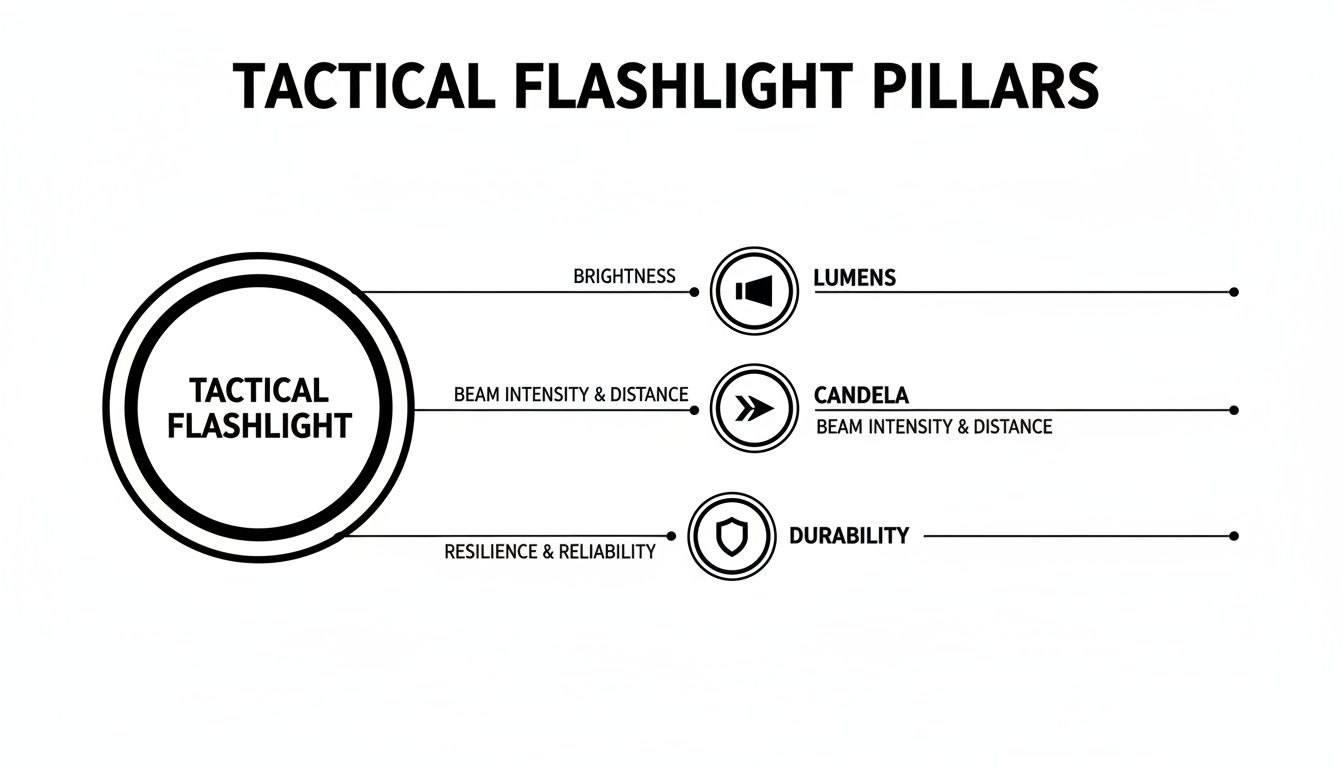
Think of lumens as the total amount of light pouring out of the flashlight. It’s the raw horsepower. A high-lumen light floods an area with a wide, bright wash of light, which is fantastic for total situational awareness up close.
When you're clearing a room or doing a quick search of the immediate area, a powerful flood of 2,000 lumens or more is what you want. It fills the space, eliminates shadows, and ensures you don't miss a thing. The trade-off? That light spreads out and fades fast, so it won’t do you much good at a distance.
Candela: The Secret to Long-Range Throw
This is where candela comes in. Candela measures the beam's intensity—its ability to stay focused and punch through the darkness. In simple terms, candela equals throw. A high-candela rating gives you a tight, piercing beam that’s built for identifying things far away.
Picture this: you're scanning a fence line 150 yards out. A floody, high-lumen beam will just illuminate the grass at your feet. What you really need is a light with 50,000 candela or more to put a concentrated hotspot exactly where you need it, giving you a positive ID on a potential threat from a safe distance.
Here’s a simple way to think about it: A water hose on its widest setting is like high lumens—lots of water covering a big area up close. Crank that nozzle to a tight jet stream, and you've got high candela—all that power is focused to hit a target far away.
These three pillars—brightness, intensity, and sheer toughness—are what separate a real tactical tool from a hardware store flashlight.
Durability Ratings That Actually Count
A flashlight isn't "tactical" if it can't take a beating. We look for standardized ANSI FL1 ratings to get an objective measure of toughness, specifically for impact and water resistance.
Impact Resistance: This tells you the height (in meters) from which a light can be dropped onto a hard surface without failing. A 1-meter rating is the bare minimum. For professional use, you should be looking for something rated for 2 meters or more.
Water Resistance (IP Rating): The IP code is all about how well a light is sealed. Pay close attention to the second number. An IPX7 rating means the light can survive being submerged in 1 meter of water for 30 minutes. An IPX8 rating, however, means it’s built for continuous submersion, usually deeper than 1 meter.
For anyone who works in the rain, near water, or just wants a bomb-proof piece of kit, IPX8 is the only way to go. It’s the peace of mind that a sudden downpour or an accidental drop into a creek won’t leave you in the dark. Even for simpler needs, understanding how output and build quality interact is key; our breakdown of what a 100 lumen flashlight is good for shows how these principles apply at every level.
Head-to-Head Comparison of Leading Tactical Flashlights
Choosing a tactical flashlight is about more than just numbers on a spec sheet. It's about how that tool performs when your hands are cold, you're under stress, and the lights are out. In this section, we’re putting flagship models from Nitecore, SureFire, and Streamlight through their paces, moving beyond marketing claims to deliver real-world tactical flashlight reviews.
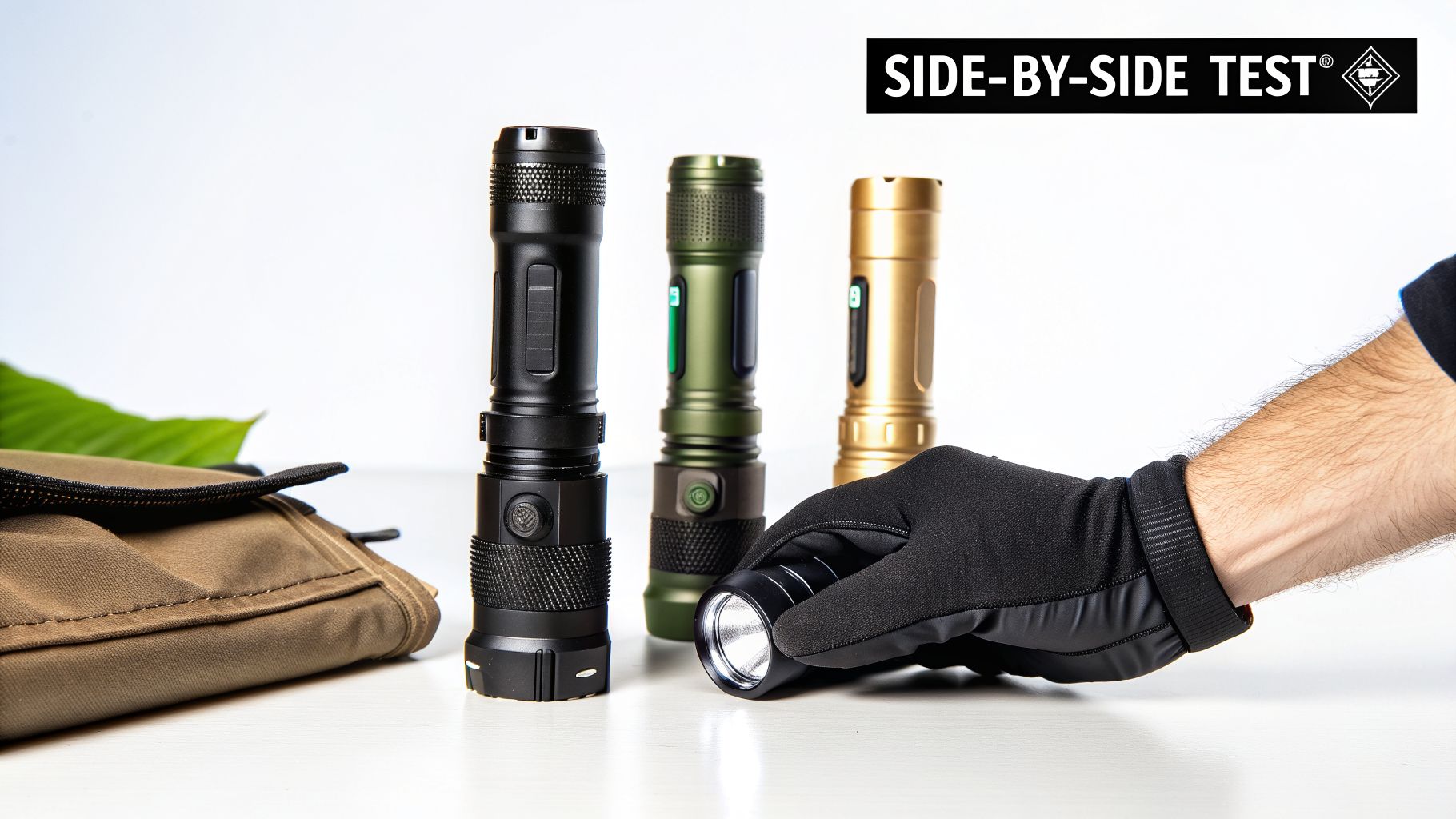
Our goal is to see how they stack up in scenarios you’ll actually face. We’ll be looking at things like ergonomics, the control interface, battery logistics, and sheer toughness. It’s one thing to read about a tail switch; it's another to try and use it with gloves on in the dark.
Ergonomics And Control Accessibility
The most powerful flashlight on earth is worthless if you can't activate it without thinking. This is where the physical design—from the grip texture to the button placement—can make or break a light.
SureFire G2X Pro: This light is a perfect example of elegant simplicity. The single, large, shrouded tail switch is almost impossible to miss, even with heavy gloves. A soft press gets you momentary-on light; a full click locks it on. No side switches, no complicated modes to cycle through—just reliable light. This makes it a fantastic choice for high-stress situations where muscle memory is everything.
Nitecore P20iX: Nitecore goes a different route, packing in more features with a dual-switch tail cap. You get a main tactical switch for momentary and constant-on, plus a smaller "STROBE READY" mode button for instant strobe or to cycle brightness levels. It’s incredibly capable, but using that smaller button requires more dexterity, which can be a real challenge with gloves on.
Streamlight ProTac 2.0: Streamlight gives you the power of choice with its TEN-TAP® programmable system. You can set up the light with one of three programs (like High/Strobe/Low, High-only, or Low/Med/High) to match your mission. Everything is controlled through the tail switch, but it takes a sequence of quick taps to change modes. It's a great feature for those who want to customize their gear, but it requires practice to master.
Key Differentiator: SureFire champions foolproof simplicity, making it a go-to for patrol officers or anyone needing instant, dependable light. Nitecore and Streamlight offer more versatility but add a layer of complexity. They're better suited for users who can pre-configure their tools for a specific job.
Battery Versatility And Field Logistics
A flashlight is dead weight without a reliable power source. The debate between rechargeable and disposable batteries comes down to cost, convenience, and how you plan to use the light.
Nitecore (Rechargeable Focus): Lights like the P20iX and SRT7i are designed around the powerful 21700 rechargeable battery. This gives them amazing output and runtime that older battery types just can't match. The built-in USB-C charging is super convenient for daily use, but it does mean you’re tied to a power source and it introduces a potential point of failure in the field.
SureFire (Disposable Reliability): The G2X Pro is powered by two CR123A batteries. These things are legendary for their 10+ year shelf life and great performance in extreme cold, making them the top choice for an emergency go-bag, vehicle kit, or backup light. While they cost more over time, their rock-solid reliability is hard to argue with.
Streamlight (Dual-Fuel Flexibility): Many of Streamlight's ProTac models offer a "dual-fuel" system. They come with a proprietary SL-B50® rechargeable battery pack that charges via USB-C, but they can also run on standard CR123A cells as a backup. This hybrid design gives you the best of both worlds: cheap, easy charging for everyday carry and a failsafe option when you’re far from an outlet.
Real-World Durability And Construction
All three of these brands build tough, dependable lights, usually from aerospace-grade aluminum with high water-resistance ratings. But when you start using them hard, you notice the subtle differences in their design philosophies.
SureFire's reputation is built on being practically indestructible. Their Nitrolon® polymer bodies, found on models like the G2X, are incredibly tough and surprisingly lightweight. Their aluminum models are legendary for being overbuilt, with thicker walls and reinforced components designed to take a serious beating.
Nitecore and Streamlight also produce exceptionally durable lights, often leading the pack in features like advanced IP68 waterproofing and high impact-resistance ratings. This focus on innovation has fueled the global tactical flashlight market, which hit about USD 1.5 billion in 2025. This growth is a direct result of brighter outputs that can exceed 2,000 lumens and much longer battery life. Brands like SureFire and Streamlight dominate the market by integrating smart features like programmable switches and battle-tested construction. For example, the popular Streamlight ProTac series has over 10,000 reviews averaging 4.8/5 stars for its performance and solid IPX7 waterproof rating. You can discover more insights on the tactical flashlight market's growth and key players.
Situational Performance Breakdown
To help you cut through the noise, this table breaks down how these models perform in specific tactical scenarios. Use it as a quick guide to match the right tool to your needs.
| Model | Weapon Mounting | Handheld Ergonomics (with Gloves) | Control Interface Under Stress | Overall Durability Rating |
|---|---|---|---|---|
| Nitecore P20iX | Limited; Handheld Focus | Good; requires finer motor skills for mode switch | Versatile but complex; best for planned use | Excellent |
| SureFire G2X Pro | Poor; Handheld Only | Excellent; large, easy-to-find switch | Superior; foolproof and instinctive | Exceptional |
| Streamlight TLR-1 HL | Superior; Dedicated Weapon Light | Not Applicable | Good; paddle switch is intuitive on a handgun | Excellent |
Ultimately, the best light for you depends entirely on what you'll be doing. For a dedicated weapon-mounted light, the Streamlight TLR series is a proven industry standard. If you need a simple, tough-as-nails handheld light that will never let you down, the SureFire G2X is tough to beat. And for those who crave maximum power and advanced features in a rechargeable package, Nitecore is a leading contender. Your own tactical flashlight reviews should always start with a clear mission in mind.
Matching The Right Flashlight To Your Mission
Picking the right tactical flashlight isn’t about chasing the highest lumen count. It’s about understanding the mission. The light that’s perfect for a cop on a traffic stop is all wrong for a hunter scanning a ridgeline at dusk. Let's break down what really matters for your specific needs.
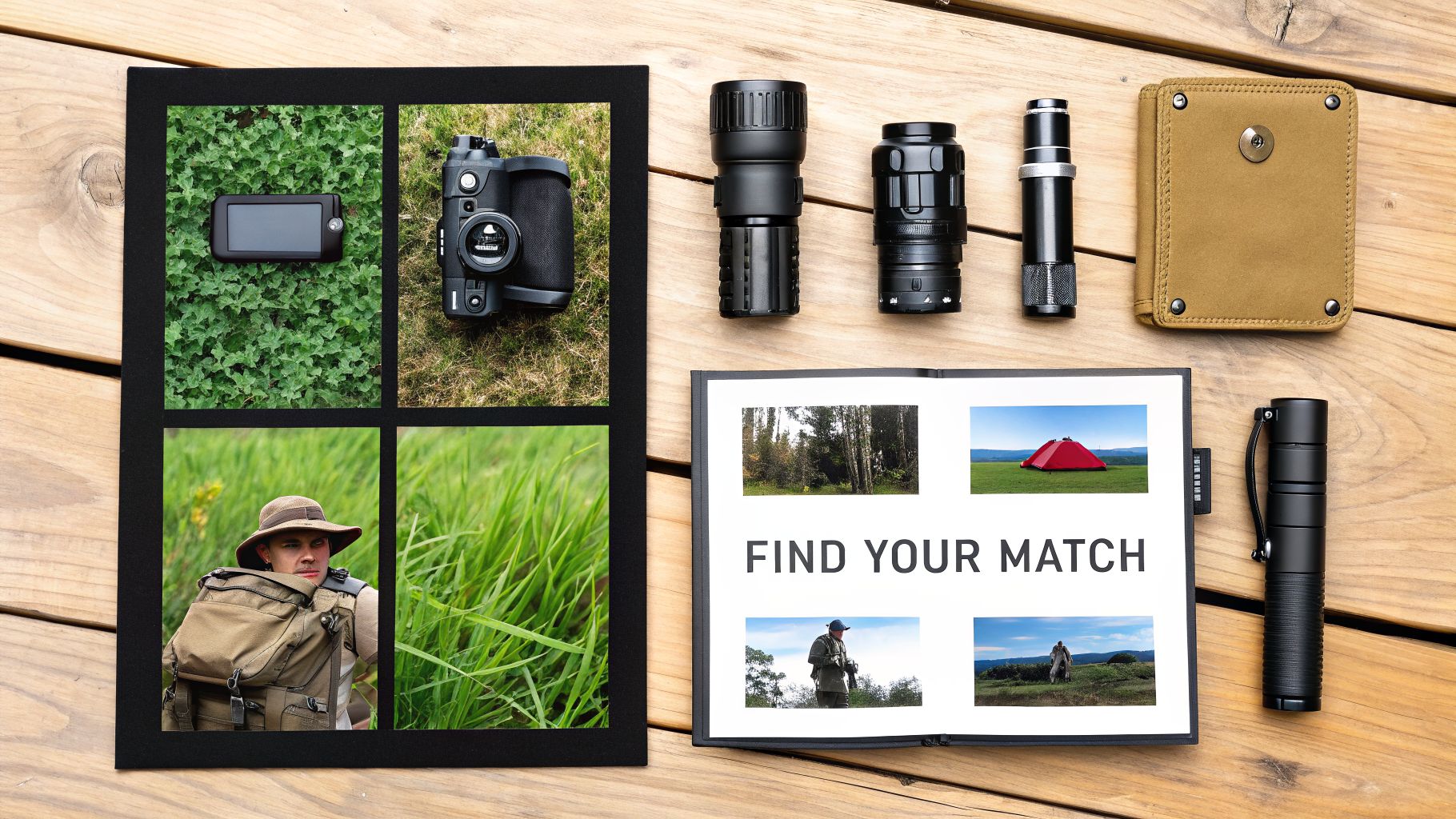
We'll dig into the distinct gear requirements for four groups: law enforcement, hunters, security professionals, and everyday carry (EDC) users. Once you see how certain features solve real-world problems, you can move past the marketing hype and choose a tool you can trust.
For Law Enforcement Officers
For an LEO, a flashlight is often a use-of-force tool first and an illumination device second. When things go sideways, you need instantaneous activation, a powerful disorienting strobe, and absolute reliability. That means simple controls, usually a big tail switch you can mash with gloves on for momentary or constant-on light.
A high-candela beam is non-negotiable for punching through dark alleys or seeing into a car from a safe distance. The light has to be tough enough to survive a fall during a foot chase and carry an IPX8 waterproof rating for those rainy shifts.
It's no surprise that a 2023 survey found 78% of officers now carry a tactical light daily. A bright strobe can disorient a subject in just 2-3 seconds, creating a critical window of opportunity. This professional demand has fueled a market that hit USD 136.64 million in North America in 2024, with a projected 10.2% CAGR through 2031. You can see more on this trend in this in-depth market analysis on tactical flashlight usage.
Top Pick For Law Enforcement: Streamlight Stinger 2020
There's a reason you see Stingers on so many duty belts. The Stinger 2020 is a proven workhorse with a flexible dual-switch design, a potent strobe, and a track record of field reliability. It perfectly balances flood and throw for the unpredictable nature of patrol work.
For Hunters And Outdoorsmen
The needs of a hunter or backcountry hiker are completely different. Here, it’s all about extended runtimes and long-range beam throw. You need to spot game or find a trail marker hundreds of yards away, which calls for a light with extremely high candela and a tightly focused beam.
Versatility in output is also key. A sub-10 lumen "firefly" mode is a lifesaver for reading a map in your tent without blinding yourself, while a full-power turbo mode is there for when you need to search a wide area.
- Runtime over Raw Power: Surviving a whole night on a medium setting is far more valuable than a few minutes of "turbo" brightness that quickly drains the battery.
- Focused Beam Profile: A tight hotspot with minimal side spill is your best friend for long-distance spotting.
- Color Rendering: Many seasoned hunters prefer a neutral or warm white LED. It can make it easier to distinguish between different shades of brown and green, reducing eye fatigue over long periods of scanning.
For Security Professionals
For security contractors walking a perimeter or checking a large warehouse, a flashlight is both a search tool and a deterrent. The primary requirement is a punishingly bright, high-candela beam that can slice through tinted car windows and illuminate the darkest corners of a property.
These lights get used hard, for hours every night, in all kinds of weather. Durability is everything. Many pros also look for a crenelated bezel, which turns the light into a ready impact tool for self-defense if a situation escalates. Simple, rugged controls are always better than fancy modes you'll fumble with under pressure.
Top Pick For Security: Nitecore SRT7i
With a staggering 87,500 candela, the SRT7i's beam is a true spotlight, perfect for inspecting long fence lines or a dark parking garage. Its unique Smart Selector Ring provides incredibly fast and intuitive control over brightness, and the light is built to handle the nightly grind of professional security work.
For Everyday Carry Enthusiasts
The EDC user needs a jack-of-all-trades: a light that is small enough to forget it’s in your pocket but powerful enough for the unexpected. Think finding a dropped key under a car, checking on a strange noise at night, or navigating a sudden power outage.
Here are the hallmarks of a great EDC light:
- Versatile Power: The best options are often dual-fuel, running on both a rechargeable battery for daily use and CR123A cells as a backup.
- Balanced Beam: You want a good mix of spill (for close-up tasks) and throw (for a bit of distance), not just a pure flood or spotlight.
- Reversible Pocket Clip: This small feature is a game-changer, allowing for deep, discreet carry or clipping the light to a hat brim for a makeshift headlamp.
The goal is a dependable tool that's a massive upgrade from your phone's LED. A light in the 500-1000 lumen range usually hits the sweet spot between compact size and serious performance for daily preparedness.
Maintaining Your Flashlight For Peak Performance
A top-tier tactical flashlight is an investment in your safety and effectiveness. And just like any other tool you stake your life on, it needs regular upkeep to perform when the chips are down. Letting basic maintenance slide is the surest way to turn a reliable light into an expensive paperweight. The good news is, it's easy to do.
It all starts with the batteries. Whether your light runs on rechargeable 18650s or disposable CR123As, a healthy power source is everything. Try not to let your rechargeable cells drain completely, as that can permanently reduce their capacity. If a light is going into storage for a while, always take the batteries out. This prevents a slow, parasitic drain and, more importantly, protects the light from a catastrophic battery leak that can corrode and ruin the internals.
Cleaning And Lubrication Essentials
The most common failure points on any hard-use flashlight are the threads and the rubber O-rings that keep water out. These spots are magnets for dirt, pocket lint, and grit, which can cause flickering, inconsistent output, or prevent the light from turning on at all.
Clean the Threads: Every so often, unscrew the tail cap and head. Take a clean cloth or a Q-tip with a bit of isopropyl alcohol and wipe down the threads. You’ll be shocked at the amount of black gunk that comes off, even on a light that looks clean.
Inspect and Lube the O-Rings: Those little rubber rings are what guarantee your light’s water resistance. Give them a quick look for any cracks or signs of drying out. A tiny dab of pure silicone grease will keep them supple and maintain a perfect seal. Never, ever use a petroleum-based product like Vaseline—it will make the rubber swell, degrade, and fail.
Troubleshooting Common Flashlight Issues
Even a perfectly maintained light can act up. Before you start a warranty claim, run through this quick diagnostic checklist.
Problem: The light is flickering, or it's completely dead.
- Check the Power: Is the battery fresh or fully charged? Did you put it in the right way? It happens.
- Tighten It Down: Make sure the head and tail cap are screwed on firmly. A loose connection is the number one cause of flickering.
- Clean the Contacts: Use another Q-tip and some alcohol to scrub the battery contact points inside the light. A clean connection is a reliable connection.
Pro Tip: A flickering light is almost always an electrical connection problem. Following these three steps—checking the battery, tightening the caps, and cleaning the contacts—will fix the issue 90% of the time.
Understanding the right power source for your specific light is also a huge part of reliability. For a deeper look at this, you can learn more about specialized batteries for SureFire flashlights and other high-performance models by reading our comprehensive guide on the topic.
The Value Of A Good Warranty
Finally, don’t forget about the manufacturer’s warranty. Reputable companies stand behind their gear. If you’ve done all the basic maintenance and troubleshooting and the light still won’t work right, reach out to their support team. Buying from a brand with a rock-solid reputation for service adds another layer of security, ensuring your light stays mission-ready for years.
Common Questions About Tactical Flashlights
When you start digging into tactical flashlights, the same questions always surface. Getting straight answers is the first step toward picking a light that won’t fail you when the stakes are high. Let's tackle the most common concerns I hear from guys on the job.
How Many Lumens Do I Really Need?
The right lumen count all comes down to your primary use case. For everyday tasks, checking a dark room, or general work up close, a range of 500–1000 lumens is the sweet spot. You get plenty of usable light without blinding yourself off a white wall or dealing with massive heat and battery drain.
But if you’re law enforcement, a security contractor, or anyone needing to put light on a potential threat from a distance, 1500+ lumens is where you should be looking. Just remember, lumens are only half the equation. That raw power needs to be paired with high candela to punch a focused beam out to where it matters.
Are Rechargeable Flashlights Better Than CR123A Models?
This is a classic "it depends" situation, but each power source has a clear advantage. Rechargeable models, typically running on 18650 or 21700 batteries, are hands-down the most cost-effective and convenient for daily use. You just top it off via USB-C at the end of your shift, and you're good to go.
On the other hand, non-rechargeable CR123A batteries are the undisputed kings of long-term readiness. With a shelf life that can stretch past 10 years and rock-solid performance in freezing temperatures, they are the only choice for a go-bag, vehicle kit, or backup light that has to work after sitting for months.
The Bottom Line: For a daily driver, go rechargeable. For a "just in case" light that you're staking your life on, nothing beats the set-it-and-forget-it reliability of CR123As. Dual-fuel models that take both give you the best of both worlds.
What Makes A Flashlight "Tactical"?
"Tactical" isn't just a marketing buzzword; it's a promise of durability and function under stress. A true tactical light has a few non-negotiable features:
- Rugged Construction: It has to be built to take a beating, usually from aerospace-grade aluminum with at least an IPX8 waterproof rating.
- Intuitive Controls: A tail-cap switch is a must. You need instant, momentary-on activation without fumbling for a side button in a high-stress situation.
- Defensive Features: Most will have a crenelated bezel (the "crown" around the lens) that can be used as a striking tool in a worst-case scenario.
At Superior Tactical, we only stock lights that meet these demanding, real-world standards. Check out our hand-picked selection of high-performance tactical flashlights and find the right tool for your mission.
