Elite 2026 Guide: tactical flashlight for self defense You Can Trust
Imagine a tool you can carry almost anywhere, one that draws zero unwanted attention but can instantly turn the tables on a potential threat. That’s the reality of using a tactical flashlight for self defense. It’s a discreet but incredibly powerful device that gives you a critical edge in any low-light situation.
Why a Flashlight Is Your Most Versatile Self Defense Tool
Think of a modern tactical flashlight as your personal guardian. It's unassuming, hiding in plain sight in your pocket, purse, or on your belt. But unlike other self-defense tools with a single, obvious purpose, a good flashlight gives you layers of protection. It’s not just about lighting up a dark path; it’s about controlling the darkness and using it to your advantage.
This is exactly why these tools, once found only on the belts of police officers and soldiers, have become a go-to for anyone serious about their personal safety. They give you options when you might otherwise have none.
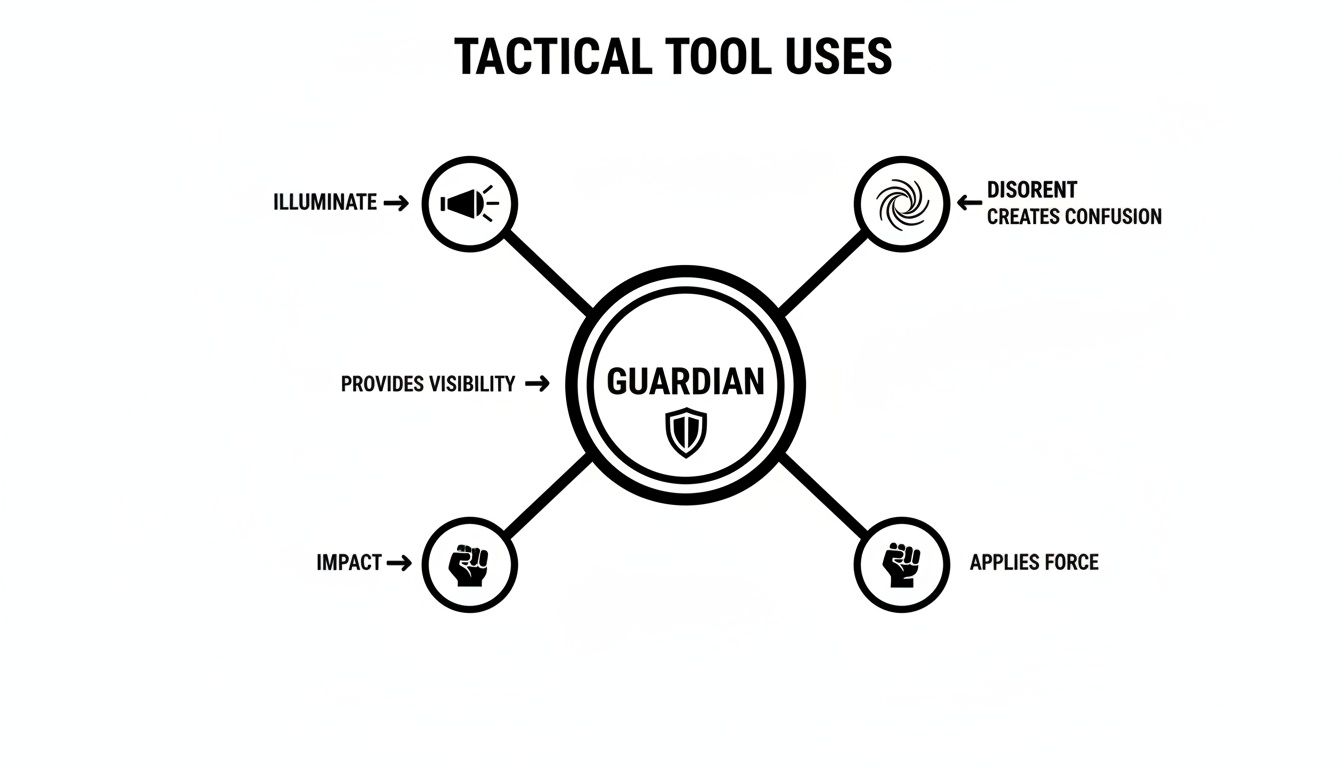
A Three-Tiered Defensive System
The real genius of a tactical flashlight is how it works on three distinct levels. Each one builds on the last, giving you a flexible, scalable response to whatever you might face.
Illumination to Identify and Deter: First and foremost, a powerful beam of light lets you own the environment. You can instantly see what’s ahead, identify potential threats from a safe distance, and figure out someone's intent. Often, just the act of lighting someone up shows you're aware and prepared, which is enough to make them think twice.
Disorientation to Create an Escape Window: If a threat keeps advancing, a blast of high-lumen light directly into their eyes causes instant, temporary blindness. This overwhelming brightness shocks their senses and completely disrupts their ability to see or focus. That gives you a precious few seconds to move, get to safety, or create more distance.
Impact to Defend as a Last Resort: Built from rugged materials like aircraft-grade aluminum and often topped with a crenellated strike bezel, a tactical flashlight is a formidable impact tool. If a physical confrontation is unavoidable, it can be used to strike vulnerable points and help you break free from an attacker's grasp.
A tactical flashlight is the only tool that can de-escalate a situation from 100 yards away with a beam of light, or function as a contact weapon up close. Its versatility is its greatest strength.
It all boils down to a layered defense. You start by using light to see and be seen, hoping to avoid a confrontation entirely. If that doesn't work, you use the intense beam to disorient and disrupt their attack. And finally, if you're forced into a physical encounter, the light's solid construction becomes your last line of defense. This practical progression is what makes the tactical flashlight for self defense such an effective tool for navigating the world safely.
Decoding the Specs That Matter in a Crisis
When you find yourself in a high-stress situation, the technical specs on your gear are no longer just numbers on a box—they're the features that can make the difference. To understand what makes a tactical flashlight for self defense truly effective, you need to look past the marketing hype and focus on how each feature performs when it counts.
Think of it like this: you wouldn't bring a pocketknife to a task that requires an axe. The same principle applies here. The specs of a defensive flashlight have to align perfectly with the demands of a crisis. Let’s get into the ones that matter most.
The Power to Overwhelm: Lumens
First up is lumens. A lumen is just a unit of light output, but in a self-defense context, it’s better to think of it as raw visual force. A dim light might help you find your keys in the dark, but a powerful one can completely shut down an attacker's ability to see you.
For a flashlight to be a credible defensive tool, it has to be bright enough to cause temporary blindness and disorientation. The benchmark we look for today is 1,000 lumens or more. A sudden blast of that intensity forces an aggressor's eyes to slam shut, scrambling their OODA loop (Observe, Orient, Decide, Act). This buys you a precious window of time to move, get away, or ready your next move.
The Shape of Your Light: Beam Type
Next, you have to consider the beam type, which controls how the light is shaped. This is a critical trade-off between focused distance and wide-angle awareness. It's a bit like adjusting the nozzle on a hose from a jet stream to a wide spray.
- Spot Beam: This creates a tight, highly focused beam of light. Its primary advantage is range. A good spot beam lets you identify a potential threat from far away—say, across a dark parking lot—without giving away your exact position.
- Flood Beam: This casts a wide cone of light, illuminating a broad area. It’s perfect for situational awareness up close, making sure you see everything in your immediate vicinity without having to constantly scan the light back and forth.
Many of the best tactical flashlights now offer a combination beam. They give you a bright central hotspot for distance, surrounded by a less intense "spill" of light that keeps your peripheral vision engaged. It's really the best of both worlds.
The Psychological Edge: Strobe Mode
The strobe function is probably the most misunderstood feature on a tactical flashlight. It's not a party trick; it's a purpose-built psychological weapon. The brain simply can't process the rapid, disorienting flashes effectively.
An effective strobe doesn't just annoy an attacker—it can induce a sense of vertigo and confusion. This neurological disruption slows their reaction time, making it harder for them to coordinate an attack and giving you a better chance to escape.
A tactical flashlight's defensive power comes from turning these technical specifications into practical advantages. The table below shows how these features translate directly to self-defense applications.
How Flashlight Features Translate to Self Defense
| Feature | Technical Detail | Self-Defense Application |
|---|---|---|
| Lumens | High output (1,000+) | Overwhelms an attacker's vision, causing temporary blindness and disorientation. |
| Beam Type | Focused hotspot with spill | Identifies threats at a distance while maintaining peripheral awareness up close. |
| Strobe | Rapid, disorienting flash | Induces confusion and vertigo, disrupting an attacker's ability to focus and react. |
| Bezel | Crenellated or strike edge | Provides a focused point of impact for striking, multiplying the force of a blow. |
| Tail Switch | Momentary/constant-on button | Allows for fast, instinctive one-handed operation under stress without fumbling. |
As you can see, every key feature is designed with a specific defensive purpose in mind, turning a simple light into a multi-functional tool.
The Unsung Heroes: Tail Switch and Battery Type
Finally, let's cover two components that are easy to overlook but are absolutely crucial for reliability: the switch and the power source.
For a defensive flashlight, a tail switch is non-negotiable. It allows for instinctive, one-handed activation when your adrenaline is pumping. You can press it for momentary-on flashes to assess a situation or click it for constant-on, all without ever changing your grip.
The battery is your flashlight’s heart, and its reliability is paramount. While disposable batteries are predictable, modern rechargeable options (like the popular 18650s or 21700s) deliver far superior power output and are much more cost-effective in the long run. Just make sure keeping it charged is part of your routine. If you need help finding the right power source for a top-tier brand, check out our guide on batteries for SureFire flashlights.
Built for Impact: Materials and Ergonomics
While a bright beam gives you the advantage of distance, a true tactical flashlight for self defense has to be ready for close-quarters contact. The way it’s built is what elevates it from a simple light to a genuine survival tool. This isn’t about aesthetics; it’s a design philosophy where every part is chosen for its ability to perform under the worst possible stress.
When your adrenaline is pumping, the last thing you need is for your gear to fail. You need a tool that won’t bend, crack, or give out when the situation turns physical. The materials and design have to work in concert to give you an undeniable edge when it matters most.
The Foundation of Strength: Aircraft-Grade Aluminum
Take a look at any serious tactical flashlight and you'll find the body is almost always machined from aircraft-grade aluminum, usually with a Type III hard-anodized finish. There's a good reason for this. It's the perfect balance of incredible strength and low weight, much like the frame of a high-performance vehicle.
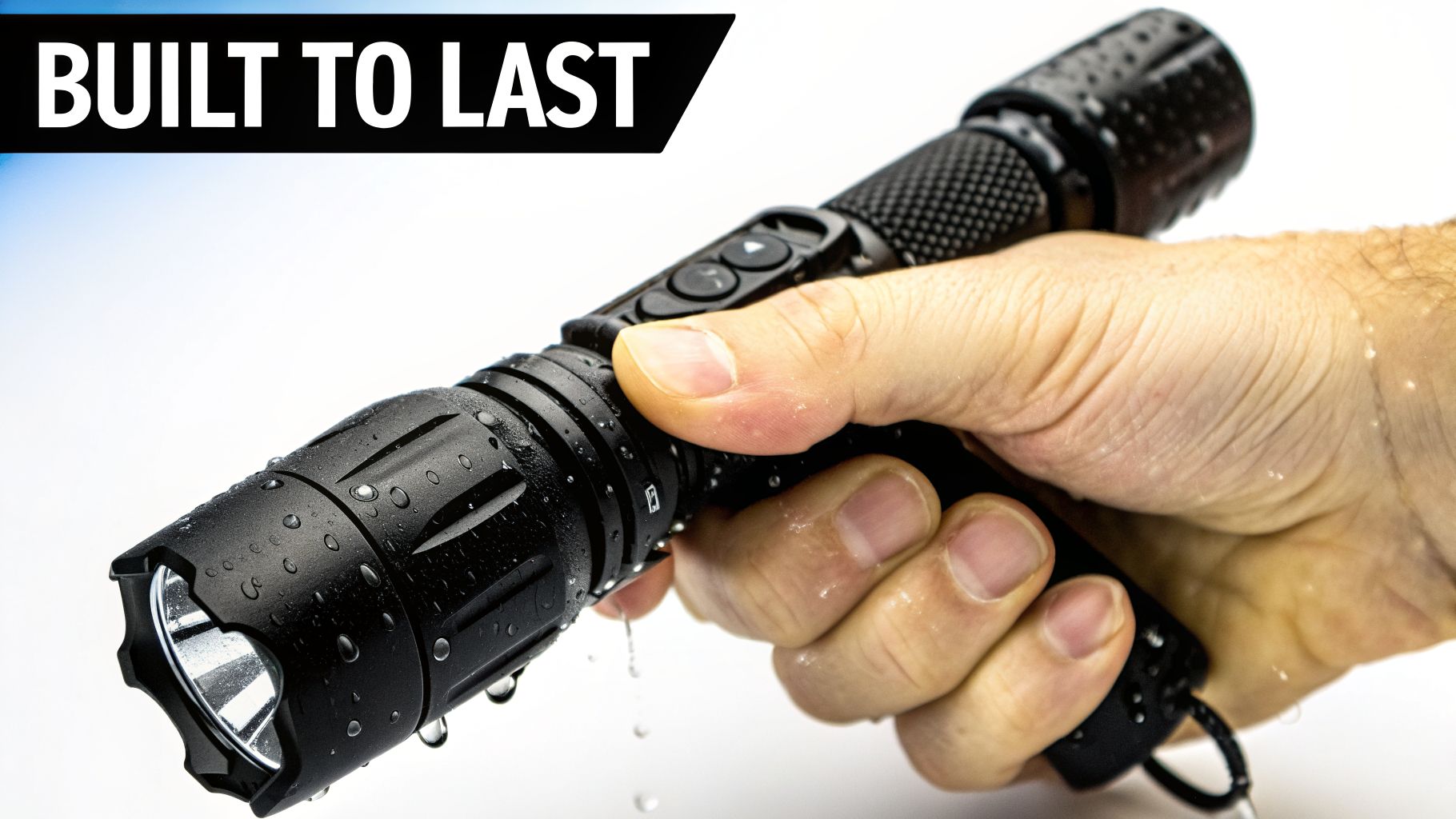
This material is light enough for comfortable everyday carry but tough enough to be used as an impact tool without caving in. The hard-anodized coating adds another layer of utility—it's rugged, resists corrosion, and has a non-reflective finish, so it's ready for hard use in any weather.
A flashlight built from a solid piece of this aluminum isn't just a housing for electronics; it's a solid tool. This unibody construction means it can transfer the full force of a strike without buckling, a critical detail if you have to use it defensively.
Ready for Anything: IP Ratings and Durability
Self-defense scenarios don't happen in a vacuum. You could be caught in a rainstorm, drop your light in the mud, or kick up a cloud of dust. That's where Ingress Protection, or IP ratings, come into play.
An IP rating gives you a clear, no-nonsense measure of how well a device is sealed against solids (like dust) and liquids (like water). For a high-quality tactical light, a rating of IP68 is the gold standard.
- The first digit (6): This signifies the flashlight is completely dust-tight. No grit or grime can work its way inside to mess with the sensitive electronics.
- The second digit (8): This tells you the light can handle being submerged in water deeper than 1 meter for an extended time without leaking.
Simply put, an IP68 rating is your guarantee that the light will function perfectly whether it's dropped in a puddle, used in a downpour, or covered in dirt. It’s about total reliability when conditions are anything but ideal.
The Sharp Edge: A Purpose-Built Strike Bezel
One of the most obvious features of a tactical flashlight for self defense is its crenellated bezel—those sharp, crown-like points around the lens. They aren't just for show; they are a purpose-built force multiplier.
Think about it: a strike with a flat surface spreads the impact out. A strike bezel does the opposite, focusing all of that force onto a few small, sharp points. This design makes it incredibly effective for causing pain and breaking an attacker's grip, giving you a crucial moment to escape.
The growing demand for such capable tools is clear. The tactical flashlight and self-defense product market was valued at $3.61 billion in 2025 and is on track to hit $5.31 billion by 2030. This boom is driven by a greater focus on personal safety, especially among urban women and outdoor adventurers who need gear that is compact, powerful, and utterly dependable. You can explore these trends further in the full market research analysis of the tactical flashlight market.
A Grip You Can Trust: Ergonomics Under Stress
At the end of the day, the most durable tool in the world is useless if you can't hold onto it. Ergonomics—how the flashlight feels and operates in your hand—is critical. In a high-stress situation, your fine motor skills deteriorate rapidly, so you need a design that feels natural and instinctive.
A deep, aggressive texture on the body, often called knurling, is essential. This cross-hatched pattern ensures you can keep a firm grip even with sweaty, wet, or gloved hands.
Equally important is the tail switch. This rear-mounted button allows for instant, one-handed operation. Your thumb naturally lands on it, letting you activate the light without shifting your grip or fumbling around. That intuitive control is non-negotiable when every second counts.
Integrating a Flashlight Into Your Everyday Carry
A high-powered tactical flashlight for self defense is a fantastic tool to have, but it does you no good sitting in a glove box or a nightstand drawer. Its real value comes from being with you when the unexpected happens. The goal is simple: make carrying your flashlight as second nature as grabbing your wallet and keys. It needs to shift from being just another piece of gear you own to being a reliable part of your personal safety plan.
This is the core idea behind Everyday Carry, or EDC. It’s all about building a consistent habit. That means finding a way to carry your light that actually works with your daily routine, your clothes, and your comfort. When you find the right setup, the flashlight just becomes part of your loadout—easy to carry and ready in an instant.
Choosing Your Carry Method
How you carry your flashlight has a huge impact on how fast you can get it into action. There's no single "best" method for everyone; it really boils down to the size of your light, what you typically wear, and what feels right to you. The most important thing is consistency. Practice drawing your light until it's pure muscle memory.
For good reason, two methods are overwhelmingly popular because they offer a great mix of quick access and discretion.
- Pocket Carry with a Deep-Carry Clip: This is the go-to for most small to medium-sized lights. A deep-carry clip lets the flashlight sit low in your pocket so only the clip is visible. It’s secure, out of the way, and blends in perfectly whether you're in jeans or business casual attire.
- Belt Holsters: If you're carrying a larger, more powerful flashlight or you just want the absolute fastest draw speed, a belt holster is the way to go. Usually made from Kydex or sturdy nylon, a holster gives your light a dedicated home on your belt. It’s always in the same spot, ready for a quick, one-handed draw.
No matter which you choose, the main objective is to eliminate any fumbling when you need it most. Whether you're just trying to find your way across a dark parking lot or reacting to a potential threat, you need to be able to grab and activate your light without a second thought.
The Power Behind the Light: Battery Management
A top-tier flashlight is only as good as the battery powering it. A dead battery instantly turns your advanced lighting tool into a simple metal stick, taking away its most critical defensive features—blinding light and disorientation. That's why having a solid battery plan isn't just a good idea; it's essential for being prepared.
You'll mainly be looking at two kinds of batteries, and each has its own set of trade-offs.
Think of your flashlight’s battery as its heartbeat. Keeping it charged or having fresh replacements on hand is the discipline that guarantees your light will work when you need it.
Rechargeable vs. Disposable Batteries
| Battery Type | Pros | Cons |
|---|---|---|
| Rechargeable (e.g., 18650, 21700) | Pushes more power for maximum brightness; Cheaper in the long run; Better for the environment. | Requires a consistent charging schedule; Higher initial cost. |
| Disposable (e.g., CR123A) | Incredible shelf life (up to 10 years); No charging needed—just swap them out; Easy to find. | Can't sustain the highest brightness levels; More expensive over time; Creates more waste. |
For a primary tactical flashlight for self defense, most people lean toward rechargeable batteries like the 18650 because they can consistently deliver that high-lumen punch. The trick is to build a charging routine. For example, make a habit of plugging in your light every Sunday night, just like you do with your phone. If you spend a lot of time outdoors, knowing your power needs for different situations is crucial, too. You can learn more about that in our guide on finding the best flashlight for camping.
By deliberately picking a carry method that works for you and sticking to a simple battery plan, you ensure your flashlight is always a tool you can count on. This kind of discipline builds the confidence and muscle memory you need to act decisively, turning preparedness from something you think about into a part of who you are.
Defensive Techniques and Practical Training
So you've got a top-tier tactical flashlight for self defense. That’s a great first step, but the gear itself is only half the battle. To really turn that tool into a lifesaving advantage, you need the skills to back it up. We’re not talking about complicated martial arts moves, but simple, proven techniques that you can rely on when your heart is pounding.
The whole point is to use light to see what’s going on, create an opportunity, and make yourself a very hard target to track. Owning the flashlight is the start; mastering these principles is what gives you real confidence.
The Light and Move Principle
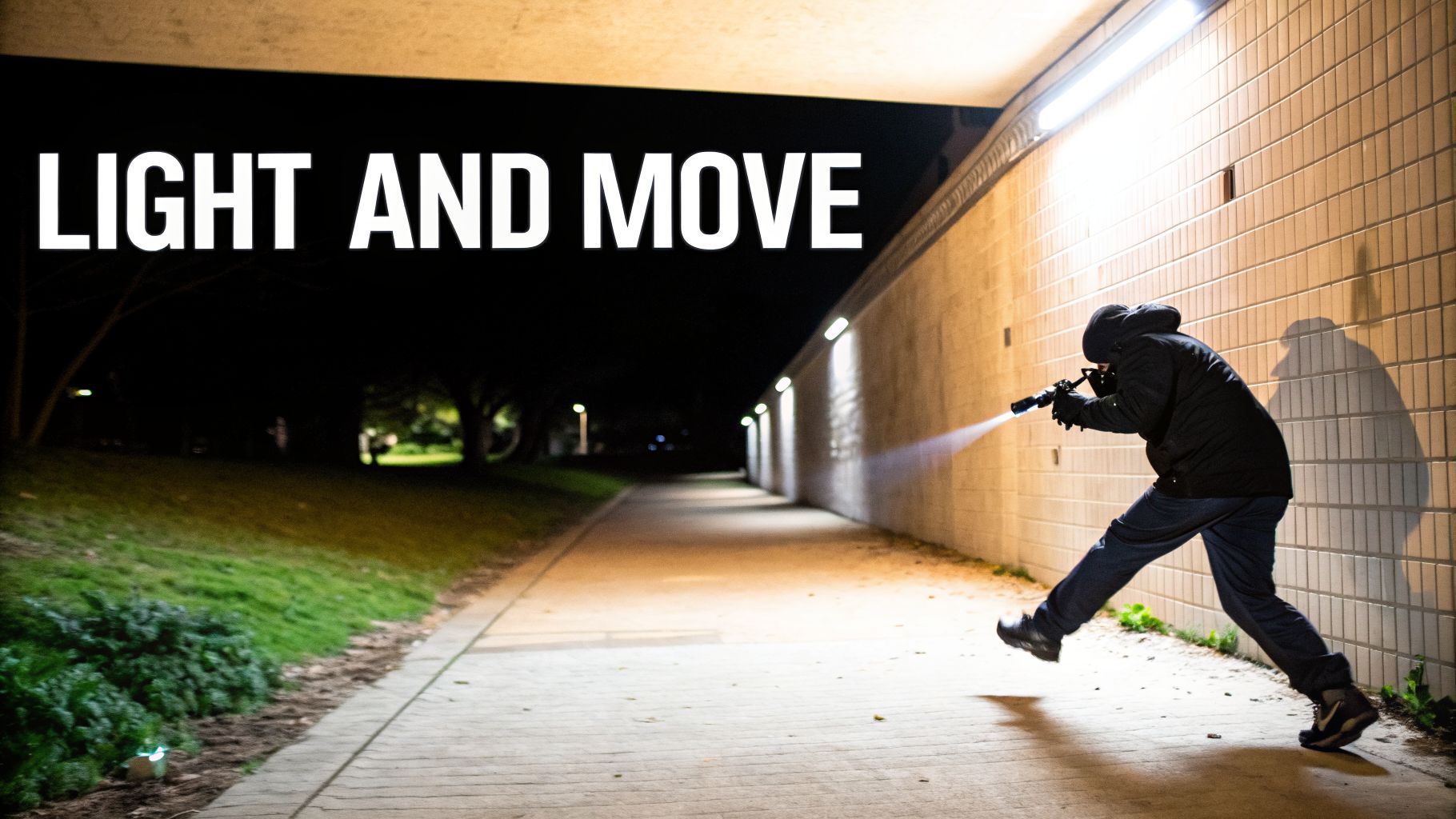
If you only take one thing away from this section, let it be this: "Light and Move." In any tense situation, a person standing still with a bright light is a big, glowing bullseye. The instant you light up a potential threat, you’ve also broadcasted your exact position. That means you have to move. Immediately.
Think of your light beam as a quick jab, not a constant stare. You flash it on to get a mental snapshot—who's there, where are they, what are they holding?—and then you get off the "X" and move to a new spot. This cycle of lighting up the dark and then disappearing back into it makes you incredibly difficult for an aggressor to pin down.
This practice of using short, deliberate bursts of light is known as light discipline. It keeps your location unpredictable and, just as importantly, helps preserve your own night vision so you can stay aware of your entire surroundings.
Stances and Grips for Maximum Control
How you hold the light is critical. You need a grip that feels solid and lets you hit the switch without thinking, especially when adrenaline is dumping into your system. While there are dozens of advanced grips for use with a firearm, let's start with a few fundamental ones that are easy to master.
- Ice Pick Grip: Your hand comes over the top of the light, with your thumb poised right on the tail switch. It’s an incredibly strong, intuitive grip that also positions the light perfectly to be used as an impact tool if you have no other choice.
- Syringe Grip: Just like it sounds, you hold the light with your index finger or thumb on a side-mounted button, almost like you’re pressing a syringe. This is a common and comfortable grip for lights that don't have a tail switch.
- Harries Technique: A classic two-handed stance for use with a pistol. You press the back of your flashlight hand firmly against the back of your shooting hand, creating a stable platform through opposing tension.
- FBI Technique: With this method, you extend your non-dominant arm (holding the light) far out and away from your body. The idea is to draw an attacker's aim toward the light and away from your vital organs.
The goal isn't to learn all of them, but to pick one and practice until it becomes muscle memory. A shaky grip is the last thing you want to worry about under pressure.
A powerful flashlight is a tool for information and disorientation. Your primary goal is to use light to see, disrupt, and move to safety. Combat is always the last resort.
Using Strobe and Beam to Your Advantage
That disorienting strobe feature isn't a gimmick; it’s a serious tool. A blast of a high-lumen, rapidly pulsing strobe can cause instant confusion, temporary blindness, and even a sense of vertigo in an aggressor. It shatters their focus and buys you precious seconds to get away.
But you have to be smart about it. A poorly timed strobe can disorient you, too. The best tactic is to first hit the threat with a solid, high-lumen beam to overwhelm their vision. If they don't stop, a quick burst of the strobe as you’re moving will compound their confusion and cover your escape.
When you're simply trying to navigate in the dark, use your beam to "paint" the environment. Don't just point it straight ahead like a car headlight. Sweep it across your path, paying special attention to corners, doorways, and deep shadows. This helps you build a mental map of the area and spot a problem before you walk right into it.
These techniques are your foundation. True competence, the kind that kicks in automatically when you need it most, is built through hands-on practice. We can't stress this enough: seek out professional training to build the skills and confidence to act decisively when everything is on the line.
Choosing the Right Ally for Your Safety
Knowing what makes a great tactical flashlight is half the battle. Now comes the important part: picking the right one for you. This isn't just about chasing the biggest numbers on a spec sheet. It's about finding a reliable, field-tested tool that fits your life—an ally you can truly count on when things go sideways.
Here at Superior Tactical, we’ve spent more than a decade outfitting everyone from law enforcement officers and serious hunters to everyday citizens who simply want to be prepared. We don't just sell gear; we live and breathe it. That experience has taught us which brands, like Fenix and Nitecore, consistently deliver when it matters most.
Matching the Tool to Your Mission
The perfect tactical flashlight for self defense looks different for everyone. The key is to match the light to your daily reality.
For Urban Everyday Carry (EDC): If you spend your time in the city—walking through a dark parking garage or navigating public transit after sunset—a compact, high-lumen flashlight is your best friend. You'll want something that disappears in a pocket, packs at least 1,000 lumens, and has a simple, instant-on tail switch.
For Professional Duty Use: Police officers and security pros need equipment that can take a beating, day in and day out. For them, the priorities shift to maximum durability, long runtimes to last a full shift, and a powerful beam distance to spot threats from a safe distance.
For Home Defense and Outdoors: Whether you're securing your property or heading into the backcountry, a larger light is often the better choice. Look for one with a high-capacity battery and a versatile beam that offers both a wide flood for situational awareness and a tight spot for long-range illumination.
Choosing the right light is a real commitment to your own safety. We only stock gear that's been proven to work under pressure, so you know you’re getting a tool that won’t quit when you need it most. To help you tell the real deal from the knock-offs, take a look at our guide on how to spot genuine tactical flashlights when buying online.
This focus on proven quality is why we hand-pick products with features that truly make a difference. Today's best lights combine IP68 waterproofing, tough CNC-machined aluminum bodies, and intense beams that can reach over 400 meters. This incredible performance is a big reason the tactical gear market continues to grow, with projections showing it will reach $3.76 billion by 2033, as detailed in this industry report. We make sure our catalog reflects this progress, giving you access to gear that’s both incredibly effective and built to last.
Common Questions About Tactical Flashlights
When you're first getting into tactical flashlights, a few key questions always seem to pop up. Let's get right into the answers I give people every day.
Can I Legally Carry a Tactical Flashlight Anywhere?
This is probably the number one question I get, and the answer is yes, almost everywhere. A huge advantage of a flashlight is that it’s seen as a utility tool, not a weapon, in most jurisdictions. This makes it far easier to carry legally than a knife or firearm.
That said, you should always double-check your local and state laws. Some areas have specific rules about flashlights with aggressive strike bezels, so it’s smart to know what’s what in your hometown.
How Many Lumens Do I Really Need for Self-Defense?
Any light is better than no light, but for self-defense, you need to think in terms of overwhelming an attacker's senses. That’s why you should look for a light with at least 1,000 lumens.
This isn't just about lighting up a dark alley. A blast of 1,000+ lumens directly to the eyes is enough to cause temporary flash blindness and a great deal of confusion. It gives you the precious seconds you need to move, create distance, and get away.
Your goal isn't just to see—it's to make sure they can't. A powerful beam is a non-lethal wall of light that stops a threat in its tracks.
Is the Strobe Function Actually Useful?
Don't mistake the strobe for a party trick. A high-frequency strobe is a powerful psychological deterrent. The brain simply can’t process the rapid, disorienting flashes, which can make an attacker feel dizzy and confused.
It makes it incredibly hard for them to focus, judge distance, or coordinate an attack. A great technique is to hit them with the solid beam first to blind them, then switch to strobe to keep them off-balance as you escape.
How Often Should I Charge or Change the Batteries?
A flashlight is dead weight without a good battery. Your charging routine really depends on your battery type and how often you use the light.
- Rechargeable (18650s, 21700s): Get in the habit of topping these off every 1-2 weeks. If you know you have an event coming up or will be out late, give it a fresh charge beforehand.
- Disposable (CR123A): These are amazing for backup and long-term storage, with a shelf life of up to 10 years. The rule here is simple: after any serious use, swap them out for a fresh set. You want full power ready for the next time, no exceptions.
We've covered some of the most common questions people have when choosing a tactical flashlight. For a quick reference, here's a table with brief answers to help you make an informed decision.
Tactical Flashlight FAQ
| Question | Answer |
|---|---|
| What's the best battery type? | Rechargeable 18650s or 21700s offer the best balance of power and cost-effectiveness. CR123As are excellent for long-term storage. |
| Is a strike bezel necessary? | It adds a physical defense option but may draw legal scrutiny in some areas. For most, a powerful beam is the primary defensive tool. |
| Can I take a tactical flashlight on a plane? | Yes, they are generally permitted in both carry-on and checked baggage, but TSA has the final say. Check their latest guidelines before flying. |
| Should my light have multiple modes? | Yes. A high mode for defense, a low mode for utility tasks, and a strobe are the essential three. |
| How do I maintain my flashlight? | Keep threads clean and lubricated, check O-rings for wear, and charge/replace batteries regularly. A well-maintained light is a reliable one. |
Having the right answers is the first step, but having the right gear is what truly prepares you.
At Superior Tactical, we don’t just sell gear; we provide field-tested tools that we trust ourselves. We’ve done the research so you can be confident in your choice.
Ready to find the right light for your needs? Check out our curated selection of high-performance tactical flashlights and find your perfect self-defense ally at https://superiortac.com.
