Scope reticle types: A Quick Guide to Mil-Dot, MOA, and BDC
Scope reticle types can be as simple as a basic crosshair for a brush gun or as intricate as a "Christmas tree" grid for extreme long-range shooting. The right one for you comes down to what you're doing—whether that’s getting on target fast in thick timber or calculating bullet drop for a 1,000-yard shot. Getting a handle on these designs is the first real step to unlocking what your rifle can do.
Decoding the Language Inside Your Scope
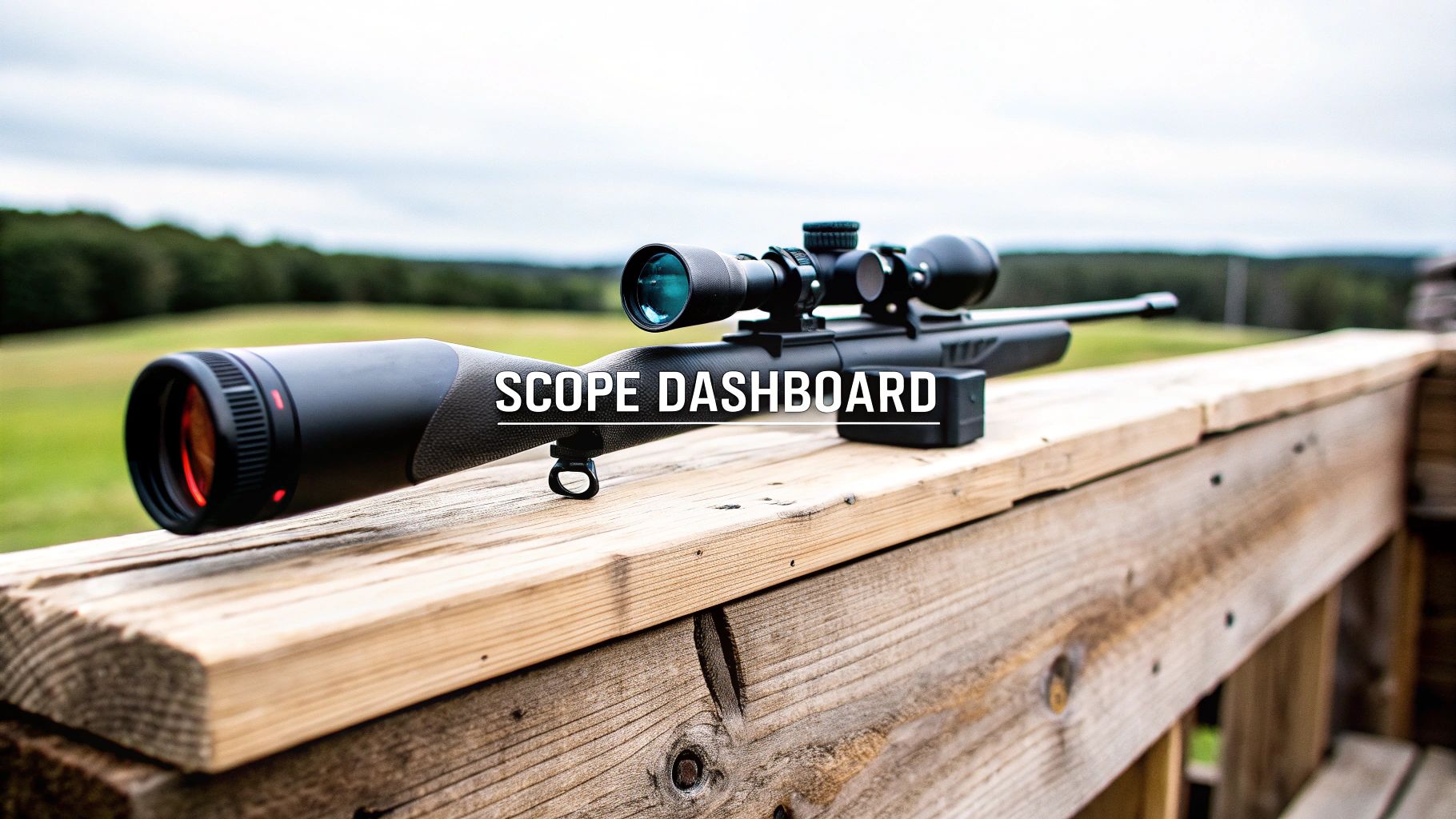
Think of your scope’s reticle as the dashboard for your rifle. It’s the visual interface that connects what your eye sees to where the bullet will land, and it’s a lot more than just a simple set of crosshairs. Some dashboards are stripped-down and clean, giving you just the essentials. Others are packed with data, built for high-performance, long-distance work.
This guide is here to walk you through all those different dashboards, from the minimalist designs perfect for a deer hunt to the complex grids needed to connect with steel plates a mile away.
Why Your Reticle Choice Matters
Picking the right reticle really does change the entire shooting experience. It’s all about getting the right information at the right time. The wrong one can be a liability—a busy grid can completely hide a target up close, while a simple crosshair leaves you guessing on wind and drop for a long shot.
The goal is to match the tool to the job. And to do that, you first need to understand what each of the primary scope reticle types was actually built for. This is fundamental, whether you’re sitting in a deer stand or setting up for your next stage at a competition.
Your scope’s reticle isn't just an aiming point; it's a specialized instrument. Its design directly impacts your speed, accuracy, and ability to make ethical shots, especially under pressure or in challenging light conditions.
From Simple to Specialized Systems
We're going to break down how these different designs work for different shooters. We’ll start with the classic reticles that have been trusted for decades and then move into the advanced systems that function like a ballistic calculator right inside your scope. Seeing how they’ve evolved makes it much easier to choose the right optic.
These principles hold true even for the digital crosshairs in today's most advanced optics. The Sightmark Wraith HD 4-32×50 Digital Rifle Scope, for example, lets you cycle through multiple reticle styles to fit the situation, which just goes to show how important this kind of versatility has become.
To get started, we'll break down the most common options into a few key groups:
-
Foundational Reticles: These are the simple, effective workhorses like the Duplex, built for general-purpose hunting.
-
Precision Reticles: Think Mil-Dot and MOA systems, which are designed for calculating range, wind drift, and bullet drop.
-
Specialized Reticles: This category includes BDC (Bullet Drop Compensating) and illuminated designs that prioritize speed and low-light visibility.
By the time we’re done, you’ll be able to look at any reticle and know instantly if it’s the right match for the way you shoot.
The Classics: Duplex and Crosshair Reticles
Before we get into the complex reticles that do everything but pull the trigger for you, we need to talk about the classics. The foundational designs that started it all are still incredibly popular for a reason—they solved the most basic problems for shooters, and they did it well.
The Fine Crosshair: Simplicity Perfected
The original and most straightforward aiming system is the fine crosshair. It’s nothing more than two thin, intersecting lines that give you a single, incredibly precise point of aim. That’s it.
Because there are no other distractions, you get a completely uncluttered view of your target. This makes it a long-time favorite for benchrest shooters and varmint hunters who need to place a perfect shot on a tiny target far away. With a fine crosshair, you aren't holding over or guessing; you're dialing your scope's turrets for elevation and wind, keeping the sight picture clean.
The Duplex Reticle: A True Game-Changer
As great as the fine crosshair is on a bright day at the range, it has a major weakness. Try finding those razor-thin lines against a dark animal standing in the shadows at dusk. They vanish. This frustrating problem led to one of the most brilliant inventions in optics: the Duplex reticle.
Often called a Multi-X, the Duplex was a genius solution that blended two ideas into one highly effective design.
-
Thick Outer Posts: The reticle has heavy, bold posts on the outer edges.
-
Fine Center Crosshair: These thick posts get thinner as they approach the middle, becoming a fine crosshair right at the aiming point.
This design masterfully draws your eye straight to the center of the scope. Even in the worst lighting conditions, those thick posts are impossible to lose against a messy background, guiding you instantly to where you need to be. The result is dramatically faster target acquisition, which is a massive advantage when the moment of truth arrives.
The real magic of the Duplex is how it gives you a fast, can't-miss aiming guide without sacrificing the pinpoint precision of a fine crosshair. It's the perfect harmony of speed and accuracy.
This simple, practical design is why the Duplex became the gold standard for hunting scopes for decades. It's still one of the most common reticles you'll find today because it gives new shooters an easy-to-learn sight picture while delivering the low-light performance that serious hunters need.
Why Simplicity Still Wins
In a world full of high-tech ballistic reticles, why do these simple designs still have such a huge following? Because for many shooters, they’re just plain better for the job at hand.
Think about a hunter in the thick woods of the Northeast, where a long shot is 150 yards. They don't need a complicated grid of holdover points; they need to get on target fast before the deer disappears. For millions of shooters in these kinds of common scenarios, the Duplex provides everything they need—and nothing they don't. It's a powerful reminder that sometimes, the best design is the one that just works.
When you move past the simple utility of a basic crosshair or Duplex, you start to see how a scope can be more than just a simple aiming device. It can be a powerful ballistic calculator etched right into the glass. This is the world of precision reticles, designed for shooters who need to master distance, bullet drop, and wind.
These advanced systems, usually built on either Mil-Dot or MOA measurements, give you a language for long-range accuracy. Instead of a single point of aim, they provide a detailed map to guide your bullet to the target, letting you make precise adjustments without ever touching your scope’s turrets.
The Mil-Dot Reticle: A Tactical Ruler
Picture this: you're trying to hit a target hundreds of yards away. Your bullet is going to drop, and even a light crosswind can push it feet off course. The Mil-Dot reticle was invented to solve exactly this problem by putting a ruler right in your field of view.
The "Mil" in Mil-Dot is short for milliradian, a unit of angular measurement. On a Mil-Dot reticle, the space from the center of one dot to the center of the next is exactly one milliradian. This standardized spacing lets a trained shooter do two crucial things:
-
Range a Target: If you know the rough size of your target—say, a standard 18-inch wide IPSC steel plate—you can use the dots to measure how big it looks through your scope. A quick calculation then gives you a very accurate distance.
-
Hold for Drop and Wind: Once you have the range, your ballistic data tells you how much the bullet will drop. Instead of dialing that correction on your elevation turret, you can just hold the correct Mil-Dot over the target and send it.
The ability to range and hold so quickly makes the Mil-Dot a beast for tactical work and long-range hunting. It’s one of the most popular scope reticle types out there for a reason. Originating from military use in the 1970s, its influence is huge. In North America, which made up 40.79% of the global market in 2020, Mil-Dot scopes are king in defense applications. In fact, armed forces accounted for an 80.2% share of end-use, where these reticles are proven to cut ranging errors by 20-25% over simple crosshairs. You can discover more insights on the riflescope market and its trends.
This diagram shows the difference between a simple crosshair and the Duplex reticle, which was really the stepping stone to these more advanced designs.
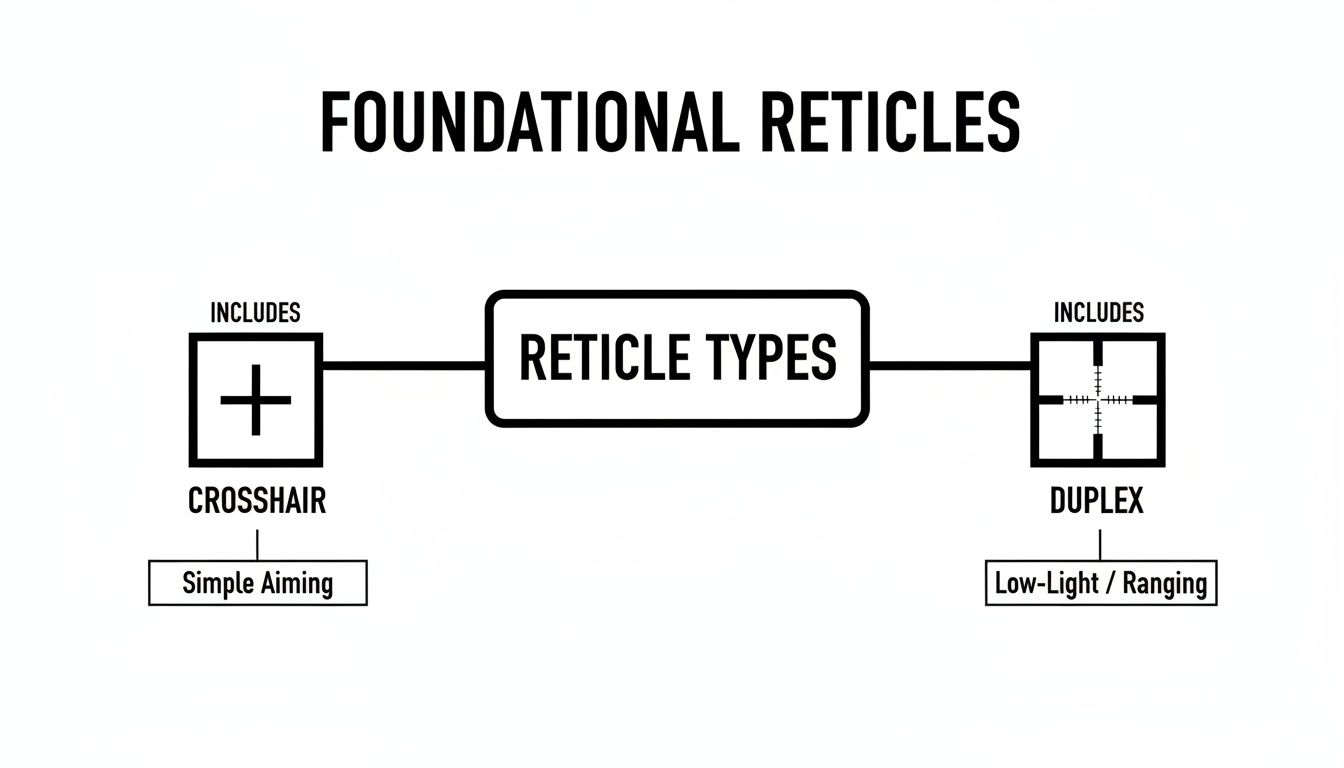
You can see how the Duplex uses thick outer posts to draw your eye in, while the fine center allows for a precise shot. That core idea heavily influenced the ranging reticles that came later.
MOA Reticles: The Intuitive Alternative
For a lot of shooters, especially here in the States, thinking in inches, feet, and yards is just second nature. This is where the MOA (Minute of Angle) reticle system shines. It lines up perfectly with the imperial system, making it feel incredibly intuitive.
A Minute of Angle is another way to measure angles, but it has a super convenient conversion: it’s roughly 1 inch at 100 yards, 2 inches at 200 yards, 3 inches at 300, and so on. This makes math on the fly incredibly simple. If your shot hits 4 inches low at 200 yards, you know instantly you need a 2 MOA upward correction.
Think of MOA and Mil-Dot as two different languages that say the same thing. Neither one is better than the other. The best system is the one you, your spotter, and your ballistic calculator can all speak fluently. Just be consistent.
Just like Mil-Dots, MOA-based reticles use hash marks or other subtensions at set intervals. They do the exact same job of ranging and holding for drop and wind, just with a different unit of measurement.
The "Christmas Tree" Reticle: Maximum Information
As shooters started pushing the boundaries of long-range precision, they needed more information, and they needed it faster. Enter the "Christmas Tree" reticle. It's the natural evolution of Mil-Dot and MOA systems, built for fast-paced, dynamic shooting where you don't have time to be twisting dials.
These reticles start with a main vertical and horizontal crosshair. But below the center, the reticle expands into a grid of dots or hash marks that looks a bit like a pine tree.
-
The main vertical line gives you your elevation holdovers.
-
The horizontal lines that branch out give you reference points for wind holds at each specific distance.
This layout gives you an instant aiming point for almost any combination of distance and wind. If you're a competitor in a Precision Rifle Series match or a hunter facing a long shot in a gusty canyon, a Christmas tree reticle is a massive advantage. It lets you make lightning-fast follow-up shots and corrections without ever taking your eye out of the scope, making it one of the most effective scope reticle types for really complex shots.
Specialized Reticles for Speed and Low Light
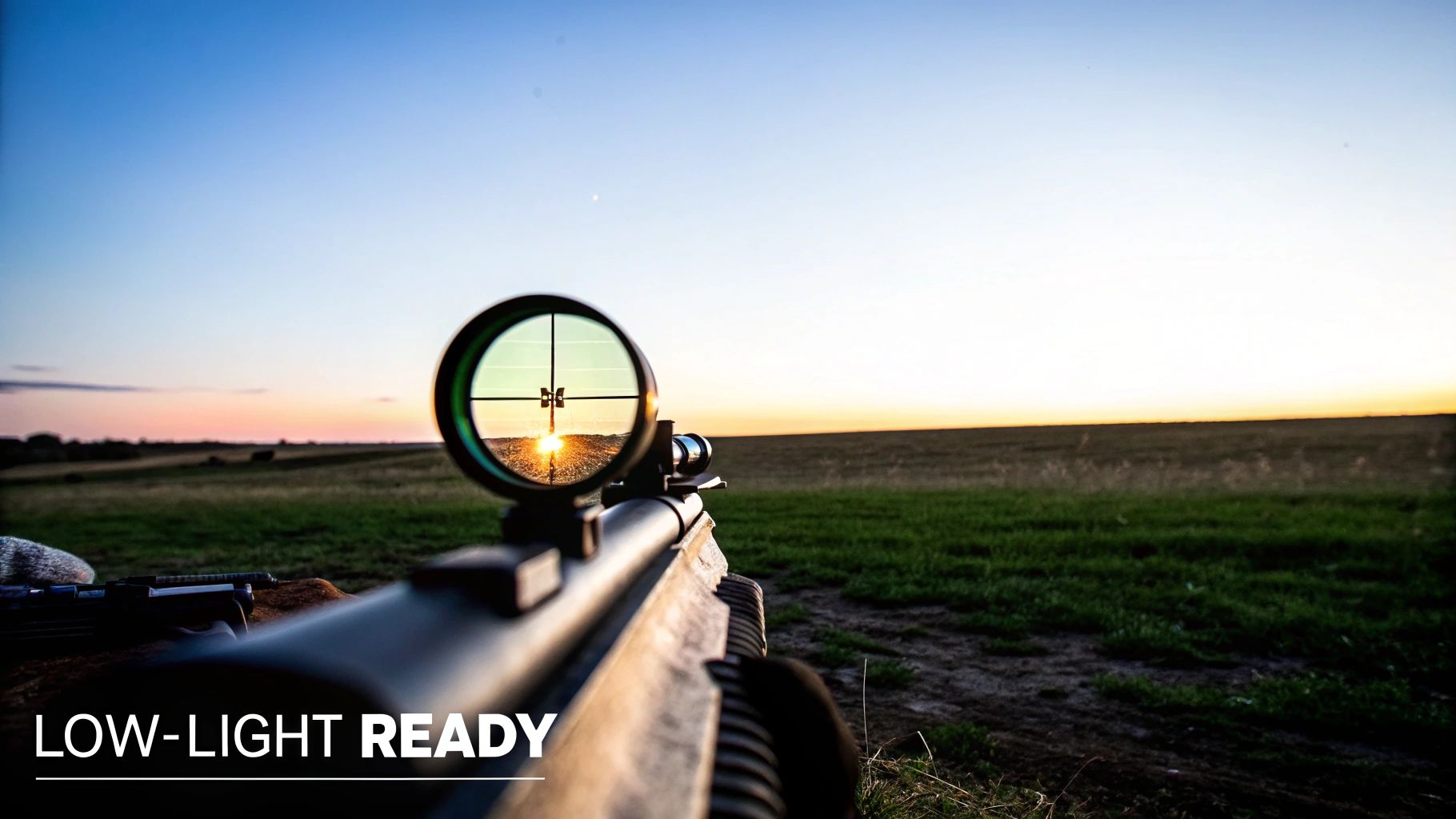
While grids like Mil-Dot or MOA are made for careful, calculated shooting, some situations demand pure speed and visibility over everything else. This is exactly where specialized scope reticle types shine. They're designed to solve very specific problems, like engaging targets quickly at different ranges or making a confident shot as the sun goes down.
These reticles trade complexity for pure function, giving shooters a real edge when time is a luxury they don't have. Two of the best and most popular designs out there are the Ballistic Drop Compensating (BDC) reticle and the illuminated reticle. Each has its own job, but they both help you make the shot when it counts.
The BDC Reticle: Your Ballistic Cheat Sheet
The Ballistic Drop Compensating (BDC) reticle is a hunter's best friend, especially if you need to make fast shots at typical engagement distances. Just think of it as a pre-calculated cheat sheet etched right onto your scope's glass, perfectly matched to the flight path of a specific type of ammo.
Instead of a busy grid, a BDC reticle gives you a main crosshair (usually zeroed at 100 yards) with a series of aiming points dropping down below it. Each of these extra marks—whether it’s a dot, a hash, or a little circle—lines up with a specific distance, like 200, 300, and 400 yards.
This setup means you don't have to mess with turret adjustments or do math in the field. If a deer steps out at 300 yards, you just put the 300-yard aiming point on it and squeeze the trigger. It’s an incredibly fast and intuitive system for hunting in open country where shot distances can change in a heartbeat.
The real power of a BDC reticle is its simplicity under pressure. It takes the guesswork out of the equation, letting you focus on the fundamentals of the shot instead of getting tangled up in ballistic calculations.
But here’s the critical part: BDC reticles are calibrated for a very specific cartridge, bullet weight, and velocity. To get true accuracy, you absolutely must match your ammo to what the reticle was designed for and then confirm your actual point of impact at each distance on the range.
Illuminated Reticles: Conquering Low Light
One of the biggest problems for any shooter is trying to see a black reticle against a dark target or in deep shadows. This is especially true for hunters during those prime hours of dawn and dusk when game is most active. An illuminated reticle is the perfect solution.
By lighting up the central aiming point—or sometimes the whole reticle—this feature makes your crosshair pop with sharp contrast. It gives you a crystal-clear aiming reference, no matter how bad the light gets. It’s a genuine game-changer that can easily be the difference between a successful hunt and a missed opportunity.
The popularity of illuminated scopes has exploded. In major markets like North America, which held a 40.79% global share in 2020, their adoption has surged among hunters. In fact, field studies have shown these systems can boost hit rates by up to 30% in low-light scenarios. You can discover more research about the riflescope market and its continued growth.
You'll generally find two main styles:
-
Partially Illuminated: This is the most common and often the best option. It only lights up the very center dot or crosshair, which keeps the glow from washing out your target.
-
Fully Illuminated: This style lights up the entire reticle. While it can be useful in some tactical scenarios, it can also be too bright for hunting and cause your pupil to constrict, hurting your natural night vision.
Illumination isn't just for traditional scopes, either. It’s a foundational feature in red dot sights, which are built for maximum speed up close. To get a better sense of how those work, check out our guide on the benefits of red dot magnifiers. At the end of the day, adding illumination is one of the most practical upgrades any shooter can make.
First Focal Plane vs. Second Focal Plane Explained
Beyond just the lines and dots you see, one of the most fundamental choices you'll make when buying a scope is between a First Focal Plane (FFP) and a Second Focal Plane (SFP) design. This decision dictates how your reticle behaves when you crank the magnification dial, and it has massive implications for how you'll use it in the field.
It sounds complicated, but it's not. Let's break it down with a simple analogy.
Imagine you're looking at a photograph with a ruler printed on a clear overlay on top of it.
With a Second Focal Plane (SFP) scope, it’s like that ruler is glued to your eyeball. As you zoom into the photo (increase magnification), the image gets bigger, but the ruler stays the exact same size. The inch marks on your ruler are only "correct" for measuring things at one specific distance—when you're not zoomed in at all.
That's exactly how an SFP scope works. The reticle is placed at the rear of the magnification assembly. So, when you zoom from 3x to 9x, the target gets larger, but the reticle appears to stay the same size.
The Second Focal Plane Advantage
For a huge number of shooters, especially hunters, this is exactly what they want. The reticle remains bold, black, and easy to see no matter the power setting. It never gets too tiny to see at low power or so thick it covers your target at high power. It’s consistent.
The trade-off, however, is a big one. Any of the fancy hash marks on your reticle—like BDC stadia lines or Mil-Dots—are only accurate at one specific magnification. This is almost always the scope’s highest power setting. If you try to use a holdover mark at half magnification, you're just guessing, and your shot will be way off.
-
Best For: Hunters and shooters who typically shoot at known distances and want a simple, highly visible reticle at all times.
-
Key Strength: The crosshair is always easy to see and acquire, regardless of the zoom level.
-
Main Weakness: Any ranging or holdover marks are only accurate at a single power setting.
Think of SFP as a specialist's tool. It's perfect for the whitetail hunter who sets their scope to 6x and leaves it, or for someone who knows they'll only be using the holdover dots when they're maxed out on magnification.
The First Focal Plane Solution
Now, let's go back to that photo analogy. With a First Focal Plane (FFP) scope, the ruler is printed directly onto the photograph itself. When you zoom in on a section of the photo, the ruler and the image grow together, proportionally. An object that was one inch long on the ruler stays one inch long, no matter how much you zoom.
FFP scopes work the same way. The reticle is placed in front of the magnification lenses. As you increase power, both the target and the reticle grow in size at the exact same rate.
This means the spacing between your hash marks is always true. A 1 MOA gap on your reticle will always cover one inch of your target at 100 yards, whether you’re on 5x, 15x, or 25x power. This is an absolute game-changer for long-range shooters who need to estimate range and make holdover corrections on the fly, at any magnification.
-
Best For: Precision long-range shooters, competitors, and tactical users who need their reticle's measurements to be accurate across the entire zoom range.
-
Key Strength: All reticle subtensions (Mil or MOA marks) are true and usable at every single magnification setting.
-
Main Weakness: At low power, the reticle can become very fine and difficult to see; at high power, it can seem thick.
FFP vs SFP Reticles at a Glance
To make the choice clearer, here’s a direct comparison of how the two systems stack up in the real world. Think about what you'll be doing most often with your rifle when you review this.
| Feature | First Focal Plane (FFP) | Second Focal Plane (SFP) |
|---|---|---|
| Reticle Appearance | Changes size with magnification (grows/shrinks with the target) | Stays the same size regardless of magnification |
| Holdover Accuracy | Accurate at all magnification levels | Accurate at only one magnification level (usually the highest) |
| Ranging Ability | Can range targets accurately at any power setting | Can only range targets accurately at one specific power setting |
| Low Power Visibility | Can be very fine and hard to see | Bold and highly visible |
| High Power Visibility | Can appear thick, potentially obscuring small targets | Stays fine and precise, offering a clear view of the target |
| Primary User | Long-range, tactical, and competition shooters | Hunters, plinkers, and many casual target shooters |
| Cost | Generally more expensive due to complex manufacturing | Typically more affordable |
Ultimately, there's no single "best" answer—it's about what's best for your application. For a hunter in the thick woods of the eastern U.S., the straightforward, always-visible SFP reticle is often the smarter choice. But for a PRS competitor needing to quickly engage targets from 300 to 1,200 yards, the versatile accuracy of an FFP reticle is absolutely essential.
How to Choose the Right Reticle for Your Needs
Knowing what the different scope reticle types are is one thing. Actually picking the perfect one for your rifle? That's a whole different ballgame. This is where we stop talking theory and start getting practical.
There’s no single “best” reticle out there. The best one is the one that gives you a genuine advantage for your specific environment, your firearm, and the way you shoot. An overly busy reticle can be a huge handicap in the wrong situation, just as a simple one can leave you high and dry when a challenging shot presents itself. Think of this choice as a direct investment in your performance.
Matching the Reticle to Your Environment
First things first: be honest about where and how you shoot. The demands of a thick, dark forest are a world away from a wide-open prairie, and your reticle needs to match that reality.
-
Dense Woods or Thick Brush: If you're a whitetail hunter in the Eastern woods, shots are likely to be close, fast, and often at dawn or dusk. A simple Duplex or an illuminated dot in a Second Focal Plane (SFP) scope is your best friend here. It gives you a clean, uncluttered view and pulls your eye straight to the center for lightning-fast target acquisition. You don't want a complex grid getting lost against a busy background.
-
Open Plains and Mountains: Out West, where the landscape opens up, long-range precision shooters and hunters need data. This is where a First Focal Plane (FFP) scope with a Mil-Dot or "Christmas Tree" reticle shines. It provides all the information you need to calculate holdovers for bullet drop and windage, and it works at any magnification.
-
Mixed Environments: If your hunting spots or competitions throw a little bit of everything at you, versatility is the name of the game. A Ballistic Drop Compensating (BDC) reticle strikes a great balance, giving you quick holdover points for common distances without the mental workload of a full grid.
Considering Your Shooting Discipline
What you're trying to do with each shot is just as critical as where you're shooting from. Different applications demand a different balance between speed and precision.
A 3-Gun competitor, for example, needs to smack targets from spitting distance out to several hundred yards, and do it fast. For them, a BDC or a simple illuminated dot is often the ticket—it's quick, intuitive, and provides just enough info for rapid transitions. Many shooters who need speed up close will even pair a non-magnified optic with a magnifier for maximum flexibility. You can see how this works by exploring the EOTECH EFLX Mini Red Dot Sight and how it fits into a modular setup.
Contrast that with a benchrest shooter who is obsessed with printing the tightest possible groups on paper. They'll almost always opt for a fine crosshair. This minimalist design provides the most precise aiming point imaginable and an uncluttered view of the target, letting them make tiny, deliberate adjustments with the scope’s turrets.
The right reticle should feel like an extension of your own skills. It shouldn’t make you work harder to find your target or calculate a shot; it should make the entire process faster and more intuitive.
Ultimately, you’re looking for a system that just feels natural. Take a hard look at your typical engagement distances, the lighting conditions you face, and the balance of speed versus precision your discipline requires. Doing so will help you cut through the noise and find the one reticle that’s perfectly suited to you. That’s how your optic goes from being an accessory to a real performance-enhancing tool.
Still Have Questions? Let's Clear Things Up
Choosing a reticle can feel like a big decision, and even after you've narrowed it down, you probably still have a few questions rolling around. That's perfectly normal. Let's tackle some of the most common ones we hear from shooters.
Is an Illuminated Reticle Really Necessary?
If you ever find yourself shooting when the sun is low—think first light, dusk, or deep in the shadows of the woods—then yes, an illuminated reticle is a game-changer. It makes your aiming point pop against a dark background, exactly when a standard black reticle can completely vanish.
For a casual day at a well-lit range? It's more of a "nice-to-have" than a "must-have." But for hunters and tactical shooters, it’s an invaluable tool.
Can I Use a BDC Reticle with Any Ammo?
This is a big one: no. A BDC (Bullet Drop Compensating) reticle is a fantastic shortcut, but it's a shortcut calibrated for one specific type of ammunition—a certain bullet weight moving at a certain speed.
Sure, it might get you "on the paper" with a similar load, but for real precision, it's only truly accurate with the cartridge it was designed for.
Always, always, always head to the range to confirm your actual bullet drops with your specific rifle and ammo. Don't just trust the markings on the reticle right out of the box. That verification is what separates a hopeful shot from a confident, ethical hit.
Mil-Dot vs. MOA: Which One Should a Beginner Choose?
Honestly, one isn't "better" than the other. It really boils down to which system clicks with your brain.
-
MOA (Minute of Angle): This system is based on inches and yards. Since 1 MOA is about 1 inch at 100 yards, it feels very intuitive for American shooters who think in imperial units.
-
Mils (Milliradians): Mils are metric-based, which can make some of the math for long-range calculations a bit simpler. It’s the standard for most military and serious tactical communities.
Here’s the best advice anyone can give you: pick one system and go all-in. Get your scope, your rangefinder, and your ballistic app all speaking the same language. That consistency is the secret to getting good at long-range shooting, fast.
At Superior Tactical LLC, we've seen every setup imaginable and can help you find the right optic for your mission. Whether it's a low-light hunt or a demanding tactical environment, we have the gear to get it done. Explore our collection of high-performance scopes and night vision gear and find your perfect solution.
