
Your Complete Guide to the PVS 31 Battery Pack
When people talk about the legendary PVS-31, the focus is almost always on the optics. But the secret to using them effectively for hours on end isn't just what’s in front of your eyes—it's what’s on the back of your helmet: the PVS 31 battery pack.
This isn't just a box of batteries. It's a cleverly designed piece of kit that does two critical jobs at once: it powers the unit and, just as importantly, provides essential helmet balance. Without it, you're turning a top-tier night vision system into a front-heavy liability.
The Unsung Hero of Your Night Vision System
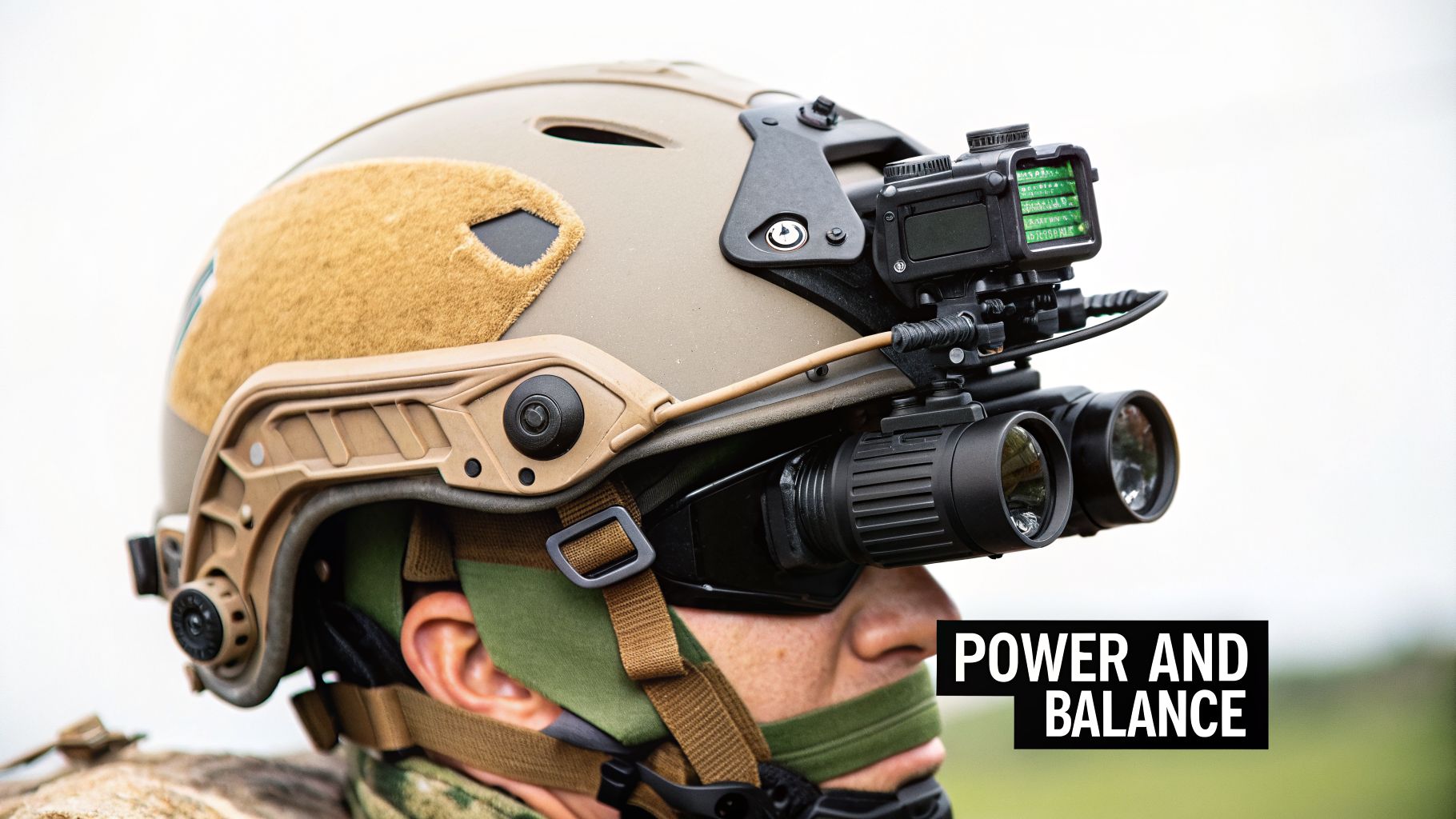
Think about the physics of a modern helmet setup. You have the PVS-31s hanging off the front, creating a constant forward pull. The battery pack, mounted at the rear, is the unsung hero that solves this problem. It acts as a dedicated counterweight.
This isn't a minor comfort feature; it's a fundamental ergonomic solution. By shifting the power source to the back, the entire system feels more integrated and less like a brick strapped to your forehead. The difference is night and day.
Transforming the User Experience
For anyone who has spent hours under NODs—whether on patrol or a long surveillance operation—that familiar neck ache is the enemy. It kills focus and wears you down long before your mission is over. The counterweight function of the PVS-31 battery pack directly combats this.
Here’s what that improved balance actually means for you in the field:
- Drastically Reduced Neck Fatigue: The constant strain on your neck muscles disappears, allowing you to stay in the fight longer without pain or distraction.
- Enhanced Stability: Your sight picture becomes much steadier. This is especially noticeable when you're on the move, scanning, or trying to get a clear view of a target.
- Extended Mission Endurance: Running power from an external pack means you aren't fumbling with the tiny onboard battery in the dark. You can operate for much longer stretches with confidence.
- Increased Operator Focus: When you’re not fighting your gear, you can dedicate 100% of your attention to the mission.
Ultimately, this simple piece of equipment is what makes the PVS-31 a genuinely usable long-duration tool. In this guide, we'll dive deep into everything you need to know about the pack, from installation and power options to maintenance, so you can get the most out of your entire night vision setup.
Understanding the Dual-Role Design
The real genius of the PVS-31 battery pack isn't just that it powers the goggles—it’s that it also serves as a purpose-built counterweight. This dual-role design is what makes the entire system work so well, especially when you're wearing it for hours on end.
Think about it this way: strapping a pair of night vision goggles to the front of your helmet is like taping a brick to the brim of a baseball cap. All that weight pulls your head forward, creating a constant strain on your neck. The PVS-31 battery pack solves this by moving the power source to the very back of the helmet.
It’s not just an afterthought; it’s a critical piece of engineering. By shifting the battery’s weight to the rear, it perfectly offsets the forward-leaning weight of the optics. This turns an otherwise front-heavy setup into a balanced, comfortable system that feels surprisingly light.
More Than Just a Power Source
Sure, its main job is to keep the lights on, but the ergonomic benefit is what truly makes a difference in the field. This smart design directly translates to less neck fatigue, a much steadier image while you're on the move, and the ability to stay focused for significantly longer.
This approach transforms the PVS-31 from a simple optical device into a balanced, wearable system. By solving the inherent front-heavy nature of night vision setups, it allows operators to maintain situational awareness without being distracted by physical discomfort or strain.
This is a huge leap forward from older systems. In the past, you'd often have to add a separate pouch filled with dead weight just to balance your helmet. The PVS-31 pack ingeniously handles both jobs. What’s even more impressive is that it achieves this balance while running on just a single AA battery, which provides up to 25-30 hours of continuous use. You can see how this kind of practical innovation has shaped modern night vision sale trends.
The Real-World Payoff
For anyone who has spent serious time under a helmet, the benefits are immediately obvious. The thoughtful engineering behind the PVS-31 battery pack delivers clear, practical advantages.
- Better Comfort and Posture: By canceling out the forward lever effect from the goggles, the pack helps you keep your head up naturally, preventing the notorious "NOD-neck" that causes serious pain.
- Sharper Mobility: A balanced helmet feels like part of you. It stays put when you run, climb, or turn your head quickly, so your gear moves with you, not against you.
- Sustained Focus: Pain is a distraction. By eliminating that constant neck strain, you can focus all your attention on the task at hand, which is absolutely critical when the stakes are high.
Ultimately, this battery pack isn't just an accessory—it's the anchor of the entire PVS-31 system. It makes sure the incredible optical performance is backed by solid ergonomics, turning your gear into a true force multiplier.
Key Specifications and Performance Data
When you get serious about night vision, the spec sheet is where the rubber meets the road. For a piece of kit like the PVS-31 battery pack, those numbers aren't just for show—they directly impact how you perform in the dark. Let's break down what makes this component so fundamental to the entire PVS-31 system.
At its heart, the pack is built for two things: endurance and simplicity. It’s powered by a single AA battery, which is a huge logistical advantage. Anyone who's been stuck in the field knows the pain of hunting for proprietary batteries. With the PVS-31 pack, a standard AA gets you an incredible 40+ hours of continuous runtime, though this can vary a bit with temperature and the specific battery you're using.
Balancing Weight and Endurance
Now, here’s where the design really shines. The pack itself, with a battery inside, comes in at about 180 grams. That might not sound like much, but its purpose is two-fold. It’s not just a power source; it’s a dedicated counterweight. The PVS-31 optics hanging off the front of your helmet weigh roughly 450 grams, and that front-heavy load can become a real pain in the neck—literally.
The battery pack attaches to the rear of the helmet, creating a perfectly balanced system. Anyone who has spent long hours under NODs knows the constant, nagging strain from a poorly balanced helmet. It's a fight you're always losing.

As you can see, a balanced setup means less strain, less fatigue, and a much steadier sight picture when you’re on the move. You're not fighting your gear; you're just focused on the mission.
This isn't just theory, either. The performance gains are well-documented. U.S. Army trials showed that this kind of integrated counterweight system boosted operational effectiveness by 30-40% in extended use. They measured a 25% reduction in helmet tilt and a 35% drop in user fatigue over a 12-hour period. For security professionals who might spend over 2,000 hours a year under NODs, that difference is enormous. More details on these findings can be found in the night vision technology trial results.
Performance Compared to Legacy Systems
To really appreciate the leap forward the PVS-31 system represents, it helps to look back at what came before. Older systems like the AN/PVS-15 and AN/PVS-14 relied on internal batteries, which created a host of problems that the PVS-31's external pack was designed to solve.
The table below lays out a clear comparison.
PVS-31 Battery Pack Performance vs Legacy Systems
| Feature | PVS-31 with External Pack | AN/PVS-15 (Internal) | AN/PVS-14 (Internal) |
|---|---|---|---|
| Primary Power Source | 1 x AA (in pack) | 1 x AA (onboard) | 1 x AA (onboard) |
| Typical Runtime | 40+ hours | 10-15 hours | 20-30 hours |
| Helmet Balance | Excellent (Counterweighted) | Poor (Front-heavy) | Poor (Front-heavy) |
| Battery Changes | Easy, pack-based swap | Awkward, on-device swap | Awkward, on-device swap |
As you can see, the external pack isn't just an incremental improvement. It offers massively extended runtime, solves the persistent issue of helmet balance, and makes battery swaps far more practical in the field.
This shift to a dedicated, counterweighted power pack isn't just an upgrade; it's a complete change in operational philosophy. It prioritizes user endurance and system stability, recognizing that a user's ability to stay focused is just as important as the clarity of the image intensifier.
Proper Installation and Helmet Integration
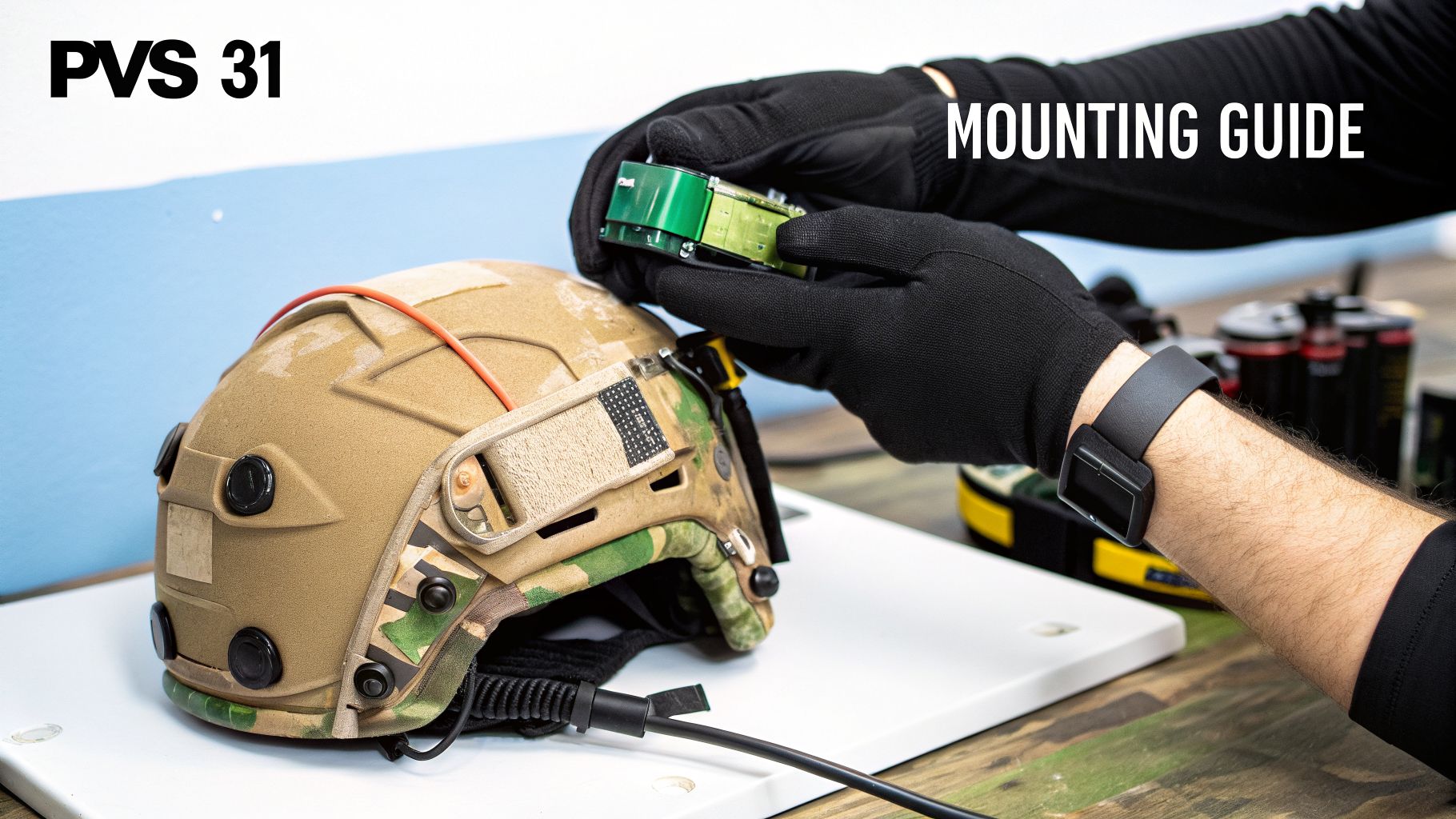
Getting your PVS-31 battery pack mounted correctly is just as crucial as choosing the right NODs in the first place. If your setup is sloppy, you're in for a world of hurt—from an unbalanced helmet that causes neck strain to a complete power outage at the worst possible moment. The goal here is to build a system that's so stable and balanced it feels like part of you, not some clunky accessory you've strapped to your head.
Most guys run the pack on the back of their tactical helmet, which is ideal for counterbalancing the weight of the goggles up front. Depending on your helmet—whether it’s an Ops-Core, Team Wendy, or another model—you’ll typically attach it using the built-in shroud clips or a big patch of industrial-strength Velcro. Honestly, it often comes down to what your helmet offers and what you prefer.
Securing the Pack and Cable
Once the pack is on, your next job is to wrangle the power cable. This is, without a doubt, where most people drop the ball. A loose cable is a snag magnet, just waiting to catch on a branch or piece of gear. When that happens, you can kiss your night vision goodbye as the plug gets ripped out.
You need to route that cable from the pack to your goggles in a way that’s completely snag-free. That means tucking it tight against the helmet shell.
Step 1: Get the Pack Rock Solid. Whether you're using the helmet's shroud or a big Velcro field, make sure that battery pack is on there tight. Give it a good shake. If it wobbles at all, it's not secure enough.
Step 2: Route the Cable Intelligently. Run the power cable along the side of the helmet toward your front mount. Use any channels, accessory rails, or Velcro tabs your helmet has to lock it down and keep it flush.
Step 3: Build in Some Strain Relief. This is key. Near the connector that plugs into your goggles, intentionally leave a small "S" curve of slack. This little loop acts as a shock absorber; if the cable does get tugged, the slack pulls tight before the connector gets yanked out.
Think of it like setting up a climbing rope. You want a clean, direct path, but you always build in just enough slack at critical points to absorb shock and prevent a catastrophic failure.
Following these steps ensures your PVS-31 battery pack not only acts as a solid counterweight but also delivers uninterrupted power. If you're just starting to build out your helmet, it's worth getting familiar with the different mounts available. Getting a rundown on how a quality helmet night vision mount creates a truly stable platform is a great place to start. Take the time to dial in your setup, and your gear will work with you, not against you.
Field Maintenance and Troubleshooting Tips
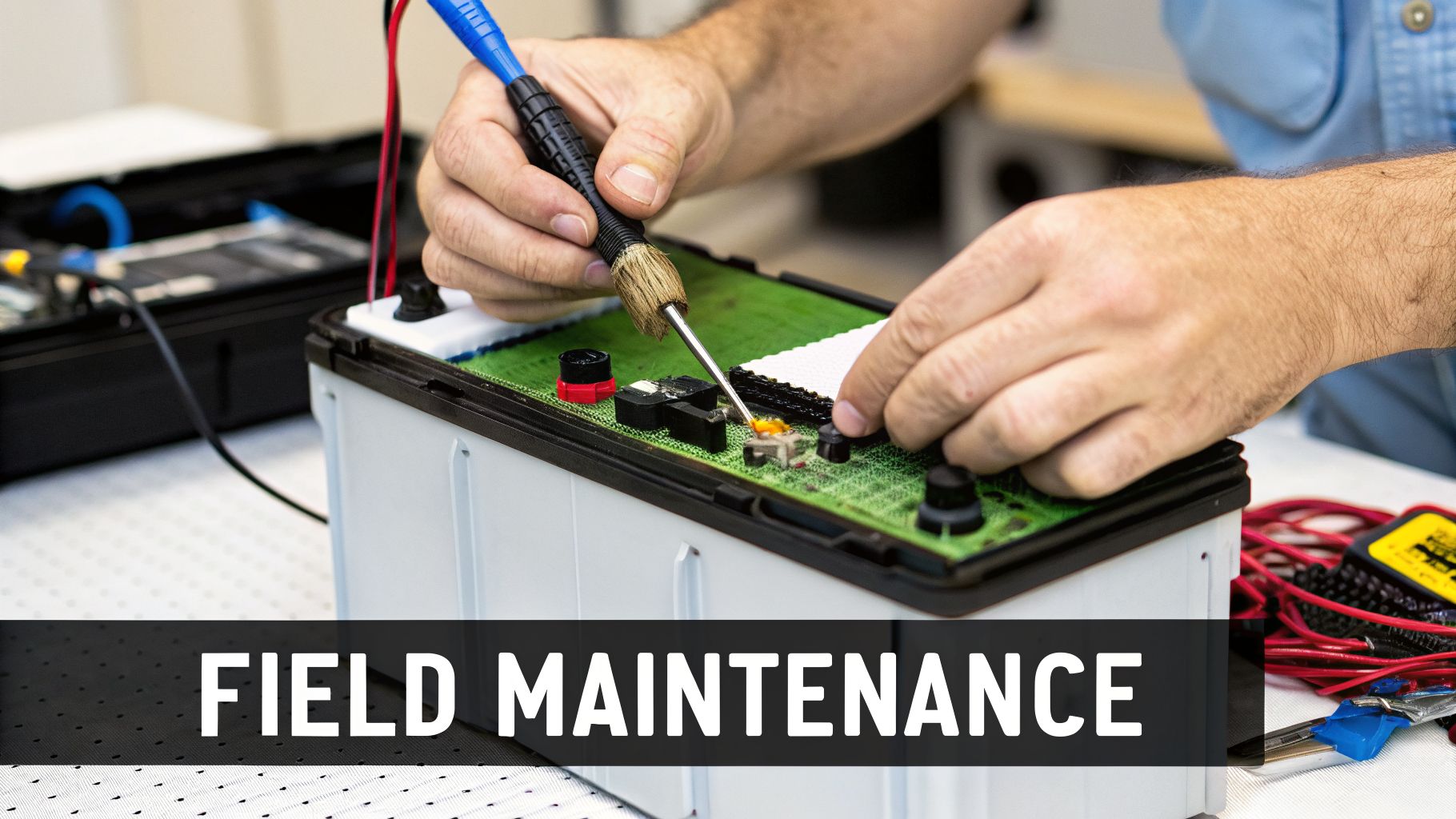
Let's be real—your night vision setup is a serious investment, and it has to work when you need it most. The PVS 31 battery pack is the heart of that system, and a little bit of preventative care goes a long way in making sure it never lets you down. We're not talking about complex teardowns, just simple, smart checks that stop major headaches before they start.
Think of it this way: you wouldn't head out on a long road trip without checking the tires on your truck. A few minutes of inspection on your battery pack can save you from a complete power failure in the field. It all boils down to keeping connections clean and components solid.
Routine Maintenance Checklist
Get into the habit of running through this quick check before and after you use your gear. This simple routine will add years to the life of your equipment and give you total confidence that it’s ready to go.
- Clean Electrical Contacts: Dirt, dust, and grime love to build up on the small metal contacts on your pack's connector and the goggle's port. Use a clean, dry cotton swab to wipe them down. For stubborn buildup, a soft pencil eraser works wonders to gently polish the contacts and ensure a rock-solid power connection.
- Inspect the Power Cable: This is your number one point of failure. Run your fingers along the entire cable, feeling for any cuts, nicks, or pinch points. Pay extra attention to where the cable meets the connector housings, as this is where stress and repeated flexing can cause internal damage.
- Check the Battery Compartment: Pop open the battery compartment and look for any fuzzy white stuff. That’s corrosion, and it’s usually caused by a leaky alkaline battery. If you see any, clean it out immediately with a cotton swab and a little isopropyl alcohol.
- Verify Secure Mounting: Grab the pack and give it a good shake. If it’s loose or rattles on your helmet, tighten down the mounting hardware or re-secure the Velcro. A wobbly pack is a recipe for intermittent power loss, especially when you're on the move.
A clean, secure connection is non-negotiable. Intermittent power is often worse than no power at all—it’s an unpredictable failure that can break your focus right when you need it most.
Quick Field Troubleshooting Guide
Even with the best maintenance, things can still go wrong out in the wild. Here’s a quick guide to diagnosing and fixing the most common issues on the spot.
Problem: Power flickers or cuts out when you turn your head.
- Solution: This almost always points to a cable problem. First, make sure the connector is pushed in all the way and locked into both the battery pack and the PVS-31. If that doesn't fix it, you likely have an internal break in the cable. Gently wiggle different sections of the cable to try and pinpoint the bad spot.
Problem: The unit won't power on at all.
- Solution: Always start with the simplest fix: swap in a fresh, high-quality battery. If there's still no power, clean all the electrical contacts—on the battery itself, inside the pack, and on the goggle port. As a last check, carefully inspect the connector pins to make sure none are bent or broken.
For anything more complex, your best bet is to get a professional to look at it. If you're dealing with stubborn issues, it might be time to look into some of the common night vision gear issues and how repairs can help. A proactive mindset is what keeps your gear mission-ready.
Choosing the Right Batteries for Your Mission
When you're running a high-end setup like the PVS 31, the battery you choose for your pack isn't just a battery—it’s a critical piece of mission support. It's easy to overlook, but skimping here is like putting cheap, retread tires on a performance vehicle. It's a risk that's just not worth taking.
The decision you make directly affects how long your goggles run, their reliability when the temperature drops, and the consistency of the image you see. While the PVS-31 is built to run on the ubiquitous AA battery, you quickly learn that not all AAs are created equal. We're going to break down the three main chemistries you'll encounter: Lithium, Alkaline, and rechargeable NiMH.
Lithium vs Alkaline vs NiMH
Each battery type comes with its own set of pros and cons. The key is matching the battery to the job at hand so you know exactly what to expect from your gear when you flip that switch.
Lithium (L91): The Gold Standard
For any serious operational use, Lithium AA batteries are the only real answer. They provide a rock-solid, stable voltage throughout their entire discharge cycle. This means the image in your tubes won't slowly dim as the battery drains. Most importantly, they laugh at extreme cold, a known killer for other battery types. With a shelf life of over 10 years, they are the perfect choice for go-bags, vehicle kits, and long-term storage.Alkaline: The Backup Option
You can find alkaline batteries anywhere, and their low cost is tempting. The problem is their voltage steadily drops off as they're used, which translates to a progressively dimming image. Worse, their performance absolutely tanks in the cold, making them a liability for any critical work. Keep a few on hand for an absolute pinch, but never rely on them as your primary power source.
For a critical mission, the superior cold-weather reliability and stable voltage of Lithium batteries are non-negotiable. Using anything less introduces an unnecessary risk of equipment failure when you can least afford it.
- Rechargeable (NiMH): The Training Partner
Good-quality NiMH rechargeables are a smart, cost-effective pick for high-volume training or frequent recreational use. They won't give you the cold-weather confidence or the incredible shelf life of lithium, but they deliver consistent power for repeated trips to the range. Just get in the habit of keeping them topped off and rotating your stock. If you're looking to optimize power for your other gear, check out our guide on selecting batteries for a SureFire flashlight.
Frequently Asked Questions
When you're dealing with high-end gear like the PVS 31 battery pack, you need clear answers, not guesswork. We get a lot of questions from guys running this setup, so let's tackle the most common ones head-on.
Can I Use a PVS 31 Battery Pack with Other Goggles?
That’s a hard no. The battery pack for the PVS-31 isn't just a generic power source; it's a purpose-built part of a system. It uses a very specific Fischer-style connector and is engineered to supply a precise voltage just for the PVS-31.
Trying to rig it up to another set of goggles, like a PVS-14 or PVS-15, is a recipe for disaster. It's not just that the plug won't fit. Even if you could Jerry-rig an adapter, the different voltage and electrical pinouts could permanently fry your expensive NODs, the battery pack, or both. Think of it as a key cut for a single, very specific lock.
What Is the Real-World Battery Life?
The manufacturer's specs are one thing, but what you get in the field is what really counts. Your actual runtime depends almost entirely on two things: the quality of your AA batteries and the ambient temperature. For the best and most predictable results, you should only be using premium Lithium AAs.
On a single lithium battery in moderate weather, say around 60°F (15°C), you can realistically expect 30 to 50 hours of continuous use. That's a solid baseline that lets you plan for long stints without weighing yourself down with a pocketful of spares.
Keep in mind, that number will take a nosedive in freezing temperatures. This is exactly why lithium batteries are the standard—they handle the cold far better than alkalines, which can die surprisingly fast when the temperature drops.
Do I Have to Use the External Pack?
Technically, no. The PVS-31 has an onboard battery compartment that takes a single AA, which is a great feature for a quick look or as an emergency backup if your cable gets snagged.
But running it on the internal battery alone comes with two significant downsides. First, you lose the counterweight function of the battery pack, making your helmet incredibly front-heavy and a real pain in the neck for more than a few minutes of wear. Second, your runtime is slashed to just 8-15 hours. For any serious use where comfort, balance, and endurance matter, the external PVS 31 battery pack isn't just an accessory; it's essential.
Ready to get your night vision setup dialed in for peak performance and balance? Check out the full lineup of authentic tactical equipment at Superior Tactical LLC. We've got the expertise to make sure you get the right gear for the mission. https://superiortac.com
