A Complete Guide to Picatinny Rail Grips
Picatinny rail grips are accessories that clamp onto your firearm's rail, and they're one of the single best upgrades you can make for better ergonomics and control. They give your support hand a solid, comfortable place to anchor itself, which is a game-changer for accuracy and managing recoil.
What Are Picatinny Rail Grips and Why You Need One
Think about trying to steer a car by grabbing the bare steering column instead of the wheel. Sure, you could probably make it work, but it would be clumsy, uncomfortable, and you'd have zero precision. A bare Picatinny rail is a lot like that column—it's functional, but it’s not designed for direct handling.
Adding a grip is like putting a perfectly molded steering wheel on that column. Suddenly, the whole system becomes more intuitive, comfortable, and far more effective. It transforms your rifle from something you just hold into something you can truly control.
More than just a handle, a Picatinny rail grip is a core component for building a stable shooting platform. It lets you pull the rifle firmly into your shoulder, which helps fight muzzle rise and keeps your sights locked on the target for quicker, more accurate follow-up shots. That level of control is crucial in any dynamic situation, from a tactical operator clearing a building to a hunter navigating thick brush.
The Foundation of Modern Firearm Customization
The Picatinny rail system these grips attach to is the industry standard for a reason. Formally adopted by the U.S. military back in 1995 under the MIL-STD-1913 specification, it completely changed how shooters attach everything from grips to optics. This system’s market impact is undeniable, and it remains a go-to solution for its reliability.
This modularity means you can set up your firearm for literally any scenario. A vertical grip might be ideal for close-quarters work, while an angled grip could provide better comfort for a long day on the range. The Picatinny system is the universal language that makes this all possible. You can see how this integration works with other gear in our guide on ARC rail adapters for communication systems.
At its core, a Picatinny rail grip turns your rifle from a collection of parts into a cohesive tool. It bridges the gap between the firearm and the shooter, making it feel like a natural extension of your body.
The advantages go way beyond just pulling the trigger; they improve how you handle the weapon in every situation.
- Enhanced Stability: A firm grip gives you a rock-solid anchor point, cutting down on weapon sway and helping you hold steady on a target.
- Superior Recoil Control: By letting you apply consistent rearward pressure, a grip tames recoil and makes your rifle much easier to control, shot after shot.
- Improved Ergonomics: A well-designed grip reduces strain on your wrist and fights fatigue, which means you can stay comfortable and effective for much longer.
Quick Guide to Picatinny Rail Grip Types
To get you started, here’s a quick breakdown of the main types of grips you'll find and what they're best suited for. This table will help you match a grip style to your specific needs.
| Grip Type | Primary Use Case | Key Benefit |
|---|---|---|
| Vertical Foregrip | Close-quarters engagement, weapon manipulation | Maximum control and leverage for quick movements |
| Angled Foregrip | General purpose, long-range shooting | More natural wrist angle, reduces fatigue |
| Hand Stop | Minimalist setups, precision shooting | Provides a consistent anchor point without adding bulk |
| Bipod Grip | Marksman roles, stationary shooting | Combines a vertical grip with a deployable bipod |
Each of these designs offers a different approach to solving the same problem: giving you better command over your rifle. Choosing the right one depends entirely on how you plan to use it.
Choosing Your Grip Style: Vertical, Angled, or Hand Stop
Now that you know why a good grip matters, let's get into the fun part: picking the right one for you. When you start shopping around, you'll quickly notice that most grips fall into one of three camps: vertical, angled, or a hand stop.
Each style was born from a specific need and offers a totally different feel and tactical advantage. It's like choosing tires for a car—you wouldn't put slicks on an off-road truck. The grip you pick should match how you plan to use your rifle.
Vertical Foregrips for Maximum Control
The Vertical Foregrip (VFG) is the classic, old-school option. It juts straight down from the rail, giving you a solid, broom-handle-like post to grab onto. Its biggest strength? Leverage.
A VFG lets you really manhandle the rifle, making it a beast for close-quarters work. When you're clearing rooms or shooting around cover, that solid grip gives you the muscle to drive the gun from target to target. It also helps you pull the stock tight into your shoulder pocket, which is a huge help in taming recoil, especially during faster strings of fire.
Think of a VFG as a joystick for your rifle. It gives you direct, powerful control for quick, aggressive movements.
Angled Foregrips for Superior Ergonomics
Next up is the Angled Foregrip (AFG). This is a more modern take that’s all about ergonomics and comfort. Instead of a 90-degree post, an AFG slopes forward, letting your support hand rest at a much more natural angle.
If you’ve ever felt your wrist start to ache after holding your rifle at the ready for a while, an AFG might be your new best friend. It dramatically reduces that strain. While you lose a little bit of that raw leverage you get with a VFG, an AFG encourages a "C-clamp" grip. This is where you wrap your thumb over the top of the handguard, giving you fantastic recoil control by pulling the rifle straight back into your body. It's a favorite for shooters who value stability for more precise, well-aimed shots.
This simple chart can point you in the right direction based on what you're trying to achieve.
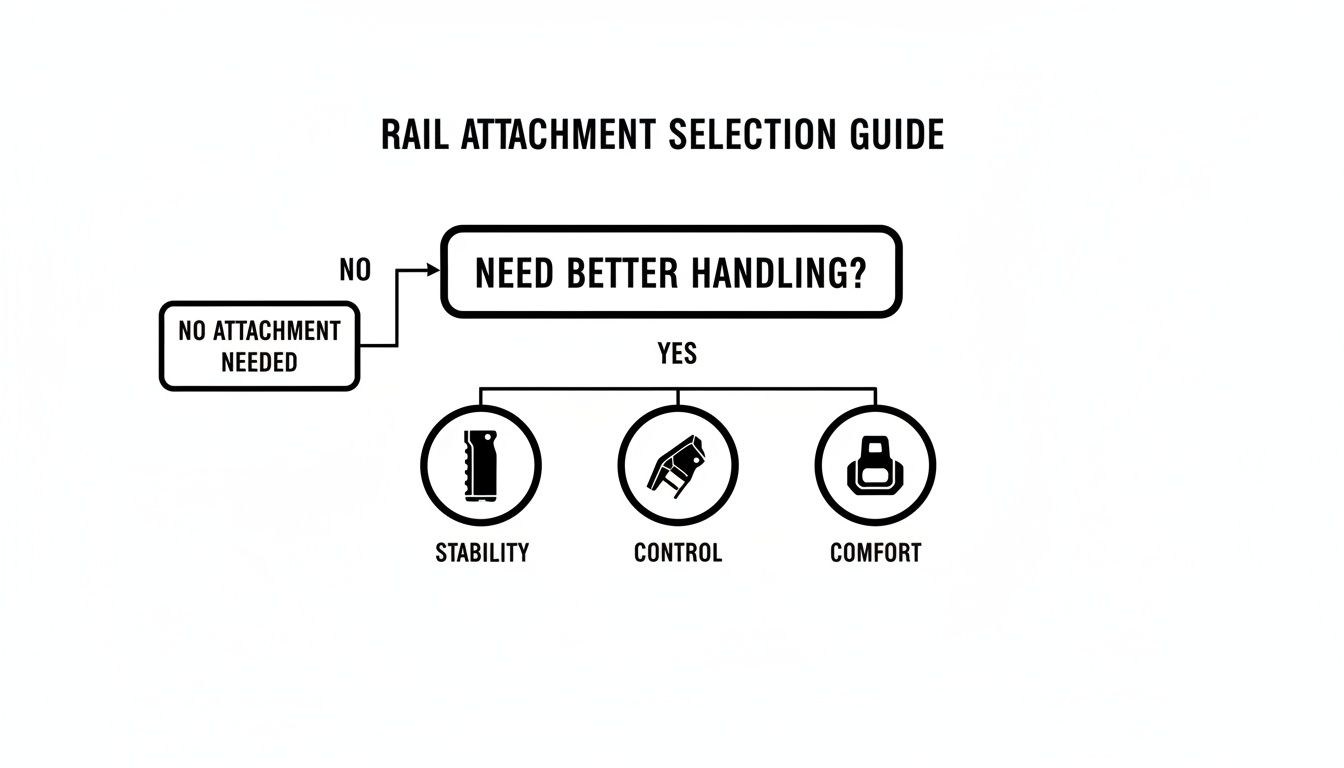
As the flowchart shows, figuring out if you need more stability, control, or comfort is the first step to finding the perfect grip for your setup.
Hand Stops for Minimalist Precision
Finally, there's the Hand Stop. This is the ultimate minimalist choice. It’s for the shooter who doesn't want the bulk of a full grip but still wants a consistent, repeatable hand position. A hand stop is just a small nub that mounts on your rail.
But don't let its size fool you. It serves two critical purposes:
- Consistency: It acts as an index point, guaranteeing your support hand finds the exact same spot every time. That's the key to building good muscle memory and shooting accurately under pressure.
- Support: It gives you something to pull back against, locking the rifle into your shoulder. You can also press it firmly against a barricade, windowsill, or sandbag to create an incredibly stable shooting platform.
Hand stops are perfect for precision-focused shooters or anyone trying to keep their rifle as light and snag-free as possible without giving up that crucial point of contact. The right choice really comes down to your personal shooting style, but each one offers a clear path to better handling.
Choosing The Right Material: Polymer vs. Aluminum
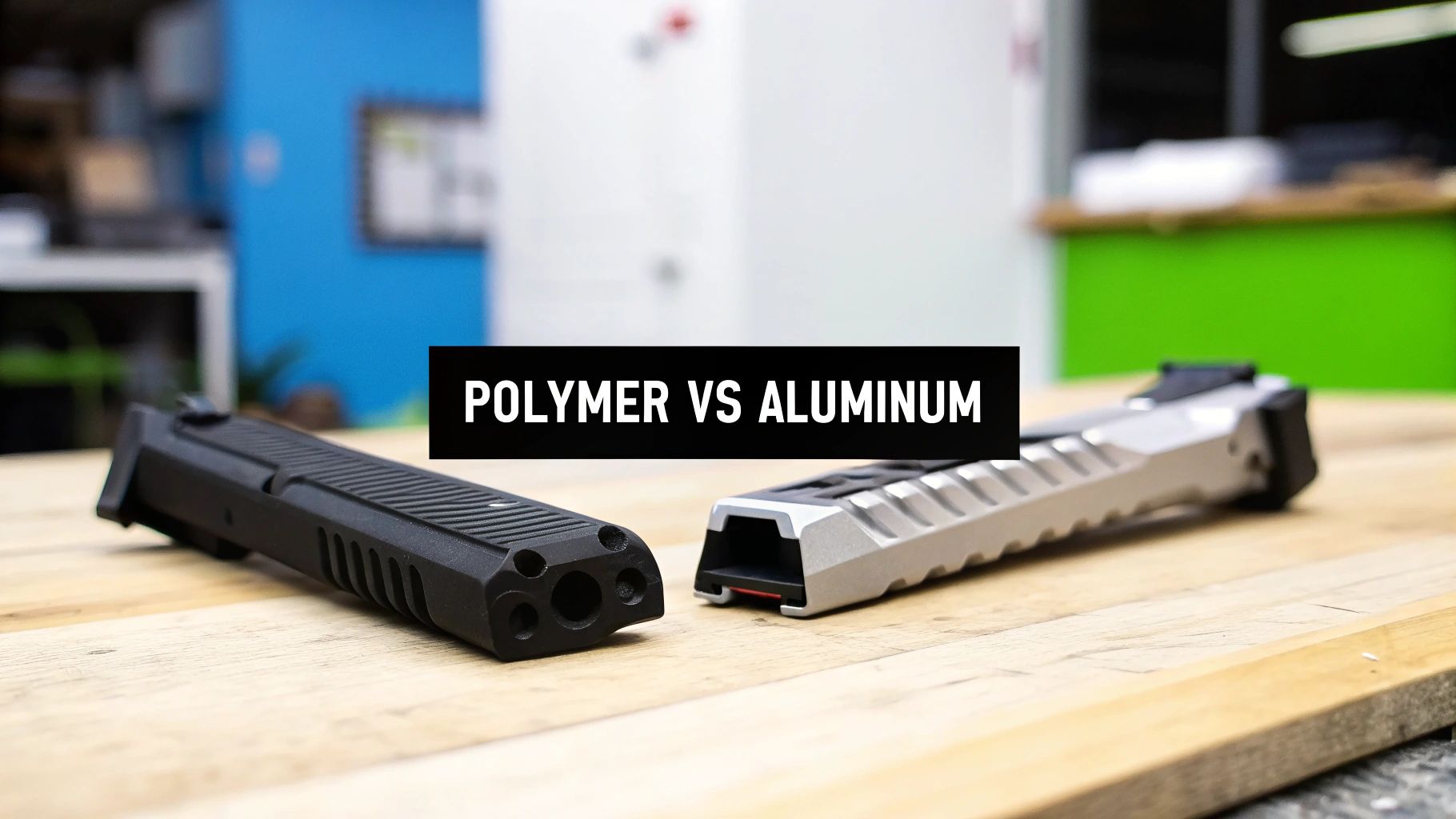
When you're picking out a Picatinny rail grip, the material you choose is one of the biggest decisions you'll make. It directly impacts your firearm's weight, durability, and even how it feels to handle in extreme weather. Think of it like deciding between a pair of high-tech trail running shoes and some classic, rugged leather hiking boots. Both get the job done, but they excel in very different scenarios.
The Lightweight Champion: Polymer
Polymer grips are the trail runners of the firearms world. They're incredibly lightweight, which is a huge plus for anyone trying to build an agile setup and cut down on fatigue during a long day at the range or in the field. They also don't get scorching hot in the sun or painfully cold in the winter, making for a much more comfortable grip without gloves.
For a lot of shooters, polymer is the default choice. It offers plenty of durability for most situations without tacking on extra ounces that can throw off your rifle's balance.
Here’s why polymer might be the right call for you:
- Reduced Weight: Every ounce counts. A lighter rifle is quicker to get on target and far easier to carry around all day.
- All-Weather Comfort: Polymer doesn't transfer heat or cold well. This insulates your hand from a blazing hot barrel or the freezing bite of a winter morning.
- Cost-Effective: They're usually easier on the wallet, which means you can try out different grip styles without a big investment.
The Durable Workhorse: Aluminum
Then you have aluminum Picatinny rail grips—the heavy-duty hiking boots. These are typically precision-machined from aircraft-grade aluminum, giving you unmatched rigidity and toughness. If your rifle is a tool that gets knocked around in harsh environments, aluminum offers the confidence that your grip can take a beating and keep performing.
Aluminum is also a great heat sink, which helps pull heat away from your handguard during sustained fire. This combination of toughness and thermal management makes it a top choice for serious duty and tactical use.
The choice often comes down to your primary mission. Aluminum's rigidity provides a rock-solid, zero-flex feel that many precision shooters value for its absolute consistency when bracing against barricades or other supports.
The North American market definitely leans toward robust materials. This region leads the Picatinny rail accessory market, largely because of a high rate of firearm ownership—around 32% of U.S. adults own a gun. Within that market, aluminum grips are king, holding over 60% of the market share thanks to their ideal balance of strength and weight. You can dig deeper into these trends in a comprehensive report from Data Ins Market.
To make the decision a bit easier, let's break it down into a direct comparison.
Polymer vs Aluminum Picatinny Grips Comparison
| Feature | Polymer Grips | Aluminum Grips |
|---|---|---|
| Weight | Very lightweight; excellent for reducing fatigue. | Heavier; can add noticeable weight to the front end. |
| Durability | Strong enough for most uses, but can crack or break under extreme impact. | Extremely durable and rigid; can withstand heavy abuse. |
| Temperature | Insulates well; stays comfortable in hot and cold weather. | Conducts heat/cold; can get very hot or cold to the touch. |
| Feel & Flex | May have a slight amount of flex under heavy pressure. | Completely rigid with zero flex for a rock-solid feel. |
| Cost | Generally more affordable and budget-friendly. | Typically more expensive due to materials and machining. |
| Best For | General use, lightweight builds, hunting, recreational shooting. | Duty use, tactical applications, competition, hard-use rifles. |
Ultimately, there’s no single "best" material that fits everyone. The right choice depends on a clear-eyed look at what you actually need. Are you putting together a feather-light hunting rifle for the backcountry, or a bomb-proof duty weapon that has to perform no matter what? Answering that question will point you straight to the right material for your build.
How to Install Your Grip for a Rock-Solid Fit
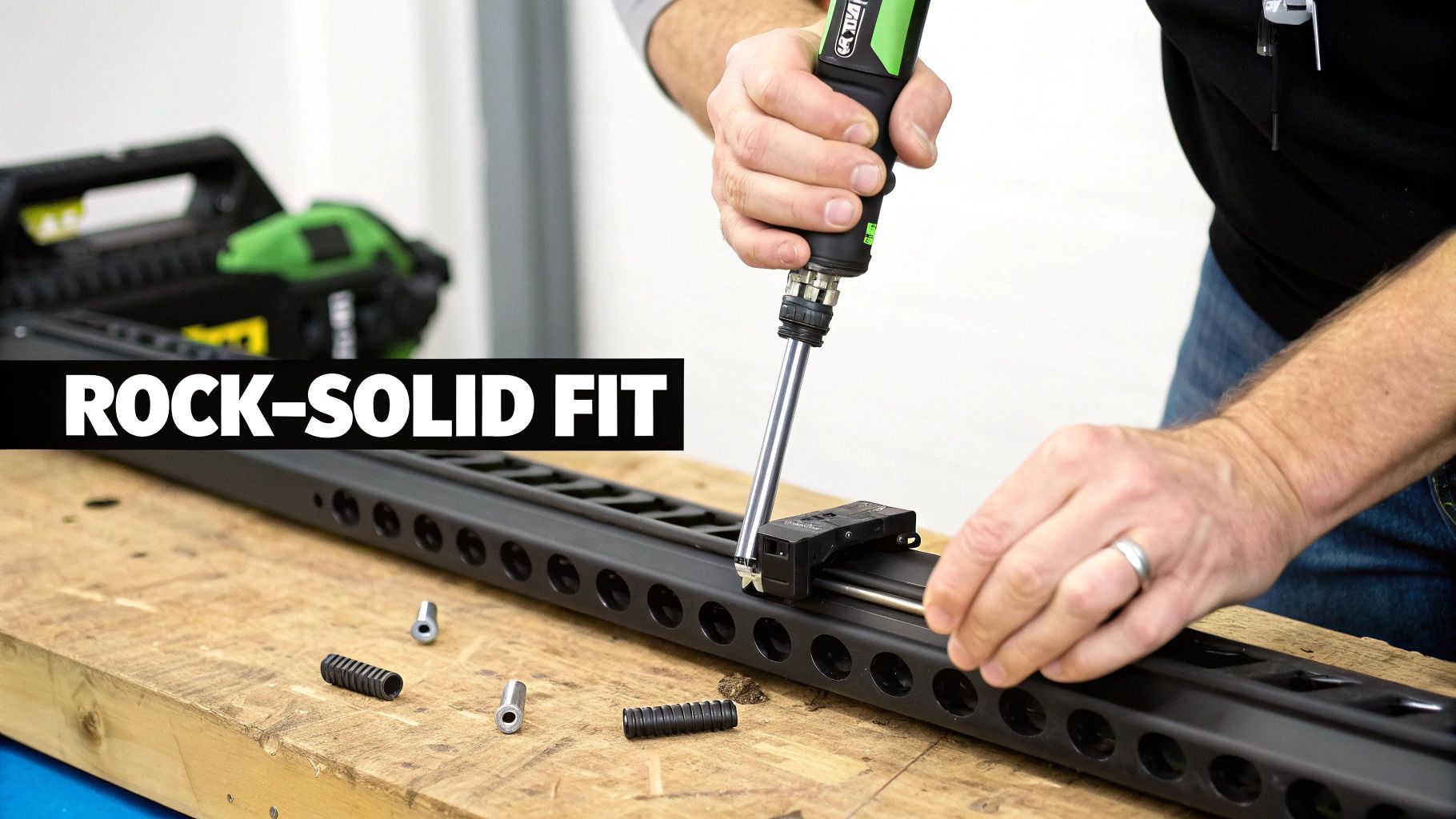
A wobbly grip is more than annoying—it’s a liability that can throw off your aim and compromise control. Getting that grip mounted so it feels like a seamless part of your firearm is the goal, and thankfully, it's pretty straightforward if you do it right.
Think of it this way: you wouldn't accept a loose scope mount, right? Any play between the grip and the rail will translate into inconsistent handling and poor performance. We want that grip to feel like it was forged as one piece with the handguard. Zero movement.
This isn’t just a matter of cranking down on screws until your knuckles turn white. It’s about prepping your gear, finding the sweet spot for your body, and using the right technique to lock it all down. Let's get it done.
Prepare the Rail and Grip
First things first, start with a clean surface. Grab some degreaser and a rag and wipe down the section of the Picatinny rail where the grip will live. You want to get rid of any factory oil, grime, or carbon buildup that could get in the way of a perfectly flush fit.
Give the grip’s mounting interface a quick wipe-down, too. A clean, dry connection creates maximum friction, which is exactly what you need to keep it from shifting around during recoil or hard use. This is a 30-second step that makes a world of difference.
Position for Optimal Ergonomics
Where you put the grip matters just as much as how tight it is. There’s no universal "best" spot; it's all about what works for you, your stance, and your other attachments.
Here's a good way to find your starting point. Close your eyes and shoulder your firearm like you normally would. Now, reach out with your support hand to where it naturally wants to go on the handguard. Open your eyes. That’s probably where your grip should be.
- Test and Adjust: Slide the grip along the rail a bit. Move it forward, move it back. Find that sweet spot where you get the best leverage and the rifle feels balanced.
- Check Your Other Gear: Make sure the grip doesn’t block access to your weapon light’s switch, your laser, or any sling attachment points.
- Practice a Bit: Shoulder the rifle a few times, run some dry-fire drills, and make sure the position feels repeatable and comfortable before you tighten a single screw.
A well-placed grip shouldn't force you into an awkward position. It should enhance your control, making it easier to pull the rifle firmly into your shoulder pocket for a stable, consistent shot.
Secure the Mounting Hardware
Once you've found the perfect home for your grip, it's time to lock it in place. Slide the grip onto the rail and make sure its locking lugs or cross-bolts are fully seated in the Picatinny slots. Get the screws hand-tight just to hold it steady.
If you want this to be a semi-permanent setup, put a tiny drop of blue thread locker (like Loctite 242) on the screw threads. This is your insurance against the screws backing out from vibration. Steer clear of red thread locker unless you never, ever want to take it off again.
Now, tighten the screws down. If there’s more than one, alternate between them to apply even pressure. The best way to do this is with a torque wrench set to the manufacturer's spec, which is usually around 15-25 inch-pounds. This ensures you won't strip the screws or crack a polymer grip by over-tightening. These same principles apply to other rail-mounted accessories; our guide on installing a Picatinny rail scope covers similar ground. Properly torqued screws are the final step to a truly bulletproof, wobble-free fit.
Integrating Grips Into Advanced Tactical Setups
Think of a Picatinny rail grip as more than just a handle. For a serious operator, it’s the command center for the entire weapon system. Especially when you’re running tactical setups in low-light environments, that grip becomes the main interface for controlling your most critical gear, like lights and lasers.
This is usually done by mounting pressure pads right onto the grip itself. Suddenly, you have a perfectly intuitive control scheme. Hitting your light or laser becomes a natural part of just holding the rifle—no fumbling, no breaking your grip. Your controls are right where your hand already is, which shaves off precious time when every split second matters.
The Grip as a Stability Platform
When you’re working with night vision, stability isn't just nice to have; it's everything. A solid Picatinny rail grip gives you that rock-solid foundation you need for precise laser work. Even the slightest wobble in your hold gets amplified way downrange, making your laser jump all over the place. A firm, repeatable grip keeps that laser locked on target, which is absolutely critical for identifying threats and coordinating with your team.
A stable grip is the bedrock of low-light effectiveness. It allows an operator to manage front-end weight, activate accessories, and maintain precise laser discipline without compromising control of the weapon.
This stability is also key for managing the weight of a kitted-out rifle. Once you start adding lights, lasers, and other gear, the balance point shifts forward, making the gun feel front-heavy. A good grip gives you the leverage to drive the weapon effectively, fighting off fatigue and keeping you in the fight longer. You'll find similar principles apply to stabilizing other critical attachments, which we cover in our guide to mounting an EOTech sight.
Why Picatinny Dominates Professional Setups
Sure, newer mounting systems have popped up, but Picatinny rails are still the gold standard in professional circles for one simple reason: they are bombproof. Despite challenges from lighter systems like M-LOK, the market for Picatinny accessories is still growing, with Picatinny rings alone projected for a 5.6% CAGR through 2030.
A 10-inch M-LOK rail might be nearly 54% lighter than its Picatinny equivalent, but for pros, the Picatinny's ability to hold zero under heavy recoil is a non-negotiable trade-off. You simply can't afford to have your grip or optic shift, period. You can dig into more of these market insights from HTF Market Intelligence.
In a high-stakes situation, that reliability is what you bet your life on. Picture clearing a building where you need your light to fire up instantly. A pressure pad locked down on a solid Picatinny grip guarantees that when you squeeze, your gear works. Every time. That’s why choosing the right grip for an advanced setup is less about adding a part and more about building a completely dependable system.
Common Questions About Picatinny Rail Grips
Even after you've got a handle on the different types and materials, a few nagging questions always seem to pop up right before you hit "buy." Getting these last few details straight is the key to choosing the right Picatinny grip with confidence. Let's tackle some of the most common ones I hear.
You need to know for sure that the grip you're eyeing will actually fit, work the way you expect, and solve a real problem for you—no surprises. I'll give you some straight answers to help you lock in your decision and get your firearm set up just right.
Will a Picatinny Grip Fit on an M-LOK or KeyMod Rail?
This is probably the number one question I get asked, and the short answer is no—not without a little help.
Think of it like trying to plug an American appliance into a European wall socket. They're both designed to do the same thing, but the physical connections are completely different. Picatinny grips use chunky cross-bolts that slot into the rail's deep grooves, while M-LOK and KeyMod use clever little T-nuts that lock in from behind the handguard.
But don't worry, there's a simple fix. You can grab a small section of Picatinny rail that's designed to mount directly onto your M-LOK or KeyMod handguard. It acts as an adapter, giving you a rock-solid platform to attach any Picatinny accessory you want, grips included.
Don't let your handguard's mounting system dictate your choice of grip. A small, affordable adapter is all it takes to bridge the gap and get the exact setup you're after.
Are Vertical Foregrips Legal on Pistols?
Okay, this one is a big deal, and the answer is tricky. In the United States, under the National Firearms Act (NFA), adding a vertical foregrip to a firearm that is legally a "pistol" can change its classification to an "Any Other Weapon" (AOW).
An AOW is an NFA item, which means it requires federal registration and a tax stamp from the Bureau of Alcohol, Tobacco, Firearms and Explosives (ATF). It's a whole process you don't want to stumble into by accident.
Here's the critical distinction you need to understand:
- Vertical Foregrips: A grip that sticks out at a 90-degree angle from the barrel is usually what lands a pistol in AOW territory.
- Angled Foregrips: Grips that are clearly angled (not vertical) have generally been seen as okay by the ATF and don't typically create an AOW.
Laws and official interpretations are always shifting. It is absolutely essential that you check the most current federal, state, and local gun laws before you even think about attaching a forward grip to a pistol. When in doubt, talk to a legal expert.
How Do I Know Which Grip is Right for My Shooting Style?
Honestly, this just comes down to knowing yourself and how you shoot. There's no such thing as the single "best" grip out there—only the one that’s best for you and your rifle.
Think about how you actually run your firearm.
- Fast and Aggressive: If you're doing a lot of dynamic, close-quarters work, a vertical grip gives you incredible leverage to swing the rifle from one target to the next.
- Comfort and Precision: For long days on the range or when you need a super stable hold for precise shots, an angled grip is your friend. It eases wrist strain and naturally supports a modern C-clamp grip.
- Minimalist and Supportive: If you want a lightweight, snag-free setup and just need a consistent index point or something to brace against a barricade, a hand stop is perfect.
Plenty of shooters find their preferences change over time or as they build out different rifles for different purposes. The cool thing about Picatinny grips is they're usually pretty affordable and a breeze to swap out. Don't be afraid to experiment a little to find what truly clicks for you.
Ready to find the perfect grip for your setup? Superior Tactical LLC offers a curated selection of tactical accessories from trusted brands to keep you mission-ready. Explore our collection of grips and accessories and get expert guidance for your build.
