Master the peq laser light: Essential tactics for night ops
At its most basic, a PEQ laser light is a multi-tool for your firearm. It’s a single, compact box that mounts to your rifle and combines a visible laser, an infrared (IR) laser, and an IR illuminator. This setup is your all-in-one solution for aiming and identifying targets, especially when paired with night vision.
Unpacking the PEQ Laser Light System
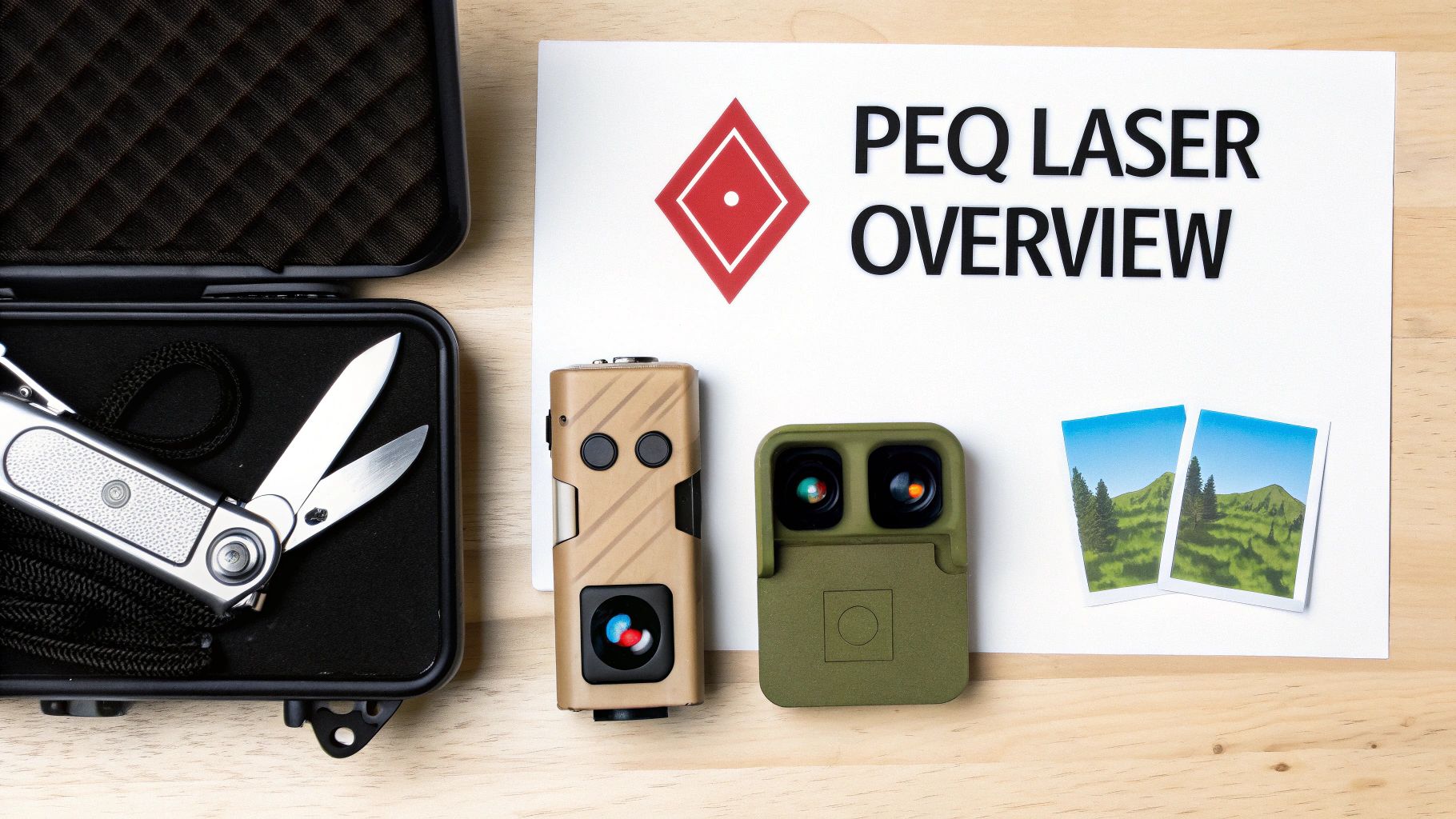
Think of a PEQ unit as the ultimate decluttering tool for your rifle's rail space. Instead of bolting on a separate visible laser, an IR laser for night vision, and an IR flashlight, a PEQ rolls all of that capability into one rugged housing.
The name itself, PEQ (or more formally, AN/PEQ), is a military designation that stands for "Army/Navy Portable Emitter, Special/Combination." It’s a mouthful, but it hints at the device's core mission: solving the fundamental problems of operating in the dark. It gives you the power to aim, identify threats, and move through environments where your own eyes would fail you.
Who Uses a PEQ and Why
While these devices were born from special operations needs, their usefulness has found its way into a number of fields. They’re no longer just for the military.
- Law Enforcement: SWAT teams and tactical units depend on PEQ systems to clear darkened buildings and aim precisely without broadcasting their position with a bright white light.
- Nocturnal Hunters: Anyone hunting hogs or predators after sundown knows the value of IR. It allows for ethical, accurate shots in total darkness, which is often a legal requirement for night hunting.
- Prepared Citizens: For home defense, a PEQ offers an undeniable advantage in a low-light encounter, dramatically improving your ability to see what's happening and aim effectively.
A Game-Changing Innovation
The modern PEQ unit we know today owes a lot to trailblazing designs like the AN/PEQ-15. When Insight Technology introduced it back in 2003, it set the standard by packing a powerful visible laser, an IR aiming laser, and an IR illuminator into one compact unit. For a deeper dive into its history, the AN/PEQ-15 Wikipedia page is a great resource.
The fundamental purpose of a PEQ is to act as a force multiplier. It doesn’t just help you see in the dark; it fundamentally changes how you operate within it, turning darkness from a liability into a tactical advantage.
At the end of the day, a PEQ isn't just another cool gadget. It's the heart of any serious low-light fighting system, designed to work hand-in-glove with night vision goggles. This synergy is what unlocks a level of capability that a simple flashlight or standard optic could never touch.
Breaking Down the Three Core Functions of a PEQ Unit
A PEQ unit is way more than just a laser pointer bolted onto a rifle. It's a highly sophisticated system designed to give you an undeniable advantage in any lighting condition, day or night. From the outside, it looks like a single, tough-as-nails box, but inside, it packs three distinct tools that can work on their own or together.
You can think of these functions like different tools in a toolbox. One is your standard, bright-and-obvious laser everyone can see. Another is a stealthy laser that's completely invisible unless you're wearing night vision. And the third is like a powerful, invisible floodlight that illuminates the dark. This is what makes a peq laser light such a game-changer.
A simple selector switch on the unit lets you flip between these modes on the fly. No fumbling with multiple gadgets—just a quick turn of a knob to adapt to whatever the situation throws at you. Getting a handle on what each mode does is the first step to truly mastering the device.
The Visible Laser: Your Daylight Pointer
The most basic function is the visible aiming laser. This is the bright red or green dot you're probably familiar with, projecting a clear aiming point right onto your target. It's loud and clear, perfect for getting on target fast in daylight or in low-light situations where you aren't using night vision.
Its biggest advantage is raw speed. Instead of trying to line up iron sights or find the dot in your optic, you just put the laser where you want the bullet to go. This is incredibly handy for shooting from awkward positions or if you need to react instantly. But remember, its biggest strength is also its biggest weakness: if you can see it, so can your target, which could give away your position.
The Infrared Laser: The Covert Aiming Point
Here’s where a PEQ unit really earns its keep. The infrared (IR) laser is the core of its tactical power. It projects an aiming dot that is completely invisible to the naked eye. Think of it as a secret message—a precise aiming point that only someone with night vision devices (NVDs) can see.
This solves one of the most frustrating parts of shooting with head-mounted night vision: trying to aim. Getting a good cheek weld and looking through a scope while wearing goggles is next to impossible. The IR laser completely sidesteps that issue. It paints the target with a dot you can easily see through your NVDs, making fast, accurate shots in total darkness a reality without alerting anyone not equipped to see in the IR spectrum.
An IR laser turns aiming in the dark from a clumsy, awkward struggle into something incredibly fast and intuitive. It's the bridge between your eye and the target, giving you a clear point of impact that only you can see.
The IR Illuminator: Your Invisible Floodlight
Finally, we have the IR illuminator, which is basically an invisible flashlight. While night vision goggles are great at amplifying ambient light, they're useless in true, absolute darkness—think a windowless room or a cloudy, moonless night. That's when the illuminator becomes your best friend.
It casts a wide beam of infrared light over your target area, flooding it with energy that your NVDs can see. This invisible light turns a dark, grainy mess into a bright, clear picture, which is absolutely critical for positive target identification. If you're looking to dive deeper into these kinds of tools, browsing through a full lineup of laser aiming modules is a great way to see what's out there.
To make things even clearer, this table breaks down how each mode works and when you'd want to use it.
PEQ Laser Light Operational Modes Explained
| Mode | What It Does | Best Use Case |
|---|---|---|
| Visible Laser | Projects a bright red or green dot visible to the naked eye. | Rapid aiming in daylight or low-light conditions without NVDs. |
| IR Laser | Projects an aiming dot that is only visible through night vision. | Covert aiming in darkness when paired with NVDs. |
| IR Illuminator | Floods an area with invisible infrared light for NVDs to see. | Navigating and identifying targets in zero-light environments. |
When you put all three functions together, you have a complete system for owning the environment, 24/7. It ensures you always have the right tool for the job, whether the sun is up or it's pitch black.
How PEQ Lasers and Night Vision Work Together
A PEQ laser light is a solid piece of kit on its own, but it doesn't really come alive until you pair it with a night vision device (NVD). This isn't just about bolting more gear to your rifle; it's about creating a complete system that fundamentally changes how you operate in the dark. The two pieces of equipment work hand-in-glove, each one making the other exponentially more effective.
Ever tried to aim a rifle with standard iron sights or even a red dot while wearing a helmet-mounted NVD? It's a clumsy, frustrating mess. You have to crank your head into an awkward position and you can forget about a natural cheek weld. This is the exact problem the infrared (IR) laser was born to solve.
The IR laser projects a crisp, precise aiming point directly onto your target—a dot that's completely invisible to the naked eye but glows like a beacon through your NVDs.
The Invisible Bridge: Connecting Your Eye to the Target
In short, the IR laser creates a direct line of sight that bypasses your traditional optics entirely. Instead of wrestling with your gear to get a proper sight picture, you just look at the target through your goggles, lay the glowing IR dot where you want your round to go, and you're set.
This "heads-up" aiming is unbelievably fast and intuitive. It allows for rapid target engagement from just about any position, even unconventional ones, without ever needing to shoulder the rifle perfectly. This is exactly what makes the PEQ and NVD combo so deadly for tactical teams clearing darkened rooms or for hunters on the trail of nocturnal game. It takes the guesswork out of aiming when you can't see.
This diagram breaks down how a PEQ’s different functions are used in various lighting conditions, from broad daylight to complete darkness.
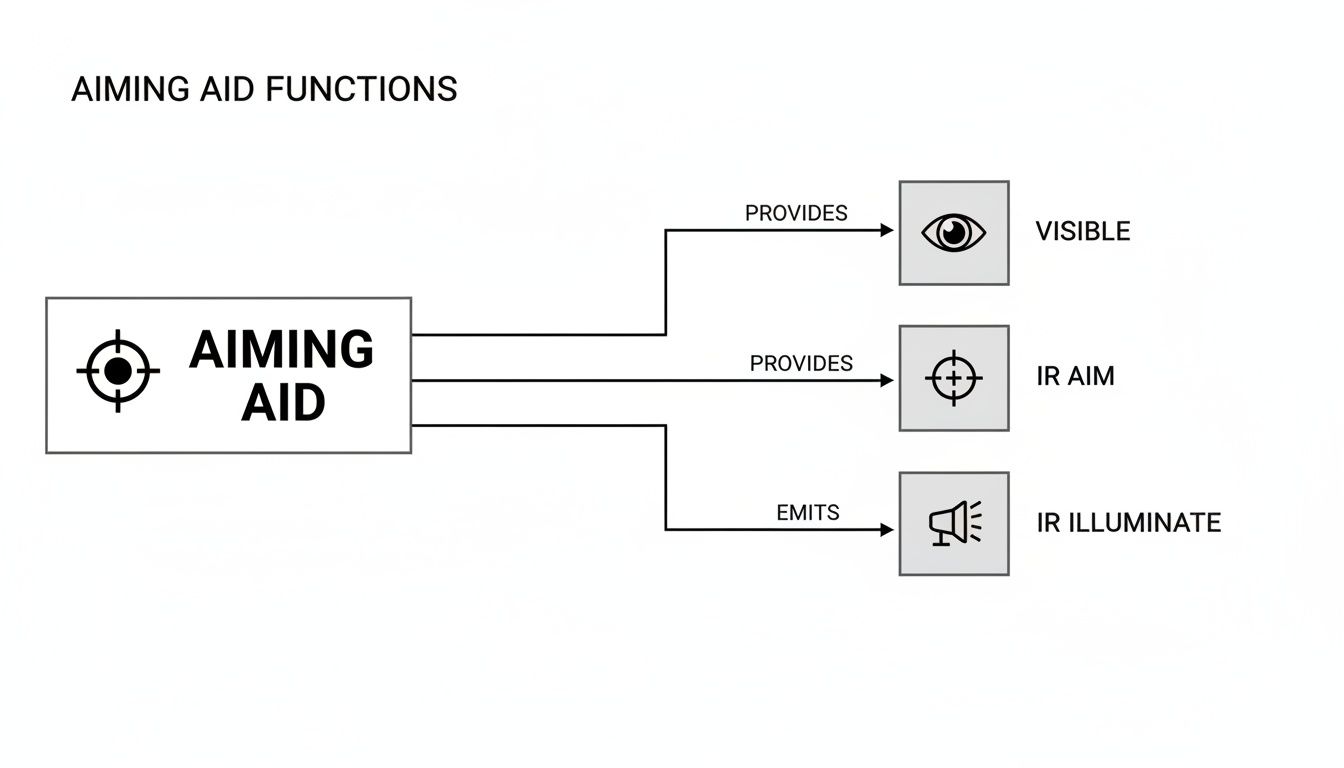
As you can see, the IR modes are the heart and soul of its partnership with night vision.
Conquering Absolute Darkness with an IR Illuminator
While the IR laser handles the aiming, the IR illuminator solves another huge problem you face at night: light starvation. NVDs work by amplifying tiny amounts of ambient light from the moon or stars. But what happens when there is zero ambient light—like inside a sealed building, a deep cave, or just on a moonless, overcast night? Your NVDs have nothing to amplify, and you're left just as blind as everyone else.
This is where the IR illuminator comes in, acting as your own personal invisible floodlight. It throws a wide beam of infrared light downrange that your NVDs can see perfectly, turning a grainy, static-filled image into a clear, detailed picture.
This is critical for:
- Positive Target ID: Making sure you can tell a threat from a non-threat at a distance.
- Situational Awareness: Scanning a wide area to spot obstacles, doorways, or other people.
- Navigation: Moving through tricky, dark terrain becomes much safer and faster.
The science behind this goes way back. The PEQ laser lights we use today are direct descendants of the laser research boom of the 1960s, a journey that kicked off with Theodore Maiman's first successful ruby laser demonstration on May 16, 1960. That breakthrough paved the way for the development of the precise, eye-safe IR wavelengths used in devices like the PEQ-15.
A Real-World Scenario
To really see how this all comes together, picture a law enforcement officer clearing a warehouse after a break-in. The power is out, and the inside is a maze of shelving and deep, dark shadows.
Without a PEQ, the officer’s only option is a white light, which instantly broadcasts their position to everyone in the building. With a PEQ and NVDs, they can move silently, using the IR illuminator to scan the aisles and spot the suspect without being seen. Once the target is located, the IR laser gives them an instant, precise aiming solution.
This system turns a high-risk gamble into a controlled situation where the good guy has a massive information advantage. It’s this powerful synergy that has made the peq laser light an essential tool for anyone who needs to own the night.
To dig deeper, see our guide on how an infrared illuminator for night vision can seriously upgrade your low-light capabilities.
Real-World Applications for Tactical and Civilian Use
It’s one thing to talk about specs and features, but where a PEQ laser light really proves its worth is out in the field. This isn't just a gadget to bolt onto a rifle; it's a genuine problem-solver that gives you a massive advantage when the lights go out and the stakes get high. Whether for professional operators or prepared civilians, its uses are specific, practical, and often critical.
The core benefit, no matter the user, is the ability to see, aim, and navigate in environments that would otherwise leave you completely blind. A PEQ unit essentially turns darkness from a crippling weakness into a tactical advantage. For many, that capability is the deciding factor between success and failure—or even life and death.
Law Enforcement and SWAT Operations
For any law enforcement team, but especially SWAT, a PEQ is pretty much standard-issue gear. Think about executing a high-risk warrant or clearing a dark, unfamiliar building. Positive target identification isn't just a goal; it's a legal and moral necessity. This is where the IR illuminator becomes invaluable, letting officers light up an entire room with invisible light to confirm a threat without giving away their position with a blast of white light.
Picture a team stacked on a door. Before they even make entry, they can use the illuminator to "paint" the room, getting a clear picture of the layout and identifying any immediate threats. Once inside, the IR laser offers a fast, instinctive way to aim while wearing helmet-mounted NODs. This lets them keep their head up, maintain situational awareness, and accurately engage threats from awkward shooting positions.
A PEQ system gives officers control of the engagement. They can see, identify, and aim long before a suspect even knows they're there, which dramatically increases officer safety and the odds of a peaceful resolution.
This ability to operate covertly is a game-changer for de-escalation and minimizing risk for everyone involved. Seeing first means making better decisions under intense pressure.
Nocturnal Hunting and Pest Control
Night vision and PEQ technology have completely reshaped the world of nocturnal hunting. If you're out chasing predators like coyotes or dealing with invasive species like feral hogs, a PEQ laser light is an absolute must-have for hunting ethically and effectively. These animals are busiest after dark, operating in an element where hunters used to be at a huge disadvantage.
The IR laser is the real hero here. It lets a hunter put a precise, invisible aiming point on the target without sending it running for the hills, which is a constant problem with visible red or green lasers. Combine that with the IR illuminator, and a hunter can scan an entire field, positively identify their quarry, and take a clean, ethical shot in what appears to be total darkness.
- Positive Identification: The IR illuminator is crucial for telling the difference between your target and a non-target animal or nearby livestock, preventing a tragic mistake.
- Precision Aiming: The IR laser guarantees accurate shot placement, resulting in a quick, humane harvest.
- Stealth Advantage: The entire setup is covert. You see them, but they have no idea you're there.
This system doesn't just boost success rates; it fundamentally supports more responsible and ethical hunting in some of the most challenging conditions.
Civilian Preparedness and Home Defense
For the citizen focused on preparedness, a PEQ offers a powerful advantage in a home defense situation. A home invasion is a chaotic, terrifying event, and it almost always happens in low light. The ability to move through your own home, identify a potential threat, and aim your firearm without fumbling for a light switch is a massive force multiplier.
Imagine the power is out. The IR illuminator lets you navigate your home safely, and the IR laser gives you a foolproof aiming solution if you're forced to defend yourself. This is worlds better than using a standard weapon light, which acts like a giant "shoot here" sign, instantly broadcasting your exact location. The various applications of night vision paired with a PEQ go far beyond just self-defense, helping with everything from finding a lost pet at night to general property security.
And let's not forget the visible laser. In a high-stress encounter, it can be a powerful psychological deterrent. It's also an incredibly simple aiming tool that works without needing to look through an optic. The versatility to switch between visible and IR modes makes the PEQ an incredibly robust tool for keeping your family safe, turning a dark and vulnerable home into a controlled environment.
How to Choose the Right PEQ Laser Light for Your Needs
Picking the right PEQ laser light can feel overwhelming. You're hit with a wall of acronyms, power ratings, and tech specs that can make your head spin. But let's cut through the noise. The most important question to ask yourself is simple: what is my mission?
Once you have a crystal-clear answer to that, the right choice practically reveals itself. The goal is to match the unit’s real-world capabilities to your intended use, whether that's hunting hogs under the cover of darkness, setting up a rifle for home defense, or professional tactical work. Not all PEQs are built the same, and knowing the key differences will save you a lot of time and money.
H3: Laser Power and Class Ratings
One of the biggest lines in the sand you'll encounter is the one drawn between civilian-legal and full-power units. The distinction all comes down to the laser's power output, which is strictly regulated for eye safety.
Civilian-legal units are almost always Class 1 or Class 3R. These devices keep their power output low enough to be considered eye-safe under normal circumstances, which drastically cuts down the risk of accidentally hurting someone. Don't let the "lower power" label fool you, though. A quality civilian model is plenty capable for most uses like hunting or home defense, easily reaching out a few hundred yards.
Full-power units, typically reserved for military and law enforcement, fall into the Class 3B category. These are the real deal—lasers powerful enough to paint a target at extreme distances. That power, however, comes with a serious risk of causing permanent eye damage. This is exactly why their sale is restricted to government and agency personnel only.
H3: Understanding the Key Specs
Beyond the laser class, a few other specs will make or break your decision. Thinking through these details beforehand ensures the PEQ you get will fit your rifle and your overall plan.
- Illuminator Beam Pattern: Is the IR illuminator fixed or adjustable? A fixed beam is simple and great for close-quarters work. An adjustable beam, on the other hand, gives you the flexibility to either flood an entire room with light or tighten the beam to spot a target way out there.
- Weight and Size: On a rifle, every single ounce counts. A smaller, lighter unit might be the perfect match for a compact SBR, while a designated marksman rifle could easily accommodate a larger, more powerful device.
- Battery Life: You need to know how long the unit runs and what kind of batteries it eats. Most use CR123A batteries, which are easy to find but can get pricey. Make sure the runtime fits how you actually plan to use it.
- Mounting System: Nearly all PEQ units clamp onto a standard Picatinny (RIS) rail. Double-check that you have enough open rail space and think about where it will sit in relation to your optic, flashlight, and hands.
The choice between a civilian and full-power PEQ isn't just about what's legal—it's about matching the tool to the job. For the vast majority of people, a high-quality civilian laser provides all the capability they'll ever need, without the immense liability and red tape of a restricted unit.
To make things clearer, let's break down the key differences side-by-side.
Civilian vs. Full-Power PEQ Unit Comparison
Understanding the key differences in specifications and legality between civilian-accessible and restricted PEQ laser light devices.
| Feature | Civilian-Legal Unit (e.g., Class 1) | Full-Power Unit (e.g., Class 3B) |
|---|---|---|
| IR Laser Power | Lower output (<0.7mW) | High output (>5mW) |
| Effective Range | Effective to several hundred yards | Effective to 1,000+ yards |
| Eye Safety | Generally considered eye-safe | Poses a significant eye hazard |
| Legality | Unrestricted for civilian purchase | Restricted to LE/Military |
| Primary Use | Hunting, home defense, training | Military combat, LE operations |
As you can see, the specifications are worlds apart, and for good reason. Each is designed for a completely different operational environment.
H3: Matching the Device to Your Mission
At the end of the day, your choice has to be driven by your specific needs. Are you a hog hunter who needs to ID and shoot targets inside 200 yards? A solid civilian-legal PEQ laser light with a good illuminator is your ticket. Setting up a carbine for home defense? A compact, simple-to-use unit is what you want.
Don’t get tricked into chasing the highest power ratings or the most bells and whistles. Focus on what you actually need to accomplish. By thinking realistically about your engagement distances, weight budget, and the law, you'll be able to confidently pick a device that will serve you well for years to come.
Getting Set Up: Maintenance and Zeroing Your PEQ
Just bolting a PEQ laser light onto your rifle is only half the battle. The real secret to making it a truly effective tool lies in the setup, zeroing, and a little bit of routine care. These aren't just "nice-to-have" steps; they're what separate a high-tech paperweight from a piece of gear you can bet your life on. Skip them, and you're setting yourself up for missed shots and a serious lack of confidence when it matters most.
It all starts with a rock-solid mount. Your PEQ needs to be clamped down tight on your rifle's Picatinny rail, with absolutely no wiggle or play. A loose mount is the number one enemy of a good zero, so make sure those clamps are torqued down to spec. If the unit can shift, your zero will shift with it.
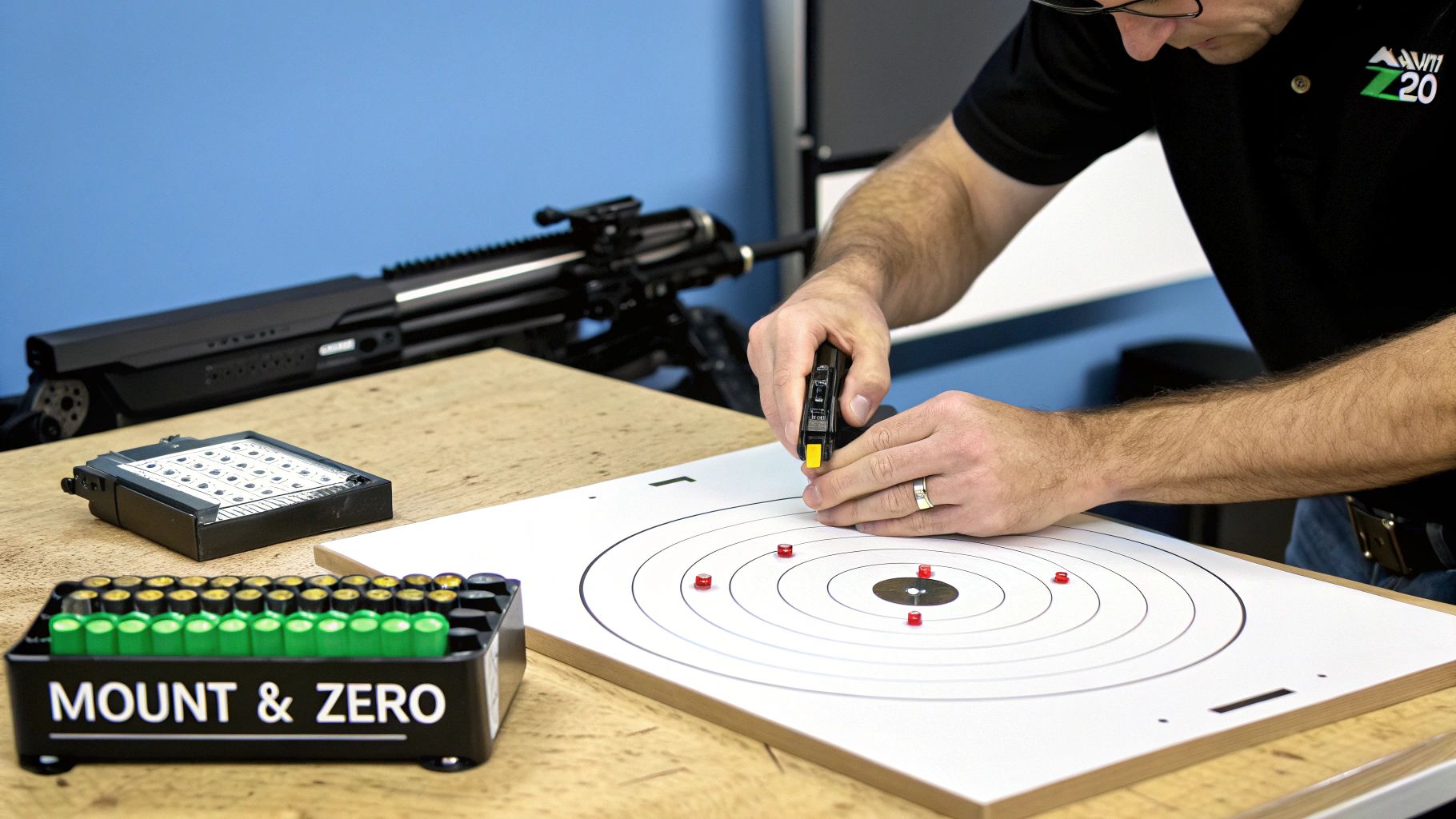
The Co-Witnessing Shortcut
By far the quickest way to get your PEQ on target is to co-witness it with an optic you've already zeroed, like a red dot sight. Think of it as creating a parallel aiming system—you're making your laser and your primary optic agree on where the bullet is going to land at a specific distance.
- Get Your Baseline: First things first, make sure your red dot or scope is dialed in and properly zeroed. A 50-yard zero is a common and effective starting point. This optic is now your source of truth.
- Turn on the Visible Laser: Switch your PEQ to its visible laser mode.
- Stack the Dots: Aim your rifle at a distant target. Keeping the rifle perfectly still, use the small windage and elevation knobs on the PEQ unit to "walk" the laser dot until it sits perfectly on top of your red dot's reticle.
That's it. Your visible laser is now zeroed. The best part? The next step doesn't even require you to fire another round.
Aligning the IR Laser
One of the most brilliant design features of a modern PEQ is that the visible and IR lasers are slaved to each other. Once one is zeroed, the other is just a simple adjustment away.
Think of this as convergence. You've already made the visible laser converge with your trusted, zeroed optic. Now, you just need to make the IR laser converge with the visible one. This makes the whole system dead simple to use under night vision.
With your visible laser still on, switch your PEQ to a mode where both the visible and IR lasers are active at the same time. Looking through your night vision, you'll see both dots. Simply adjust the IR laser until its dot is perfectly stacked on top of the visible one. Done. Both lasers are now zeroed and ready for duty.
Keeping Your Gear in the Fight
A zero is a terrible thing to waste. A few simple maintenance checks will ensure your PEQ stays reliable and on-target, even after a hard day on the range.
- Battery Health: Stick with high-quality CR123A batteries. Always check the charge before you head out, and if you're storing the unit for a while, pull the batteries out to prevent any nasty corrosion.
- Keep it Clean: The lenses for your lasers and illuminator will inevitably get caked with dust, mud, or carbon. A quick wipe with a microfiber cloth and a good lens cleaner will keep the beams bright and crisp.
- Confirm Your Zero: If you've bumped your rifle or put it through a demanding training day, take a second to confirm your zero. A quick check at the start of a session is cheap insurance against a miss down the line.
Your PEQ Laser Questions Answered
Stepping into the world of PEQ-style laser units can feel a bit overwhelming, especially when it comes to the rules and practical uses. We get a lot of questions about these devices, so let’s clear up some of the most common ones.
Are PEQ Lasers Legal for Civilians?
Yes, absolutely. Civilian-legal versions of these devices are readily available and perfectly legal for you to own.
The key difference lies in the laser's power output. Civilian models are typically classified as Class 1 or Class 3R lasers. These are regulated by the FDA to keep the power at a level that won't cause eye damage with a brief or accidental glance.
Full-power military units, on the other hand, are a different beast. These are often Class 3B lasers with a much higher output, posing a serious risk of permanent eye injury. For that reason, their sale is restricted to military and law enforcement agencies. Your best bet is always to buy from a reputable dealer to make sure you're getting a compliant, civilian-legal unit.
Can I Use a PEQ Without Night Vision?
You sure can. Every PEQ-style unit has a visible laser (usually red or green) that works just like any other laser sight during the day or in low light. It's a fantastic tool for aiming quickly without needing night vision goggles.
But to be blunt, you'd be missing out on the whole point of the system.
The real magic of a PEQ is its infrared laser and illuminator, both of which are completely invisible to the naked eye. To see and use these features, you absolutely have to pair the unit with a night vision device.
What's the Difference Between an IR Laser and an IR Illuminator?
This is a great question, and it gets to the heart of how these systems work. The easiest way to think about it is like using a laser pointer versus a flashlight.
The IR Laser is your laser pointer. It projects a tiny, precise dot of infrared light that only your night vision can see. You place that dot on your target, and that's where your shot is going. It's all about pinpoint aiming.
The IR Illuminator is your flashlight. Instead of a dot, it throws a wide beam of infrared light, "illuminating" a whole area. This IR floodlight gives your night vision device the energy it needs to see clearly in pitch-black conditions, letting you spot targets, navigate, and maintain situational awareness.
At Superior Tactical LLC, we provide the mission-ready gear you need to operate effectively in any lighting condition. Explore our full range of laser aiming modules and night vision optics today.
