Understanding PEQ 15 Cost a Buyer’s Guide
When you ask about the PEQ 15 cost, there's no single, simple answer. The price tag can swing wildly, from just a few hundred bucks for a simple look-alike to well over $2,500 for a restricted, full-power unit on the gray market.
For most civilian shooters, the sweet spot is a brand-new, civilian-legal ATPIAL-C. You can generally expect to pay somewhere between $1,400 and $1,800 for one. Think of it like shopping for a vehicle—the final price tag is a direct reflection of its performance, authenticity, and legal status.
What Does a PEQ 15 Really Cost?
The term "PEQ-15" refers to the AN/PEQ-15, also known by its manufacturer's name, the Advanced Target Pointer Illuminator Aiming Laser (ATPIAL). It’s an all-in-one device that bundles a visible laser, an infrared (IR) laser for aiming with night vision, and an IR illuminator to light up your target in the dark.
The massive price differences all come down to what's under the hood. A full-power military model packs a high-output laser that's restricted from public sale, while its civilian counterpart is specifically engineered with an eye-safe laser to comply with federal regulations.
At the end of the day, the cost of any laser aiming module is tied directly to its power output, durability, and legal status. Higher power and restricted access always mean a much higher price tag on specialized markets.
This chart gives you a clear visual breakdown of where different aiming devices fall on the cost spectrum.
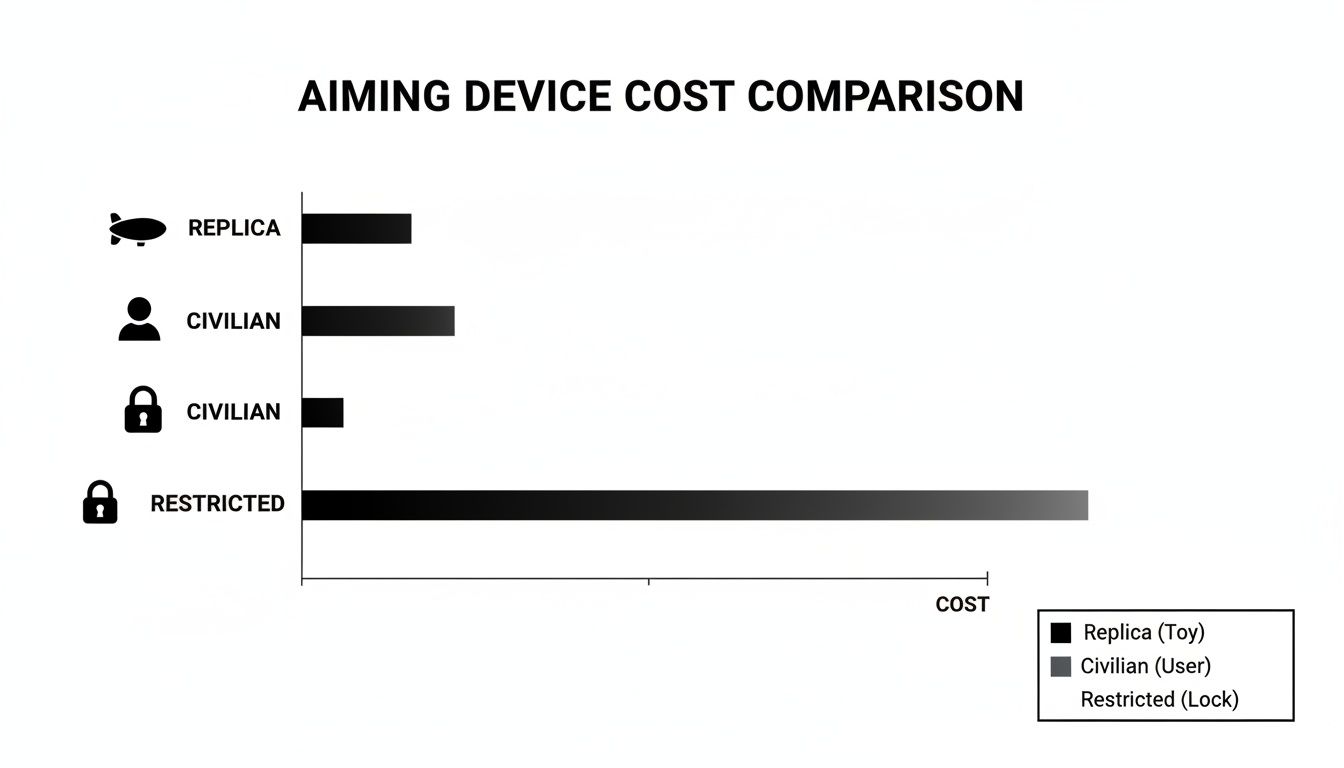
As you can see, jumping from a basic replica to a genuine civilian-legal unit is a serious financial commitment. The restricted, full-power devices sit in their own category entirely, with prices driven by scarcity and raw performance.
Understanding the Main Tiers
To really make sense of the market, it helps to break it down into three distinct tiers. Each one is built for a different user, with a vastly different price and feature set. While you can dive deeper in a complete guide to laser aiming modules, here’s the quick-and-dirty breakdown:
- Restricted Military/LE Units: These are the real deal—full-power devices that are not sold to the general public. When they pop up on secondary markets, they command premium prices, often pushing past $2,500.
- Civilian-Legal Models: Devices like the ATPIAL-C are purpose-built for the commercial market. To meet regulations, their IR lasers are dialed down to be eye-safe, and you’ll find them new from authorized dealers for $1,400 to $1,800.
- Replicas and Clones: These are essentially dummy units or airsoft-grade copies. They look the part and are cheap at $100 to $300, but they are completely unsuitable for a real firearm—they can't hold zero, and recoil will shake them apart.
Full Power vs. Civilian Lasers and Why It Matters
When you start shopping for a PEQ-15, the single biggest factor dictating the price tag is the power output of its infrared (IR) laser and illuminator. This one detail splits the market into two very different categories: "full-power" units for military/LE use and "civilian-legal" commercial models. Getting a handle on this difference is the most important step in making a smart buy.
A good way to think about it is like a professional race car versus a high-end sports car you can buy at a dealership. They might share a similar design and purpose, but one is built with zero compromises for a closed track, while the other has to follow specific rules to be legal on public roads. That's the exact relationship between military and civilian aiming lasers.
Understanding Power Regulations
The "full-power" PEQ-15s, the ones built for warfighters, have lasers that are absolutely not eye-safe. Their sale and distribution are tightly controlled under the International Traffic in Arms Regulations (ITAR). Because of this, you simply can't walk into a store and buy one new as a civilian.
On the other side of the coin, you have commercial models like the ATPIAL-C (the "C" is for Commercial). These are designed from the ground up to meet Food and Drug Administration (FDA) regulations, which cap their IR laser output at an eye-safe level of less than 0.7 milliwatts (mW).
The core difference isn't build quality—it's regulated power. A civilian unit from a top-tier brand is just as tough as its military sibling; the laser is simply dialed back to comply with federal safety laws.
This power difference has a massive impact on cost and availability. A genuine, full-power PEQ-15 that makes its way onto the second-hand or "grey" market will easily fetch over $3,000. In contrast, you can buy a brand-new, high-quality ATPIAL-C from an authorized dealer for anywhere between $1,400 and $1,800.
Practical Performance Differences
So, what does that power gap actually look like out in the field? It really comes down to effective range, especially when you fire up the IR illuminator.
-
Civilian Lasers (<0.7mW): For most of us, these units are more than capable. You get a sharp aiming point and enough IR light to positively identify targets out to 100-150 yards in decent conditions. This is plenty of juice for home defense, carbine courses, and most nighttime hunting.
-
Full-Power Lasers (>0.7mW): This is where you see what unrestricted power can do. These devices can throw a usable aiming laser and a powerful beam of illumination well past 300-400 yards. That kind of reach is critical for military teams who might need to engage threats at much greater distances.
At the end of the day, your choice boils down to your real-world needs and budget. For the vast majority of civilian shooters, a quality Class 1 laser system delivers all the performance you'll ever need. You get a durable, reliable aiming device without the crazy price tag and legal headaches of chasing a restricted unit. To see how these devices pair with other gear, you might want to check out our guide to PEQ laser and weapon light setups.
Decoding the Market: New, Used, and Clones
When you start shopping for a PEQ-15 or a similar laser unit, you'll quickly realize the market is split into three very different tiers. You have brand-new units, the sprawling used market, and the cheap clones. Where you decide to spend your money will completely change the price, performance, and potential headaches you'll face.
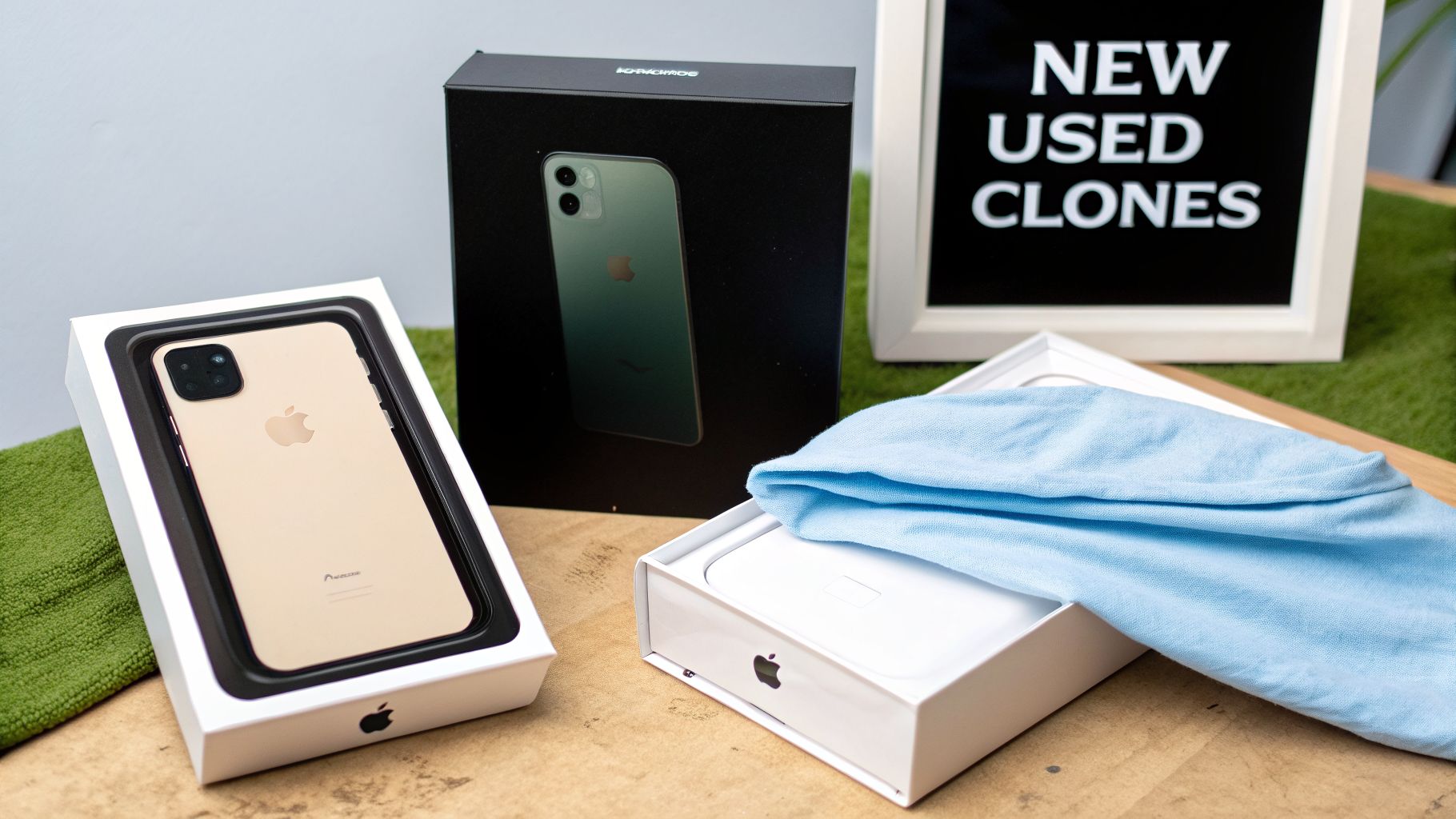
Honestly, the easiest way to wrap your head around this is to think about the iPhone market. You can walk into an Apple store and buy a new one, no questions asked, with a full warranty. You can also hop on eBay and find a used one for a discount, but you’re taking a bit of a gamble. Or, you could buy a cheap knockoff from a sketchy website that looks the part but is basically a paperweight. The PEQ-15 world isn’t much different.
New Civilian Models: The Safest Bet
For most folks, buying a new, civilian-legal unit like an ATPIAL-C from an authorized dealer is the "buy once, cry once" approach. It's the most straightforward and secure way to get into the game.
You get a device that’s factory-fresh, 100% authentic, and backed by a manufacturer's warranty and customer support. Yes, this is the most expensive route for a civilian-legal unit, typically running from $1,400 to $1,800. But that price buys you peace of mind and eliminates all the guesswork and risk that comes with the other options.
The Used Market: Deals and Dangers
Welcome to the wild west of tactical gear. In the used market, you can find just about anything, from a lightly used ATPIAL-C for a good discount to a legitimate, full-power military surplus PEQ-15 that "fell off a truck." The price here is all over the map, driven by the unit’s condition, who made it, and its power output.
While there are definitely some fantastic deals to be had, this territory is absolutely riddled with traps. You could easily end up with a damaged unit someone is trying to offload, a stolen device, or a cleverly disguised fake. You have to vet the seller and inspect the unit with a fine-toothed comb before any cash leaves your wallet.
A classic trap I've seen countless times is someone paying a huge premium for a "full-power" unit that's really just a beat-up civilian model with fake stickers. Checking for authenticity isn't just a good idea—it's absolutely essential to avoid getting fleeced.
Clones and Replicas: The Airsoft Option
Last up is the clone market. These devices are purely for looks, designed to mimic a real PEQ-15 for airsoft or for guys who just want the aesthetic on a rifle they don't actually shoot. At $100 to $300, they are functionally props, not professional tools.
Let's be clear: these are toys. They're made with cheap plastic that will crack under firearm recoil, the electronics are bargain-bin quality, and the lasers are pathetically weak. Most importantly, they will not hold zero, making them completely useless for aiming. Don't even think about putting one on a real firearm.
How to Spot a Fake PEQ-15
Telling a genuine unit from a good clone takes a bit of practice. As you'll see when looking at any option for the best AR laser, quality is everything. Here’s a quick-and-dirty checklist to help you sniff out the fakes:
- Housing Material: A real PEQ has a rugged, matte-finish polymer body. It feels substantial. Clones often use cheap, shiny plastic that feels brittle and hollow.
- Sticker Quality: Look closely at the data matrix stickers on the side. Real units have crisp, high-resolution printing. Fakes will often have blurry text, wrong fonts, or labels that are already peeling at the edges.
- Selector Switch: On a genuine PEQ-15, the mode selector switch has a solid, tactile "click" you can feel and hear as it snaps into each position. Clones usually have a mushy, vague-feeling switch with no positive engagement.
- Battery Cap: Check out the battery cap and the little steel lanyard that keeps it from getting lost. Authentic units use robust hardware. Fakes often have a flimsy lanyard that feels like it will snap if you look at it wrong.
The Hidden Costs of a Complete Laser Setup
Don't let the price tag on the PEQ-15 itself fool you. Getting the laser is just the start of your journey, not the end. To build a rifle that’s actually effective and ready for the field, you need to budget for the essential accessories that make the whole system work together.
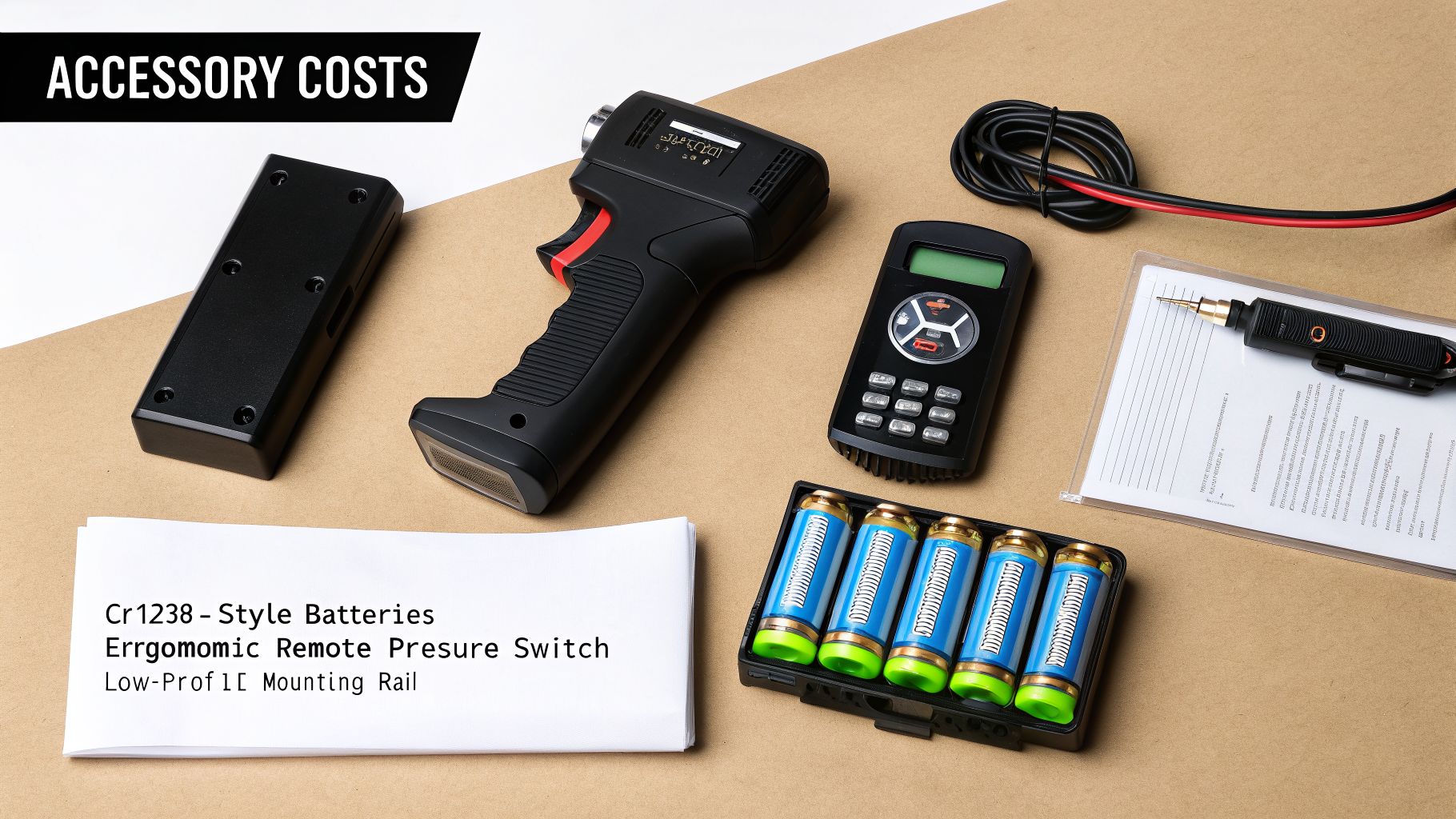
It’s like buying a high-performance engine; you still need a transmission, wheels, and a steering wheel to actually go anywhere. A lot of first-time buyers make the mistake of blowing their entire budget on the laser, only to find their setup is clumsy and impractical to use.
Be realistic and plan to spend an additional $200 to $500 on these critical components. This extra investment is what turns an expensive paperweight into a truly capable tool, saving you a lot of frustration down the road.
Powering Your Device
Your laser is dead in the water without a reliable power source. For a PEQ-15, that means a good supply of quality CR123A batteries. Going cheap on batteries is a classic rookie mistake that can have serious consequences, like your laser dying in the cold or failing when you can least afford it.
It’s not enough to just have batteries; you need the right ones. Stick with trusted brands like SureFire, Streamlight, or Duracell. They provide consistent power and are far less likely to leak and ruin the inside of your very expensive laser.
Plan on spending $20 to $40 for a dozen of these. That gives you enough for training days and duty use, with spares ready to go so you're never caught off guard.
Ergonomic Control and Mounting
While every PEQ-15 has a fire button on top of the unit, actually using it means shifting your support hand into an awkward, unnatural position. This is where a remote pressure switch becomes less of a luxury and more of a necessity. It lets you activate the laser instantly without ever breaking your grip.
-
Pressure Switches: A quality switch from a dependable brand like SureFire or Unity Tactical will run you anywhere from $70 to over $200. You’re paying for durability and the confidence that it will work every single time you press it.
-
Aftermarket Mounts: The factory mount works, but that’s about it. Many shooters upgrade to an aftermarket option almost immediately. Mounts from companies like Unity can raise the laser, freeing up valuable rail space for your support hand or other accessories. Expect to spend another $50 to $100 for this ergonomic improvement.
These aren't just "nice-to-have" upgrades. They are fundamental parts of a complete, functional fighting rifle. Factoring them into your total PEQ-15 cost from the very beginning is the only way to build a setup that is both dependable and truly effective.
PEQ-15 Legality: What You Absolutely Need to Know
Before you even think about the price tag, you've got to wrap your head around the rules of the game. Getting your hands on an IR laser isn't like buying a scope, and the legal side of things can be tricky. It all comes down to two big government agencies and how a device makes it to the market in the first place. Knowing this stuff is key to avoiding a bad deal or, worse, legal trouble.
First, let's talk about ITAR, the International Traffic in Arms Regulations. Think of ITAR as the government's way of keeping advanced U.S. military technology on a very short leash. Full-power aiming lasers, like the genuine military-issue AN/PEQ-15, are considered "defense articles."
That designation means they are strictly controlled. They can't be sold to the public or shipped out of the country without a special license from the State Department. This is the single biggest reason you can't just walk into a store and buy a brand new, full-power PEQ-15.
Civilian vs. Restricted Power
The other major player is the Food and Drug Administration (FDA). This might seem strange, but the FDA regulates all laser products sold in the U.S. to ensure they're safe for public use—from the barcode scanner at the grocery store to the laser on your rifle. Their main concern is preventing eye damage.
For a civilian to legally purchase one new, an aiming laser must be certified as "eye-safe." This typically means it falls into the Class 1 (or Class 3R for visible lasers) category, with an infrared power output capped at less than 0.7 milliwatts (mW).
This FDA rule is precisely why "civilian" models like the ATPIAL-C were created. Manufacturers build these units from the ground up to meet that power restriction, which makes them perfectly legal to sell to anyone in the U.S.
The Grey Market and Ownership Risks
Okay, so what about owning a full-power PEQ-15? Is that illegal for a civilian? Here's where it gets murky. While simply having one isn't usually a crime in itself, the way you got it is what matters most. Since they aren’t sold new to civilians, any full-power unit you find for sale is on the second-hand market, which is often a legal "grey area."
The real danger is that these units are almost always military or law enforcement surplus. A huge number of them are technically stolen or were "improperly demilitarized" government property. Buying stolen federal property is a felony, and good luck proving you acquired it legitimately if someone comes asking.
For that reason, the safest and most straightforward path is crystal clear:
- Purchase a new, civilian-legal model from a reputable, authorized U.S. retailer like Superior Tactical.
- This guarantees you get an authentic product with a real warranty and completely avoids any legal question marks.
Going this route saves you from the headache of fake units, potential legal drama, and the often-inflated peq 15 cost you'll find on the grey market.
Where and How to Make a Smart Purchase
So, you’ve decided a PEQ-15 style unit is right for you. Now comes the tricky part: actually buying one. How you get your hands on a unit is just as critical as which model you choose, and making the right call from the start can save you from owning a very expensive paperweight—or worse, a legal nightmare.
Let's cut right to the chase: the absolute safest and most recommended way to buy is from an experienced, authorized retailer. This is your ticket to a brand-new, factory-fresh civilian unit like an ATPIAL-C that is fully legal and compliant. This isn't just about getting a new toy; it's about the entire ecosystem of support that comes with it.
Think of it this way: buying from an authorized dealer gets you a full manufacturer's warranty, access to real experts who can help with setup and troubleshooting, and ironclad certainty that you aren't buying a knock-off or stolen property. That peace of mind is a huge part of the total PEQ 15 cost.
This stands in stark contrast to the Wild West of online forums and social media groups. Sure, the promise of a cheap deal is tempting, but you're rolling the dice. These places are hotspots for outright scams, busted units, convincing-looking clones, and even stolen government property. Getting caught with the latter can land you in some very serious legal trouble.
Vetting a Used Market Purchase
If you're still determined to hunt for a deal on the used market, you need to go in with your eyes wide open and a healthy dose of skepticism. Your ability to properly vet both the seller and the device itself is everything. Before a single dollar leaves your wallet, you have to insist on a thorough inspection.
Use this checklist as your guide. No exceptions.
-
Check the Seller, Not Just the Gear: Dig into their profile. Do they have a long history of transactions with positive feedback on similar high-value gear? Be extremely cautious of brand-new accounts or any seller who gets cagey when you ask for details.
-
Demand a Live Function Check: This is non-negotiable. Get them on a live video call and have them walk you through every function. You need to see the visible laser, IR laser, and IR illuminator all working perfectly. Make sure the selector switch clicks cleanly and positively into each and every position.
-
Do a Final Authenticity Inspection: Go back over all the tell-tale signs of a fake. Look closely at the housing, the stickers, and the hardware. A mushy or gritty selector switch, fuzzy text on the warning labels, or a cheap, glossy plastic finish are all massive red flags.
At the end of the day, the total peq 15 cost is an investment in your capability. By choosing a reputable source like Superior Tactical, you're ensuring that investment is sound. Making the smart choice upfront is the single best way to save yourself a world of frustration and money down the road.
Frequently Asked Questions
When you start digging into the world of tactical lasers, a lot of questions pop up, especially around what a PEQ-15 costs and what you’re really getting for your money. Let's clear the air with some straight answers to help you make a smart final decision.
What Is a Realistic Budget for a Complete PEQ-15 Setup?
Look, if you're serious about getting a dependable, new, civilian-legal setup in 2026, you need to budget between $1,600 and $2,300. It's a serious investment, and the cost breaks down into more than just the unit itself.
Here’s a realistic look at where that money goes:
- The Unit Itself: A high-quality, authentic ATPIAL-C or a comparable civilian-legal model is going to run you $1,400 to $1,800. There's just no way around that price for a new, legitimate unit.
- Essential Accessories: Set aside another $200 to $500. This covers a good remote switch (don't cheap out here), a healthy stock of reliable CR123A batteries, and maybe an aftermarket mount if you want better ergonomics or a more streamlined fit on your rail.
If you see a "deal" that's way below this price range, your alarm bells should be ringing. You're almost certainly looking at a junk clone or a beat-up used unit with a very questionable past.
A classic rookie mistake is only budgeting for the laser device. Forgetting about the accessories is like buying a high-performance car and not budgeting for fuel or tires—it’s not going to get you very far. You have to factor in the entire system to make it field-ready.
Is It Legal for a Civilian to Own a Full-Power PEQ-15?
This is where things get tricky. In the United States, it's generally not illegal for a civilian to own a full-power PEQ-15. The real question is how you got it.
Since these full-power units are not sold to the public, pretty much every one you see on the market is military or law enforcement surplus. The massive risk here is that buying stolen government property is a felony. And if you're ever questioned, proving you acquired it legitimately is next to impossible.
To stay completely clear of any legal trouble and guarantee you're getting a genuine, functional device, the answer is simple: stick to civilian-legal models from authorized dealers.
Why Can't I Just Use a Cheap Clone on My Rifle?
Because they're basically expensive paperweights. Clones are made for the airsoft market, designed to look the part for games and pictures, not for use on a real firearm.
They fail spectacularly in two ways that make them a total waste of money and a potential safety hazard. First, they can't hold zero. The first time you send a round downrange, the recoil will knock the laser off-target, making it completely useless for aiming. Second, their IR lasers are incredibly weak, offering zero practical illumination when you're actually using night vision. Don't even bother.
Ready to build a complete, professional-grade setup without the guesswork? Superior Tactical LLC is your trusted source for authentic, high-performance tactical gear, from night vision to lasers and accessories. Explore our curated selection of top-tier equipment and get started today at https://superiortac.com.
