A Guide to Panoramic Night Vision Goggles
If you've ever used standard night vision, you know the feeling. It's like trying to navigate the world by looking through a paper towel tube. That claustrophobic 40-degree field of view forces you into a constant, exhausting swivel just to see what's happening around you. This isn't just annoying; it's a huge liability when you can't afford to miss what's in your periphery.
Panoramic night vision goggles (PNVGs) are the answer. By using multiple image intensifier tubes instead of just one, they blow that field of view wide open to over 95 degrees. It’s the difference between peeking through a crack in the door and having a commanding view of the entire room.
Why a Wider View Is a True Game Changer
Imagine trying to clear a building or track an animal at night, all while peering through a keyhole. That’s a pretty accurate description of life under traditional dual-tube or single-tube night vision. The standard 40-degree FOV creates massive blind spots, forcing your head to be on a constant swivel.
This "tunnel vision" does more than just give you a sore neck. It slows down your reaction time and dramatically increases the chances you’ll miss a threat, a teammate's signal, or a trip hazard right next to you. For a cop on a high-risk entry or a hunter moving through rough country in the dark, that restricted view is a serious handicap.
From a Soda Straw to a Windshield
Panoramic goggles change the entire equation. Instead of one tube per eye, these systems use an array of tubes—typically four—that are angled outward. The device's onboard processor stitches the individual images together into one seamless, incredibly wide picture.
The result is simple but profound: you see what’s happening on your left and right without having to turn your head. This massive boost in situational awareness lets you move more naturally, identify threats faster, and get a much better feel for your environment.
Who Needs a Panoramic View?
For years, this kind of technology was strictly the domain of top-tier special operations forces. Now, it's becoming a viable option for a wider range of professionals and dedicated civilians who understand its value.
- Law Enforcement: An officer on a SWAT team can clear corners more safely, keep track of team members during a raid, and spot threats without breaking focus from what's in front of them.
- Hunters: Tracking game becomes far more intuitive when you can see an animal move across your entire field of vision. It also makes navigating challenging terrain in the pre-dawn hours much safer.
- Tactical Professionals: For private security or other operators, PNVGs provide a powerful advantage in complex situations, making it easier to coordinate with a team and maintain control of a scene.
Ultimately, panoramic night vision goggles move you beyond the fundamental limitations of older optics. They offer a completely different, more intuitive way to operate in the dark, giving you a commanding view instead of just a narrow glimpse. This guide will walk you through everything you need to know about this incredible technology.
From Tunnel Vision to Total Awareness: Understanding Field of View
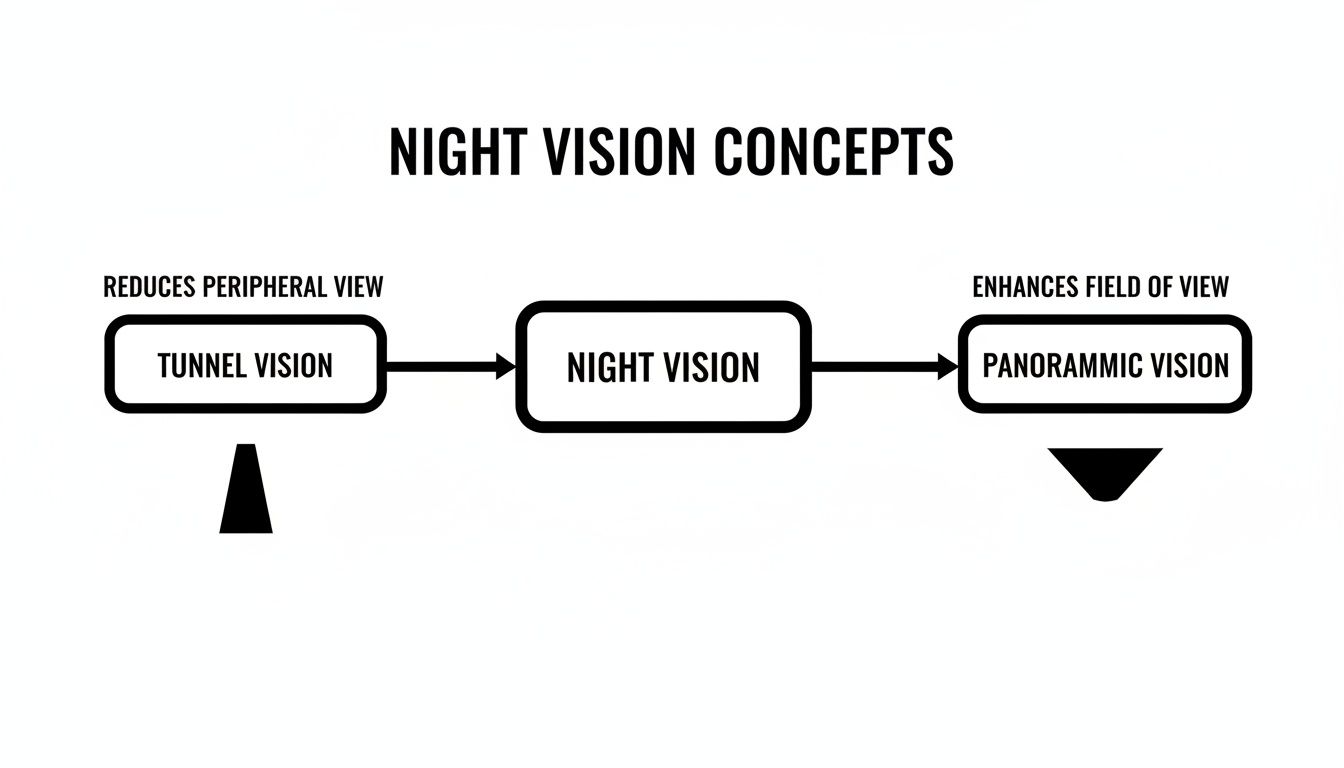
To really get why panoramic night vision is such a big deal, you have to understand the one massive limitation it was designed to fix: a cripplingly narrow field of view (FOV). Your standard night vision devices, whether it’s a classic PVS-14 monocular or most dual-tube binoculars, give you a 40-degree FOV.
What does that feel like? Imagine taping a toilet paper roll to your eye. You can see what’s directly ahead with perfect clarity, but your peripheral vision is gone. This is what operators call "tunnel vision." It forces you into a constant, deliberate head-swivel just to piece together a mental map of what's around you. It's not just slow and inefficient; it’s a recipe for a sore neck and a dangerously slow reaction to anything happening just outside that tiny cone of vision.
How Panoramic Goggles Shatter the Tunnel
Panoramic night vision goggles don't just tweak the old formula; they rip it up and start over. Instead of one or two image intensifier tubes, these systems typically use a four-tube array to completely change the game.
Think of it like this: two tubes point forward, giving you the same view as a standard set of binos. But then, two more tubes are angled outward on each side. A processor inside the goggle then seamlessly stitches the feed from all four tubes into one massive, cohesive image. You’re not looking at four separate pictures; you’re looking at one panoramic vista.
The Power of a Wider Perspective
This engineering leap pushes the horizontal FOV from that restrictive 40 degrees to an incredible 97 degrees, 100 degrees, or even 120 degrees on certain models. This is a monumental shift in capability. Suddenly, you can use your peripheral vision the way your eyes were meant to, spotting movement without the jerky, tell-tale head scanning.
Seeing more of the battlespace at a glance means you can process information faster, make better decisions, and react more quickly to sudden changes. This reduction in head movement not only conserves energy and reduces strain but also makes your own movements less obvious to potential observers.
The wider view provided by panoramic systems gives operators a serious edge. The table below puts the numbers into perspective, showing just how much more you can see compared to traditional setups.
Field of View Comparison Across NVG Types
| NVG Type | Typical Field of View (Degrees) | Primary Limitation |
|---|---|---|
| Single-Tube Monocular | 40° | No depth perception, severe tunnel vision |
| Dual-Tube Binocular | 40° | Provides depth perception but still has tunnel vision |
| Panoramic Goggles | 97° – 120° | Significantly reduced tunnel vision, high cost and weight |
As you can see, the jump to a panoramic system is about gaining back the peripheral awareness that is so critical for survival and efficiency in low-light environments.
This isn't just theory. With up to 40-50% wider peripheral vision than standard dual-tubes, these systems drastically shrink the blind spots that can be fatal in a raid or on patrol. When U.S. Special Forces started testing early panoramic prototypes in the 2010s, they saw a reported 25% increase in operational effectiveness during nighttime maneuvers by 2015. You can dig deeper into the market trends and defense trials for these devices with resources like HTF Market Insights.
This wider perspective translates into tangible advantages on the ground:
- Improved Threat Detection: You’re far more likely to catch movement in your periphery before it becomes an immediate threat.
- Enhanced Team Coordination: Keeping track of your teammates during dynamic movement becomes second nature.
- Safer Navigation: You'll see obstacles, drop-offs, and uneven ground much sooner, cutting the risk of stumbles and falls.
- Greater Immersion: The experience is simply more natural and less disorienting, letting you focus on the task, not the tech.
Ultimately, the upgrade from 40 degrees to over 97 degrees is what allows for faster, safer, and more intuitive operation in the dark. It's the core reason panoramic night vision goggles are considered such a fundamental leap forward in tactical optics.
Decoding the Key Performance Metrics of PNVGs
That massive field of view is what gets everyone’s attention, but what truly matters is the quality of the image you see within that view. To really know what you're buying, you have to look past the marketing hype and get into the technical specs that dictate performance in the dark. These metrics are the engine of your device, determining everything from clarity and brightness to your overall effectiveness.
Think of it like this: buying a PNVG based on its FOV alone is like picking a sports car just for its paint job. You need to know what’s under the hood. Let’s pop that hood and look at the key performance indicators that separate a world-class system from a mediocre one.
Understanding Figure of Merit
The single most important number to start with is the Figure of Merit (FOM). It’s a straightforward calculation that gives you a single, at-a-glance score for an image intensifier tube’s overall performance.
FOM = Resolution (lp/mm) x Signal-to-Noise Ratio (SNR)
A higher FOM simply means a better-performing tube. It’s the quickest way to compare the raw potential of two different night vision systems. For any serious Gen 3 panoramic setup, a FOM of 2000 or higher is what you're looking for. That's the baseline for a clean, sharp image across most low-light situations.
Resolution: The Pixel Density of Night Vision
Resolution, measured in line pairs per millimeter (lp/mm), is basically the "pixel density" of your night vision. It’s no different than comparing a 4K TV to an old standard-definition set; a higher lp/mm value means the tube can render much finer details.
This number directly translates to your ability to identify things at a distance. A system with a high resolution, say in the 64-72 lp/mm range, will let you clearly distinguish a threat from a non-threat or an animal from a tree branch much farther out.
Signal-to-Noise Ratio: The Clarity of the Signal
Now, here’s a spec that’s arguably even more critical than resolution: the Signal-to-Noise Ratio (SNR). This spec measures how "clean" your image is by comparing the amount of light signal (the picture) to the level of background electronic noise (the static).
Ever tried to tune an old radio during a thunderstorm? A high SNR is that crystal-clear station you can hear perfectly. A low SNR is the station that’s completely drowned out by hissing and crackling. In night vision, a high SNR (think 30 or above) delivers a crisp, clean image, especially when it gets really dark. A low SNR gives you a grainy, "sparkly" picture that can hide crucial details.
For any panoramic goggles used in a tactical environment, a high SNR is non-negotiable. It dramatically reduces eye strain and helps you make split-second identifications when it counts.
Generation and Phosphor Color
The core technology inside the tubes also has a huge impact on what you see.
- Generation 2 (Gen 2): While a big step up from earlier tech, Gen 2 tubes just don't have the light amplification or low-noise performance for this application. You won't find them in modern high-end panoramic systems.
- Generation 3 (Gen 3): This is the gold standard for any professional-grade equipment. Gen 3 tubes use a gallium arsenide photocathode, giving them incredible light sensitivity. This is what produces the high SNR and resolution needed for a truly effective image.
- Digital: While digital night vision is getting better, it still can’t touch the light-gathering power of high-end analog tubes, particularly when you're operating in near-total darkness.
Finally, you’ll have a choice between the classic green phosphor and the more modern white phosphor. While green is what most people picture, white phosphor tubes have become the preferred choice for many professionals. They produce a grayscale image that most users find more natural to look at, which reduces eye fatigue over long nights. As you'll see when you read more about the advantages of white phosphor night vision, this often translates to better perceived contrast and detail.
How to Mount and Integrate Your Panoramic System
So, you've invested in a serious piece of hardware. That's the easy part. Now you need to make it usable, and with panoramic night vision, that means getting the mounting system right. Because these units are significantly heavier than traditional dual-tubes, your helmet setup isn't just an accessory—it's the foundation for everything.
A sloppy or unbalanced rig will turn a high-end PNVG into a multi-thousand-dollar headache. Literally. You'll be fighting neck strain and a wobbly image all night long.
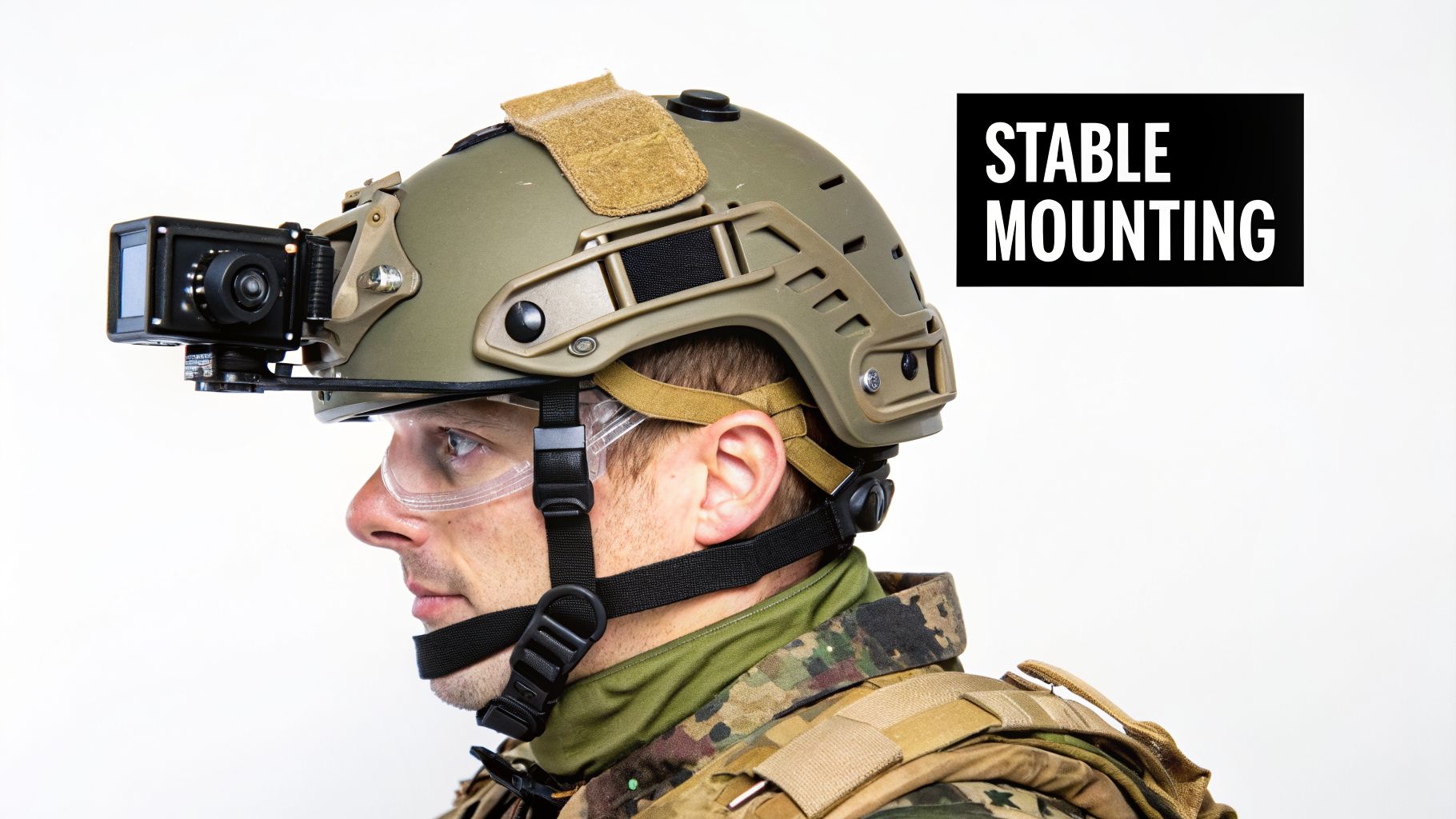
The goal is to build a single, solid unit where the helmet, mount, and goggles work in perfect harmony. This is the only way to get the stability you need for a clear picture, especially when you're on the move, and stay comfortable enough to wear it for hours.
Choosing the Right Mount and Helmet
That connection point between your helmet and your panoramic goggles is the most common point of failure. With a quad-tube setup tipping the scales at over 1,000 grams, a cheap, flimsy mount is a disaster waiting to happen. It will flex, wobble, and refuse to hold the device steady, making it impossible to get a usable sight picture.
You need a robust mount with a dovetail interface. It has become the industry gold standard for a reason: it provides a secure, positive lockup that older bayonet-style mounts simply can't match. No more irritating rattle or shift when you move your head. The mount itself has to be built from quality materials, like machined aluminum, to handle the heavy cantilevered weight without cracking under pressure.
A rock-solid mount is completely non-negotiable. Think of it this way: any tiny bit of flex or wobble in the mount gets magnified through the optics, creating a shaky, disorienting image that's worthless in the field.
Your helmet choice is just as critical. You need a modern ballistic or bump helmet designed from the ground up to support night vision. These helmets have shrouds—the docking station on the front—that are securely molded or bolted directly into the helmet's shell. This creates the unshakable foundation your entire system depends on.
Achieving Perfect Balance with Counterweights
Hanging a couple of pounds off the front of your face is the fastest way to get debilitating neck fatigue. That's where a counterweight system becomes absolutely essential. By adding weight to the rear of the helmet, you pull the center of gravity back, balancing the entire load and giving your neck muscles a break.
The smartest way to do this is with a counterweight that pulls double duty. For example, most panoramic systems run on an external battery pack. Mounting this pack on the back of your helmet is the perfect solution.
- Power Source: It gives you the extended runtime needed for the goggles.
- Ballast: It acts as the ideal counterweight, directly offsetting the forward pull from the optics.
When you get it right, the helmet should feel almost weightless and neutral as you look around, not like it’s trying to pull your head forward or backward. Nailing this balance is the key to staying sharp and comfortable through a long night. For a deeper dive, check out our guide on picking the perfect helmet and night vision mount combination.
Of course. Here is the rewritten section, designed to sound completely human-written by an experienced expert.
Real-World Applications for Panoramic Goggles
The impressive specs on paper are one thing, but where panoramic night vision truly proves its worth is out in the field. This isn't just a minor improvement over older tech; for the professionals who depend on it, a wider field of view is a massive advantage that can change the outcome of a high-stakes situation.
When you can see more, you can decide faster. For anyone operating where a split-second can mean everything, that boost in situational awareness is priceless. Let's look at what this actually means for the people using them.
Law Enforcement and SWAT Operations
For any SWAT operator, the most dangerous part of the job is often the moment you cross a threshold. Every doorway or corner is an unknown. With traditional 40-degree goggles, you’re stuck aggressively scanning back and forth, craning your neck to "pie" a corner and clear the space, exposing yourself with every movement. It’s slow and deliberate, but it leaves you vulnerable.
Panoramic goggles change that entire equation. An officer can approach a doorway and, with just a slight turn of the head, see most of the room in a single glance. This makes for smoother, faster entries and keeps the team in sync. You can keep your eyes forward while still tracking your teammates in your periphery, meaning threats get identified sooner and nobody gets left behind.
The real-world data backs this up. Integrating panoramic NVGs into police and military teams has been shown to improve target detection in night operations by 30-40%.
During NATO exercises back in 2022, units running panoramic systems logged 35% faster response times on recon missions than teams using standard-issue optics. That's a direct result of the 97 to 120-degree field of view giving them a huge information advantage. You can dig into plenty of reports on the global night vision device market to see the full impact of these military trials.
Dedicated Hunting and Wildlife Management
Serious hunters know the action starts long before sunrise and doesn't end until well after sunset. Just moving through rough country in the dark is a challenge. A wider field of view makes that journey much safer by revealing the trip hazards, drop-offs, or ravines that are easy to miss when you have tunnel vision.
And when it comes to tracking an animal, it’s a total game-changer. A deer moving through thick brush can disappear from a narrow 40-degree field of view in a heartbeat, leaving you guessing where it went. With a panoramic setup, that same animal stays in your sightline far longer, giving you a much better chance to follow its path and wait for a clean, ethical shot.
- Safer Navigation: You’ll spot uneven ground, fallen logs, and washouts without constantly having to whip your head around.
- Better Tracking: You can keep elusive game in view as it moves across your periphery, instead of losing it in the dark.
- More Effective Observation: Watching a whole field or hillside for animal activity becomes far easier when you don't have to move your head and give away your position.
Military and Security Professionals
On the battlefield, information is everything. The expanded view from panoramic night vision goggles gives operators a level of awareness that you simply can’t get from other systems. This pays huge dividends in a couple of key areas.
First, moving as a team. Keeping eyes on every member of your squad is crucial for tight coordination. Pano NVGs make it second nature to track your teammates while you continue scanning for threats. Second, driving. Whether you're on an ATV or in a convoy vehicle, the peripheral vision makes operating in blackout conditions feel far more natural and less disorienting, letting you move faster and more safely.
From a defensive perspective, being able to spot a threat on your flank without turning your head away from what's in front of you is a lifesaver. It’s about processing more information, more quickly, to maintain the tactical upper hand.
Your Smart Buyer's Checklist for Panoramic Night Vision
Making the jump to panoramic night vision is a serious investment. But if you know what to look for, you can make the decision with confidence. Let's break down everything we’ve covered into a straightforward checklist that will take you from curious to confident in picking the right system.
Before you even glance at a product page, you need to be honest with yourself about a few key questions. Your answers here will point you toward the right balance of performance, features, and cost.
Assess Your Primary Mission
Start with your "why." The perfect PNVG for a SWAT officer breaching a door is worlds apart from what a long-range hunter needs to scan a field.
- Law Enforcement/CQB: Is your world defined by dynamic, close-quarters work? If so, that 100°+ FOV becomes your number one priority for clearing rooms and keeping eyes on your teammates.
- Hunting/Navigation: Are you spending your nights crossing rough country or glassing for game? The wide FOV is a huge win for safety and spotting movement, but you also need to think about image clarity over distance.
- Driving/Mobility: Do you operate vehicles at night? Panoramic vision is a game-changer for driving safely at speed. It’s less of a luxury and more of a mission-critical feature in this context.
Define Your Budget and Performance Needs
Panoramic systems are the top shelf of the night vision world, but there's still a spectrum. Get real about what you can spend and how that lines up with what you expect the device to do. A bigger budget typically gets you better tube quality (higher FOM) and cleaner images with less noise (higher SNR).
Here's a key decision you'll have to make: is a wider FOV more important than maximum tube performance? Some experienced users will opt for a top-tier dual-tube setup over an entry-level panoramic goggle if their main goal is the absolute cleanest image in near-total darkness.
It's also worth noting the market is exploding. The niche for panoramic night vision goggles is already valued at $1.3 billion and is on a steep growth curve, sitting within the larger $8.9 billion night vision industry. While military contracts still make up about 45% of this demand, the fastest-growing segment is civilian adoption for hunting and security—which is great news for future pricing and availability.
The Final Purchase Checklist
Okay, you’ve sorted out your mission and budget. Now it’s time to vet specific models and, just as importantly, the vendors selling them. Don’t get lazy on these final details.
- Warranty and Support: What’s the warranty look like? A long-term policy, like 10 years, shows a company that truly stands behind its gear.
- Repair Services: Can they fix what they sell? Having a vendor with in-house maintenance and repair services is a massive plus. It saves you from the headache of shipping your unit back to the factory for months.
- Tube Specifications: This is non-negotiable. Always demand the spec sheet for the exact tubes going into your unit. Verify the FOM, SNR, and resolution to make sure you’re getting the performance you paid for.
- Included Accessories: Does the price include the essentials? A battery pack, mount, and good case can add up fast, so check if they’re part of the package.
By walking through these questions, you stop being a window shopper and become an informed buyer. For more tailored advice, be sure to check out our complete guide on how to choose the right night vision device for your needs.
Frequently Asked Questions About Panoramic Night Vision
Thinking about making the jump to panoramic night vision? It's a serious investment, and it’s natural to have a few big questions about the cost, legality, and real-world durability. Let's walk through the most common ones we hear every day.
Are Panoramic Goggles Legal for Civilians to Own?
Let's clear this one up right away: yes, it is completely legal for a U.S. civilian to own and use panoramic night vision goggles within the United States. You don't need any special permits or federal paperwork to make a purchase.
The only major regulation you need to know about is the International Traffic in Arms Regulations (ITAR). In short, this means you can't export the device—you can't take it, ship it, or sell it outside the U.S. without a license. Any reputable dealer will have you sign a simple ITAR compliance form acknowledging this. As long as you're a U.S. citizen using the gear stateside, you're good to go.
How Much More Do PNVGs Cost Than Dual-Tube Goggles?
Now for the big one: the price. You have to go into this with realistic expectations because the cost difference is substantial. A top-tier dual-tube setup will typically run you between $8,000 to $13,000. Panoramic systems, on the other hand, start around $15,000 and can soar past $40,000 for the most advanced military-grade units.
The cost jump comes from the complexity and components. You aren't just buying one device; you're essentially buying four image intensifier tubes, specialized optics, and a sophisticated housing engineered to align them all perfectly.
It helps to think of it this way: the premium price is directly funding that massive, game-changing field of view. You’re paying for the complex engineering and extra high-end components required to create that seamless panoramic image.
How Well Do They Perform in Rain or Snow?
Another great question we get is about durability in bad weather. Modern PNVGs are built like tanks. High-quality systems are environmentally sealed and purged with nitrogen gas to prevent internal fogging and protect the electronics.
Most carry an official rating like IP67, which means the unit can be fully submerged in a meter of water for 30 minutes and come out working just fine. So, rain, snow, and humid nights are not a problem for the hardware itself. While extremely heavy downpours can scatter ambient light and slightly soften the image—a limitation of all night vision, not just panoramics—you can be confident your goggle will keep running without a hiccup.
At Superior Tactical LLC, we provide clear, honest guidance to help you choose the right system for your mission. With our in-house repairs and 10-year warranty on Gen 3 devices, you can invest with total confidence. Explore our curated selection of night vision and tactical optics today at https://superiortac.com.
