Panoramic Night Vision Your Ultimate Explainer Guide
If you've ever used standard night vision, you know the feeling. It's like looking at the world through a toilet paper roll. This narrow, "tunnel vision" effect is the single biggest limitation of traditional NVDs. You're constantly sweeping your head back and forth, trying to piece together a mental picture of your surroundings, which is slow, tiring, and leaves you with massive blind spots.
Panoramic night vision completely shatters that limitation. It’s the difference between watching a movie on an old tube TV versus seeing it in a full-blown IMAX theater.
Beyond the Tunnel: An Introduction to Panoramic Night Vision
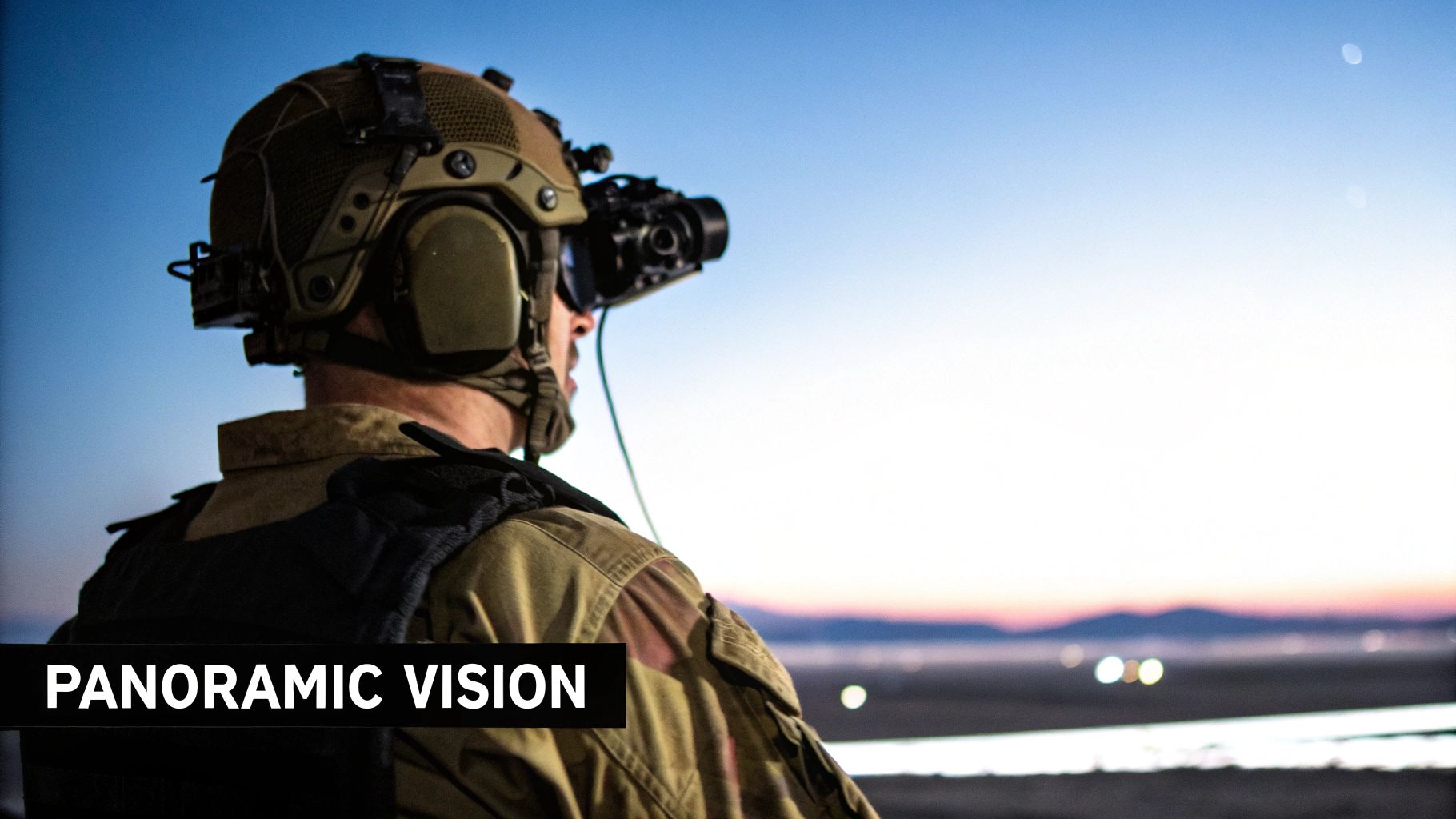
For years, the standard 40-degree field of view (FOV) was just a fact of life for night vision users. It was the trade-off for the incredible ability to see in the dark. But in high-stakes environments, what you can't see in your periphery is what can get you hurt. The demand from elite operators for a more natural, human-like field of view drove the development of a new class of technology.
Breaking Free From the 40-Degree Box
Panoramic night vision is the answer. By using clever optical designs and multiple image intensifier tubes, these systems stitch together a much wider, more cohesive image. We're talking about an FOV that can reach 97 degrees or even more.
This isn't just a minor upgrade. It’s a game-changer for situational awareness.
The ability to catch movement in your periphery without constantly turning your head is huge. It lets you clear a room faster, drive more safely, and navigate rough country with a level of confidence that a single-tube PVS-14 just can't provide. It feels far more natural and dramatically cuts down on neck fatigue over long nights.
It's important to know that "panoramic" isn't one specific device. It's an approach to achieving that wide FOV, and it comes in a few different flavors:
- Dedicated Panoramic Housings: This is the top tier, like the legendary GPNVG-18. These "quad-tube" goggles use four image intensifiers working in concert to create a seamless, incredibly wide picture.
- Articulating Dual-Tube Goggles: Modern dual-tube setups often feature pods that can be angled outwards. This small adjustment can significantly expand your peripheral vision compared to a fixed, forward-facing setup.
- Wide-Angle Optics: For those with single-tube devices, specialized lenses can be added to stretch the standard 40-degree view, giving you a wider picture without buying a whole new system.
To really get why this matters so much, it helps to see where the technology came from. You can learn more about this journey by reading our guide on the evolution of night vision technology, which traces the path from clunky, early-gen scopes to the incredible systems we have today. Every step forward was about trying to see more of the dark.
Standard vs Panoramic Night Vision at a Glance
To put it simply, the jump from a standard monocular to a panoramic system is massive. This table breaks down the core differences in a practical way.
| Feature | Standard Night Vision (e.g., PVS-14) | Panoramic Night Vision (e.g., GPNVG) |
|---|---|---|
| Field of View (FOV) | Typically a fixed 40° circle | Can exceed 95°, providing extensive peripheral vision |
| Situational Awareness | Limited; requires constant head scanning to see the bigger picture. | Immense; allows for natural peripheral detection of threats/objects. |
| User Experience | Often described as looking through a "soda straw" or tube. | Provides a more immersive, natural viewing experience. |
| Mobility | Can be disorienting when moving quickly; risk of missing obstacles. | Enables faster and more confident movement and navigation. |
| Primary Advantage | Simplicity, lower cost, and lighter weight. | Unmatched situational awareness and operational effectiveness. |
As you can see, the choice isn't just about how wide the image is—it's about how that wider view fundamentally changes the way you operate in the dark.
The Journey to a Wider View in the Dark
The story of panoramic night vision isn't about a single "eureka" moment. It's a tale of slow, hard-won progress, born from a simple but urgent need to see more of the world when the lights go out.
The earliest attempts to own the night were a bit crude. These first systems, now known as Generation 0, were "active." They couldn't just gather the faint light that was already there; they had to bring their own flashlight, just a really, really big one.
These setups worked by blasting the landscape with a powerful infrared (IR) searchlight, which is invisible to the naked eye. A special scope would then pick up the reflected IR, painting a picture in the dark. It was a huge leap forward, but it had one massive drawback: that IR beam was a dead giveaway to anyone else with night vision. It basically screamed, "Hey, look over here!" This made operators a sitting duck.
From Active Beams to Passive Stars
The real game-changer came when engineers cracked the code on "passive" systems—devices that could work with the dim, ambient light from the moon and stars alone. This breakthrough led to Generation 1 "Starlight" scopes, which made a name for themselves during the Vietnam War. Suddenly, you could amplify available light thousands of times without sending out a giant, detectable IR beacon.
This was a profound tactical shift. For the first time, soldiers could see the enemy in the dark without telegraphing their own position. The success of Starlight scopes proved just how critical passive operation was, and with this newfound stealth came a renewed focus on an old problem: the frustratingly narrow field of view. Seeing was one thing, but seeing the whole picture was another.
Interestingly, the seeds of this technology were planted much earlier than most people think. The basic ideas for wide-field night viewing emerged back in the late 1920s and 1930s. A pivotal moment came in 1929 when Hungarian physicist Kálmán Tihanyi developed an infrared-sensitive camera for British anti-aircraft defenses, letting them spot enemy bombers at night over a wide patch of sky. This early Gen 0 tech could amplify light by 1,000 times, but the required IR illuminators were so monstrous that some had to be hauled on flatbed trucks. They were obvious targets, but they enabled panoramic surveillance out to 600 meters. Learn more about these early technological milestones that shaped today's devices.
The Engineering Push for a Fuller Picture
Even with passive technology, the limitations were clear. A Gen 1 scope was a massive improvement, but its tunnel vision meant you had to constantly pan your head back and forth just to see what was going on around you. This wasn't just tiring; it created dangerous blind spots where a threat could appear and vanish in the moments between sweeps.
That very real operational headache is what fueled the evolution through the next generations of night vision. Each new step brought critical gains:
- Better Light Amplification: The jump from Gen 1 to Gen 2, and later to the Gen 3 tubes we use today, made devices incredibly more sensitive. They could see in near-total darkness, relying less and less on a bright moon.
- Improved Clarity and Resolution: Images got sharper, making it easier to tell friend from foe at a distance.
- Reduced Size and Weight: The gear got smaller and lighter, eventually becoming easily helmet-mountable. This freed up an operator's hands and made moving in the dark much less clumsy.
Every single improvement to the core image intensifier tube brought the industry closer to solving the field-of-view puzzle. As the tubes got better and more efficient, it finally became practical to think about combining several of them into one device without making it ridiculously heavy or power-hungry.
This constant, steady refinement built the foundation for the gear we have now. The development of smaller, more powerful, and more efficient image intensifiers was the essential first step toward creating true panoramic night vision. Without those decades of painstaking engineering and feedback from the field, the dream of an immersive, wide-angle view of the dark would have stayed a dream. The path from those bulky, active searchlights to modern multi-tube panoramic systems is a perfect example of innovation driven by necessity.
How Panoramic Night Vision Technology Actually Works
To really get what makes panoramic night vision so special, you have to pop the hood and see what's going on inside. The engineering behind it is obviously complex, but the basic ideas are surprisingly easy to grasp when you break them down. Don't think of a panoramic goggle as a single piece of gear; it’s more like a highly specialized team of components working in perfect sync.
The heart and soul of any analog night vision system is the image intensifier tube. This is the engine that makes everything go. Its one job is to grab the tiny, invisible bits of light—photons—that are always around, even on the darkest nights, and amplify them by the thousands. The optics, those lenses out front, are the eyes. They gather that faint light and focus it perfectly onto the intensifier tube.
This flowchart maps out the journey from the bulky, primitive systems of the past to the sophisticated multi-tube devices that define panoramic night vision today.
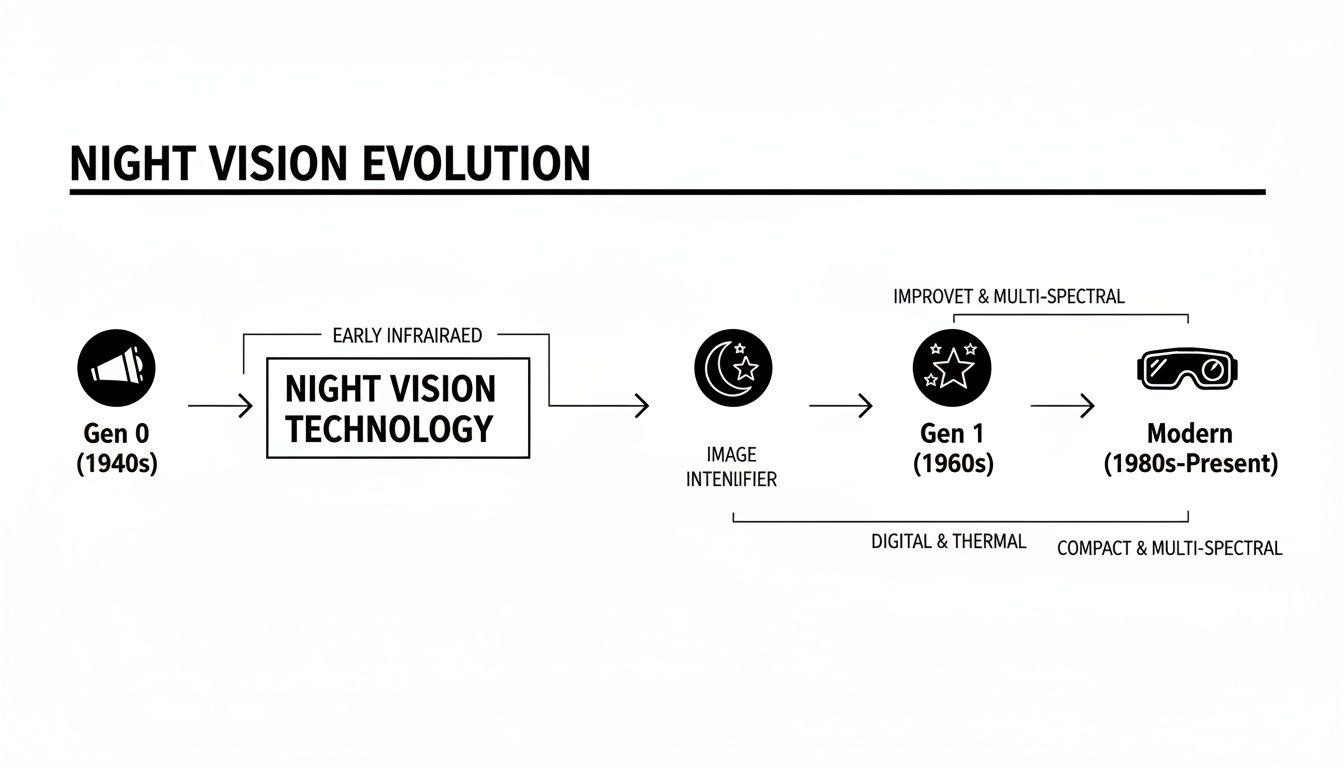
You can clearly see the jump from needing an active IR light source in Gen 0 to the passive light-gathering tech that paved the way for modern panoramic systems.
Fusing Multiple Views Into One
The real magic of a true panoramic night vision setup, like a quad-tube goggle, is how it combines multiple "engines" and "eyes." Instead of one image intensifier and one set of lenses, it uses four. Each of these tube-and-lens pairs captures a specific slice of the world in front of you.
Those individual images are then channeled through the optics and presented to your brain, which seamlessly stitches them together into one massive, unbroken picture. It’s like setting up several big-screen TVs around your head but without any of the bezels or gaps in between. This optical fusion is what kills the tunnel vision of a "soda straw" view and gives you that immersive, wrap-around image.
Understanding the Key Performance Specs
When you start comparing spec sheets, a few key terms will tell you almost everything you need to know about how a device will perform. Getting a handle on these is crucial.
-
Field of View (FOV): This is the big one for panoramic NV. Measured in degrees, it’s simply how much you can see from left to right. A standard PVS-14 monocular gives you a 40° FOV. A quad-tube GPNVG-18, on the other hand, opens that up to a huge 97° FOV. That's more than double the peripheral vision.
-
Resolution: Think of this as the sharpness of the image, measured in line pairs per millimeter (lp/mm). A higher number means a clearer, more detailed picture. This makes it far easier to spot the difference between a threat and a shadow at a distance.
-
Gain: This is simply the level of light amplification. It's the system's power to turn a pitch-black scene into a bright, easy-to-see image. On modern units, you can adjust the gain manually to dial in the perfect brightness for any situation.
A common mistake is thinking more gain is always better. Crank it too high, and you'll start to see "scintillation," or electronic noise, that makes the image look grainy. The real skill is finding that sweet spot between brightness and clarity for the task at hand.
The Thermal Fusion Advantage
Some of the most advanced panoramic systems kick things up another notch by integrating thermal imaging. This creates a "fused" image, layering the heat signatures from a thermal sensor right on top of the amplified light image from the intensifier tubes. To really dig into how these different technologies work, check out our guide comparing thermal, digital, and analog night vision.
This fusion gives you an incredible tactical edge. The image intensification lets you see details and navigate terrain, while the thermal overlay makes any heat source—like a person hiding in bushes or behind camouflage—pop out with a bright glow. This combined view can punch through obscurants like smoke and fog in a way that amplified light just can't do alone. By bringing these technologies together, operators get the best of both worlds and achieve a level of awareness that's impossible with a single-spectrum device.
Comparing Different Panoramic Night Vision Systems
Getting a wide, panoramic view in the dark isn't a one-size-fits-all deal. The world of panoramic night vision has a few different ways to get you there, and each comes with its own design, performance quirks, and, of course, price tag. Getting a handle on these differences is the first real step to picking the right system for your mission.
Think of it like picking a vehicle. A sports car, a pickup, and an SUV will all get you down the road, but they're built for very different jobs. The same logic holds true here as we break down the three main ways to open up your field of view when the sun goes down.
Wide Angle Optics: The Entry Point
The most straightforward way to get a wider FOV is to enhance a traditional single-tube device, like a PVS-14, with special wide-angle optics. These are basically screw-on lens attachments for the front of your existing unit, stretching its standard 40° view out to something like 55° or more.
It’s a popular route because it’s simple and relatively cheap—you’re just buying an accessory, not a whole new device. But there’s a catch, and it’s a big one: the "fish-eye" effect.
When you bend that much more light into a single intensifier tube, you're bound to get some image distortion. You’ll see more on the edges, but objects in your periphery can look warped or curved, and you might notice a slight drop in overall image sharpness.
This makes wide-angle lenses a decent choice for static observation, maybe a hunter scanning a field from a blind. But for running and gunning where accurate depth perception is everything? Not so much.
Dedicated Panoramic Housings: The Apex Predator
At the very top of the food chain, you'll find dedicated panoramic housings. These are systems built from the ground up for one purpose: delivering the widest, most immersive view possible. The poster child for this technology is the GPNVG-18, better known as the "quad-tube," which uses four separate image intensifier tubes.
- Unmatched FOV: Two tubes point straight ahead like normal binos, while two more are angled out to cover your flanks. This gives you a seamless 97° horizontal field of view.
- True Depth Perception: Those two forward-facing tubes give you true stereoscopic vision, which is absolutely critical for judging distance and moving through tricky terrain.
- No Image Distortion: Each tube has its own optics, completely eliminating the fish-eye effect. The picture is crisp and clear across the entire panorama.
These systems offer a level of situational awareness that’s simply in a class of its own. The trade-off is their hefty weight and even heftier cost. They’re the premier tool for elite operators whose lives depend on seeing everything at once. If you're curious about what goes into this top-tier gear, checking out something like the Argus Panoramic Nightvision Goggle (APNVG) build kit can give you a great look under the hood.
Articulating Dual Tubes: The Versatile Middle Ground
Splitting the difference between the other two options is the increasingly popular world of articulating dual-tube goggles. Devices like DTNVS or KATANA housings use two separate monoculars on a bridge that lets you pivot each pod outwards.
By angling the pods just a bit, you can stretch your horizontal FOV well beyond the standard 40°. It won’t hit the massive 97° of a quad-tube, but the ~55° to 70° you get is a huge upgrade over a single monocular. You end up with a small "gap" in the middle, but your brain stitches it together, giving you great depth perception plus a ton of extra peripheral vision.
This approach strikes a fantastic balance between performance, flexibility, and cost. You get a serious boost in situational awareness without the extreme price and neck strain of a quad-tube setup. Plus, being able to roll each pod up and out of the way individually is incredibly useful for quickly switching between NODs and your naked eye. This versatility is why articulating duals have become the go-to for a huge range of serious users, from tactical professionals to hardcore night hunters.
To make things even clearer, let's lay out the options side-by-side. Each approach has its place, and seeing the pros and cons together can help you figure out which one makes the most sense for your needs and budget.
Comparing Panoramic Night Vision Approaches
| System Type | Typical FOV | Pros | Cons | Best For |
|---|---|---|---|---|
| Wide Angle Optics | 55° – 60° | – Low cost – Easy to add to existing gear |
– "Fish-eye" image distortion – Reduced edge clarity |
Static observation, budget-conscious users looking for a wider view. |
| Articulating Duals | ~55° – 70° | – Great balance of FOV & cost – Modular and versatile – Maintains depth perception |
– More expensive than a monocular – Heavier than a single tube |
Tactical professionals, serious hunters, and anyone needing enhanced awareness with flexibility. |
| Dedicated Panoramic | 97°+ | – Unmatched situational awareness – True stereoscopic vision – No image distortion |
– Extremely expensive – Heavy and bulky |
Elite military units, high-stakes law enforcement operations. |
Ultimately, the choice comes down to what you're trying to accomplish in the dark. Whether you're adding a simple lens or investing in a four-tube system, expanding your field of view fundamentally changes how you operate at night.
Weighing the Pros and Cons Against Traditional NVGs
Deciding to jump into panoramic night vision is a big step, and it's not a simple one. The huge field of view is obviously the main attraction, but that advantage doesn't come for free. You have to understand the real-world tradeoffs, and I like to think of it as "gain versus pain"—what you get for what you give up.
The most obvious gain is just plain situational awareness. Going from a standard 40-degree tunnel view to over 90 degrees completely changes how you operate in the dark. You can take in information faster, catch threats in your periphery without having to whip your head around, and move through tricky terrain with more confidence and speed.
But getting that panoramic view brings some real burdens with it. No piece of gear is a magic bullet, and you have to be honest about the costs tied to this capability. We're not talking about minor annoyances; these are factors that hit your comfort, endurance, and wallet.
The Downside of a Wider World
When you start adding more glass and more image intensifier tubes, you can't cheat physics. These are the main "pains" you have to balance against the incredible "gain" of that panoramic sight picture.
- Increased Weight and Bulk: This is the one you'll feel first. A quad-tube GPNVG, for instance, weighs around 27 ounces (765 grams). Compare that to a standard PVS-14 monocular at just 12.4 ounces (350 grams). That extra pound on your head adds up, leading to serious neck fatigue over long nights.
- Higher Power Consumption: Powering four tubes instead of one or two just takes more juice. You’ll burn through batteries faster, which means you need to carry more spares. That adds another layer of planning and a little more weight to your pack.
- Significantly Higher Cost: The financial hit is massive. A true panoramic system can easily cost ten times more than a top-tier monocular. That price tag reflects the complexity and the number of high-end components crammed into a single housing.
It's a classic engineering problem you're paying to solve. You are essentially strapping multiple high-end night vision devices to your face and asking them to work together seamlessly. The cost and weight are direct results of that incredible optical achievement.
Image Quality and Distortion Considerations
Beyond the physical load, there are also some optical tradeoffs, especially with certain panoramic setups. While a high-end quad-tube system gives you a stunningly clean image, more budget-friendly solutions like wide-angle lenses can introduce their own quirks.
For example, slapping a wide-angle lens onto a PVS-14 will absolutely expand your view, but it often creates a "fish-eye" effect. You'll notice this distortion most at the edges of the image, where straight lines start to look curved. For just sitting and observing, it might be fine, but it can mess with your depth perception and feel disorienting when you're moving fast.
In the end, it all comes down to your personal cost-benefit analysis. Is the tactical advantage of seeing almost everything in front of you worth the extra weight, logistical headaches, and steep price? For a top-tier special operations unit, the answer is almost always yes. For a civilian hunter or a prepared citizen, the answer is a lot murkier and really depends on your specific needs and how deep your pockets are.
Panoramic Night Vision in the Real World
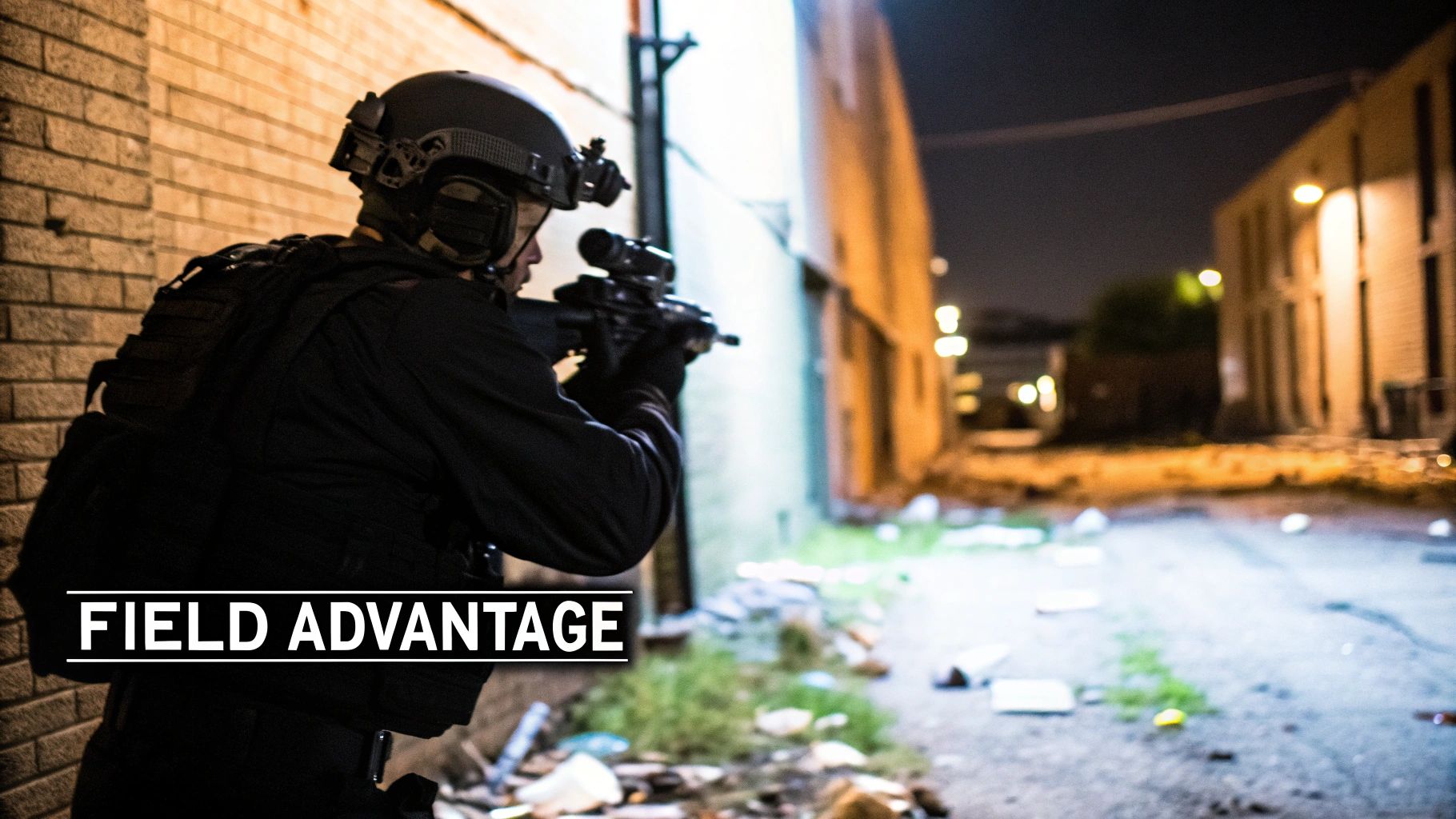
It’s easy to get lost in the numbers and spec sheets, but the true test of panoramic night vision happens when the lights go out for real. A wider field of view isn't a luxury—it’s a fundamental advantage that directly translates to better safety, higher efficiency, and mission success in some of the most demanding environments imaginable.
Think about clearing a building in complete darkness. With a standard 40-degree field of view, you're constantly whipping your head back and forth just to see the room. It's exhausting, and every turn of the neck creates a momentary blind spot where a threat could be waiting. A panoramic system changes that entirely. You can clear a hallway or scan the corners of a room with a single, steady glance.
Law Enforcement and SWAT Operations
For SWAT teams, operations like dynamic entry and room clearing are high-stakes, high-stress events. Everything depends on speed, coordination, and knowing exactly what’s happening around you. This is where panoramic NVGs truly shine.
- Catching Threats in the Periphery: The ability to spot a threat in an adjacent room or a hidden doorway without turning your head is a game-changer. It buys you precious fractions of a second to react.
- Preventing Friendly Fire: When moving in a tight stack, operators can track each other's movements effortlessly, massively reducing the risk of collisions or tragic crossfire incidents.
- Sorting Threats from Friendlies: A wider, more natural view allows the brain to process the scene faster. Officers can distinguish between threats, hostages, and teammates with more speed and confidence.
Military Navigation and Threat Detection
On the battlefield, seeing more of your surroundings at once is a non-negotiable advantage. Whether you’re navigating a dense forest on foot or driving a vehicle at speed, a panoramic view makes the experience far more intuitive and safe. This isn't a new concept. During the Vietnam War, early Gen 1 'Starlight' scopes gave U.S. troops wide-angle views that amplified ambient light 20,000 times, effectively turning night into day.
By 1969, over 80% of U.S. infantry night patrols were using the AN/PVS-2. Its 40-degree FOV was double that of earlier models and allowed for panoramic sweeps that cut casualties by an estimated 30% in nighttime engagements. For more background on this, you can check out this article on the evolution of U.S. night vision on peaknano.com. Today’s quad-tube systems are the direct evolution of that battlefield need, giving modern soldiers a massive advantage in detecting enemy movement.
In a tactical environment, the operator with the most information wins. Panoramic night vision provides an overwhelming information advantage, turning a reactive situation into a proactive one.
Hunting and Predator Control
Dedicated night hunters know the challenge of scanning large, open fields for coyotes or hogs. A standard monocular forces you to constantly pan back and forth, making it easy to miss an animal moving just outside your narrow view. With a panoramic setup, you can watch a huge kill zone from a fixed position, spotting game sooner and giving you more time to line up the perfect shot.
The same logic applies to search and rescue operations, where every second is critical. Trying to cover a vast, dark mountainside is an enormous task. A team with panoramic night vision can scan an area far more quickly and effectively than a team stuck with tunnel vision. The ability to spot a flicker of movement, a piece of clothing, or a reflective strip from a distance can absolutely be the difference between life and death.
Answering Your PNVG Questions
Making the jump to panoramic night vision is a big step, so it's natural to have a few questions about what it takes to run a system like this. Let's dig into some of the most common things people ask us, so you can understand the full picture of what's involved.
Do I Need a Special Helmet and Mount for Panoramic Systems?
Yes, and this is non-negotiable. Panoramic setups are heavier and have a different footprint than standard binocular or monocular units. Your typical issued mount just isn't built to handle the extra weight and will lead to wobble, instability, and a whole lot of frustration.
You absolutely need a robust, high-quality mount designed specifically for the added load. This ensures your expensive PNVGs stay put, preventing sag and maintaining the proper eye relief you need for a stable, clear image. Think of the helmet and mount as the foundation—if it's weak, the whole system will fail you when it matters most.
How Does the Extra Weight Affect Long-Term Use?
There's no sugarcoating it: the extra weight is a real factor. A quad-tube system is significantly heavier than what most people are used to, and you will definitely feel that extra strain on your neck after a few hours in the field.
Properly balancing your helmet with a good counterweight system is the key to managing this.
It's a bit like a seesaw for your head. The PNVGs pull the front down, and a well-placed counterweight on the back brings your helmet back into a neutral, comfortable position. This simple addition makes a world of difference in reducing fatigue.
Don't skimp on your helmet, either. A modern, comfortable helmet with a quality suspension system is just as crucial as the night vision itself. It's what makes the difference between focusing on your objective and being distracted by an aching neck.
Can Panoramic Night Vision Systems Be Repaired or Serviced?
They can, but they demand specialized attention. These aren't your average PVS-14s. PNVGs are complex pieces of equipment with very precise optical alignments, and keeping them in top shape requires a technician who knows exactly what they're doing.
For some major issues, the unit might have to go back to the original manufacturer. However, a qualified service center can handle most common problems, perform routine maintenance like nitrogen purges, and help you navigate the factory repair process if needed. Having that expert support is vital for protecting your investment and ensuring your gear performs flawlessly for years to come.
At Superior Tactical LLC, we don't just sell high-end panoramic night vision; we provide the expert support to back it up. Our team is here to answer your questions, and we offer in-house repairs with free diagnostics to keep you ready for whatever comes next. Check out our complete lineup of night vision and tactical gear at https://superiortac.com.
