A Definitive Guide to NVG Goggles Gen 3
If you've spent any time researching night vision, you've heard the term "Gen 3." It’s not just a buzzword; it's the professional standard. For anyone who truly depends on their gear—from law enforcement to serious hunters—nvg goggles gen 3 aren't just an upgrade. They're the baseline for clear, reliable vision when the lights go out.
What Makes Gen 3 NVG Goggles the Gold Standard
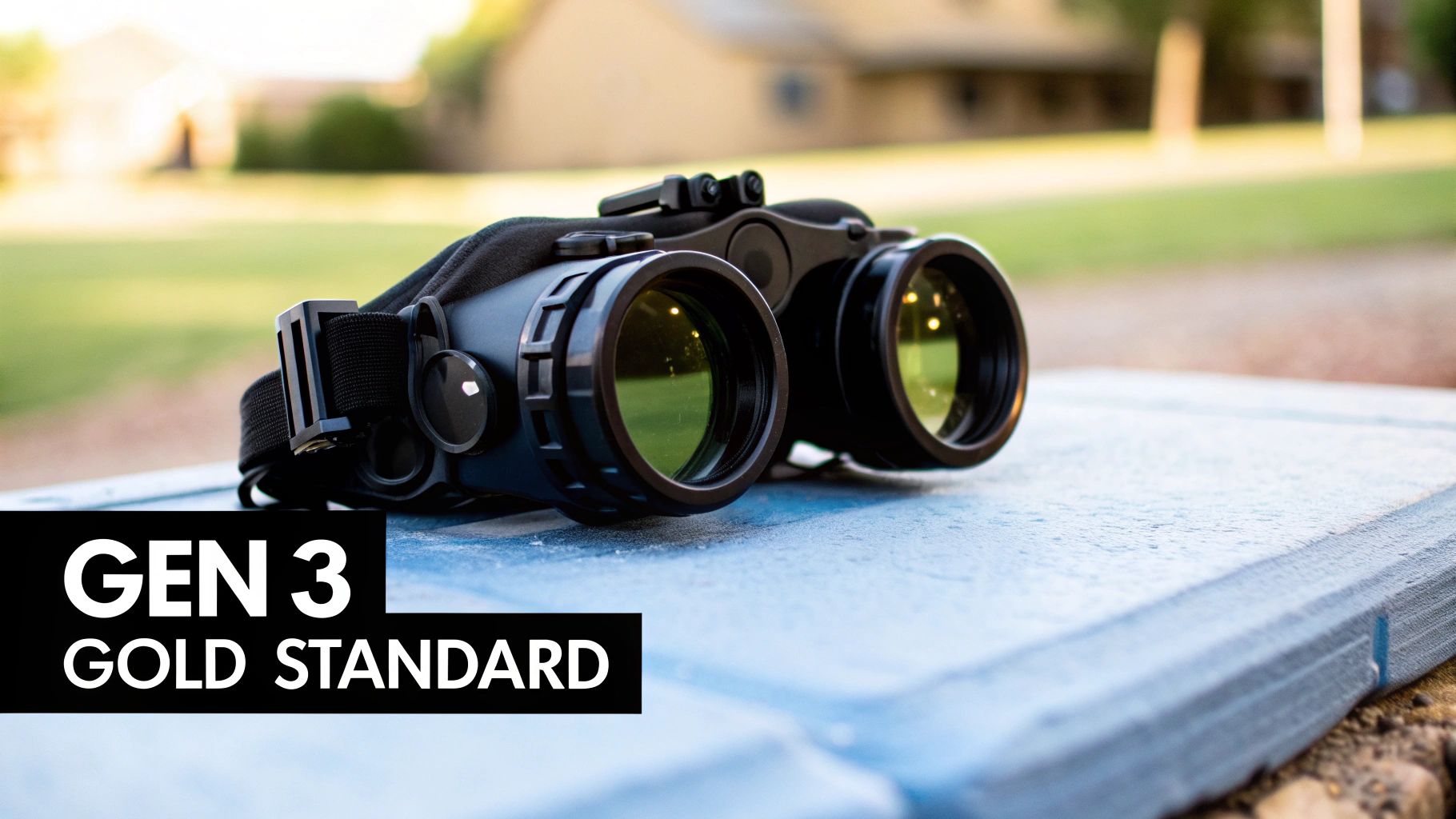
The secret sauce is inside the image intensifier tube, specifically its gallium arsenide (GaAs) photocathode. Think of the photocathode as the engine of your night vision. While older generations used less effective materials, the GaAs in Gen 3 is incredibly sensitive to light. It excels at converting the few photons available in the dark into electrons—the first step in creating a visible image.
This efficiency is what gives you that signature Gen 3 look: a bright, sharp picture with minimal "snow" or static. It's the difference between trying to make out a fuzzy shape on an old security camera and seeing a crisp, high-definition image. This massive leap in performance is exactly why Gen 3 became the go-to for professionals.
Forged on the Battlefield
Gen 3 technology proved its worth in the late 1980s and became legendary during the 1991 Gulf War. U.S. forces, armed with devices like the AN/PVS-7, could see with startling clarity well beyond 300 yards without needing an IR illuminator—a dead giveaway of your position. This ability to "own the night" provided a staggering tactical advantage.
On top of that, these tubes were built to last, boasting an operational life of over 10,000 hours, more than double that of Gen 2. You can learn more about the history and development of night vision on Wikipedia.
Who Relies on Gen 3 Performance Today
The advantages of nvg goggles gen 3 are just as critical now as they were then. When performance is non-negotiable, this is the technology people turn to.
- Law Enforcement: Officers need that exceptional clarity for surveillance, SWAT operations, and navigating dangerous, low-light environments where every detail matters.
- Serious Hunters: Predator hunters and nocturnal trackers count on Gen 3 to positively identify targets at a distance, ensuring a safe and ethical shot.
- Security Professionals: For those patrolling large properties or protecting critical infrastructure, Gen 3 provides the passive, reliable observation needed to stay ahead of threats.
When you invest in Gen 3 night vision, you're not just buying a piece of equipment; you're acquiring a critical capability. It’s a long-term investment in your safety, situational awareness, and operational effectiveness.
Getting the right device means going to people who live and breathe this technology. Here at Superior Tactical, we don't just sell mission-ready gear; we back it with a 10-year warranty and handle all repairs in-house. We make sure your investment stays ready for a decade of hard use, because we know it has to work when it counts.
Decoding Gen 3 Image Intensifier Tube Specs
When you're ready to step into the world of Gen 3 night vision, you're really investing in one critical component: the image intensifier tube. The spec sheet might look intimidating at first glance, like a jumble of acronyms and numbers, but it's not as complex as it seems.
Learning to read these specs is like learning what makes a high-performance engine tick. A handful of key metrics tell you everything you need to know about how the device will perform when the lights go out. They're the difference between seeing a vague shape in the dark and seeing a crystal-clear image with confidence.
Signal-to-Noise Ratio (SNR): The Clarity Factor
Ever tried to have a quiet conversation in a loud, crowded room? That’s the perfect analogy for Signal-to-Noise Ratio (SNR). The "signal" is the image you want to see, and the "noise" is the distracting, grainy static that can clutter the picture.
A higher SNR means you get a cleaner signal with less background noise. In near-total darkness, a low-SNR tube will produce a snowy, fuzzy image that makes it hard to identify anything. But a high-SNR tube cuts through the static to deliver a crisp, stable picture. This is arguably the single most important spec for overall image quality.
A high SNR is what separates professional-grade night vision from the rest. It’s the difference between guessing what you’re looking at and knowing for certain—a critical advantage when every second counts.
Gen 3’s legendary performance comes from its gallium arsenide photocathode, which enables incredibly high SNR (often above 22) and resolution (exceeding 64 lp/mm). This combination creates the bright, clean images that give users a passive range of over 300 yards and a tube life that can top 10,000 hours—that’s more than double what you’d get from Gen 2. If you want a deeper dive, you can read about the benchmarks that set Gen 3 technology apart and see why it remains the gold standard for military forces worldwide.
Resolution: The Sharpness Factor
If SNR is about how clean the image is, resolution is all about how sharp it is. Measured in line pairs per millimeter (lp/mm), this number tells you how much fine detail the tube can actually resolve. Think of it like the pixel density on a 4K TV—more line pairs mean a sharper, more defined picture.
A high lp/mm count is what lets you pick out small details from a distance. It's how you can tell a coyote from a stray dog hundreds of yards away, or identify the object someone is holding in their hands. That level of detail is non-negotiable for positive target identification and true situational awareness.
Photocathode Sensitivity: The Light Gathering Power
Photocathode sensitivity is a measure of how good the tube is at its fundamental job: converting tiny particles of light (photons) into an electrical signal (electrons). Put simply, it’s the tube’s raw light-gathering power.
A higher sensitivity rating means the device can build a clear image with less available light. This is what allows you to operate on a moonless, overcast night in the middle of a forest or inside a pitch-black building. A tube with a high sensitivity rating will still deliver a bright, usable image long after lesser units have given up.
Figure of Merit (FOM): The Quick-Check Score
So, how do you put it all together? That’s where Figure of Merit (FOM) comes in. It’s a straightforward calculation that gives you a single number to gauge a tube's overall performance potential.
- The Formula: FOM = Signal-to-Noise Ratio (SNR) x Resolution (lp/mm)
While it doesn't tell the whole story, FOM is a fantastic at-a-glance metric. Military and government contracts often specify a minimum FOM, making it an industry-wide benchmark for quality. You can learn more about how to use these specs in our guide on how to choose the best Gen 3 Elbit image intensifier tube for your specific needs.
To make this even easier, here’s a quick breakdown of what you should be looking for.
Gen 3 Tube Specifications At A Glance
| Specification | What It Means | Good (Minimum) | Excellent (High-End) |
|---|---|---|---|
| SNR | Image clarity, less static or "snow" | 22+ | 30+ |
| Resolution | Image sharpness and detail at a distance | 64 lp/mm | 72+ lp/mm |
| Photocathode Sensitivity | Performance in extreme darkness | 1800+ µA/lm | 2200+ µA/lm |
| FOM | Overall tube performance score | 1600+ | 2300+ |
Getting comfortable with these four key specs—SNR, Resolution, Photocathode Sensitivity, and FOM—is the key. It lets you look past the marketing and choose a device with the exact performance you need for your mission.
Comparing Gen 3 Against Other Night Vision Tech
To really understand why Gen 3 night vision goggles are the gold standard, you have to know what you're comparing them against. The world of night vision is filled with different technologies, from older analog generations to newer digital systems, and each has its place. Knowing the real-world differences is what separates a smart purchase from a costly mistake.
Let’s start at the beginning. For a lot of people, Gen 1 is their first taste of night vision, mainly because it's cheap. But you get what you pay for. Gen 1 devices almost always have a noticeable "fish-eye" distortion around the edges, and the image is often blurry. Critically, they're completely dependent on a built-in infrared (IR) illuminator—basically a flashlight that only other night vision users can see. In any serious situation, that’s a dead giveaway.
Gen 2 was a huge step up. The introduction of the microchannel plate made the image much brighter and cut down on that weird distortion. But Gen 2 tubes have their own quirks, namely an artifact called "scintillation" or sparkle, which looks like a faint shimmering, especially when it’s really dark. They're perfectly capable for a lot of tasks, but they just don’t deliver the clean, crisp picture of a modern Gen 3 unit.
Gen 3: The Peak of Analog Performance
The jump from Gen 2 to Gen 3 is where night vision goes from being useful to being truly exceptional. The key is the gallium arsenide photocathode, which results in a much cleaner, brighter, and sharper image.
- Insane Light Sensitivity: A good Gen 3 tube can amplify available light by 30,000 to 50,000 times. For comparison, Gen 2 usually maxes out around 20,000x. This means Gen 3 thrives in the kind of near-total darkness where Gen 2 starts to fail.
- Built to Last: You can expect a Gen 3 tube to run for over 10,000 hours. Most Gen 2 tubes are only rated for about half that. That longevity makes the initial investment in Gen 3 pay off in the long run.
- A Cleaner Picture: The high signal-to-noise ratio in Gen 3 technology dramatically cuts down on the background static, or "snow." This gives you a clear sight picture, which is critical for identifying targets at a distance.
What About Digital Night Vision?
Digital night vision is a different beast altogether. It uses a digital sensor, kind of like a camcorder, instead of an analog tube. This comes with some cool perks, like being able to record video or use it during the day without damage. For serious use, however, it has some major deal-breakers.
The biggest problem is latency—the lag between what’s happening in front of you and what you see on the screen. It might only be a fraction of a second, but it’s enough to be disorienting and throw you off during fast-paced movement. Digital sensors also just aren't as sensitive to light as top-tier analog tubes yet, so they lean heavily on IR illuminators in conditions where a Gen 3 unit would be running passively.
While digital night vision is an interesting technology, its inherent latency and lower light sensitivity make it a non-starter for high-stakes applications. For true tactical advantage, the instant, clear feedback of analog Gen 3 remains unmatched.
The chart below shows the key specs that define a high-quality Gen 3 tube and contribute to that superior performance.
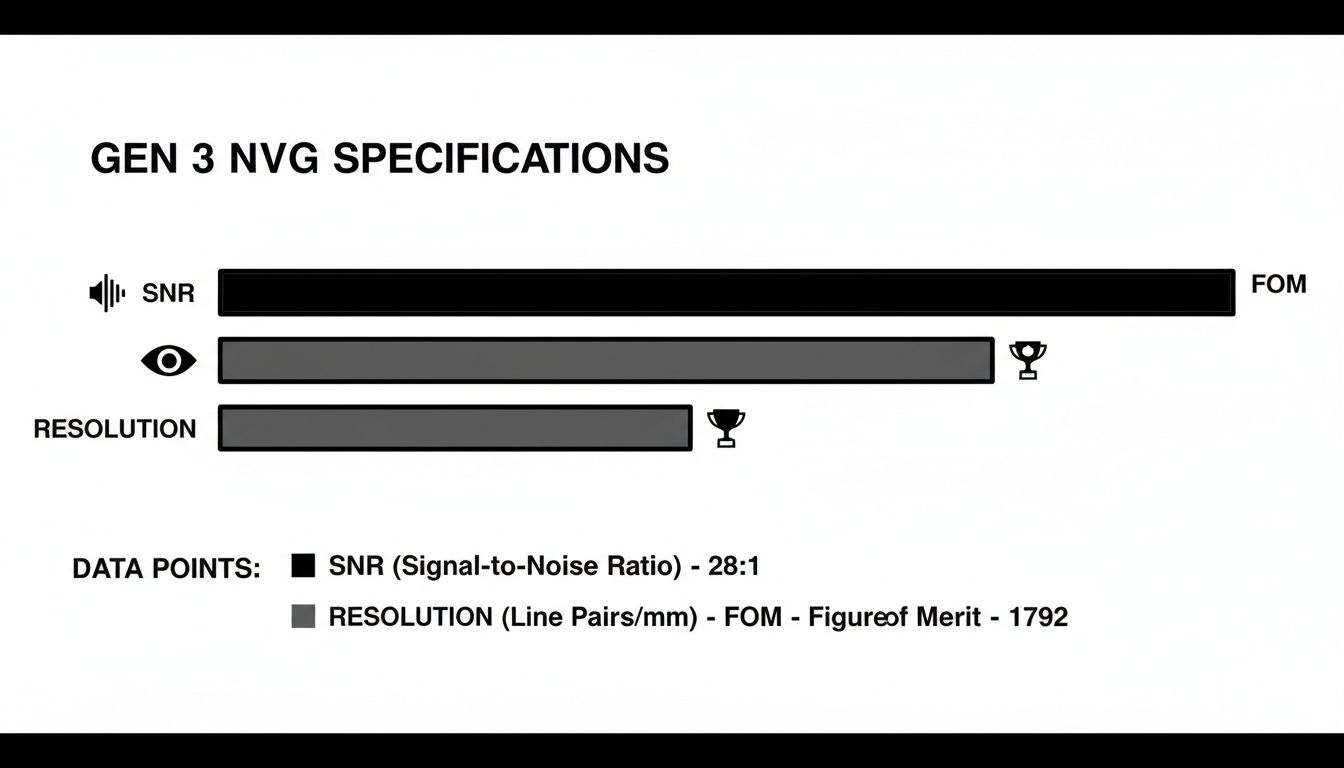
As you can see, it's the combination of a high Signal-to-Noise Ratio (SNR) and Resolution that gives Gen 3 its legendary image quality.
To make these differences crystal clear, here’s a quick side-by-side breakdown.
Night Vision Technology Comparison
This table lays out the core differences between the generations, helping you see where each technology shines—and where it falls short.
| Feature | Gen 1 | Gen 2 | Gen 3 | Digital NV |
|---|---|---|---|---|
| Image Quality | Blurry, with "fish-eye" distortion | Good clarity, some "sparkle" | Excellent, clean, and crisp | Good, but can be pixelated |
| Low-Light | Very poor, needs constant IR use | Decent, often needs IR help | Superior, works in starlight | Poor, heavily reliant on IR |
| Latency (Lag) | None (analog) | None (analog) | None (analog) | Noticeable, can be disorienting |
| Tube Lifespan | ~1,500 hours | ~5,000 hours | 10,000+ hours | Sensor life varies |
| Best Use Case | Entry-level curiosity, airsoft | Budget-conscious recreational | Professional, tactical, serious hunting | Recording, casual use |
This comparison makes it obvious why professionals who bet their lives on their equipment overwhelmingly choose Gen 3 night vision goggles.
Of course, night vision is just one piece of the puzzle. For those wondering how it stacks up against other low-light tools, our guide on thermal imaging vs. night vision breaks it all down. In the end, your mission dictates the gear, but for unmatched clarity and performance in the dark, Gen 3 is still king of the hill.
How to Choose Your Ideal Gen 3 NVG Configuration
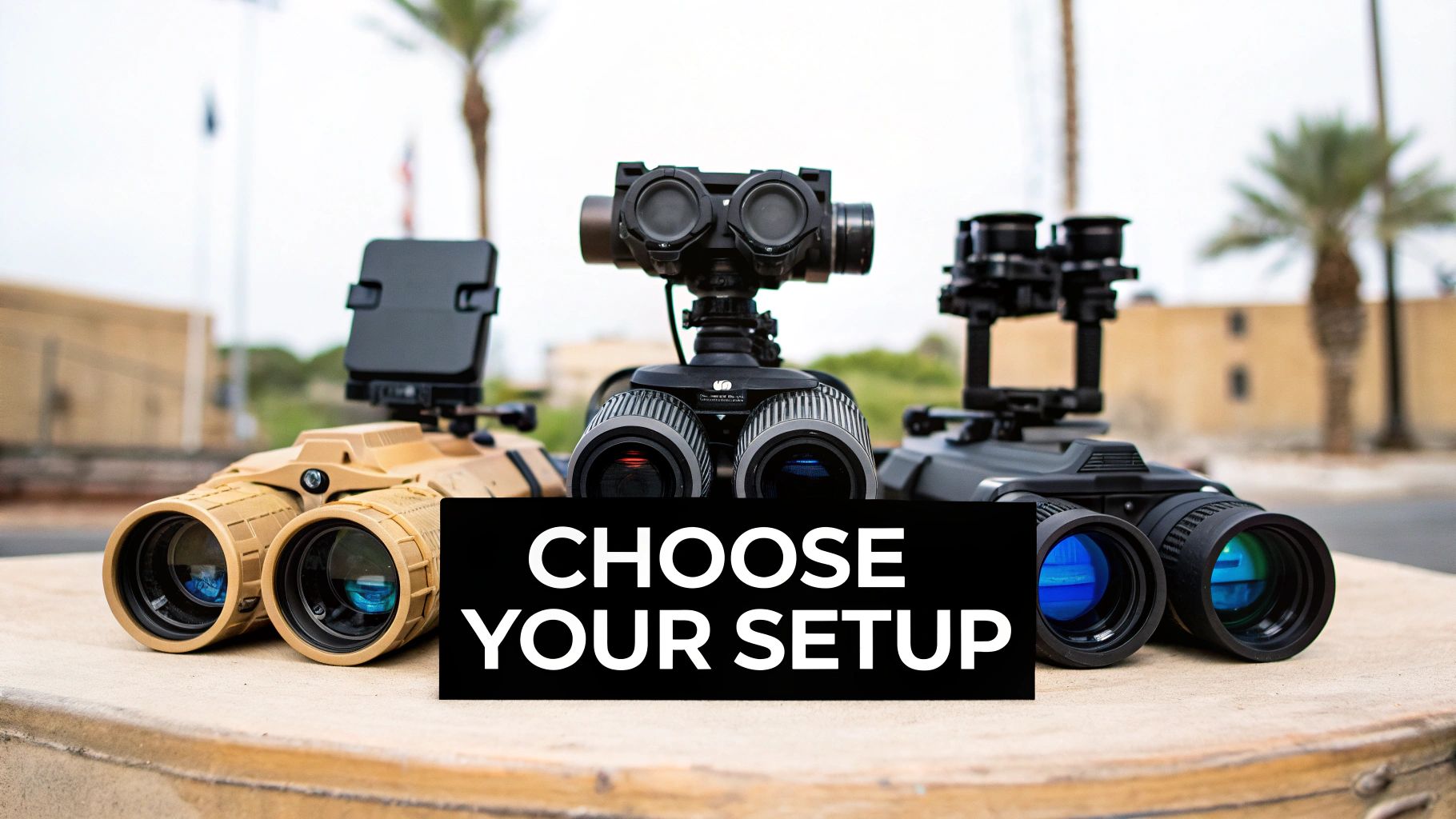
Knowing the specs is one thing, but building a mission-ready loadout is a completely different ballgame. The best nvg goggles gen 3 setup isn't something you can just pull off a shelf. It's a purpose-built system where every piece, from the housing to the mount, is chosen to excel at a specific job.
The first and most important question to ask is: what's the mission? Your answer dictates everything. A rig built for spotting coyotes across a field will be worlds apart from one designed for clearing rooms.
Let's walk through a few common scenarios. By breaking down the unique needs of different users, you'll see how a high-performance system comes together. This way, you invest in gear that actually makes you better, not just gear that looks cool.
Law Enforcement and Tactical Operations
For officers in high-stakes situations, situational awareness isn't just a buzzword—it's what keeps them alive. This is where a dual-tube binocular setup, like a set of DTNVS or RNVGs, proves its worth. Having an image for each eye provides the depth perception you need to judge distances, move with confidence, and fight off eye fatigue on long call-outs.
- Primary Configuration: Dual-Tube Binoculars (e.g., RNVG, DTNVS). The true stereoscopic vision is a game-changer in cluttered urban environments or inside a structure.
- Essential Accessories: A rock-solid helmet mount like the Wilcox G24 is non-negotiable for stability and its life-saving breakaway feature. An IR laser/illuminator on the officer's rifle is just as critical for aiming, target designation, and non-verbal communication.
- Why It Works: This rig is all about maximizing awareness and speeding up your decision-making loop. The ability to navigate obstacles and engage threats with natural depth perception is an advantage you can't put a price on.
The Dedicated Hunter and Outdoorsman
Hunters play by a different set of rules. They need a tool that’s as versatile as they are—something that can be helmet-mounted for scanning but also slapped on a rifle for the shot. This is the monocular's world.
The PVS-14 monocular is the undisputed king of versatility. It can be a handheld spotter, a hands-free navigation tool on your helmet, or a weapon-mounted sight. It's the Swiss Army knife of night vision.
Imagine you're tracking hogs through thick brush. A helmet-mounted PVS-14 lets you keep one eye adapted to the ambient darkness. This "unaided eye" makes it far easier to check your gear or glance through a thermal optic without having to constantly flip your NVGs up.
Want to dig deeper into what device is right for you? Our guide on how to choose the right night vision device for your needs has you covered.
Security Professionals and Long-Duration Patrols
When your job is watching and waiting for hours on end, comfort becomes a mission-critical spec. For security pros on long patrols, a heavy setup is a recipe for fatigue, and a tired operator is an inattentive one. Every ounce on your head matters.
- Primary Configuration: A lightweight monocular or a specialized lightweight bino system. Keeping the total head-borne weight under 1.5 lbs should be the goal.
- Essential Accessories: A comfortable helmet with a good counterbalance is crucial for preventing neck strain over an eight-hour shift. A powerful, handheld IR illuminator (think Nitecore) is also a smart addition for punching through the darkness to investigate something suspicious without weighing down your helmet.
- Why It Works: This entire setup is built for endurance. By minimizing physical strain, you help your security personnel stay sharp and focused for their entire shift, ensuring nothing slips through the cracks.
Keeping Your Gen 3 Goggles Running for Years
A set of Gen 3 night vision goggles is a serious piece of equipment, and just like any other precision instrument, it needs a little care to keep it performing at its peak. We're talking about a device with a lifespan of 10,000+ hours, and with the right habits, you can make sure it runs flawlessly for every single one of them.
This isn't about complex tear-downs or technical wizardry. It’s all about simple, consistent maintenance. The small things—cleaning lenses the right way, managing batteries, and storing your unit properly—are what protect the sensitive optics and electronics from the most common problems. Think of it as field discipline for your gear.
How to Clean Your Lenses Without Damaging Them
The lenses on your NVGs have sophisticated anti-reflective coatings that are absolutely essential for gathering light and giving you a crisp image. If you use the wrong stuff to clean them, you can scratch or even strip those coatings for good, leaving you with a blurry, hazy view.
Here’s the right way to do it:
- Get the Grit Off First: Before you even think about wiping the lens, blow off any loose dust, sand, or dirt with a can of compressed air or a soft-bristled lens brush. Wiping a gritty lens is like taking sandpaper to it.
- Use the Right Gear: Put a couple of drops of a quality lens cleaning solution onto a clean microfiber cloth. Never spray solution directly on the lens itself—it can easily seep past the seals and into the housing.
- Wipe Smart, Not Hard: Use a gentle, circular motion, starting from the center of the lens and working your way out. This pushes any leftover grime to the edges instead of smearing it around your field of view. And whatever you do, avoid using your t-shirt or a paper towel. They're far more abrasive than you think.
Smart Battery and Storage Habits
Your image intensifier tube is the heart and soul of your night vision unit. It’s also the most delicate part. The best way to protect it when you’re not using it comes down to smart battery management and storage.
Believe it or not, a huge number of night vision failures aren't from being dropped or banged around. They're caused by battery acid corrosion from a forgotten battery. Always, always take the battery out before you store your unit.
When you're packing your NVGs away, make these steps a reflex:
- Cap It Up: The day cap isn't just for looks; it's a critical safety feature that protects the intensifier tube from bright light. A sudden blast of intense light can cause permanent burn-in damage. Make it a habit to cap the lens the second you're done.
- Pull the Battery: This is the big one. A leaky $2 battery can easily cause $2,000 in damage by eating away at the internal electronics. It’s the simplest and most important preventative step you can take.
- Give It a Good Home: Store your goggles in their padded hard case. Keep them in a place that's cool and dry to protect them from impacts, humidity, and the kind of extreme temperature swings that can wreak havoc on delicate components.
Common Troubleshooting and Getting Support
Even with the best care, you might run into an occasional quirk. Knowing what's normal and what's not can save you a lot of grief. For instance, those tiny black specks you might see in the image? Those are called "blems," and they're a normal part of the tube manufacturing process. Don't sweat them.
But if you’re suddenly having issues with focus that you can’t adjust, or if the unit starts flickering on and off, it’s probably time to get it checked out by a professional.
This is where buying from a dealer who handles their own service really pays off. Here at Superior Tactical, we don't pass you off to some random third-party repair shop. We handle all our own diagnostics and service, and we stand behind our Gen 3 night vision with a solid 10-year warranty. If something goes wrong, you have an expert team ready to get your gear back in your hands, not an endless customer service loop.
Alright, you've done the homework. You know the difference between FOM, SNR, and resolution, and you’re ready to pull the trigger on a set of nvg goggles gen 3. Now comes the fun part: making sure the specific unit you choose is the right one for you.
This isn't just about buying a cool piece of gear. It's about building a system that works for your specific mission, so let's walk through the final steps to make sure you get it right the first time.
What’s the Mission?
Before you even glance at a product page, get crystal clear on what you'll be doing. A hog hunter sitting in a blind has wildly different needs than a law enforcement officer clearing a building. The "best" specs on paper don't mean a thing if they don't match your reality.
-
Define Your Arena: Are you primarily hunting coyotes from a static position, navigating thick woods on foot, or conducting vehicle-based security patrols? Write down your top three activities.
-
Set Your Performance Floor: Based on those activities, decide on your minimum acceptable specs. For general use or hunting in mixed lighting, a 1600+ FOM tube will serve you well. For professional use where identifying threats in near-total darkness is non-negotiable, you should be looking for something in the 2000+ FOM range.
-
List Your "Must-Have" Kit: Think beyond the goggles. Do you absolutely need a helmet and a quality mount like the Wilcox G24 right away? Is an IR laser for aiming or a high-powered illuminator for long-range observation critical from day one?
Remember, you're not just buying a night vision device; you're investing in an entire system. Working with a knowledgeable U.S. dealer who lives and breathes this stuff is crucial. They can guide you through the ecosystem, ensure your gear is ITAR-compliant, and make sure you walk away with a legitimate warranty.
Who Are You Buying From?
The final piece of the puzzle is the vendor. A good dealer is more than just a storefront; they're your long-term partner for this investment.
-
The Warranty Matters: How long is the company willing to stand behind their product? We offer a 10-year warranty on our Gen 3 systems because we trust the tubes we source and the housings we build.
-
Service and Repairs: What’s the plan if something goes wrong? A dealer with an in-house repair shop, like Superior Tactical, is a huge advantage. It means faster diagnostics and service from people who actually understand the technology, getting you back up and running without a long wait.
Once you’ve got these questions answered, you’re ready to make a confident choice. Feel free to browse our hand-picked Gen 3 NVG packages, or just give our team a call. We're here to help you build the perfect setup from the ground up.
Frequently Asked Questions About Gen 3 NVGs
Stepping into the world of high-performance night vision can feel a bit overwhelming, and you've probably got some questions. That's perfectly normal. We've pulled together the most common questions we hear about nvg goggles gen 3 to give you clear, straight-to-the-point answers from people who use this gear every day.
Are Gen 3 NVG Goggles Legal for Civilians?
Yes, absolutely. It is 100% legal for any U.S. citizen to buy, own, and use Gen 3 night vision inside the United States. You don't need any special permits or licenses to make a purchase.
Now, here’s the important part. This technology falls under the International Traffic in Arms Regulations (ITAR). What does that mean for you? It means taking a Gen 3 device out of the country, even for a short trip, is a serious federal offense without the right licenses from the U.S. State Department. This is exactly why buying from a trusted, U.S.-based dealer is non-negotiable—it keeps you on the right side of the law.
What Is the Difference Between Green and White Phosphor?
This is probably the most common question we get, and it really boils down to the color of the image you see through the tube. Neither one is definitively "better" than the other; it’s more about what works for your eyes and your specific needs.
-
Green Phosphor: This is the classic "night vision green" everyone recognizes from movies and video games. It's not just for looks; the human eye is exceptionally good at picking up different shades of green, which can make it great for spotting movement in the dark.
-
White Phosphor: This technology gives you a black-and-white image, kind of like a high-contrast security camera feed. Many users, myself included, find that this grayscale view feels more natural and leads to less eye strain over long nights. The enhanced contrast can also be a game-changer for identifying details in the environment.
How Long Will a Gen 3 Image Intensifier Tube Last?
A well-made Gen 3 image intensifier tube is built like a tank. These things are designed to last, with a typical operational lifespan rated for over 10,000 hours of use.
Let's break that down. If you used your night vision for a solid two hours every single night, it would still take you over 13 years to hit that 10,000-hour mark. This isn't a disposable piece of tech; it's a serious, long-term investment.
Of course, getting that kind of life out of your tube means taking care of it. A few simple habits go a long way. Always keep the daylight cap on when it's not in use, never point it at bright lights, and store it without the battery inside. Think of a solid warranty, like the one we provide, as your backstop—it's there to make sure your investment stays ready for action for years to come.
Ready to see what you've been missing in the dark? The team at Superior Tactical LLC is here to help you get the right Gen 3 setup for your mission. Check out our hand-picked selection of mission-ready night vision packages today. https://superiortac.com
