Your Essential Guide to the Norotos NVG Mount
At its core, a Norotos NVG mount is the bridge between your tactical helmet and your night vision device. But calling it just a "bridge" doesn't do it justice. It's a precision-machined piece of hardware designed for rock-solid stability, perfect alignment, and unfailing reliability when you need it most.
The Unseen Hero of Your Night Vision Setup
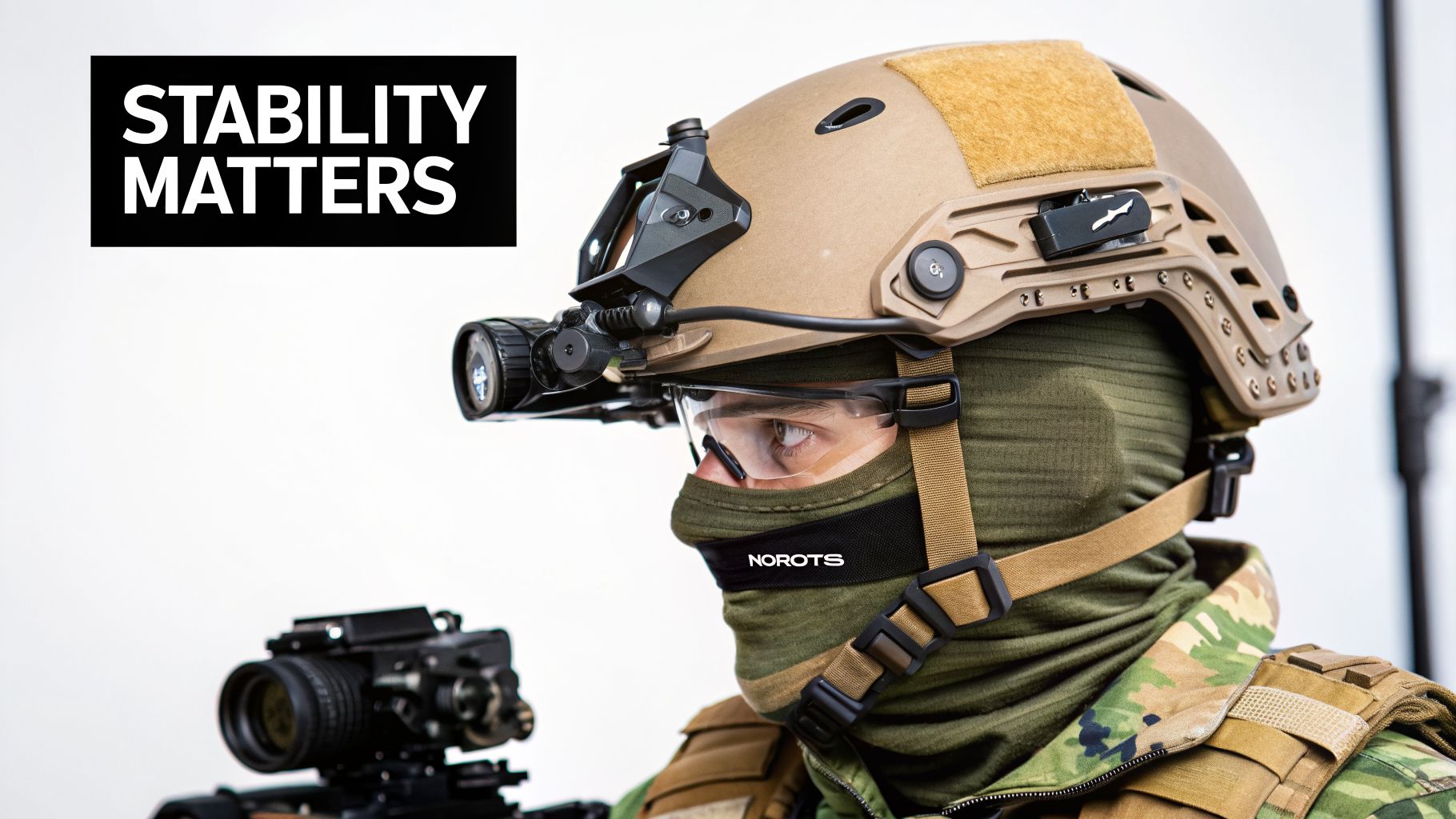
When you’re operating in the dark, the multi-thousand-dollar optic in front of your eye is only as stable as the mount holding it there. This is where a top-tier mount from a company like Norotos comes into play. It's not just another accessory; it's the very foundation of your entire night vision system.
Think of it like the scope rings on a precision rifle. You wouldn’t put a cheap, wobbly set of rings on a high-end rifle and expect to hit anything. The same logic applies here. A flimsy mount introduces wobble, ruins your sight picture, and can fail at the worst possible moment.
Why Your Mount Choice Matters
For anyone serious about using night vision—whether in law enforcement, military operations, or as a dedicated civilian—a high-quality mount is non-negotiable. The right choice affects everything about your experience.
- Operator Comfort: A solid, well-adjusted mount eliminates the dreaded NVG "wobble," which directly translates to less neck strain and fatigue over long nights.
- Situational Awareness: When your optic is perfectly aligned with your eye, you get a clear, consistent image. This means you can spot and react to things much faster.
- Equipment Protection: Premium features like a breakaway function can save your expensive NVG from being destroyed if you snag it on a door frame or branch.
- Mission Readiness: Smooth, positive-locking adjustments for stowing and deploying your NVG are crucial for moving between light and dark environments without fumbling with your gear.
Simply put, the mount is the linchpin that holds your headborne system together. Spending a little extra on a quality Norotos mount is a direct investment in your own performance, safety, and the longevity of your gear.
This guide will break down everything you need to know about Norotos mounts, from their legendary engineering to the different interfaces and models available. By the time you're done, you'll have the confidence to choose the perfect mount for your helmet, your optic, and your mission.
What Sets Norotos Engineering Apart
The first time you handle a Norotos NVG mount, you get it. There's a certain feeling—a solid, authoritative click—that’s just different. It’s the same satisfying thud you get when closing the door on a high-end German car versus a budget hatchback.
That's no accident. It’s what happens when a company obsesses over precision engineering and top-shelf materials.
Think of a Norotos mount as a precision instrument, almost like a mechanical watch. Every component is machined from lightweight, aerospace-grade aluminum to incredibly tight tolerances. This fanatical attention to detail is what kills the annoying wobble and slop you find in cheaper mounts. It means your night vision stays locked in, perfectly aligned with your eye, no matter how hard you’re running, jumping, or moving.
Purpose-Built Design Features
But it's not just about the fancy materials. Norotos bakes in some brilliant, real-world features that solve serious operational problems. To really understand what makes them special, you need to know about two key concepts: force-to-overcome and breakaway.
Force-to-Overcome: This is that stiff, deliberate "clunk" you feel when snapping your NVGs down from the stowed position. It's a positive lock designed to keep the optic from flopping down in front of your face when you don't want it to. It stays where you put it, period.
Breakaway: This is a genuine lifesaver. If you snag your expensive NVGs on a tree branch, a vehicle, or a doorway, the breakaway feature lets the mount pop off the helmet shroud under a set amount of force.
This feature does two critical things. First, it prevents the kind of violent head-snapping that can cause serious neck or spinal injuries. Second, it protects your multi-thousand-dollar NVG from being ripped apart. A potentially career-ending injury becomes a simple matter of reattaching your gear.
A Norotos NVG mount is engineered to be a point of failure, but in a controlled, protective way. It’s designed to sacrifice itself to save both you and your gear—a hallmark of truly thoughtful design.
This level of engineering is more important than ever. The global night vision device market is exploding, projected to hit USD 12.91 billion by 2030, according to research highlighted by MarketsandMarkets.com. As more people—from law enforcement to prepared citizens—invest in this technology, the demand for mounts that can safely handle the new gear and rugged use is skyrocketing.
Ultimately, this combination of premium materials, exact machining, and smart safety features is what defines Norotos. It’s not just about holding a piece of equipment; it’s about providing a rock-solid, reliable, and safe platform that lets you focus on the mission.
Understanding Dovetail and Bayonet Interfaces
Getting into night vision can feel like learning a new language, and one of the first hurdles is figuring out how the goggle actually connects to the arm on your helmet mount. It really comes down to two very different systems: the legacy bayonet interface (often called a "horn" mount) and the modern dovetail interface.
The best way to think about it is like the difference between an old, proprietary scope mount and today's Picatinny rail. One gets the job done, but the other is the professional standard for a reason.
The bayonet interface is the old guard. You’ll find it on standard-issue PVS-7 goggles and the plastic J-Arm that ships with most PVS-14 monoculars. It uses a "horn" on the night vision device that slides into a receiver on the mount's arm. It works, but the real issue is that these connections are notorious for developing wobble and slop over time.
The Rise of the Dovetail Standard
This brings us to the dovetail interface, which is the go-to for any serious user today. Instead of a horn, the goggle features a solid, trapezoidal-shaped shoe that slides into a precisely machined slot on the arm. This creates a tight, metal-on-metal lockup that's worlds apart from the bayonet.
What this means for you is a completely stable image, free from the distracting wobble that plagues older mounts. That’s why you see dovetail systems used exclusively on high-end units like the PVS-31 and why upgrading a PVS-14 with a dovetail J-Arm is one of the most common first steps people take.
The rule is simple: Your NVG's interface dictates the arm you need; your helmet's shroud dictates the mount you need.
This is a critical point to remember. The mount body (like a Norotos AKA2) physically attaches to the shroud on your helmet. But the arm—the piece that actually holds the goggle—has to match the interface on your PVS-14, PVS-7, or other device. We cover this in-depth in our complete guide to dovetail mounts for night vision goggles, which is a great resource for sorting out compatibility.
To help you see the differences at a glance, here’s a quick comparison.
Dovetail vs Bayonet Interface Quick Comparison
The table below breaks down the key differences between the two main mounting interfaces. This will help you identify which system your night vision device uses and understand the pros and cons of each.
| Feature | Dovetail Interface | Bayonet (Horn) Interface |
|---|---|---|
| Connection Type | Machined metal shoe slides into a tight-fitting slot for a secure, metal-on-metal lock-up. | A plastic or metal "horn" on the NVG clips into a receiver on the mount arm. |
| Stability | Excellent. Provides a rock-solid, wobble-free connection that maintains alignment. | Fair to Poor. Prone to developing slop and wobble over time, especially with plastic components. |
| Common Devices | PVS-31, DTNVS, and PVS-14s upgraded with a dovetail J-Arm. | Standard-issue PVS-14s (with stock J-Arm) and older PVS-7 goggles. |
| Primary Advantage | Unmatched stability and durability, which is essential for professional and serious use. | Lower initial cost and wide availability on legacy and standard-issue systems. |
Ultimately, picking the right Norotos NVG mount starts with knowing what’s on your goggle. If you have a bayonet-style device, you'll need a mount with a compatible arm. But for the absolute best performance and a truly solid setup, making the switch to a dovetail system is a worthwhile investment.
Comparing Popular Norotos Mount Models
Picking the right Norotos mount isn't about finding a single "best" option. It’s about understanding their design philosophies and matching one to how you’ll actually be using your gear. Each of the big names in their lineup has its own distinct personality and excels in different situations.
Think of it like this: your helmet is the foundation, your NVG is the tool, and the mount is the critical bridge connecting them. The entire stability of your system rests on this one component.
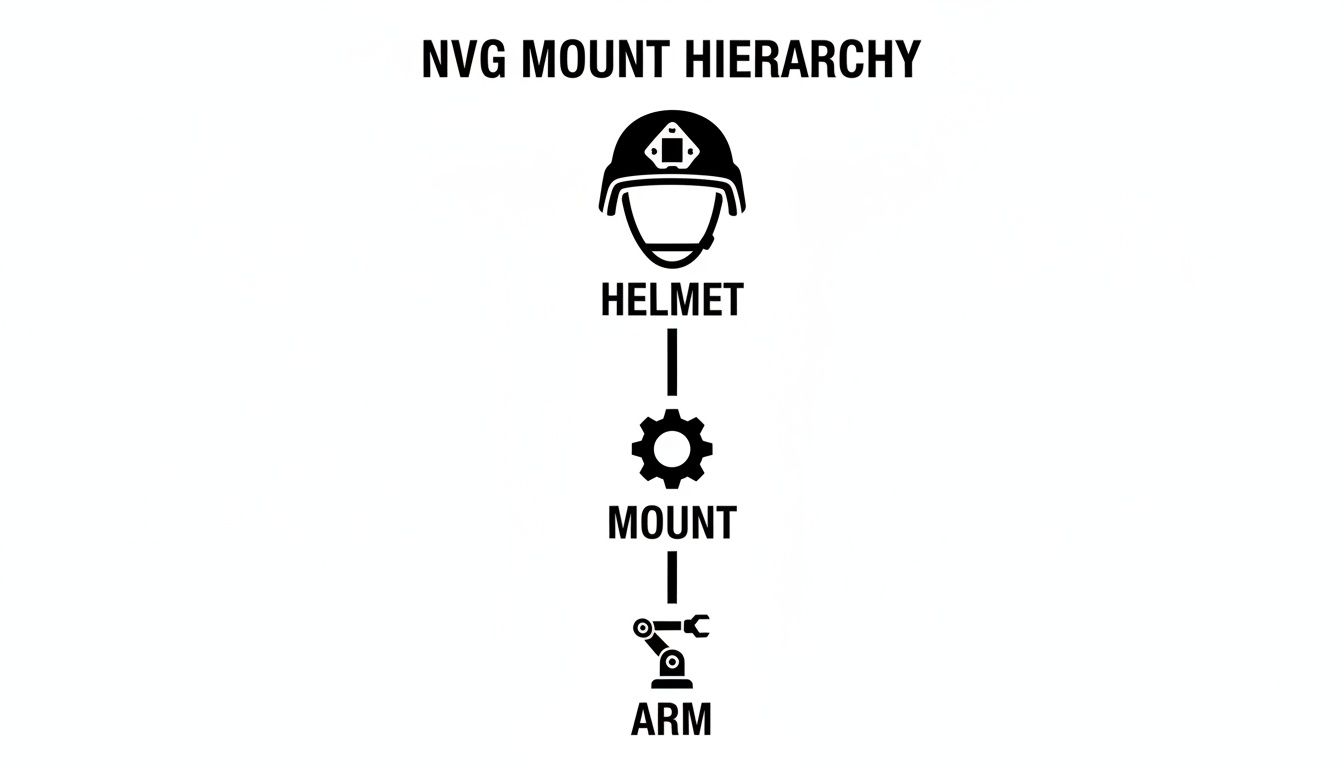
As you can see, a wobbly mount means a wobbly image, no matter how good your helmet or night vision is. Now, let's get into the models you're most likely to encounter.
The AKA2: The Rugged Workhorse
The Norotos AKA2 is a legend for a reason. Its reputation is built on tank-like durability and a dead-simple "force-to-overcome" design. This mount was engineered for absolute reliability when things go sideways.
There are no buttons to fumble with in the dark. To stow your NVG, you just push it firmly up until it clicks into place. To bring it down, you pull. That’s it. This simplicity is its greatest strength, especially under stress.
- Best For: Anyone who values bombproof reliability and intuitive function above all else.
- Ideal User: A great fit for military or law enforcement personnel who need a "set-and-forget" system that is guaranteed to perform, or for civilians who demand a combat-proven solution.
Machined from aerospace-grade aluminum, the AKA2 provides a rock-solid lockup that eliminates wobble. It’s the definition of a field-ready combat mount.
The INVG: The Low-Profile Specialist
But what if brute strength isn't your only priority? The Norotos INVG mount offers a completely different, more specialized approach. Its defining feature is a unique rotational hinge.
Instead of just flipping straight up, the INVG lets you swing a monocular (like a PVS-14) horizontally, parking it right against the side of your helmet. This creates an incredibly low-profile stowed position, perfect for getting in and out of vehicles or moving through tight hallways where snagging your NVG is a real risk.
The INVG's ability to hug the helmet is its defining characteristic. It minimizes your head's silhouette and keeps the device out of your peripheral vision when stowed.
This design also makes it incredibly fast to transition from using the optic to using your natural vision without breaking your cheek weld on a rifle.
The Lo-Sto: The Ultimate Stowage Profile
Just as the name suggests, the Lo-Sto was engineered with one mission in mind: achieving the lowest possible stowage profile. It pulls the NVG in tighter and closer to the helmet than any other mount, including the INVG.
When your number one concern is minimizing snag hazards and keeping your profile as slick as possible, the Lo-Sto is the undisputed champion.
This kind of hyper-specialization is a direct response to a booming market. The dedicated night vision goggle market was valued at USD 2.7 billion in 2024 and is projected to climb to USD 4.36 billion by 2030, according to a report from Stratview Research. This growth fuels innovation and creates demand for gear like the Lo-Sto that solves very specific user problems.
While these Norotos models are fantastic, it's always smart to understand the competition. To get a feel for the broader landscape, check out our detailed comparison of the Wilcox G24 vs. the Argus A4, two other giants in the high-performance mount world.
How to Install and Adjust Your Mount for Peak Performance
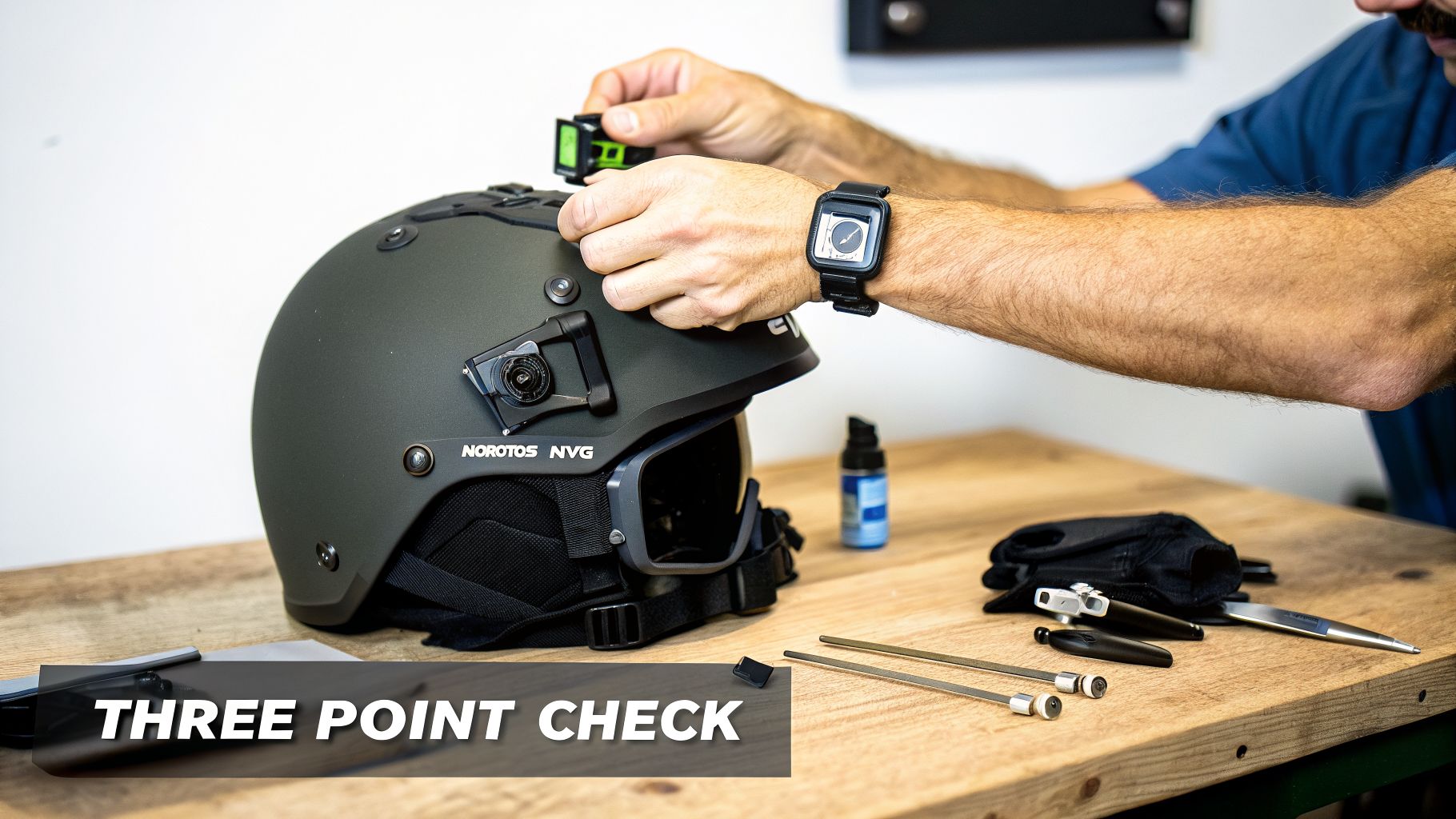
So, you've got your hands on a top-tier Norotos mount. That’s a great start, but getting the hardware is only half the job. To get the performance you paid for, you have to nail the installation and adjustment. A poorly configured mount is more than just an annoyance; it can cause serious eye strain, an unstable image, and completely undermine the quality of your gear.
Think of it this way: you wouldn't slap a set of high-performance tires on your car without getting a proper alignment, right? Same principle here. The setup is what turns potential into actual, reliable performance in the field.
First things first, let's get the mount on your helmet. Most modern tactical helmets come with a standard front shroud, like a Wilcox L4 or an Ops-Core VAS pattern. Your Norotos mount is designed to mate with this shroud. When you press it in, you should hear and feel an authoritative "clack" as it locks into place.
Now for the wiggle test. Grab the body of the mount and give it a good, firm shake. There should be zero play or wobble. If you feel any movement, something’s not right. Double-check that your helmet shroud is bolted down tight and that the mount is fully seated in the shroud’s locking mechanism.
Dialing in Your Sight Picture
With the mount solidly on your helmet, it’s time to attach your NVG via its arm (whether it's a dovetail or bayonet style). This next part is the most critical phase: adjustment. The entire goal here is to perfectly align the eyepiece of your night vision device with your eye, giving you a full, clean, circular image with no black crescents or "scope shadow" around the edges.
This all comes down to fine-tuning three main adjustments:
- Fore/Aft Adjustment: This slides the whole NVG unit closer to or farther from your face. A good technique is to start with it too far out, then slowly bring it back toward your eye until the image fills your view completely, without feeling crowded.
- Vertical Adjustment: This controls the height, moving the device up or down. You want the eyepiece centered on your pupil. The right height means you're not craning your neck up or tucking your chin down to see—it should just be there.
- Tilt Adjustment: This angles the NVG to match the unique contours of your face and how you hold your head. Most people need a few degrees of tilt to get an image that looks perfectly flat and level to their eyes.
A correctly adjusted mount means you see a perfect, full-circle image through your NVG without straining your eye or neck. It should feel natural and effortless, almost like the device isn't even there.
The Final Performance Check
Once you think you have it dialed in, it's time for a quick reality check to make sure everything is rock-solid and ready for use. This simple shakedown will tell you if your setup is truly ready for action.
- Stability: With the NVG flipped down in front of your eye, move your head around quickly—look left, right, up, and down. The image you see should stay completely stable, with no bouncing or vibration.
- Alignment: Close your non-dominant eye. The image through the NVG should be perfectly centered and clear without you needing to instinctively shift your head or neck.
- Deployment: Flip the NVG up and down a few times. The movement should be smooth but deliberate, locking securely in both the stowed (up) and deployed (down) positions. No slop, no hesitation.
Taking a few extra minutes to get this right is what separates a frustrating, headache-inducing night vision experience from an effective one. It ensures you’ll be comfortable during long hours of use and, most importantly, that your gear will perform exactly as it should when you need it most.
Choosing the Right Norotos Mount for Your Needs
Picking the right Norotos mount isn't about finding the "best" one—it's about finding the best one for you. We've covered the what and the why, so now let's connect the dots and match your specific needs to the right piece of gear.
The global demand for night vision has exploded, rocketing from a USD 4.66 billion market in 2019 to an estimated USD 11.37 billion by 2024. This surge, fueled by everything from military modernization to increased civilian interest, has put a spotlight on the mounting systems that professionals trust. You can dive deeper into the market data over at the IMARC Group.
Recommendations by User Type
Different jobs call for different tools. A mount built for the jarring reality of forced entry is overkill for a quiet night of hog hunting, and vice versa.
For Law Enforcement and Military Professionals:
In your world, gear failure is not an option. You need something that is absolutely bombproof and works without a second thought. The Norotos AKA2 is a go-to for a reason. Its "force-to-overcome" design means your NVG isn't going anywhere unless you want it to, which is crucial. The optional breakaway feature is a literal lifesaver when you're moving fast in and out of vehicles or through tight spaces.
For Hunters and Serious Outdoorsmen:
You're often out for hours, and comfort matters just as much as stealth. This is where the Norotos INVG really shines. Its ability to rotate a monocular completely to the side of the helmet creates an incredibly low-profile and balanced setup. No more snagging on branches or dealing with a sore neck after a long night tracking game.
The most important factor is balancing cost, durability, and compatibility. A PVS-14, for example, can be configured for either bayonet or dovetail systems, which will directly influence your mount choice.
For the Preparedness-Minded Civilian:
For general use, you want a sweet spot between solid performance and reasonable cost. A fantastic route is to pair a common monocular like a PVS-14 with an upgraded arm, such as the Norotos Dual Dovetail Adapter. This gives you the rock-solid stability of a modern dovetail system and ensures your setup is ready for future upgrades without breaking the bank.
Frequently Asked Questions About Norotos Mounts
Once you've sorted out your helmet and NVGs, the mount itself can bring up its own set of questions. Let's clear up a few of the most common ones we hear from both new and experienced users.
Will a Norotos Mount Fit My Specific Helmet?
The short answer is yes, it almost certainly will. The key isn't the helmet itself, but the shroud attached to the front of it.
Norotos designs their mounts to work with industry-standard helmet shrouds, like the common Wilcox L4 or Ops-Core VAS patterns. As long as your helmet is equipped with one of these standard shrouds, a Norotos NVG mount will lock right in. Just give it a good wiggle after you attach it to make sure the connection is rock-solid.
What Is Force-to-Overcome Versus Breakaway?
These terms sound similar, but they describe two very different and critical functions. Think of it as a deliberate action versus an emergency reaction.
- Force-to-Overcome is the intentional push you need to flip the NVGs up and out of the way, or pull them back down. It’s a firm, positive click that keeps your expensive optic from flopping around while you're moving.
- Breakaway is a non-negotiable safety feature. If you snag your NVGs on a branch or door frame, the mount will snap away from the shroud. This protects your neck from serious injury and saves your gear from a catastrophic impact.
You'll find that premium Norotos mounts, especially those built for professional duty, feature both. They give you the best of both worlds: operational control and a built-in safety net.
Is a Norotos Mount Really Worth the Higher Cost?
For anyone who depends on their night vision gear, the answer is an emphatic yes. A basic "rhino" mount will technically hold an NVG to your head, but a Norotos NVG mount provides a completely different level of performance in stability, adjustment, and long-term durability.
The difference is night and day. A quality mount eliminates the wobble and sag that plague cheaper options. It gives you the precise alignment and ergonomic control needed to reduce eye strain and use your equipment effectively for hours on end. It's a true investment in performance and safety.
Ready to see the difference a professional-grade mount can make for your night vision setup? Check out the full range of tactical gear at Superior Tactical LLC. Our team offers straightforward advice to help you get the right equipment for your mission. Visit our website at https://superiortac.com to find the perfect solution.
