A Guide to Night Vision with Thermal Overlay
Night vision with thermal overlay isn't just a gadget; it's a completely different way of seeing in the dark. It takes two powerful technologies—light amplification and heat detection—and merges them into a single, intuitive visual feed.
What you're seeing is a real-time fusion. The system overlays the heat-detection data from a thermal sensor directly onto the light-amplified image from a traditional night vision device. This gives you a fused view where you see the physical world in crisp detail while also seeing heat signatures that would otherwise be completely invisible.
Why Fused Vision Changes Everything
Picture this: you're moving through a dense forest at night. With standard night vision, you can see every tree and rock, but a well-camouflaged threat could be completely hidden in the brush. Now, switch to a thermal imager. That threat's body heat glows like a beacon, but you can't see the terrain—the rocks, ditches, and roots at your feet are gone. You've traded one blind spot for another.
This is the classic dilemma. Standard night vision, which amplifies ambient light, gives you incredible detail for navigation and identification. But it’s defeated by good camouflage.
A thermal imager, on the other hand, detects infrared radiation (heat) and is a master of detection. Nothing with a body temperature can hide from it, even through smoke or fog. The problem? It offers almost zero environmental context, making movement difficult and dangerous.
Bridging the Sensory Gap
This is exactly where night vision with thermal overlay steps in and completely changes the game. You no longer have to choose between seeing your surroundings and seeing heat signatures. You get both, at the same time, in one seamless picture.
The real power of fused vision is the total situational awareness it delivers. By layering critical thermal intelligence over a detailed, navigable night vision image, it removes the guesswork and gives you the confidence to detect, identify, and act.
Think of it as adding a vital intelligence layer to your natural field of view. The technology literally projects the thermal image from a sensor onto the output of the image intensifier tube. In practice, this means you can:
-
See a detailed landscape through the image intensifier, just like you would with a high-quality PVS-14.
-
Instantly spot heat signatures that pop out thanks to the thermal overlay, which can often be customized from a full thermal image to a simple, clean outline.
-
Move with confidence while simultaneously spotting targets or threats that either technology alone would have missed.
This isn’t just about adding more data; it's about creating a more complete and instinctual understanding of your environment. That camouflaged adversary hiding in the shadows is no longer invisible—their body heat gives them away. You can spot a recently driven vehicle from its warm engine or even track residual heat from footprints on certain surfaces.
By combining the strengths of both technologies, a night vision with thermal overlay system provides a decisive edge for anyone operating in low-light environments.
How Thermal Fusion Technology Works
To really get a handle on what makes fused systems so effective, you have to understand the two very different technologies working together. It’s not about one replacing the other; it’s about a perfect partnership where each one’s weakness is covered by the other’s strength.
Think of it like this: you have two experts giving you intel. The night vision expert describes the terrain and obstacles, while the thermal expert points out hidden threats. A processor in the middle instantly combines their reports into a single, crystal-clear picture of what’s ahead.
This powerful combination is why the demand for these systems is exploding. The global market for night vision devices, including fused systems, was recently valued at $7.5 billion and is on track to hit $9.5 billion soon. That's a massive market, and thermal's share of it proves just how critical heat detection has become.
The Foundation: Image Intensification
At its heart, traditional night vision is basically a light amplifier. A standard night vision device (NVD) uses an image intensifier (I²) tube to gather whatever tiny amount of ambient light is available—from stars, the moon, anything—and crank it up thousands of times.
The result is a surprisingly detailed, visible image. This is what gives you incredible environmental context. You can navigate tricky terrain, identify obstacles, and recognize shapes with amazing clarity. The catch? It needs some light to amplify. In absolute darkness or against perfect camouflage, an I² tube can be left blind. To see how I² stacks up against other systems, check out our complete guide to night vision technology.
The Detection Powerhouse: Thermal Imaging
While night vision sees amplified light, thermal sees heat. Plain and simple. It uses a tiny sensor called a microbolometer to pick up on infrared radiation—the heat signature that every object gives off. It’s the same way a pit viper "sees" the body heat of its prey in pitch-black conditions, completely independent of visible light.
This makes thermal an absolute master of detection. A warm body, a recently driven engine, or even disturbed earth will glow like a beacon against a cooler background, no matter the lighting or camouflage. But thermal has its own blind spot: because it only sees heat differences, it gives you almost no detail about the surrounding environment, making it dangerous to navigate with alone.
The Fusion Engine: Where the Magic Happens
The real game-changer in a night vision with thermal overlay system is the fusion engine. This is a powerful, onboard processor that acts as the brain of the whole operation, blending the two separate video feeds into one cohesive image in real-time.
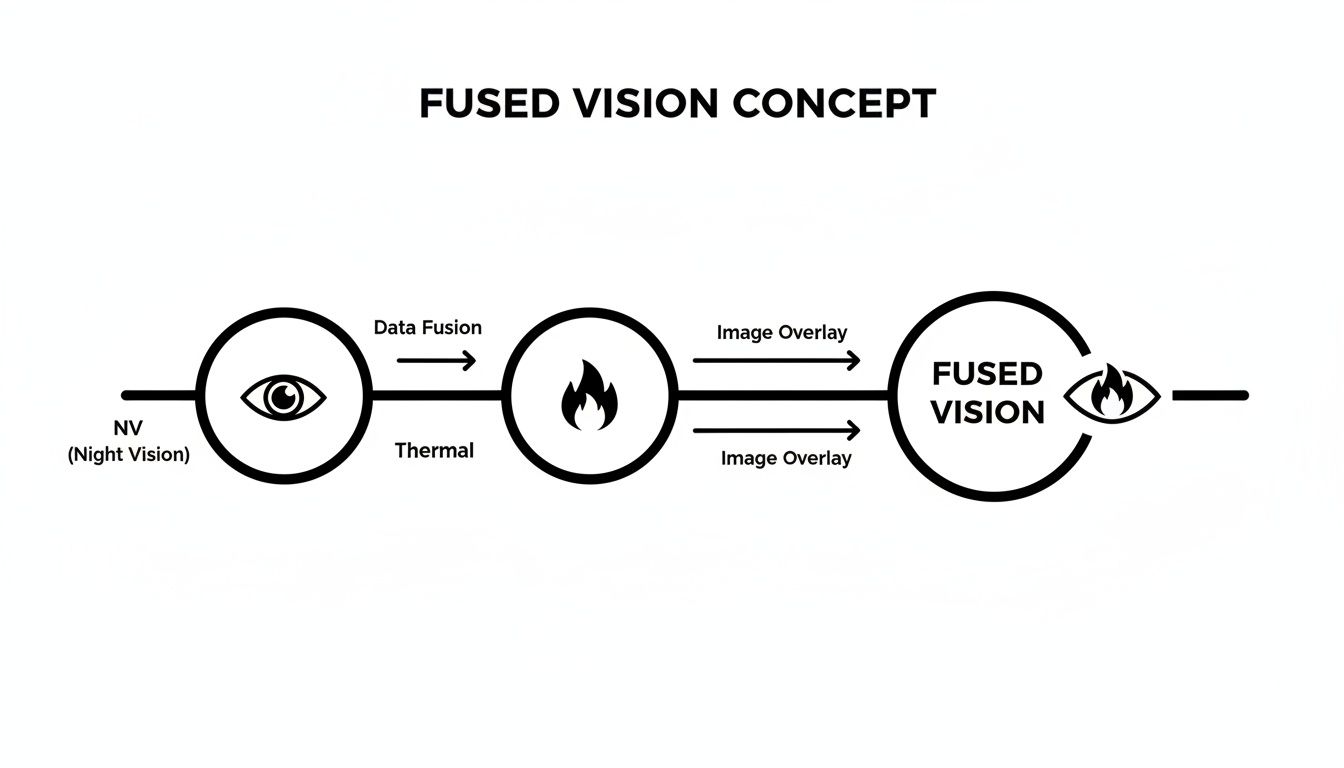
The processor takes the data from the thermal sensor and intelligently projects it over the image from the I² tube. It's far more sophisticated than a simple copy-paste job. Modern systems give you multiple view modes so you can tailor the display to your exact needs.
To put it in perspective, here's a quick breakdown of how these technologies compare on their own versus when they're fused.
Night Vision vs Thermal vs Fused Overlay
| Capability | Standard Night Vision (I²) | Standard Thermal | Fused Thermal Overlay |
|---|---|---|---|
| Detection | Poor against camouflage | Excellent | Excellent |
| Navigation | Excellent | Poor | Excellent |
| Identification | Good at close ranges | Poor (identifies "what," not "who") | Excellent |
| Performance in Smoke/Fog | Poor | Good | Good |
| Situational Awareness | Good | Fair | Superior |
As you can see, the fused overlay doesn't just combine the two; it creates a capability greater than the sum of its parts. You get the best of both worlds without the compromises.
This is all thanks to the different overlay modes the fusion engine provides. You can usually cycle through a few options to get the perfect view for the job. Common modes include:
-
Outline Mode: My personal favorite for most situations. It draws a crisp, glowing outline around heat signatures without washing out the I² image. It gives you instant target detection while keeping all that crucial terrain detail.
-
Full Thermal Overlay: This mode lays the entire thermal image over the night vision view. It’s great for when you need to see more subtle heat details across the entire scene.
-
Blended Mode: Think of this as a more transparent overlay. It smoothly mixes both sensor feeds, creating a balanced image that pulls the best from both technologies at once.
By managing these inputs, the fusion engine turns two limited perspectives into one all-seeing sight picture, giving you a level of confidence in the dark that neither technology could ever provide on its own.
Comparing Standalone Systems to Fused Overlays
So, you're weighing your options: standalone night vision, a separate thermal imager, or a fused system? The choice really boils down to understanding the operational pros and cons of each. While every technology has its place, only a night vision with thermal overlay rig truly covers the dangerous gaps left by the others. This isn't about which is "better" on paper, but what gives you the decisive edge when every second matters.
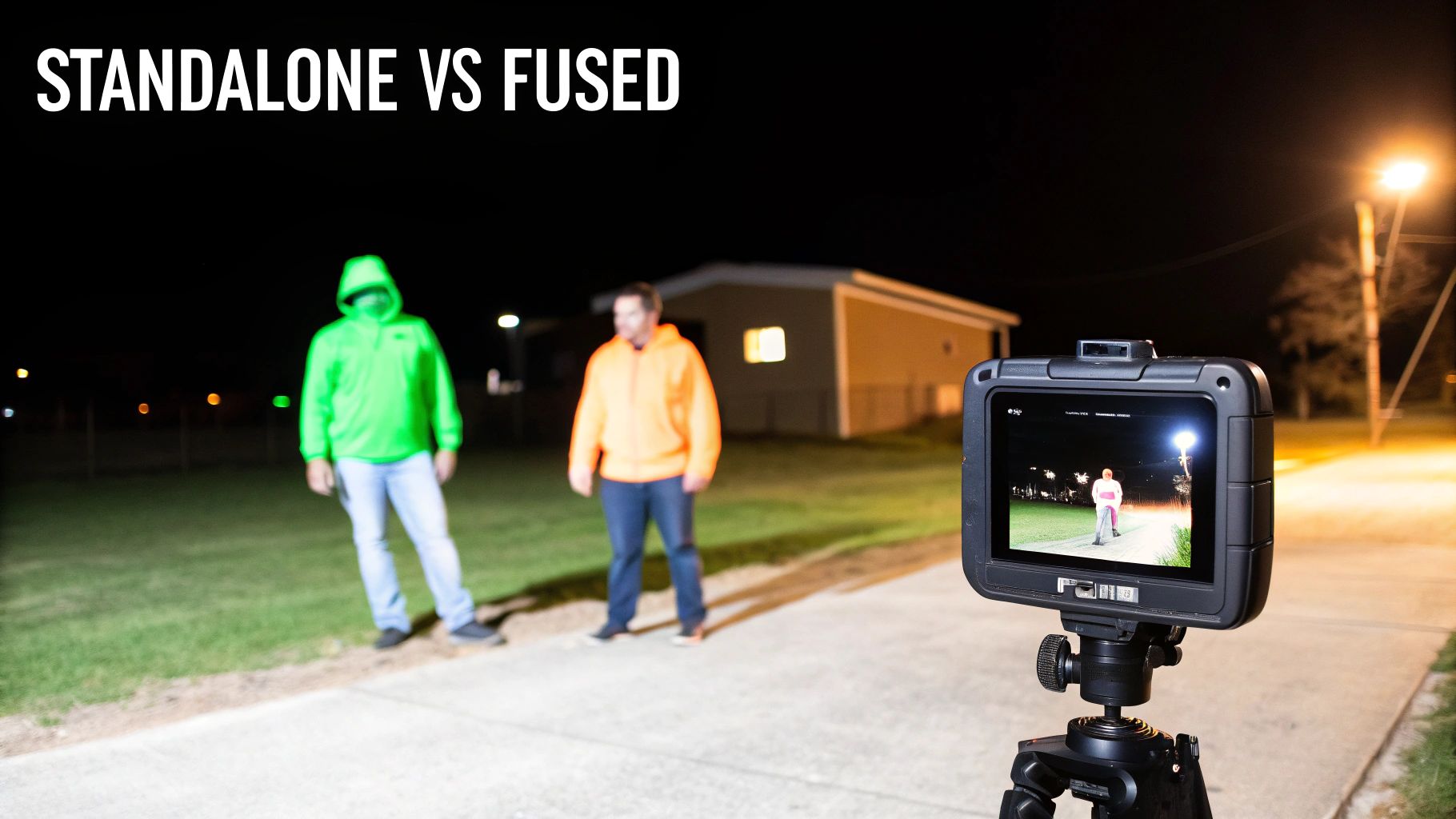
Let’s paint a picture. A search and rescue team is working a dense forest at 0200. One operator, using a top-tier Gen 3 monocular, can navigate the treacherous ground with confidence, seeing every rock and fallen log. But he walks right past the missing hiker, who is curled up under a thick evergreen, completely hidden from the amplified light.
A second operator, scanning with a thermal monocular, gets an instant hit—a bright yellow heat signature against the cold ground. It’s a game-changing detection. But while zeroed in on that signature, he doesn't see the washout in front of him and takes a nasty fall. This is the exact dilemma we face with standalone systems; you’re always missing a critical piece of the puzzle.
Situational Awareness vs. Target Detection
At its core, this whole debate comes down to two things: situational awareness and target detection. Traditional night vision is king when it comes to the first, giving you a detailed, recognizable view of your surroundings so you can move and orient yourself. Thermal, on the other hand, is the undisputed champ of the second, cutting through camouflage, smoke, and darkness to find a heat source.
Fused vision is the only way to get the best of both worlds, simultaneously. You get the full environmental picture from your night vision, with the thermal overlay acting as a high-contrast beacon for anything you need to see.
Now, imagine that SAR operator with a fused system. He sees the terrain with perfect clarity and sees the glowing outline of the hidden person at the same time. There’s no switching between devices, no mental gymnastics trying to stitch two different views together. It’s one seamless picture that leads to faster, safer, and more successful outcomes.
Key Operational Capabilities Head-to-Head
Let's get down to brass tacks and see how these systems stack up in real-world tasks. This is where you'll see why a fused night vision with thermal overlay isn't just an upgrade; it's a whole new level of capability.
-
Navigation: Night vision is great for moving around. Standalone thermal is downright dangerous for this, offering zero detail of the ground beneath you. Fused vision is excellent, giving you all the detail of night vision plus thermal cues.
-
Identification: With night vision, you can get a good PID (Positive Identification) at reasonable distances. Thermal just tells you something warm is there, not what it is. Fused vision is superior; the thermal detects, and the night vision lets you identify.
-
Threat Detection: Here’s where it gets serious. A bad guy in ghillie suit is practically invisible under standard NVGs. With thermal, he glows, but so does every other rock that was in the sun all day. A fused overlay instantly highlights the human-shaped threat against the detailed tactical backdrop. No guesswork.
Making the Tactical Choice
At the end of the day, the mission dictates the gear. If you're just stargazing or watching deer in an open field, a good PVS-14 might be all you need. If you're purely spotting for hogs, a thermal scanner is a fantastic tool.
But for any scenario where you’re dealing with complex terrain, potential concealment, and the need to both move and detect, the argument for fusion is overwhelming.
Whether you're a cop clearing a dark warehouse, a hunter tracking a wounded buck into a thicket, or a professional running surveillance, the power to see both the world and the heat within it is a massive force multiplier. The investment in a night vision with thermal overlay system pays for itself in safety, efficiency, and mission success. It changes the game from managing compromises to achieving total visual dominance.
Real-World Applications of Thermal Fusion
Okay, enough with the theory. Let's talk about where the rubber meets the road. A night vision with thermal overlay system isn't just a cool piece of gear; it’s a game-changer in high-stakes environments where you simply can't afford to miss what's right in front of you.
From the battlefield to a backcountry rescue, fused vision provides the complete picture when darkness would otherwise leave you blind. It’s about saving lives and getting the job done.
For military and law enforcement operators, the advantage is stark. Think about clearing a building filled with smoke. Your standard NVGs are useless, completely whited out. But a thermal overlay cuts straight through the haze, lighting up heat signatures and revealing threats long before you're in the line of fire.
The same goes for rural operations. An operator on overwatch can maintain perfect terrain awareness with their night vision, while the thermal layer instantly flags a camouflaged enemy hiding in a tree line. No more swapping between a PVS-14 and a thermal monocular—your focus stays where it needs to be.
Tactical Hunting and Game Recovery
Hunters immediately understand the value here. We've all been there—trying to spot game tucked away in thick brush or deep shadows at dusk. A thermal overlay makes a warm-bodied animal stand out like a beacon against the cool background, defeating natural camouflage that would make it invisible to the naked eye or even standard night vision.
But the real magic happens after the shot. Tracking a wounded animal in the dark is one of the toughest parts of hunting. With a fused system, the heat trail from blood spots or the animal itself glows, making recovery quicker, safer, and far more ethical. For more on this, check out our guide on pairing thermal spotters with your NV setup.
Search and Rescue Operations
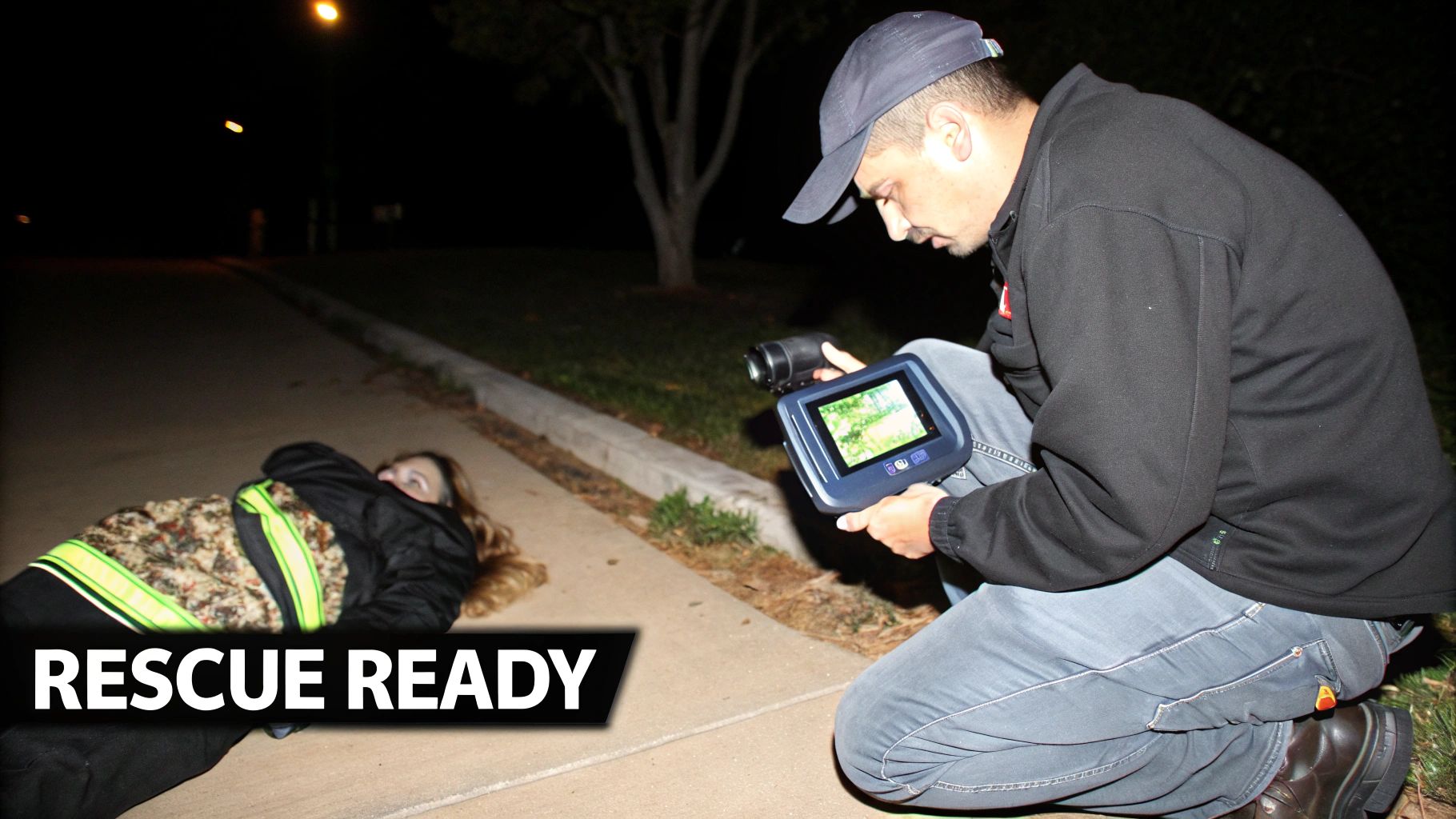
When it comes to search and rescue (SAR), every second counts. Fused vision gives teams a massive advantage, empowering them to find missing people in brutal conditions where the clock is always ticking.
Imagine a SAR team scanning a vast, dark mountainside. With a fused device, they can instantly pick up the faint heat signature of a person suffering from hypothermia. At the same time, the night vision gives them the environmental detail needed to safely navigate the treacherous terrain to get there—something you just can't do with thermal alone.
This technology is an absolute lifeline in scenarios like:
-
Avalanche Rescue: Finding victims buried under the snow by detecting their faint, residual body heat.
-
Lost Hikers: Spotting people in dense forests where they'd otherwise be completely hidden from view.
-
Disaster Response: Identifying survivors trapped in collapsed buildings or floodwaters where visibility is near zero.
By combining crystal-clear navigation with powerful heat detection, a night vision with thermal overlay system drastically increases the chance of a successful rescue.
Maritime and Coastal Navigation
The maritime world is another area where this tech has found a firm footing. Navigating a busy channel or the open ocean in total darkness is filled with hazards, from unlit buoys to other boats running dark.
In fact, marine applications are a huge reason this technology is growing so fast. The global market for marine night vision cameras, which is heavily reliant on thermal, was valued at around USD 2.7 billion and is expected to climb to USD 4.1 billion. That growth is being driven by more boat traffic and tougher safety rules. You can dig into the specifics in this comprehensive marine technology report.
For a boat captain, a fused system means they can:
-
Spot Buoys and Debris: See channel markers, logs, and other floating hazards that radar might miss entirely.
-
Identify Other Vessels: Detect everything from a small kayak to another large boat long before it poses a collision risk.
-
Handle Man-Overboard Emergencies: Instantly locate a person in the water by their body heat against the cold sea—a critical, life-saving advantage.
Whether you're a professional operator or a private citizen, the story is the same: fusing these two technologies gives you a level of awareness and safety in the dark that neither can provide on its own.
How to Choose Your Fused Night Vision System
Investing in a night vision with thermal overlay system is a big commitment, and making the right call goes way beyond just looking at the price tag. Your decision really hinges on what you’ll be doing with it. Are you clearing rooms, tracking game through the woods, or running a search and rescue mission?
The answer to that question will guide you. The first major fork in the road is choosing the form factor. You can go for an all-in-one, dedicated fused monocular, or you can take a more modular approach.
A popular choice for many operators is a Clip-On Thermal Imager (COTI). These units attach right onto your existing night vision device, like a PVS-14, giving you that thermal overlay capability without needing a whole new primary optic. It's a fantastic, flexible solution.
On the other hand, dedicated fused systems are built from the ground up as a single, cohesive unit. This means the controls are often more intuitive and the weight is better balanced—a huge plus when you’re wearing it for hours on end.
Evaluating Key Technical Specs
When you start comparing different models, it's easy to get lost in a sea of technical jargon. To cut through the noise, focus on a few key metrics that really define a unit's performance out in the field.
-
Thermal Sensor Resolution: This is measured in pixels (e.g., 320×240 or 640×480). More pixels mean a sharper, more detailed thermal image, which is critical for identifying targets at a distance. A 640×480 sensor is widely considered the gold standard for most serious applications.
-
Refresh Rate: Measured in Hertz (Hz), this spec tells you how smoothly the image updates. A 60Hz refresh rate delivers a fluid, real-time video feed that’s perfect for tracking fast-moving targets. A 30Hz rate, by comparison, can look a bit choppy.
-
Night Vision Tube Quality: Don't forget that the image intensifier (I²) tube is still the foundation of the system. For fused setups, you need a high-quality Gen 3 tube with a great Figure of Merit (FOM) and signal-to-noise ratio. This ensures the base image you're seeing is as clear as possible.
The goal is to find a balanced system. A high-resolution thermal sensor paired with a low-quality night vision tube is a waste of capability. Both components must be strong for the fused image to be truly effective.
This kind of thermal tech is rapidly expanding beyond the tactical world. The car thermal imaging market, for instance, was recently valued at USD 980.37 million and is projected to grow 7.74% annually. This shows just how mainstream the technology is becoming. You can find more about this expanding market and its role in smart city initiatives on 360iResearch.com.
Comparing Dedicated vs. Clip-On Systems
So, which path is right for you? It really comes down to a direct comparison between a dedicated unit and a COTI, based on your current gear and what you need to accomplish.
| Feature | Dedicated Fused Monocular | Clip-On Thermal Imager (COTI) |
|---|---|---|
| Integration | Seamless, factory-calibrated | Requires user mounting and alignment |
| Cost | Higher initial investment | Lower entry cost if you own an NVD |
| Flexibility | All-in-one system | Can be removed when not needed |
| Weight | Often better balanced | Adds front-heavy weight to an NVD |
If you already own a top-tier monocular like a PVS-14, adding a COTI is a smart and cost-effective way to get thermal fusion. But if you're building a new kit from scratch and want the most streamlined, hassle-free setup, a dedicated fused device is tough to beat.
For more on this, check out our guide on how to leverage a separate thermal monocular alongside your PVS-14 in our detailed guide. At the end of the day, matching the gear to your mission is what ensures you make a choice you can depend on.
The Future Is Fused Vision
As we've covered, night vision with thermal overlay isn't just a minor improvement—it’s a total game-changer for operating in the dark. This is the difference between getting a piece of the puzzle and seeing the whole picture with stunning clarity. You're no longer forced to pick between seeing where you're going and seeing what's out there. You get both, in real-time.
This fusion hands you an undeniable tactical edge. It cuts through camouflage to expose hidden threats, gives you the detail needed for positive identification when thermal alone can't, and delivers a level of situational awareness that was once impossible. For any serious operator, fused vision is quickly becoming the new baseline for staying safe and effective.
Layering a thermal signature on top of a detailed night vision image patches the critical holes left by standalone systems. It's not just about seeing more—it's about knowing exactly what you're looking at with complete confidence.
What Lies Ahead for Fused Technology
And this technology is still just getting started. The push is on to make these systems smaller, lighter, and smarter than ever before. Looking ahead, we can expect a few major developments:
-
Miniaturization: Gear will keep getting smaller, cutting down on neck strain and overall weight without compromising what you can see.
-
AI-Powered Identification: Expect to see onboard processors using artificial intelligence to automatically flag potential threats, telling you if that heat signature is a person, a coyote, or a vehicle.
-
Increased Accessibility: As the technology matures and production scales up, the price tag on entry-level fused systems should start coming down, opening the door for more people to get their hands on it.
At the end of the day, the real power of night vision with thermal overlay is how it gives you a complete, intuitive grasp of your surroundings. As it continues to evolve, fused vision will cement its place as the essential tool for anyone who needs to own the night.
Frequently Asked Questions
Even after you get the hang of how night vision with thermal overlay works, there are always a few practical questions that pop up. We get them all the time. Here are the most common ones, with straight-shooting answers to help you figure out what this gear can—and can't—do for you.
Can Thermal See Through Walls or Glass?
This is probably the biggest myth about thermal imaging. The short answer is a hard no. Thermal imagers don't see through things; they see surface heat. They can't penetrate solid objects like walls, concrete, or even a thick tree trunk.
Glass is another roadblock for thermal. It acts like a mirror for infrared radiation, so instead of seeing what's on the other side, you'll just see a reflection of the heat around you—including your own. On the flip side, standard night vision works just fine through a window because it's only amplifying available light.
What Is a COTI Versus a Dedicated Fused Device?
This really boils down to a choice between modularity and a fully integrated setup. It's kind of like deciding whether to drop a high-performance engine into your favorite car or to buy a supercar built around that engine from the factory.
-
A COTI (Clip-On Thermal Imager) is a separate thermal unit you attach to your existing night vision device, like a PVS-14 monocular. It's a fantastic way to add thermal capabilities to a high-end night vision setup you already own and have trained with.
-
A dedicated fused device is an all-in-one system. The night vision tube and the thermal sensor are built together into a single, cohesive unit. These are often better balanced, more ergonomic, and the controls are designed from day one to work together seamlessly.
Your choice often hinges on what gear you're already running. If you've invested in a top-tier monocular, a COTI is a smart, cost-effective upgrade. But if you're starting from square one, a dedicated fused system gives you a purpose-built solution that’s ready to go right out of the box.
How Much Does a Quality Fused System Cost?
Be prepared—this is a serious investment. While some entry-level options might dip into the low thousands, a professional-grade night vision with thermal overlay system will typically run anywhere from $10,000 to over $20,000.
So, what are you paying for? It's all about the components inside:
-
Thermal Sensor Resolution: A higher-resolution sensor, like a 640×480, gives you a dramatically clearer thermal image than a 320×240, and that performance comes at a premium.
-
Night Vision Tube Quality: The image intensifier tube is the heart of the system. A Gen 3 white phosphor tube with a high FOM (Figure of Merit) is a top-of-the-line component that heavily influences the final price.
-
Build Materials and Durability: You're paying for housings machined from aircraft-grade aluminum or advanced polymers, nitrogen-purged optics, and serious waterproofing. This gear is built to be abused.
-
Features and Integration: The processors that fuse the images, the different overlay modes, and the software that makes it all work together seamlessly add significant cost and capability.
At the end of the day, the price tag reflects the unbelievable advantage you're getting: the ability to see both the world around you and the hidden heat signatures within it, all in a single, clear picture.
Ready to gain a decisive advantage in the dark? The team at Superior Tactical LLC has spent over a decade outfitting professionals and serious enthusiasts with the best night vision and thermal solutions on the market. Explore our curated selection of top-tier gear and get expert advice to find the perfect system for your mission.
Browse Our Night Vision and Thermal Optics Collection at superiortac.com
