Night Vision Scope Vs Thermal Which Is Right for You
It all boils down to one simple concept: night vision amplifies existing light, while thermal imaging detects heat.
Think of it this way: night vision lets you see what's there with incredible detail, just like your own eyes would if they were a thousand times more sensitive to light. On the other hand, thermal imaging shows you that something is there by its heat signature, even in pitch-black conditions. Your choice hinges on whether you need to identify your target or simply detect its presence.
How Vision in the Dark Actually Works
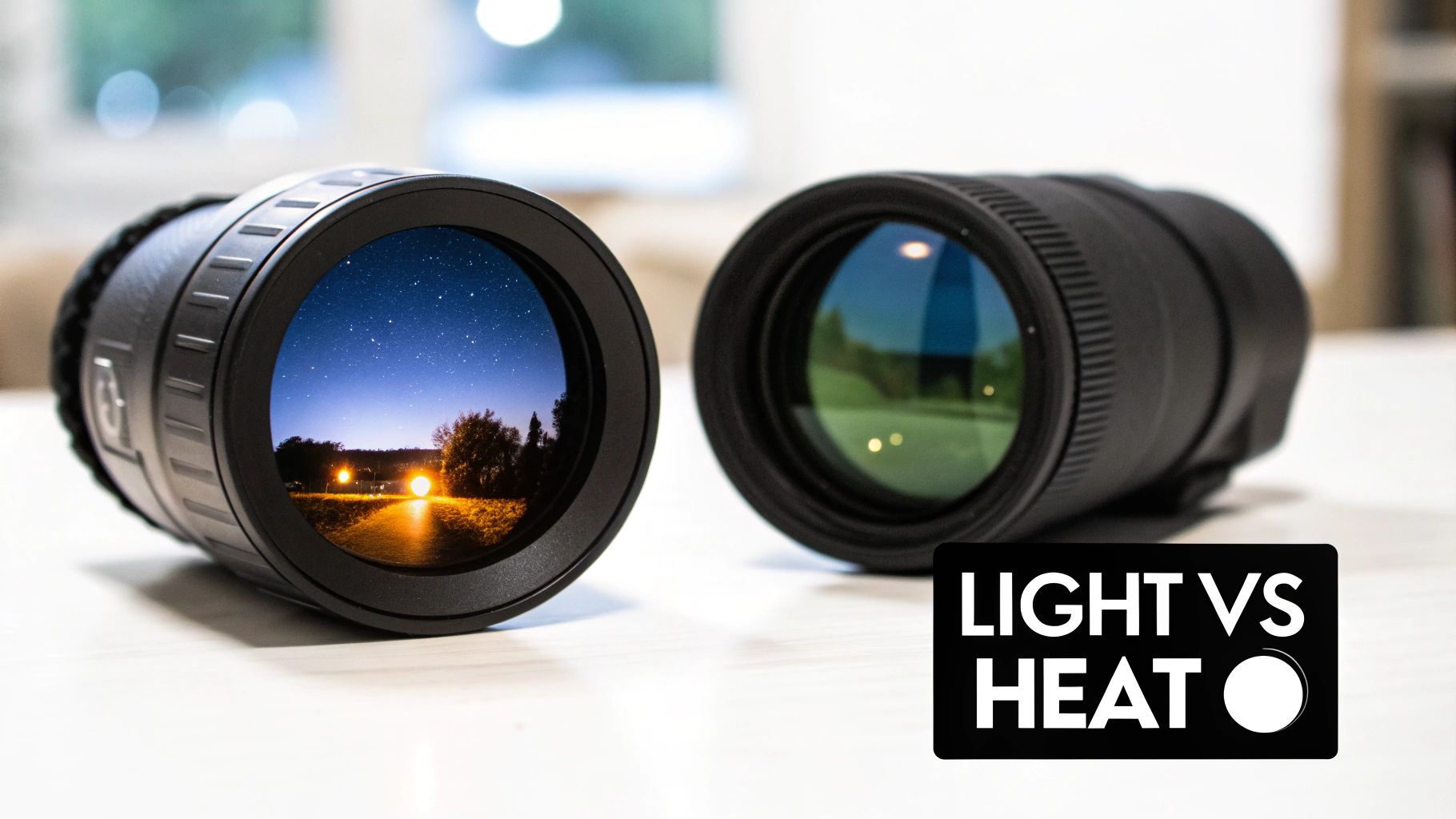
Before you can pick the right tool for the job, you have to understand how these two technologies get the job done. They aren't just magic "see in the dark" devices; they operate on entirely different scientific principles, interpreting different parts of the electromagnetic spectrum. This is what gives each one its unique strengths and weaknesses out in the field.
The Science of Night Vision Image Intensification
At its core, traditional night vision, or image intensification (I²), is a super-powered light amplifier. It gathers minuscule amounts of ambient light—from starlight, moonlight, or even distant city glow—that your naked eye could never register.
Inside the scope, a photocathode converts those tiny light particles (photons) into electrons. These electrons are then shot through a microchannel plate, multiplying them thousands of times before they hit a phosphor screen. That’s what creates the classic green or white-and-black image you’re used to seeing. Our deep dive into how night vision works breaks down this fascinating process even further.
The Bottom Line: Night vision gives you a crisp, recognizable picture that looks almost like a black-and-white photo. This makes it king for identifying exactly what you're looking at. The catch? It needs some light to work and can be overwhelmed or "whited out" by sudden bright lights.
The Science of Thermal Imaging
Thermal imaging plays by a completely different set of rules. It ignores light entirely and instead detects heat, specifically infrared radiation. Literally everything with a temperature above absolute zero gives off this thermal energy, from a coyote in a field to a recently driven truck.
A special lens inside a thermal scope focuses that infrared energy onto a sensor grid called a microbolometer. Each tiny sensor measures the heat it receives, creating a detailed temperature map known as a thermogram. The scope’s brain then assigns colors or grayscale tones to these different temperatures, creating the image you see. This is why a warm-blooded animal pops against the cold ground, glowing brightly.
Core Technology Comparison Night Vision Vs Thermal
To put it simply, these optics are built for different missions. This table breaks down their fundamental operational differences.
| Operational Principle | Night Vision (Image Intensification) | Thermal (Infrared Imaging) |
|---|---|---|
| Energy Source | Amplifies ambient light (photons) | Detects heat signatures (infrared radiation) |
| Image Output | Detailed, recognizable image (green/white) | Heat map showing temperature differences |
| Light Requirement | Needs minimal ambient light to function | Requires no light; works in total darkness |
| Primary Use Case | Identification (recognizing features) | Detection (spotting heat sources) |
While night vision has long been the gold standard for military and law enforcement, thermal is rapidly closing the gap and, in many cases, pulling ahead. The global market reflects this shift. Industry analysis predicts the night vision device market will grow from USD 8.57 billion in 2025 to USD 12.91 billion by 2030, and thermal imaging is the driving force behind that growth. Its ability to detect targets in any condition makes it a game-changer for serious hunters and tactical professionals.
A Deeper Look at Technical Performance
Getting a grip on the basic science of how these optics work is one thing. But to really know what you're buying, you have to learn to speak the language of the spec sheets. Those numbers and acronyms aren't just marketing fluff—they directly translate to what you'll see in the field.
Ignoring the specs is like buying a truck without ever looking under the hood. You might end up with something that looks the part but falls flat the second you need it to perform. Let's dig into the numbers that truly matter for both of these systems.
Image Quality and Resolution
Right off the bat, night vision and thermal measure clarity in completely different ways. You can't compare them directly, because their core technologies are fundamentally different.
With night vision, the gold standard is resolution, which we measure in line pairs per millimeter (lp/mm). Think of it as the optical equivalent of a high-definition screen. It tells you how many tiny black-and-white lines the tube can resolve within a single millimeter. High-quality Gen 3 tubes will hit 64-72 lp/mm, giving you that sharp, detailed picture needed to identify a threat or even read a license plate in the dark.
Thermal works like a digital camera, so its resolution is all about pixels. The numbers you see, like 384×288 or 640×480, represent the grid of sensors capturing heat. More pixels mean more thermal data, which gives you a cleaner, less blocky image. Jumping from a 384×288 to a 640×480 sensor more than doubles your pixel count, a difference you’ll immediately notice when trying to discern the shape of an animal at a distance or using digital zoom.
The key takeaway here is function. Night vision's high lp/mm is built for positive identification. Thermal's pixel count is all about pure detection and classification from afar.
Sensitivity and System Performance
Beyond just clarity, we need a way to measure the overall horsepower of the system. For night vision, that metric is the Figure of Merit (FOM). For thermal, it’s the Noise Equivalent Temperature Difference (NETD).
The Figure of Merit (FOM) is a dead-simple calculation with huge implications: Resolution (lp/mm) multiplied by the Signal-to-Noise Ratio (SNR). A high FOM means the image intensifier tube is both sharp and clean, especially in near-total darkness. The best tubes on the market boast a FOM of 2000 or higher, which translates to a pristine image with very little of that telltale electronic "snow" or scintillation.
On the thermal side, Noise Equivalent Temperature Difference (NETD) tells you how sensitive the sensor is. Measured in millikelvins (mK), it defines the smallest temperature difference the optic can detect. With NETD, lower is always better.
- < 50 mK: This is standard-grade performance, perfectly fine for many situations.
- < 40 mK: Now you're getting into high-quality territory. You’ll see a much clearer image, especially in rain or high humidity.
- < 25 mK: This is top-tier. A sensor this sensitive can pick up on incredibly subtle heat variations, like the velvet on a deer's antlers, giving you a remarkably detailed thermal image.
A low NETD rating is what allows a thermal scope to paint a vivid picture even when there's very little temperature contrast between a target and the background.
Refresh Rate and Its Impact
Refresh rate is a spec you’ll almost exclusively find on thermal scopes, and it's a huge factor in the field. Measured in Hertz (Hz), it tells you how many times per second the thermal image is updated on the screen.
A higher refresh rate means a smoother, more natural-looking image, which is absolutely critical when you're trying to track anything that moves.
- 9 Hz: The image will look choppy. It’s usable for spotting static targets, but trying to track a running coyote or scan from a moving vehicle is frustrating.
- 30 Hz: This is a massive leap forward. The view is much more fluid and is a great all-around choice for hunting and general observation.
- 60 Hz: This is the professional standard. It delivers a seamless, real-time feed with zero lag, which is exactly what you need for fast-moving targets.
Since traditional night vision is analog—it amplifies light in real time—it doesn't have a refresh rate. The image is instantaneous. That's an undeniable advantage, but thermal’s incredible ability to detect heat often makes a slightly lower refresh rate a worthwhile trade-off.
How They Stack Up in the Real World
Specs on a product page are one thing, but how these optics perform when you're out in the field is what really matters. When the rain starts pouring, fog rolls in, or your target ducks behind cover—that's the moment of truth. Getting a feel for these practical differences is the only way to pick the right tool for the job.
Instead of just listing pros and cons, let's walk through a few common scenarios. You'll quickly see that the "best" optic really just depends on what you need it to do.
Dense Fog and Bad Weather
Picture this: you're trying to spot a coyote across a field, but a thick fog is settling in fast. With a top-tier night vision scope, the IR illuminator's light just bounces off the water vapor in the air. You’re left with a blinding white-out, making it impossible to see more than a few feet in front of you.
This is where thermal truly shines. Because thermal sees heat instead of light, it punches right through visual obscurants like fog, smoke, and even heavy rain. That warm-bodied coyote will pop against the cool, damp background, making detection almost effortless.
- Night Vision: Gets crippled by fog, smoke, or dust. The amplified light hits the particles and creates a white wall, hiding your target.
- Thermal: Excels here. It reads heat signatures directly, letting you see through things that would completely blind a night vision device.
Detection vs. Identification
Now, let's change the scene. Your thermal scope just picked up a heat signature at the far end of your property. You know something is out there, but is it a person, a big deer, or the neighbor's dog? The thermal image is just a distinct blob of heat, lacking the detail you need to be sure.
This is when you'd swap to a night vision scope. The image intensifier tube delivers a clear, recognizable picture of the world. Suddenly, you can make out the subject's shape, see what they're wearing, and tell if they're carrying anything. For law enforcement, security patrols, or ethical hunting, that level of detail isn't just nice to have—it's essential.
The Bottom Line: This is the heart of the debate. Thermal is for detection—knowing something's there. Night vision is for identification—knowing exactly what it is.
Power and Endurance in the Field
When you're miles from the nearest outlet, battery life becomes a mission-critical resource. Night vision devices are fundamentally analog, which makes them incredibly efficient. A single set of batteries can easily keep a high-quality scope or monocular running for 40-50 hours, sometimes even longer.
Thermal scopes, however, are digital. They have power-hungry sensors, processors, and screens that chew through batteries. You're typically looking at a runtime of 4 to 8 hours on a single charge. For any operation lasting more than a few hours, carrying spare batteries or an external power pack is non-negotiable.
Moving and Navigating Terrain
Trying to walk through the woods at night with only a thermal scope is a recipe for disaster. Since it only shows you temperature differences, the ground often looks like a flat, uniform surface. You simply won't see tripping hazards like holes, rocks, or fallen logs unless they happen to be a different temperature than the surrounding dirt.
For moving around, night vision has a massive advantage. It gives you a detailed, true-to-life image of your surroundings, letting you see the terrain for what it is. This makes it far safer and more effective for walking, driving, or just keeping your bearings in the dark.
The industry is clearly taking note of thermal's powerful detection capabilities. Market projections show the thermal imaging sector is expected to climb from $7.57 billion in 2024 to $8.24 billion in 2025, largely driven by demand from defense, law enforcement, and serious hunters. This growth speaks volumes about what this technology brings to the table, and retailers like us at Superior Tactical LLC are on the front lines, equipping professionals with these tools. For a deeper dive, you can read the full research on thermal market trends.
How to Choose the Right Optic for Your Mission
Deciding between a night vision scope and a thermal optic isn't about which one is "better." It's about which tool is right for the job you need to do. The best choice comes down to your specific mission, the environment you'll be operating in, and what you're trying to accomplish out there in the dark.
Getting this right is the key to a smart investment that actually enhances your capabilities.
The whole debate really boils down to one simple question. This decision tree cuts right to the chase.
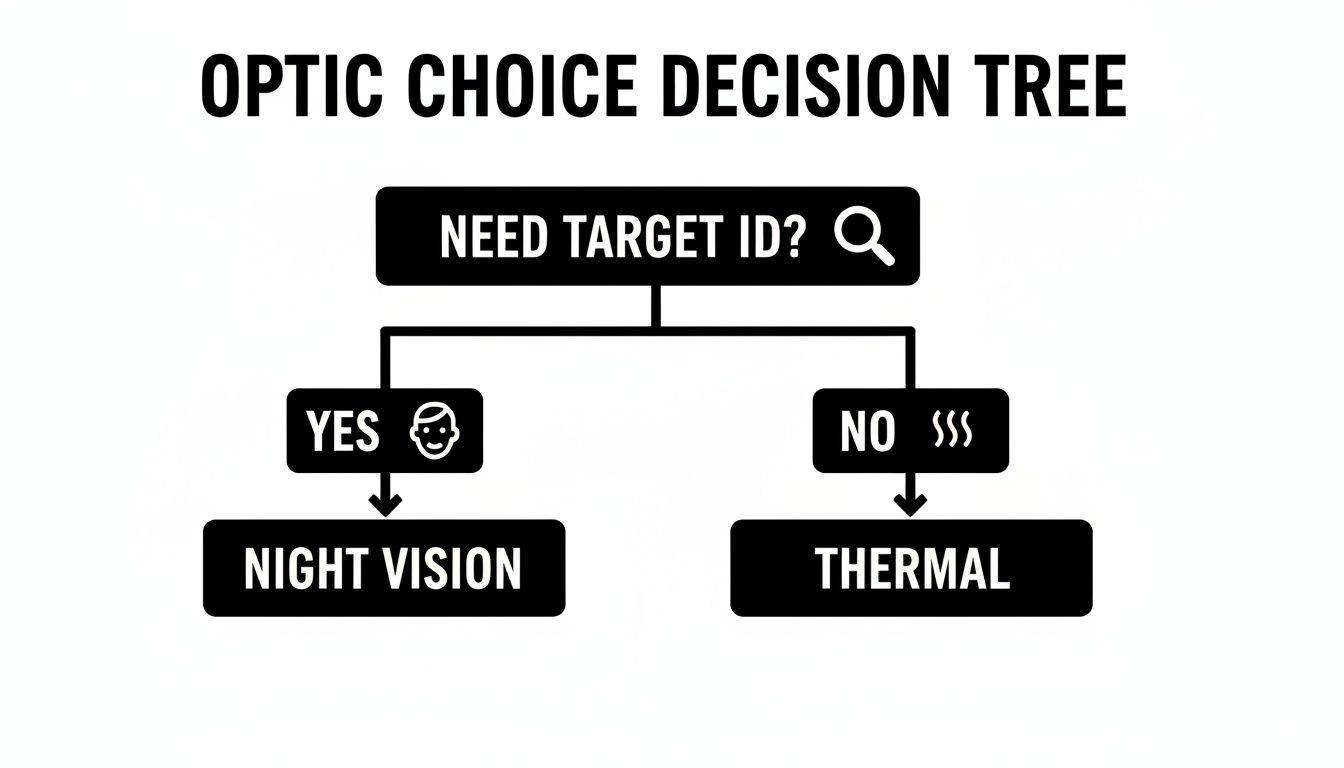
As you can see, your primary goal dictates the technology. If you absolutely need to identify what you're looking at, you need night vision. If you just need to know that something is there, thermal is king.
Guidance for Law Enforcement and Security
For law enforcement professionals, the choice is a constant tactical calculation. The truth is, most teams need both to maintain a decisive advantage, as each technology shines in different phases of an operation.
-
Thermal for Detection: Need to find a suspect hiding in a pitch-black alley or concealed in thick woods? Thermal is the answer. A person's body heat glows like a lightbulb, cutting right through visual camouflage and shadows. This makes it the go-to for clearing large areas, securing a perimeter, or making initial contact.
-
Night Vision for Identification: Once a threat is located, the mission changes. You need positive identification. During a building clear or a high-risk warrant, an officer has to see details. Night vision provides the clarity to see facial features, tell the difference between a firearm and a cell phone, and read a suspect’s intent. Those details are critical when making split-second decisions.
A common and incredibly effective tactic is for patrol officers to carry a handheld thermal monocular. They can scan an area quickly and covertly. If they pick up a heat signature, they can transition to helmet-mounted NODs or a weapon-mounted I² scope to approach and engage. This two-system approach covers all your bases.
Recommendations for the Modern Hunter
Hunters run into a very similar decision process, but with ethical and legal lines that can't be crossed. It's not just about finding an animal; it's about ensuring a clean, humane, and legal harvest.
The biggest challenge in hog or predator hunting is simply finding your quarry, especially in dense brush or across a wide-open field at night. A thermal optic—whether a scope or a handheld scanner—is a game-changer here. It lets you spot an animal's heat signature when it would be totally invisible otherwise. For pure detection, nothing beats thermal.
But spotting the animal is only step one. Positive target ID is non-negotiable. You have to be 100% certain of your target and what lies beyond it. This is where a night vision scope delivers the detail needed to confirm the species, sex, and size of the animal, ensuring you take a legal and ethical shot.
For this reason, a lot of serious hunters run a two-optic setup:
- A Thermal Monocular: Perfect for scanning fields and tree lines to find game in the first place. Our guide on choosing the best thermal imaging monocular is a great resource for picking the right scanner.
- A Night Vision Scope: Mounted on the rifle, this is what you use for positive ID and taking the actual shot once you've located a target with your thermal.
This strategy gives a hunter the best of both worlds: the unmatched detection of thermal and the critical identification detail that only night vision can provide.
Advanced Mission Setups
For professionals who demand maximum capability, the answer is simple: run both systems at the same time. These advanced setups provide a massive operational edge.
Fused Systems: These are the top-tier units that overlay a thermal image on top of a night vision image, blending them into one view. You get the detailed context of the environment from night vision, with heat signatures brightly highlighted by thermal. It’s an incredible boost to situational awareness.
Running in Tandem: A more common and practical approach is using both technologies together, but independently. Think of an operator with a PVS-14 monocular over one eye for navigating and ID, paired with a weapon-mounted thermal scope for detecting and aiming. This lets the user play to the strengths of each system on the fly. This dual-optic configuration is the ultimate answer to the night vision vs. thermal debate, giving you a solution for almost any low-light problem you can imagine.
Evaluating Cost, Integration, and Long-Term Value
When you're deciding between a night vision scope and a thermal optic, it’s easy to get tunnel vision on the price tag. But that initial number is just the starting line. A real-world evaluation looks at the total investment—from the mounts and batteries to maintenance and manufacturer support.
Thinking through these factors before you buy is the difference between getting a tool that works for you and one that becomes a costly paperweight. A cheap optic that dies in the field isn't a bargain, and a premium scope with a rock-solid warranty and reliable performance pays for itself over and over.
Analyzing the Total Cost of Ownership
The upfront price difference between night vision and thermal can be stark. High-end Gen 3 night vision often carries a higher initial cost because the manufacturing process for image intensifier tubes is incredibly complex. Thermals are becoming more affordable, but prices still vary wildly based on sensor resolution and onboard features. The purchase price, however, is just one piece of the puzzle.
To get the full financial picture, you have to factor in the running costs. This is where the long-term value really starts to show.
- Power Consumption: Night vision is an absolute champ when it comes to efficiency. A single set of batteries can easily last 40-50 hours. Thermal optics, being fully digital systems with power-hungry sensors and screens, typically drain batteries in just 4-8 hours. That means a thermal user is going to be buying a lot more batteries or investing in rechargeable power packs.
- Maintenance and Durability: Night vision tubes are sensitive. Expose them to bright light, and you can cause permanent damage that requires a very expensive repair. Thermal sensors are far more rugged in that respect; you can use them day or night without worrying about the sun. Still, both systems need to be handled with care to perform at their best.
- Essential Accessories: Neither optic is a standalone solution. You've got to budget for quality mounts, protective cases, and maybe an external IR illuminator for night vision or a power bank for thermal. These aren't just nice-to-haves—they're mission-critical for getting the most out of your gear.
For a deeper dive into planning your purchase, our guide on budgeting for night vision and finding the right balance offers solid advice on making a smart investment.
Integration with Your Existing Gear
How your new optic bolts onto your existing kit is a massive practical—and financial—consideration. Whether it's going on a helmet or a rifle, compatibility is everything.
A weapon-mounted scope needs a bomb-proof mount that holds zero, period. For night vision, guys often run quick-detach (QD) mounts to swap between day and night optics without a fuss. Thermal scopes generally use the same Picatinny rail interface, so they're pretty straightforward to integrate.
Helmet mounting is where things get a bit more involved. A standard PVS-14 monocular needs a helmet, a shroud, and a mounting arm (like the popular G24). This whole rig lets you navigate and observe hands-free. While you can helmet-mount some of the lighter thermal monoculars, they’re more often used as handheld scanners to work alongside a primary weapon sight.
Key Takeaway: Always, always factor in the cost of a complete mounting solution. A top-tier optic on a cheap, wobbly mount is a recipe for disaster. Your integration hardware is just as important as the device itself.
The Value of Warranty and Support
Finally, let's talk about long-term value. This is where a manufacturer's warranty and your retailer's support really shine. A strong warranty is your insurance policy; it protects a major financial investment from defects or early failure. Here at Superior Tactical, we stand behind our Gen 3 night vision systems with a 10-year warranty. That’s not just a number—it’s our confidence in the gear we sell.
Good after-sales support is just as crucial. When you run into a problem or just have a question, you need access to experts who can provide free diagnostics and handle repairs in-house. That level of service keeps your gear mission-ready and minimizes downtime, which is a direct return on your investment. Choosing a trusted partner who backs their products is one of the most important decisions you'll make.
Common Questions About Night Vision and Thermal
Even after digging into the tech and specific uses, there are always a few practical questions that pop up. These are the ones we hear all the time from customers trying to make that final decision between a night vision scope and a thermal. Let's get you some straight answers so you can choose with confidence.
Can Night Vision See in Complete Darkness?
No, it can't. Think of a night vision scope as a massive light amplifier. It needs some ambient light to work with—starlight, moonlight, even the faint glow from a city miles away is enough. It takes that tiny amount of light and multiplies it thousands of times to create a visible image.
But if you're in a place with zero light, like a basement with no windows or a deep cave, a night vision device is blind. That’s where thermal shines, because it couldn't care less about light. It sees heat, making it perfect for true pitch-black conditions.
Which Optic Is Better for Hog Hunting?
This is the classic debate, and honestly, the smartest hunters often end up using both. There’s no single "best" answer, but there is a best system.
- Thermal for Detection: Nothing beats a thermal for spotting a hog's heat signature. You can pick them out through thick brush or across a massive field from hundreds of yards away. It’s the ultimate tool for just finding them.
- Night Vision for Identification: Once you’ve found a target, night vision gives you the detail thermal can't. You can positively identify what you're looking at, see other hogs or animals nearby, and make a safe, ethical shot.
A killer setup that many pros use is a handheld thermal monocular for scanning and a rifle-mounted night vision scope for the actual engagement. You get the best of both worlds.
Can I Use These Scopes During the Day?
This is a huge one, and getting it wrong can be a very expensive mistake. A thermal scope is perfectly safe to use during the day. Since it only sees heat and not visible light, daylight doesn't affect it and won't cause any damage.
Night vision is a completely different story. You should never use a night vision scope in bright daylight without its protective day cap filter on. Exposing that sensitive image intensifier tube to direct sunlight can permanently burn it out in seconds. It's a fast way to turn a high-dollar optic into a paperweight.
Crucial Takeaway: Thermal is safe for day and night use. Night vision is strictly for low-light. Don't learn this lesson the hard way.
What Are the Legal Restrictions on These Devices?
For the most part, owning and using both night vision and thermal optics is legal for civilians in the United States. Where things get tricky is with local regulations and specific uses.
Hunting laws can vary wildly from state to state, so you absolutely have to check your local regulations before you take one into the field. On top of that, the really high-performance gear is often regulated by ITAR (International Traffic in Arms Regulations). This means exporting it outside the U.S. without a license is a serious federal offense. Always do your homework to make sure you're squared away legally.
At Superior Tactical LLC, we provide the expert guidance and mission-ready gear you need to operate effectively in any light condition. Explore our full selection of night vision and thermal optics today.
