Expert Night Vision Monocular Reviews and Buyer’s Guide
Navigating the world of night vision monocular reviews can feel like a deep dive into technical jargon, but your choice really comes down to one thing: what's the mission, and what's the budget? For most serious users, a Generation 3 monocular hits the sweet spot between performance and portability. For enthusiasts just getting started, a high-quality digital unit is a solid entry point. This guide cuts through the noise to focus on what actually matters in the field.
Why a Monocular Gives You the Edge in the Dark
When pros and seasoned enthusiasts need to operate after sundown, the monocular is almost always their tool of choice. It's not just about seeing in the dark; it's about how you see. Unlike dual-tube goggles or dedicated weapon scopes, a good monocular gives you an unbeatable mix of versatility, portability, and situational awareness. It’s a true force multiplier that you can hold in your hand.
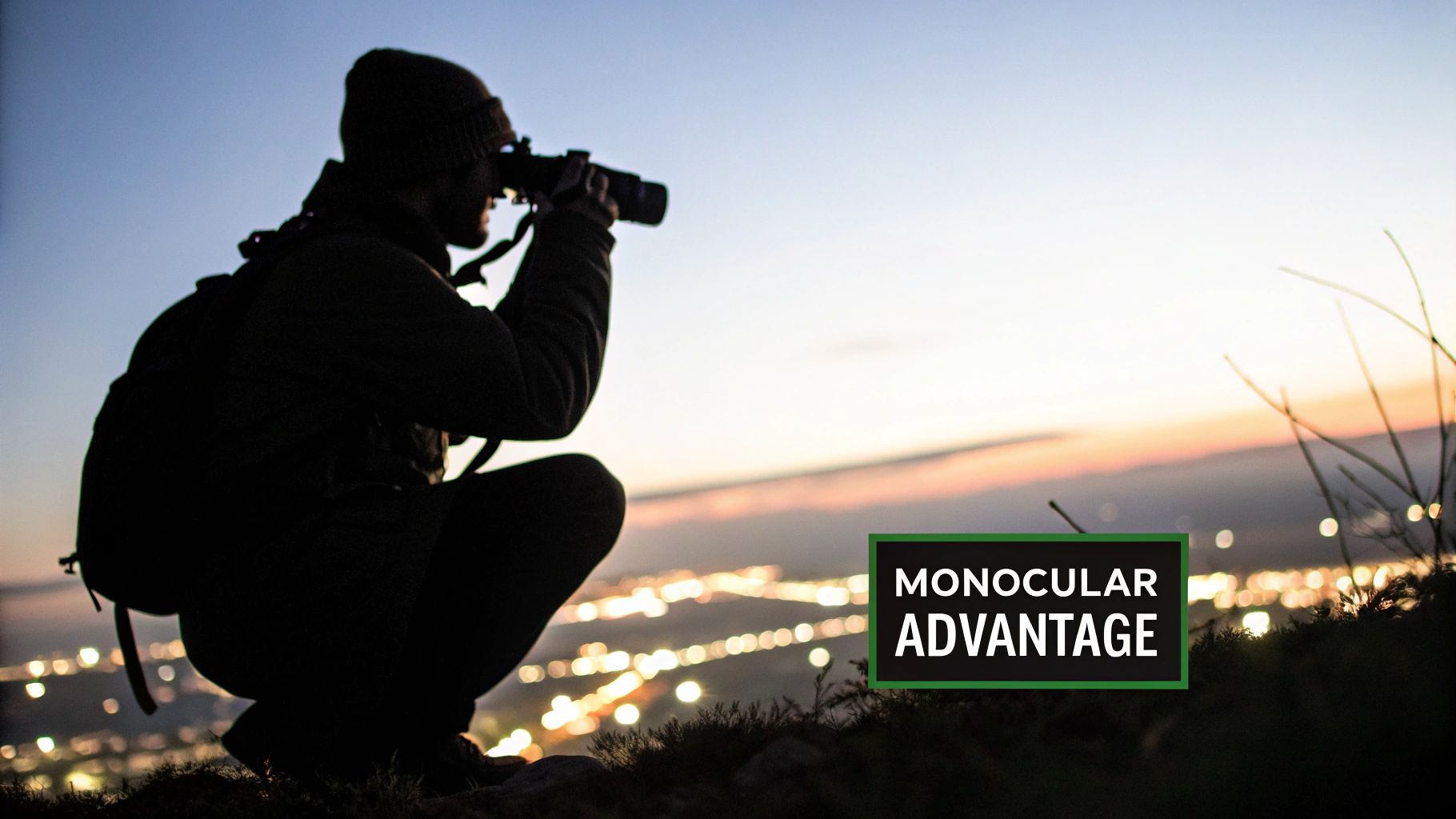
The biggest advantage is simple but critical: you keep one eye free. This preserves your natural, unaided night vision, which is essential for maintaining depth perception and staying aware of your immediate surroundings. You avoid the disorienting tunnel vision that can plague binocular systems, letting you move smoothly between looking through the device and navigating the world around you.
Core Advantages for Tactical and Field Use
In a tactical scenario, this means you can clear a room without sacrificing your peripheral vision. For a hunter, it’s the ability to scan a field for movement with one eye while the other watches for treacherous terrain underfoot. This dual-view approach also dramatically cuts down on eye strain over long periods—a game-changer on an all-night surveillance mission or hunt.
A monocular's sheer adaptability is another huge draw. These compact units are jacks-of-all-trades.
- Hand-held: Perfect for quick scans and spot checks.
- Helmet-mounted: Frees up your hands for navigation, driving, or handling a weapon.
- Weapon-mounted: Can be paired with a red dot sight for effective low-light aiming.
This modular design means one device can do the job of three, making it a smarter, more cost-effective investment. You can go from spotting to engaging a target without ever swapping out your gear.
Monocular vs. Binocular Systems
To really get a feel for the trade-offs, here’s a look at how monoculars stack up against dual-tube binocular systems in the real world.
| Feature | Monocular System | Binocular System (Goggles) |
|---|---|---|
| Situational Awareness | Excellent. One eye remains adapted to the dark. | Good. Offers an immersive, wide-field view. |
| Depth Perception | Maintained naturally with the unaided eye. | Enhanced through true stereoscopic vision. |
| Weight & Portability | Lightweight and compact. Easy to carry and stow. | Heavier and bulkier, requires dedicated mounting. |
| Versatility | High. Handheld, helmet, or weapon-mounted. | Limited almost exclusively to helmet mounting. |
| Cost | More affordable (one intensifier tube). | Significantly more expensive (two tubes). |
The most compelling argument for a monocular is efficiency. You get about 80% of the capability of a dual-tube goggle system at less than half the cost and weight. For the vast majority of users, that makes it the most practical choice by a long shot.
Ultimately, sifting through night vision monocular reviews points to the same conclusion time and again. These devices deliver outstanding performance without the weight, cost, or operational limitations of other systems. They are the definitive multi-tool for anyone serious about owning the night.
Understanding Night Vision Generations
When you start digging into night vision monoculars, you’ll run into the term "generation" right away. This isn't just marketing fluff; it signifies massive technological leaps that define how a device actually performs. Think of it like the difference between an old flip phone camera and a modern professional DSLR—the core technology is worlds apart.
Getting a handle on these differences is the single most important step you can take to pick the right monocular for what you need and what you're willing to spend.
Each generation marks a major upgrade to the heart of any analog night vision device: the image intensifier tube. This is the magic part that gathers tiny, invisible amounts of light from the moon or stars and amplifies it thousands of times, creating that classic green-hued image. The clarity and power of this amplification process are what separate a Gen 1 from a Gen 3.
Generation 1: The Entry Point
Generation 1 (Gen 1) is the most basic and affordable night vision you can get. It uses a photocathode to turn photons (light particles) into electrons, then zaps them across a vacuum to hit a phosphor screen, which lights up to create an image. It's a straightforward light amplifier.
Gen 1 devices work okay with a half-moon or more, but they have some serious limitations. You'll often see a distorted, "fish-eye" effect around the edges of the image, and most units emit a faint, high-pitched whine. Their light amplification is pretty low, around 1,000x, which means in real darkness, you’ll be leaning heavily on a built-in infrared (IR) illuminator to see anything.
Generation 2: A Major Leap Forward
Generation 2 (Gen 2) introduced a true game-changer: the Micro-Channel Plate (MCP). This is a tiny glass disc packed with millions of microscopic channels. When electrons enter these channels, they bounce off the walls, creating a cascade effect that releases thousands of additional electrons for every single one that went in.
This innovation cranked light amplification up to around 20,000x. The result is a dramatically brighter, sharper image with far less distortion than any Gen 1 device. Gen 2 is the first generation that can truly operate passively—meaning it works well in low light without needing an IR illuminator constantly on. This makes it a solid choice for serious applications like hunting or securing your property.
Generation 3: The Professional Standard
Generation 3 (Gen 3) is the gold standard, trusted by military forces and law enforcement agencies across the globe. The key breakthrough here was the use of a gallium arsenide (GaAs) photocathode. This material is incredibly sensitive to light, especially in the near-infrared spectrum, blowing older technologies out of the water.
This heightened sensitivity, paired with an ion barrier film that protects the MCP, pushes light amplification past 50,000x. You get an exceptionally crisp, bright image with almost no distortion, even on an overcast, moonless night. The performance jump from Gen 2 to Gen 3 is stark and immediately obvious the first time you look through one.
A good analogy is to think about camera sensors. A Gen 1 device is like that old flip phone camera struggling in a dimly lit restaurant. A Gen 3 monocular is like a professional-grade DSLR that can pull a crisp, detailed photo out of near-total darkness.
For those who need top-tier performance, you’ll see Gen 3 tubes rated at 64+ lp/mm resolution. That translates to a roughly 40% boost in clarity over many Gen 2 units, which is a massive advantage for a hunter trying to identify game at over 200 yards on a dark night. The demand for this level of performance is growing fast; the global night vision market was valued at USD 11.37 billion in 2024 and is projected to hit USD 17.72 billion by 2033, driven largely by professional use.
You might also see terms like Gen 3+ or "unfilmed" in your research. This refers to high-spec Gen 3 tubes where the protective ion barrier film is either ultra-thin or removed entirely. This modification squeezes out even more performance, delivering the cleanest images possible, though it can sometimes mean a slightly shorter tube lifespan. For a more detailed look, you can read our complete breakdown to get a deeper understanding of the night vision generations.
To put it all together, the table below gives you a practical look at how these generational differences play out in the real world.
Night Vision Generation Performance Comparison
This table breaks down how each generation stacks up on key performance specs and where they fit best, helping you match the tech to your specific needs and budget.
| Generation | Typical Resolution (lp/mm) | Effective Range (Yards) | Light Amplification | Ideal Use Case |
|---|---|---|---|---|
| Gen 1 | 20-38 | 50-75 | ~1,000x | Casual backyard observation, airsoft, close-range pest control. |
| Gen 2 | 45-54 | 100-200 | ~20,000x | Serious hunting, farm security, and preparedness enthusiasts. |
| Gen 3 | 64-72+ | 250-350+ | ~50,000-80,000x | Law enforcement, military operations, and professional hunters. |
Ultimately, choosing the right generation comes down to balancing your mission with your budget. Gen 1 will get you in the game for basic tasks. Gen 2 offers serious, dependable capability for enthusiasts. But for anyone who relies on their gear when the stakes are high, the unmatched low-light performance of Gen 3 makes it the only real choice.
What Performance Specs Actually Matter
When you start digging into night vision monoculars, it's easy to get buried in a mountain of technical specs. Manufacturers love to throw big numbers around, but only a handful of them truly dictate how a device will perform when you're out in the dark. Getting a handle on what they mean in the real world is the key to buying a solid tool instead of an expensive paperweight.
These aren't just numbers on a sheet; they directly translate to your ability to spot, recognize, and identify what's out there. Let's break down the big ones—Signal-to-Noise Ratio (SNR), Resolution, Figure of Merit (FOM), and HALO—and talk about what they really mean for you.
Signal-to-Noise Ratio (SNR)
The best way to think about Signal-to-Noise Ratio (SNR) is like tuning an old radio. The "Signal" is the clear image you want, and the "Noise" is that annoying static that gets in the way. With night vision, that noise shows up as "scintillation" or "sparkles" in the image.
A higher SNR means a cleaner, more stable picture, and this becomes absolutely critical in near-total darkness where the device is working its hardest.
For a cop clearing a pitch-black warehouse, a high SNR is non-negotiable. It cuts through the visual static, making it easier to tell a shadow from a threat. A low SNR device, on the other hand, would produce a "snowy" image, making it incredibly hard to see subtle movements or make a positive ID.
A tube with an SNR of 25 is going to give you a dramatically cleaner image than one with an SNR of 20. That difference is most obvious on a moonless night when you're relying on nothing but starlight. It's the single most important spec for seeing into the shadows.
Resolution (lp/mm)
Resolution, measured in line pairs per millimeter (lp/mm), is all about image sharpness and detail. It’s a direct measure of how many tiny black-and-white lines the image intensifier tube can distinguish in a single millimeter. More line pairs mean a crisper, more detailed picture.
Imagine you're a hunter trying to figure out if that dark shape 100 yards away is a big buck or just a weird-looking stump. High resolution is what lets you pick out the individual tines on an antler or the flick of an ear.
- A monocular with 64 lp/mm or more gives you the detail needed for positive identification at longer ranges.
- A unit with a lower resolution, say 45 lp/mm, will let you detect movement, but you’ll have to get much closer to figure out what you’re actually looking at.
Resolution works hand-in-hand with SNR. It’s essential for any task where small details matter, from reading a license plate to counting points on a rack. On that note, many users find that the advantages of white phosphor night vision also help with perceived sharpness and contrast, making it easier to pick out those fine details.
Figure of Merit (FOM)
Figure of Merit (FOM) is basically a quick-and-dirty spec for grading a tube's overall performance. The math is simple: SNR multiplied by Resolution (lp/mm). A higher FOM generally means a better tube because it combines both clarity (SNR) and detail (Resolution) into one number.
While it's not the end-all-be-all, FOM is a really useful benchmark when you're trying to compare two different units. For instance, a tube with a FOM of 1800 is considered very good quality, but anything over 2300 is top-tier stuff, usually reserved for military and serious professional use. A high FOM is especially helpful for long-range observation, where you need a great balance of clarity and detail to make sense of what you're seeing.
Halo
Halo is that glowing ring you see around bright lights—like a streetlight or a car's headlights—when looking through a night vision device. It's caused by stray light bouncing around inside the tube. A smaller halo value, measured in millimeters, is always better.
Think about a security guard watching a fence line next to a lit parking lot. A device with a big, distracting halo will "bloom out," and that bright ring could easily hide someone trying to sneak past. A monocular with a small halo (typically under 1.0mm) keeps that bloom tight, letting you see right up to the edge of the light source. If you’re operating in urban or suburban areas, a low halo value is a must-have.
Comparing Top Monoculars for Every Mission
Choosing the right night vision monocular isn't about finding one "best" device. It's about matching the right tool to the mission. A law enforcement officer's needs are worlds apart from a weekend hunter's, and different again from someone prepping for an emergency. So, instead of a generic list, let's break down the top contenders based on who's actually using them.
This approach cuts through the marketing fluff and spec sheet overload to show you how certain features translate into real-world performance for very different jobs.
To get started, think about the core trade-offs: clarity, range, and low-light capability. These are the three pillars that define how well a monocular actually works in the dark.
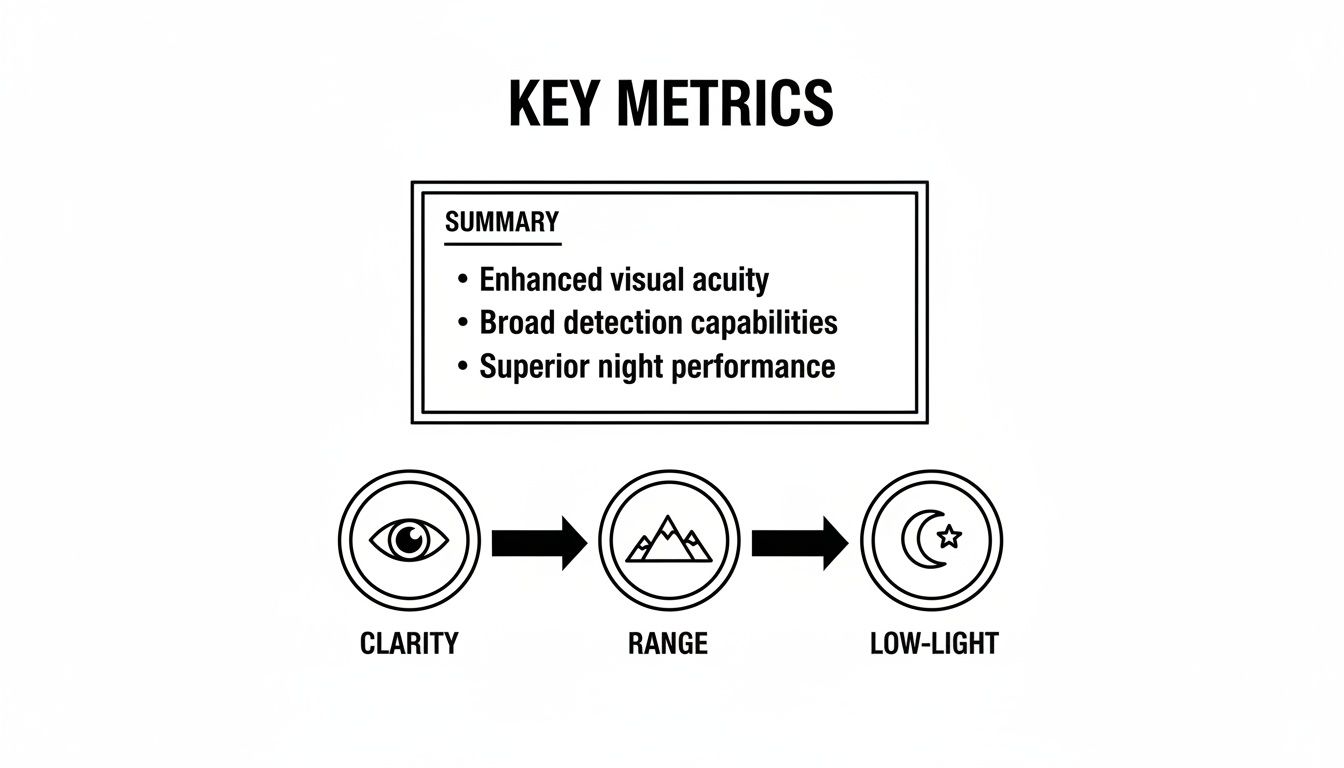
This visual really sums it up. It’s a constant balancing act between seeing clearly, seeing far, and seeing anything at all when the lights go out. We'll explore this balance through a few key scenarios.
The Tactical Operator: A Gen 3 PVS-14 Workhorse
For anyone in law enforcement, security, or the military, there is simply no substitute for a high-spec Generation 3 PVS-14. It's the industry standard for a reason. Its ability to pull a crisp, bright image out of near-total darkness is absolutely critical for identifying threats when it matters most.
The make-or-break feature for this role is manual gain control. This gives the operator the power to adjust the tube's brightness on the fly.
The PVS-14's manual gain isn't a luxury; it's a non-negotiable feature for operators moving between different lighting conditions. It stops the image from blowing out when you go from a dark alley to a lit street, preserving your dark-adapted vision and keeping you aware of your surroundings.
On top of that, its rugged, mil-spec construction means it's built to take a beating. Paired with a solid helmet mount for hands-free use, the PVS-14 isn't just a tool—it's mission-essential equipment designed for life-or-death reliability.
The Dedicated Hunter: A High-Value Gen 2+ Monocular
If you’re a serious hunter out for predators or hogs after sundown, a quality Generation 2+ monocular hits the sweet spot between performance and price. It won't quite hang with a Gen 3 unit on a moonless night, but a good Gen 2+ device gives you more than enough clarity to spot and identify game at typical hunting distances of 100-200 yards.
The real advantage here is the value proposition. You get a massive performance leap over Gen 1 and digital units without the sticker shock of a Gen 3. A quality Gen 2+ monocular delivers a clean image with minimal distortion, letting you catch an animal's movement and get a positive ID before taking a shot.
For a hunting setup, think about these points:
- Passive Operation: A good Gen 2+ tube works great under starlight alone, so you won't always need an IR illuminator that could spook your target.
- Durability: These units are generally built tough enough to handle the bumps, scrapes, and foul weather that come with being in the field.
- Mounting Versatility: You can use it handheld to scan a field or pop it on a helmet mount for stalking through the woods.
For the hunter who needs serious low-light performance but doesn't need to meet military specs, a Gen 2+ monocular is the smartest money you can spend.
The Preparedness Enthusiast: A Capable Digital Model
For the preparedness-minded civilian, homeowner, or recreational user, modern digital night vision offers incredible versatility and features at a great price. Unlike analog tubes, these devices use a camera sensor to display an image on a tiny screen in the eyepiece. This tech brings some unique perks to the table.
First off, you can't damage a digital monocular with bright light, so you can use it during the day or in mixed lighting without worry. Many also come with video recording and internal storage, which is a fantastic feature. Their nighttime performance relies heavily on a built-in IR illuminator, but the ones on modern units are surprisingly powerful.
This corner of the market is booming. People are using them for everything from night hiking to keeping an eye on their property during a power outage. Reviews for devices from brands like Bushnell and Night Owl are often very positive, with 85% of users reporting battery life up to 50 hours and detection ranges of 250 yards—more than enough for preparedness. This is where a company like Superior Tactical LLC really shines, offering not only great consumer digital units but also high-end Gen 3 systems, all backed by in-house repairs that can slash downtime by 70%. You can dig into the data yourself by reading the full research on the night vision device market.
At the end of the day, the best monocular is the one that fits your reality. The PVS-14 offers uncompromising performance for professionals, a Gen 2+ unit provides fantastic value for serious hunters, and a digital model delivers versatile, user-friendly features for the prepared citizen.
Essential Features and Accessories
A top-tier monocular is the core of your night vision capability, but it's the features and accessories that turn it from a simple optic into a mission-ready system. Anyone who has spent serious time looking through night vision monocular reviews knows that the pros focus just as much on their kit as they do on the tube specs. These add-ons aren't just for convenience; they are genuine force multipliers that make a huge difference in how you can use the device out in the field.
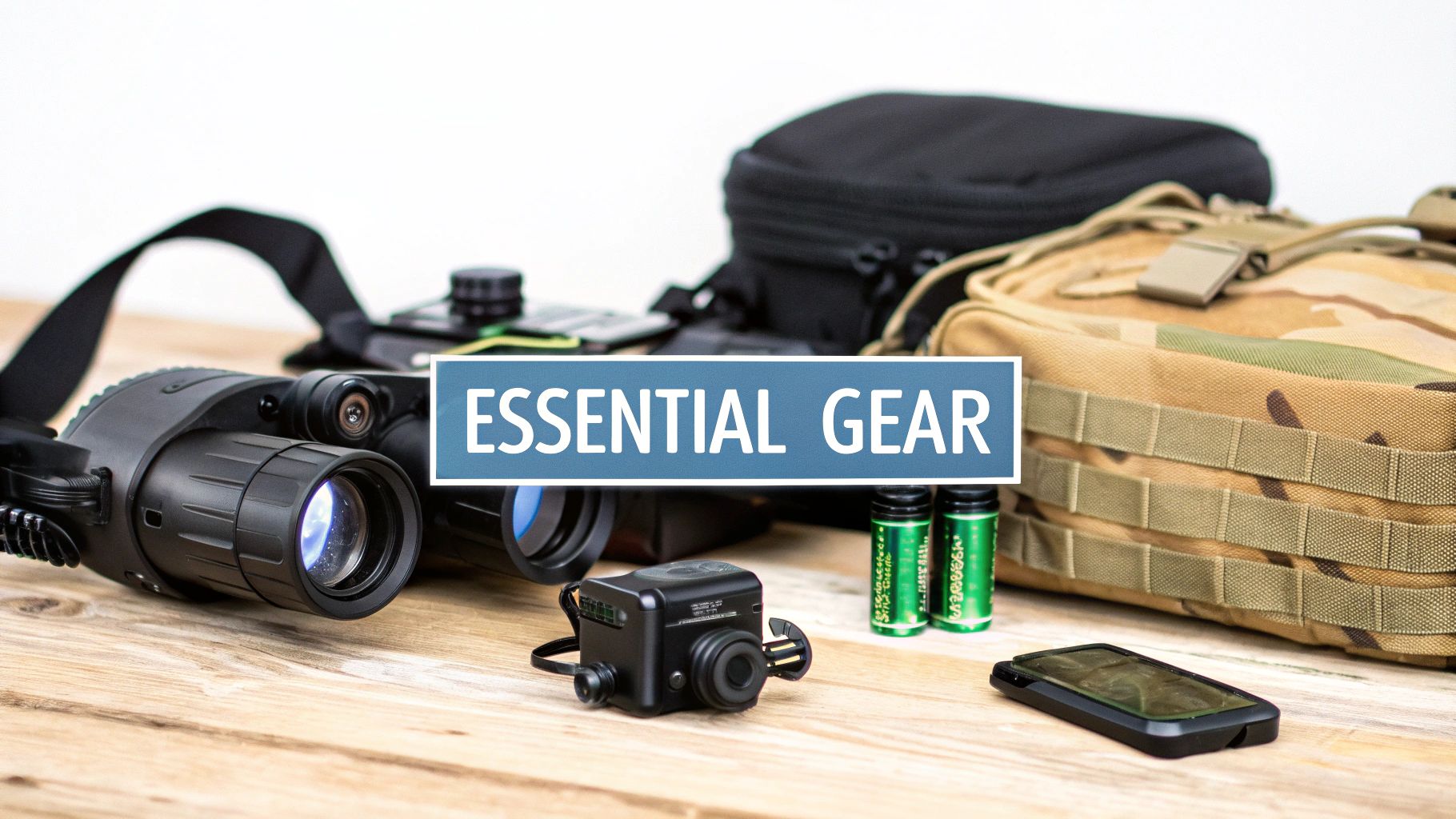
From punching through total darkness to spotting targets at a distance, every piece of gear plays a vital role. Knowing what's out there lets you build a setup that's perfectly dialed in for your exact needs, whether that’s dynamic movement, static surveillance, or long-range hunting.
Illuminators and Magnifiers
Even the best Gen 3 unit hits a wall in true no-light situations, like inside a building with no windows or deep in a cave. That’s when an Infrared (IR) Illuminator goes from a "nice-to-have" to a "must-have." These devices throw a beam of infrared light that's invisible to your eye but acts as a high-powered flashlight for your monocular, lighting up the entire scene.
Of course, not all illuminators are the same. A quality, focusable IR illuminator is key—it lets you adjust the beam from a wide "flood" for navigating tight spaces to a concentrated "spot" for identifying something way out there. If you really want to unlock your device's full potential in zero-light environments, it pays to look into a powerful external unit. To see what a difference they make, you can learn more by reading our guide on choosing an infrared illuminator for night vision.
Magnifiers are the other big-ticket accessory. Most monoculars come with a standard 1x magnification, but clipping on a 3x or 5x magnifier lens immediately gives you more reach for stationary observation.
A 3x magnifier is a total game-changer for a hunter scanning a field or a security professional keeping eyes on a perimeter. It delivers the extra detail needed to positively identify a target at 200+ yards without shrinking your field of view too much.
Mounting Solutions for Hands-Free Operation
If you need your hands for anything else—and you probably do—a solid mounting system is non-negotiable. The two main setups you'll see are helmet mounts and weapon mounts, and they each have a specific job.
Helmet Mounting
This is the go-to for tactical users, hunters, and anyone who needs to move around on foot at night. A good helmet mount, like a G24-style breakaway, gives you some crucial advantages:
- Hands-Free Navigation: You can move, climb, or drive without having to hold the monocular.
- Auto-Shutoff: Many modern mounts will automatically kill the power to the unit when you flip it up, which saves battery life and stops the green glow from giving away your position.
- Adjustability: You can dial in the alignment perfectly with your eye, making it comfortable for hours of continuous use.
Weapon Mounting
This configuration puts the monocular directly behind a red dot sight, creating a surprisingly effective night-time aiming system. It’s a popular and flexible option for hunters and shooters who want to acquire targets quickly in the dark.
Battery Life and Ruggedization
Finally, don't overlook the practical stuff: power and durability. Most professional-grade monoculars are designed to run on common batteries like CR123A or AA cells, typically giving you anywhere from 20 to 50 hours of runtime. For any serious use, having spare batteries is just part of the drill.
Ruggedization is just as critical. You want to see a housing made from high-impact polymer or aluminum. Look for specs like water resistance (IP67 or higher) and shock proofing. These are the things that ensure your investment can actually survive the realities of being in the field, from a sudden downpour to an accidental drop. It's these practical, tough features that make a night vision system something you can truly depend on when it counts.
Finding a Partner, Not Just a Product
A high-performance night vision monocular is a serious piece of equipment, and it's a mistake to think the device itself is all that matters. Just as important is the company you buy it from. Real long-term value isn't found in the initial price tag; it's in the warranty, the quality of service, and knowing you've got support for the life of your gear.
When you're digging through night vision monocular reviews, it’s easy to get lost in the specs. But what truly separates a decent purchase from a smart investment is what happens after the sale. A rock-solid warranty and a team of experts you can actually talk to are non-negotiable.
What to Look for in a Retailer
Your first line of defense is a strong warranty. For high-end Gen 3 units, you should be looking for multi-year coverage. When a company offers something like a 10-year warranty, it tells you they have complete faith in what they’re selling—and gives you real peace of mind.
But the warranty is just the starting point. You need to dig into the retailer’s actual service capabilities.
- In-House Repairs: Find out if they service their own units or just ship them off to a third party, potentially overseas. A U.S.-based, in-house repair shop means your gear gets back in your hands much, much faster.
- Real Customer Service: Can you get a knowledgeable human on the phone? When you have a problem, you need an expert who can troubleshoot, not just read from a script.
- Specialized Knowledge: Does the retailer live and breathe night vision, or is it just one item in a massive catalog? True specialists will give you better advice and support from the start.
Your best bet is almost always a U.S.-based retailer with dedicated, in-house technicians and a support team that actually knows the gear. If something goes wrong, you want a direct line to getting your equipment back in action, not a long, complicated runaround.
The global night vision market is blowing up, with big names like Armasight and ATN trying to keep up with both military and civilian demand. With so many options, picking a reliable partner is more critical than ever. Retailers like Superior Tactical LLC, which not only stocks Gen 3 PVS-14s but also backs them with a 10-year warranty, are the gold standard. They're proving they're in it for the long haul.
You can learn more about the night vision monocular market trends to get a sense of why this kind of expertise is so vital. A commitment like that ensures your device isn't just a purchase, but a dependable tool you can count on for years.
Answering Your Top Questions
When you're diving into night vision reviews, a few technical questions always seem to pop up. Getting straight answers is the only way to make a decision you won't regret. Here are the most common things people ask us, whether they're new to night vision or seasoned pros.
What's the Real Difference Between Green and White Phosphor?
Honestly, it boils down to personal preference and how your brain interprets the image. The classic green phosphor (P43) is what most people picture when they think of night vision, and it works exceptionally well.
White phosphor (P45), on the other hand, gives you a black-and-white view. Many users, myself included, find this offers better contrast and makes it easier to pick out details or separate a shape from a busy background. Some also say it feels more natural and leads to less eye fatigue after hours behind the device. While the tube's core performance stats aren't tied to the color, the perceived clarity of white phosphor is why it’s the top choice for those with the budget.
For a lot of people, the improved contrast of white phosphor is a game-changer. It can be the deciding factor in identifying something partially hidden or telling two similar shapes apart at a distance—a massive advantage when hunting or in a tactical situation.
Can I Use a Night Vision Monocular During the Day?
Absolutely not. Flipping on an image-intensified device like a Gen 2 or Gen 3 monocular in daylight will instantly and permanently destroy the intensifier tube. These tubes are built to amplify tiny amounts of light thousands of times over, and a blast of bright light will simply burn them out.
Yes, most modern units have a Bright Light Cut-Off feature, but think of that as an emergency brake, not something to rely on. It’s a safeguard, not a guarantee. This rule doesn't apply to digital night vision, which is basically a specialized camera. You can often use digital units day or night, but their low-light performance just doesn't compare to a quality analog tube.
How Important Is Manual Gain Control?
For anyone moving through changing light conditions, manual gain is a must-have. It lets you fine-tune the brightness of the image intensifier tube in real-time.
Imagine moving from an open field into a neighborhood with streetlights. Without manual gain, the halos around the lights would wash out your entire view. With it, you can dial down the brightness, kill the bloom, and keep a clear picture. This also helps preserve the natural night vision in your unaided eye. If you're just observing from a fixed position with consistent light, it’s less of a big deal, but for any kind of dynamic use, I strongly recommend it.
Ready to find the right night vision system for your mission? Superior Tactical LLC offers expert guidance and a curated selection of mission-ready gear, all backed by a 10-year warranty and in-house service. Find your next monocular here.
