A Hunter’s Guide to Mastering Night Vision Hunting
Hunting after dark used to be a completely different game. But with the right gear, it opens up a whole new world, letting you ethically and effectively pursue nocturnal animals like hogs and coyotes. The secret is image intensification technology, which gathers whatever little light is available—starlight, moonlight—and boosts it, transforming a pitch-black field into a clear, visible landscape. This isn't just about seeing in the dark; it's about making safer, more precise shots and dramatically improving your odds of success.
Why Modern Hunters Are Turning To The Dark
There's been a massive shift in the hunting world lately. Technology that was once strictly for military and law enforcement is now in the hands of everyday hunters, and for good reason. We're facing a huge challenge with nuisance animals, especially feral hogs, which are responsible for billions of dollars in agricultural damage every single year. Hunting them at night isn't a gimmick; it's one of the most effective tools we have for modern wildlife management.
By getting out there when these animals are most active, you're not just creating new opportunities for yourself—you're essentially doubling your available time in the field. This allows for a much more efficient way to control invasive species and protect livestock from predators.
The Two Pillars of Night Hunting Technology
When you get into night hunting, you'll hear about two main types of tech: traditional night vision and thermal imaging. They both let you see in the dark, but they work in completely different ways. Figuring out which is right for you starts with understanding how each one operates.
- Image Intensification (I²): This is the classic "green screen" night vision everyone pictures. It functions like a light vacuum, sucking in any available ambient light and amplifying it thousands of times to create a visible image. The big win for I² is detail. You can see the terrain, identify branches, and get a clear, recognizable picture of your target.
- Thermal Imaging: This technology couldn't care less about light. It sees heat. Thermal optics detect tiny differences in temperature and display them as an image, making warm-blooded animals glow against their cooler surroundings. Its superpower is detection—it can pick out a coyote hidden in tall grass or fog that would make it invisible to the naked eye or even standard night vision.
So, what's the takeaway? I² helps you see your environment, while thermal helps you find the animal. A lot of serious hunters I know run a hybrid system. They’ll use a handheld thermal monocular to scan and locate a heat signature, then switch to a rifle-mounted I² scope for positive identification and the shot. It’s the best of both worlds.
Practical Benefits Beyond the Harvest
Getting into night hunting is about more than just bagging more animals. It fundamentally makes you a safer, more ethical hunter.
The ability to clearly identify your target and what lies beyond it is non-negotiable. Modern night vision and thermal optics provide the clarity needed to make a responsible, one-shot harvest, fulfilling the core tenet of ethical hunting.
With this level of visibility, you can be 100% certain of your target species, judge its orientation for a clean shot, and ensure your backstop is safe. That’s a level of confidence you just can’t get from a spotlight, which often spooks game and gives you a fleeting, washed-out view.
If you want to get deeper into the specifics, you can learn more about how night vision goggles can improve your hunt in our other guide. Ultimately, this gear empowers us to be better, more responsible stewards of the land we hunt on.
Choosing Your Night Vision And Thermal Optics
Getting into night hunting means you've got a big decision to make right out of the gate: what kind of optic are you going to run? There’s no single "best" answer here. The right choice is completely tied to how you hunt, what you're after, and the ground you'll be covering.
A coyote hunter working the thick woods of the Southeast has a totally different set of needs than someone hunting hogs over a massive Texas field. It all comes down to finding that sweet spot between performance, your budget, and how you plan to use it. The interest in this gear has exploded, and the numbers back it up. The global market for night vision devices hit USD 7.5 billion in 2023 and is on track to break USD 11.2 billion by 2028. Scopes, goggles, and other portable gear are driving this surge, making up 45% of the portable segment, as more hunters want lightweight, flexible options for those long nights. You can read the full analysis on this market growth to see just how fast this is moving.
Image Intensification Generations Explained
When you start shopping for traditional night vision, you'll hear a lot about "Generations." This isn't just marketing fluff; it represents a huge leap in the technology inside the image intensifier tube. That tube is the heart of the device, and the generation dictates everything from image clarity to how well it works on the darkest nights.
Gen 2: This is really the baseline for any serious hunting setup. Gen 2 tubes are a massive improvement over the old Gen 1 stuff, giving you a much clearer picture with less of that "fish-eye" distortion. They're a solid, budget-friendly option for hunters who need reliable performance without dropping top dollar.
Gen 3: For the dedicated hunter or professional, Gen 3 is the gold standard, and for good reason. It uses a more advanced photocathode (gallium arsenide) that’s incredibly sensitive to even the smallest amounts of light. The result is a significantly brighter and sharper image, which is a lifesaver on nights with a new moon or heavy cloud cover. For many, that boost in target ID and overall clarity makes Gen 3 worth every penny.
The difference in the field is night and day. On a moonless, overcast night, a Gen 3 unit can often pull in enough ambient light to give you a clean image on its own. A Gen 2 device in the same conditions will almost certainly need an IR illuminator to be effective.
Monoculars Versus Dedicated Weapon Sights
Another big choice you'll face is how you want to run your optic. Are you looking for a dedicated scope that lives on your rifle, or do you prefer the flexibility of a monocular system?
A dedicated night vision or thermal scope is a simple, purpose-built solution. You mount it, you zero it, and you're done. Its biggest advantage is that it feels just like shooting a traditional rifle scope, so there's no learning curve with new cheek welds or holds.
On the other hand, a monocular, like the classic PVS-14, brings incredible versatility to the table. You can mount it on a helmet for hands-free navigation and scanning, use it as a handheld spotter, or even mount it behind a red dot on your rifle. This "clip-on" approach lets you keep your favorite day optic on your gun, so your zero and sight picture stay exactly the same. That adaptability is a huge win for hunters who need to stay aware of their surroundings.
A killer strategy we see all the time is running a helmet-mounted monocular to scan and move. It keeps your head up and your hands free. When you spot a target, you can smoothly shoulder your rifle and look right through your weapon-mounted optic to take the shot.
The Power of Thermal Imaging
While traditional night vision works by amplifying existing light, thermal operates on a totally different principle. It detects heat signatures, making warm bodies glow against a cooler background. This gives thermal one massive, undeniable advantage: detection.
An animal that’s perfectly camouflaged in deep brush or standing in thick fog is going to be completely invisible to even the best Gen 3 night vision. But for a thermal optic, its body heat makes it pop like a lightbulb. This makes thermal an absolutely unmatched tool for finding game, especially at long range.
Night Vision Vs Thermal Optics For Hunting
So, which technology is right for you? It really depends on the job at hand. Traditional image intensification (I²) excels at giving you a detailed picture of your surroundings for navigation and identification, while thermal is the undisputed king of detection. This table breaks down their core differences in common hunting situations.
| Feature | Image Intensification (e.g., PVS-14) | Thermal Imaging (e.g., Thermal Scopes) |
|---|---|---|
| Primary Strength | Identification & Navigation | Detection |
| How It Works | Amplifies ambient light (starlight, moonlight) | Detects infrared energy (heat signatures) |
| Best Use Cases | Positive target ID, moving through terrain, seeing environmental details. | Spotting animals in thick cover, fog, or at extreme distances. |
| Performance in Fog/Smoke | Poor; light is scattered, making it impossible to see through. | Excellent; sees through obscurants by detecting the heat behind them. |
| Image Detail | High; provides a detailed, recognizable image of the environment. | Lower; displays heat gradients, making terrain details harder to see. |
| 24/7 Operation | No; requires some ambient light to function. | Yes; works in complete darkness and during the day. |
| Cost | Generally more affordable for high-quality units. | Tends to be more expensive, especially for high-resolution models. |
As you can see, each has clear strengths and weaknesses. Many experienced hunters ultimately end up using both—a thermal scanner for spotting and a night vision scope or monocular for positive identification and taking the shot.
Ultimately, the choice comes down to your primary goal in the field. If your main challenge is just finding animals in tough conditions, thermal is your best bet. If you need to navigate difficult terrain and be absolutely certain of your target, image intensification is the way to go. For a more detailed breakdown, check out our complete guide on thermal vs. night vision for hunting.
Getting Your Gear Set Up and Zeroed
Having a top-shelf night vision or thermal optic is a great start, but it's only half the job. If that expensive piece of glass isn’t mounted rock-solid and zeroed with precision, you might as well be guessing. A solid, repeatable setup is the bedrock of any successful night hunt—it’s what ensures your bullet goes exactly where you’re aiming when that coyote finally steps into the open.
Before we even get to tightening screws, let's back up. Choosing the right optic in the first place is crucial. This flowchart breaks down the thought process I walk people through, covering everything from what you're hunting to how much you want to spend and where you'll be doing it.
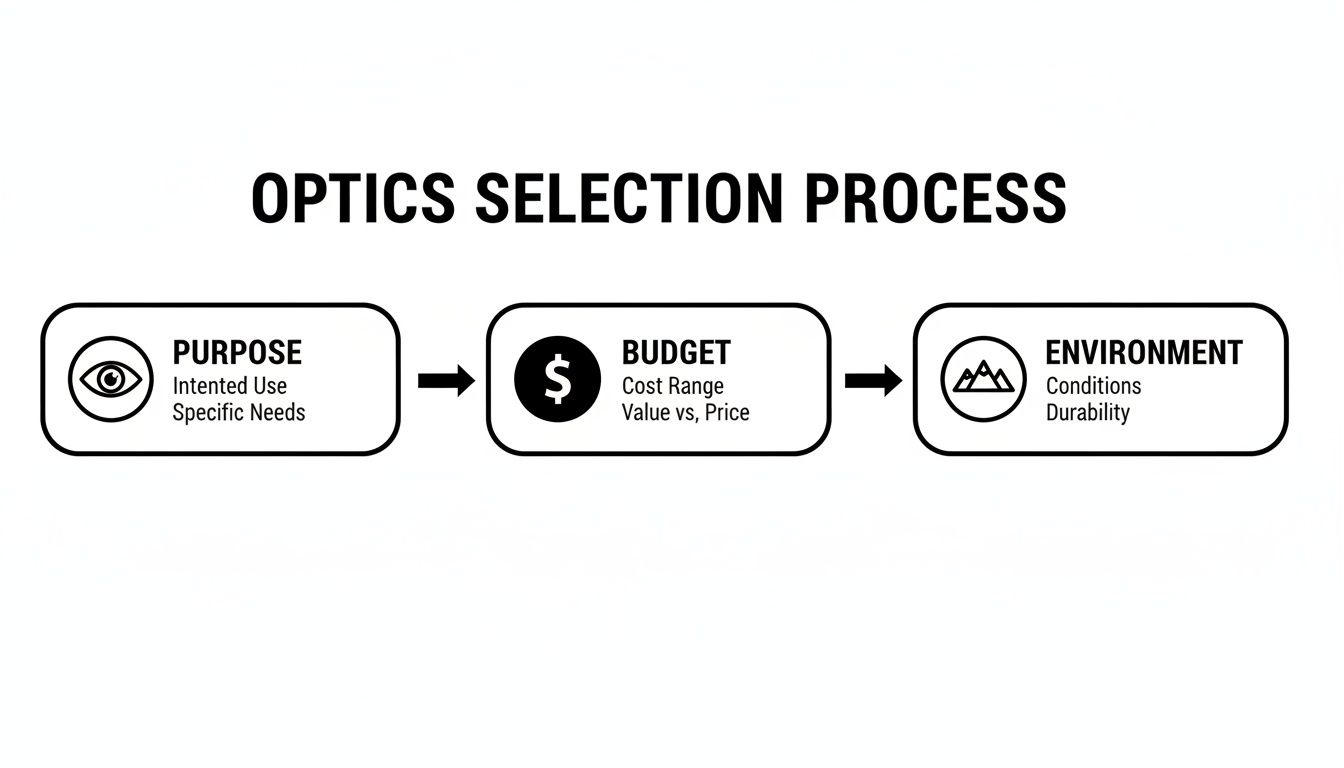
Think of it as a roadmap. Following these decision points helps you navigate from a general idea of what you want to having the perfect, field-ready rig for your specific needs.
Nailing the Mount for Peak Performance
The link between your rifle and your optic is everything. I’ve seen more hunts ruined by a cheap, wobbly mount than almost any other gear failure. Don't skimp here. A quality mount from a reputable brand isn't just a purchase; it's insurance against a shifting zero and endless frustration.
When you're mounting a dedicated scope, there are two key things to get right: eye relief and height-over-bore.
- Eye Relief: This is all about getting a full, crisp sight picture without straining. Shoulder your rifle like you mean it, in a natural shooting position. Now slide the scope back and forth in the rings until the image is perfect from edge to edge. If you have to creep up on the scope or stretch your neck back, you need to adjust it.
- Height-Over-Bore: Simply put, this is the distance from the center of your barrel to the center of your optic. It’s a critical measurement because a higher mount creates a more pronounced trajectory arc, which really comes into play at closer ranges. Know this number—your ballistic calculator will thank you.
If you’re running a PVS-14 monocular behind a red dot, the game is about alignment. The goal is to get the monocular and your red dot on the exact same optical plane for a seamless sight picture. The principles in our guide on mounting an EOTech are a great resource and apply to most red dot setups.
Zeroing for the Dark: A Different Ball Game
You can't just staple a paper target to a tree and expect to zero your thermal or night vision rig. The process is different after the sun goes down.
For night vision scopes or IR lasers, you need a target that will pop under infrared light. A small square of reflective tape or a purpose-built IR target patch will glow like a beacon through your device.
With a thermal scope, you need a heat signature. The go-to solutions are hand warmers taped to a target, a small piece of tin foil that reflects the cold of the night sky, or one of the many commercial thermal targets now available.
Pro Tip: Start close. I always begin my zeroing process at 25 or 50 yards. This guarantees you're on paper from the first shot and saves a ton of time, frustration, and expensive ammo trying to find your impacts at longer ranges.
Once you’re dialed in at a short distance, you can move back to your final zero distance, which for most of us is 100 yards. Make small, deliberate adjustments, and always fire a 3-shot group to confirm each change before you touch the dials again.
Mastering Your IR Illuminator
On those pitch-black, moonless nights, a good infrared (IR) illuminator is non-negotiable. It's an invisible flashlight that only your night vision can see, cutting through the darkness to extend your detection and identification range significantly.
While many NVDs have a small, built-in IR, a powerful, weapon-mounted external illuminator is a massive upgrade. It throws a much cleaner, more focused beam, letting you spot targets at distances you couldn't touch before.
Be aware of "IR splash"—that blinding reflection you get when the beam hits nearby trees or the ground. You can manage this by playing with the illuminator's focus (from flood to spot) and adjusting the power level. Modern fusion optics, blending thermal with image intensification, are game-changers, enabling ethical shot placement well past 200 yards and pulling double duty for those who use their gear professionally.
Final Systems Check
Before you ever head out, run through a final pre-flight checklist. This little ritual has saved me more than once.
- Confirm Zero: Fire one last 3-shot group to be absolutely sure nothing has moved.
- Check Screws: Grab your torque wrench and verify every screw on your rings and mount is tightened to the manufacturer's spec. Loose hardware is the enemy.
- Battery Check: Put fresh, high-quality batteries in everything—optic, laser, and illuminator. And pack spares. Always pack spares.
- Dry-Fire Practice: Spend some time in a dark room shouldering your rifle, activating your gear, and finding your sight picture. Building that muscle memory at home pays off big time in the field.
Walking through these steps ensures that when the moment of truth arrives, your equipment is an extension of you, ready to perform flawlessly. All that's left is for you to make a clean, ethical shot.
Field Tactics For Successful Nocturnal Hunting
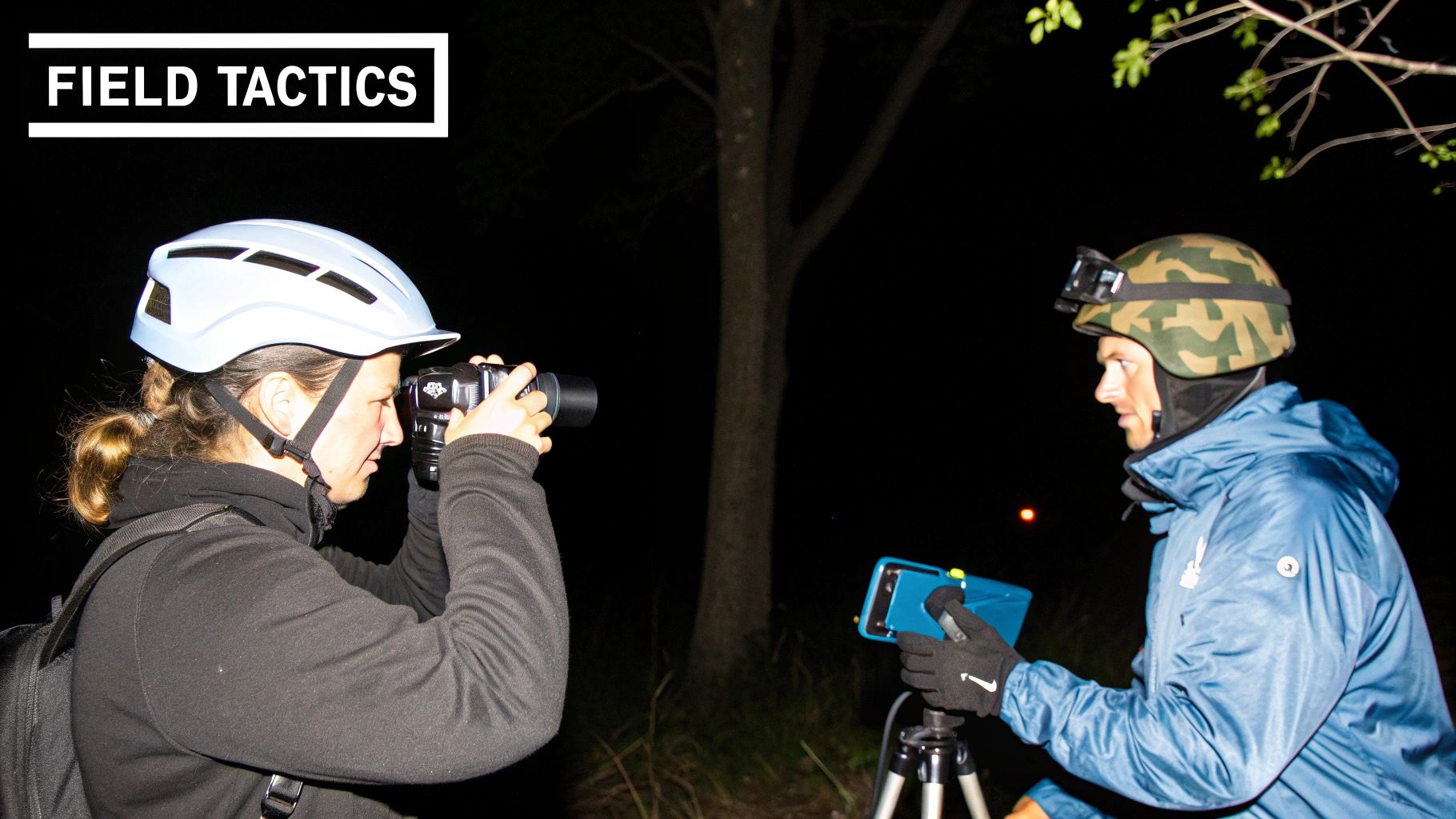
With your gear zeroed and ready to go, the real hunt begins. Let's be clear: successful night hunting has less to do with expensive hardware and more to do with your personal software—how you actually operate in the field. Darkness changes the game completely, forcing you to be far more deliberate and patient with every move you make.
Moving after dark isn't just about being quiet; it's about being slow. Each step has to be intentional. The relatively narrow field of view you get through an optic means you're constantly on a swivel, scanning to keep your bearings. Rushing is the surest way to miss the subtle signs of game or, worse, walk right into a dangerous situation.
Mastering Movement And Concealment
Your greatest ally at night is the darkness itself, but it’s an advantage you can lose in an instant. Nocturnal animals have senses that are dialed in for low-light conditions, especially their hearing and sense of smell. To beat them, your movement has to be methodical.
- Slow Is Smooth, Smooth Is Fast: Move at a pace that feels almost ridiculously slow. This forces you to place your feet carefully, avoiding the snap of a twig or the rustle of dry leaves that can echo in the quiet. It also gives your brain more time to process the grainy, green world you’re seeing through the optic.
- Use the Terrain: Just like in daylight, use the land to your advantage. A shallow ditch, a treeline, or even a patch of tall grass can break up your silhouette and mask your approach. The darkness is great camouflage, but it won’t make you invisible.
- Play the Wind: This is non-negotiable. Scent control becomes even more critical when animals are relying on their noses more than their eyes. Always know which way the wind is blowing and plan your stalk so your scent is carried away from your quarry.
A common mistake is thinking the darkness hides everything. I know an experienced hunter who spent nearly an hour stalking a group of hogs, only to have them all bolt at the last second. He hadn't noticed a subtle shift in the wind that carried his scent right to them.
The growing interest in this type of hunting is a major market driver. The global night vision device market is on track to grow from USD 8.57 billion in 2025 to USD 12.91 billion by 2030. A huge piece of that pie comes from civilian use, where wildlife spotting and hunting now account for a 25% market share. In North America alone, hunters are logging over 5 million outings under the cover of darkness each year. You can discover more insights about these market trends to see just how much this space is evolving.
Effective Scanning And Target Acquisition
Scanning the pitch-black landscape through an optic is a skill all its own. If you just stare at one spot, you'll get tunnel vision and miss all the action happening just outside your view. A systematic approach is key to covering ground efficiently and, just as importantly, safely.
One of the most effective strategies is a two-optic system. Many hunters run a helmet-mounted monocular, like a PVS-14, for general navigation and scanning a wide area. This setup keeps your head up and your hands free, letting you move more naturally while you’re constantly observing your surroundings.
Once a potential target is spotted, you can transition to your weapon-mounted optic—whether that's a dedicated night vision scope, a thermal unit, or a red dot sighted in with your monocular. This two-step process separates the job of finding from the job of engaging, which makes the whole sequence much smoother and more effective.
Shot Placement In The Dark
Making an ethical shot at night comes with its own set of challenges. The flat, often two-dimensional image you get from night vision or thermal can make it tough to judge an animal's true orientation. What might look like a perfect broadside shot could actually be a hard quartering-away angle you can't see.
This is where your patience and knowledge of animal anatomy are absolutely critical.
- Wait for a Good Angle: Never force a shot on a target that isn't giving you a clean look. Be patient and wait for the animal to turn and present a clear broadside or slightly quartering-away shot.
- Pinpoint Key Anatomy: Through a thermal scope, the brightest heat signatures are usually the head and chest cavity. For hogs, you want to aim right behind the shoulder to hit the vital organs. The same high-shoulder shot works great on predators like coyotes.
- Know Your Holds: You've already zeroed your rifle, but you still have to account for distance. Use your rangefinder, know your trajectory, and be confident in your holds for various yardages before you even think about touching the trigger.
Let's walk through a typical scenario. You've spotted a sounder of hogs at 150 yards feeding in a field. You used your thermal scanner to find them and checked that the wind is in your favor. You begin closing the distance, using a fenceline for cover. At 100 yards, you get into a stable shooting position. Peering through your weapon-mounted scope, you scan the group, looking for a mature boar standing clear of the others. You wait for it to turn broadside, take a steady breath, and make a clean shot. That discipline is what separates a lucky shot from consistent success.
Knowing the Rules: Laws and Ethics for Hunting After Dark
When you start hunting with night vision, you're taking on a whole new level of responsibility. This gear gives you a massive advantage, no doubt about it. But that advantage comes with a serious obligation to follow the law to the letter and uphold the unwritten code of ethical hunting. This is about more than just avoiding a fine—it’s about protecting the sport and keeping everyone safe.
First things first: night hunting laws are not universal. They change wildly from one state to the next, and sometimes even from county to county. What’s standard practice for hog hunting in Texas could land you in serious trouble in another state. It's on you to know the rules for where you're hunting.
Sorting Out the Legal Details
Before you even dream of heading out after sunset, you need to get crystal-clear answers on the local regulations. Your best bet is to start with your state's wildlife agency website—like the Department of Fish and Wildlife—and then follow up with a call to a local game warden if anything is unclear.
Make sure you know the specifics on:
- Legal Species: What can you actually hunt at night? Most of the time, it's limited to predators and nuisance animals like coyotes, bobcats, or feral hogs.
- Weapon Restrictions: Are there rules about the rifle, caliber, or even magazine size you can use? Some places might restrict you to rimfire or shotguns after dark.
- Technology Use: Does your state have specific laws about using night vision, thermal scopes, or IR illuminators? The legality of this tech is a big one.
- Public vs. Private Land: The rules for public land can be completely different from those for private property. Never make assumptions.
Failing to do this homework can be a very expensive lesson. "I didn't know" won't get you very far with a game warden.
The Ethical Hunter's Code After Dark
Legal regulations are one thing, but ethics are what truly define you as a hunter. When hunting at night, the absolute, most important rule is 100% positive target identification. A blurry heat signature or a pair of glowing eyes is not enough to go on.
Your job as a hunter is to make a quick, clean, and humane kill. Modern night vision is a tool that helps you do just that—it’s not a shortcut. It’s about making a precise shot that ensures a respectful and ethical harvest.
This means you have to be able to clearly identify the animal, know which way it's facing, and be certain of what's behind it before your finger ever goes near the trigger. Is that a coyote or someone's German Shepherd? Is there a barn or a house in the backdrop behind that group of hogs?
You have to answer these questions with total certainty, every single time. The technology gives us the power to see in the dark, but it’s our judgment that makes us ethical hunters.
Taking Care of Your Night Vision Investment
Your night vision optic is a serious piece of gear and a significant investment. Just like any other precision instrument, how you treat it directly impacts its performance and how long it'll last. A little bit of care goes a long way in making sure it’s ready to go every single time you are.
It’s the simple habits that make the biggest difference. Seriously, always keep the objective lens cap on when you're not actively using the device. This is the single best way to protect the sensitive image intensifier tube from getting zapped by a sudden bright light. When it comes to cleaning the glass, be gentle. Use a proper lens pen or a soft microfiber cloth—anything else risks leaving fine scratches that will permanently mess with your sight picture.
Keeping It Running: Basic Care and Quick Fixes
Battery management sounds boring, but it's critical. Stick with high-quality lithium batteries. They handle cold weather way better than alkalines and are far less likely to leak acid all over the internal components. If you're putting your unit away for more than a couple of weeks, always take the batteries out. I've seen expensive gear ruined by a cheap, leaky battery, and it's a completely avoidable problem.
Even with meticulous care, things can still go wrong in the field. Don't panic; most common hiccups are surprisingly easy to fix yourself.
Blurry or Grainy Image? Nine times out of ten, this is just a focus issue. Take a moment to adjust both the objective lens (the one at the front) and the diopter (the eyepiece) until everything sharpens up. If it's just grainy on a pitch-black night, that's normal for night vision. Firing up a good external IR illuminator will clean that right up.
Device Won't Turn On? Before you assume the worst, check the battery cap. A loose cap is the most common reason for a power failure. If it's tight, pop it open and clean the battery contacts with a simple pencil eraser. That'll remove any corrosion or gunk that's blocking the connection.
Seeing Black Spots? Those little black spots, which we call "blems," are usually just a normal part of the manufacturing process for the image tube. They don’t impact performance. However, if you suddenly see new spots appear or notice existing ones getting bigger, that could signal tube damage that needs a professional's touch.
Honestly, protecting your investment is straightforward. A good hard case for transport and storage, combined with a little cleaning and battery discipline, will keep your night vision running reliably for years of successful hunts.
When you've squeezed all the performance you can out of your current setup, upgrading is the next logical step. For major repairs or a serious performance boost, sending your unit in for professional servicing can make an old device feel brand new. Or, if you're the hands-on type, building your own PVS-14 from a kit with a new image intensifier tube is an incredibly rewarding project that leaves you with a top-tier, custom-built optic.
Answering Your Top Night Vision Hunting Questions
Getting into night hunting is exciting, but it definitely comes with a learning curve. The tech is one thing, but knowing how to use it in the real world is what separates a successful hunt from a frustrating night. Let's tackle some of the most common questions we get from guys just starting out.
Can You Use Night Vision During The Day?
For a traditional image intensifier (I²) tube, the answer is a hard no. You should never expose it to bright light or direct sunlight. Think of it like a speaker for light—it amplifies whatever it gets. Daylight is like screaming into a microphone, and it will permanently damage the tube, leaving you with ugly dark spots or a completely fried unit.
Thermal optics, on the other hand, are a different beast entirely. They see heat, not light, so daylight doesn't affect them at all. You can run a thermal scope 24/7, making it an incredibly versatile tool for any time of day.
How Far Can You See With Night Vision?
This is the million-dollar question, and the honest answer is, "it depends." Your effective range isn't just one number; it's a moving target based on a few key variables.
- The Generation: A good Gen 3 tube will always see farther and clearer than a Gen 2. It’s just a massive leap in performance.
- Ambient Light: Your visibility on a bright, full-moon night is worlds apart from a moonless, overcast one. More natural light means more for the tube to amplify.
- IR Illuminator: This is your secret weapon. A powerful external IR illuminator can easily double your effective range, taking a setup that’s good to 150 yards and pushing it well past 300.
A quality Gen 3 monocular paired with a solid IR illuminator can let you detect a man-sized target out past 500 yards. But for hunting, what really counts is your identification range—the distance where you're 100% certain of what you're about to shoot.
Ready to find the perfect optic for your next hunt? The team at Superior Tactical LLC has over a decade of experience outfitting hunters with reliable, high-performance night vision and thermal gear. Find your night vision solution here.
