
A Practical Guide to Night Vision Generation 1
Welcome to where modern night vision began. Generation 1 (Gen 1) night vision is the technology that first opened up the dark for civilian use, making it both accessible and affordable. You can think of it as the original amplifier for light—it grabs whatever faint moonlight or starlight is available and boosts it into a clear, visible image.
What Is Generation 1 Night Vision
Generation 1 marks the first truly successful passive image intensification technology, a massive leap forward from what existed in the 1960s. Before Gen 1, "night vision" meant active systems that blasted an area with a powerful, and very obvious, infrared (IR) spotlight. Gen 1 changed the game by simply amplifying the ambient light that was already there. This was huge—it made covert observation a reality and laid the groundwork for every advancement that followed.
At its heart, a Gen 1 device uses an image intensifier tube to collect photons (the tiny particles that make up light) and convert them into electrons. Those electrons are then shot across the tube, hitting a phosphor screen that glows brightly, creating that classic green-hued image we all recognize. This process cranks up the available light by about 1,000 times, effectively turning a nearly black scene into something you can actually see. To get the full picture of how different systems stack up, take a look at our complete guide on night vision generations.
Why Gen 1 Is Still Relevant
Sure, newer and more powerful generations are out there, but Gen 1 holds its ground as a practical and popular choice for a ton of uses. Its biggest advantage is affordability, making it the perfect gateway for anyone just getting into night vision. It offers a serious leg up for activities where you don't need military-grade performance.
The key to appreciating Generation 1 is understanding its purpose. It's not meant to compete with a $10,000 Gen 3 unit; it’s designed to provide a massive visual advantage over the naked eye at an accessible price point.
Gen 1 is a fantastic tool for:
- Home Security: Keeping an eye on your property or backyard without broadcasting your position with a flashlight.
- Wildlife Observation: Spotting nocturnal animals without scaring them off with bright lights.
- General Navigation: Safely finding your way around a dark campsite or trail after the sun goes down.
This guide will cover everything you need to know about night vision generation 1, from the technology inside to its real-world performance and how to pick the right device for you. Think of this as your complete primer for stepping into the world of affordable night vision.
How Gen 1 Technology Turns Darkness Into Daylight
At its heart, a night vision generation 1 device is basically a super-powered light scoop. It can't pull an image out of thin air, but what it can do is grab the faintest traces of ambient light—from the moon, the stars, or even distant city glow—and crank up the volume. We're talking about multiplying the effect of those tiny light particles, or photons, thousands of times over. This is what turns a scene you can't see into that classic, green-tinted night vision picture.
The real workhorse doing all this heavy lifting is a component called the image intensifier tube. You can think of it as a three-step assembly line for light, where each stage plays a critical role in building the final image that hits your eye.
Step 1: Turning Photons into Electrons
First up, the objective lens at the front of the unit acts like a funnel, gathering every available photon and directing it into the intensifier tube. These photons smack into a light-sensitive surface known as a photocathode. The easiest way to picture it is like a solar panel, but for light particles. For every single photon that hits the surface, one electron is knocked loose.
So, in this first step, we've converted light energy into electrical energy. An invisible pattern of photons is now an identical, but still very weak, pattern of electrons. This signal is nowhere near strong enough to see yet—the real magic is about to happen.
This simple diagram breaks down how Gen 1 night vision takes a little bit of light and turns it into a whole lot of image.
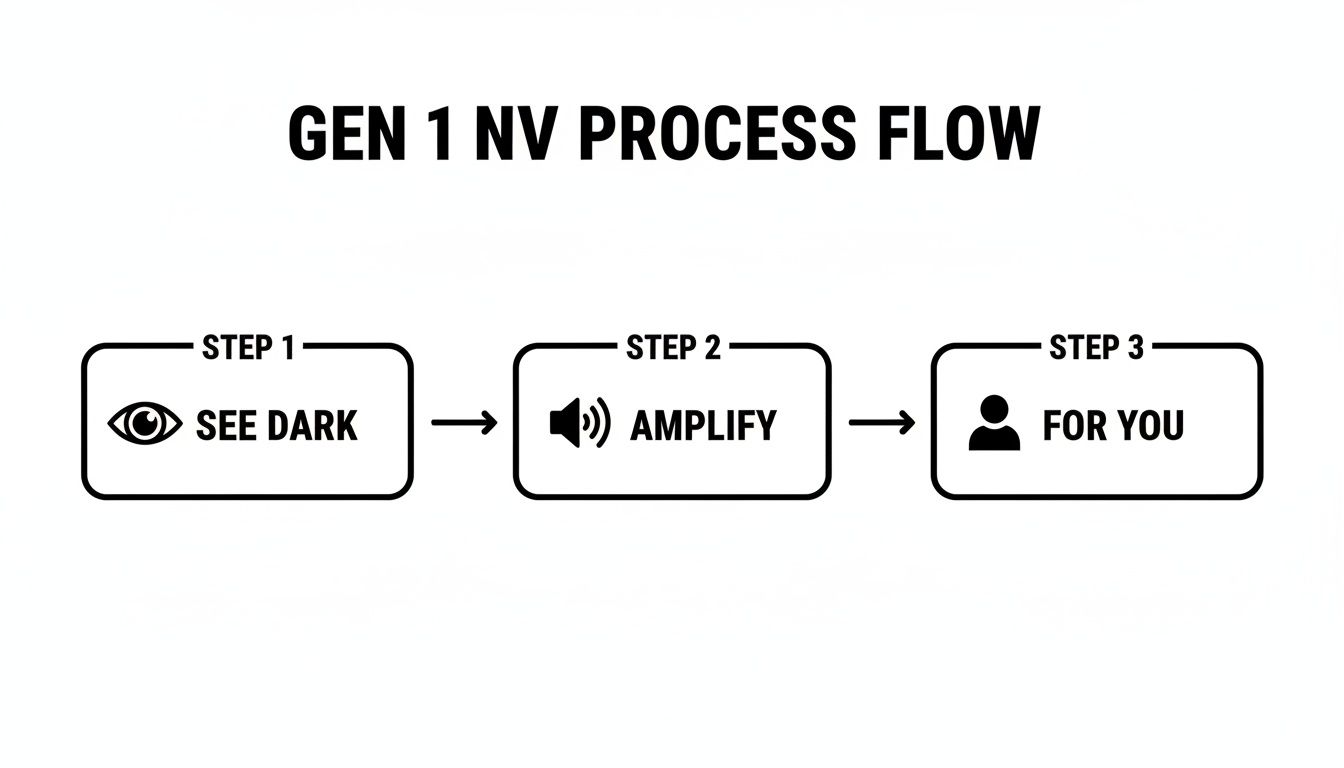
As you can see, the process is straightforward: the device gathers the minimal light available, boosts it significantly, and then projects a clear image for you to see.
Step 2: Amplifying the Signal
Once those electrons are free, a high-voltage field kicks them across a vacuum inside the tube. This is where the "amplification" part of the equation comes in. As these electrons speed up, they trigger a chain reaction, knocking loose a whole cascade of additional electrons. For every one electron that started the trip, many more are created along the way. The result is a signal multiplication of around 1,000 times.
The process inside a Gen 1 tube is a controlled cascade. A single electron, knocked loose by a faint photon, ultimately results in a thousand or more electrons striking the final screen, creating a much brighter representation of the original light.
This raw amplification is what makes Gen 1 technology work. It’s effective, but it's not a perfectly clean process. This is why Gen 1 images often have some graininess or static, especially when the light is extremely low. That "noise" is a direct side effect of this intense electron multiplication.
Step 3: Making the Image We Can See
Finally, this supercharged flood of electrons slams into a phosphor screen at the back of the tube. This screen is coated with a special material that lights up whenever an electron hits it. When the thousands of electrons strike this screen, they recreate the original scene, only now it's bright enough for the human eye to easily make out.
And that signature green color? It’s not just for looks. The human eye is incredibly sensitive to the green part of the spectrum, which means we can pick out more detail and subtle shapes with less strain. This final screen is what converts that invisible, amplified electrical signal back into a picture you can actually use, completing the journey from near-total darkness to sight.
What To Expect From Gen 1 Performance
When you're looking at Gen 1 night vision, it's crucial to connect the numbers on the box to what you'll actually see in the field. Those specs aren't just tech jargon; they define the device's limits and its strengths, helping you manage your expectations.
At its heart, Gen 1 is a balancing act between cost and capability. No, it won't give you the crisp, high-definition view of a top-tier Gen 3 unit. But what it will do is turn a pitch-black environment that's useless to the naked eye into a space you can navigate, observe, and operate in. That’s a huge advantage.
Key Specs: What The Numbers Really Mean
Let’s get into the nitty-gritty. Understanding these core metrics is like learning the language of night vision—it tells you exactly what a device is built for.
Resolution (lp/mm)
Resolution, measured in line pairs per millimeter (lp/mm), is all about image clarity. Think of it like the resolution on a TV—more line pairs mean a sharper, more detailed picture.
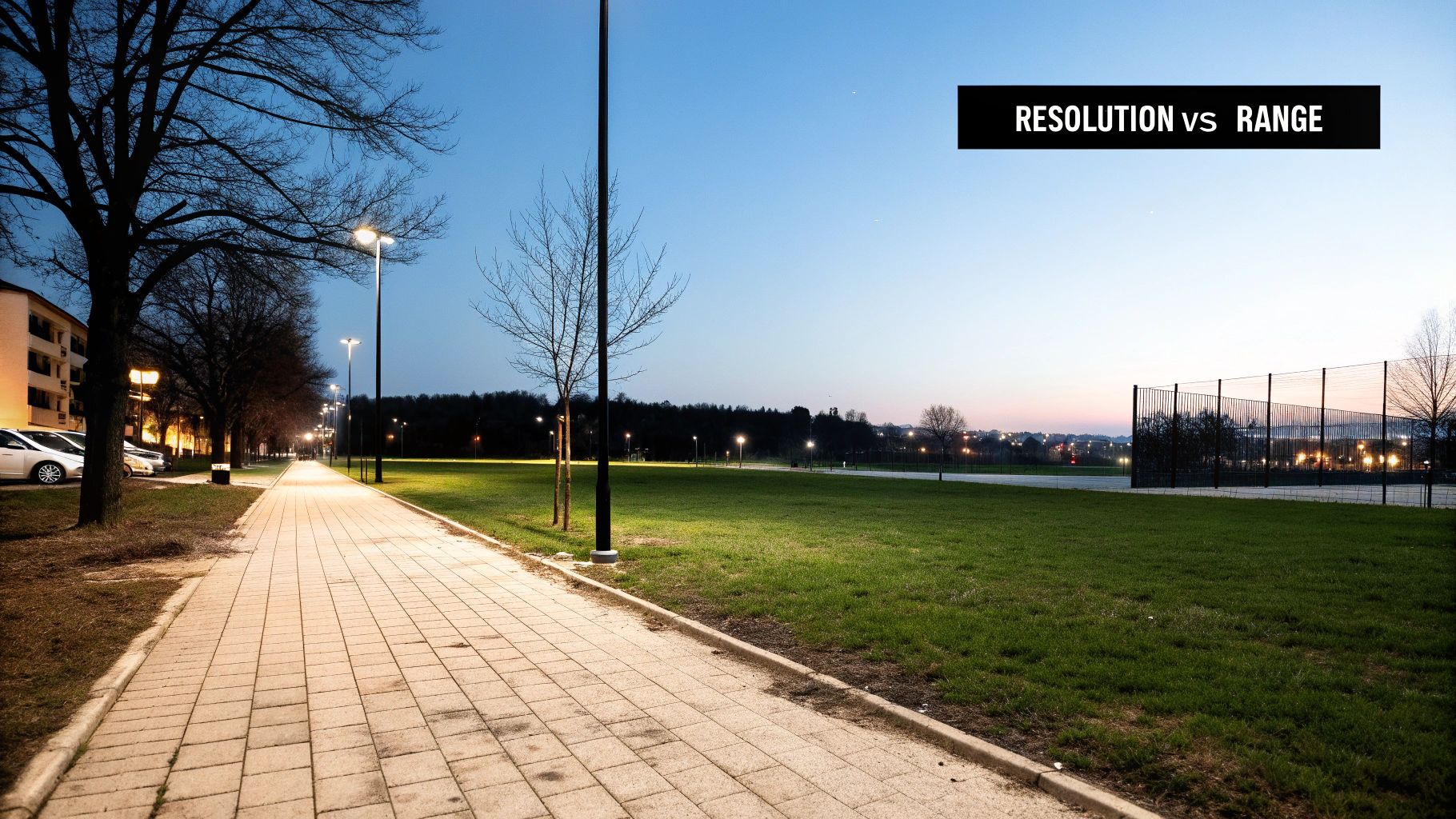
A typical Gen 1 device will land somewhere between 25-35 lp/mm. This is enough to spot a person-sized target out to 75-100 yards on a good moonlit night. However, you'll find it challenging to pick out finer details, like what that person is holding, at that same distance.
Light Gain
Gain is simply how much the device multiplies existing light. A standard Gen 1 tube will amplify the ambient light by about 1,000 times. That's an incredible boost, but it hinges on having some light to start with. In absolute, total darkness, even the best gain is useless without an infrared (IR) illuminator to provide a light source for the tube to see.
Effective Range
This is where the rubber meets the road, and it all comes down to how much ambient light you have.
- With a Quarter Moon: You can realistically expect to detect targets at 75-100 yards.
- Starlight Only: Your effective range will likely drop to 50 yards or less.
- Total Darkness: With the built-in IR illuminator on, you're looking at a range of 50-75 yards. Most stock illuminators just aren't powerful enough to punch out much further than that.
To help you visualize these specs, here's a quick reference table breaking down what you can expect from a standard Gen 1 device.
Generation 1 Night Vision Performance at a Glance
| Specification | Typical Gen 1 Performance | What This Means for You |
|---|---|---|
| Resolution | 25-35 lp/mm | The image will be clear enough for detection and general observation but lacks fine detail at a distance. |
| Light Gain | Approx. 1,000x amplification | Greatly improves on the naked eye, but still heavily reliant on moonlight or an IR illuminator. |
| Effective Range | 75-100 yards (ideal conditions), <50 yards (low light) | Best suited for shorter-range tasks like property security, airsoft, or hunting over bait. |
| Tube Lifespan | 1,000-1,500 hours | More than enough for years of recreational or occasional use. Not designed for constant professional duty. |
| Distortion | Noticeable "fisheye" effect at edges | The view can be slightly warped, especially around the perimeter of the image. It's a normal Gen 1 trait. |
This table shows the trade-offs clearly. Gen 1 is a fantastic entry point, but it's important to work within its known limitations to get the most out of your gear.
Practical Realities and Limitations
Beyond the numbers, there are a few practical things you'll notice with any Gen 1 unit.
One of the most common characteristics of Gen 1 optics is geometric distortion, often called a "fisheye" effect. This causes straight lines near the edge of the view to look a bit curved. It's a completely normal byproduct of the way the electron optics in the intensifier tube are designed.
Another key factor is the lifespan of the image intensifier tube. A Gen 1 tube is typically rated for around 1,000 to 1,500 hours of operation. While that might not sound like a lot, for a hunter or homeowner using it a few hours at a time, that translates to years of reliable service. The image intensifier tube is a fascinating piece of tech; for a deeper dive, check out our article comparing thin-filmed and unfilmed image intensifier tubes.
Finally, don't forget about batteries. Most Gen 1 devices are pretty efficient on power, but leaning heavily on that IR illuminator will drain them much faster. My advice? Always pack spares if you plan on being out for a while. Knowing these details ensures you're buying the right tool for the job and you know exactly what your Gen 1 device can—and can't—do.
The Birth of Seeing in the Dark: The Gen 1 Story
To really get what Generation 1 night vision is all about, you have to picture a world without it. Before Gen 1, working at night was a dangerous guessing game. The only options were massive infrared (IR) searchlights that basically screamed, "Here I am, shoot at me!"
Everything changed with the arrival of Gen 1 technology during the Vietnam War. This was a massive shift, moving away from "active" IR illumination and into the world of "passive" observation. For the first time, you could see in the dark without lighting yourself up like a Christmas tree—a tactical advantage that completely rewrote the rulebook.
The poster child for this new era was the AN/PVS-2 "Starlight" scope. Sure, it had its quirks, but it was a revolutionary leap forward. It gave troops the ability to own the night in a way no one thought possible.
From IR Beams to Starlight Beams
The magic of Gen 1 was its passive nature. Instead of needing a clunky, power-draining IR lamp to flood an area with light, these scopes could gather and amplify the tiny bit of light already there—from the moon, the stars, whatever. This gave soldiers a stealthy way to spot enemy movement from a covered position, completely undetected.
When Generation 1 tech hit the scene in the mid-1960s, it turned low-light operations on their head. It could boost ambient starlight by about 1,000 times. The iconic AN/PVS-2 'Starlight' scope was a game-changer in the jungles of Vietnam, with over 30,000 units in the hands of U.S. troops by 1969. It allowed them to finally see the enemy in the dead of night. For a deeper dive, check out the history and development of night vision technology.
Understanding this history is crucial. It tells you exactly what Gen 1 was built for: to give a massive upper hand to a soldier who could see against an enemy who was still completely in the dark.
The Foundation for Everything That Followed
The core ideas cooked up for Gen 1 are still the bedrock of every night vision device made today. That central concept of an image intensifier tube—sucking in photons, converting them to electrons, multiplying them, and then splashing them onto a phosphor screen to create an image—is still how modern tubes work.
Every single Gen 2, Gen 3, and digital unit out there today stands on the shoulders of the battle-tested principles pioneered by Generation 1.
It's better to think of Gen 1 not as "obsolete," but as the granddaddy of modern night vision. It proved that passive night observation wasn't just a sci-fi dream; it was a real, effective tool. That breakthrough kicked off the decades of innovation that got us to the incredible high-performance systems we have now.
Where Gen 1 Night Vision Shines Today
Alright, we've covered the tech, but where does the rubber meet the road? Knowing how Gen 1 works is one thing, but figuring out if it’s the right tool for you is what really matters. Even with newer, fancier tech out there, night vision generation 1 holds its ground as an incredibly useful tool for a simple reason: it nails the balance between solid performance and a price that won't make you wince.
Let’s be clear, this isn't about trying to outperform a military-grade unit. It's about giving you a massive advantage over the naked eye without emptying your wallet.
This affordability is exactly why Gen 1 dominates the civilian market. In fact, these devices account for over 60% of global sales in the under-$1,000 price bracket. For most recreational users, a practical range of 75-100 yards and a generous field of view is more than enough to get the job done. This blend of usability and accessibility is how Gen 1 carved out this essential market niche in the first place, making it the default choice for a lot of common situations.
Home Security and Property Surveillance
For a homeowner, a Gen 1 monocular or scope is a total game-changer. Imagine hearing a strange noise outside. Instead of fumbling for a flashlight and announcing your position to the entire neighborhood, you can discreetly scan your property and see exactly what's going on. It lets you identify a potential threat from the safety of your window long before they have any idea you're watching.
- Stay Hidden: You can observe your property without giving away your location with a bright light.
- Identify the Source: Quickly determine if that sound was just a stray cat or something that needs your attention.
- Affordable Peace of Mind: It’s a powerful surveillance tool that doesn't come with the hefty price tag of high-end thermal or digital systems.
Hunting and Wildlife Observation
Hunters and wildlife watchers get a ton of mileage out of Gen 1 gear. If you're into things like hog hunting or tracking animals that only come out after dark, seeing in low light is everything. Sure, the range has its limits, but it’s perfectly adequate for hunting over bait or watching animals at typical distances without spooking them with a spotlight.
For most hunting scenarios inside 100 yards, a decent Gen 1 device gives you all the capability you need to spot and identify your target. It's a smart, effective investment that gets the job done.
The trick is simply to play to its strengths. When it's pitch black, that built-in IR illuminator becomes your best friend. It lights up the scene so you can get a clear image and make a positive ID on your target.
Outdoor and Recreational Use
Gen 1 isn't just for tactical situations; it’s fantastic for all kinds of outdoor adventures. Think about navigating a dark trail back to your campsite, sorting through gear after sundown, or even just doing a bit of stargazing. A simple monocular makes the whole experience safer and way more interesting.
These devices are generally built tough, making them a great companion for camping, hiking, or just having in your general preparedness kit. Plus, since they aren't subject to the same strict ITAR regulations as higher-end units, they are much easier for civilians to buy and own for recreational fun.
How to Choose Your First Gen 1 Device
Jumping into the world of night vision with a Generation 1 device is a great move, but picking the right one can feel a bit daunting. Don't worry, it's simpler than it looks. The trick is to match the gear to your mission and know what to inspect before you hand over any cash.
First up, you need to decide on the form factor. Think about what you'll actually be doing with it, because each style has its own strengths.
- Monoculars: This is the most common and versatile choice for a reason. They're light, easy to handle, and great for quickly scanning an area, whether you're checking out a noise at your campsite or spotting for game.
- Scopes: If you plan on doing any kind of night hunting or pest control, a dedicated rifle-mounted scope is what you need. These are built for aiming, not so much for general-purpose observation.
- Goggles/Binoculars: Using both eyes gives you a more natural, immersive view with better depth perception. The trade-off is that they're usually heavier and will cost you more than a comparable monocular.

What to Look For Before You Buy
When you get your hands on a Gen 1 unit, the single most important thing to check is the image intensifier tube. It's totally normal for Gen 1 tubes to have some minor cosmetic imperfections—we call them "blems"—that show up as tiny black spots in your view.
A few tiny specks, especially if they're pushed off to the edge of the image, are no big deal and won't get in your way. What you really want to avoid are big, distracting spots right in the middle of your sight picture.
A clean tube is a happy tube. While minor specks are part of the Gen 1 experience, a large blemish in the center of your field of view will be a constant distraction. Always check the image before you buy if possible.
Finally, look into the warranty and the company behind the device. A good warranty is your safety net and shows the manufacturer stands behind their product. Starting with a solid Gen 1 unit is also a fantastic way to learn the ropes of operating at night. The experience you gain will be invaluable if you ever decide to upgrade to a more advanced system down the road.
For a deeper dive, our guide on how to choose the right night vision device for your needs has a lot more detail. Taking the time to get this first purchase right sets you up for success.
Answering Your Top Gen 1 Questions
When you’re first dipping your toes into the night vision world, a lot of the same questions tend to come up. Let's tackle them head-on so you know exactly what to expect from a Gen 1 device.
One of the first things everyone asks is, "Can I see in total darkness?" The short answer is no, not on its own. Gen 1 tubes are light amplifiers, not light creators. In a place with zero ambient light—think a sealed basement or a cave—you’ll need to flip on the built-in infrared (IR) illuminator to light up the scene.
Can I Use Gen 1 During The Day?
This is a big one, and the answer is a hard no. You should never power on a Gen 1 unit in daylight or even a brightly lit room. Firing up that sensitive image intensifier tube in bright light can permanently scorch it, leaving you with ugly black spots or a completely dead device.
A good way to think about it is like your own eyes adjusting to the dark. If someone shines a bright flashlight in your face, you're blinded. For a Gen 1 tube, that "blinding" light can cause irreversible damage.
Always, always, always keep the lens cap on when you're not actively using it. It's the single most important thing you can do to protect your investment. These tubes are generally rated for 1,000 to 1,500 hours of life, and avoiding bright light is how you get there.
Why Does The Image Look Blurry Around The Edges?
If you've used a Gen 1 monocular, you've probably noticed some distortion around the outer edge of the view, almost like a "fisheye" lens. Don't worry, your unit isn't broken. This is a completely normal quirk of Gen 1 technology. It’s simply a side effect of how the electron optics in the tube bend the light.
You might also hear a faint, high-pitched whine when the device is on. That’s normal, too. It’s just the sound of the high-voltage power supply doing its job to get the image intensifier tube running. In fact, if you don't hear it, that's when you might have a problem.
Ready to gain a clear advantage in low-light conditions? Explore our curated selection of night vision and tactical optics at Superior Tactical LLC. Our team is here to help you find the perfect gear for your mission, backed by expert advice and a commitment to quality. Visit us today at https://superiortac.com to see the difference.
