Night vision gen2: A Practical Explainer for Modern Optics
When you think of night vision, what's the first thing that comes to mind? For a lot of people, the answer is night vision gen2. It's the technology that really hits the sweet spot between affordability and serious, field-ready performance. This is the dependable workhorse of the night vision world, delivering crisp, usable images when older tech just can't cut it.
Why Gen 2 Night Vision Is Still a Top Contender
Trying to make sense of the different night vision generations can feel a bit overwhelming, but a simple analogy clears it right up. Think of Gen 1 as a cheap, flickering flashlight. It barely lights up a dark room and always seems to need a new battery. On the other end of the spectrum, Gen 3 is a high-dollar, specialized searchlight—incredibly powerful, sure, but often overkill for most situations.
Night vision gen2 is like a high-quality LED headlamp in this scenario. It gives you bright, clear light right where you need it, without the astronomical cost or fragility of the searchlight. This makes it the most practical choice for a massive range of users, from law enforcement to dedicated hunters. It strikes that perfect balance, offering mission-ready capability that won’t break the bank.
The Micro-Channel Plate Advantage
The real game-changer that separates Gen 2 from everything that came before it is the Micro-Channel Plate (MCP). This component is essentially a massive amplifier for light. Picture a thin wafer riddled with millions of microscopic channels. When a single particle of light (an electron) enters one of these channels, it bounces off the walls, releasing thousands more electrons in a cascade.
When this technology hit the scene in the 1970s, it completely changed military optics. This new design allowed Gen 2 devices to amplify ambient light by about 20,000 times. That's a staggering jump from Gen 1 systems, which topped out around 1,000 times amplification. You can dive deeper into the history of night vision development on thorsen.com.ua.
This huge leap in light gain means Gen 2 units can work passively, painting a clear picture using nothing more than starlight. Unlike Gen 1, they don’t rely on a built-in infrared (IR) illuminator—a feature that acts like an invisible flashlight to you, but a giant "shoot here" sign to anyone else with night vision. Seeing without being seen is a fundamental tactical advantage.
The Micro-Channel Plate is what gives Gen 2 its teeth. It’s the engine that turns a faint whisper of light into a clear, bright image, allowing you to own the dark without broadcasting your position.
This guide is here to cut through the technical jargon and give you a straightforward, practical understanding of Gen 2 technology. We’ll break down how it works, what the key performance specs actually mean for you, and where it shines in the real world. By the end, you'll know exactly if a night vision gen2 device is the right tool for your mission.
How Gen 2 Technology Turns Night Into Day
At its heart, a Gen 2 night vision device is a light amplifier. Think of it like a high-end stereo system that takes a barely audible whisper and turns it into a clear, loud voice. But instead of sound, it's grabbing tiny, invisible particles of light—photons—and multiplying them by the thousands. This is what transforms a pitch-black scene into a bright, usable image, all thanks to the image intensifier tube inside.
This whole process happens almost instantly, unfolding in four distinct stages. It's this sequence that gives Gen 2 such a massive leg up on older systems, letting you own the night while others are still fumbling for a flashlight.
Stage 1: The Objective Lens Gathers Light
It all begins at the front of the device with the objective lens. Its only job is to collect every last bit of available ambient light—from the moon, the stars, or even the faint glow from a town miles away. In our stereo analogy, this is the microphone, picking up the faintest sounds from the environment.
Stage 2: The Photocathode Converts Photons to Electrons
Once that focused light enters the image intensifier tube, it hits a component called the photocathode. This is where the first critical conversion happens. When a photon strikes this surface, it knocks an electron loose. In that moment, light energy becomes electrical energy, turning the 'whisper' of light into a tiny electrical signal.
The Micro-Channel Plate is what truly separates Gen 2 from its predecessors. It's an incredibly thin wafer, perforated with millions of microscopic glass tubes, each acting as a particle accelerator for electrons. This is the engine that provides the massive light amplification, making Gen 2 a serious tool, not just a novelty.
Stage 3: The Micro-Channel Plate Amplifies the Signal
Here's where the real magic is. Those newly freed electrons are accelerated into the Micro-Channel Plate (MCP), the technological jump that defines the entire Gen 2 category. As a single electron enters one of the millions of channels, it careens off the walls. Every impact dislodges a cascade of new electrons.
This chain reaction creates an avalanche. An electron goes in, and thousands come pouring out the other side. This is the "shout" in our analogy—taking a minuscule signal and making it powerful enough to work with.
This quick overview shows just how much of a leap forward each generation of night vision represents.
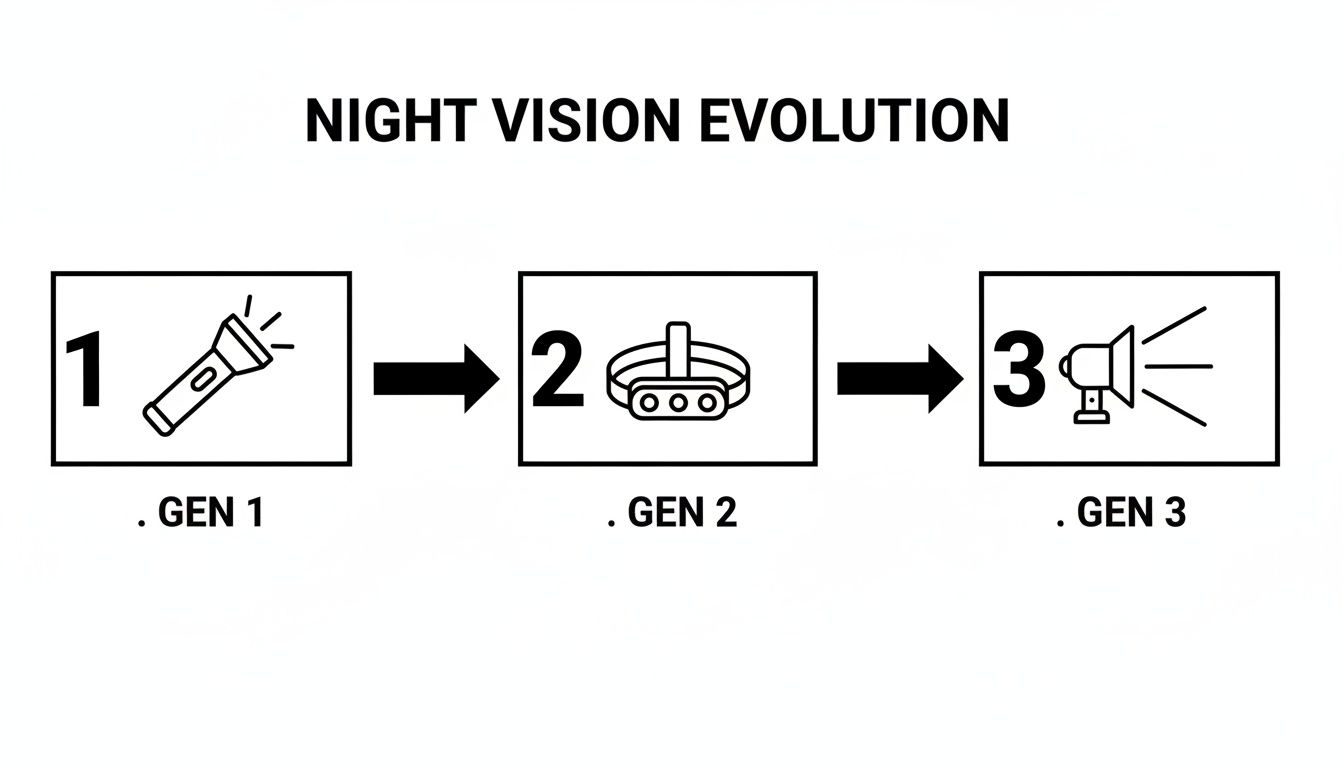
The image really drives home the difference, from Gen 1's reliance on active illumination to the powerful, self-sufficient amplification that started with Gen 2.
Stage 4: The Phosphor Screen Creates the Image
Finally, that massive cloud of electrons rockets out of the MCP and slams into a phosphor screen at the back of the tube. This screen behaves a lot like an old-school CRT television. When electrons hit it, the phosphor material glows, releasing photons that your eye can easily see.
This is what creates that classic green image we all associate with night vision. The brighter the glow, the more light was present in the original scene, giving you a detailed and high-contrast view of what's out there in the dark. For a deeper dive into the different kinds of night vision, check out our guide on night vision technology explained.
From gathering faint starlight to painting a clear picture for your eye, this four-step process is how a modern Gen 2 night vision device truly turns night into day.
Breaking Down Gen 2 Performance Specs
Stepping into the world of Gen 2 night vision means looking at spec sheets, but the numbers and acronyms can feel like a foreign language. Honestly, the key to knowing how a device will perform in the field is understanding these metrics. Think of it less like a technical exam and more like reading the stats on a star athlete—each number tells you a story about capability under pressure.
Let’s translate the most important specifications into what they mean for real-world performance, focusing on what you will actually see through the eyepiece. This is about empowering you to look past marketing fluff and choose a device that truly fits what you need to do.
Resolution: The Sharpness of Your View
The first metric you'll likely see is resolution, which is measured in line pairs per millimeter (lp/mm). In simple terms, this is the sharpness or clarity of the image. A higher lp/mm means the device can render finer details, letting you distinguish between a tree branch and an antler at a distance.
Here’s a practical way to think about it: imagine looking at a picket fence from far away. A low-resolution device might just show the fence as a blurry white line. A high-resolution Gen 2 unit, on the other hand, lets you count the individual pickets.
- Standard Gen 2: Typically offers 45-54 lp/mm. This is a huge leap from Gen 1 and provides more than enough detail for most applications, like identifying a target or navigating rough terrain.
- High-End Gen 2+: Some premium Gen 2 tubes can push this number even higher, getting closer to Gen 3 performance for those who need extra detail without the full Gen 3 price tag.
For most users, a solid Gen 2 resolution delivers a clear, usable image that's perfect for hunting, property security, and patrol duties.
Signal-to-Noise Ratio: Image Clarity vs. Static
If resolution is sharpness, then the Signal-to-Noise Ratio (SNR) is how clean the image is. It measures the amount of useful light signal compared to the background “noise,” or electronic static, you see in the tube. A low SNR is like a grainy, snowy TV picture with bad reception—the image is there, but it’s hidden behind a lot of distracting fuzz.
A high SNR, however, delivers a clean, crisp image, especially in very dark conditions where the device has to work its hardest. The "signal" is the light that forms the image you want to see; the "noise" is the scintillation that can make that image look fuzzy.
A higher SNR directly translates to a cleaner, more defined image in the lowest light conditions. It's often considered one of the most important metrics for determining real-world performance on a moonless night.
For a Gen 2 night vision device, a good SNR is critical. While Gen 3 units are famous for exceptionally high SNR, a quality Gen 2 unit provides a clean enough image for positive target identification at effective ranges. This metric is a dead giveaway for how well the tube will perform when ambient light is scarce.
Gain: How Bright Is the Image?
Gain, sometimes called system gain or tube gain, is simply the degree of light amplification. It’s a measure of how much the image intensifier tube brightens the available ambient light. Think of it as the volume knob on a stereo; higher gain equals a brighter image.
But more isn't always better. If you crank the gain too high in an environment with decent ambient light (like a half-moon), the image can get "washed out" and lose contrast. On top of that, excessive gain can amplify noise right along with the signal, making the image grainier.
Most Gen 2 devices use Automatic Brightness Control (ABC) to manage this, preventing the image from becoming overly bright and protecting the tube from damage. While Gen 3 brought in more advanced features like manual gain, the ABC in Gen 2 systems offers reliable performance across a wide range of lighting conditions. The complex relationship between the photocathode and the ion barrier film is a key factor here; you can learn more by reading a comparison of thin-filmed and unfilmed image intensifier tubes to better understand these subtle but important differences.
Gen 2 vs. Gen 3: Which One Is Right for You?
This is the big question, isn't it? When you're ready to invest in serious night vision, the choice between Gen 2 and Gen 3 is where the rubber meets the road. It’s a classic balancing act: do you go for incredible, mission-ready performance, or do you need that absolute, top-tier edge? This isn't about what's "best" on paper; it's about matching the right tool to your world and your wallet.
Think of it this way: Gen 2 is the rugged, reliable workhorse that gets the job done exceptionally well in most situations you'll ever face. Gen 3 is the thoroughbred, giving you a clear advantage when the lights go out completely. Knowing the difference is key to making a smart buy you won't regret.
The Case for Gen 2: The Smart Choice for Most
For a lot of people, a high-quality night vision gen2 unit isn't just a "budget" option—it's the right one. These devices truly shine in environments where you have at least a little ambient light to work with, like from the stars or the faint glow of a distant town. That makes them perfect for a ton of real-world uses.
Take a local law enforcement officer working a suburban beat. They're constantly moving from well-lit streets to pitch-black alleys. A solid Gen 2 device gives them the clear, usable intel they need in these mixed-light situations. Plus, the lower cost means the department can afford to equip more officers, which is a huge win.
It's the same story for hunters. If you're out chasing hogs or coyotes under a half-moon, a modern Gen 2 monocular gives you more than enough performance to spot your target and make a clean, ethical shot. The jump in capability from older tech is massive.
A top-tier Gen 2+ device can often outperform a lower-spec Gen 3 unit in certain conditions. The choice is less about the generation number and more about the quality of the specific image intensifier tube inside the housing.
When Gen 3 Is the Only Answer
While Gen 2 is a powerhouse, some situations demand the absolute best, and that’s where Gen 3 comes in. The magic is in the photocathode; Gen 3 tubes use gallium arsenide, which is just plain better at turning tiny bits of light into a usable image. When you're in near-total darkness, that difference is night and day.
Picture this: you're tracking something through a thick forest on a cloudy, moonless night. A Gen 2 unit might start to show some noise and lose detail, making it harder to see what's ahead. A Gen 3 device, in the same conditions, will still give you a crisp, bright image, letting you see further and with more confidence. It’s why special operations forces and federal teams depend on it.
So, how do you decide? Let’s break it down.
- Choose Gen 2 if:
- You're looking for the best bang for your buck.
- You'll mostly be using it in places with some background light (starlight, city glow).
- Your primary uses are hunting, securing your property, or general preparedness.
- Choose Gen 3 if:
- You need peak performance in the absolute darkest environments, no exceptions.
- You're in a line of work where a missed detail could have serious consequences.
- You need advanced features like autogating for fast-changing light, like in urban operations.
At the end of the day, it comes down to being honest about how you'll use it. A night vision gen2 device gives you incredible capability, letting you own the night in the vast majority of scenarios. But for those who operate on the ragged edge of darkness, Gen 3 offers an unmatched advantage that’s worth every penny. For everyone else, today's Gen 2 technology is the smart, powerful, and dependable choice.
Real-World Applications for Gen 2 Devices
Technical specs and performance metrics are one thing, but the true test of any gear is how it holds up in the field. Night vision gen 2 technology isn’t just some abstract concept—it’s a proven force multiplier in a whole host of demanding situations. Its unique blend of performance and affordability makes it the workhorse choice for professionals and serious civilians who need a clear edge after dark.
This technology didn't just appear overnight. The groundwork for Gen 2 was laid throughout the 1970s, born from hard-won lessons in the Vietnam War. By the 1990s, it had become standard issue for tactical and law enforcement teams, completely pushing aside older, less reliable systems. You can get a deeper dive into the history of night vision on bosonsystems.store.
Law Enforcement and Security Operations
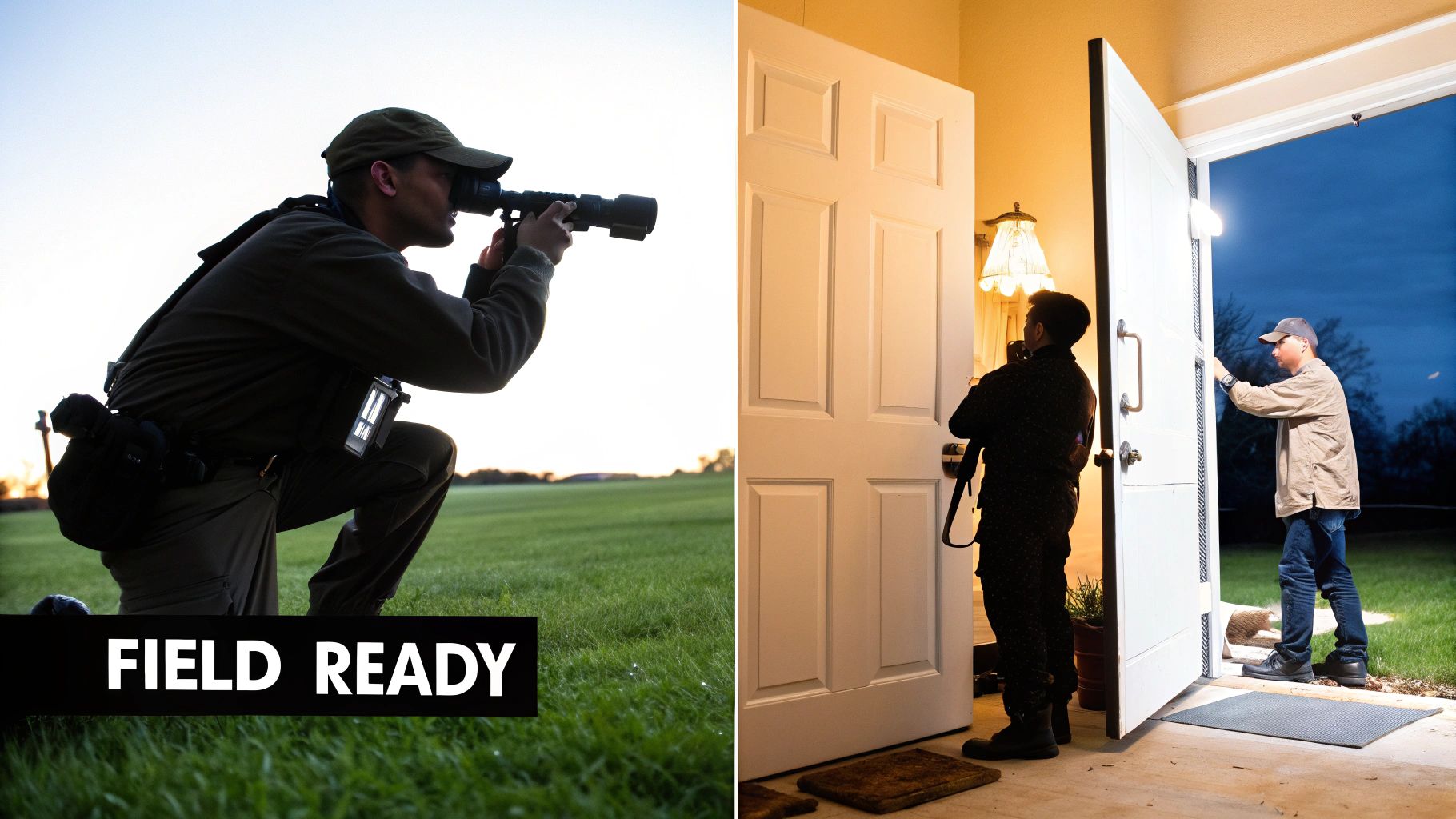
For police officers and private security, owning the night isn’t optional; it’s part of the job description. A night vision gen 2 monocular or set of goggles gives them the crucial ability to see without being seen—essential for surveillance, patrols, and tactical operations.
Picture a patrol officer responding to a silent alarm at a warehouse. Armed with a Gen 2 device, they can scan the dark perimeter, spot a potential threat hiding in the shadows, and move with confidence before ever making entry. The image is clear enough to tell a suspect from a civilian, or a weapon from a phone, all without giving away their position with a flashlight beam.
- Surveillance: An officer can watch a location from a safe distance, gathering intel without tipping off the people inside.
- Perimeter Security: Guards can patrol large, unlit properties and detect an intruder long before they get close.
- Search and Rescue: In the critical first hours, teams can scan dark fields or dense woods for a missing person when every second is vital.
Hunting Nocturnal Game
Today's hunters going after nocturnal animals like hogs and coyotes need a serious advantage. These critters are most active when the sun is down, and night vision gen 2 provides a clean, ethical way to identify and engage targets in near-total darkness.
Think about it. A hunter is posted up on a field edge with just a sliver of moon. A group of feral hogs steps out of the woods 100 yards away. With a good Gen 2 scope or monocular, that hunter can positively identify their target, check the backstop, and make a clean, precise shot. That’s what turns a frustrating night into a successful hunt.
A huge plus for hunters is that Gen 2 is a passive system. Unlike Gen 1, it doesn't usually need a bright IR illuminator that can spook wary game, letting you stay completely undetected.
Civilian Preparedness and Property Monitoring
Beyond the professionals, Gen 2 night vision is an incredibly valuable tool for any prepared citizen. When the power goes out for an extended time or a natural disaster hits, being able to move and see in the dark is a fundamental part of staying safe.
A homeowner can use a Gen 2 monocular to check on a strange noise outside without flipping on lights and announcing their presence. During a blackout, they can navigate their home or neighborhood safely, spot hazards, and keep an eye on things. It provides a real sense of security and control when everything else feels uncertain. This is why a solid night vision gen 2 unit is a cornerstone of any serious preparedness loadout.
Protecting Your Investment in Night Vision Gear
A quality night vision Gen 2 device is a serious piece of kit, and like any precision instrument, it needs proper care to keep it running at its best for years. Protecting your investment isn't difficult, but it does mean paying attention to the details. With the right habits, you can make sure your gear is ready to go whenever you are.
The absolute number one rule? Protect the image intensifier tube from bright light. Exposing it directly to sunlight or other powerful light sources can cause permanent damage, leaving you with dark spots or "burn-in" on the tube. Always, always keep the objective lens cap on when you’re not using the device, especially during the day.
Think of the image intensifier tube as the heart of your night vision device. Protecting it from bright light, impact, and moisture is the single most important thing you can do to ensure its longevity.
Essential Care and Maintenance Practices
Simple, consistent maintenance is the secret to a long service life. You should treat your night vision optic with the same care you give your firearm or any other critical piece of equipment. That means keeping it clean, dry, and stored correctly.
- Lens Cleaning: Stick to approved lens cleaning solutions and microfiber cloths. The coatings on night vision lenses are delicate, and using the wrong chemicals or a rough cloth can easily scratch them or strip the coating, which will wreck your image quality.
- Battery Management: Don't cheap out on batteries. If you plan on storing your device for a while, take the batteries out. Leaky batteries will corrode the contacts and can completely fry the electronics inside.
- Moisture Control: Most units are water-resistant, but that doesn't mean they're waterproof. If you've been out in damp or humid conditions, wipe down the housing and let it air dry. Tossing a desiccant pack into its storage case is a great way to pull out any lingering moisture.
Understanding Lifespan and Degradation
Every image intensifier tube has a limited lifespan, usually measured in hours of operation. A typical night vision Gen 2 tube is rated to last anywhere from 2,500 to 5,000 hours. For the average hunter or landowner, that's a whole lot of nights.
Over time, you might notice a slow decline in performance—maybe the image seems a bit dimmer, or you see more scintillation (sparkling) in really dark conditions. This is a normal part of the aging process.
However, sudden changes are a different story. If new black spots pop up or the image starts flickering, that could signal a real problem. When that happens, you need to know what to do next. Our guide on common night vision gear issues and how repairs can help is a great resource for troubleshooting and knowing when to call in the pros. By spotting the early warning signs, you can get ahead of issues before they cause a critical failure when you're counting on your gear the most.
Answering Your Top Questions About Gen 2 Night Vision
When you're getting into Gen 2 night vision, a few questions always seem to pop up. Let's tackle them head-on. Getting these answers straight is the key to understanding what your gear can do and, just as importantly, what it can't.
Do Gen 2 Devices Need an IR Illuminator?
Here’s one of the biggest leaps from Gen 1 to Gen 2: you can usually run it completely passive. Because of that Micro-Channel Plate doing the heavy lifting, these units are fantastic at gathering and amplifying the tiniest bits of ambient light, like starlight or a sliver of moon.
For most nights outdoors, you will not need an IR illuminator.
The exception? Total, absolute darkness. Think a windowless basement, a deep cave, or a sealed room. In those scenarios, an IR illuminator becomes your best friend. It’s basically an invisible flashlight that gives your tube the photons it needs to see.
Can You Use Night Vision During the Day?
This one is a hard and fast rule: never, ever use your Gen 2 device in daylight without the protective day cap on. The cap has a tiny pinhole that lets you test the unit safely, but that's it.
Direct sunlight or any bright light source can cause catastrophic, permanent damage to the image intensifier tube.
Think of it like this: protecting your tube from bright light is the number one rule of night vision ownership. One bad mistake can cause permanent black spots (burn-in) across your view, wrecking your investment and its effectiveness.
What Is the Lifespan of a Gen 2 Tube?
You can expect a long service life from a quality Gen 2 tube. Most are rated for 2,500 to 5,000 hours of runtime.
For most folks—hunters, homeowners, or law enforcement officers—that translates to years and years of solid performance before you'd even begin to notice any real degradation.
If you treat it right by avoiding bright lights and hard drops, your gear will take care of you. A well-maintained unit is an asset that will serve you reliably for a very long time.
Ready to find the right night vision solution for your needs? The team at Superior Tactical LLC has over a decade of experience outfitting professionals and enthusiasts with mission-ready optics. Explore our curated selection of night vision and tactical gear at https://superiortac.com.
