Night Vision for Hunters: A Practical Guide to Gear, Tactics, and Safety
For most hunters, sundown has always meant packing it in. But what if you could unlock the hours when game is most active? Night vision for hunters does just that, turning a daylight-only pursuit into a round-the-clock opportunity, especially when you're after nocturnal animals like hogs and coyotes. This technology isn't just another accessory; it's a fundamental advantage for hunting ethically and successfully after dark.
Why Night Vision Is a Game-Changer for Modern Hunters
The world doesn't stop when the sun goes down. In fact, for many of the animals we hunt, that’s when things really get going. For generations, we were stuck on the sidelines, but modern optics have completely changed the game, giving us a crystal-clear advantage in the dark that the naked eye could never achieve.
Think about it this way: traditional hunting is like being told you can only fish one small corner of a massive lake. Getting night vision is like suddenly getting the keys to a boat and being able to explore every last inch, including the deep, active spots you could never reach before. It's about opening up a whole new world of opportunity, whether you're managing predator populations or chasing that elusive trophy.
Extending Your Hunt into Prime Time
The simple truth is, a lot of game is on the move when we can see the least. Hogs, coyotes, and other predators use the cover of darkness to their advantage. Without the right gear, we’re left to guess, hope, and rely on sheer luck. Night vision flips the script and puts you back in the driver's seat.
This gear lets you spot, identify, and engage targets with total confidence. It’s not just about seeing something in the dark; it’s about seeing clearly enough to hunt responsibly and make ethical shots.
The explosive growth in this technology tells the whole story. The hunting and wildlife spotting segment is the fastest-growing part of the entire night vision market, projected to jump by 12.8% annually from 2023 to 2030. Hunters, particularly in North America—which accounts for a massive 36% of the global market—are embracing these optics to spot game from incredible distances. You can dig into more of the data on night vision market growth at MordorIntelligence.com.
The Two Paths to Seeing in the Dark
When you start looking at night vision for hunters, you’ll quickly find there are two main technologies. They both let you see what's hidden by the night, but they do it in completely different ways. Getting a handle on how they work is the first, most important step in picking the right tool for the job.
- Image Intensification: This is the classic, green-hued "night vision" you see in movies. It works by grabbing every tiny bit of available ambient light—from the moon, stars, whatever—and amplifying it thousands of times to create a visible image. It shows you a much, much brighter version of the world as it is.
- Thermal Imaging: Instead of light, thermal optics see heat. Everything with a temperature, from a coyote to a truck that was running ten minutes ago, gives off a heat signature. A thermal device picks up on these differences in heat and turns them into a picture. You're seeing the heat, not the light.
Both are incredible tools, but they shine in different scenarios. We’ll break down exactly which one is right for your type of hunting as we go through this guide.
Night Vision Versus Thermal Imaging Explained
When you decide to start hunting after dark, your first big choice is between traditional night vision and thermal imaging. People often lump them together, but they're completely different tools that work on totally separate principles. Figuring out which one is right for you, or if you need both, is the first and most important step.
Think of it this way: traditional night vision is like giving yourself a superpower to see in the dark. It takes whatever tiny amount of light is available—from the moon, stars, or even distant city glow—and boosts it thousands of times to paint a clear, green-tinted picture. You're seeing the world as it is, just much, much brighter.
Thermal imaging, on the other hand, is more like developing a sixth sense for heat. It doesn’t care about light at all. Instead, it sees the invisible world of thermal energy. Every animal, person, or running engine gives off heat, and a thermal scope picks up these tiny temperature differences, making warm bodies pop against their cooler surroundings.
Ultimately, the goal is to get an edge by hunting when nocturnal game is most active. Both technologies open up that world for you.
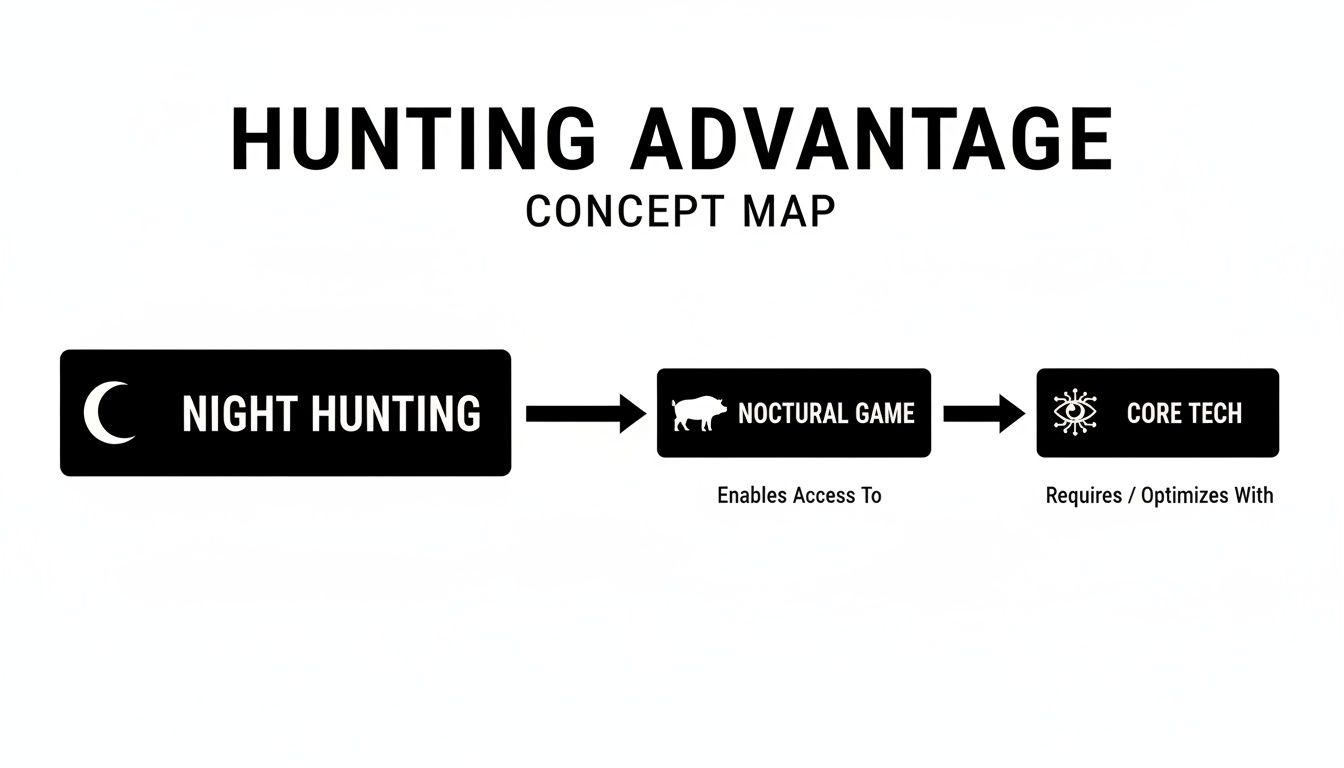
This ability to hunt nocturnal game is the core advantage, and it’s made possible by these two distinct technologies.
The Big Difference: Detection vs. Identification
If you remember one thing, let it be this: thermal is for finding, and night vision is for identifying. This is the absolute heart of the debate for any hunter. One helps you answer, "Is anything out there?" while the other answers, "What exactly is that?"
Thermal imaging is the king of detection. Nothing beats it. An animal's body heat stands out like a beacon against a cool landscape, making it almost impossible for it to hide. A hog bedded down in a shadow or a coyote slipping through tall grass will glow on a thermal display from hundreds of yards out, even in total darkness.
But thermal has its limits. Because it only shows you a heat map, it can be tough to see the fine details. You might spot a warm blob, but is it a big coyote or a young deer? A legal boar or a sow you can't shoot? That's where night vision takes over.
Why The Details Matter
Traditional night vision is built for positive identification. Since it works by amplifying light, it shows you a real image with texture and depth. You can see the hide on an animal, count antler points, and clearly make out the branches and terrain between you and your target.
Night vision lets you see the animal itself, while thermal lets you see its heat signature. For a responsible hunter, being 100% certain of your target is a non-negotiable part of the process.
Let's say you're scanning a cut cornfield for hogs. A thermal monocular will spot the heat of a sounder in seconds. Now you know they're there. To take the shot, you'd switch over to your night vision scope to pick out a specific boar from the group and ensure you have a clear, safe backstop.
For a more detailed breakdown, our complete guide on the differences between thermal and night vision hunting optics digs even deeper into these comparisons.
Night Vision vs Thermal for Common Hunting Scenarios
To make it even clearer, here’s how each technology stacks up in situations you'll actually face in the field.
| Hunting Scenario | Night Vision (Image Intensification) | Thermal Imaging |
|---|---|---|
| Scanning a large, open field | Can be slow; requires more panning to cover ground. Details can be lost at a distance. | Winner. Quickly spots heat signatures across vast areas, making it easy to locate game. |
| Hunting in thick woods/brush | Difficult. Branches and leaves obscure the view, making it hard to see an animal clearly. | Winner. An animal's heat can often be seen through light brush and foliage. |
| Positive target ID (e.g., deer vs. hog) | Winner. Provides the detail needed to see an animal's shape, fur, and features for 100% certainty. | Can be difficult. Shapes can look similar, making it risky to identify a target on thermal alone. |
| Navigating terrain in the dark | Winner. You can see the actual ground, including holes, rocks, and logs, making it much safer to walk. | Difficult. Shows a flat, low-contrast world, making it hard to judge terrain and avoid hazards. |
| Trailing a wounded animal | Can work if the blood trail is very fresh and heavy, but it's not a strong point. | Winner. A fresh blood trail is warm and often glows on a thermal imager, making recovery easier. |
As you can see, each one has its moment to shine. There's no single "best" option—it all depends on the job at hand.
Practical Pros and Cons for the Hunt
Let's boil it all down to a simple list of strengths and weaknesses you'll experience firsthand.
-
Thermal Pros:
- Unbeatable Detection: Works in zero light and can see through fog, smoke, and light cover.
- Fast Scanning: Lets you sweep huge areas in seconds to find what you're looking for.
- Easy Blood Trailing: Fresh blood from a wounded animal often glows, helping with recovery.
-
Night Vision Pros:
- Positive Identification: Gives you the crisp detail you need to identify species, sex, and age.
- Safer Navigation: Seeing the real terrain makes it much easier to move around without tripping or falling.
- Not Affected by Temperature: Performance isn't impacted by weather that can sometimes reduce thermal contrast.
In the end, many serious night hunters find that the ultimate night vision for hunters setup isn't one or the other—it's both. Using a handheld thermal monocular to scan and a rifle-mounted night vision scope to identify and shoot is a deadly effective combo that gives you the best of both worlds.
Choosing the Right Optic for Your Hunting Style
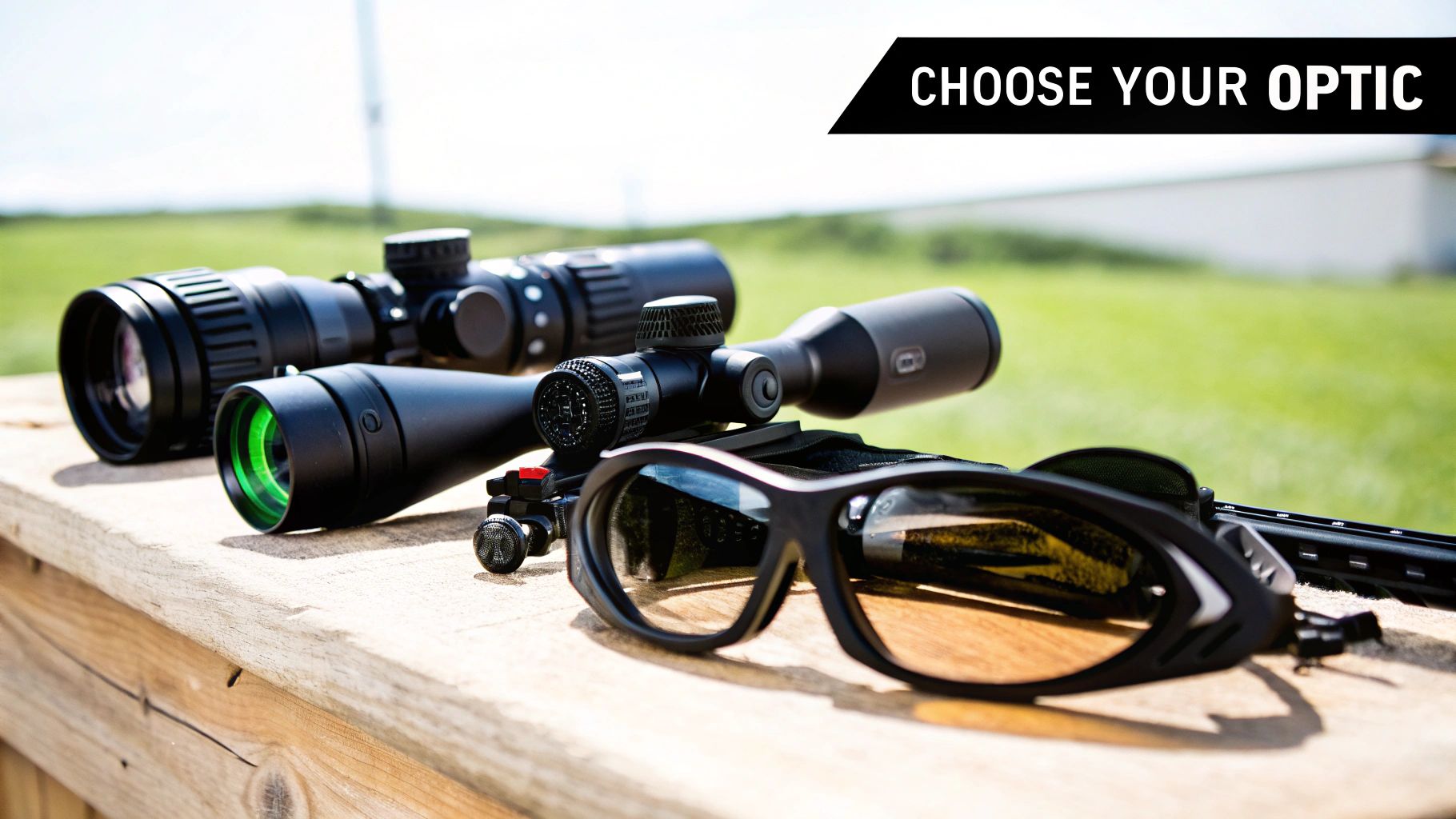
Knowing the tech is one thing, but picking the right tool for the job is a whole different ball game. The best night vision for hunters isn't some universal, one-size-fits-all device. It's the one that feels like a natural extension of your body and perfectly matches how you hunt, whether you're stalking thick timber or sitting dead still in a blind.
How a night vision device is shaped and meant to be used—its form factor—really determines its role in the field. Let's dig into the four main types so you can match the right piece of gear to your game.
Monoculars: The Versatile Scout
Think of a night vision monocular, like the legendary PVS-14, as the Swiss Army knife of the night optics world. It’s a simple, single-tube device you hold in your hand, and its versatility is just incredible.
Because it's so compact and light, a monocular is the perfect tool for scanning your surroundings and getting around in the dark. You can pop it up to one eye for a quick look at a field or trail, all while your other eye stays naturally adjusted to the darkness. This little trick helps you avoid the "tunnel vision" you can get with two-eyed systems, keeping you much more aware of what's going on around you.
- Perfect for Scanning: Sweep large areas to find game without having to point your rifle at every shadow that moves.
- Ideal for Navigation: Get to and from your stand safely by spotting those trip hazards like rocks, roots, and fallen branches.
Honestly, for the hunter who does a little bit of everything, a good monocular is usually the first and most useful piece of night vision you can own.
Dedicated Scopes: The Precision Shooter
When it's time to actually take the shot, nothing comes close to a dedicated night vision riflescope. These units are built from the ground up to mount directly on your firearm, giving you a crystal-clear and rock-steady sight picture for aiming.
Unlike other setups, a dedicated scope has the night vision tech and the reticle fully integrated, which means you get maximum accuracy and a zero you can trust. This is the go-to solution for hunters who live and breathe precision—think predator callers working coyotes at long range or hog hunters who need to make an ethical shot from a fixed position.
A dedicated scope is purpose-built for one thing and one thing only: placing a perfect shot in the dark. It gives you the highest level of confidence when that moment of truth finally arrives.
If your style is to set up in a blind or a stand and let the game come to you, a dedicated scope is the best investment you can make for clean, effective harvests.
Goggles: The Hands-Free Operator
For the hunter who is always on the move, night vision goggles are the answer. These are usually dual-tube systems worn on a helmet or head mount, feeding a view to both of your eyes and leaving your hands totally free.
This kind of setup gives you fantastic depth perception and a much more natural, immersive view of your surroundings, making it perfect for active stalking or tracking. Having both hands free to carry your rifle, work a call, or just push a branch out of the way is a massive advantage. Goggles are for the hunter who needs to move through the darkness and be fully engaged with their environment.
Clip-On Systems: The Flexible Hybrid
What if you absolutely love your high-end daytime scope and hate the idea of swapping it out when the sun goes down? That's where a clip-on night vision device (CNVD) comes in. This clever unit mounts on a rail right in front of your existing scope, instantly turning it into a capable night vision sight.
Clip-ons offer incredible flexibility. You get to keep using the optic you know and trust, complete with its familiar reticle and magnification, deep into the night. The system works with your scope's existing zero, letting you shift from day to night hunting without ever having to un-mount your primary optic.
This makes it the perfect choice for anyone who needs one rifle to do it all, or for hunters who have already invested a serious chunk of change into a premium daytime scope.
Understanding the Specs That Actually Matter
Jumping into the world of night vision can feel like you're trying to learn a new language. The spec sheets are a jumble of acronyms and numbers that mean absolutely nothing until you translate them into what you'll actually see in the field. Let's cut through the jargon and get straight to what helps you spot, identify, and take down game after dark.
Think of it this way: night vision generations are a lot like upgrades to a high-end camera sensor. Each new version gives you a cleaner, brighter, and more detailed picture. While the older tech might be fine for spotting raccoons in the backyard, serious hunters need performance they can bet their entire trip on.
The All-Important Generations
The "Gen" of a night vision device is the single biggest clue to its performance. It tells you everything about the engine under the hood—the image intensifier tube—which is what magically turns a pitch-black night into a visible, green-hued landscape.
-
Gen 1: This is your starting point. Gen 1 units are easy on the wallet and work for basic observation, but they almost always need an IR illuminator to be useful. You'll also notice a classic "fish-bowl" distortion around the edges of the image.
-
Gen 2: Here's where things get serious. Gen 2 is a massive leap forward, offering much cleaner images, better performance in very low light, and a more rugged build. It's a fantastic middle ground for hunters who need reliable gear without breaking the bank.
-
Gen 3: This is the gold standard for serious night vision for hunters. Gen 3 tubes are incredibly sensitive to even the faintest light, producing bright, crisp images with almost no distortion, even on a cloudy, moonless night. This is the same level of performance trusted by military and law enforcement professionals.
For a much deeper dive into the tech and visual comparisons, our complete guide on understanding night vision generations breaks it all down. For hunting, though, the bottom line is this: investing in Gen 3 gives you the absolute clarity needed for positive target ID at ranges that matter.
Decoding the Key Metrics
Once you know the generation, a few other numbers on the spec sheet will tell you the rest of the story.
Resolution (lp/mm)
Think of resolution, measured in line pairs per millimeter (lp/mm), as the "HD vs. 4K" of the night vision world. It's a direct measure of how much detail the tube can resolve. A higher lp/mm number means a sharper, less grainy image, letting you see things like the texture of a hog's hide or the small branches in front of your target.
A device with 64 lp/mm or higher is considered excellent for hunting. That’s the kind of clarity that lets you confidently tell a coyote from a stray dog at 150 yards. A lower-res unit might just show you a fuzzy blob at that same distance.
This technology has come a long way, pushed forward by both military needs and a growing civilian market. The global night vision industry, valued at USD 8.57 billion, is expected to reach USD 12.91 billion by 2030, with activities like hunting playing a huge role. Milestones like the AN/PVS-14's use in Afghanistan, where Gen 3 tech with 64 lp/mm resolution allowed for 90% target detection in near-zero light, paved the way. For hunters, this translates directly to making ethical shots and cutting down on wounding losses by as much as 50%. You can dig into these market trends and the technology's impact on MarketsandMarkets.com.
Field of View (FOV)
Field of View (FOV) is your window to the world after dark, measured in degrees. A wide FOV is like watching a widescreen TV—you see more of the landscape at once, which is perfect for scanning a big field for movement. A narrow FOV is more like being zoomed in, giving you more detail but on a smaller slice of the area.
Most helmet-mounted monoculars and goggles stick to a standard 40-degree FOV. It’s a sweet spot that gives you a great balance of situational awareness and the ability to focus on a target. Just remember, any device with built-in magnification will naturally have a tighter, narrower field of view.
Range Performance: DRI Explained
Finally, you'll hear manufacturers talk about range using the terms Detection, Recognition, and Identification (DRI). These aren't just marketing fluff; they define what you can realistically expect at different distances.
-
Detection Range: The farthest you can be and still see something. It might be a faint flicker or a dark shape, but you won't have a clue what it is.
-
Recognition Range: At this distance, you can tell the type of object you're looking at. For instance, you can see it's a four-legged animal, but you can't be sure if it's a big coyote or a small deer.
-
Identification Range: This is the only number that truly matters to a hunter. It’s the maximum distance where you can be 100% certain of your target's species and what's behind it.
Always, always focus on the identification range when you're looking at specs. That's the number that guarantees you're making a safe, ethical, and legal shot every single time.
Building Your Complete Night Hunting System
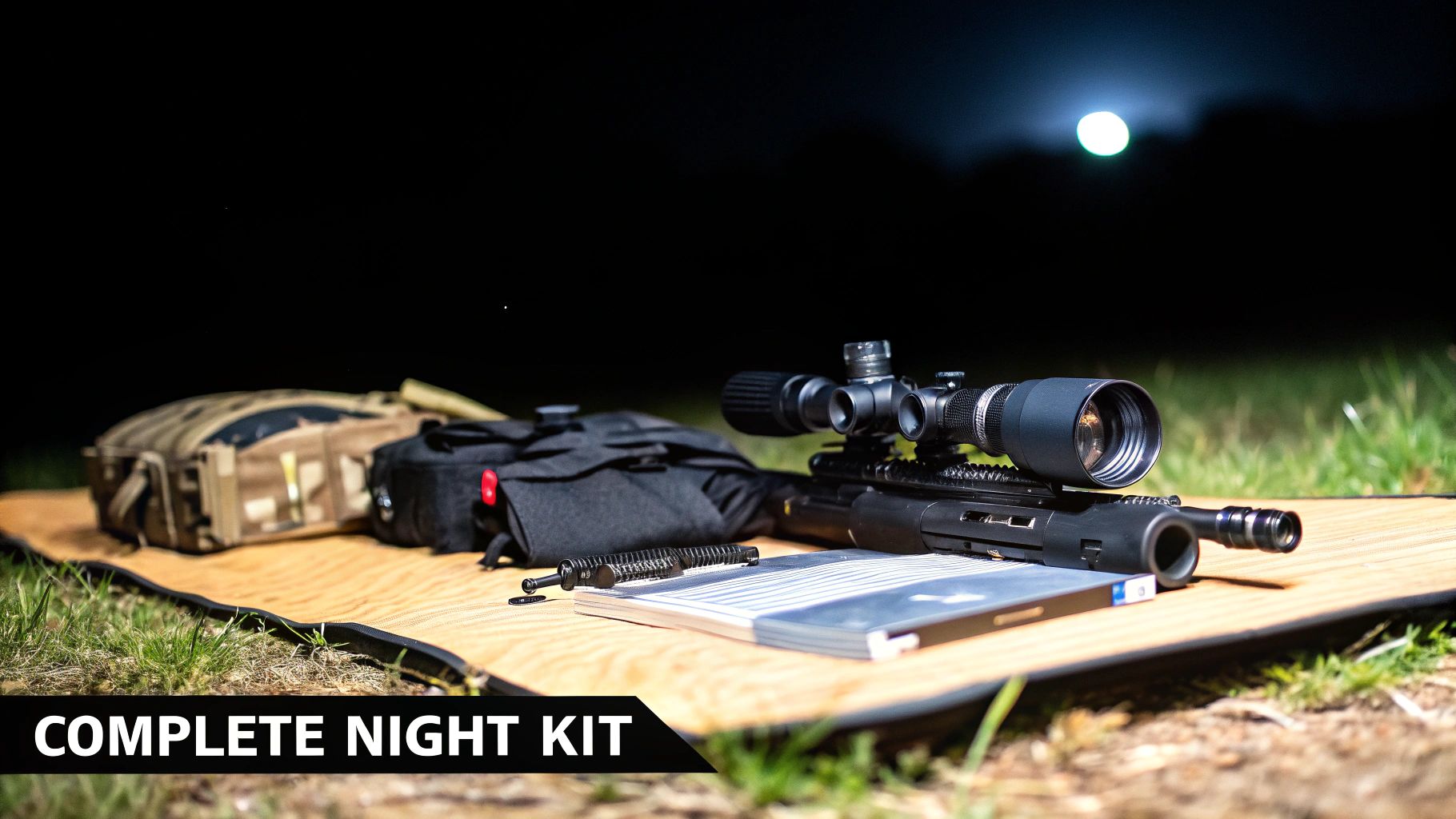
Getting your hands on a good night vision optic is a huge first step, but it's really just one piece of the puzzle. To truly own the night, you need to think in terms of a complete system built around that core device. The right accessories aren’t just nice to have; they multiply your optic's effectiveness and turn your setup into a reliable rig that won't let you down when a coyote finally steps into the clear.
I like to think of the night vision scope or monocular as the engine. It’s got all the power, but an engine alone doesn't get you anywhere. You need the chassis, the wheels, the steering—all the other components that put that power to work. That's what your accessories do.
Illuminators: The Invisible Flashlight
Even the most advanced Gen 3 night vision needs a little bit of ambient light to amplify. On a cloudy, moonless night or deep in the woods under a thick canopy, it can get so dark that even the best tube struggles. This is precisely when an infrared (IR) illuminator proves its worth.
An IR illuminator is basically a special flashlight. It throws a beam of light that’s completely invisible to the naked eye but shows up bright as day through your night vision. It floods your target area with usable light, drastically improving image quality and pushing your identification range way out. You'll go from a fuzzy, grainy picture to a crisp, identifiable target.
An IR illuminator is like hitting the high beams in a thick fog. It cuts through the murk of total darkness, revealing details you were missing and giving you the clarity needed to make a clean, ethical shot.
Most good illuminators let you focus the beam. You can cast it wide to scan a field or tighten it up to pinpoint something at a distance. For anyone serious about hunting after dark, a quality IR illuminator isn't optional.
Aiming Lasers for Quick Shots
If you're running a helmet-mounted monocular or goggle system, an IR aiming laser is a total game-changer. These units mount on your rifle's rail and shoot a powerful laser beam that only you can see through your night vision. Instead of having to bring the rifle up and find your scope, you just put the dot on the target and press the trigger.
This method is incredibly fast and intuitive, which is a massive advantage when hogs scatter or a predator is on the move. It lets you keep your head up and stay aware of everything happening around you.
- IR Illuminator: Your personal moonlight, giving your optic the light it needs to see in pitch-black conditions.
- IR Laser: Provides a lightning-fast, heads-up-display-style aiming point for those running helmet setups.
- High-Quality Mounts: The critical link that keeps your optic attached and zeroed on your firearm.
Mounts: Where You Shouldn't Cut Corners
Finally, none of this tech matters if your scope isn't locked down tight to your rifle. A cheap mount is the quickest way to see a multi-thousand-dollar investment get damaged by recoil or, just as bad, lose zero at the worst possible moment.
Good mounts are precision-engineered from materials like aircraft-grade aluminum to handle the violent kick of a rifle without budging. They ensure your point-of-impact stays exactly where you set it, shot after shot. This is the last place you want to try and save a few bucks. A solid, reputable mount protects your gear and the success of your hunt.
As you start putting all this together, it's smart to keep a running list. To make sure you've covered all your bases, our guide on building the ultimate hunting gear checklist is a great place to start.
Hunting Legally and Ethically After Dark
Getting your hands on a high-tech night vision setup is one thing, but knowing how to use it responsibly out in the field is what really counts. The ability to hunt after dark is a privilege, and it comes with a serious set of rules and ethical duties you just can't ignore.
The very first thing you have to do is get crystal clear on the law. Night hunting regulations can change drastically from one state to the next—sometimes even from one county line to another. What's perfectly fine in one spot could get you in serious trouble just a few miles down the road.
Know Your Local Regulations
Before you even think about heading out, you must be absolutely sure of the specific rules for your hunting area. For the most part, hunting at night is focused on managing predators and invasive species.
- What you can hunt: The usual suspects are animals like feral hogs, coyotes, and other varmints that cause problems for livestock and local ecosystems.
- What you can't: Taking game animals like deer, turkey, or elk after dark is almost always illegal and comes with some stiff penalties.
Your best bet is to go straight to the source: your state's wildlife agency. Their website and official handbooks have the final say on legal hunting hours, permitted species, and any restrictions on the gear you can use.
It's simple: ignorance isn't an excuse. The responsibility is 100% on you to know the laws. Getting it wrong can mean big fines, losing your hunting license, and having your expensive gear confiscated.
The popularity of hunting with this kind of tech has exploded. In fact, wildlife spotting and hunting now accounts for a 26.9% revenue share of a global market expected to reach USD 16.32 billion by 2030. This boom means it's more important than ever for every hunter to set a good example. You can read more about these market dynamics at GrandViewResearch.com.
Ethical Hunting in the Dark
Beyond just following the rules, there's the core ethics of the hunt. Two principles should be burned into your brain: 100% positive target identification and knowing what is behind your target.
Night vision lets you see in the dark, but it’s your skill and judgment that make for a safe, clean shot. Never, ever pull the trigger unless you are absolutely certain of your target and what's beyond it.
One last thing to keep in mind, especially if you travel, is the International Traffic in Arms Regulations (ITAR). High-end Gen 3 night vision is treated as controlled military technology. That means you can’t legally take it outside the United States without getting the proper government licenses—a serious rule meant to protect national security.
Answering Your Lingering Questions
Even after going through all the specs and options, a few practical questions always pop up. It's totally normal. Let's tackle some of the most common things hunters ask before they're ready to pull the trigger on a new night vision setup.
Can I Use My Night Vision Scope During the Day?
For traditional night vision, the answer is a hard no. Firing up an image intensifier tube—the heart of a Gen 2 or Gen 3 device—in daylight is a recipe for disaster. The intense light will instantly overwhelm and "burn" the tube, leaving you with permanent black spots or, even worse, a completely dead unit.
Think of it this way: your night-adapted eyes are painfully sensitive to a bright light; an intensifier tube is thousands of times more so. Always keep that lens cap on unless it's dark. Now, some digital and thermal scopes are built for dual day/night use, but you absolutely must verify that in the manual before you even think about it.
What's the Real Deal with White vs. Green Phosphor?
This is all about the color of the image you see. Green phosphor is that classic, iconic look you see in movies and video games. It works great, but some people find it leads to a bit of eye fatigue after staring through it for a few hours.
White phosphor is the newer kid on the block, giving you a crisp black-and-white image. A lot of hunters feel it's more natural and less strenuous on the eyes, and many will tell you it makes details and shadows pop a little better. It usually comes with a higher price tag, but for many, the improved clarity is worth it. Ultimately, it comes down to personal preference.
How Do I Take Care of My Night Vision Optic?
Your night vision device is a serious piece of gear, and protecting that investment is key. A little bit of routine care will make sure it’s ready to go for years to come.
- Smart Storage: Keep it in its protective case in a cool, dry spot. If you're putting it away for the off-season, always take the batteries out to prevent them from leaking and ruining the electronics.
- Cleaning the Lenses: The coatings on these lenses are delicate. Never use your t-shirt; only use a proper lens cloth and an approved cleaning solution to avoid permanent scratches.
- Handle with Care: These are precision instruments, not hammers. Banging them around or dropping them can easily damage the sensitive components inside.
- Leave Repairs to the Pros: If something seems off, don't try to be a hero and open it up. You’ll void the warranty and likely make the problem worse. Contact a qualified technician.
Treat your night vision optic just like you treat your rifle. You clean and care for your firearm to ensure it works when it matters most. Your NVD deserves the same respect so it won’t fail you when that perfect shot finally presents itself in the dark.
At Superior Tactical LLC, we live and breathe this stuff. We provide the high-performance night vision and thermal optics you need to own the night, and we back it all up with a 10-year warranty and in-house repair services. Our gear is built to last.
Ready to see the difference? Explore our complete collection of night vision for hunters.
