
A Tactical Guide to Night Vision Digital Goggles
Think of night vision digital goggles as a highly specialized digital camera, but one that’s built from the ground up to own the dark. Instead of just amplifying existing light like older tech, it uses a sensitive electronic sensor to capture what you can't see—faint ambient light and even invisible infrared energy. This raw information is then processed and displayed on a tiny internal screen, giving you a clear window into the nighttime world.
It’s a modern, feature-rich approach that stands apart from traditional analog night vision.
Understanding Digital Night Vision Technology
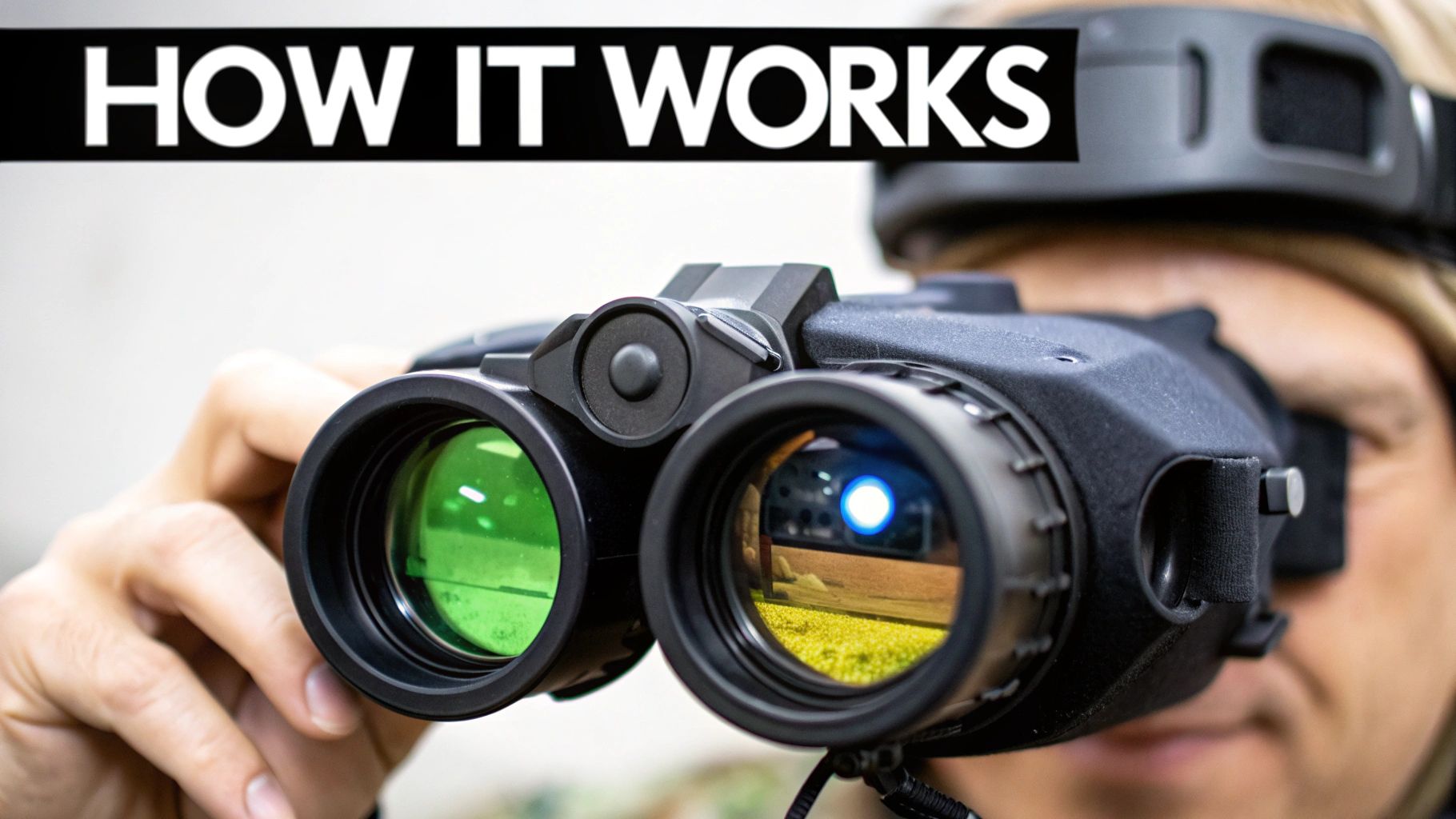
Classic analog (image intensifier) night vision works by collecting photons and multiplying them through a vacuum tube. Digital systems, however, take a completely different route. It's less like looking through an enhanced telescope and much more like using a supercharged version of the camera sensor in your phone, one specifically engineered for near-total darkness.
The whole process is a clean, lightning-fast conversion of light into data, and then data back into a visible picture. This digital foundation not only makes the technology more affordable but also unlocks a whole suite of capabilities that are simply impossible for analog devices to replicate.
The Core Components and Process
At the heart of every set of digital night vision goggles is a specialized sensor, usually a CMOS (Complementary Metal-Oxide-Semiconductor) sensor. This is the same basic technology found in today's high-end digital cameras, but it's been fine-tuned for extreme low-light sensitivity.
The journey from a dark scene to a clear image happens in a few distinct steps:
- Light Collection: First, the objective lens acts like a funnel, gathering every bit of available light—from the moon, stars, or an active infrared illuminator—and focusing it directly onto the sensor.
- Signal Conversion: The CMOS sensor then does its magic, converting the incoming light particles (photons) into an electrical signal. This creates a raw digital snapshot of the environment.
- Image Processing: An onboard processor instantly takes that raw signal and cleans it up. It actively boosts brightness, sharpens contrast, and scrubs out electronic "noise" to produce a crisp, usable image.
- Display: Finally, that polished image is beamed to a high-resolution micro-display (often an LCD or OLED screen) inside the eyepiece for you to see.
This entire conversion happens so fast it feels like you're looking through glass, delivering a near-real-time view. The final image is typically shown in a high-contrast black and white or the iconic "night vision green."
The Rise of Digital Systems
The demand for more capable and flexible night vision is fueling some serious market growth. The global Night Vision Goggles Market was valued at USD 10.28 billion in 2024 and is on track to hit an incredible USD 19.16 billion by 2032. That’s a compound annual growth rate (CAGR) of 8.1%, propelled by military modernization, law enforcement adoption, and a growing number of civilian hunters and tactical enthusiasts.
This trend underscores a major shift in the industry. Users want systems that can record video, stream footage, and survive exposure to bright light without damage—all things that digital technology excels at.
To see exactly how these systems measure up against other options, our detailed comparison of thermal imaging vs digital night vision vs analog night vision breaks down all the key differences.
Digital vs. Analog: A Head-to-Head Comparison
When you’re looking at night vision, the first major fork in the road is deciding between digital systems and traditional analog image intensifier tubes, like the Gen 2 and Gen 3 models we all know. It helps to think of it like choosing an engine. Analog is that classic, high-performance V8—it’s incredibly powerful and sensitive, a true specialist. Digital is more like a modern turbocharged engine—versatile, loaded with tech, and tough as nails.
Neither one is flat-out "better" than the other. It's about what you need it to do. Each technology brings its own set of strengths and weaknesses to the table, making one a better fit than the other depending on whether you're tracking game, clearing a building, or running a tactical operation.
Let's get past the spec sheets and dive into how these two technologies actually perform in the real world.
Image Clarity and Low-Light Performance
The biggest and most important difference between digital and analog night vision is how they see in the dark. Analog tubes, especially high-end Gen 3 units, are the undisputed kings of passive light amplification. They can scoop up the tiniest bits of ambient light—the faint glow from a sliver of a moon or distant stars—and multiply it by the thousands. The result is a stunningly clear, almost organic-looking image.
For a hunter trying to spot a deer on a moonless night, this raw sensitivity is everything. The image is crisp, with great contrast and almost zero lag, so you can catch that subtle flicker of an ear in the brush without having to pop on an IR illuminator and risk spooking your target.
Digital systems, on the other hand, use a CMOS sensor, much like a digital camera. While these sensors are getting better every year, they just can't match the light-gathering physics of a top-tier analog tube in near-total darkness. To compensate, digital units rely heavily on a built-in or add-on IR illuminator to paint the scene with infrared light that's invisible to the naked eye.
For a law enforcement officer methodically clearing a pitch-black warehouse, this isn't a problem at all. Firing up the IR illuminator is like flipping on an invisible flashlight, instantly bathing the area in bright, usable light. The digital image is sharp and full of detail, but it looks more like a high-quality black-and-white video feed than the classic green-and-black view from an analog tube.
To help you visualize these differences, here's a direct comparison of the core attributes of each technology.
Digital vs Analog (Gen 3) Night Vision Key Differences
| Feature | Digital Night Vision | Analog Night Vision (Gen 3) |
|---|---|---|
| Low-Light Performance | Good; heavily reliant on IR illumination in extreme darkness. | Exceptional; excels at passive light amplification. |
| Image Quality | Clear, high-resolution video feed. Often black & white. | Natural, high-contrast view. Classic green phosphor look. |
| Bright Light Durability | Completely immune. Can be used in daylight without damage. | Highly vulnerable. Can be permanently damaged by bright light. |
| Daytime Use | Yes, can function as a digital optic during the day. | No, cannot be used in daylight without a lens cap. |
| Features | Onboard recording, Wi-Fi streaming, digital zoom, color palettes. | Primarily focused on real-time viewing; very few extra features. |
| Power Consumption | Generally higher; requires more battery power. | Very efficient; long battery life. |
| Cost | Typically more affordable, offering high value. | Significantly more expensive, especially for high-spec tubes. |
As you can see, the right choice really hinges on what you value most: the raw, passive viewing performance of analog or the rugged, feature-rich versatility of digital.
Durability Against Bright Light
This is where digital technology lands a knockout blow. The heart of an analog system, the image intensifier tube, is incredibly sensitive to bright light. A sudden blast from a car's headlights, a security light, or a flashlight can permanently "burn" spots into the tube, leaving you with annoying black blemishes or, in a worst-case scenario, a dead unit that needs an expensive replacement.
Even though modern analog devices have protective features like auto-gating to help reduce the risk, the danger is always there.
Night vision digital goggles are completely immune to this type of damage. You could stare directly into a spotlight or even use them in broad daylight without harming the CMOS sensor one bit. This resilience is a game-changer for how you can operate.
- For Law Enforcement: An officer can move from a dark alley out onto a lit street and back again without ever worrying about frying their gear. They can even use their goggles during the day to peer into dark rooms or shadowy corners.
- For Tactical Users: In a chaotic situation where light conditions can change in a flash, that durability provides critical peace of mind and operational freedom.
This one factor alone often makes digital the smarter, more practical choice for anyone working in urban or mixed-lighting environments. To get a better feel for devices built for this kind of work, you can explore the features of digital binoculars for night vision and see how they are engineered to handle these exact scenarios.
Feature Set and Versatility
Beyond just letting you see in the dark, digital systems open up a world of possibilities that analog simply can't touch. Since the image starts as a digital signal, you can record it, stream it, and manipulate it in all sorts of useful ways.
These are some of the key features you'll only find on digital units:
- Onboard Recording: Capture high-definition video and photos directly to an SD card. This is perfect for gathering evidence, conducting after-action reviews, or just saving a memory of a successful hunt.
- Wi-Fi Streaming: Send a live video feed from your device to a teammate's smartphone or a command post tablet, giving everyone on your team better situational awareness.
- Digital Zoom: Magnify the image to get a better look at something in the distance—a feature completely absent from standard 1x analog goggles.
- Color Palettes: Some advanced digital units can even render a full-color image in low light. Many also offer different display palettes like black-and-white, green, or amber to help reduce eye strain during long sessions.
These capabilities turn the device from a simple viewing tool into a full-fledged information-gathering and sharing platform. For a police department, being able to record an operation for evidence is huge. For a hunting party, streaming a view to a buddy can help coordinate a stalk. Analog just isn’t built for this; its singular purpose is to give you the best possible live image, and nothing else.
Understanding the Specs That Actually Matter
Diving into the world of night vision digital goggles can feel like trying to crack a secret code. Product pages are littered with technical specs and big numbers that sound impressive but don't always translate to real-world performance. To make a smart buy, you've got to cut through the marketing noise and zero in on the specs that actually make a difference when you're out in the field.
Let's break down the four most important things to look at: sensor resolution, frame rate, detection range, and the onboard IR illuminator. Once you get a handle on these, you'll be able to confidently size up any unit and pick the one that truly fits your needs, whether you're on patrol, tracking game, or running surveillance.
Sensor Resolution Is Not Just About Megapixels
When we hear "resolution," our minds immediately jump to the megapixel wars in the smartphone world, where more is always better. That logic doesn't quite hold up for digital night vision. Here, the sensor's main job is to gobble up every last photon of available light. Sometimes, a lower-resolution sensor with physically larger pixels can actually do that better, resulting in a cleaner, less "noisy" image when it's pitch black.
So, instead of getting hung up on the pixel count (like 1920×1080), focus on the sensor's physical size and the manufacturer's track record for low-light performance. A well-built 1080p sensor will consistently outperform a cheap 4K sensor that gives you a grainy, unusable mess when the lights go out.
What to Look For: Don't just read the spec sheet. Watch product reviews and demo videos to judge the image clarity for yourself. A crisp, high-contrast picture from a quality Full HD (1080p) sensor is worth far more than a fuzzy 4K image.
Frame Rate For Smooth Motion
Frame rate, measured in frames per second (FPS), is all about how smoothly you see movement. Think of it like a flipbook—the more pages you flip per second, the smoother the animation looks. The exact same thing happens with your night vision feed.
- 30 FPS: This is the bare minimum you should accept. It’s fine for general observation and moving slowly, but that's about it.
- 60 FPS: This is what you should be aiming for, especially for tactical use. A higher frame rate cuts down on motion blur, making it much easier to track a fast-moving target or navigate terrain quickly without getting disoriented.
A low frame rate makes moving objects look choppy and smeared, which can be a serious handicap in a high-stakes situation. For anyone in law enforcement or a serious hunter, a device that holds a steady 60 FPS is a non-negotiable performance standard.
The chart below shows how these digital systems, which produce video feeds, fundamentally differ from their analog cousins.
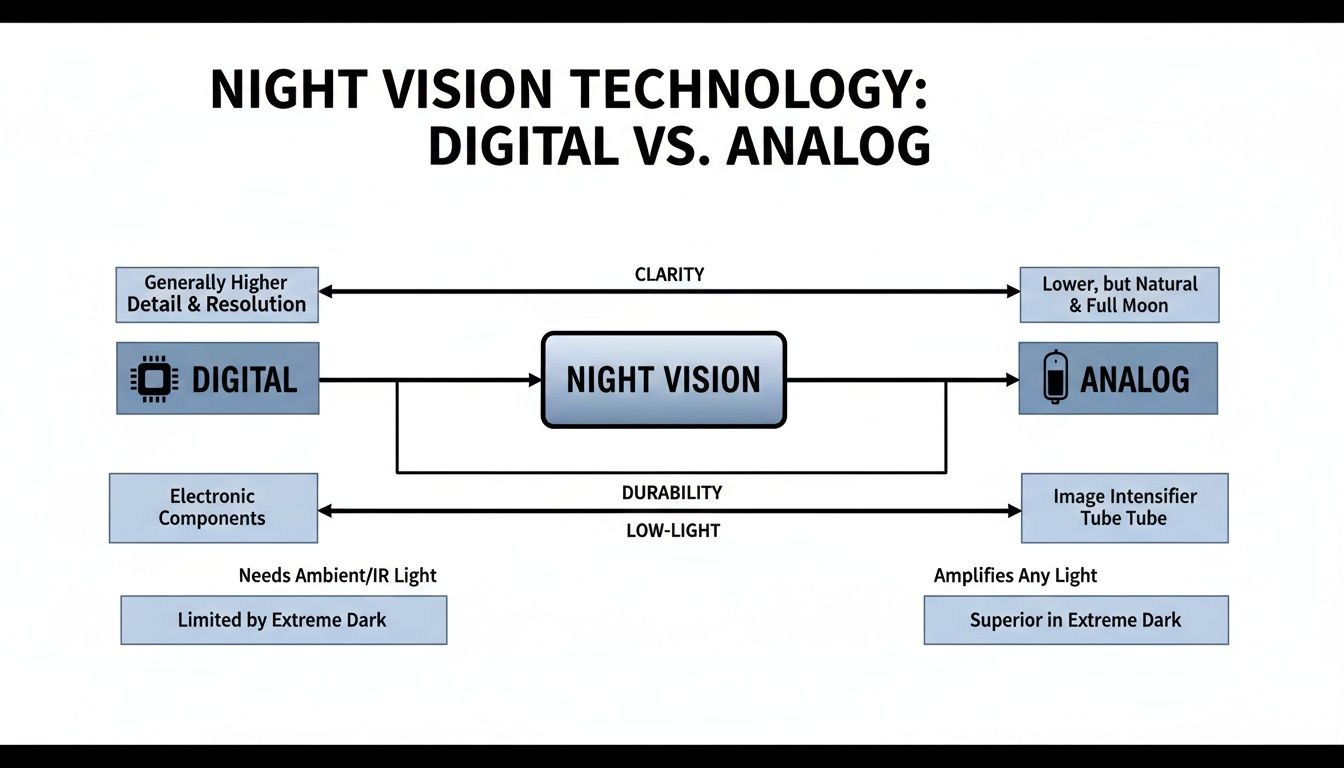
As you can see, digital tech really leans into image processing to deliver clarity and durability, while analog's strength has always been its raw sensitivity in the darkest conditions.
Detection Range: Separating Fact from Fiction
Manufacturers love to splash huge numbers on the box, claiming you can see targets at 300 or even 400 yards. It’s crucial to know what that "detection range" number really means. It's the absolute maximum distance where you might notice a man-sized blob or shape—not necessarily identify what it is.
The numbers that really matter for practical use are:
- Recognition Range: How far out can you tell that shape is a person and not a deer?
- Identification Range: How far out can you see key details, like if that person is carrying a rifle or a shovel?
Always take the advertised detection range with a grain of salt; it’s a best-case scenario. A unit with a 300-yard detection range might only give you a solid identification range of 75-100 yards. That's the number that actually matters for most tactical and hunting applications.
The Power of the IR Illuminator
In total darkness, the built-in infrared (IR) illuminator is what makes a digital system work. Think of it as a powerful, invisible flashlight. It floods the area with IR light that the sensor can see perfectly, but is completely invisible to human and most animal eyes. The quality of this little component can make or break the entire device.
The global market for these systems is booming, projected to jump from USD 3.46 billion in 2025 to USD 4.25 billion by 2029. This isn't surprising when you see how heavily modern militaries are investing in digital vision. In fact, North America accounted for over 35% of the market in 2024, driven by defense spending. You can read the full research on the infrared night vision market to see just how fast this technology is moving.
What you want is a powerful and adjustable illuminator. The ability to focus the beam—from a wide flood for scanning a field to a tight spot for punching down a long, dark alley—is what gives you tactical flexibility. A high-quality illuminator is the single most important factor for pushing out the effective range of your digital night vision.
Going Beyond Just Seeing: Advanced Digital Features
Today's night vision digital goggles are far more than just a tool for seeing in the dark; they've become full-blown information hubs. While a traditional analog tube is a master of its one craft—amplifying light—digital technology unlocks a whole world of features that turn your goggle into a complete situational awareness system. This gives you a tactical edge that analog simply can't offer.
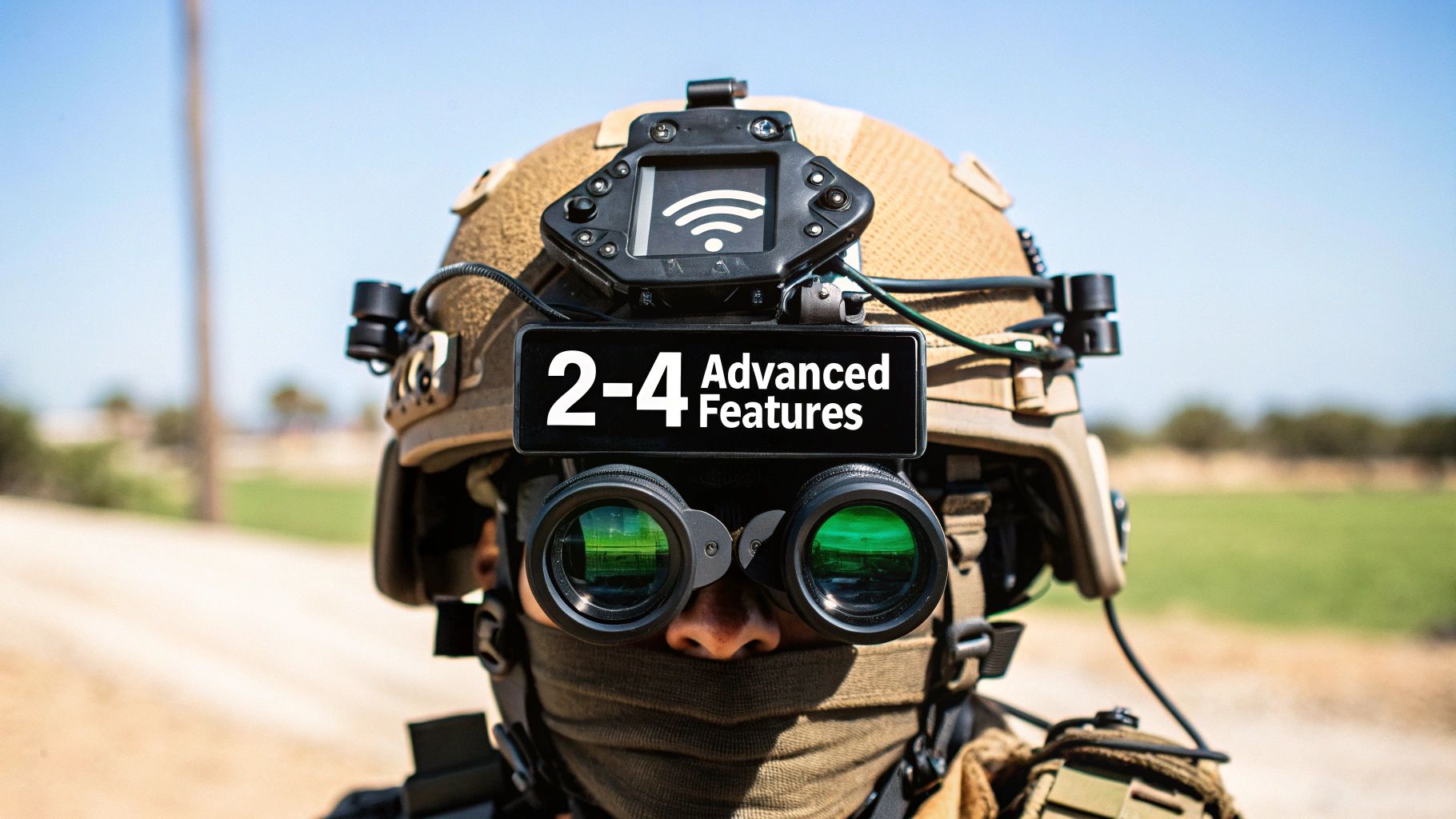
This leap is possible because the image you're seeing is, at its core, just data. As soon as light hits the sensor and becomes a digital signal, it can be recorded, shared, and manipulated in all sorts of ways. For operators in law enforcement, hunting, and tactical fields, this means having unprecedented control, turning simple observation into actionable intelligence. Let's dig into some of the most impactful features you'll find.
Onboard Recording for Review and Evidence
One of the biggest game-changers with digital night vision is the built-in ability to record high-definition video and snap photos, saving them directly to a memory card. This isn't just a novelty; it provides huge practical value for professionals and hobbyists alike.
Think of it as a dashcam for your face. Every critical moment can be captured with the push of a button, creating an undeniable record.
- For Law Enforcement: Officers can document nighttime operations with crystal-clear video, which is invaluable for incident reports, court cases, and general accountability.
- For Tactical Teams: The after-action review (AAR) becomes exponentially more valuable when you can replay a mission from a true first-person perspective. It’s the ultimate tool for seeing what went right and what needs work.
- For Hunters: Recording that perfect shot not only saves the memory but also lets you go back and analyze animal behavior and shot placement, making you better for the next hunt.
Honestly, this one feature alone is often enough to justify the switch to a digital system. It provides a tangible benefit that directly improves training, documentation, and overall success.
Live Streaming and Connectivity
The digital brain inside these goggles also opens the door to connectivity, usually through built-in Wi-Fi. This lets you stream the live video feed from the goggle directly to a smartphone, tablet, or a monitor back at a command post. The tactical implications here are massive—it's like giving your entire team a shared set of eyes.
Picture a SWAT team making an entry. The point man's view is streamed directly to the team leader posted outside, who can now provide real-time guidance and coordinate the team's movements with a complete picture of what's happening. Or for a hunting duo, a spotter can share their view with the shooter, guiding them into the perfect position for the shot without a word.
This shared perspective is a huge boost to team coordination and safety. It turns a group of individuals into a connected network where information flows instantly, allowing for smarter, faster decisions.
Integrated Navigation and Data Overlays
Modern night vision digital goggles are also pulling in other critical data streams and displaying them right in your field of view. It essentially transforms your screen into a heads-up display (HUD), much like what you'd see in a fighter jet cockpit. Some of the key integrations include:
- GPS and Compass: With a built-in GPS and digital compass, your exact location, heading, and waypoints can be overlaid on the image. This is a lifesaver for navigating tough terrain at night, as you no longer have to look down and away from your surroundings to check a separate GPS unit.
- Rangefinder: Some high-end models even include a laser rangefinder, giving you an instant and accurate distance to your target without needing to carry another piece of gear.
By consolidating all this information into a single sight picture, these overlays drastically reduce your mental workload. You spend less time fumbling with different devices and more time focused on the mission itself.
Building Out Your Helmet Rig
Getting your hands on a quality pair of night vision digital goggles is really just the starting point. The real magic happens when you build a stable, comfortable, and functional rig that makes the device a true extension of your own vision, not just another piece of gear to carry.
The foundation for any serious setup is a solid helmet and mount. This is what turns your goggles from a handheld gadget into a hands-free system, and getting it right is everything. A good helmet rig isn't just about holding the device in place; it’s about perfect eye alignment, balancing the weight to save your neck, and giving you a stable platform for all your other essential tools.
Getting the Mount Right
The single most important connection in your entire setup is the one between your helmet and your night vision device. This isn't one piece, but two: the shroud on the helmet and the mount arm that connects to your goggles.
-
The Shroud: This is the bracket bolted to the front of your helmet. Thankfully, most modern tactical helmets come with a good one pre-installed, usually a standard pattern like a Wilcox L4 or a Norotos Universal. A high-quality shroud made from machined aluminum is what you want for a rock-solid anchor.
-
The Mount Arm: This is the piece that clips into the shroud and actually holds your goggles. It’s what gives you all the crucial adjustments—up and down, forward and back, and tilt—to get the eyepiece perfectly lined up with your eye. A quality mount should also have a "breakaway" feature, which lets it pop off under heavy impact to prevent a nasty neck injury.
Proper alignment is non-negotiable. If your goggle is even slightly off, you're in for a world of eye strain, headaches, and a distorted view. To really dig into the details, check out our complete guide to choosing a helmet night vision mount for a deep dive on the best options out there.
Adding Mission-Essential Accessories
Once your goggles are mounted and aligned, it's time to add the accessories that bring the whole system to life. For anyone running night vision digital goggles, this almost always means adding supplementary infrared devices.
An IR laser is absolutely essential for aiming a weapon at night. You can't use your regular sights, so the laser paints a target with a beam that’s invisible to the naked eye but shows up as a bright, clear dot through your goggles. It makes for incredibly fast and intuitive aiming.
A supplementary IR illuminator is like strapping an invisible spotlight to your kit. Most digital units have a small built-in illuminator, but a powerful, weapon-mounted one can punch through deep shadows and dramatically boost your identification range.
There's a reason these integrated systems are becoming so common. The overall Night Vision Device Market is on a serious growth trajectory, expected to jump from USD 8.57 billion in 2025 to USD 12.91 billion by 2030. Goggles have been leading the charge, making up 33.26% of the market back in 2019. This boom is fueled by military and law enforcement agencies needing clear viewing ranges of 100-400 feet for everything from patrols to hunts. You can see the trends shaping the night vision market for yourself to get a sense of where this tech is headed.
Ultimately, building an effective helmet rig is an art. It's about more than just bolting on expensive gear; it's about carefully choosing components that work in harmony to make you more effective when the lights go out.
Protecting Your Investment with Proper Care
Dropping a significant amount of cash on a set of night vision digital goggles is a serious commitment. Think of it like any other piece of high-performance gear—it needs the right care to keep it running reliably for years to come. This isn't just about making your equipment last; it's about knowing it will perform at its peak when you absolutely need it, whether that's on a critical mission or deep in the backcountry.
The good news is that digital systems are built tougher than their analog cousins. Still, you're dealing with sensitive optics and electronics that demand a bit of attention. A few simple, consistent habits are all it takes to protect your investment.
Essential Maintenance Practices
Keeping your digital goggles in top shape is pretty straightforward. You don't have to stress about permanent screen burn-in like with old-school analog tubes, but the lenses and internal components still need to be kept clean and safe for a crystal-clear view.
Your maintenance routine really boils down to three main things:
- Lens Care: The objective and eyepiece lenses are your windows to the dark. Always—and I mean always—use a dedicated lens cloth or a cleaning pen. Wiping them with your shirt or a paper towel is a surefire way to scratch the anti-reflective coatings, which will permanently degrade your image quality.
- Battery Management: If you're putting your goggles away for a while, take the batteries out. It’s a simple step that prevents leakage, which can spew corrosive acid all over the internal electronics and completely ruin your device.
- Safe Storage: When you’re done for the night, put the unit back in its hard, padded case. This is its best defense against drops, dust, and moisture, all of which can damage the sensitive CMOS sensor and micro-display inside.
A solid warranty is your ultimate safety net. Reputable U.S.-based retailers like Superior Tactical LLC are known for offering extensive coverage—sometimes up to 10 years on high-end systems. They also tend to have in-house repair services, giving you real peace of mind that your gear is covered.
Navigating Legal and Regulatory Rules
Finally, let's talk about the rules. It's incredibly important to understand the legal landscape that governs night vision technology. Most high-performance devices fall under the International Traffic in Arms Regulations (ITAR), which strictly controls the export of defense-related tech.
What does that mean for you? It means you can't just take certain night vision units outside of the United States without getting the proper government licenses first. Sticking with a reputable, U.S.-based company is the smartest move you can make. It ensures you're buying a compliant device and getting the right guidance. Plus, it guarantees you have access to legitimate customer support and repair services, something you likely won't get if you buy from a shady overseas seller. It’s about protecting yourself as much as your investment.
Common Questions About Night Vision Digital Goggles
Even after digging into the tech, specs, and features, a few questions always seem to pop up. Getting straight answers to these is the last piece of the puzzle before you can confidently decide which digital setup is right for you. Let's tackle some of the most common ones I hear.
Can You Use Digital Night Vision During the Day?
Absolutely. This is probably one of the biggest wins for digital night vision over traditional analog tubes. The CMOS sensor that drives a digital goggle isn't bothered by bright light, so you can't accidentally burn it out like a Gen 2 or Gen 3 tube.
In fact, most digital units work perfectly well as a standard optic during daylight hours, often showing you a full-color image. This dual-use capability is a huge advantage, making them incredibly versatile for anyone whose work or hunt starts before sunset and ends after sunrise.
How Much Magnification Do I Really Need?
This is a critical point. For any situation where you’ll be moving—walking, driving, or navigating terrain—you need 1x magnification. Period. Any magnification will mess with your depth perception, making you feel disoriented and even nauseous. True goggles are built for situational awareness, not for spotting things a mile away.
Now, many digital devices do come with a digital zoom feature. Think of this as a tool to be used only when you’re stationary. If you're a hunter in a blind or running surveillance from a fixed position, being able to zoom in for a better look is a fantastic benefit. But for moving around, always keep it on 1x.
Are Digital Goggles Heavy or Uncomfortable?
Weight is always a fair question when you’re talking about strapping gear to your head. Digital goggles do tend to be a bit heavier than top-tier analog units because they have to house processors, screens, and batteries. That said, manufacturers are making huge strides with lightweight polymers and more compact electronics.
The secret to comfort isn't just about the raw weight of the goggles. It’s all about a balanced helmet setup. A good counterweight on the back of your helmet is non-negotiable—it makes a night-and-day difference in preventing neck fatigue over long hours.
What Is the Average Battery Life I Can Expect?
Battery life with night vision digital goggles is all over the map and really depends on the model and what you're doing with it. If you’re recording video, streaming to a device, or blasting the built-in IR illuminator on full power, you're going to burn through batteries much quicker.
As a general rule, you can probably count on 4 to 8 hours of continuous use from internal batteries, whether they're rechargeable or common disposables like CR123s. For anything longer, most serious users run an external battery pack. These can easily push your run time past 12 hours, ensuring your vision doesn't die at a critical moment.
At Superior Tactical LLC, we provide the mission-ready gear and expert guidance you need to operate effectively in any lighting condition. Explore our full range of night vision and tactical optics to find the perfect solution for your needs.
