A Guide to Night Owl Optic Night Vision Systems
Welcome. If you've ever wondered how military operators, dedicated hunters, and security professionals seem to own the night, you're in the right place. This is your practical guide to understanding Night Owl Optics and the technology that turns total darkness into a clear, usable environment.
Unveiling The Power of Night Owl Optics
We're going to cut through the noise and technical jargon. My goal here is to give you a real-world understanding of night vision, from the basic science that makes it work to the specific features that matter in the field. This isn't just about specs on a page; it's about giving you the knowledge to operate effectively when the sun goes down.
And there's never been a better time to get familiar with this gear. The night vision market is growing fast, valued at USD 12.56 billion in 2025 and projected to hit an incredible USD 24.48 billion by 2035. A massive 58% of that demand comes from defense contracts, which tells you just how critical this technology is for modern operations. You can dig deeper into these numbers with this Global Growth Insights market report.
What You Will Learn
We’ll build your knowledge from the ground up, focusing on what you actually need to know to choose the right device. By the time you're done here, you’ll be able to make a confident, informed decision.
By the end of this guide, you will be able to:
- Grasp the core principles that give you a tactical advantage in the dark.
- Tell the difference between night vision generations and know which one suits your mission.
- Pinpoint the key features that make Night Owl a go-to choice for so many users.
- Select and set up the perfect system for your professional or recreational needs.
Think of a Night Owl Optic device not just as a tool, but as a key that unlocks the 50% of your environment that disappears after sunset. It provides the clarity and confidence needed to navigate, observe, and act decisively in complete darkness.
So let’s pull back the curtain and get started. It’s time to see what makes this technology an essential piece of any serious kit.
How Night Vision Turns Night Into Day
Ever wondered how you can see a crystal-clear image through a Night Owl Optic night vision device on a moonless night? It's not magic, but it's close. The technology doesn't create light out of thin air; it’s a master of amplification.
At the heart of it all is a component called an image intensifier tube. Think of it as a light-gathering engine. Its entire job is to take the faintest traces of ambient light—from stars, the moon, or even distant city glow—and multiply its power thousands of times until it’s bright enough for your eye to see.
It all starts when the objective lens pulls in whatever little light is available. This light is composed of tiny particles called photons. When these photons enter the device, they hit a special surface called a photocathode. This is the first critical step: the photocathode converts the light energy from the photons into electrical energy, releasing a stream of electrons.
The Amplification Engine
Once those electrons are free, they are accelerated toward the component that truly defines modern night vision: the microchannel plate (MCP). This isn't just a simple part; it's an incredibly sophisticated, hair-thin glass disc packed with millions of microscopic channels.
As the initial electrons enter these channels, they start a chain reaction. They bounce off the channel walls, and each impact knocks loose a flood of new electrons. This happens over and over, multiplying the original number of electrons by tens of thousands.
It's like a single whisper entering a vast chamber and being amplified into a powerful shout. This incredible multiplication is what transforms a barely perceptible scene into a usable image, forming the heart of true image intensification technology.
Finally, this powerful cascade of electrons shoots out of the MCP and smacks into a phosphor screen. The screen is coated with phosphors that light up when struck by electrons, instantly creating the bright, green-hued image we all recognize. The human eye is most sensitive to the green part of the spectrum, which is why that color was chosen—it delivers a sharp, detailed picture with minimal eye strain during long-term use.
This diagram breaks down that entire journey from faint light to a clear, intensified image.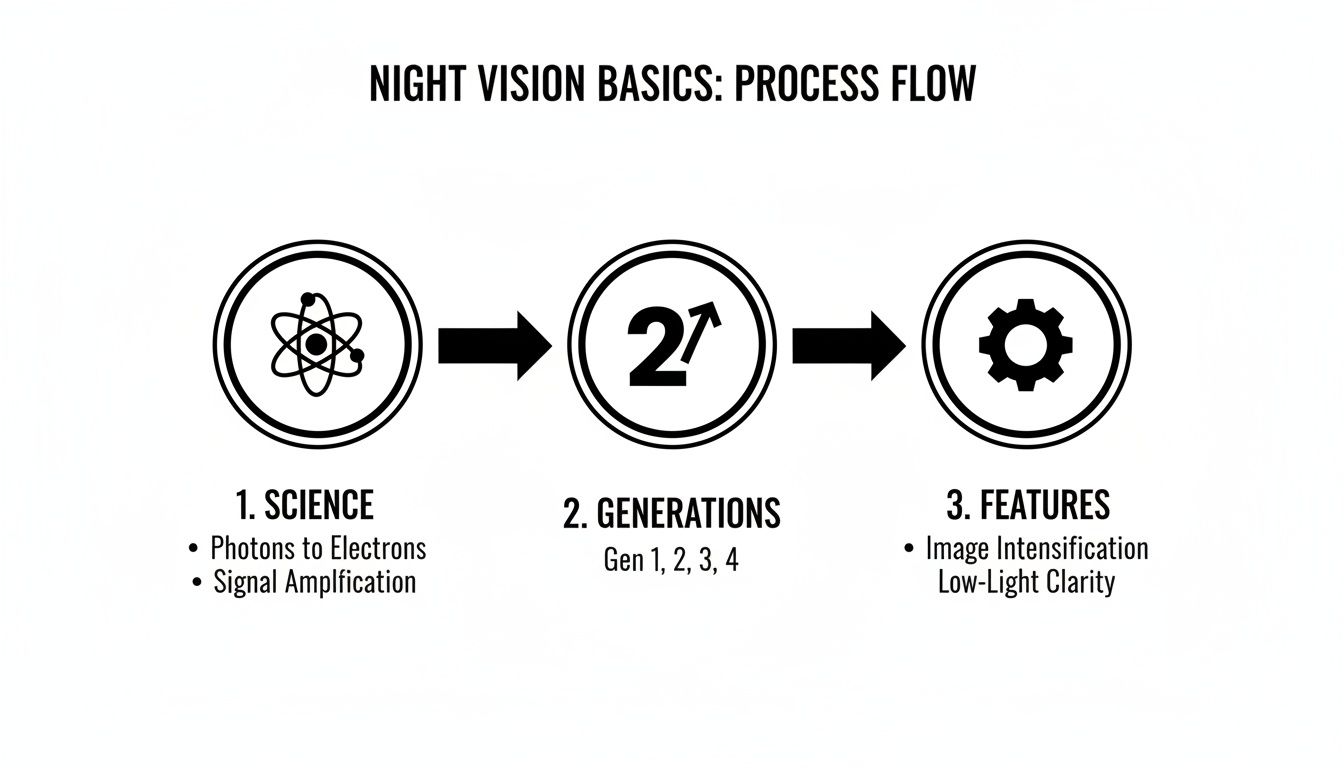
As you can see, the whole process is about amplifying what’s already there, not inventing light.
Image Intensification vs. Digital
It's really important to know the difference between traditional image intensification and the digital night vision systems that have become more common. They both let you see in the dark, but they get there in completely different ways.
Image Intensification (I²): This is the analog technology we just covered, found in classic Night Owl Optic night vision units like Gen 2 and Gen 3 models. Its strength is its incredible performance in extremely low-light environments. Because it directly amplifies light, you get a fluid, natural-looking image with zero lag, which is critical for moving, navigating, or tracking a target.
Digital Night Vision: This works more like a camcorder. It uses a sensitive digital sensor (usually a CMOS sensor) to capture an image, which is then processed by an internal computer and shown on a tiny display in the eyepiece. Digital units are tough and can be used in daylight without getting damaged, but they often have a slight video lag and can't compete with high-end I² in near-total darkness unless you blast the area with a powerful IR illuminator.
If you want to go even deeper into the science behind it all, you can learn more about how night vision works in our dedicated guide.
For professionals who demand the absolute best performance when light is scarce, true image intensification is still the gold standard. It provides the clarity and reliability needed for tactical operations, serious hunting, and advanced surveillance, giving you a decisive edge when the sun goes down.
Exploring The Night Owl Optics Model Lineup
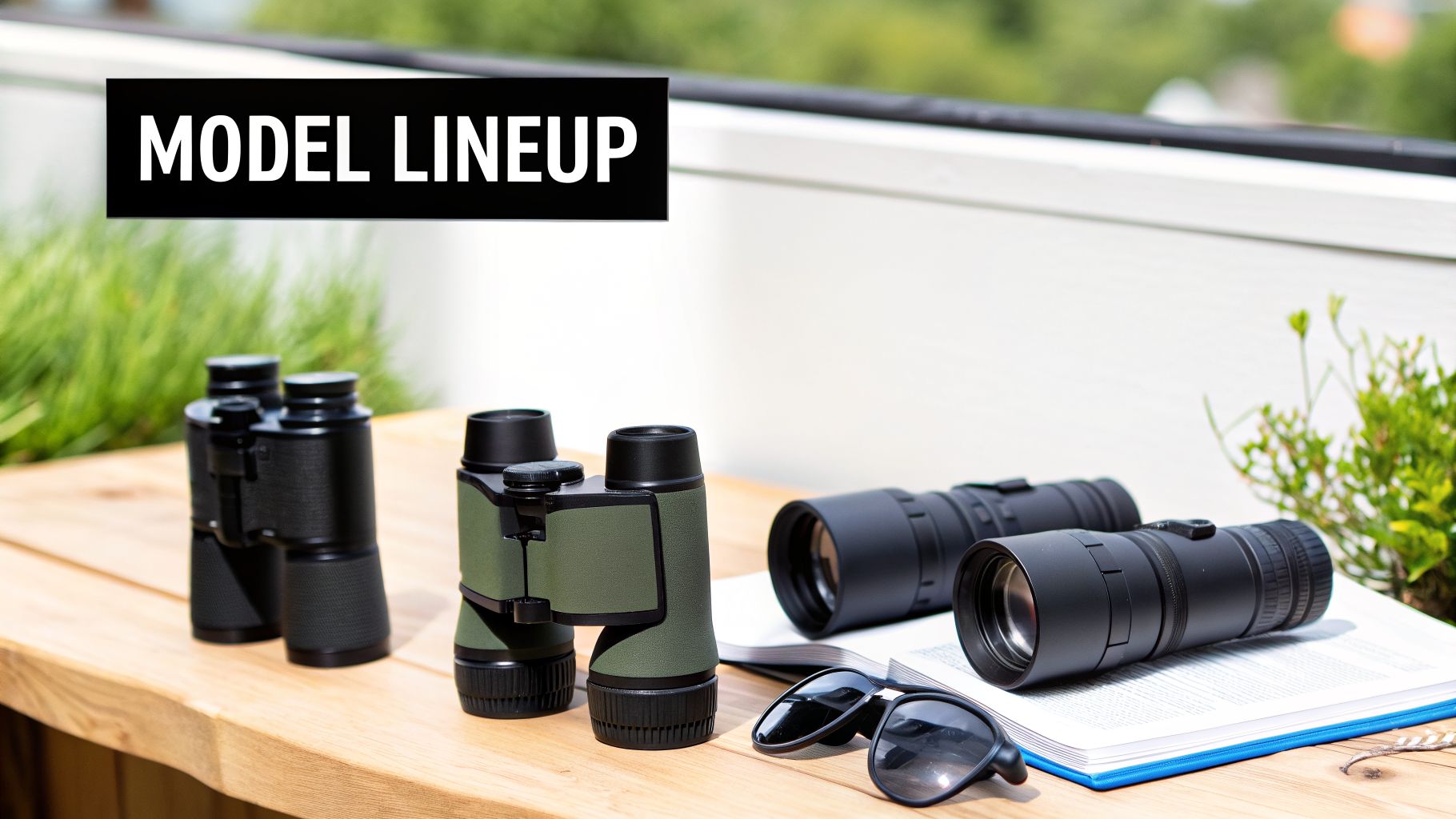
Night Owl Optics has built a solid reputation by offering a night vision device for just about everyone, from a homeowner curious about backyard critters to a security professional securing a perimeter. Getting to know their product lineup is the best way to match the right tool to your mission and budget.
Let's walk through their main offerings. The entire lineup is built around three core types of devices: monoculars, binoculars, and rifle scopes. Each one is designed with a specific job in mind, offering a different balance of portability, depth perception, and application.
Whether you need a compact scanner for your go-bag or a dedicated scope for after-dark predator control, the Night Owl Optic night vision catalog has you covered. The trick is to look beyond the marketing and focus on the specs that will actually make a difference for you out in the field.
Compact And Versatile Monoculars
Think of Night Owl's monoculars as the jack-of-all-trades in their lineup. They're popular for a reason: they are small, lightweight, and incredibly versatile. A monocular is basically half a binocular, so it's used with one eye. This simple design is a huge advantage when you need to keep one eye free to maintain your natural night vision and situational awareness.
Imagine a security guard scanning a dark parking garage or a hunter glassing a field line at last light. A monocular lets them quickly see what's out there without committing both eyes. This keeps one eye adapted to the dark, which is a big deal. Their compact size also makes them perfect for simple handheld use or for helmet mounting when you need your hands free.
When you're shopping for a Night Owl monocular, keep an eye on these features:
- Magnification: Most are low-power (1x to 3x) to give you a nice, wide field of view for scanning. More magnification narrows that view but helps you identify things farther away.
- IR Illuminator: A built-in infrared (IR) light is non-negotiable for true, pitch-black darkness. The illuminator's power dictates how far you can effectively see when there’s no ambient light to amplify.
- Mounting Capability: Check if the model is compatible with head or helmet mounts. This is what turns a simple handheld scanner into a serious hands-free system for navigation or surveillance.
Binoculars For Enhanced Depth Perception
When you need to spend a lot of time observing or need to judge distances accurately, Night Owl's night vision binoculars are the way to go. By feeding an image to both eyes, binoculars give you true stereoscopic vision. This creates a 3D view with excellent depth perception—something a monocular just can't do.
That stereo vision is a game-changer for navigating rough terrain in the dark, driving a vehicle off-road, or tracking a moving target. It also dramatically reduces eye strain, making binoculars far more comfortable for long stakeouts or observation posts. They are bigger and heavier than monoculars, but for many, the performance trade-off is well worth it.
The most significant advantage of a binocular system is its ability to provide true depth perception. This allows you to accurately judge distances and navigate complex environments with confidence, a critical factor for both safety and tactical effectiveness.
So, while you're adding some bulk to your kit, the comfort and spatial awareness you gain from a good set of binos are often a deciding factor for stationary roles.
Dedicated Night Vision Rifle Scopes
Night Owl's dedicated night vision rifle scopes are purpose-built for one thing: putting rounds on target in the dark. These aren't just monoculars rigged behind a day scope; they are fully integrated units with built-in reticles, turret adjustments, and rugged housings designed to handle firearm recoil. They are the definitive tool for nocturnal hunters, hog controllers, and law enforcement marksmen.
These scopes are a massive segment of the optics industry. To give you an idea, the global night vision scope market was valued at USD 8.69 billion in 2026 and is projected to more than double, hitting USD 16.94 billion by 2032. That explosion in growth, highlighted in a comprehensive market report from ResearchAndMarkets.com, shows just how essential these tools are becoming.
When you're choosing a Night Owl Optic night vision scope, you need to zero in on these specs:
- Magnification and Range: You'll need enough magnification for positive target identification at your expected engagement distances.
- Reticle Type: Scopes come with different reticles, from simple crosshairs to more advanced Ballistic Drop Compensating (BDC) designs for long-range shots.
- Recoil Rating: This is non-negotiable. Make sure the scope is rated to handle your rifle's caliber, or you'll quickly destroy its sensitive electronics.
To help you visualize the differences, here's a quick breakdown of how Night Owl's product categories serve different users.
Night Owl Optics Model Comparison
| Model Category | Example Model | Primary Use | Key Feature |
|---|---|---|---|
| Monoculars | NOXM50 | General observation, navigation | Portability and hands-free mounting |
| Binoculars | NOB5X | Extended surveillance, terrain navigation | True depth perception, reduced eye strain |
| Rifle Scopes | NIGHTSHOT | Nocturnal hunting, tactical use | Integrated reticle, recoil-rated |
By understanding these core categories and what makes each one tick, you can confidently choose the Night Owl device that truly fits your mission.
Comparing Night Vision Generations
When you're looking at any night vision device, including a Night Owl Optic night vision system, the "generation" is the single most important spec. It’s not a marketing gimmick—it’s a direct reflection of the technology inside, telling you everything you need to know about its performance, clarity, and cost. Getting this right is the key to picking the right tool for the job.
It helps to think of it like car engines. Sure, a basic four-cylinder will get you from A to B, but it’s never going to perform like a finely-tuned V8. Night vision generations work the same way, with each step up representing a massive leap in what the device can do. Let's break down what that means in the real world.
Gen 1: The Accessible Entry Point
Generation 1 is where modern night vision got its start, and it’s still the most common tech you’ll find in affordable, consumer-grade gear. It was revolutionary for its time, but by today's standards, the performance is pretty limited.
Gen 1 tubes work by amplifying existing light, but they aren't very efficient. Because of this, they almost always need a built-in infrared (IR) illuminator to see anything in truly dark conditions. This IR beam is invisible to our eyes but acts like a dedicated flashlight for the night vision unit.
You'll notice a few distinct traits with Gen 1:
- Heavy Reliance on IR: Without an active IR illuminator, a Gen 1 device is going to struggle on a cloudy, moonless night.
- Image Distortion: A classic sign of Gen 1 is the "fish-eye" effect. The center of the image might be clear, but the view gets warped and blurry around the edges.
- Shorter Lifespan: The intensifier tubes in Gen 1 units typically have a shorter operational life, often rated for around 1,500 hours of use.
Even with these trade-offs, a Gen 1 device is a fantastic, budget-friendly way to get your feet wet with night vision for casual spotting or keeping an eye on your property.
Gen 2: The Major Performance Leap
Generation 2 was a massive jump forward in technology. The key innovation here was adding a microchannel plate (MCP)—that tiny glass disc we talked about earlier. Think of it as a huge signal booster, multiplying every electron it receives thousands of times.
The difference is night and day. You get a much brighter, clearer, and sharper image with way less of the distortion you see in Gen 1. Gen 2 devices can operate in much lower light, often without needing an IR illuminator unless you’re in total darkness. This is the point where Night Owl Optic night vision systems become serious tools for more demanding situations.
A Gen 2 device delivers a much cleaner picture with a better signal-to-noise ratio. That means you see more of your target and less of the "snow" or static that plagues lower-end units, making it solid enough for navigation and target identification.
This generation hits the sweet spot for a lot of people. It gives you a fantastic balance of performance and cost, offering a huge upgrade from Gen 1 without the premium price of Gen 3.
Gen 3: The Professional Standard
Generation 3 is what the pros use. It's the current gold standard for military, law enforcement, and serious hunters. The main difference is the photocathode, which is made from gallium arsenide. This material is incredibly sensitive and efficient at converting light particles (photons) into an electrical signal (electrons).
What that means for you is the best possible performance in near-total darkness. Gen 3 gives you the cleanest, brightest, and sharpest images possible, along with an outstanding operational lifespan that often exceeds 10,000 hours.
This is the kind of performance you need when your life might depend on it. That's why the defense and security sectors are the main customers for this tech. In fact, of the global night vision market—expected to hit USD 13.43 billion by 2026—military applications account for 58% and surveillance another 32%. If you're interested in market trends, you can discover more insights on the night vision market from Persistence Market Research.
While Gen 3 offers unmatched performance, it comes with a high price tag and is often subject to stricter sales regulations. For a deeper look at how these technologies compare, check out our guide on night vision generations and their specific uses. Ultimately, choosing the right one is all about matching your budget to what you truly need to accomplish in the dark.
Building Your Ideal Night Vision Setup
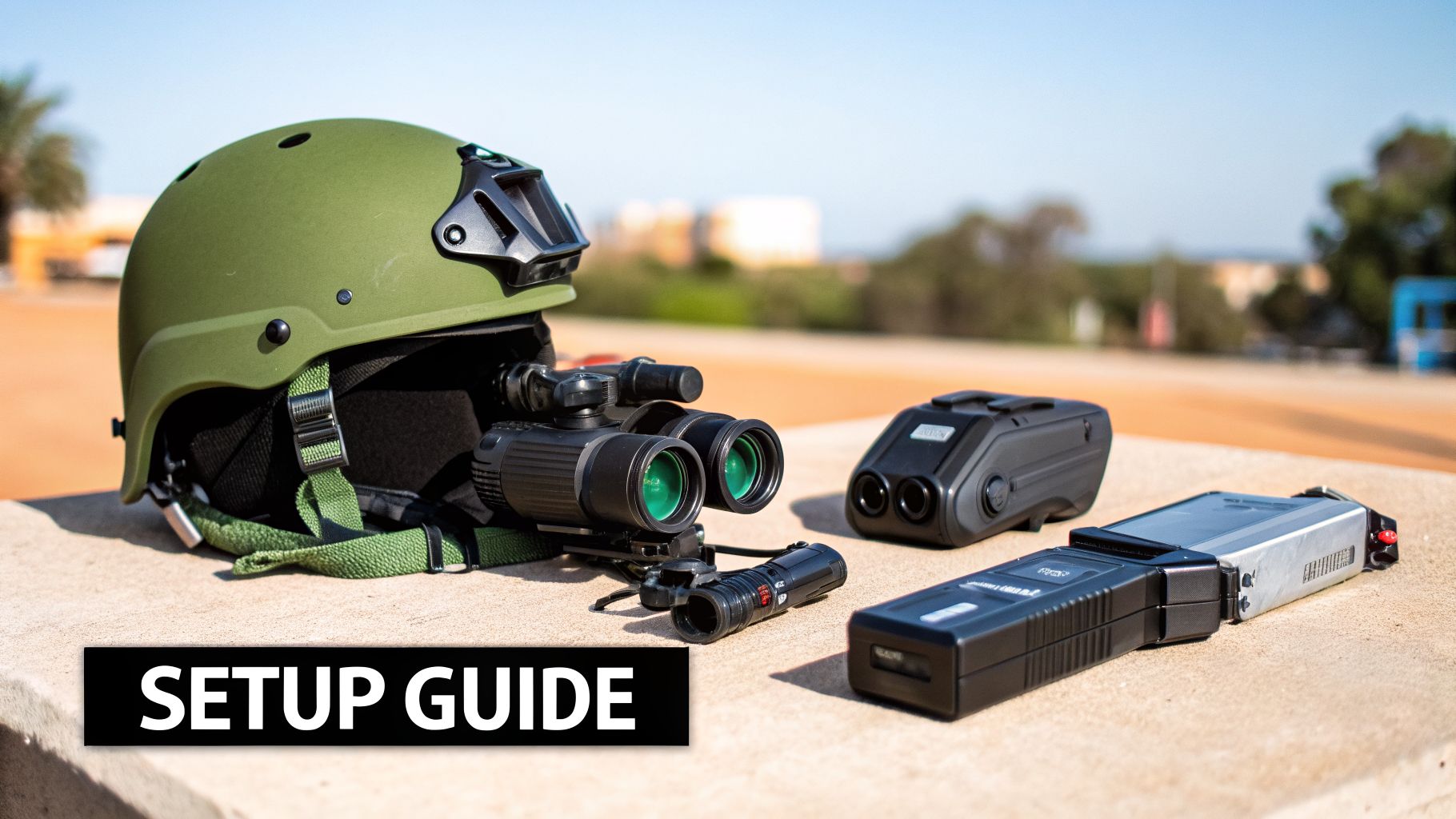
Picking out a great Night Owl Optic night vision device is a fantastic start, but it's really just the beginning. Even the best optic in the world is dead weight if it's not mounted properly or is awkward to use when you need it most. The real magic happens when you build a complete system that turns a cool piece of tech into a genuine extension of your own senses.
Your ideal loadout depends entirely on the mission. A law enforcement officer about to clear a dark building has totally different needs from a hunter settled in for a long night in a deer stand. This isn't about bolting on every accessory you can find; it's about smart integration. The goal is a stable, comfortable, and reliable setup that feels like it’s working with you, not getting in your way.
This is where things like mounts, helmets, and support tools like IR lasers really come into play. A cheap, wobbly mount can make a top-tier monocular completely useless, while a well-balanced helmet rig makes hours of wear feel like minutes. Let’s break down how to build some optimized kits for a few common applications.
Law Enforcement And Tactical Operations
For police officers and tactical teams, the mission demands two things above all else: hands-free operation and the ability to engage threats instantly. The standard for this work is a helmet-mounted monocular, typically a Night Owl Optic Gen 2 or Gen 3 unit.
By mounting the monocular on a ballistic or bump helmet, an operator keeps both hands free to run their weapon, open doors, or handle a suspect. This setup also lets you keep one eye on the real world for situational awareness while the other scans the darkness through the optic.
The next layer is adding an infrared (IR) laser and illuminator to the primary rifle.
- IR Laser: This projects a aiming dot that’s only visible through night vision. It allows for incredibly fast and accurate aiming without having to shoulder the rifle and line up traditional sights.
- IR Illuminator: Think of this as an invisible flashlight. It floods an area with infrared light, dramatically brightening the scene through your optic for positive target ID in pitch-black conditions.
This combination is a game-changer. An operator can move through a structure, scan with their head-mounted NVD, and if a threat appears, they can engage immediately just by shouldering their rifle and activating the laser.
Recommended Hunter Loadout
A hunter’s world is all about spotting game, identifying it correctly, and making a precise shot, often at a distance. Here, a dedicated night vision rifle scope is king. These scopes provide the magnification you need to be 100% sure of your target and place an ethical shot.
But there’s a huge safety issue here: you should never, ever use your rifle scope to scan for game. That’s why the smart hunter pairs their rifle scope with a handheld monocular.
Use the handheld monocular to safely scan your surroundings and locate animals. Once you’ve spotted something, you can switch to your rifle-mounted scope for positive identification and, if appropriate, the shot. This two-device system is both safe and effective.
This method keeps you from pointing your rifle at anything you don't intend to shoot and also saves the battery on your main scope. It's far more comfortable for long periods of scanning, too. A quality Night Owl Optic night vision scope and a compact monocular are an unbeatable duo for any serious night hunter. For more on mounting options, you might be interested in our guide on how to choose the right night vision monocular head mount.
Security Professional Patrol Systems
Security pros patrolling large properties, warehouses, or construction sites face a different challenge: navigation. Walking over uneven ground, dealing with stairs, and avoiding obstacles with a single monocular can be tough and disorienting because you lose your depth perception.
This is where a dual-tube goggle system—often called binoculars or binos—is the far better choice. By giving an image to each eye, these systems restore your natural stereoscopic vision.
The difference is night and day. It becomes significantly easier and safer to move around, which reduces eye strain and boosts your overall awareness during a long shift. While binos are heavier than a monocular, the massive improvement in navigation and comfort is a worthy trade-off for anyone spending hours on patrol after dark.
Keeping Your Gear Field-Ready with Superior Tactical
Think of your night owl optic night vision device as a serious investment—because it is. Like any finely-tuned piece of equipment, from a rifle to an engine, it needs a little routine care to perform at its best when you need it most. The good news is that keeping it in top shape isn't difficult.
Honestly, the biggest killer of night vision is simple neglect. A few bad habits can lead to a fuzzy image, expensive repairs, or worse, a fried image intensifier tube.
The number one rule, and I can't stress this enough, is to protect the intensifier tube from bright light. Never, ever power on your unit in daylight without the lens cap securely in place. The same goes for pointing it directly at streetlights, car headlights, or other intense light sources at night. Doing so can permanently burn the tube in seconds, leaving you with permanent black spots in your view.
Your Essential Maintenance Checklist
Beyond protecting the tube, a few other simple habits will make all the difference. These are the things that separate a unit that lasts a decade from one that dies in a year.
- Battery Discipline: Always use high-quality batteries. More importantly, pull them out before you put the device away for any length of time. I’ve seen more electronics ruined by a single leaky AA battery than you can imagine—it’s a cheap and totally avoidable mistake.
- Lens Care: Treat your lenses like you would a high-end camera. Start by blowing off any loose grit with a puffer bulb or gently brushing it away with a soft lens brush. Then you can use a proper lens cloth and an approved cleaning solution, wiping gently from the center out to avoid scratching the coatings.
- Keep It Dry and Secure: If you’ve been out in the rain or damp, let the unit air dry completely before packing it up. Storing it in a padded, hard case is your best insurance against bumps, drops, and impacts.
When you get your gear from Superior Tactical, you’re not just making a purchase. You’re gaining a partner for the long haul, one who is just as invested in keeping your equipment mission-ready as you are.
Superior Tactical’s Unmatched Support
We know that professional-grade equipment demands professional-grade support. That’s why our relationship doesn’t end when the box arrives at your door. We’re here to make sure your investment is protected for years to come.
It’s about more than just a warranty card. It's about knowing a team of experts has your back for the entire life of your device.
We stand behind our Gen 3 night vision systems with an industry-leading 10-year warranty. This isn’t some limited-run guarantee; it's a comprehensive promise that your gear is free from defects. If you ever run into a problem, our in-house technicians are on standby. We offer free diagnostics to pinpoint any issue, and since we handle most repairs right here, we can get your optic back in your hands and into the field far faster than anyone else.
Answering Your Questions About Night Owl Optics
Getting into night vision for the first time brings up a lot of questions. It's a big investment, and you want to get it right. Let's run through some of the most common things we get asked about Night Owl systems.
Are High-End Night Vision Devices Even Legal To Own?
The short answer? Yes, for the most part. Here in the United States, civilians are legally allowed to buy and own Gen 1, Gen 2, and the vast majority of Gen 3 night vision devices. No special permits are needed.
The line is usually drawn at the very highest-spec Gen 3 and Gen 4 units, which are generally restricted to military and law enforcement use.
The biggest thing to be aware of is ITAR, or the International Traffic in Arms Regulations. These are strict federal rules that control where this technology can go. In simple terms, you cannot take or ship your advanced night vision device outside of the U.S. without getting the proper government licenses first.
Green Phosphor vs. White Phosphor: Which One Is Better?
This is the classic debate, and honestly, a lot of it comes down to what you prefer and where you'll be using it.
- Green Phosphor: This is the iconic "movie" look of night vision. The human eye is incredibly sensitive to the color green, which is why these tubes produce images that seem exceptionally bright and detailed. It’s the time-tested industry standard for a reason.
- White Phosphor: This is a newer technology that gives you a crisp, black-and-white image. Many operators find it feels more natural, almost like watching a high-contrast thermal image. It can really help with picking out details in urban or mixed-light environments and tends to be easier on the eyes over long periods.
While many professionals are moving toward white phosphor for its superb clarity and reduced eye strain, green phosphor is still a fantastic, battle-proven choice that's often more friendly to your wallet. If you ever get a chance to look through both, do it. That’s the best way to know what’s right for you.
Can I Trust Night Owl Optics for Professional Duty?
Absolutely. While Night Owl has a great lineup for recreational users, their high-end Gen 2 and Gen 3 models are absolutely built for the serious stuff. We’ve seen these units run hard by law enforcement officers, private security teams, and dedicated hunters who can't afford equipment failure.
The key is matching the device to the job. A Gen 3 monocular for surveillance or a rugged, dedicated night vision scope from their professional series has the clarity and durability you need when the stakes are high. They wouldn't be in our inventory if they couldn't handle real-world operational demands.
At Superior Tactical LLC, we don't just sell gear; we provide solutions that work in the field. Explore our full range of professional-grade optics and let us help you find the right system to own the night.
