Unpacking the Meaning of Collimator and How They Work
A collimator is a device that takes messy, scattered light and transforms it into a clean, parallel beam. This single function is the magic behind modern aiming systems, creating reticles that seem to float at an infinite distance and practically eliminating the aiming errors that can plague traditional sights.
What Is a Collimator and Why Does It Matter?
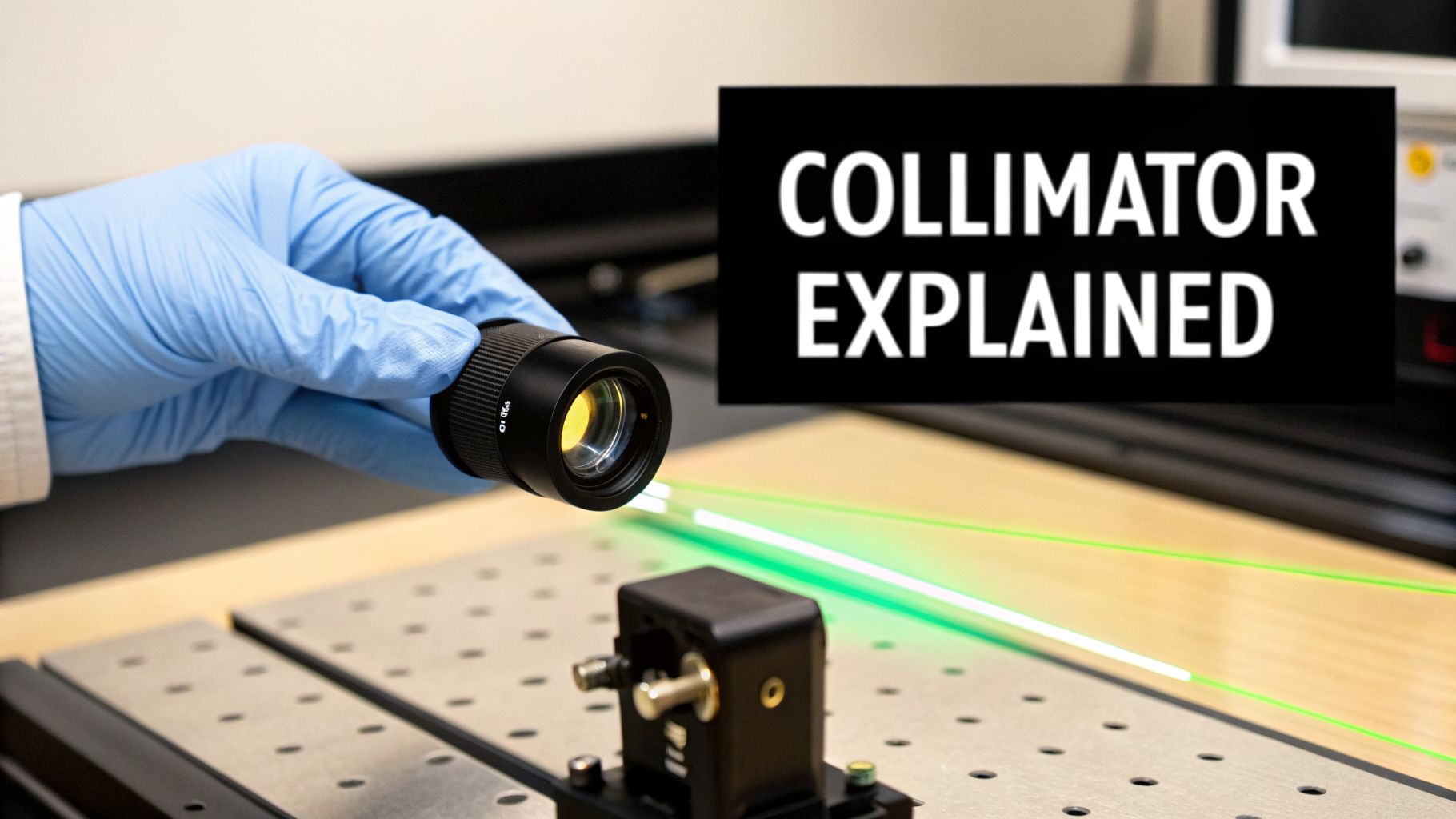
Think of it this way: imagine a floodlight casting a wide, dispersed cone of light. The rays spread out in every direction. A collimator is like a set of optical blinders that forces all those divergent rays to straighten up and travel in the same direction, perfectly parallel to one another.
This concept isn't some new-age tech. The groundwork was laid centuries ago, but the first practical device came from English physicist Henry Kater, who presented his 'floating collimator' in January 1825. Building on ideas from mathematicians like Gauss, Kater's invention was a huge leap forward for astronomy, allowing for incredibly precise alignment of telescopes. You can dive deeper into the history of collimator development and see how these early designs evolved.
The Power of Optical Infinity
So, why is a beam of parallel light rays so important for aiming a rifle? When light is collimated, it creates a virtual image that our eyes perceive as being at optical infinity. This has a game-changing effect on how we aim.
Simply put, the aiming reticle stays locked onto the target, no matter where your eye is positioned behind the optic. This is the key to parallax-free performance.
A collimator's ability to project a reticle to "infinity" is the secret behind parallax-free aiming. It allows for rapid, heads-up target acquisition where perfect alignment is no longer a requirement for accuracy.
This is exactly why collimator-based optics, like the ubiquitous red dot sight, are so fast and intuitive. A shooter can keep both eyes open, maintaining complete situational awareness, and just place the dot over the target to get a reliable hit. It removes the need to line up a front sight, rear sight, and target all at once.
To make sense of the different devices that use this principle, it helps to see how they're categorized. Here’s a quick breakdown of the most common types and what they do.
Collimator Types at a Glance
This table provides a simple overview of the main collimator types you'll run into and their primary roles, from the battlefield to the workshop.
| Collimator Type | Core Function | Primary Application |
|---|---|---|
| Reflex Sight (Red Dot) | Reflects a collimated LED dot onto a lens | Fast target acquisition on firearms |
| Holographic Sight | Records and reconstructs a collimated 3D hologram | Tactical aiming with superior parallax correction |
| Bore Sight Collimator | Aligns a rifle's sights with the barrel's axis | Zeroing optics without firing a shot |
Each of these designs leverages the core principle of collimation to achieve a specific goal, showing just how versatile this fundamental optical technology really is.
The Science of Parallel Light Explained
At its heart, a collimator is built on a simple, brilliant optical trick. It all boils down to the relationship between a light source and a lens, and once you get that, you understand the core of how these advanced aiming systems work.
Think about a standard flashlight bulb. On its own, it throws light in every direction. The rays scatter and spread out, losing power and focus the farther they go. This is called divergent light, and for precise work like aiming, it’s not much help.
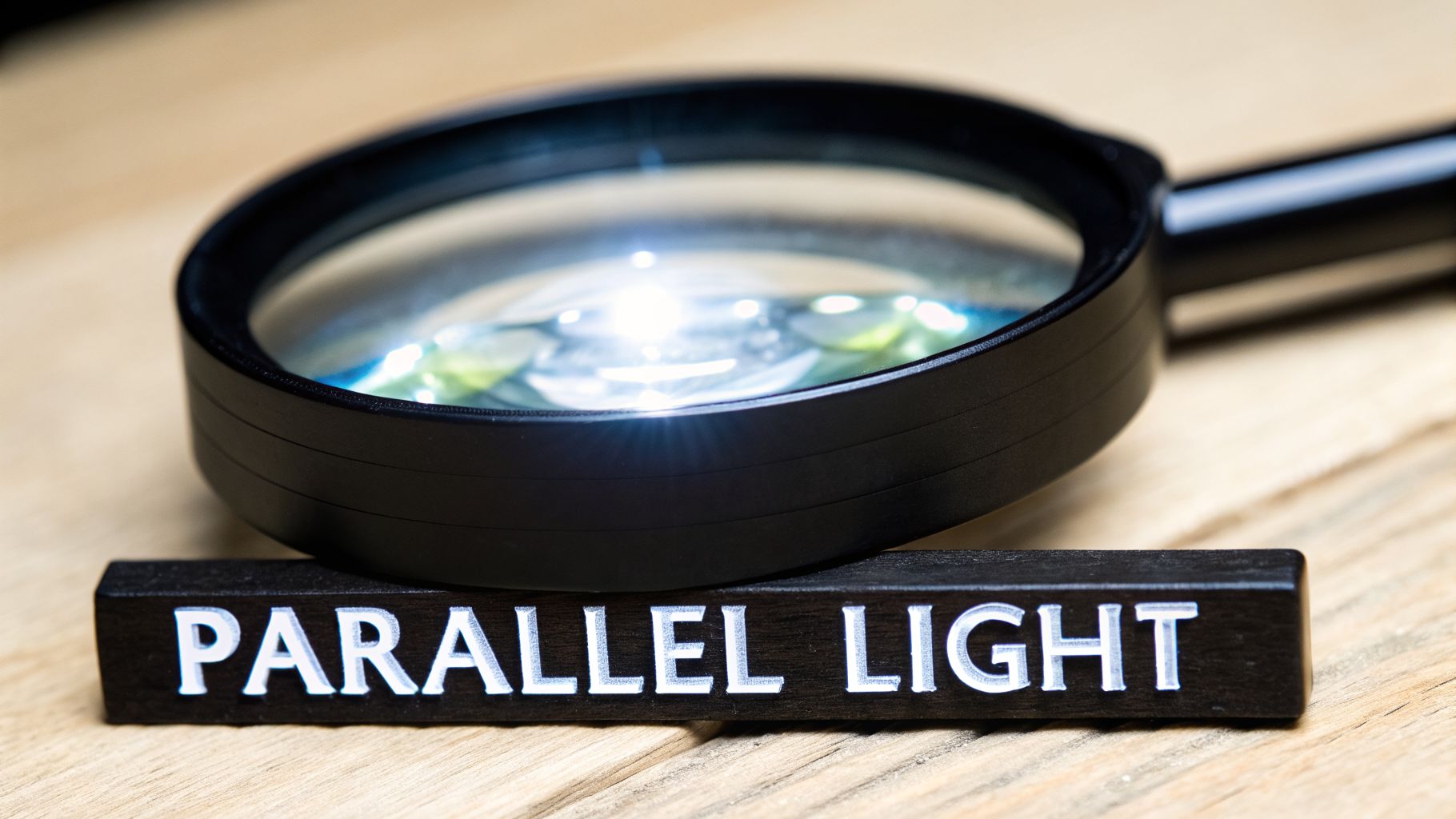
Now, let's introduce a lens. Imagine placing that same bulb at the focal point of a convex lens—a magnifying glass is a perfect example. The focal point is that sweet spot where light rays naturally converge. When you put a light source right at that specific point, the lens works its magic. It captures all those scattered, messy rays and straightens them out, sending them forward in a tight, parallel beam.
This perfectly organized beam is what we call collimated light.
From Scattered Rays to a Perfect Beam
That one transformation is the whole secret. Instead of spreading out into nothing, the light rays now travel in a disciplined column. They behave as if they came from a source that is infinitely far away, which is why experts say the image is projected to "optical infinity."
In simple terms, a collimator takes messy, divergent light from something like an LED and aligns the rays so they travel in a parallel beam. This tricks your eye into seeing the light source as if it's way out on the horizon, which is the key to killing parallax error in an optic.
The position of the light source is everything. A slight change completely alters what the lens does:
- Source Inside the Focal Point: If the light source is closer to the lens than its focal point, you get a magnified virtual image. This is exactly how a magnifying glass makes things look bigger.
- Source At the Focal Point: When the source is placed precisely at the focal point, the lens produces that perfectly straight, collimated beam we're looking for.
- Source Outside the Focal Point: Move the light source past the focal point, and the lens will instead cause the light rays to converge and create a focused, real image on the other side.
The Impact on Aiming
So, how does this apply to your red dot? The glowing dot or reticle you see is just an LED light source. It's positioned with extreme precision at the focal point of the sight’s lens.
Because the light leaving the sight is collimated, your eye and brain perceive the dot as being "out there" on the target, not floating on a piece of glass a few inches from your face. If you want to dive deeper into how different light properties affect optics, our guide can help you understand the full spectrum of light.
This is the very reason you can shift your head around behind the optic and the dot stays locked on the target. Those parallel light rays ensure the reticle’s position doesn't seem to wander, giving you that true, parallax-free "heads-up" aiming capability that makes these sights so effective.
How Collimator Sights Changed the Aiming Game
All that optical theory really comes to life when you look through a collimator sight. These optics take the physics of collimated light and turn it into a massive real-world advantage, fundamentally changing how we aim. They work by projecting a reticle that appears to be at "optical infinity," which gives them a performance edge that traditional iron sights just can't touch.
The biggest game-changer is how they enable the Bindon Aiming Concept (BAC). This is a fancy term for a simple, natural technique: aiming with both eyes open. One of your eyes stays locked on the target, while your other eye sees the glowing reticle from the sight. Your brain then works its magic, merging the two images. The result? The aiming dot seems to float in space, perfectly superimposed over your target.
This two-eyed approach is a huge deal. It gives you incredible situational awareness and dramatically speeds up how quickly you can get on target. For anyone in law enforcement, the military, or even competitive shooting, those fractions of a second are everything.
From World War Dogfights to Modern Rifles
This idea isn't new. In fact, it goes all the way back to World War I. By 1917, early versions of collimator sights were being fitted to aircraft, and they were credited with increasing hit probabilities in dogfights by an estimated 40%. You can dig into more of the backstory in this deep dive on the history of collimator sights on Wikipedia.
That same basic technology has now completely taken over the U.S. firearm optics market. With over 393 million privately owned firearms in the country, the reflex sight segment, which includes collimator sights, is a $1.1 billion industry. Brands like EOTech have become household names.
Today’s collimator sights—what most of us just call reflex or red dot sights—give you practical advantages that go way beyond just being fast.
Unlimited Eye Relief: Since the reticle is projected out to infinity, it doesn't matter how far your eye is from the sight. You'll always see the aiming point clearly. No more hunting for that perfect "sweet spot" when you're under pressure.
Reduced Eye Fatigue: Trying to line up a rear sight, a front sight, and a target forces your eye to constantly shift focus between three different distances. It’s exhausting. A collimator sight simplifies everything: just look at the target and put the dot on it.
True "Heads-Up" Aiming: You don't need a perfect cheek weld to be accurate. As long as you can see the dot through the optic's window, you can place an accurate shot. This is a lifesaver when you're forced into an awkward shooting position.
Think of a collimator sight as a shortcut. It gets rid of the tricky sight alignment part and lets your brain focus entirely on the target.
This blend of speed, awareness, and forgiveness makes these optics incredibly effective. They let a shooter react almost purely on instinct while still delivering a high degree of precision. If you're curious about how different sight designs accomplish this, we break it all down in our guide on the performance of open reflex sights.
Watching the technology evolve from those bulky WWI gun sights to the tough, hyper-efficient optics made by companies like EOTech and Sightmark today really shows you just how powerful the simple principle of collimated light is.
Choosing Your Optic: Collimator vs. Red Dot vs. Holographic
This is one of the most common questions we hear from shooters, and for good reason. Is a red dot a type of collimator? How is a holographic sight actually different? While all these optics are designed for fast, parallax-free aiming, what’s going on inside them is surprisingly distinct.
Let's clear the air. For all practical purposes, most modern red dot sights are a type of collimator sight. Specifically, they fall into a sub-category called "reflex sights." They work with a beautifully simple and durable system: an LED projects light forward, which bounces—or reflects—off a specially coated lens and back to your eye as a crisp, collimated aiming dot.
Holographic sights, on the other hand, are a different beast entirely. They use a far more complex laser system to record and then reconstruct a true hologram of a reticle that appears to float out at the target's distance. This core difference in how the reticle is created has a huge impact on performance, durability, and of course, cost.
Optic Comparison: Collimator, Red Dot, and Holographic
So, which one is right for you? There's no single "best" optic; the right choice comes down to your specific needs, budget, and priorities. One optic isn't universally better than another, they simply trade blows in different categories.
This table breaks down the key trade-offs between the classic Occluded Eye Gunsight (OEG), the modern reflex sight, and the high-tech holographic sight.
| Feature | Collimator Sight (OEG) | Reflex Sight (Red Dot) | Holographic Sight |
|---|---|---|---|
| Aiming Method | Bindon Aiming Concept (two eyes open) | One or two eyes; reticle superimposed on target | One or two eyes; reticle superimposed on target |
| Reticle Creation | Ambient light gathered into a fiber optic dot | Simple LED reflected off a lens | Complex laser-reconstructed hologram |
| Battery Life | N/A (often passive fiber optic) | Extremely long (20,000-50,000+ hours) | Shorter (typically 600-2,500 hours) |
| Parallax | High parallax; very dependent on head position | Very low, but can have minor shift at window edges | Virtually zero parallax across the entire window |
| Durability | Extremely tough due to simplicity | Very robust, simple and proven electronics | Tough, but the laser emitter can be more sensitive |
| Cost | Generally very affordable | Affordable to mid-range | Typically a higher-end investment |
| Night Vision | Not compatible | Good performance, but can have some "bloom" | Superior performance with minimal bloom |
As you can see, the trade-offs are clear. A reflex sight, like the popular EOTech EFLX Mini Red Dot Sight, gives you incredible battery life and a much friendlier price point, making it a fantastic all-around choice for most shooters. You can learn more about its features in our hands-on review of the EOTech EFLX Mini Red Dot Sight.
On the flip side, a holographic sight provides the absolute best performance, especially when paired with a magnifier or night vision. That's why its higher price is often justified for professional users who demand every last ounce of optical advantage.
The flowchart below gets to the heart of why these optics are so effective: they are built for speed and awareness by encouraging you to keep both eyes open.
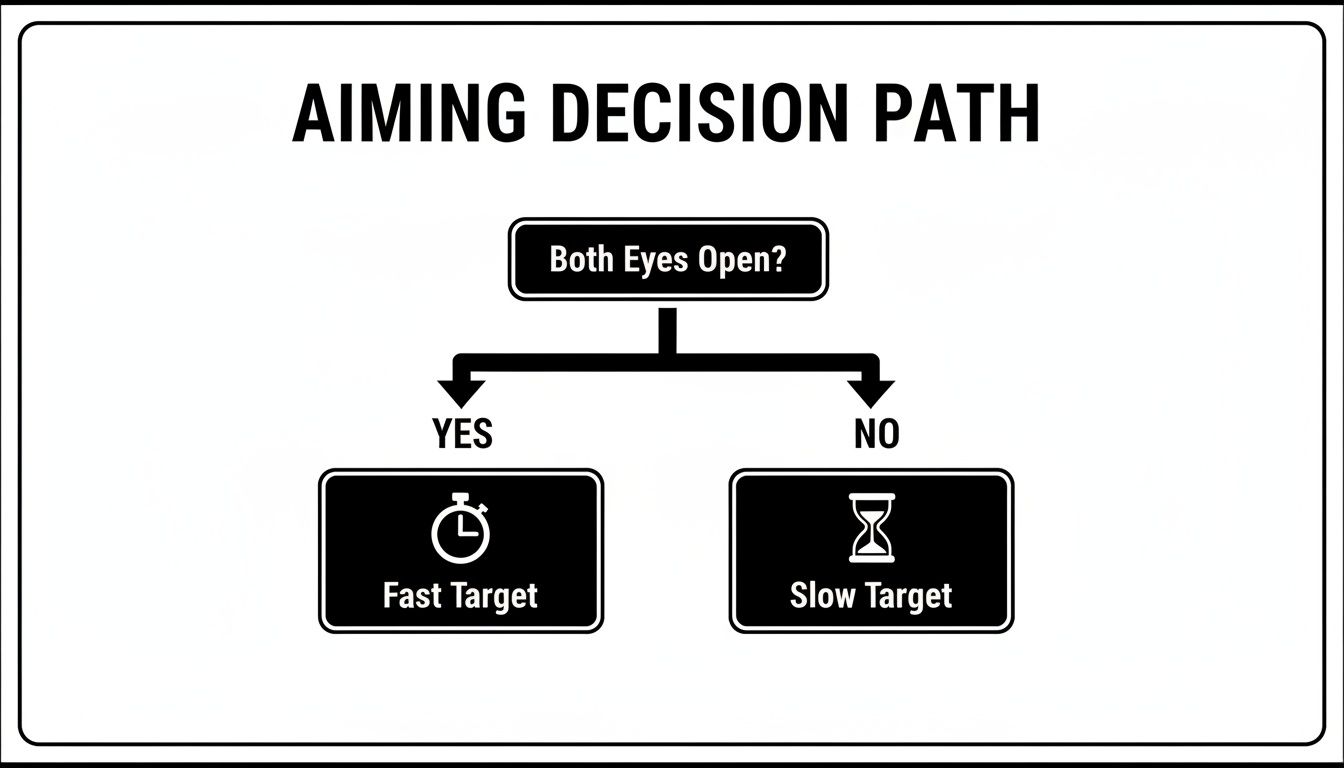
This simple decision path shows that the primary benefit of any collimator-style sight is getting on target fast without losing track of what’s happening around you.
The takeaway is this: A red dot offers unmatched efficiency and value, while a holographic sight delivers peak optical performance. Your choice comes down to whether you prioritize battery life and cost-effectiveness or absolute precision and night vision clarity.
Critical Applications Beyond Firearm Sights

While we often think of collimators in the context of shooting, the core principle—making light rays parallel—is a cornerstone of modern science and medicine. The same idea that gives you a crisp aiming point on a rifle is also at work in fields where precision can be a matter of life and death.
It turns out that shaping a beam of visible light isn't so different from shaping invisible X-ray or gamma-ray beams. This is exactly what happens in radiology, where a medical collimator is one of the most important components for both safety and image quality.
By filtering and narrowing these high-energy beams, a radiology collimator ensures radiation is pointed only where it needs to go. This is the exact same concept of beam alignment used in tactical gear like night vision and laser aiming modules, just applied on a different scale.
Precision in Medical Imaging
If you've ever had an X-ray, you've seen a collimator in action. The technician uses dials to adjust what are essentially a set of lead shutters, shaping the beam to match the size of the body part being imaged—from a single tooth to your entire chest.
This precision has two massive benefits:
- Patient Safety: Preventing stray radiation from exposing healthy tissue is a huge deal. The widespread use of modern collimators has been shown to reduce a patient's total radiation exposure by as much as 50-70%. It’s a simple concept with a profound impact on medical safety, as detailed in this overview of collimator technology.
- Image Clarity: Uncontrolled radiation scatters, creating a "fog" that makes diagnostic images blurry and hard to read. A focused, collimated beam dramatically reduces this scatter, producing the sharp, high-contrast images doctors need for an accurate diagnosis.
A medical collimator is the ultimate expression of beam control. By shaping X-rays with precision, it protects the patient and provides a clearer diagnostic image, proving the life-saving importance of the same principles used in tactical optics.
From Labs to Lasers
Beyond the hospital, collimators are indispensable in optical labs and scientific research. You’ll find them inside devices like spectrometers, which are used to figure out what something is made of by analyzing the light it emits or reflects.
Scientists also rely on collimators to test the quality of high-end lenses and align powerful lasers. By creating a perfectly parallel beam of light, they can measure optical performance with incredible accuracy.
This brings us right back to where we started. That same task is what a laser aiming device on a rifle does. Collimation is what keeps that little red or green dot tight and round over hundreds of yards instead of turning into a useless, fuzzy blob. It all comes back to controlling the path of light.
Field Guide to Using and Maintaining Your Collimator
Even the best gear is useless if you don't know how to run it properly. Think of this as your personal cheat sheet for setting up, using, and maintaining your collimator sight so it never lets you down. We'll cover everything from getting it on paper to keeping it running for the long haul.
Your first step to hitting what you're aiming at is a proper zero. Sure, you could just head to the range and start blasting away, but there's a much smarter way to do it that will save you a ton of time, ammo, and frustration.
Zeroing Your Sight the Smart Way
Enter the bore sight collimator. This handy little device is your shortcut to getting on target. It shoots a precise grid or laser beam straight down your barrel, giving you a perfect reference point to align your optic with before you've fired a single shot. This process, called bore sighting, gets you "on paper" immediately.
What does that mean in practice? It means your first rounds will actually be near the bullseye instead of somewhere off in the weeds. You'll still need to fire live rounds to confirm and fine-tune your zero at your preferred distance (say, 50 or 100 yards), but bore sighting does 90% of the work for you.
Mounting for Your Mission
How you mount your optic is every bit as crucial as how you zero it. The right mount height determines how quickly you can get a sight picture, how comfortable you are, and how well your other gear plays along.
Co-Witnessing with Iron Sights: This is a popular setup where your iron sights are still usable through the optic's window. An "absolute" co-witness lines the dot up perfectly with your irons. A "lower 1/3" co-witness, my personal preference, places the irons in the bottom third of the window, giving you a much cleaner, less cluttered view.
Pairing with Magnifiers and Night Vision: If you're running a magnifier or a night vision monocular like a PVS-14, you absolutely need everything to line up perfectly. This is where using mounts from a single ecosystem, like those from Unity Tactical, really pays off. It guarantees all your optics are on the same plane for a seamless transition between them.
A proper optic height isn't just about comfort—it's about building a reliable system. It enables a natural head position, lightning-fast sight acquisition, and flawless integration with magnifiers or NVGs.
Essential Maintenance for Peak Reliability
Your collimator is built tough, but a little preventative maintenance goes a long way in ensuring it's ready to perform when the stakes are high.
- Lens Care: The lenses are the soul of the optic. To clean them, always use a dedicated lens pen or a clean microfiber cloth. First, use the brush end to whisk away any dust or grit. Then, gently wipe away smudges. This prevents you from grinding debris into the lens and scratching the coatings.
- Battery Checks: Don't get complacent with battery life. Even with optics boasting 50,000+ hour runtimes, make it a habit to swap the battery on a schedule. For a duty or defensive rifle, once a year (or every six months) is cheap insurance.
- Security Checks: Recoil has a way of loosening things. Periodically check that your mount screws are still tight. When you first install the mount, use a torque wrench to get the specs just right and add a drop of thread-locking compound to keep those screws from backing out.
Common Collimator Questions Answered
Even after getting a handle on the science, some practical questions always pop up when you're on the range or setting up a new rifle. Let's tackle some of the most common ones I hear from shooters.
Can I Use a Collimator Sight with a Magnifier?
You bet. In fact, most modern collimator sights—think red dots and holographic sights—are built with this exact capability in mind. A magnifier simply mounts on the rail right behind your main optic, giving you the power to flip between 1x for fast, close-quarters work and a magnified view to better identify and engage targets farther out.
The real trick is getting a quality flip-to-side mount. This is what guarantees both your optic and the magnifier line up perfectly on the same optical plane. When they're aligned correctly, flipping the magnifier into place gives you a sharp, clean sight picture, not a blurry or distorted mess.
Pro Tip: Always get your primary optic zeroed before you even touch the magnifier. A magnifier is just a telescope for your dot; it should never change where your rounds are actually landing.
What Does Parallax-Free Really Mean?
This is a big one. Parallax-free means your aiming reticle appears to stay locked on the target, even if your head isn't perfectly centered behind the optic. If you’ve ever shot with iron sights, you know that if you shift your head even slightly, your sight alignment changes and your shot can go wide.
A collimator projects its reticle out to what’s called “optical infinity,” which basically cancels out that aiming error caused by eye movement. As long as you can see the dot and put it on the target, that’s where the shot is going to go. This is a huge benefit in real-world shooting scenarios where getting a textbook-perfect cheek weld just isn't an option.
Are All Red Dot Sights Collimator Sights?
Technically speaking, yes. "Red dot sight" has become the common, everyday term for what is more formally known as a reflex sight. A reflex sight is just one specific type of collimator sight.
They all operate on the same brilliantly simple principle: an LED shines a collimated dot onto a specially coated lens, which then reflects that dot back into your eye.
So, while the umbrella term collimator sight also covers some older or more obscure designs, for all practical purposes in today's market, when someone says "red dot," they're talking about a collimating reflex sight.
