Unlock the meaning of collimation: A Practical Guide
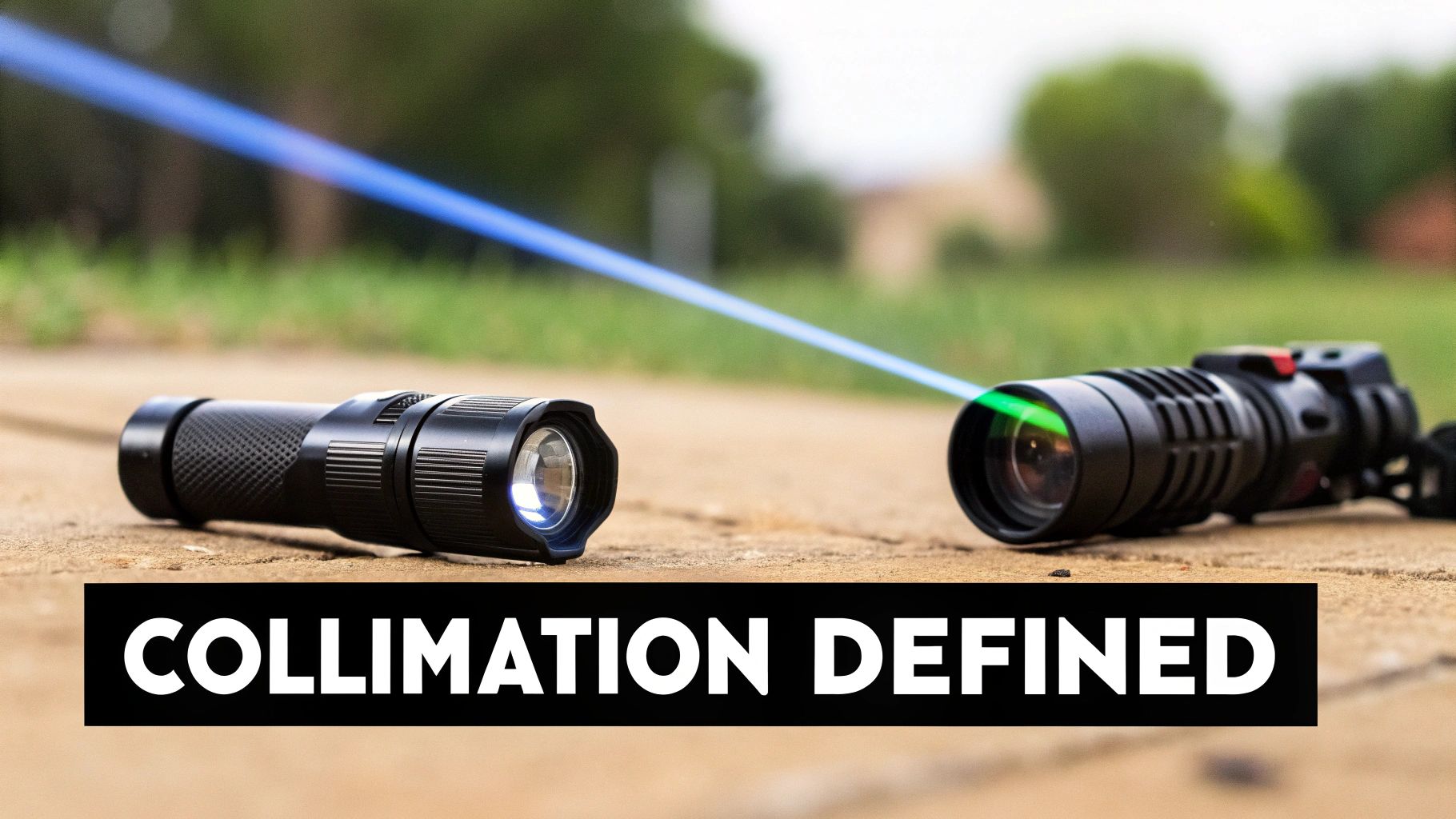
Before we get into the weeds, let's nail down what collimation actually means in the real world. Think about a regular flashlight. When you turn it on, the light sprays out in a wide cone, getting dimmer and less defined the further it goes. Now, contrast that with a laser pointer—a tight, focused beam that stays sharp over a long distance.
That laser-like focus is the essence of collimation.
What Collimation Means For Your Gear
At its heart, collimation is all about getting light rays to travel parallel to one another. It’s the process of taming scattered light into a disciplined, straight-traveling beam. For the gear you rely on—whether it's a PVS-14 night vision monocular or a red dot sight—this alignment is what delivers a crisp image, a precise aiming point, and less eye strain.
Think of proper collimation as the invisible foundation of high-performance optics. It's the secret sauce that makes your expensive equipment work the way it's supposed to.
This process takes diverging light from a source and wrangles it into a tight, parallel bundle. It’s absolutely critical for precision. In night vision systems, for instance, a lack of collimation can absolutely wreck your image quality, sometimes degrading resolution by a staggering 30-50%. The image just won't be focused at infinity, making everything look slightly off.
Collimation isn't just a term for engineers. It's the make-or-break principle that determines whether you have a clear tactical advantage or a blurry, headache-inducing liability.
So, what does a well-collimated device actually give you?
- Razor-Sharp Image Clarity: When all the light is focused correctly, you get a detailed picture that's sharp from edge to edge. No weird distortion or fuzzy halos.
- True Aiming Accuracy: For red dots and aiming lasers, perfect collimation is what kills parallax error. It ensures that where you put the dot is exactly where the impact will be.
- Drastically Reduced Eye Strain: In bino setups like dual-tube night vision, proper collimation merges the two images seamlessly into one. Without it, your brain fights to combine two slightly different images, leading to fatigue and headaches that can take you out of the fight.
To give you a clearer picture, here’s a quick breakdown of what you’re dealing with when an optic is properly aligned versus when it's not.
Collimated vs Uncollimated Light in Tactical Optics
| Characteristic | Collimated Optics (Aligned) | Uncollimated Optics (Misaligned) |
|---|---|---|
| Image Quality | Crisp, sharp, and focused to infinity. | Blurry, distorted, or "soft" around the edges. |
| Aiming Precision | Point of aim matches point of impact; minimal parallax. | Significant parallax error; the dot shifts as you move your head. |
| User Comfort | A single, cohesive image (in binos); no eye strain. | Double vision, headaches, and rapid eye fatigue. |
| Device Performance | The device operates at its maximum potential. | Degraded resolution and overall poor performance. |
This table shows why paying attention to collimation isn't optional—it's fundamental. Understanding what it is and why it matters is the first step to truly getting the most out of your optical equipment.
Why Proper Collimation Is a Mission-Critical Advantage
Knowing the textbook definition of collimation is one thing, but truly grasping its impact in the field is what really counts. Getting the alignment right isn't just a minor technicality—it’s the single factor that decides whether your expensive gear works for you or against you. When you can't afford to miss a single detail, a properly collimated system gives you three massive advantages.
First and foremost is enhanced image clarity. For anyone using night vision, this is the difference between seeing a crisp, identifiable silhouette and a blurry, questionable blob in the dark. A perfectly collimated optic delivers a sharp image focused out to infinity, cutting through the visual noise that can obscure a threat or hide a target.
Pinpoint Accuracy and Reduced User Fatigue
Next up is pinpoint aiming accuracy. For any kind of weapon sight, from a simple red dot to a sophisticated holographic unit, good collimation is what kills parallax error. It’s the invisible guarantee that where you place the dot is exactly where the impact will be, no matter how you shift your head or change your viewing angle. Without it, you’re just guessing.
Collimation is the invisible force that ensures what you see is what you get. Misalignment introduces doubt, and in high-stakes situations, doubt can be a mission-killer.
Finally, proper collimation is absolutely essential for reducing user fatigue, especially if you're running dual-tube night vision goggles. When both optical pods are perfectly aligned with each other, your brain can effortlessly stitch the two images into a single, seamless view. But when they're out of sync, your brain and eyes are forced to constantly fight each other to make sense of the conflicting information. This leads to some serious problems:
- Severe eye strain that degrades your ability to focus over long periods.
- Disorienting headaches that destroy your concentration and situational awareness.
- Double vision or that frustrating "crossed-eye" feeling that can make the device unusable.
Whether you're on a critical operation or a multi-day hunt, these aren't just "nice-to-have" features. They are fundamental to your safety, effectiveness, and ability to stay in the fight. Collimation is what turns a high-tech piece of equipment into a reliable extension of your own vision.
How Collimation Works Across Your Tactical Gear
The term "collimation" isn't a one-size-fits-all concept. Its real-world meaning shifts depending on the gear you're looking through. Getting a handle on how it works in each piece of your kit is the first step to understanding why it's so critical for your entire system's performance.
Let's start with a night vision device, like a PVS-14 monocular. Here, the main job of collimation is to take the image coming off the intensifier tube and focus it perfectly out to infinity. This precise alignment means your eye can relax and view the scene naturally, giving you a sharp, clear picture without any weird focusing strain.
Now, think about aiming devices like red dot sights or lasers. The goal here is a bit different. Collimation makes sure the projected aiming point—that little red dot or laser beam—is perfectly parallel with the sight's own optical axis. This is what gives you a parallax-free sight picture, where the dot stays on the target even if your head isn't in the exact same spot every time.
Unifying Your Optical System
Things get really interesting when you start stacking optics. Whether you're putting a magnifier behind your red dot or a thermal clip-on in front of your scope, collimation is the essential glue holding it all together. Its job is to make sure the optical path of the device you're adding is perfectly in sync with your primary optic.
Without that perfect alignment, you’d be looking at a distorted, shifted, or blurry mess. It would make the whole combination pretty much useless. Good collimation is what gives you that seamless visual transition from one device to the next.
This graphic really drives home the core benefits you get when your gear is properly collimated.
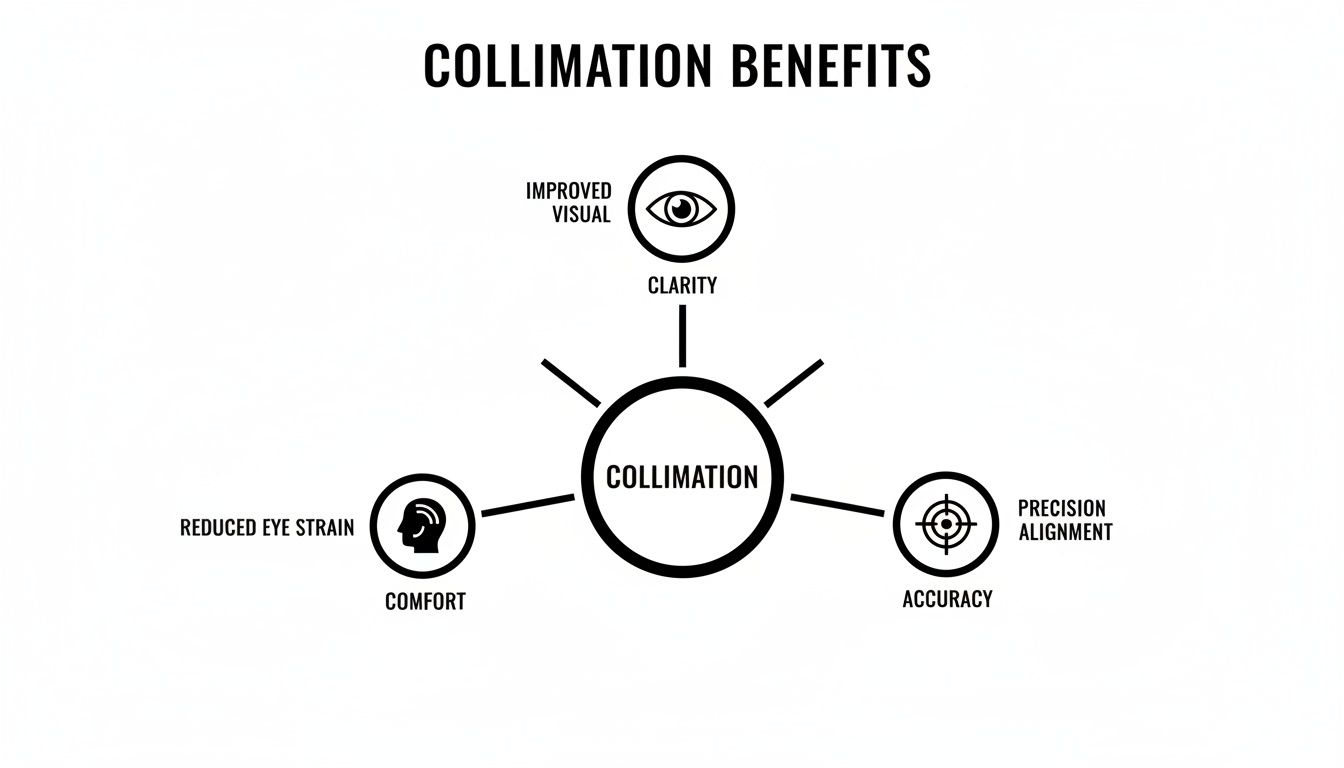
As you can see, that fundamental principle of alignment directly translates into better clarity, more comfort, and dead-on accuracy for your entire setup.
The level of precision we're talking about is mind-boggling.
- In dual-tube night vision goggles, the collimation tolerance has to be under 0.5 degrees to fuse the two images into a single, cohesive view. Getting this right can boost situational awareness by an estimated 35%.
- For a quality red dot sight like an EOTech, proper collimation keeps parallax under 1 MOA (minute of angle). That's absolutely vital for accuracy, especially at distances where even a tiny error means a big miss.
If you happen to run that kind of optic, you'll want to check out our guide on mounting an EOTech to make sure you're getting the most out of it.
Spotting the Telltale Signs of Poor Collimation
The first step to fixing a problem is knowing you have one. When your optics are out of whack, they'll give you signs. You just need to know what you’re looking for. Think of it as your gear’s way of telling you something is misaligned internally.
In a single-tube night vision device, like a PVS-14, the biggest red flag is a stubborn blurriness that you can't seem to focus away. If you've fiddled with the objective lens and adjusted the diopter but the image is still soft, bad collimation is a prime suspect.
Dual-Tube and Aiming Optic Issues
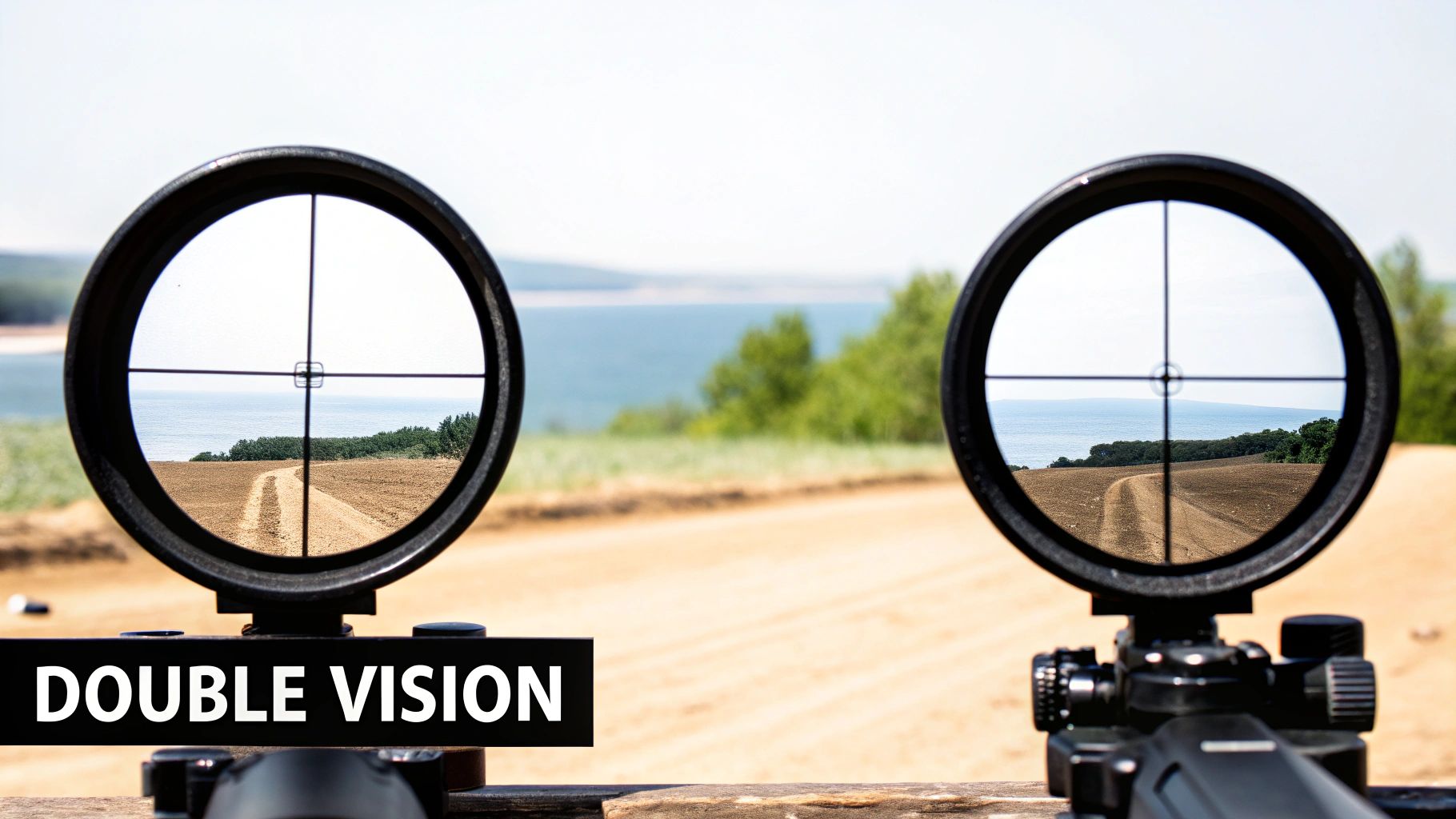
With dual-tube systems, the classic symptom is double vision. It feels like your brain is struggling to stitch two separate images into one. This forces your eyes to work overtime, quickly leading to strain, fatigue, and even headaches. If you're "seeing two moons" when there should only be one, your collimation is off.
When a red dot sight is mis-collimated, the dot will seem to "swim" or shift on the target as you move your head. This parallax effect means your point of aim isn't your point of impact, a critical failure in any shooting scenario. You can learn more about how this alignment is affected by other optics in our guide on the benefits of red dot magnifiers.
Key Takeaway: Eye strain, double vision, persistent blurriness, and a shifting aiming dot aren't just minor annoyances. They are clear indicators that your device's optical alignment—its collimation—is compromised.
This problem isn't limited to night vision or red dots. For hunters and professionals using thermal imagers, mis-collimation can cause the effective spot size to balloon by as much as 40%. This can result in false positives or a completely inaccurate read on a target.
On the flip side, well-collimated professional gear is incredibly robust. Field data shows that properly aligned systems can maintain 98% of their performance even after enduring thousands of recoil cycles.
Should You Fix It Yourself or Call a Pro?
So, you’ve spotted the signs and think your gear's collimation might be off. What's the next move? The answer really boils down to the specific problem you're seeing and the type of optic you're running. Some basic checks can be done at home, but trying to fix certain issues yourself can turn a small problem into a very expensive paperweight.
When it comes to aiming optics like red dots, you can often diagnose a major issue on your own. If you notice a huge shift in your dot’s position as you move your head, that’s a classic sign of parallax, which is related to collimation. This simple check doesn't fix anything, of course, but it confirms you have a problem. Diagnosing it is one thing; trying to crack it open and fix it is another matter entirely.
Why Internal Adjustments Are Best Left to the Experts
When it comes to the internal alignment of your optics—especially sealed night vision devices or dual-tube goggles—this is strictly professional territory. This isn't a kitchen table project. Technicians use highly specialized optical benches, custom tools, and controlled, nitrogen-purged environments to make these adjustments and properly re-seal the unit.
Attempting an internal fix without the right training and gear can go wrong in a hurry. You're likely to cause more harm than good.
- Permanent Damage: It's incredibly easy to scratch a lens, strip a tiny screw, or knock a prism out of alignment for good.
- Losing the Purge: The moment you break that factory seal, you introduce moisture and contaminants. This leads to internal fogging that will make the device completely useless.
- Voiding Your Warranty: Manufacturers can tell when a device has been opened. Doing so yourself is the fastest way to void your warranty.
Think of it like this: you can change your own oil, but you probably wouldn't rebuild your car's transmission in your garage. Professional collimation isn't an unnecessary expense—it's critical maintenance for a high-performance tool.
This is especially true when you consider how an optic's internal alignment works with external factors like measuring your scope height and getting a perfect mount. Sending your gear to a qualified technician protects your investment and ensures it will be there for you when it counts.
Your Partner in Optical Precision
We've pulled back the curtain on collimation, showing how it's not just some technical jargon, but the very foundation of clarity, accuracy, and even comfort in your optics. Getting a handle on this concept is the single most important step you can take to get every bit of performance out of your gear. When everything is lined up right, your equipment works for you, not against you.
Our goal isn’t just to sell you high-quality optics. We want to make sure you have the know-how and the support to keep that equipment in fighting shape, ready and reliable for when you need it most. Your ability to get the job done depends on gear you can trust, and we’re here to back that up.
We’re Here to Help
Whether you think something might be off with your setup and just need some expert advice, or you need a professional service to get things perfectly aligned again, our team is ready to step in. We believe in giving our customers the knowledge they need and the support they can count on. Don't let a simple alignment issue get in the way of your effectiveness or safety.
Think of your gear as an investment in your own readiness. Keeping it properly collimated is how you protect that investment and guarantee it won't fail you under pressure.
Feel free to browse our selection of professionally collimated optics, or reach out to our technicians for any maintenance questions you have. Let us be your go-to resource for achieving total optical precision and keeping that tactical edge sharp. We're here to make sure your gear is always mission-ready.
Optical Collimation FAQs
Got questions about collimation? You're not alone. Here are some quick, straightforward answers to the things we get asked most often.
Can Dropping My Gear Mess Up the Collimation?
Absolutely. A nasty fall or a hard slam can easily knock the finely-tuned lenses and prisms inside your scope or night vision device out of alignment. This is a big reason why professional-grade optics are built like tanks—but even the toughest gear has its limits.
What's the Difference Between Collimation and Zeroing?
This is a great question, and it's a common point of confusion.
Think of it like this: Zeroing is about matching your optic's reticle to where your rounds are actually hitting. It’s an external adjustment you make.
Collimation is about making sure all the lenses inside the optic are perfectly lined up with each other. This internal alignment is what gives you a crisp, single image without distortion. You can't have a good zero without good collimation first.
How Often Should I Check My Dual-Tube Goggles?
It's smart to do a quick check before any serious use. Just put them on and see if your brain is happy. Is the image clear? Do you feel any immediate eye strain?
If you find yourself getting headaches, feeling unusual eye fatigue, or literally seeing two separate images instead of one seamless view, stop. Those are classic signs that your tubes are out of alignment and need professional attention.
Do Big Temperature Swings Affect Collimation?
In theory, yes. Extreme heat or cold can cause the materials inside an optic to expand or contract. However, any well-made, high-quality optic is designed from the ground up to handle this. They use specific materials and construction techniques to ensure everything stays perfectly aligned, whether you're in the desert or the arctic.
At Superior Tactical LLC, we live and breathe this stuff. We make sure every single device is perfectly collimated and ready for duty. Check out our selection of professionally serviced night vision and tactical optics at https://superiortac.com.
