A Complete Guide to Magnifier Holographic Sight Combos
Pairing a holographic sight with a magnifier is arguably one of the most effective and versatile optic setups you can run on a modern rifle. It’s a combination that gives you the best of both worlds: the lightning-fast, both-eyes-open target acquisition of a holographic for close-quarters work, and the ability to instantly zoom in for precise shots at a distance.
Think of it as adding a tactical "zoom" feature right behind your primary sight, ready to flip into action the moment you need it.
The Tactical Advantage of a Magnifier Holographic Sight
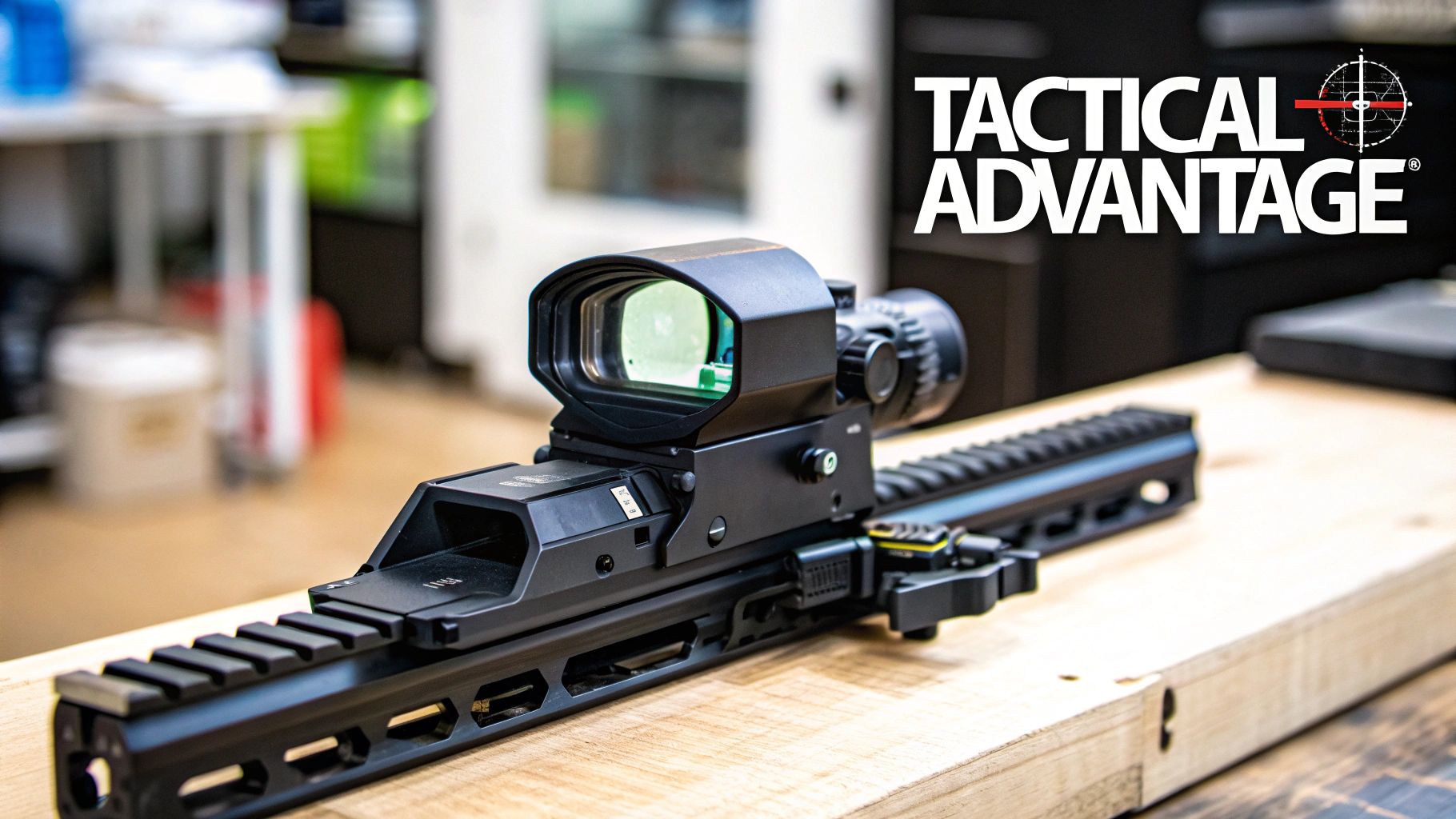
The real magic of this setup is its modularity. You aren't locked into a single magnification level. Instead, you get the flexibility to adapt to dynamic situations in a split second, which can make all the difference when it counts.
The system is pretty straightforward, combining two distinct pieces of gear:
- The Holographic Sight: Known for its incredible speed, a holographic weapon sight (HWS) projects a reticle that appears to float on the target, not on the glass. This is the key to its legendary situational awareness and rapid targeting, especially in close-quarters battle (CQB) scenarios.
- The Magnifier: This is essentially a simple monocular mounted on a pivot directly behind your HWS. It has no reticle of its own; its only job is to magnify your entire field of view, including the holographic reticle projected by your main optic.
Why This Combination Is Gaining Popularity
The demand for adaptable optic solutions has absolutely exploded, and it’s easy to see why. The tactical optics market jumped from $10.92 billion in 2022 to $11.59 billion in 2023 and is on track to hit an estimated $18.61 billion by 2031. This isn't just a trend; it's a direct response to the real-world need for systems that can handle both close-range speed and mid-range precision. If you're interested in the numbers, you can dig into the full tactical optics report from SkyQuestt.com.
This combo offers a clean solution without the typical compromises of other systems. For instance, unlike a Low Power Variable Optic (LPVO) that requires you to break your cheek weld and turn a stiff dial, a flip-to-side magnifier can be engaged or disengaged with a simple, intuitive flick of the wrist.
That instant transition is precisely why it’s become a go-to choice for law enforcement, competitive shooters, and serious hunters who need to react immediately to targets appearing at any distance.
How Holographic Sights and Magnifiers Work Together
To really get the most out of a magnifier and holographic sight setup, you first have to understand what each piece of gear is doing. Don't think of them as two separate optics you just happen to have on your rifle. Think of them as a team, where one's job is to make the other's job easier. The real magic is in how they play together to give you a single, seamless sight picture.
First up, you have the holographic weapon sight (HWS). This isn't your standard red dot. A typical red dot just bounces an LED off a lens, but a holographic sight uses a laser and mirrors to project a true hologram of the reticle. That reticle looks like it’s floating out there on the target, almost like a heads-up display in a fighter jet.
This is exactly why holographic sights are famous for being incredibly fast. Your eyes don't have to shift focus between the reticle and the target; you see them both on the same focal plane. This lets you shoot with both eyes open, which is huge for speed and maintaining situational awareness.
Adding the Power of Magnification
The magnifier is the simpler part of this equation. It's basically a small monocular sitting behind your holographic sight, usually on a flip-to-side mount. It doesn't have a reticle of its own or any fancy electronics. Its only job is to make everything you see through it bigger.
When you flip that magnifier into place, you're not just making the target look closer. You're also magnifying the holographic reticle itself. The reticle grows in proportion to the target, which means all your holds for bullet drop and windage stay accurate at those longer distances.
This slick combination has become a go-to for everyone from law enforcement to serious hunters. The market numbers tell the same story. The global red dot sight market, which is a close cousin to holographic sights, was valued at around $2.24 billion USD in 2024 and is expected to hit $4.016 billion USD by 2035. That kind of growth shows just how much shooters value this kind of flexible precision. You can dig into more of the data on this trend over at Market Research Future.
The bottom line is that these two optics are meant for each other. The HWS gives you a fast, precise aiming point, and the magnifier gives you the reach to identify and engage targets further out. To see how these systems have improved over the years, check out our article on the evolution of EOTech magnifiers. Grasping this core concept is the key to getting your setup mounted right, zeroed perfectly, and running effectively no matter what you're doing.
Getting Your Optic Combo Mounted and Aligned
You can have the best magnifier and holographic sight on the market, but if it's not mounted correctly, you're just sabotaging your own accuracy. A shaky or misaligned setup will kill your performance before you even fire a shot. Nailing the installation from the get-go is the only way to get the most out of your gear.
First things first: mounting order. This one isn't up for debate. The holographic sight always goes on the rail first, closer to the muzzle. The magnifier sits behind it, right in front of your eye. This arrangement lets the magnifier do its job—enlarging the entire sight picture, including the holographic reticle you see projected downrange.
This diagram breaks down how the image travels from the sight, through the magnifier, and to your eye.
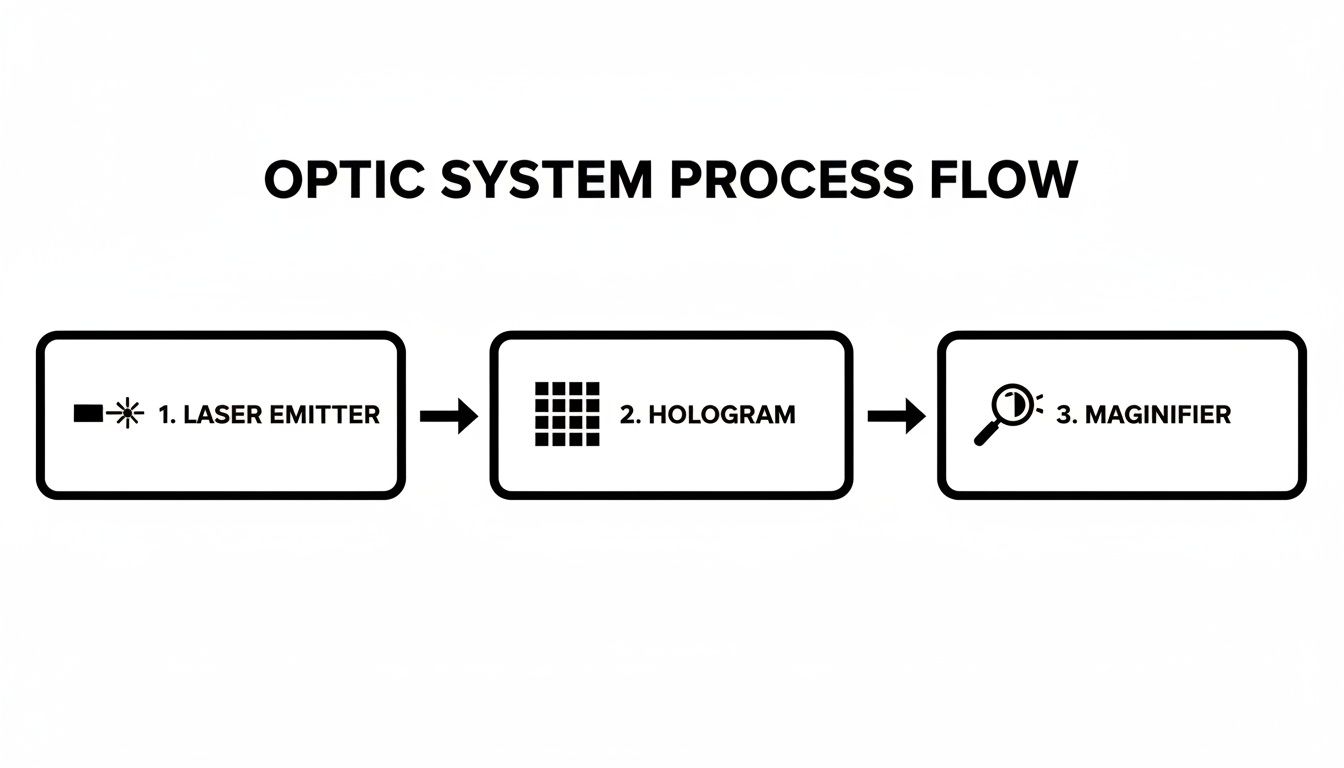
As you can see, the sight's laser creates the hologram, and the magnifier simply enlarges that entire image, giving you a crystal-clear view for positive identification at a distance.
Dialing in a Perfect Co-Witness
With the optics mounted, the next vital step is alignment. We call this co-witnessing, which is just a fancy term for how your holographic reticle lines up with your iron sights. The point isn't to use both at the same time, but to make sure your backup irons are zeroed and ready to go if your primary optic ever fails.
You'll generally see two schools of thought on this:
- Absolute Co-witness: Simple and direct. The holographic dot and your iron sights sit on the exact same horizontal line. When you look through your rear peep, the dot sits right on top of your front sight post.
- Lower 1/3 Co-witness: This is a more modern approach. It places your iron sights in the lower third of the optic's window. The reticle appears to float above them, giving you a much cleaner, less cluttered sight picture for fast, heads-up shooting.
Choosing between absolute and lower 1/3 co-witness really comes down to personal preference. Most experienced shooters lean toward a lower 1/3 setup because it keeps the iron sights out of the way, preserving that wide-open field of view that makes holographic sights so fast in the first place.
Using Mounts and Risers to Get it Right
Getting the right co-witness height is all about your mounts. Most quality holographic sights and magnifiers come with mounts designed for one of these two heights right out of the box. For instance, many EOTech models are built for a lower 1/3 co-witness. If you need a more in-depth look, our guide on mounting an EOTech walks through the specifics.
What if your optic and magnifier don't line up? That's where a riser comes in. A riser is just a small block that sits between your rail and your optic mount, bumping it up to the proper height. The goal is to get the centerline of both the holographic sight and the magnifier perfectly aligned. When you flip the magnifier into place, you should see a crisp, perfectly round image—not an oval or a clipped picture.
How Zero, Reticle Size, and Parallax Work Together
One of the first questions I always hear about running a magnifier and holographic sight is about the zero. People get twisted up thinking they need to re-zero the rifle with the magnifier flipped up, but it's way simpler than that.
You only ever zero the holographic sight itself. Period. Get it dialed in at 50 or 100 yards, just like you would without a magnifier. The magnifier is just along for the ride.
Think of it like putting a pair of binoculars behind your sight. The binoculars don't change where your rifle is pointing, right? They just give you a closer look. That’s all the magnifier is doing—enlarging the entire sight picture, which includes both the target and your reticle.
What Happens to the Reticle Under Magnification?
When you swing that magnifier into place, you'll immediately notice your reticle looks bigger. A tiny 1 MOA dot on its own will suddenly look like a 3 MOA dot through a 3x magnifier. This isn't a flaw; it's a huge advantage.
Since the reticle and the target scale up at the same rate, all the built-in holdover points in your reticle stay true. Your 500-yard hash mark is still for 500 yards—it’s just easier to see.
This kind of flexible performance is why these setups have exploded in popularity. The market for red dot magnifiers is expected to jump from $500 million USD in 2025 to $950 million by 2033, with 3x and 4x models leading the charge. They offer that sweet spot of useful magnification without killing your field of view. You can dig into the numbers yourself in this full market report from Data Insights Market.
Remember this: The magnifier is an observation tool, not an aiming tool. It’s just there to give you a better view of what your holographic sight is already doing. Zero the sight, and you’re done.
A Quick Word on Parallax and Alignment
Holographic sights are famous for being virtually parallax-free. That means your dot stays on the target even if your head isn't perfectly aligned behind the optic. A magnifier doesn't take away that amazing benefit.
However, you do need to make sure everything is aligned for a clean sight picture. Your magnifier has its own little windage and elevation turrets, but these are not for zeroing. Let me repeat: do not use these to zero your rifle. Their only job is to center the reticle inside the magnifier’s field of view.
It’s a simple, one-time setup:
- Step 1: Zero your holographic sight completely, without the magnifier in the way.
- Step 2: Flip the magnifier into position behind your now-zeroed optic.
- Step 3: Look through the magnifier and use its adjustment turrets to move the holographic reticle right into the middle of the glass.
This little tweak gets you that perfect, crisp, circular image without any weird shadows or distortion around the edges. It’s an adjustment for optical clarity, not ballistic accuracy.
How to Choose the Right Magnifier and Holographic Sight
Picking the right magnifier holographic sight combo isn't about finding some mythical "best" product. It's about matching the gear to your mission. What works for a 3-Gunner running and gunning is probably not the ideal setup for a law enforcement officer on patrol or a hunter in the deer woods. Let's break down how to think through this so you can make a smart, informed choice.
First, you've got to land on the holographic sight itself. While there are a few players, the field is really dominated by heavyweights like EOTech and Vortex. EOTech is famous for that big, rectangular window and their iconic "donut of death" reticle—it’s just incredibly fast for getting on target up close. On the other hand, Vortex makes a compelling case with their bomb-proof construction and legendary warranty, which is a huge draw for anyone who's tough on their gear.
Evaluating Magnifier Specifications
With your primary optic chosen, it's time to think about the magnifier. This isn't a "more is better" situation; you're dealing with some real trade-offs.
The single biggest mistake I see shooters make is over-magnifying. A 5x magnifier sounds great on paper, but you pay for it with a much tighter eye box and a smaller field of view. That makes it a lot harder to get behind the gun and find your sight picture quickly. For almost any general-purpose use, a 3x magnifier is the sweet spot.
Here’s what you need to be looking at when you compare different magnifiers:
- Magnification Level: The big decision is usually between 3x and 5x. A 3x magnifier is the jack-of-all-trades, giving you a serious boost for targets out to 300-400 yards without much compromise. Stepping up to a 5x or even 6x magnifier lets you identify things farther out, but it demands more consistent head placement.
- Eye Relief: This is simply how far your eye can be from the lens and still see the full picture. Good, forgiving eye relief is a must for comfort and speed, especially if you're wearing bulky gear. If the eye relief is too short, you'll find yourself craning your neck into an awkward position every time.
- Field of View (FOV): Usually measured in feet at 100 yards, this tells you how wide of a scene you can see. A wider FOV is a huge plus for situational awareness, making it easier to scan an area or track a moving target. Just remember, as you crank up the magnification, your FOV will always shrink.
- Mount Style: The mount is every bit as critical as the glass. A good flip-to-side mount needs to be rock-solid, locking up tight in both positions without any wobble. It should also be easy to use instinctively, even under stress. Look for options with a quick-detach (QD) lever if you want the ability to strip the magnifier off the rifle completely without tools.
In the end, choosing your magnifier holographic sight system comes down to being honest about what you’ll actually be doing with it. To dive deeper into what these systems bring to the table, take a look at our guide on the benefits of red dot magnifiers.
Are you a competitor where fractions of a second matter? A hunter who needs to make a positive ID at 200 yards? An officer who needs that blend of CQB speed and the ability to reach out? Nail down that answer first, and it'll point you straight to the right setup.
Real-World Scenarios Where This Optic Combo Shines
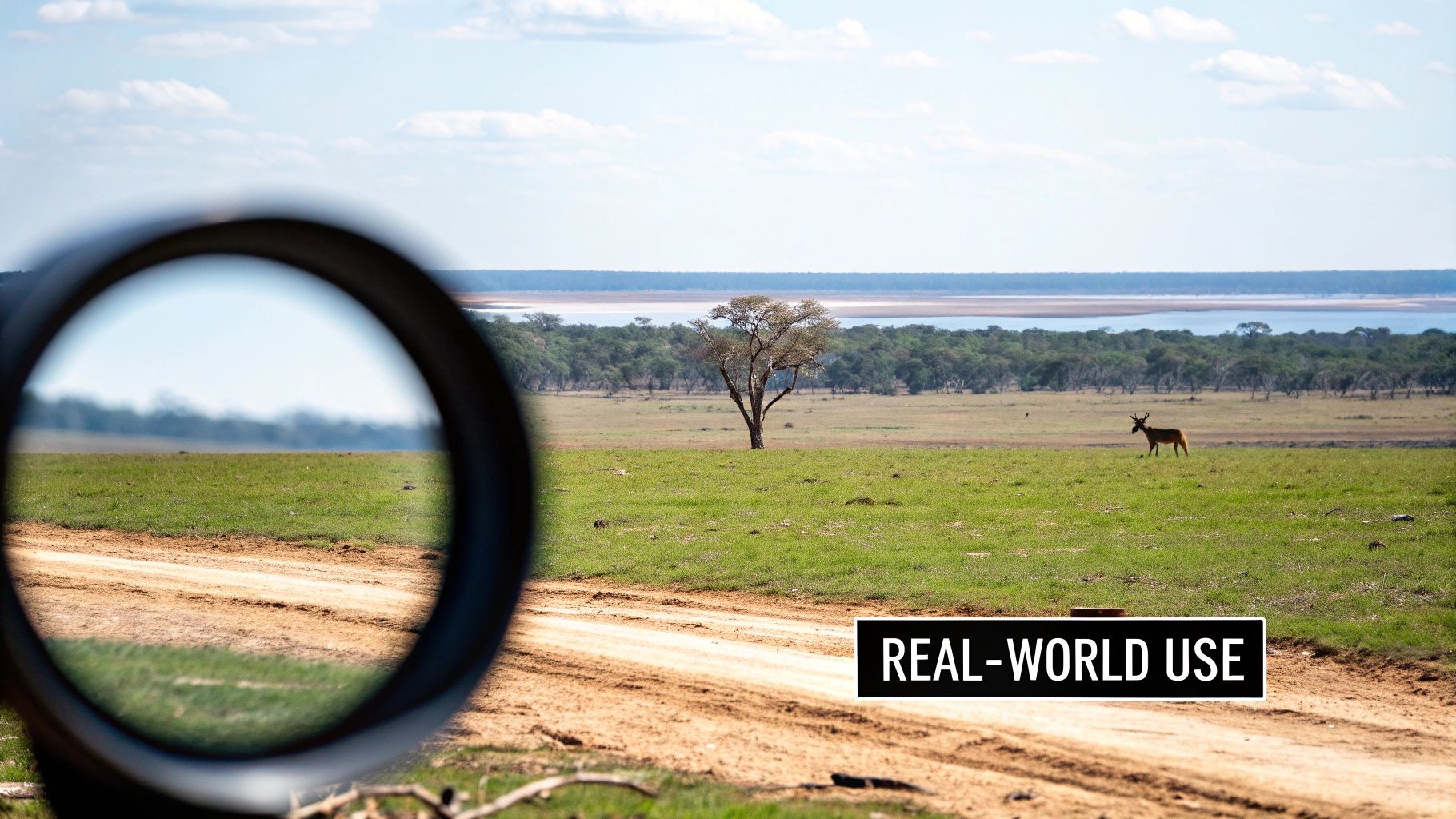
The real value of a magnifier and holographic sight isn't something you'll find on a spec sheet. It's proven in the field, where seconds count and adaptability is everything. Being able to instantly switch from close-quarters speed to mid-range precision gives a shooter a huge edge in dynamic environments. This isn't just about convenience; it's a genuine tactical advantage.
Let's ground all the technical details in real-world performance. The following scenarios show just how this setup delivers when both speed and accuracy are non-negotiable.
Law Enforcement and Urban Operations
Picture an officer clearing rooms in a building. With the magnifier flipped out of the way, their holographic sight gives them a wide, unlimited field of view. This 1x, both-eyes-open setup is perfect for the tight corners and short distances of close-quarters battle (CQB), maximizing situational awareness and cutting down reaction time.
Suddenly, a threat appears down a long hallway, maybe 75 yards away. In a split second, the officer can flip the magnifier into place. The target is now magnified, making positive identification and a precise, confident shot possible. This instant transition is exactly why so many patrol and SWAT teams rely on this combo.
The ability to positively identify a threat before engaging is a critical rule of engagement. A magnifier provides the clarity needed to make that split-second decision correctly, enhancing both officer safety and operational effectiveness at standoff distances.
The Modern Hunter
Today's hunters often cover wildly different terrain in a single trip. Imagine you're tracking a deer through thick, dense woods. At 1x, the holographic sight is perfect for catching movement and taking a quick shot on an animal that might pop out at 40 yards. The unmagnified view keeps you aware of your surroundings, letting you scan the brush effectively.
Then, you step out to the edge of a field and spot game 200 yards out. Flip the magnifier into place, and you can now properly identify the animal, confirm it's a safe and ethical shot, and place your reticle with precision. This setup basically eliminates the need for a separate pair of binoculars, lightening your load and helping you make a clean, humane shot at a moment's notice.
Competitive Shooting Dominance
In the high-speed world of 3-Gun and other action shooting sports, every fraction of a second matters. Competitors face stages that force them to switch between paper targets a few feet away and steel plates hundreds of yards downrange. A magnifier and holographic sight combo feels like it was designed specifically for this challenge.
Shooters can fly through the close-range targets with the magnifier disengaged, then seamlessly flip it into position to nail the distant steel without breaking their shooting rhythm. That on-the-fly adaptability shaves precious time off their scores, which often decides who ends up on the podium.
The versatility of this setup makes it a top choice for anyone who needs to be effective at a variety of distances without changing their weapon system.
The following table breaks down which groups get the most out of this optic pairing and why.
Ideal Use Case for Magnifier And HWS Combo
| User Group | Primary Benefit | Common Engagement Distance |
|---|---|---|
| Law Enforcement | Rapid PID and engagement flexibility in urban/suburban environments. | 5 – 100 yards |
| Hunters | Adaptability for varying terrain, from dense woods to open fields. | 25 – 250 yards |
| Competitive Shooters | Seamless transitions between close-quarters and long-range stages. | 3 – 300+ yards |
| Home Defense | Unmagnified speed for indoor use with the option for precise outdoor shots. | 3 – 75 yards |
Ultimately, this combo empowers shooters to handle whatever challenge comes their way, bridging the gap between close-quarters speed and mid-range accuracy with a simple flick of the wrist.
Frequently Asked Questions
Jumping into a magnifier and holographic sight combo for the first time? It’s completely normal to have a few questions. Here are some straightforward answers to the things we get asked most often.
Does a Magnifier Need its Own Battery?
Nope, not at all. Think of the magnifier as a small, rugged telescope bolted to your rifle. It’s a purely optical tool with lenses that enlarge your view, but it has zero electronics. No batteries, no circuits, no fuss.
The holographic sight is the powered component doing all the heavy lifting—projecting the reticle with its internal laser. The magnifier just gives you a closer look at what the holo sight is already showing you.
Can I Use Any Brand of Magnifier with My Holographic Sight?
You often can, but there's one critical detail you can't ignore: optical alignment. The absolute center of the magnifier’s lens must line up perfectly with the center of the holographic sight's window.
This is why sticking with the same brand for both is usually the path of least resistance; they're designed to match up right out of the box. If you decide to mix and match brands, just make sure you get a mount that lets you adjust the height. Without that perfect alignment, you’ll be fighting a distorted sight picture.
The whole point is to get a perfect co-witness between the two optics. If they're misaligned, you'll see a weird oval shape or dark, shadowy crescents in your view instead of a clean circle. Getting the height right is non-negotiable for the setup to work properly.
Why Does My Holographic Reticle Look Blurry Through the Magnifier?
This is the number one question we hear, and the fix is almost always simple: the diopter adjustment. That fuzzy, pixelated look isn't a defect; your magnifier just isn't focused for your eye yet.
Look for a focus ring on the eyepiece of the magnifier (the part closest to your face). Simply turn it one way or the other until that reticle snaps into a sharp, crisp image. It's a quick calibration every shooter needs to do.
Ready to build the ultimate adaptable optic system? Superior Tactical LLC offers a curated selection of top-tier holographic sights and magnifiers from trusted brands like EOTech. Find the perfect combination for your mission at https://superiortac.com.
