Infrared Night Vision Illuminator Explained
Think of an infrared night vision illuminator as an invisible flashlight, built specifically for your night vision device. It shoots out a beam of infrared light that your eyes can't see, but your gear can. This allows you to get a crisp, bright image even when it's pitch-black outside.
How IR Illuminators Cut Through Complete Darkness
Imagine your night vision device is a set of super-powered eyes. Even the best eyes can't see without some light. Most of the time, even on a dark night, there’s a bit of ambient light from the moon or stars. Night vision works by taking those tiny bits of light—photons—and cranking up their brightness thousands of times.
But what if you're in a basement with no windows, a deep cave, or under a thick, cloudy sky? In those situations, there is zero ambient light. Your expensive night vision gear, no matter how good it is, is effectively blind. It has no light to amplify, so it can't create an image.
The "Invisible Flashlight" at Work
This is exactly where an infrared night vision illuminator comes in. It solves the "no-light" problem by creating its own. It's just like a regular flashlight, but instead of a visible beam that would give you away, it projects light from the infrared spectrum—totally invisible to the naked eye.
The concept is brilliantly simple:
-
The illuminator throws its invisible infrared beam onto whatever you're looking at.
-
That IR light reflects off surfaces, just like visible light from a normal flashlight.
-
Your night vision device picks up all that reflected IR light.
-
The device then amplifies this new, powerful light source, giving you a perfectly clear and detailed view.
This isn't just a handy accessory; it's a critical piece of kit. An illuminator fundamentally changes your night vision from a passive, light-gathering tool into an active system that works in any light conditions, period. To learn more about how different systems handle light, check out our guide on the core differences between thermal, digital, and analog night vision technology.
An illuminator turns a zero-light environment from a total dead-end into a massive tactical advantage. You're never left in the dark.
This game-changing capability is why the night vision market is growing so fast. The global market, valued at USD 8.57 billion in 2025, is expected to hit USD 12.91 billion by 2030, which is a compound annual growth rate of 8.5%. This boom is driven by everything from defense and border security to law enforcement and even wildlife enthusiasts. You can read the full research about the night vision device market for more details.
Decoding an IR Illuminator Spec Sheet
Shopping for an infrared illuminator can feel like trying to read a foreign language. The spec sheets are loaded with terms like nanometers, milliwatts, and degrees. What do those numbers actually mean for you out in the field? Getting a handle on these key metrics is the difference between buying a powerful tool and an expensive paperweight.
Let’s cut through the jargon. Think of a spec sheet less like a scientific paper and more like the performance stats for a car. Each number tells you a specific story about how the illuminator will perform when you need it most.
This diagram shows the simple but powerful relationship between an illuminator, your night vision goggles, and your eyes.
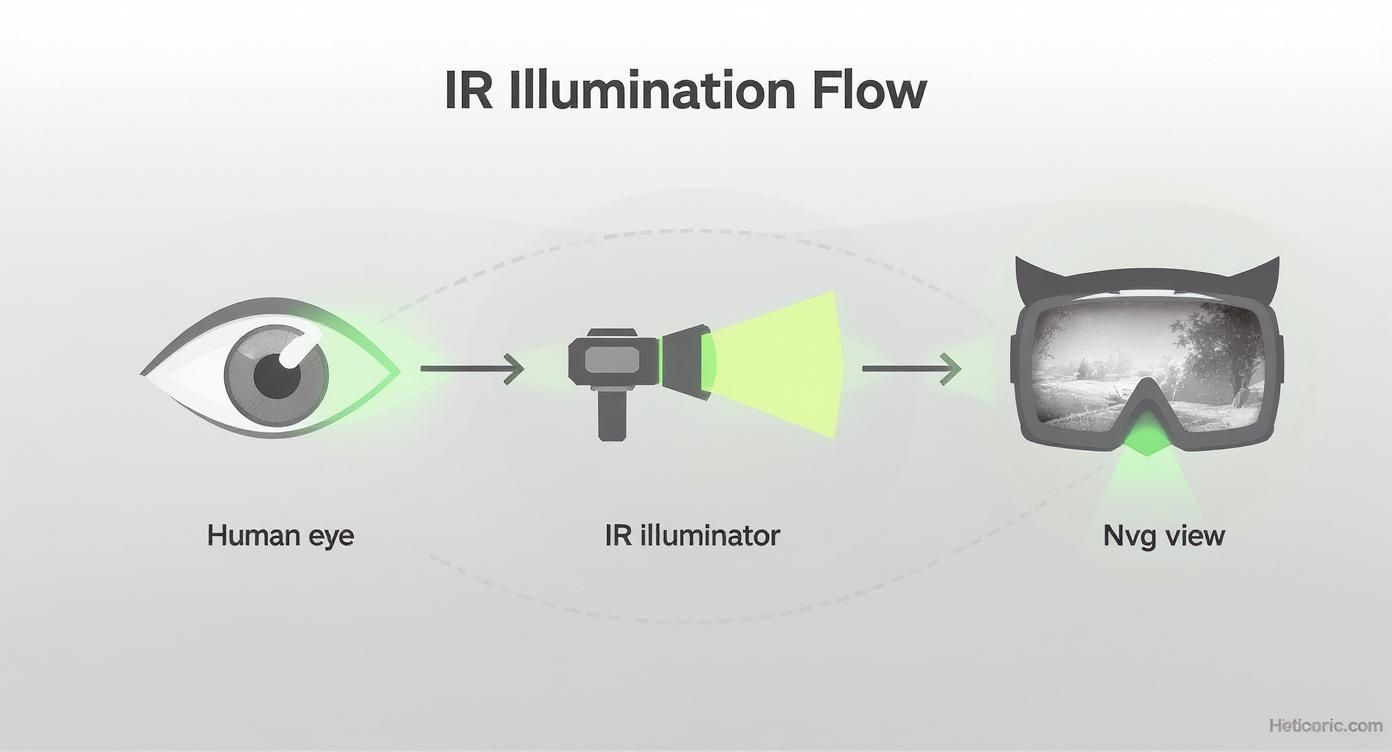
It’s a great visual reminder: while your eyes see nothing, the illuminator acts as an invisible floodlight, giving your night vision device (NVD) the energy it needs to build an image out of complete darkness.
Wavelength: The Stealth Factor
The first spec you’ll run into is wavelength, measured in nanometers (nm). This number defines the "color" of the infrared light, which directly impacts how visible it is to the naked eye. The two most common options you'll see are 850nm and 940nm.
To help you decide, here’s a quick breakdown of how these two common wavelengths stack up against each other.
Comparing 850nm and 940nm IR Wavelengths
| Specification | 850nm Illuminator (Semi-Covert) | 940nm Illuminator (Fully Covert) |
|---|---|---|
| Visibility | Produces a faint, dull red glow at the emitter. Visible to the naked eye up close. | Completely invisible to human and most animal eyes. Total stealth. |
| Performance | High output and range. Most NVDs are highly sensitive to this wavelength. | Lower output and range. Effective range is 30-40% less than a comparable 850nm unit. |
| Best For | Law enforcement, search and rescue, general purpose use where maximum range is critical. | Covert surveillance, hunting wary game, situations where any visible signature is unacceptable. |
| Trade-Off | Sacrifices complete stealth for maximum power and illumination distance. | Sacrifices significant range and brightness for complete invisibility. |
Choosing the right one really boils down to your mission. For a law enforcement officer clearing a building, the raw power of 850nm is probably worth the slight signature. But for a hunter trying to watch a coyote without spooking it, the total invisibility of 940nm is the only real choice.
Output Power: The Engine's Horsepower
Next up is output power, measured in milliwatts (mW). This is the horsepower of your illuminator. It’s a direct measure of how much infrared energy the device is kicking out. Generally, a higher mW rating means a longer effective range and better illumination on distant targets.
It’s pretty straightforward: a 100mW illuminator might be great for scanning your backyard, but you’ll want 600mW or more if you're trying to identify something hundreds of yards away. More power pushes that IR light further and ensures a stronger reflection comes back to your device. The downside? More power eats batteries faster.
A common mistake is thinking more power is always better. Blasting a high-power illuminator at a close-range target will cause "blooming"—a massive washout in your night vision that completely blows out the details you're trying to see.
Beam Angle: Flood vs. Spot
The beam angle, measured in degrees, dictates the shape of your IR light. Just like a high-end flashlight, a good infrared night vision illuminator will let you adjust between a focused "spot" or a wide "flood" beam.
-
Wide Angle (Flood): A beam of 10 degrees or more throws a wide cone of light. This is perfect for situational awareness, scanning a field, or just moving around on foot. You trade long-distance punch for a much larger field of view.
-
Narrow Angle (Spot): A tight beam of 5 degrees or less concentrates all the illuminator's power into one small, intense circle. This is what you’ll use for long-range detection and getting a positive ID on a specific target.
The ability to adjust from a wide flood to a tight spot on the fly is a game-changing feature. You can use the flood to scan a large area, and the moment you spot something, crank the beam down to a tight spot for a crystal-clear look. It gives you the best of both worlds in a single piece of gear.
Choosing Your Tech: LED vs. VCSEL Illuminators
When you pop the hood on an infrared illuminator, you're going to find one of two engine types doing the heavy lifting: a Light Emitting Diode (LED) or a Vertical-Cavity Surface-Emitting Laser (VCSEL).
Think of it this way: both will light up the dark, but they do it in completely different ways. An LED is like a trusty floodlight, bathing a wide area in smooth, even light. A VCSEL, on the other hand, is like a high-powered spotlight, punching a tight, disciplined beam deep into the darkness. Which one you need really boils down to what you're trying to accomplish.
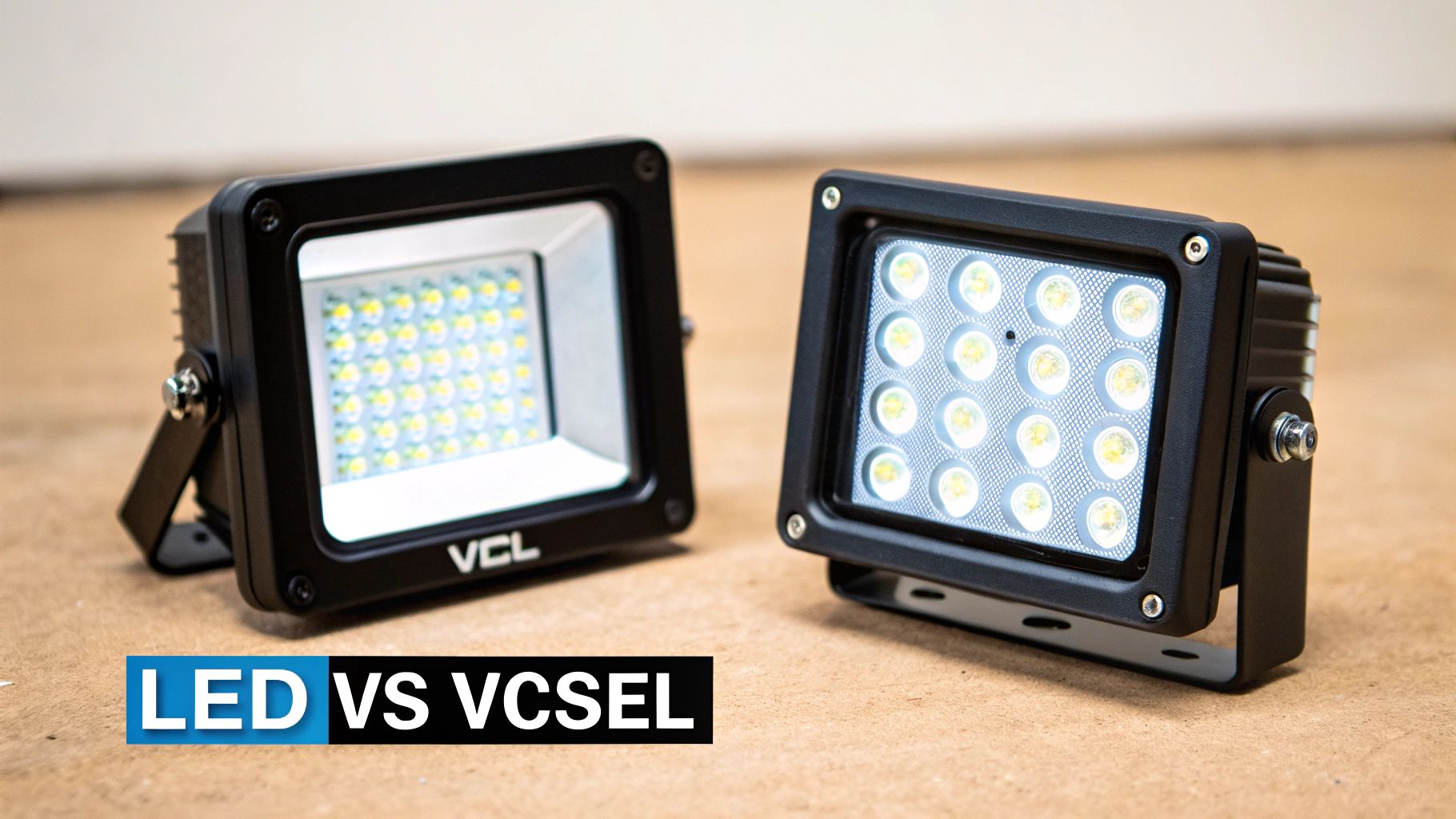
There’s no single "best" choice, only the right tool for the job. Are you clearing a building and need to see every corner, or are you trying to identify a target hundreds of yards away? Let's break down where each one shines.
The Dependable LED Illuminator
LEDs are the old guard of IR illumination, and for good reason. They're reliable, rugged, and get the job done without much fuss. An LED illuminator works a lot like a high-quality flashlight, just in a wavelength your eyes can't see.
Its biggest strength is the beautiful, even cone of light it produces. You get a soft-edged, consistent beam that’s perfect for scanning your immediate area. There's no distracting "hotspot" in the center that washes out details, which makes them ideal for:
-
Close-Quarters Work: Navigating tight spaces or dense woods where you need broad situational awareness.
-
General Observation: Casually scanning a field or your property without the intensity of a laser.
-
Budget-Conscious Builds: LED illuminators are typically more affordable, offering incredible value and performance.
The trade-off? Range. An LED's beam just doesn't have the legs for long-distance work. As the light travels, it spreads out and loses its punch, making it difficult to see much detail on targets far away.
The Precision of VCSEL Illuminators
VCSEL technology is a whole different beast. By using a sophisticated laser diode, these illuminators create an incredibly focused and efficient beam of IR light. Almost no energy is wasted on spill; it all goes where you point it.
A VCSEL doesn't just throw light; it projects a disciplined, coherent beam. This efficiency is what allows it to achieve identification ranges that are often double that of a comparable LED unit.
This laser-focused power is what makes VCSELs the undisputed king of long-range illumination. The clean beam slices through humidity and haze far better than an LED, giving you a much crisper image on distant targets. You’ll notice less of that grainy, swimming effect (photon scintillation) that plagues night vision when it’s starved for light.
So, how do they stack up head-to-head?
| Feature | LED Illuminator | VCSEL Illuminator |
|---|---|---|
| Beam Quality | Smooth, even floodlight with soft edges. | Highly focused, clean spotlight with minimal spill. |
| Best Use Case | Close-to-mid-range scanning and navigation. | Long-range target identification and precision tasks. |
| Range | Good | Excellent; often 2x the effective range of LEDs. |
| Potential Issue | Limited long-distance performance. | Can create a distracting, grid-like pattern in the beam. |
| Cost | More affordable. | Generally more expensive due to advanced technology. |
Ultimately, your decision comes down to your typical engagement distance. If you mostly need to light up a large area within 100-150 yards, a quality LED illuminator is a fantastic, cost-effective tool. But if you need to positively identify what’s out there at 300 yards or more, the reach and clarity of a VCSEL-powered infrared night vision illuminator is a game-changer.
Real-World Scenarios for IR Illuminators
Knowing the specs of an infrared illuminator is one thing, but understanding what it can actually do for you in the field is another. This is where the theory meets reality. From high-stakes tactical entries to quiet nights watching wildlife, these devices are absolutely essential tools across a huge range of activities. They give you active control over the dark, rather than just passively working with whatever little light is available.
The basic job is always the same: paint an area with invisible light. But how you paint that area—and with what kind of light—changes completely depending on the mission. A police officer clearing a dark warehouse and a search and rescue volunteer scanning a mountainside have completely different needs.
Law Enforcement and Military Operations
For tactical teams, positive target identification isn't just a goal; it's a non-negotiable rule of engagement. In the true pitch-black of an abandoned building, there’s often zero ambient light, making even the best night vision devices struggle. This is exactly where a high-power, weapon-mounted infrared night vision illuminator becomes a force multiplier.
Operators almost always lean toward powerful VCSEL laser illuminators, typically in the 850nm wavelength. The top priority is punching through the darkness with maximum range and clarity, cutting through atmospheric junk like smoke or fog to identify threats from a safe distance. The ability to snap the beam from a wide flood for clearing a room to a tight spot to ID a figure down a long hallway is critical for staying ahead of the situation.
These scenarios demand gear that just plain works.
-
Positive Identification: A focused beam can light up a subject hundreds of yards away, giving an officer the critical information needed to confirm a threat before acting.
-
Breaching and Clearing: A wide "splash" of IR provides instant visibility into every corner of a room upon entry.
-
Non-Lethal Deterrence: A powerful, focused IR beam can be used to disorient an opponent who is also using night vision, giving you a tactical edge.
Hunting and Wildlife Observation
For hunters and wildlife watchers, the playbook is flipped. Here, stealth is everything. The slightest hint of human presence can send game scattering, which makes the choice of illuminator absolutely critical. This is where the 940nm illuminator truly shines—or rather, doesn't shine.
Because this wavelength is completely invisible to the eyes of most animals, it lets you watch and scan without giving yourself away. A hunter can glass a field for hogs or coyotes knowing their invisible flashlight isn't a dead giveaway.
An 850nm illuminator's faint red glow might seem minor, but to a wary deer with incredible night vision, it’s a glaring red flag. A 940nm unit completely eliminates this risk, but it comes at the cost of some illumination range.
It’s a trade-off most serious hunters are willing to make. They pair these covert illuminators with digital or highly sensitive analog night vision scopes, making up for the reduced output to enable ethical and effective hunts after sundown.
Search and Rescue Missions
When every second counts on a search and rescue (SAR) mission, teams need to cover huge, dark areas as fast as possible. This is where handheld or drone-mounted IR illuminators with a wide-angle flood beam become indispensable.
SAR teams aren't trying to identify a specific threat; they're looking for any sign of a missing person. A powerful, wide beam can light up an entire section of a forest or a mountainside, making it much easier for observers with night vision to spot a piece of clothing, movement, or a heat signature. This broad application of invisible light is just one of the many applications of night vision across different fields.
Private and Commercial Security
The private security world has fully embraced infrared illuminators to beef up their surveillance systems. While most modern security cameras have built-in IR LEDs, they’re often weak and short-ranged. Adding a quality external infrared night vision illuminator can radically extend a camera's effective reach.
You can supercharge a perimeter security setup, turning a camera that was only useful out to 50 feet into one that delivers clear images at 200 feet or more. This market is absolutely booming; the global security camera market featuring integrated IR was valued at around USD 3.6 billion in 2025 and is projected to hit USD 7.2 billion by 2035. This growth is all about the undeniable need for effective, 24/7 monitoring. You can find more data on this trend in security tech over at Future Market Insights.
Integrating an Illuminator with Your Gear
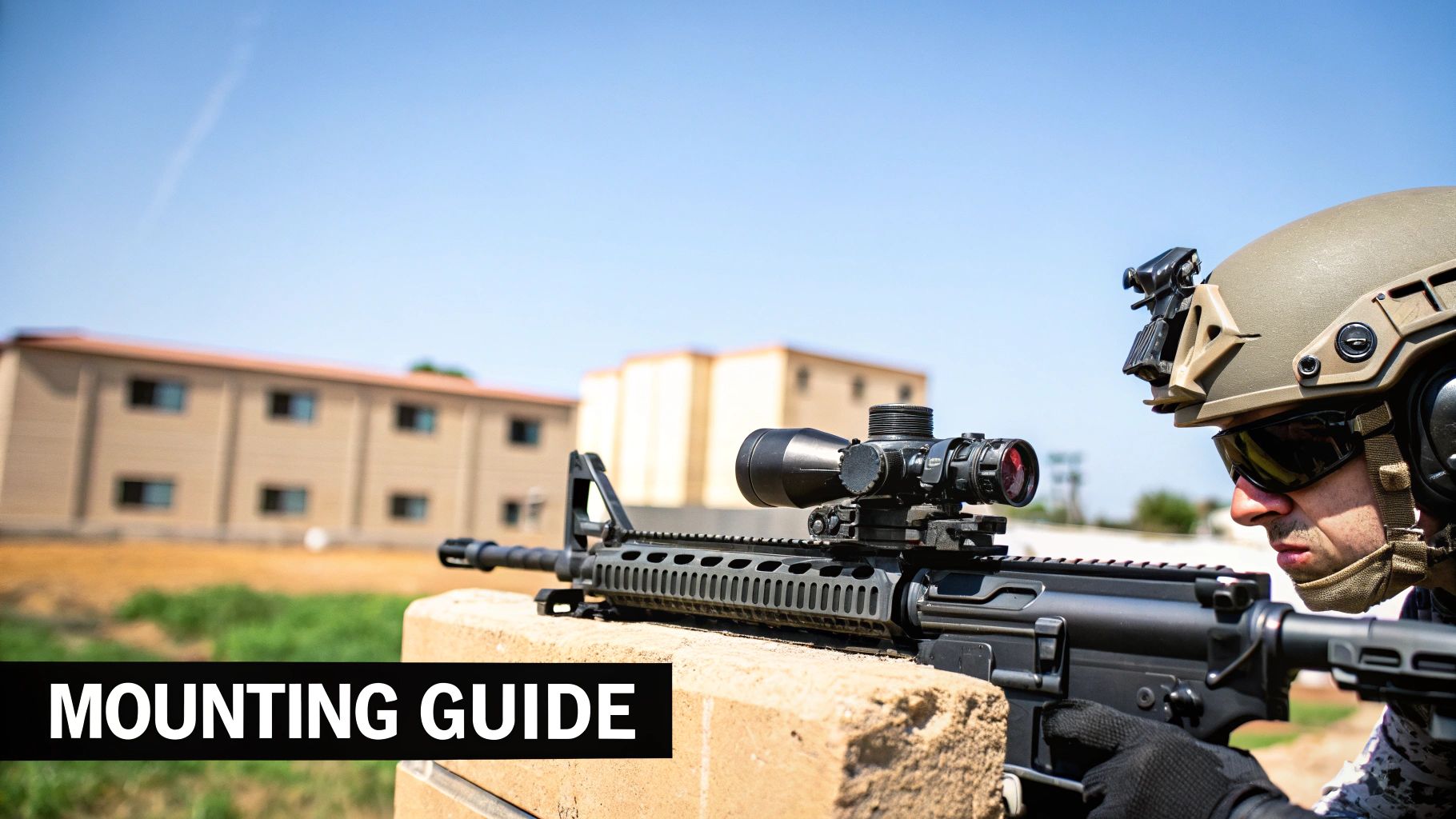
An IR illuminator is a force multiplier, but only if it plays nice with the rest of your kit. A killer beam of infrared light is useless if it’s awkwardly mounted or fighting against your night vision device. Getting this synergy right is what separates a truly capable low-light system from a clumsy collection of parts.
Proper integration isn't just about bolting on another accessory. It’s about building a balanced, intuitive setup where everything works together seamlessly. This means you can light up a target quickly and effectively, whether your illuminator is on your rifle or your helmet.
Choosing Your Mounting System
If you're putting an illuminator on a rifle, your first choice is how to attach it. The two big players in the game are Picatinny and M-LOK, and the right one depends on your rifle's handguard and what you value most.
-
Picatinny Rails: This is the old guard, the battle-tested standard known for being bomb-proof and universally compatible. A Picatinny mount is heavy-duty and secure, making it a go-to choice for larger, high-power illuminators where you can't afford any wobble.
-
M-LOK (Modular Lock): As the newer kid on the block, M-LOK offers a more streamlined approach. It lets you attach accessories directly to the handguard, skipping the need for a full-length rail. The result is a lighter, lower-profile setup that’s less likely to snag on your gear.
Helmet mounting is a completely different ballgame. It gives you hands-free illumination that points wherever you look—a huge advantage for navigating, driving, or performing medical tasks in the dark. Specialized mounts let you clip the illuminator directly to your helmet's ARC rails or shroud, freeing up your hands for what matters. If you're going down the head-borne route, check out our guide on choosing the best night vision mount to make sure your whole system is stable and comfortable.
Night Vision Generations and Illuminator Synergy
How much benefit you get from an IR illuminator depends heavily on the generation of your night vision device. Think of your image intensifier tube like an engine—a high-performance engine gets a lot more power out of the same tank of gas (or, in this case, IR light).
A top-tier Gen 3 tube is incredibly sensitive to light. When you pair it with a potent illuminator, it can paint a bright, crisp picture at distances that a lower-gen device, using the same light, could only dream of.
Here’s how it generally breaks down:
-
Gen 1: These units have very low light gain and absolutely need a strong IR illuminator to be useful in real darkness. Without one, they’re pretty much blind.
-
Digital: Much like Gen 1, digital night vision leans on an illuminator to see. The sensor needs a solid IR source to deliver a clean image without a ton of digital noise.
-
Gen 2: A big step up in light amplification, Gen 2 devices still see a massive performance jump with an illuminator, especially when you need to positively identify targets at longer ranges.
-
Gen 3: This is the gold standard. Gen 3 tubes are so sensitive they can often operate on faint starlight alone. Still, an illuminator remains an essential tool for punching through pitch-black conditions or lighting up targets hundreds of yards away.
Avoiding Common Integration Pitfalls
One of the most common headaches is dealing with "splash" or "washout," especially when using magnified optics. This is what happens when the powerful IR beam from your illuminator reflects off the inside of your scope or the objective lens, flooding your NVD with too much light and completely obscuring your view.
The fix is simple: mount your illuminator as far forward on the handguard as you can. Pushing the illuminator out past your optic ensures the IR beam travels downrange without bouncing back into your line of sight. It's a small adjustment that makes a world of difference in keeping your entire system working as one.
How to Choose the Right IR Illuminator for You
Now that we've covered the nuts and bolts, let's put that knowledge to work. Picking the right infrared illuminator isn’t about chasing the most powerful or expensive model; it’s about finding the one that perfectly fits your mission, your gear, and your budget. The best choice is the one that clicks with your typical engagement distances and stealth needs.
Think of this as a roadmap to making a smart investment. We'll walk through a few common user profiles to help you pinpoint exactly what features you should prioritize. Whether you're on a tactical team, out hunting predators, or just exploring the night, knowing your "why" is the first step to finding the right "what."
It's a good time to be in the market, too. The demand from professionals is pushing innovation forward. The infrared night vision camera sector alone was valued at roughly $2.5 billion in 2025 and is expected to grow at about 7% annually through 2033, driven by better sensors and smarter tech. You can dig into more of this data over at archivemarketresearch.com.
Matching the Illuminator to Your Mission
The right tool for the job. It's an old saying, but it's especially true here. An illuminator that’s perfect for a SWAT team clearing a building is probably the wrong choice for a hunter trying to spot a coyote across a field. Let’s figure out which camp you’re in.
The Tactical Operator
For anyone in law enforcement or professional security, there's no room for compromise. You need raw power, rock-solid durability, and the ability to adapt on the fly.
-
Wavelength: The go-to is 850nm. You're prioritizing maximum illumination and punch over complete invisibility.
-
Technology: A VCSEL illuminator is the top choice. It gives you that long-range authority and helps slice through humidity, smoke, or fog.
-
Features: A focusable beam is a must-have for quickly switching from a wide flood to a tight spot. Also, look for bomb-proof construction and compatibility with standard weapon-mounted pressure pads.
The Avid Hunter
Here, stealth is everything. Your entire goal is to see your quarry without it ever knowing you're there. Animals have incredible night vision, and you have to beat it.
-
Wavelength: 940nm is non-negotiable. The shorter range is a small price to pay for being completely invisible to your target.
-
Technology: A high-quality LED works great for closer-range setups, while a VCSEL is better for reaching out across big, open country.
-
Features: An adjustable beam is key for scanning a wide area and then tightening it up for positive identification. And since you'll be carrying it all night, a lightweight build is a huge bonus.
For hunters, the choice is clear: an illuminator's invisibility is more valuable than its maximum reach. A spooked animal is a lost opportunity, making a 940nm wavelength the superior tactical choice.
The Night Vision Enthusiast
If you're a hobbyist, a landowner checking on your property, or just someone who enjoys exploring after dark, you're looking for the sweet spot between performance and price. You need a solid, versatile tool that can do a little bit of everything.
-
Wavelength: 850nm is your best bet. It delivers the most illumination for your dollar, making it perfect for navigation, general observation, or backyard security.
-
Technology: A reliable LED illuminator usually hits that perfect balance of cost and capability for most people's needs.
-
Features: Look for adjustable power levels and a focusable beam. These two features give you a ton of flexibility to adapt the light for whatever you're doing.
Got Questions? We’ve Got Answers.
Still have a few things you're wondering about? Let's clear up some of the most common questions guys have when they're getting into IR illuminators.
Can an IR Illuminator Hurt My Eyes?
Yes, absolutely. A high-powered illuminator is no joke. Even though you can't see the infrared light, it's still a highly concentrated beam of energy. Never look directly into an active illuminator—you can cause serious, permanent damage to your retina before you even realize it.
Think of it like this: treat it with the same rules you use for a loaded firearm. Always be aware of where that beam is pointing, especially indoors. Reflections off glass, mirrors, or even polished floors can bounce that energy right back at you or someone else.
Will an IR Illuminator Work with My Thermal Scope?
That's a negative. An infrared night vision illuminator is completely invisible to a thermal optic. It’s a common mix-up, but the two technologies are looking for entirely different things.
-
Night Vision: This tech works by amplifying tiny amounts of light. It needs some light—even invisible IR light—to reflect off a target to create an image.
-
Thermal Imaging: This tech doesn't see light at all. It sees heat. It builds a picture based on the different heat signatures of objects in the environment.
Since an illuminator is a fancy flashlight (producing light, not heat), your thermal scope can't see its beam. It won't help you one bit.
Here's a simple way to remember it: Night vision needs light to see, even if it's invisible light. Thermal needs heat to see. An illuminator is a light source, not a heat source.
Does an Illuminator Work with Digital Night Vision?
You bet. In fact, most digital night vision units rely on a good illuminator to perform well. Digital sensors are thirsty for IR light; without a strong source, the image gets grainy and noisy fast.
While most digital scopes come with a small built-in IR, adding a more powerful external illuminator is one of the biggest upgrades you can make. It will drastically boost your effective range and give you a much cleaner, brighter picture.
Ready to own the night? The team at Superior Tactical LLC lives and breathes this stuff. We can help you find the right illuminator to pair with your setup and your mission. Check out our hand-picked selection of top-tier night vision and tactical gear at https://superiortac.com.
