The Ultimate Guide to an Infrared Camera for Hunting in 2026
An infrared camera is one of the biggest game-changers for hunting, period. It’s a tool that detects an animal's heat signature, letting you see it in total darkness, thick fog, or even through dense brush.
This isn't like old-school night vision that needs a little moonlight to work. Thermal imaging creates a picture purely from heat. That means a warm-bodied animal like a deer or hog will practically glow against a cooler background, giving you an almost unfair advantage when your regular optics are useless.
Seeing the Unseen World of Infrared Hunting
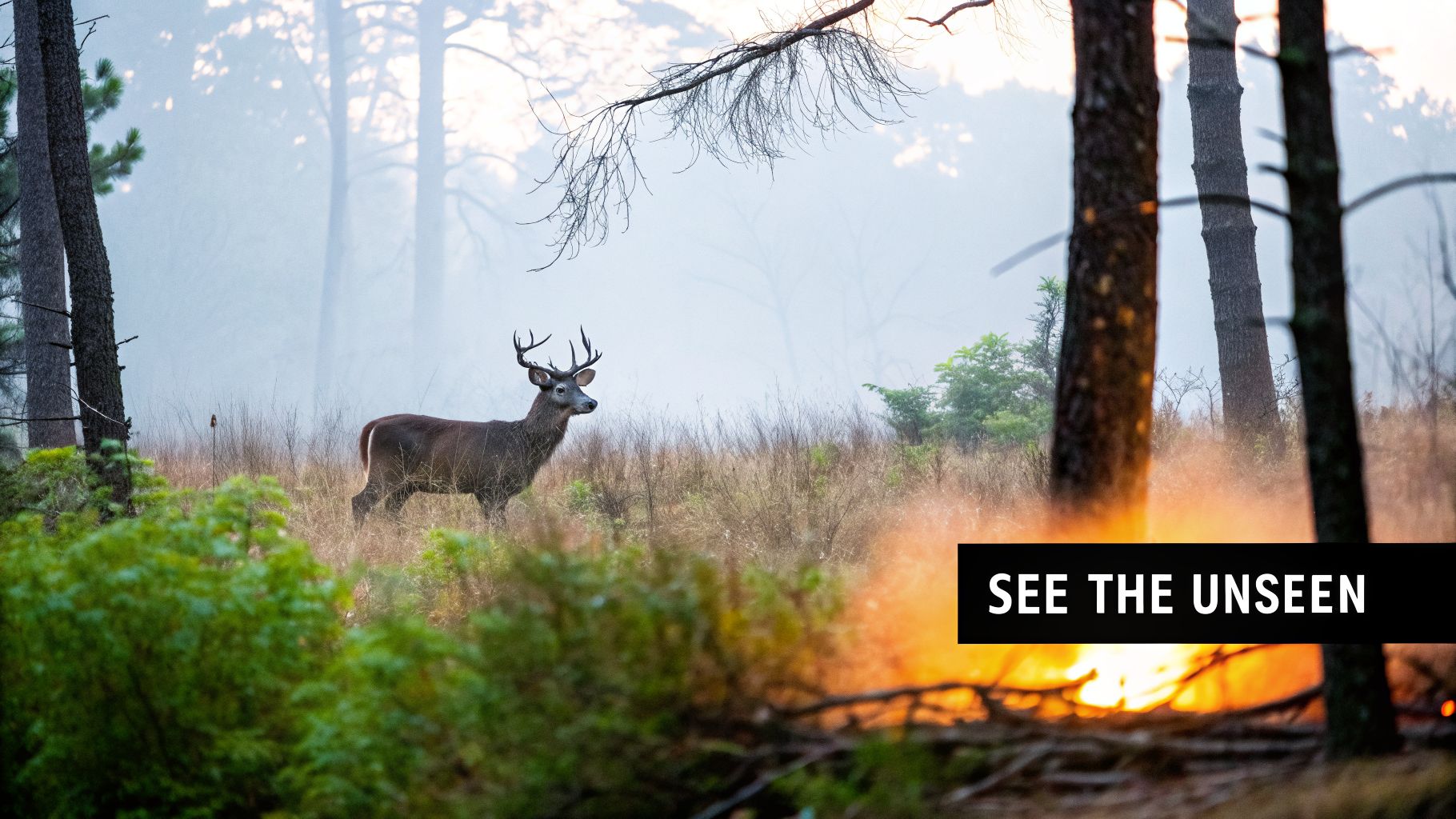
Picture this: you’re scanning a pitch-black field, and suddenly, a whole sounder of hogs pops into view, glowing bright white from over 400 yards away. That’s not science fiction—it’s the edge a good thermal gives you. It blows past the limits of your own eyes and even standard night vision, opening up a world of animal activity that only begins after the sun goes down.
For a long time, this kind of tech was reserved for military and law enforcement. Not anymore. The market for hunting-focused thermal imagers is growing fast, and it’s fundamentally changing how we approach the hunt, from pre-season scouting to recovering game ethically.
The Thermal Advantage in the Field
At its core, a thermal imager just detects tiny differences in temperature. But that simple concept has huge implications for any hunter, offering real-world benefits that lead directly to more success and greater safety in the field.
The numbers back this up. The global market for thermal imagers in hunting was valued at USD 0.1 billion in 2024 and is expected to hit USD 0.3 billion by 2033, reflecting a strong annual growth rate of 12%. This surge is all about hunters wanting to spot game using infrared radiation in conditions where nothing else works. You can get a better sense of this trend in this comprehensive business report.
Here’s what that advantage looks like on the ground:
- Detection in Any Light: Thermal works day or night because it sees heat, not light. A warm-blooded animal is just as visible at high noon as it is at midnight.
- Seeing Through Obscurants: You can finally spot game through fog, smoke, and light brush that would completely hide it from your binos or scope.
- Increased Safety and Certainty: By giving you a clear heat signature, thermal helps you be 100% sure of your target. This dramatically reduces the risk of misidentifying another animal—or, worse, another person.
"Feathers may hide them from view, but their heat signatures stand out against the cold background of water and soil."
This observation from field researchers gets to the heart of why thermal is so effective. It completely bypasses natural camouflage.
For a deeper look at how the technology works, check out our full guide on what thermal vision is. In the next sections, we'll break down everything you need to know to pick the right infrared setup for your kind of hunting.
How Thermal Imaging Actually Works for Hunters
To get the most out of a thermal optic, you need to understand what’s going on inside. Don’t worry, you don’t need a degree in physics—the core idea is surprisingly simple. Every single thing in the world, whether it's a warm-blooded hog or a cold, dead tree, gives off energy. We can't see it, but this energy is infrared radiation, which is just a fancy term for heat.
Think of it like this: the entire landscape is broadcasting invisible heat signals 24/7. Your thermal scope is basically a highly advanced receiver that tunes into these heat signals and translates them into a picture you can see. It needs zero light to function because it’s not looking for light; it's looking for the heat itself.
Active Infrared Versus Passive Thermal
This is where things can get confusing, especially when you're comparing a thermal scope to other night-hunting gear. Not all "infrared" technology is the same. The two big players are active infrared and passive thermal, and knowing the difference is critical to picking the right tool.
An active infrared system, which is what you'll find in most trail cameras and older-style night vision scopes, acts like a flashlight and camera team. It has to blast the area with an IR illuminator—a light beam that’s invisible to human (and most animal) eyes. The camera then picks up the reflection of that IR light bouncing off whatever is in front of it.
Here’s the simple breakdown:
- Active Infrared (Trail Cams, some NV): Needs its own IR light to work. It sees reflected infrared light.
- Passive Thermal (Thermal Scopes): Detects the natural heat an object emits. It sees the heat signature itself and needs no extra light source.
The Hunter's Advantage with Passive Thermal
This "passive" approach is precisely what makes a true thermal infrared camera such a game-changer for hunting. Since it reads heat signatures directly, it isn't fooled by things that trick our eyes, like camouflage or dense cover. A coyote's body, radiating heat at around 98°F, pops like a lightbulb against the cooler background of trees and grass.
This is the key takeaway: if a hog is standing behind a screen of cool bushes, a thermal optic will pick up the glowing heat signature through the gaps in the foliage. A standard night vision device would just see the bushes, because it depends on light reflecting off the very first thing it hits.
This unique ability to cut through the visual noise is what turns a questionable shot into a confident, ethical one. It’s also the reason thermal works in conditions where other optics fail completely, like thick fog, dust, or smoke. Those things block visible light, but they can't stop a powerful heat signature from reaching the sensor.
You can dive deeper into this topic in our complete guide on thermal vs night vision for hunting. This fundamental difference is what allows a hunter to spot game with incredible certainty, leading to positive target ID and smarter decisions in the field, no matter how bad the conditions get.
Decoding Thermal Specs for Better Hunting
Stepping into the world of thermal optics can feel like trying to read a foreign language. You're immediately bombarded with a laundry list of technical specs—resolution, NETD, refresh rates—and it's easy to get lost. But trust me, getting a handle on these numbers is the difference between positively identifying a coyote at 200 yards and staring at a warm, blurry blob you think might be a bedded-down deer.
Think of it like buying a truck. A small pickup is fine for hauling mulch, but you wouldn’t use it to pull a 10,000-pound trailer. The specs on a thermal scope define its capabilities and what job it’s built for. Let's cut through the jargon and break down what actually matters out in the field.
First, a quick primer on how this magic works. Your thermal optic is essentially seeing a part of the light spectrum that's invisible to our eyes. It picks up the infrared energy—or heat—that all objects give off and translates it into a picture you can see.
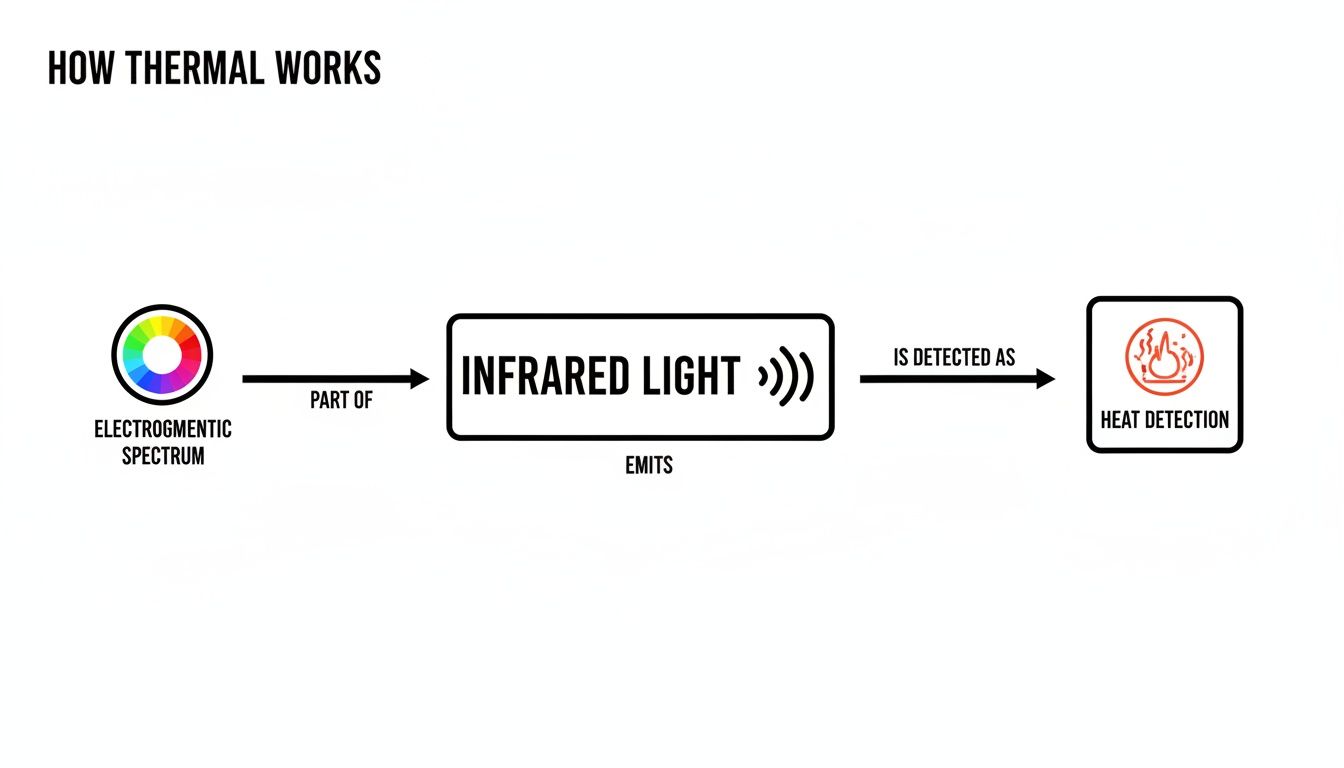
This ability to turn heat into a visible image is what gives you that incredible advantage in total darkness.
Resolution: The Foundation of Clarity
If you only pay attention to one spec, make it resolution. This is the bedrock of image quality. Measured in pixels, just like a TV screen, a higher number means a sharper, more detailed picture. In the thermal world, you’ll mostly see two options: 384×288 and 640×480.
Let's put that in a real-world hunting scenario. You spot a heat signature 300 yards out. With a 640×480 sensor, you’ll see the distinct outline of a deer’s head, neck, and body, giving you the confidence to make an identification. On a lower-res 384×288 sensor, that same animal will look much more pixelated, making it tough to be 100% sure what you're looking at.
- Higher Resolution (640×480): This is your go-to for crisp, clear images. It's essential for identifying game at longer ranges and makes your digital zoom far more effective without turning the image into a pixelated mess.
- Standard Resolution (384×288): Still a very capable choice, especially for closer-range work. It’s a great starting point for predator or hog hunters who typically engage targets inside 200 yards.
Thermal Sensitivity (NETD): Seeing the Smallest Details
Next up is NETD, which stands for Noise Equivalent Temperature Difference. In simple terms, it’s a measure of how well the scope can detect tiny differences in heat. It's measured in millikelvins (mK), and here’s the key: a lower number is always better.
Think of NETD as the scope's sense of hearing. A low NETD can "hear" the faint whispers of heat, creating an image with rich detail and sharp contrast. This becomes incredibly important on humid nights or when there's very little temperature difference between an animal and the ground around it.
A scope with a low NETD (like sub-30 mK) will show you the texture of a hog’s coarse hair against a cool, damp field. A scope with a higher NETD might just render that same hog as a uniform warm blob, blending it into the background.
The demand for this level of performance is exploding. The market for thermal imagers in hunting was valued at USD 146 million in 2024 and is expected to grow by a 10.7% CAGR through 2033. This boom is fueled by hunters wanting premium features like 640×480 resolution and sub-20 mK sensitivity, which allow for clear identification out to 2,000 yards. You can dive deeper into these trends and discover insights on Archive Market Research.
Refresh Rate and Other Field-Ready Features
Image quality is king, but a few other specs have a huge impact on how the optic performs in a dynamic hunt.
Refresh Rate (Hz): This tells you how many times per second the image updates. A 60 Hz refresh rate gives you a smooth, lag-free view, which is critical for tracking a moving target like a running coyote. A lower 30 Hz rate will look choppy, making it tough to keep your reticle where it needs to be. For any kind of hunting that involves moving animals, 60 Hz is the only way to go.
Detection, Recognition, and Identification (DRI): Manufacturers love to talk about range, but you need to know what they mean.
- Detection: The absolute maximum distance at which the scope can pick up a heat spot. You'll know something is there, but not what.
- Recognition: The range where you can tell what kind of thing it is—for example, a four-legged animal versus a person.
- Identification: This is the most important one. It's the range at which you can confidently say, "That's a boar," or "That's a whitetail doe." Always focus on the identification range when comparing models.
Finally, don’t overlook the practical, must-have features. A long battery life of 8+ hours, a good selection of reticle options, and a durable, waterproof body are non-negotiable. These are the things that ensure your infrared camera for hunting is a reliable tool that won't let you down when it counts.
Field-Tested Infrared Hunting Tactics
Owning a great thermal optic is one thing, but knowing how to actually use it is what separates a successful hunter from someone with an expensive toy. It's time to move beyond the specs on a datasheet and talk strategy. These aren't just theories; they're proven methods that will help you find more game, make smarter moves, and ultimately increase your odds of a successful harvest.
There are two main ways to hunt with thermal: strategic scouting from a distance and active hunting on the move. Each has a specific purpose, and mastering both will make you a far more effective predator.
Strategic Scouting with Thermal
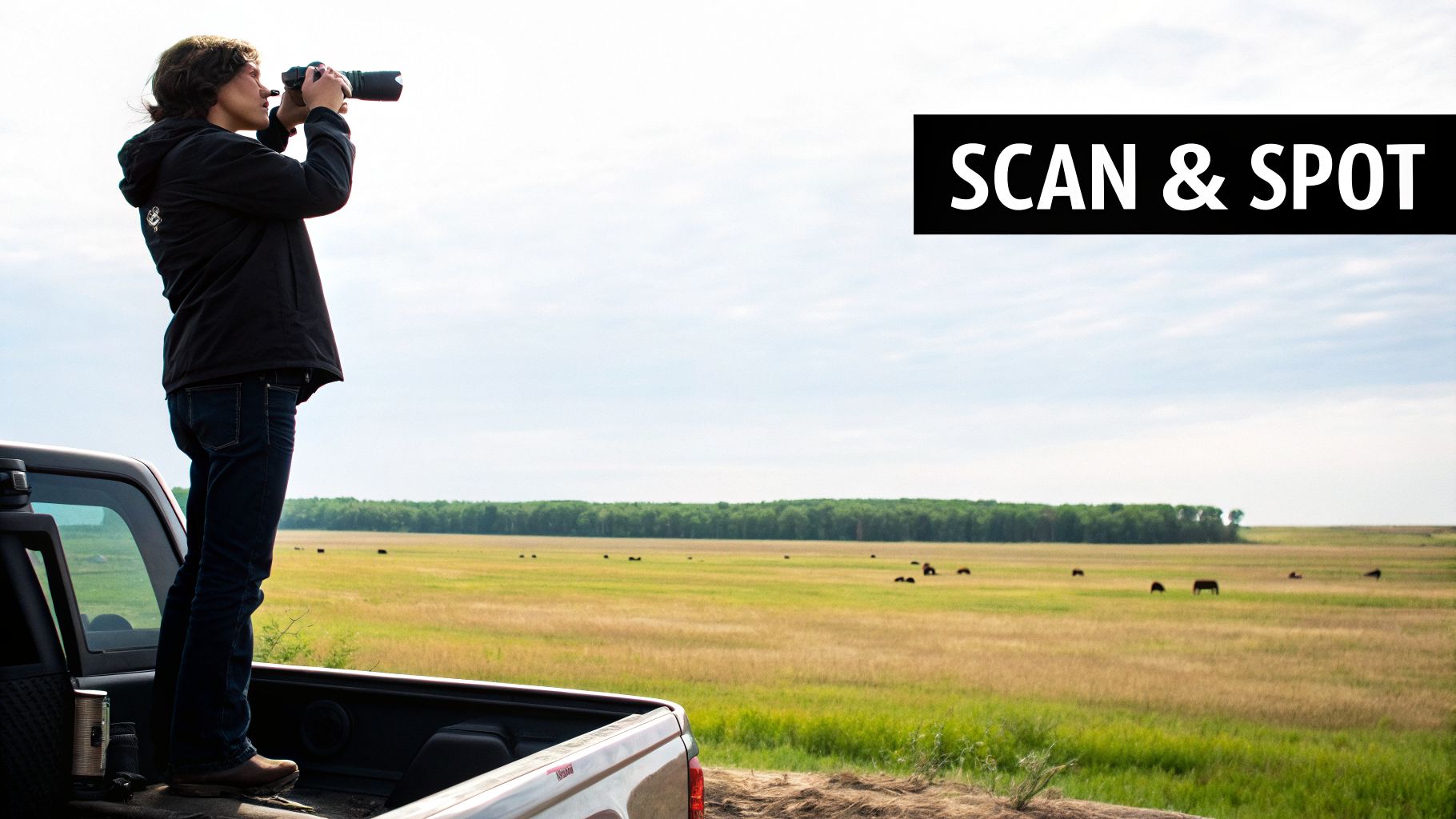
Think of strategic scouting as your intelligence-gathering phase. The entire goal is to locate game and figure out their patterns from a safe distance, all without them ever knowing you're there. This is where a good thermal monocular truly shines.
From the cab of your truck or a high ridgeline, you can scan hundreds of acres in just a few minutes. You're no longer stumbling around in the dark hoping to bump into something. Instead, you're conducting silent reconnaissance, glassing fields and tree lines for that unmistakable white-hot glow of an animal.
This approach gives you a massive advantage:
- Cover Ground Fast: Find exactly where game is feeding or traveling without leaving a single boot print or scent trail behind.
- Pattern Your Quarry: Watch how animals enter and leave an area, giving you the intel needed to set up a perfect ambush later.
- Hunt Smarter, Not Harder: Why sit for hours in a stand that's empty? Use what you learn to be in the right place at the right time.
This proactive approach is also supported by infrared trail cameras, a cornerstone of modern scouting. The market, currently valued at USD 248 million, is overwhelmingly infrared, with over 60% of all models featuring some form of night vision. In fact, low-glow and no-glow versions make up nearly 65% of sales because their subtle flash captures animal behavior without spooking them. You can find more data on the growth of the hunting camera market in this detailed report.
Active Hunting and the Scan-Scope Method
When you’re on the move and actively hunting, your priorities shift to stealth and efficiency. This is where the “scan-and-scope” method is king. It's a simple but incredibly effective system that uses two separate thermal devices: a handheld monocular for scanning and your weapon-mounted scope for the shot.
You start by using your thermal monocular, which usually has a wider field of view, to constantly scan the area around you. This keeps your head up and your rifle down, so you can move quietly and safely while maintaining full awareness of your surroundings.
The core principle is simple: never use your rifle as a pair of binoculars. Continually raising a heavy weapon is slow, tiring, and a huge safety risk. A dedicated scanning monocular solves all three problems.
Only after you’ve spotted a heat signature and identified it as your target with the monocular do you slowly bring up your rifle. This workflow minimizes your movement, saves your scope’s battery life, and prevents you from pointing your muzzle at anything you don't intend to shoot. It’s a disciplined approach that keeps you hidden until the very last second, giving you a clear advantage when it counts.
Navigating the Laws and Ethics of Thermal Hunting
Getting your hands on a powerful infrared camera for hunting is exciting, but it also puts a serious weight on your shoulders. While the tech gives you an almost unbelievable edge, using it isn't a free-for-all. Before you even think about taking a thermal into the field, you have to get a handle on the tangle of laws and personal ethics that come with it.
The single most important thing to burn into your memory is that regulations vary dramatically by state, county, and even by the species you are targeting. There’s no simple, nationwide rulebook. What’s perfectly legal for hog hunting in Texas could get your gear confiscated and your license revoked just one state over.
State Laws and Species-Specific Rules
You absolutely have to check your local regulations every single season. Laws change, and "I didn't know" is never an excuse a game warden wants to hear. A common theme you'll see is that thermals are often green-lit for non-game, invasive, or predatory animals but strictly forbidden for traditional game. The idea is to preserve the challenge and tradition of "fair chase" for our most valued species.
Here are a few real-world examples of how different these rules can be:
- Hog and Coyote Hunting: Many states, especially across the South and Midwest, have wide-open laws for thermal hunting hogs and coyotes. These animals are often managed as pests, so night hunting with thermals is seen as a crucial tool for population control.
- Deer Hunting: On the flip side, it is almost universally illegal to use any light-emitting or thermal device for hunting deer. This is one of the most hard-and-fast rules in wildlife management, so don't even think about bending it.
- Furbearer Regulations: Rules for critters like raccoons, foxes, and bobcats often fall into a gray area. Some states are fine with it, some have specific night seasons, and others ban it completely.
Your best bet is always the official source. Go directly to your state's Department of Natural Resources or Wildlife Commission website. Don't ever rely on what you heard from a buddy or read on an old forum post—the responsibility to be legal is 100% on you.
The Ethics of Fair Chase
Once you've sorted out the laws, you're left with your own personal code. The concept of fair chase is the bedrock of modern, ethical hunting. At its core, it's the belief that the animal deserves a respectable chance to use its natural senses to survive. An advanced infrared camera for hunting can easily throw that balance out of whack.
This is where you have to shift your mindset. A thermal shouldn't be about making the hunt easier, but about making it better. Your focus should be on using this incredible technology to achieve two main goals: absolute target identification and a clean, humane harvest.
The power to see in total darkness isn't for racking up cheap wins. It's for making sure you never mistake a young animal for a mature one, or worse, a non-target species. It's for guaranteeing you only take high-percentage shots that lead to a quick, ethical end. Being a true sportsman means using every tool, including thermal, to be a more responsible steward of the wildlife we pursue.
Alright, you've got the basics down on how thermal and infrared work. Now for the fun part: picking the right unit for your hunts.
Choosing Your First Infrared Hunting Camera
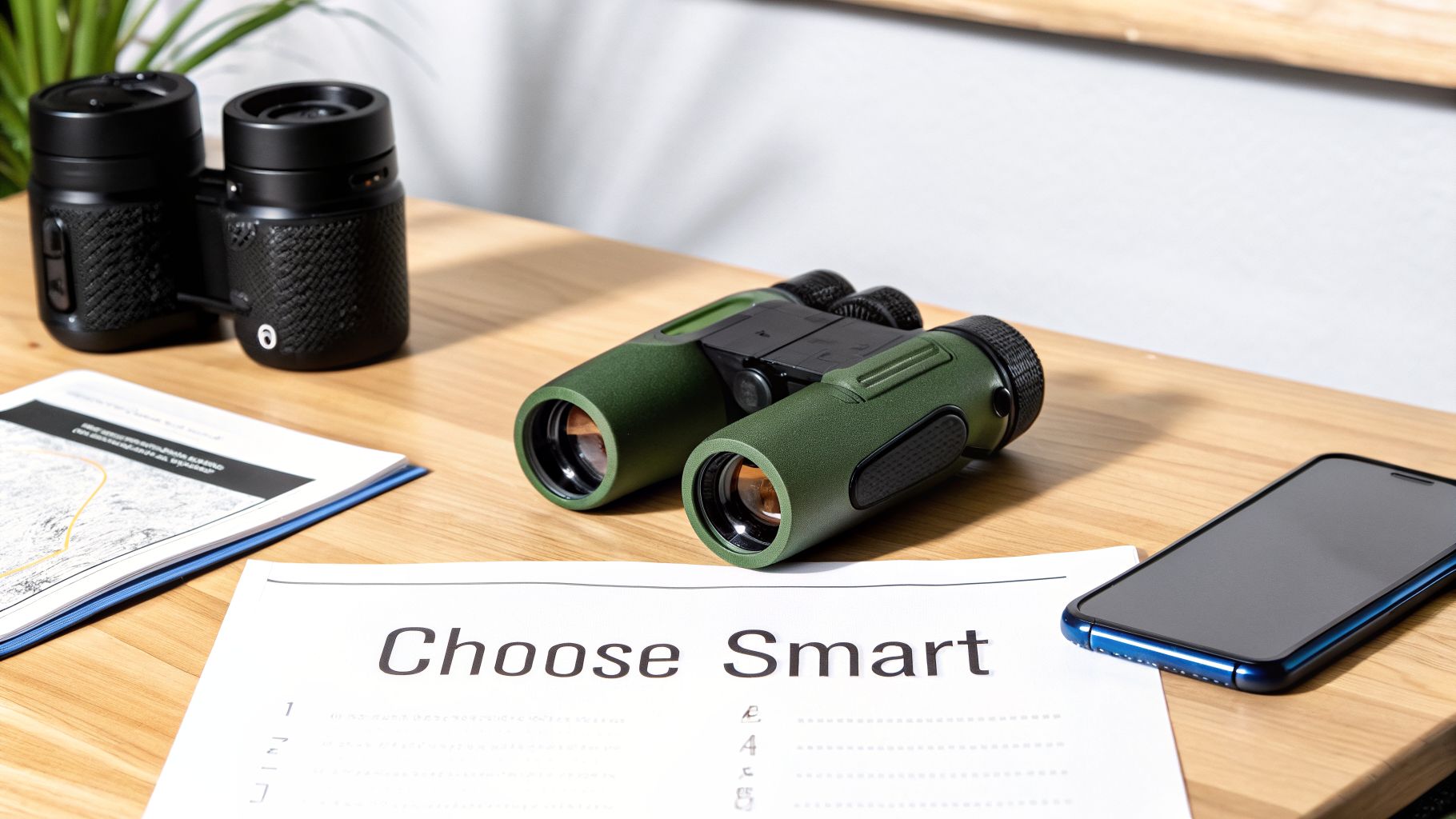
Walking into the world of thermal optics can feel a bit like drinking from a firehose. But don't get overwhelmed. The key is to ignore the noise and focus on a few core questions that connect the specs on a box to what you actually do in the field.
Forget about what the most expensive model can do. The "best" thermal is the one that fits your budget, your local game laws, and the way you hunt. Period.
Aligning Your Hunt with the Right Gear
Let's get practical. Answering these questions honestly will narrow down your options fast, turning a confusing wall of products into a handful of solid choices.
What's your typical engagement distance? This is huge. If you're hunting hogs in the thick stuff inside 150 yards, a 384×288 resolution sensor will give you all the detail you need. But if you’re calling coyotes across wide-open country and need to ID a target past 300 yards, you absolutely have to step up to a 640×480 sensor. It's not a luxury at that point; it's a necessity for positive identification.
What do your local hunting laws say? This is the first and last question you should ask. Check your state's regulations. Can you even use a thermal scope for the game you're after? A high-dollar optic is just an expensive paperweight if it lands you a hefty fine and a lost license.
Do you need a dedicated scope or a versatile monocular? Think about your primary goal. If you just need to spot game and confirm what it is before raising your rifle, a handheld monocular is your most flexible and often most affordable option. If you want a seamless, all-in-one solution for scanning and shooting, a dedicated thermal scope is the way to go. If you want to dive deeper, we have a complete guide on the best thermal monocular for hunting.
Your hunting style dictates your feature priorities. A hunter who sits in a blind has different needs than one who stalks through thick brush. Be realistic about how you'll use the device.
Feature Prioritization Checklist
Once you’ve nailed down the big-picture needs, it’s time to get into the details. This isn't about finding a device with every feature; it's about paying for the ones that will actually help you succeed. Use this simple table to think through what really matters for your specific situation.
| Feature | My Priority (High/Medium/Low) | Why It Matters for My Hunt |
|---|---|---|
| Resolution (e.g., 640 vs 384) | Example: High. I need to ID animals past 200 yards. | |
| Battery Life | Example: High. I do all-night predator hunts. | |
| Detection Range | Example: Medium. My property is mostly wooded, max shot is 150 yards. | |
| Onboard Recording | Example: Low. I don't plan on filming my hunts. | |
| Durability (e.g., IP67) | Example: High. I hunt in the rain and snow. | |
| Mounting System | Example: High. I need a rock-solid return-to-zero mount. | |
| Form Factor (Monocular vs Scope) | Example: Scope. I want an all-in-one shooting system. |
Filling this out forces you to balance your wish list against your budget. A feature might sound cool, but if you mark its priority as "Low," you know you can save money by choosing a model without it. After you have your priorities straight, you can look at a few other key trade-offs.
Key Feature Trade-Offs
Battery Life: Are you doing quick evening sits or all-night vigils? If you're out for the long haul, an internal battery with 8+ hours of life is a must. If not, make sure the unit can be powered by an external battery pack.
Recording Capabilities: Want to relive the hunt or show your buddies that monster coyote you called in? Onboard video recording is fantastic for that. But if you're not a content creator, it's an easy feature to skip to save a few bucks.
Durability and Mounting: Let's be honest, hunting gear gets beat up. If you hunt in rough weather, an IP67 waterproof rating isn't just a nice-to-have, it's essential. The same goes for the mounting system—a cheap mount that won't hold zero will cause nothing but frustration.
Frequently Asked Questions About Infrared Hunting
Alright, we've covered a lot of ground, but you probably still have some specific questions rattling around. That's completely normal. Let's tackle some of the most common things new thermal hunters ask so you can get out in the field with total confidence.
Can Animals See the Light from an Infrared Camera?
This is a great question, and the answer really depends on what kind of "infrared" you're talking about. The term gets used for a couple of different technologies.
A standard "no-glow" trail camera, for instance, uses a built-in illuminator. This little device flashes infrared light at a 940nm wavelength to light up the scene. It’s totally invisible to animals like hogs and deer, which is why it's perfect for scouting. A true thermal camera, however, is a whole different beast—it doesn't emit any light at all.
A thermal imager is completely passive. It just reads the heat signatures that animals are already putting out. This makes it the ultimate stealth tool for hunting because there’s literally nothing for the animal to see or hear.
What Is the Real Difference Between Infrared and Thermal?
I see this question all the time. The easiest way to think about it is this: a standard IR night vision device needs a light source, while a thermal imager sees heat itself.
An IR camera, like the one in a trail cam or a digital night vision scope, needs an "IR flashlight" to bounce infrared light off a target. It has to create its own light to see.
A thermal camera for hunting, on the other hand, is just detecting the heat (long-wave infrared energy) that an animal or object gives off naturally. This is its superpower. It’s the reason thermal can punch through fog, dust, and light brush when other optics can’t see a thing—it's not looking for reflected light, it's reading the heat source directly.
Is a Higher Resolution Thermal Scope Always Best?
Generally, yes. More pixels mean a sharper picture. A scope with a 640×480 sensor will give you a stunningly clear image, which is a huge advantage for identifying targets at longer ranges. But that performance comes with a much bigger price tag.
For most guys, especially if you're hunting hogs or coyotes inside 200 yards, a quality 384×288 resolution scope is the sweet spot. It provides more than enough clarity for positive identification and offers a fantastic bang for your buck. It’s all about matching the resolution to your budget and how you actually plan to hunt.
How Should I Care for My Thermal Hunting Scope?
Treat it like the serious investment it is. Proper care is simple but absolutely crucial. The germanium lens is the most expensive and fragile component, so pay special attention to it.
- Lens Care: Only ever clean the lens with a dedicated microfiber cloth and an approved lens cleaning solution. Anything else can cause permanent scratches.
- Keep it Clean: Wipe down the body and rubber parts to keep them free of mud and grime.
- Storage: When you're not using it, always put the lens cap on and store the scope in its protective case.
- Battery Health: Follow the manufacturer's charging guidelines to get the most life out of your batteries.
If you ever have an internal issue or drop the optic, don't try to fix it yourself. Send it back to a certified service center for professional repair.
At Superior Tactical LLC, we stock the reliable thermal and night vision optics you need to own the night. Check out our field-tested gear to find the perfect infrared camera for your hunt at https://superiortac.com.
