
How to Hunt Coyotes at Night A Hunter’s 2026 Guide
If you want to get serious about coyote hunting, you have to hunt at night. It's really that simple. These predators are masters of survival, and their number one rule is to steer clear of humans. That's why they've largely become nocturnal, especially in areas with any human activity.
Hunting after dark isn't just a gimmick; it's about meeting them on their own terms, which flips the script and gives you a serious edge.
Why Hunting Coyotes at Night Gives You the Upper Hand
Anyone who's spent frustrating hours in a daylight stand knows how wary a coyote can be. The moment the sun goes down, however, that all changes. The world becomes their own.
Under the cover of darkness, coyotes feel secure. They move with confidence, traveling their territory and hunting with an intensity you rarely see during the day. This is your window of opportunity. Instead of hoping a skittish dog makes a mistake in broad daylight, you can now intercept them when they're most active and vulnerable.
The Surprising Effect of Hunting Pressure
Here’s something that trips up a lot of people: heavy hunting pressure doesn't always mean fewer coyotes. In fact, it can have the opposite effect. Coyotes have an incredible biological fail-safe that kicks in when their numbers are thinned out, often called the "rebound effect."
When you take out a dominant animal, the pack structure destabilizes. The remaining coyotes respond by breeding more, having larger litters, and reaching sexual maturity at a younger age.
It's a fascinating survival mechanism. The population doesn't just bounce back; it can explode. The void you create gets filled, and fast.
This isn't just anecdotal evidence from old-timers. Nationwide camera trap surveys have put hard numbers on it, revealing that coyote populations can be up to 97% higher in areas with consistent daytime hunting. All that pressure simply forces the survivors to become strictly nocturnal, creating a population of younger, bolder, and more call-responsive coyotes. What experienced night hunters have known for years is now backed by science—the real game begins after sunset.
Turning Their Instincts Against Them
When you gear up for a night hunt, you're not just changing the time on your watch. You're completely changing the engagement. You stop reacting to them and start proactively hunting them.
Here's why it works so well:
- They Drop Their Guard: Coyotes are far less cautious in the dark. This makes them much more likely to commit to a call instead of hanging up just out of range.
- They're on the Move: At night, coyotes are actively covering ground to find food or patrol their turf. This naturally increases your odds of crossing paths with one.
- You Own the Night: With today's technology, the darkness is your greatest ally. Knowing the difference between thermal and night vision is crucial for success and gives you an almost unfair advantage.
Ultimately, effective night hunting is a game of chess. You're using a coyote's own hardwired behavior to your advantage, becoming a far more efficient predator by simply embracing the dark.
Choosing Your Essential Night Hunting Gear
Hunting coyotes after dark isn't just about having a rifle and a good spot; it's about owning the night. Your gear is what makes that possible, turning the darkness from a challenge into your greatest asset. Think of your equipment not as individual items, but as a complete system where every piece works in concert.
Success boils down to seeing without being seen. This is where every new night hunter starts: the great debate between thermal and traditional night vision. They both let you pierce the darkness, but they work in completely different ways, and each one has its place.
The pressure we put on coyotes during the day is exactly why they thrive at night. As human activity increases, they simply shift their patterns to avoid us entirely.
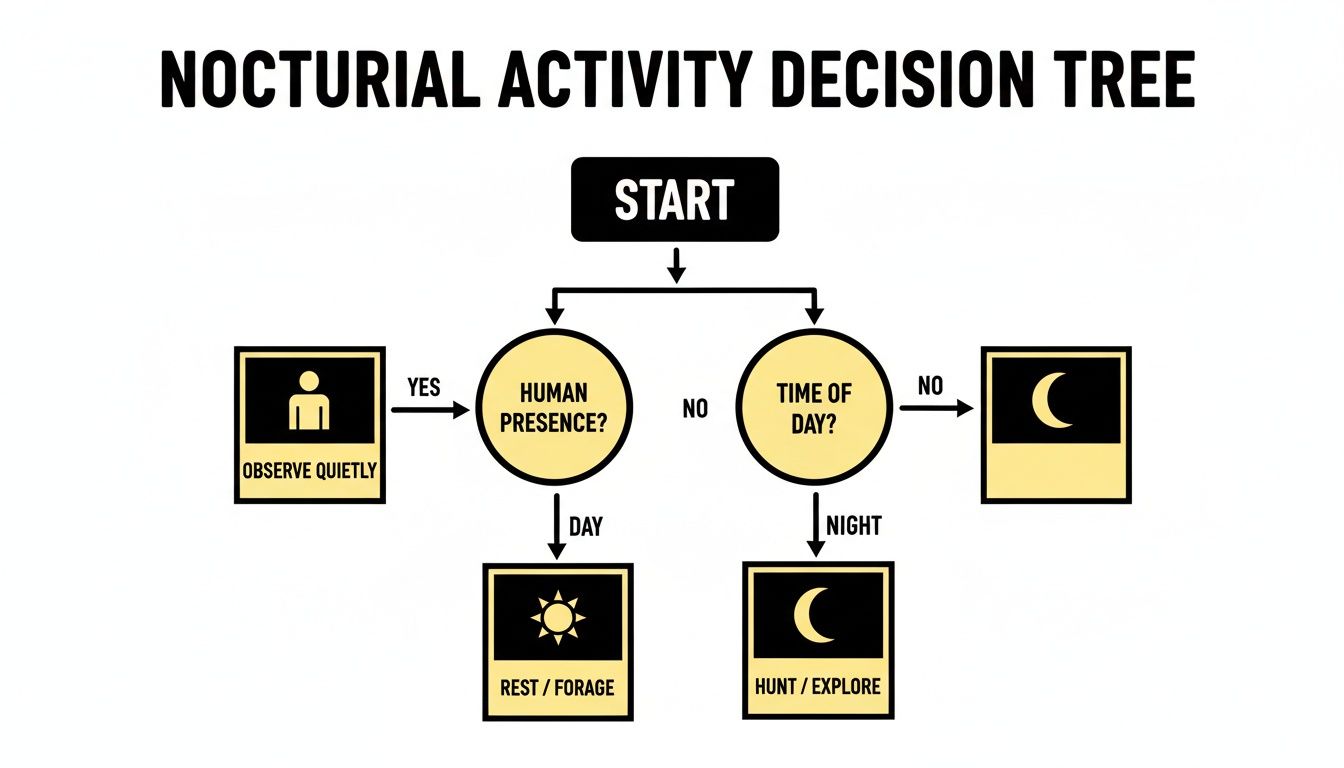
This decision tree shows it perfectly. When people are out and about, coyotes go almost exclusively nocturnal. That's the world we're stepping into.
Thermal Vs. Night Vision: The Great Debate
Thermal optics are game-changers for detection. They don't see light; they see heat. A coyote's warm body stands out like a neon sign against the cool ground, making it practically impossible for them to hide. This is your go-to for scanning wide-open country or picking out a heat signature in the brush or light fog that would swallow it whole otherwise.
Night vision, on the other hand, works by amplifying tiny amounts of ambient light from the moon and stars. The image you get is detailed and recognizable, almost like looking through a green-tinted scope in daylight. This makes it fantastic for positive target identification and for navigating terrain without tripping over every root and rock. The downside? It needs some light to work and a sudden bright light, like a nearby car's headlights, can temporarily "white out" the unit.
For a long time, the old wisdom was: thermal for detection, night vision for identification. Many seasoned hunters still run both—scanning with a thermal monocular and shooting with a helmet-mounted night vision unit.
To help you figure out what's best for your style and budget, here’s a straightforward comparison of the two technologies.
Night Vision vs Thermal Optics for Coyote Hunting
Choosing between these two can feel overwhelming, but breaking them down by function makes it much clearer. This table compares the core strengths and weaknesses of each system in a typical coyote hunting scenario.
| Feature | Night Vision (e.g., PVS-14) | Thermal Imaging (e.g., Sightmark Scopes) |
|---|---|---|
| Detection | Good, but struggles with camouflage/cover. | Excellent, detects heat through brush and fog. |
| Identification | Excellent, provides clear, detailed images. | Good, but can be difficult to ID non-target animals. |
| Environment | Needs some ambient light (moon/stars). | Works in total darkness, independent of light. |
| Cost | Generally more affordable for high-quality units. | Can be more expensive, but entry-level options exist. |
| Primary Use | Navigation, target ID, and shooting. | Scanning large areas and initial detection. |
So what's the verdict? Your budget and how you plan to hunt will ultimately make the choice for you. If I could only have one tool in my kit, I’d lean toward a quality thermal rifle scope. For the pure act of hunting coyotes, its detection capabilities are just too powerful to ignore.
Building Your Rifle System
Once you've landed on an optic, you have to build a rifle system around it. Your night rig needs to be dead reliable, accurate, and feel like an extension of your body in total darkness. The goal is zero fumbling—everything you need should be right where you expect it.
A slick and incredibly effective setup is a helmet-mounted night vision monocular (like the classic PVS-14) paired with an infrared (IR) laser on your rifle. This lets you keep your head up, scanning naturally. When you spot a coyote, you just shoulder your rifle, hit the switch on the IR laser, and put the glowing dot on the target. It's fast, intuitive, and deadly.
This setup is unbelievably fluid. Many hunters will co-witness an IR laser with a night vision-compatible red dot, giving them the choice to aim "passively" through the optic or "actively" with the laser. For a deep dive into these kinds of setups, you can check out our guide on night vision for hunters.
If you go the thermal scope route, things are a bit more plug-and-play. The scope simply replaces your day optic. The most important things here are a rock-solid mount that won't lose zero and getting the scope positioned for perfect eye relief. I highly recommend a quality quick-detach (QD) mount; it lets you swap between your thermal and day scope in seconds without needing to re-zero your rifle.
Essential Supporting Gear
The high-tech optics get all the glory, but a few other pieces of gear are just as critical. Skimping on these can quickly turn a great night into a miserable one.
- Suppressors: A suppressor is, without a doubt, one of the best investments you can make. It saves your hearing and dramatically reduces your presence. More tactically, the muffled shot often confuses other coyotes, giving you a chance for a follow-up shot on a second animal that hasn't pinpointed your location.
- Electronic Callers: This is your primary lure. You need a good e-caller with a remote and a library of high-quality sounds. Don't just stick to rabbit distress; mix in coyote vocalizations like yips, barks, and howls to sell the story.
- Decoys: Never underestimate the power of a little movement. A simple motion decoy—like a fuzzy "critter on a stick"—can be the final piece of the puzzle that convinces a hung-up coyote to commit. It gives them a visual to focus on, drawing their eyes away from your hide.
- Weapon-Mounted Lights: Even with the best optics, you need a good weapon light. It’s a non-negotiable tool for 100% positive target identification before you press the trigger and for finding your animal after the shot. Get one with both a powerful white light and an IR illuminator to give your night vision a boost on moonless nights.
When you put it all together, you have a system that lets you move unseen, scan efficiently, call convincingly, and identify with absolute certainty. Every piece has a job, and together, they make you a far more effective and ethical predator after the sun goes down.
Preparing for Your Hunt Before You Go

Ask any seasoned night hunter, and they’ll tell you the hunt is won or lost before the truck is even loaded. A successful night out isn’t about luck; it’s the direct result of careful planning. This prep work is where you lay the foundation, turning a rough idea into a solid, actionable plan that covers your legal bases, tactical approach, and gear readiness.
Getting this right separates a successful hunt from a frustrating, or even illegal, one. And the absolute first thing you need to lock down are the rules.
Navigating the Legal Maze
When it comes to hunting coyotes after dark, ignorance of the law is a fast track to a hefty fine and a conversation you don’t want to have. Game wardens don't mess around with night hunting violations, so it's on you to know the regulations cold. Your state’s fish and game department website is the definitive source.
Before you even think about buying gear or picking a spot, you need answers to these questions:
- Is it even legal? Some states have a year-round open season on coyotes at night. Others have specific dates, and a few outlaw it completely.
- What technology can I use? This is a big one. Can you legally hunt with thermal and night vision? Are artificial lights allowed, and if so, are there color restrictions like red or green only?
- Are there caliber restrictions? While not as common for predators, some states or specific public land parcels might have rules about using centerfire versus rimfire rifles.
- Can I use a suppressor? In most states where suppressors are legal to own, they're also legal for hunting. But you absolutely must confirm this.
I always print the relevant pages of the hunting regulations or save a PDF on my phone. Having the exact rulebook on hand in the field is great for peace of mind and can clear up any confusion on the spot.
These details are everything. For example, one state might allow thermal scopes but forbid scanning with a separate, powerful white light. Another might permit night hunting, but only on private land with written permission. You have to know the specifics for where you'll be.
Digital and Daytime Scouting
Once you're squared away on the law, it's time to find where the coyotes are. Modern mapping apps have completely changed this part of the game. Tools like onX Hunt or Basemap let you dissect a property from your living room, highlighting the terrain features that coyotes use as their highways.
When you're looking at a map, zero in on these coyote magnets:
- Travel Corridors: Dry creek beds, fence lines, and the edges where fields meet woods are natural funnels for predators on the move.
- Food Sources: Pinpoint cattle ranches, crop fields, or dense thickets that hold rabbits and other prey. Coyotes will never be far from their next meal.
- Pinch Points: Look for spots that naturally concentrate movement, like a saddle on a ridgeline or a narrow gate in a long fence. These are prime ambush locations.
After you've got a few promising spots marked on your digital map, it’s time for some old-fashioned recon. Get out there during the day. Drive the roads, glass the fields, and look for physical evidence like tracks and scat. Listen for howling around dawn and dusk. This "boots-on-the-ground" work confirms what you saw on the map and, just as importantly, helps you plan your access routes so you can get in and out without being detected.
Zeroing Your Night Optics
Finally, you have to get your equipment dialed in. A thermal or night vision scope is just an expensive accessory if it isn't perfectly zeroed to your rifle. The process is a lot like sighting in a regular scope, but with a few unique quirks.
You can't just pull your day scope off, clamp on a thermal, and expect to hit anything. You must confirm your zero with the exact ammunition you'll be hunting with. Many thermal scopes offer a slick one-shot zero function that simplifies the process, but you need to follow the manufacturer's guide to the letter for it to work.
Do yourself a favor and zero during the day. It's much easier. Most thermals have a "white hot" setting that makes a standard black paper target pop. A great pro tip is to stick a small square of aluminum foil or a chemical hand warmer to the bullseye. The heat signature it creates gives you a perfect, glowing aiming point for your thermal optic. A precise zero is all about confidence—knowing that when that coyote finally steps out, you can make a clean, ethical shot.
Proven Field Tactics for Outsmarting Coyotes
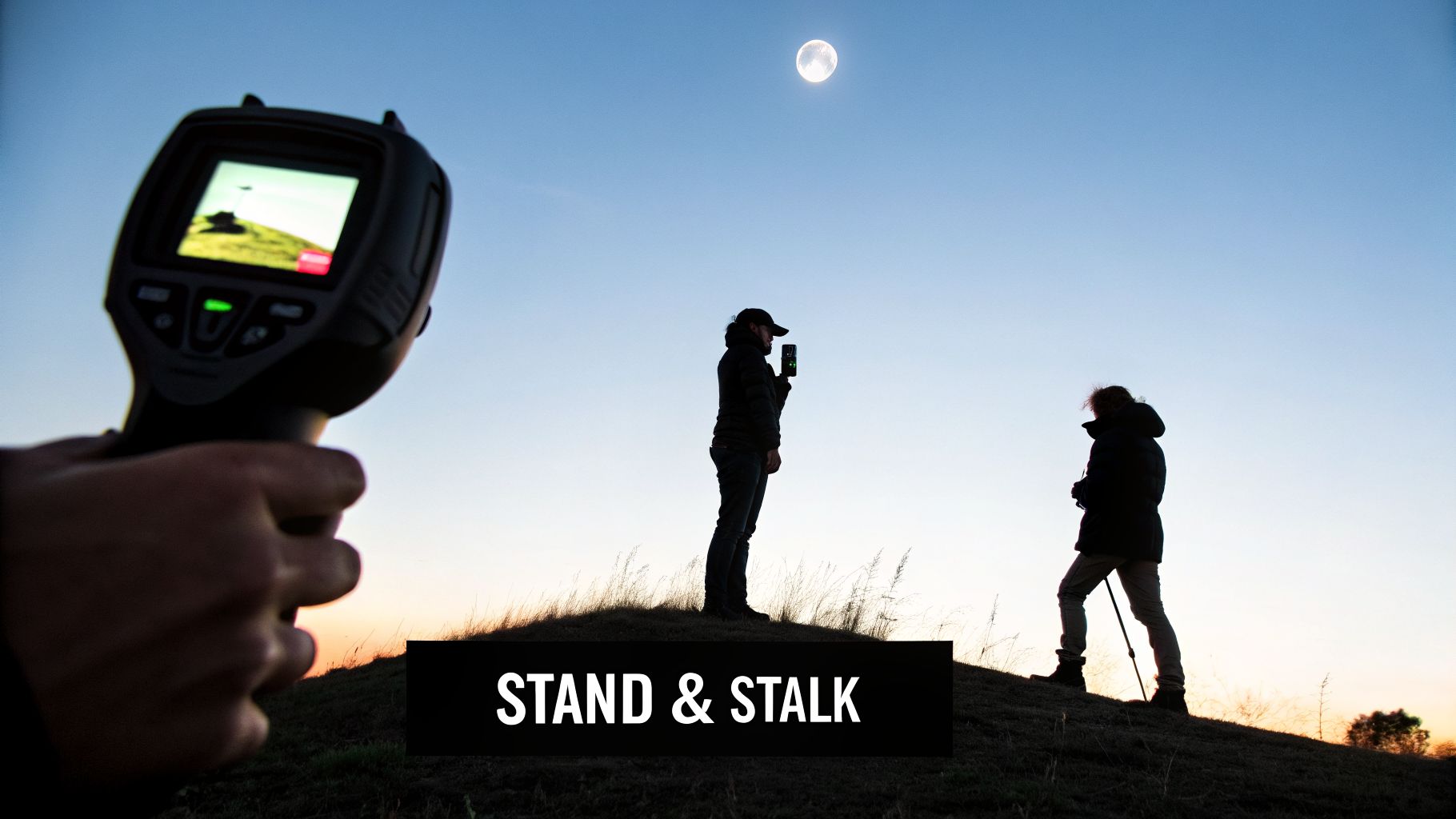
With your gear dialed in, it's time to head out into the dark. Success out here isn’t about being the fastest shot—it’s a chess match. It’s about getting inside a coyote's head and using their own instincts against them.
We're going to break down the two most effective methods for night hunting: setting up on a stand and the more aggressive spot-and-stalk. Knowing which one to use, and when, is what separates a frustrating night from a successful one.
Mastering the Art of Stand Hunting
There's a reason stand hunting is the classic approach: it flat-out works. The whole game is bringing the coyotes to you. You find a prime spot, get comfortable, and use calls to imitate prey or another coyote. Your success or failure really boils down to your setup.
Wind is everything. I can't stress this enough. You have to set up downwind of where you expect coyotes to approach from. A 'yote trusts its nose more than its eyes or ears, and if it gets a whiff of you, the hunt is over before it even starts. Always use a puff bottle with wind-checker powder to see what the air currents are really doing.
Once you’ve got the wind figured out, look for a spot with a bit of elevation. The side of a ridge or even a small hill gives you a better vantage point and helps your calls carry. It also helps to find some natural cover to sit in front of—a big sagebrush, a thicket, or even a fence post—to break up your silhouette against the night sky.
Effective Calling and Decoy Strategies
Okay, you're in position. Time to make some noise. Your electronic caller is your best friend out here, but how you use it makes all the difference.
Always, always start your calling sequence on low volume. You never know if a coyote is already bedded down just over the next rise. Blasting the call at full volume right away will send it running. I like to kick things off with a soft cottontail distress for about 30 seconds, then I go completely silent for two or three minutes while I scan constantly with my thermal.
If the field stays empty, I'll bump up the volume and maybe switch the sound. Here are a few things I've learned about building a killer calling sequence:
- Change It Up: Don't lean on the same dying rabbit sound all night. Mix it up with different sounds like rodent squeaks, bird distress calls, or even coyote vocalizations. Yips and howls can be deadly, especially around breeding season from January to March.
- Tell a Story: Try pairing different sounds to paint a picture. For instance, start with a fawn distress. If a coyote comes in but hangs up just out of range, switch to a coyote pup distress. That can trigger a protective or territorial response that makes them close the distance.
- Embrace the Silence: The quiet moments are just as important as the calling. Coyotes are sneaky and will often slip in without a sound to investigate. Constant calling can make them suspicious.
Sometimes, a little movement is all it takes to make a cautious coyote commit. A simple motion decoy, like a "quivering critter" or a spinning rabbit, gives them something visual to lock onto. It takes their focus off your position and can be the final trigger that makes them throw caution to the wind.
The Spot-and-Stalk Advantage
While stand hunting is about patience, spot-and-stalk is all about aggression. This is where you take the hunt to the coyote, a tactic made incredibly effective by modern thermal optics. From a good vantage point, you can scan thousands of acres for that unmistakable heat signature.
Once you spot one, the real work begins. The goal is to close the gap without getting busted. This takes a solid read of the terrain, constant attention to the wind, and a whole lot of patience. Every step is deliberate. Use ditches, creek beds, and rolling hills to stay hidden as you move in.
Pro Tip: Before you take a single step, map out your route in your head. Use landmarks for cover and double-check the wind. A coyote might be busy mousing, but its nose never takes a break.
This method really excels in wide-open country where you can see for miles. It lets you cover a ton of ground and actively hunt down targets rather than just waiting for them. It's an adrenaline-pumping style of hunting that will test every bit of your fieldcraft.
Teamwork Makes the Dream Work
Hunting with a partner doesn't just double your eyes and ears; it can make you exponentially more effective. A two-person team can use strategies that a solo hunter simply can't pull off.
My favorite and most lethal setup is the Scanner and Shooter team:
- One person acts as the scanner, using a high-quality thermal monocular to find coyotes. Their only job is to watch.
- The other person is the shooter, staying put with the rifle on the sticks, ready to go.
- The scanner guides the shooter onto the target with quiet, clear directions: "Coyote, 10 o'clock, 200 yards, moving left."
This division of labor is incredibly efficient. The scanner can focus 100% on detection without fumbling with a rifle, and the shooter can remain perfectly still, minimizing any give-away movement or sound.
Coyotes are unbelievably resilient. The U.S. is home to an estimated 4.7 million of them, and despite hunting pressure, their numbers keep growing. They've adapted by becoming more nocturnal, with some covering 5-10 miles per night looking for a meal. This is a big reason why hunting them after dark has become so critical for predator management.
Don't get too attached to one spot. If you've run a few calling sequences over 30-45 minutes with no action, it’s time to pack it in and move. Head to your next location quietly, always keeping the wind in your face. Knowing how to hunt coyotes at night is about knowing when to be patient and when it's time to move on. And if you're wondering about light discipline, check out our guide on whether coyotes can see red light.
Post-Hunt Procedures and Gear Maintenance
The shot is just the beginning of your work in the dark. Once a coyote is down, the clock starts on two critical tasks: recovering the animal ethically and protecting the expensive gear that made the shot possible. Don’t let the adrenaline of the moment cause you to drop the ball on either one.
First thing's first: find the coyote. Even a well-hit 'yote can cover a surprising amount of ground. This is where a thermal scanner truly shines, letting you spot the lingering heat signature in seconds, even in thick brush. Without a scanner, you'll need a powerful weapon-mounted or handheld light for a slow, methodical grid search. Be patient and be safe.
Before you rush in, confirm the animal has expired. A quick look through your thermal will show if it's still breathing. The last thing you want is a dangerous encounter with a wounded predator in the dark.
Processing and Disposal
What you do next depends entirely on your goals. Are you hunting for predator control, or are you after that prime winter fur? If pelts are your prize, you'll find the best hides in the dead of winter when their coats are thickest. Field dressing isn't complicated, but doing a clean job at night takes practice and a good headlamp—this is absolutely non-negotiable.
Crucial Reminder: You must know your local laws on carcass disposal. Don't be the hunter who gives the rest of us a bad name. Improperly dumping a carcass can lead to hefty fines and is disrespectful to the landowner. Some states require you to pack it out, while others have specific disposal sites or rules.
Protecting Your Investment
Your night vision and thermal optics are serious investments, and they need to be treated that way. The number one rule for traditional night vision (I2 tubes) is to never expose the lens to bright light without the cap on. It can cause permanent burns on the intensifier tube, effectively ruining your device.
After every hunt, run through this quick gear-check routine. It takes five minutes but can save you thousands.
- Clean Your Lenses: Dust and fingerprints can degrade your view. Use a dedicated lens pen or a clean microfiber cloth made for optics. Never use your t-shirt; it will scratch the delicate coatings over time.
- Wipe Down the Body: A slightly damp cloth is all you need to get mud, dust, and grime off the housing of your scope and scanner.
- Pull the Batteries: This is a big one. If you're storing your gear for more than a week, take the batteries out. A leaking battery will corrode the contacts and can completely fry the electronics. I’ve seen it happen, and it’s a painful lesson.
- Store It Right: Keep your optics in a hard-sided, padded case. Something like a Pelican case is perfect. Tossing a desiccant pack inside will absorb moisture and prevent fogging or damage from humidity.
Taking care of business after the hunt is what separates the serious pros from the weekend warriors. It shows respect for the animal, complies with the law, and ensures your high-tech gear is ready to go when you are.
Common Questions About Night Coyote Hunting
No matter how many hours you log in the field, certain questions always come up. Let's tackle some of the most common ones I hear from guys just starting out and even from seasoned hunters looking to sharpen their skills.
What Is the Best Caliber for Night Hunting?
I get this one a lot. The honest answer is that the "best" caliber is the one you can confidently and ethically place on target, but a few cartridges have really proven themselves for night work. Their flat trajectories and excellent terminal ballistics make them ideal for taking down 'yotes.
Most serious night hunters I know run one of these:
- .223 Remington: You just can't beat it for availability and low recoil. It’s a fantastic all-around option that's effective out to several hundred yards without being overkill.
- .22-250 Remington: This thing is a laser beam. Its blistering speed makes it a top choice for those long, open-country shots where you need to reach out and touch something.
- .243 Winchester: If you want a bit more punch to anchor a coyote decisively, the .243 is your round. It hits harder but still does a decent job of preserving the pelt compared to bigger calibers.
The goal is always a quick, clean kill. Choose a round with enough energy to do the job without causing so much damage that you ruin the hide, if that’s something you care about.
How Do I Use a Coyote Call Effectively at Night?
Calling at night is a game of finesse, not volume. Coyotes are bolder in the dark, but their ears are just as sharp, and they can pinpoint anything that sounds out of place.
When you start a calling sequence, keep the volume low. You never know if a coyote is bedded down just 50 yards over the next rise, and blasting the call will just send it running for the next county. I like to run a rabbit distress call for about 20-30 seconds, then go completely silent for at least 2-3 minutes. That period of silence is crucial—it's when you should be scanning relentlessly with your thermal.
The biggest mistake I see is over-calling. The silence is just as important as the sound. A real rabbit doesn't scream nonstop; it cries out in terror, then goes quiet. You have to mimic that natural cadence.
If nothing shows up, you can slowly bump up the volume or switch to a different distress sound. Don't be afraid to throw in some coyote vocalizations, like yips or howls. This can be especially deadly from late January through March when their breeding instincts make them aggressively territorial.
Can I Hunt Coyotes During a Full Moon?
You absolutely can, but it's a double-edged sword. On one hand, a bright moon gives you a ton of ambient light. This is a huge help if you're running traditional image-intensifier night vision, as it makes navigating the terrain and identifying your target much easier.
On the other hand, if that moonlight is helping you see, it's also helping the coyotes see you. Your silhouette will stick out like a sore thumb, and every little movement gets amplified. When the moon is bright, you have to be extra disciplined. Stick to the shadows, use the terrain for cover, and keep your movements slow and deliberate.
This is one area where thermal optics really shine, since they detect heat, not light. A full moon has zero effect on a thermal's ability to spot a coyote.
At Superior Tactical LLC, we live and breathe this stuff. Whether you're putting together your first night hunting setup or upgrading to a professional-grade kit, our team has the real-world experience to get you equipped with optics and gear that won't let you down. Check out our curated selection of thermal scopes, PVS-14s, and other essential tactical gear at https://superiortac.com.
