A Guide to Green Night Vision for Tactical Operations
That classic green night vision glow you’ve seen in countless movies and video games? It’s not just for dramatic effect. It’s the result of some seriously clever engineering that takes human biology into account. The green hue comes from a phosphor screen inside the device, chosen specifically because our eyes are most sensitive to green.
This sensitivity is a huge advantage. It allows you to pick out more detail in the dark and, just as importantly, reduces eye strain when you're scanning an area for hours on end.
How Green Night Vision Turns Night Into Day
When you look through a night vision monocular or goggle, you're not just looking through a simple green lens. You're seeing the end result of an incredible light amplification process. The core of the device is the image intensifier tube. Think of it as a microphone, but for light.
Just as a microphone can capture a faint whisper and boost it into a clear, audible sound, an image intensifier tube gathers tiny, invisible amounts of ambient light—from the moon, stars, or even distant city glow—and amplifies them thousands of times. The result is a bright, clear image where there was once only darkness.
The signature green night vision output is the final, crucial step in this process.
The Technology Behind the Glow
The real work happens inside the image intensifier tube. It has three key parts that work together to turn a few photons into a full-fledged image.
- Photocathode: This is the front door for light. When scarce light particles (photons) enter the tube, they hit the photocathode, which converts their energy into electrons.
- Microchannel Plate (MCP): The electrons are then funneled into the MCP. This is a tiny glass disc packed with millions of microscopic channels. As a single electron zips through a channel, it bounces off the walls, starting a chain reaction that multiplies it into thousands of more electrons.
- Phosphor Screen: This supercharged cloud of electrons flies out of the MCP and slams into the phosphor screen. The screen is coated with a material that glows brightly when struck by electrons, creating the visible green image you see through the eyepiece.
This diagram breaks down how that faint, invisible light becomes a clear, usable image.
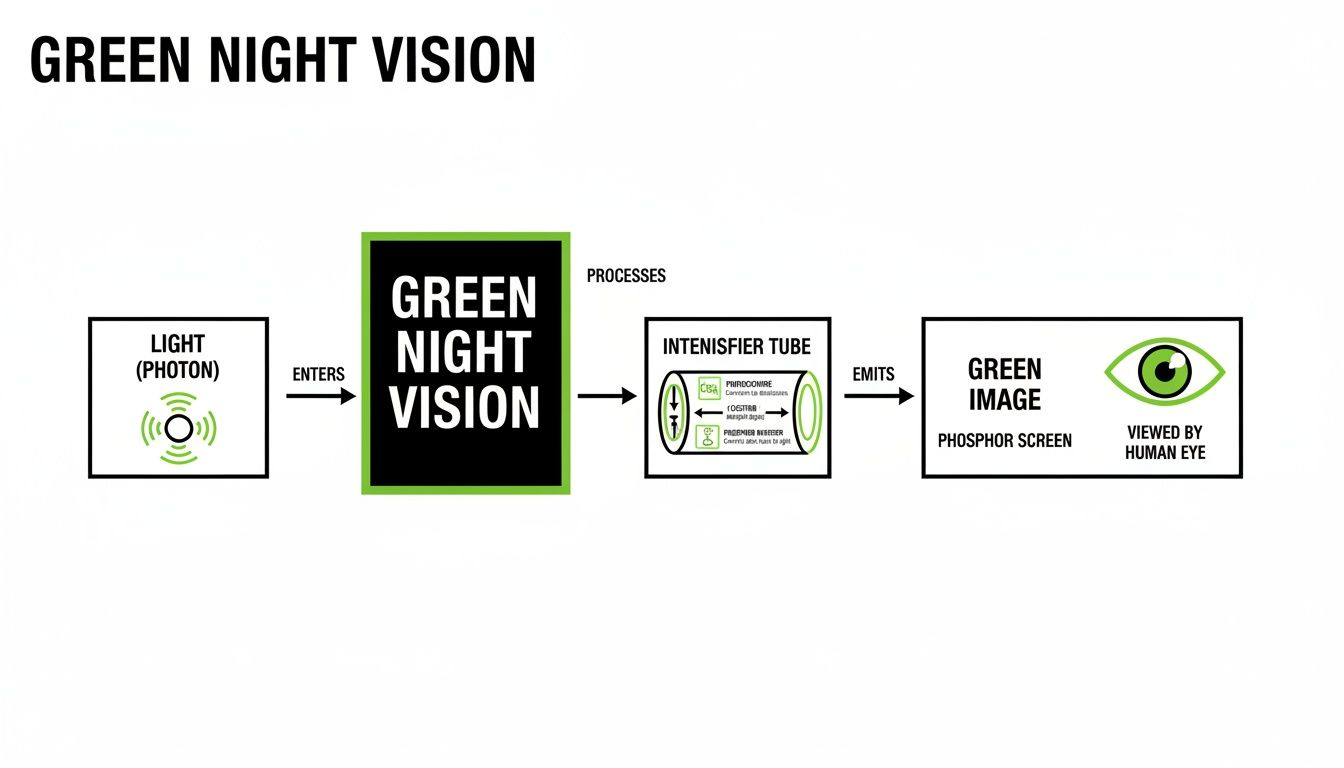
As you can see, it's a multi-stage process where light is converted and amplified, with that final green color being essential to the system's performance.
So, Why Is Green the Standard?
The choice of green phosphor wasn't random—it's based entirely on the way our eyes work. In low-light conditions, the cone cells in our eyes (which handle color vision) don't perform well. Vision is taken over by our rod cells, which are far more sensitive to light but don't see color in the same way.
Critically, our rods are most receptive to light in the green part of the spectrum.
This biological fact means the human eye can distinguish more shades and gradations of green—over 500 of them—than any other color. In a practical sense, this translates directly to better detail recognition, superior contrast, and much less eye fatigue during long nights of observation.
For anyone who relies on this gear, from a law enforcement officer on a multi-hour stakeout to a hunter tracking game before dawn, that reduced strain is a mission-critical advantage. This is precisely why green night vision has been the trusted standard for decades.
For a more detailed look at the inner workings of the tube, check out our full guide on how night vision works.
The Evolution of Night Vision Generations
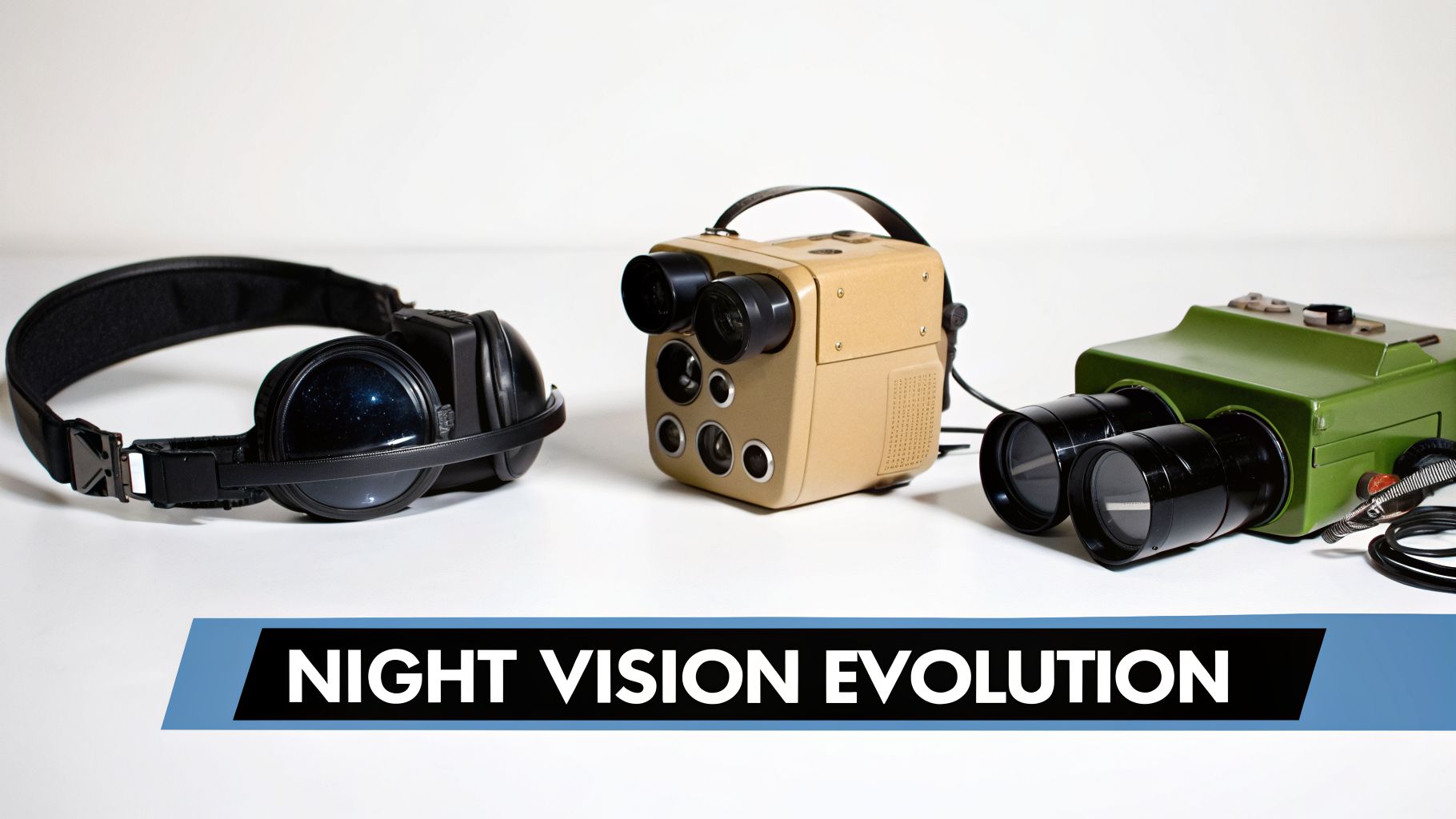
To really understand what makes modern green night vision so impressive, you have to look back at how we got here. Every step forward—what we call a "generation"—was a major breakthrough in solving the fundamental problems of seeing in the dark. We’re talking about a relentless push for better clarity, smaller size, and reliable performance when there’s almost no light to work with.
The story starts with what we now call "Generation 0" (Gen 0). These weren't the passive light-gathering tools we use today; they were active infrared systems. First developed during World War II, these units had to blast an area with a powerful infrared (IR) beam, which was totally invisible to the naked eye. The device would then see the reflected IR light. It was a huge advantage, but it was also like waving a giant flashlight that only your enemies could see. Not exactly subtle.
The iconic green glow we associate with night vision comes from the phosphor screens inside the image intensifier tubes. Green was chosen for a simple reason: the human eye is most sensitive to it, making details easier to pick out. Early systems like the German VAMPIR on Panther tanks were clunky, requiring searchlights that weighed over 30 pounds just for limited visibility. The tech matured with devices like the U.S. 'Snooperscope' in the Korean War, proving its worth on the battlefield.
The Shift to Passive Amplification
The first real game-changer arrived in the 1960s with Generation 1 (Gen 1). This was the birth of "starlight" technology. For the first time, a device could amplify faint ambient light from the moon and stars without needing a constant IR illuminator.
Gen 1 wasn't perfect, though. The images had a lot of geometric distortion, creating a "fisheye" effect, especially at the edges. They were also prone to "blooming," where a bright light source like a streetlight could completely wash out the image.
Then, in the 1970s, Generation 2 (Gen 2) introduced the single most important innovation in modern night vision: the microchannel plate (MCP). Think of this tiny glass disc as an electron supercharger. It dramatically multiplied the light gain, producing a much brighter, clearer, and less distorted image than anything seen before. Gen 2 set the new professional standard.
The Gold Standard: Gen 3
Today's benchmark for serious, high-performance night vision is Generation 3 (Gen 3), which came on the scene in the 1980s. Its secret weapon was a photocathode made from gallium arsenide (GaAs). This material is incredibly efficient at converting photons (light particles) into electrons, far more so than in previous generations.
What does that mean in the real world? Gen 3 tubes deliver outstanding clarity, a high signal-to-noise ratio, and amazing performance in near-total darkness—we're talking cloudy, moonless nights.
Gen 3 also brought us critical features like autogating, which protects the tube from sudden flashes of light by rapidly adjusting brightness. It also introduced an ion barrier film that massively extends the tube's lifespan to 10,000+ hours of operation. This blend of raw performance and rugged durability is exactly why Gen 3 green night vision became the go-to for the U.S. military and elite units across the globe.
You can dive even deeper into these technical leaps in our complete guide to night vision generations.
Green Phosphor vs. White Phosphor Performance
If you’ve spent any time in the night vision world, you know the biggest argument today isn't about tube specs or brands—it's all about color. For decades, the iconic emerald glow of green night vision was the undisputed king. But now, with high-performance white phosphor tubes on the scene, guys are left wondering which one is actually better.
The truth is, there's no simple answer. It's not about which technology is superior on paper, but how your brain actually processes the image you see. The "best" choice really comes down to your own eyes, the environments you work in, and what you need to get done. This isn't just about looks; it's a real tactical decision.
The Case for Classic Green Phosphor
There’s a good reason green phosphor (technically P43) was the standard for so long. As we touched on earlier, the human eye is just built differently, and it’s most sensitive to the color green. This gives traditional green night vision a tangible edge in some situations.
Studies have shown that our eyes can pick out more shades of green than any other color. For a lot of users, this means they can see finer details, textures, and subtle shifts in the terrain through a green tube. That can be the difference-maker when you're trying to spot a target in a dense forest or across an open field.
On top of that, many seasoned operators find the familiar green hue is easier on the eyes over long stretches. When you're posted up on surveillance for hours or glassing for game all night, less eye strain is a huge plus. And because it's been around longer, green phosphor is usually the more affordable option, giving you a fantastic bang for your buck.
The Rise of White Phosphor
White phosphor (P45) delivers a totally different visual. Instead of a green glow, you get a crisp black-and-white image that a lot of people find more natural, almost like watching an old movie. That high-contrast look can be a game-changer.
- Enhanced Contrast: Many guys feel white phosphor gives them better contrast, making it much easier to pull a target out from a cluttered background. It really shines in urban settings with weird artificial lights and deep, dark shadows.
- Depth Perception: Some users report that they can judge distances and navigate tricky terrain better with white phosphor, as it improves their sense of depth.
- Performance in Snow: In a snowy environment, a black-on-white image can feel significantly sharper and less washed out than a green-on-white one.
While white phosphor units typically come with a higher price tag, their distinct image quality has made them a go-to for many in law enforcement and special operations units. If you want to dive deeper, you can read all about the advantages of white phosphor night vision in our full write-up.
Making the Right Choice for Your Mission
So, how do you pick? You have to cut through the hype and think honestly about your own needs. There's no right answer, just the right tool for the job.
Choose Green Phosphor if:
- You need to spot maximum detail and texture in natural environments like woods or fields.
- Budget is a top factor, and you’re looking for the best performance-to-cost ratio.
- You're concerned about eye fatigue and find the green tint more comfortable for long nights.
Choose White Phosphor if:
- You'll be operating mostly in cities, suburbs, or snowy areas where high contrast is critical.
- A black-and-white picture feels more intuitive and lets you process information faster.
- You have the budget for a premium unit and value the perceived boost in depth perception.
At the end of the day, the choice between green night vision and white phosphor is a personal one. Both are incredible Gen 3 technologies that will give you a massive advantage in the dark. If you ever get the chance, the best thing to do is look through both. The "better" tube is simply the one that helps you see, move, and react more effectively when the lights go out.
Real-World Scenarios: Where Green Night Vision Shines

The tech specs and generation numbers are important, but they don't tell the whole story. The real measure of green night vision is how it performs when the lights go out for good—and that’s where decades of refinement make all the difference. This is where theory meets reality.
Let’s put it in context. A SWAT team is stacked up outside a pitch-black warehouse. Inside, there's zero ambient light, making the naked eye completely useless. But the operators are equipped with Gen 3 green night vision monoculars like the PVS-14, and they move with a quiet confidence.
Through their tubes, the familiar green glow turns chaos into clarity. They can instantly tell the difference between a pile of junk and a potential threat, spot a tripwire glinting across a doorway, and identify a suspect trying to melt into the deep shadows. In moments like these, the crisp detail rendered by green phosphor is the key to making the right split-second decision.
From Door-Kicking to Backcountry Tracking
That same principle of turning darkness into an advantage applies just as much in the wild. Picture a hunter tracking a wild hog long after the sun has set, with only a sliver of a moon for light. A quick scan with a rifle-mounted green night vision scope cuts right through the gloom.
The green image is fantastic at picking out textures and movement in natural environments. The hunter can easily distinguish the coarse hair of the hog against the brush, track its movement, and line up an ethical shot. This isn't magic; it's a direct result of how sensitive our eyes are to the green part of the spectrum.
And it’s not just for a few niche uses. The reliability of green night vision is proven across any field where seeing in the dark is part of the job.
- Private Security: An officer monitoring a large, unlit property can use green phosphor binoculars to spot someone trying to climb a perimeter fence 300 yards out, long before they become a direct threat.
- Search and Rescue: A team searching for a lost hiker on a mountain at night relies on the green view to navigate treacherous terrain, avoiding loose rocks and steep drop-offs while scanning for any sign of the missing person.
- Outdoor Adventure: For cavers and explorers, green monoculars transform a dangerous, unseen passage into a navigable environment, revealing the full scope of a cavern and its hidden obstacles.
The legacy of green phosphor is built on a simple biological fact. Our eyes have their peak sensitivity around the 555nm wavelength—the heart of the green spectrum. This allows us to perceive detail at light levels 10x better than with blue or red light.
This is the science behind its long-standing dominance. It's why green is still the workhorse. In 2023, the global night vision market hit $2.5 billion, and traditional Gen 3 green systems made up 65% of all military and hunting sales. It’s also incredibly effective at reducing the "halo" bloom from IR lasers by up to 50%, which is critical for precise aiming. You can dive deeper into the science behind green phosphor's effectiveness on AGMGlobaVision.com.
The Go-To Choice for Critical Work
Even with newer white phosphor units on the market, green night vision remains the established standard for a massive number of professionals and serious civilians. Its reputation wasn't built on marketing; it was forged in the field, from the earliest military operations to modern police work.
The reason it endures is straightforward: it flat-out works. For an operator who has spent thousands of hours training with a green tube, the image is second nature. They trust the information it gives them.
At Superior Tactical, we get it. That’s why we continue to offer rock-solid Gen 3 PVS-14s that carry on this legacy of performance, all backed by our 10-year warranty. Whether you’re clearing a building or tracking game through the woods, the proven capability of green phosphor gives you the edge you need to own the night.
How to Choose and Maintain Your Night Vision Device
So, you’re ready to invest in a serious piece of gear. Choosing a green night vision device is a big step, with prices running from a few hundred dollars into the many thousands. Getting it right the first time means you'll have a tool you can rely on for years.
The first hurdle is the spec sheet. It can look like a wall of confusing acronyms and numbers, but don’t let it throw you. Think of it like looking under the hood of a car. You don't need to be a master mechanic, but knowing the difference between horsepower and torque helps you pick the right engine for the job. It's the same with night vision—the specs tell you exactly how well a device can slice through the darkness.
Decoding the Spec Sheet
When you start comparing units, three key numbers will pop up again and again: Resolution, Signal-to-Noise Ratio (SNR), and Figure of Merit (FOM). Let's break down what they actually mean for you.
- Resolution (lp/mm): This is all about image sharpness, measured in line pairs per millimeter. A higher number here is like having a higher resolution TV; it means a crisper, more detailed picture. That extra clarity is what lets you distinguish a coyote from a stray dog at a distance.
- Signal-to-Noise Ratio (SNR): This tells you how clean the image will be. A high SNR means you see a clear view with very little of that distracting "snow" or static, which is absolutely critical when light is scarce. It’s the difference between a grainy, hard-to-read image and a smooth, confident picture.
- Figure of Merit (FOM): This one's simple math: Resolution x SNR. FOM gives you a single number for a quick, at-a-glance comparison of a tube's overall performance potential. Generally, a higher FOM means a better tube.
But here’s a pro tip: FOM doesn't tell the whole story. A tube can have a sky-high FOM because of an insane resolution, but if its SNR is low, the image will be a grainy mess in near-total darkness. Always look at Resolution and SNR individually to get a true sense of how the device will perform in the real world.
Your Dealer is Your Partner in the Dark
Where you buy your night vision is almost as crucial as what you buy. A reputable dealer like Superior Tactical isn't just selling you a box; they’re providing a safety net for your investment.
Buying from a trusted source is your guarantee that the device is legitimate, the specs are accurate, and you’re not getting a gray-market tube with a questionable history. It's also about what happens after the sale. We back our Gen 3 systems with a 10-year warranty because we stand by their quality. If an issue pops up, you have a team of experts ready to provide diagnostics, repairs, and advice to keep your gear in the fight.
For the hands-on user, we also offer DIY build kits. These kits provide the same high-quality components and the guidance you need to assemble your own custom green night vision unit, giving you an unmatched understanding of the tool you depend on.
Protecting Your Investment: Maintenance Essentials
A Gen 3 image intensifier tube is a sophisticated piece of electronics. Treat it right, and it will give you 10,000 hours or more of solid performance. A little bit of carelessness, however, can cause permanent damage and a very expensive repair bill.
Just follow a few simple rules, and your device will be ready to perform whenever you need it.
Night Vision Maintenance Do's and Don'ts
| Do | Don't |
|---|---|
| Clean lenses with a soft brush, an air blower, and proper lens paper. | Never use Windex or abrasive cloths that can strip the lens coatings. |
| Always use the daylight lens cap when the unit is not in use. | Never turn the device on in daylight or point it at bright light sources. |
| Store the device in a cool, dry place inside its protective case. | Don't leave it in a hot car or humid basement where damage can occur. |
| Remove the batteries before storing the device for an extended period. | Don't ignore flickering or odd behavior—get it checked out by an expert. |
Honestly, the most important rule is this: protect the tube from bright light at all costs. Direct sunlight will kill it in seconds. Even pointing it at a bright streetlight or oncoming headlights can leave permanent burn-in spots on the screen. While modern autogated systems have built-in protection, they aren't magic. Treat your NVD with respect, and it will give you a powerful advantage for a long, long time.
Answering Your Top Questions About Green Night Vision
When you're getting serious about buying night vision, a lot of questions start popping up. It's easy to get lost in forum debates and marketing hype. Let's cut through the noise and tackle the real-world questions we hear all the time from customers.
We're going to cover the big ones—from the green vs. white debate to the hard rules of not destroying your new investment.
Is White Phosphor Night Vision Better Than Green?
This is easily the most common question in the night vision world, and the honest answer is no, not necessarily. One isn't "better" than the other; they're just different. The right choice comes down to your eyes, your environment, and your personal preference.
There's a good reason green phosphor has been the standard for decades. Your eye is biologically hardwired to see more shades of green than any other color. For a lot of guys, this means they can pick out more detail and experience less eye fatigue, especially over a long night of scanning.
White phosphor, on the other hand, gives you that black-and-white, almost grayscale image. Some people find it feels more natural, and they argue it gives them better depth perception, particularly in urban settings or snow where you have a lot of hard lines and deep shadows. It really comes down to what you're doing, how your brain processes the image, and what your budget looks like.
Can I Damage My Night Vision by Exposing It to Light?
Yes. Absolutely. If you remember nothing else, remember this: bright light is the enemy of your image intensifier tube. These tubes are incredibly sensitive, and pointing them at a bright light source can cause permanent, expensive damage in an instant.
Even a quick flash from a passing car's headlights can cause a temporary "bloom" that washes out the image. Worse, it can leave a permanent black spot burned into your screen. Pointing your unit at the sun, even for a second, will kill the tube. Game over.
Modern Gen 3 tubes have features like autogating, which is a lifesaver. It reacts instantly to bright flashes and dials down the power to protect the tube. But think of autogating as an airbag—it’s there to save you in a crash, not to encourage reckless driving. Always, always keep your daylight lens cap on when you're not in the dark. And never power on the device in a lit room without that cap on tight.
What Does Gen 3 Mean and Why Is It Important?
"Gen 3" simply stands for the third generation of image intensifier technology, and it's the professional standard for a reason. The secret sauce in a Gen 3 tube is the Gallium Arsenide (GaAs) photocathode.
Think of the photocathode as the part that first "sees" the light. The Gallium Arsenide in a Gen 3 tube is just way better at its job than the materials in older generations. It's far more efficient at taking the few photons available in the dark and converting them into the electrons that create your image.
What does that mean for you? It means you get a much cleaner, brighter picture with less of that fuzzy static, or "scintillation." In the real world, a Gen 3 green night vision device will let you see on a moonless, overcast night in the middle of nowhere. It's the benchmark for performance and reliability, which is why it's been the go-to for military and law enforcement units for years.
Can I Upgrade an Existing Device from Green to White Phosphor?
You bet. For many common devices, this is a popular and smart upgrade. Most quality housings, like the classic PVS-14 monocular, are built to be modular. The image intensifier tube itself is a self-contained unit that can be swapped out.
This means a qualified technician can pop out your old green tube and install a new white phosphor one right into your existing housing. You get the benefit of a new image color and often a boost in performance specs without having to buy a whole new setup—housing, lenses, mounts, and all. It’s a great way to keep your gear current without starting from scratch.
At Superior Tactical LLC, we know these questions are just the tip of the iceberg. Our team has spent over a decade outfitting professionals and serious enthusiasts with the right gear. Whether you're set on a tried-and-true Gen 3 green unit or want to explore other options, we're here to give you straight answers and expert advice. Check out our curated collection of night vision and accessories at https://superiortac.com when you're ready to get mission-ready.
