A Guide to Generation 4 Night Vision Technology
Let's clear up some of the confusion around the term "Generation 4 night vision." You won't find it as an official U.S. military designation, which can make things tricky. In the field, we use "Gen 4" to describe the absolute pinnacle of Gen 3 technology, defined by two game-changing upgrades: a filmless image intensifier tube and autogating.
This combination isn't just a small step up—it’s a massive leap in performance when the lights go out.
Decoding The Gen 4 Advantage
To really get why "Gen 4" is the top of the food chain, you have to look past the label and at the tech inside. The term stuck because the industry needed a way to talk about a specific set of advancements that push the limits of what you can see in near-total darkness.
These aren't just minor tweaks. They completely change how the device gathers and processes light. Think of it like this: a high-end smartphone camera is great, but a professional DSLR built for shooting sports at night is on another level. Both take pictures, but one is engineered to capture stunningly clear images in dynamic, low-light conditions. That's what Gen 4 night vision is built for.
The Filmless Tube Breakthrough
The single biggest innovation here is the removal of the ion barrier film from the image intensifier tube. In a standard Gen 3 unit, this thin film is there to protect the tube's longevity, but it also acts like a permanent pair of sunglasses, slightly dimming the image before it's even processed.
Taking that film out gives you two huge advantages:
- More Light In: More photons (the basic particles of light) hit the photocathode. This directly translates to a brighter, more detailed image, especially under extreme low-light conditions like a moonless night deep in the woods.
- Cleaner Picture: This is all about the Signal-to-Noise Ratio (SNR). With more "signal" (light) getting through, the "noise" (that grainy, static-like effect) is dramatically reduced. The result is a much cleaner, higher-contrast view that's easier on the eyes.
The filmless design is the secret sauce. By letting the tube gather light more efficiently, it paints a much richer visual picture with far fewer distracting artifacts.
Autogating For Dynamic Lighting
The second pillar of Gen 4 is autogating. This is a wicked-fast electronic power supply that cycles the tube's voltage on and off thousands of times per second.
This rapid cycling works like an incredibly advanced camera shutter, constantly adjusting to maintain the perfect exposure. What this means for you is that the device can handle sudden, bright flashes of light—think muzzle flashes, car headlights, or an opponent's flashlight—without whiting out your view. This not only protects the sensitive intensifier tube from damage but, more importantly, it keeps you from being temporarily blinded at a critical moment.
For a deeper dive into how these technologies stack up against previous versions, you can learn more about the different night vision generations in our full guide.
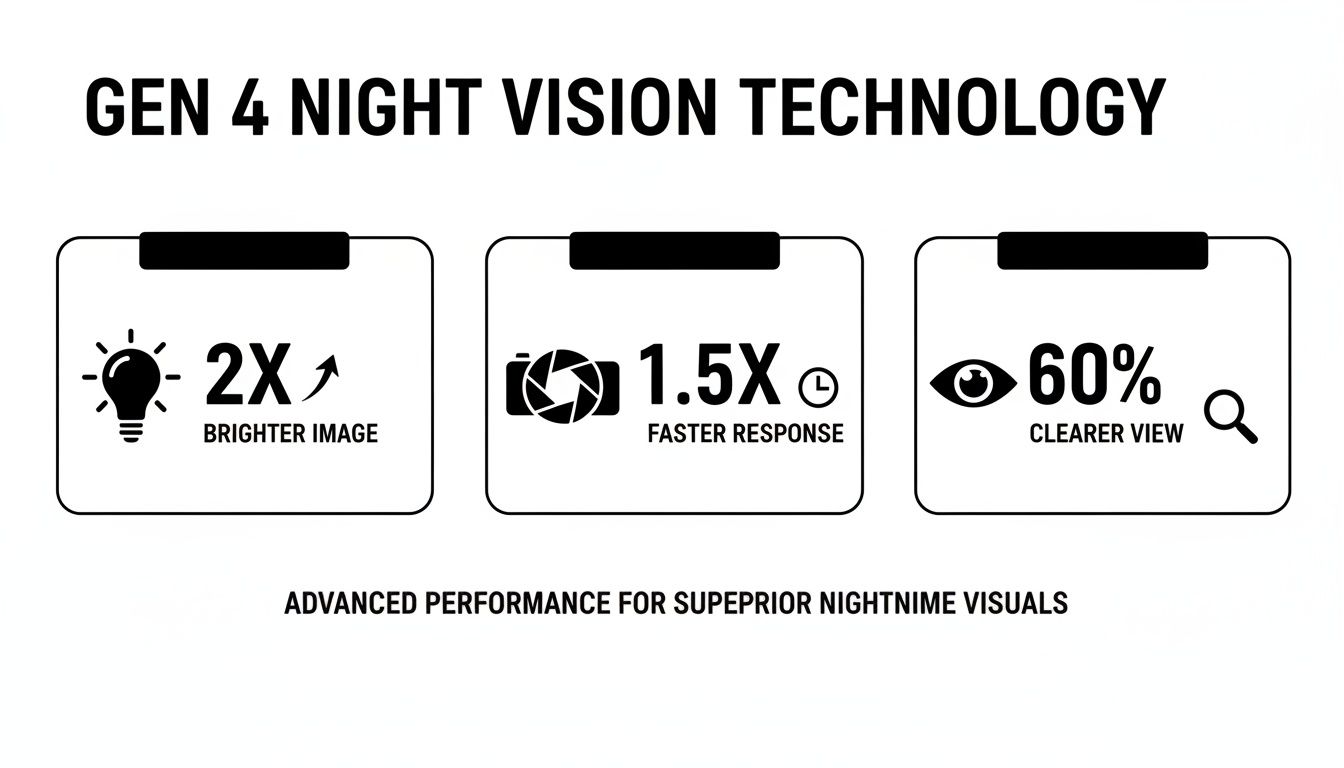
Gen 4 vs Gen 3 Performance at a Glance
To put it all into perspective, here’s a quick breakdown of how these key upgrades translate into real-world performance differences compared to a standard, high-quality Gen 3 device.
| Key Feature | Standard Gen 3 (Filmed) | Generation 4 (Filmless & Autogated) |
|---|---|---|
| Light Transmission | Good, but limited by the ion barrier film. | Excellent. No film means more light reaches the photocathode. |
| Image Clarity (SNR) | High. Provides a clean image in most conditions. | Exceptional. Dramatically reduced noise for a sharper, higher-contrast view. |
| Halo Effect | Noticeable halo around bright light sources. | Significantly Reduced. Tighter, smaller halos improve situational awareness. |
| Dynamic Lighting | Susceptible to "blooming" or washout from sudden flashes. | Superb. Autogating prevents washout and protects the tube. |
| Low-Light Performance | Strong, but can struggle in extreme darkness. | Unmatched. Excels on overcast, moonless nights. |
When you put filmless and autogated tech together, you get a system that performs where others start to fail, giving you a clear operational edge when it matters most.
The Science Behind Superior Low-Light Performance
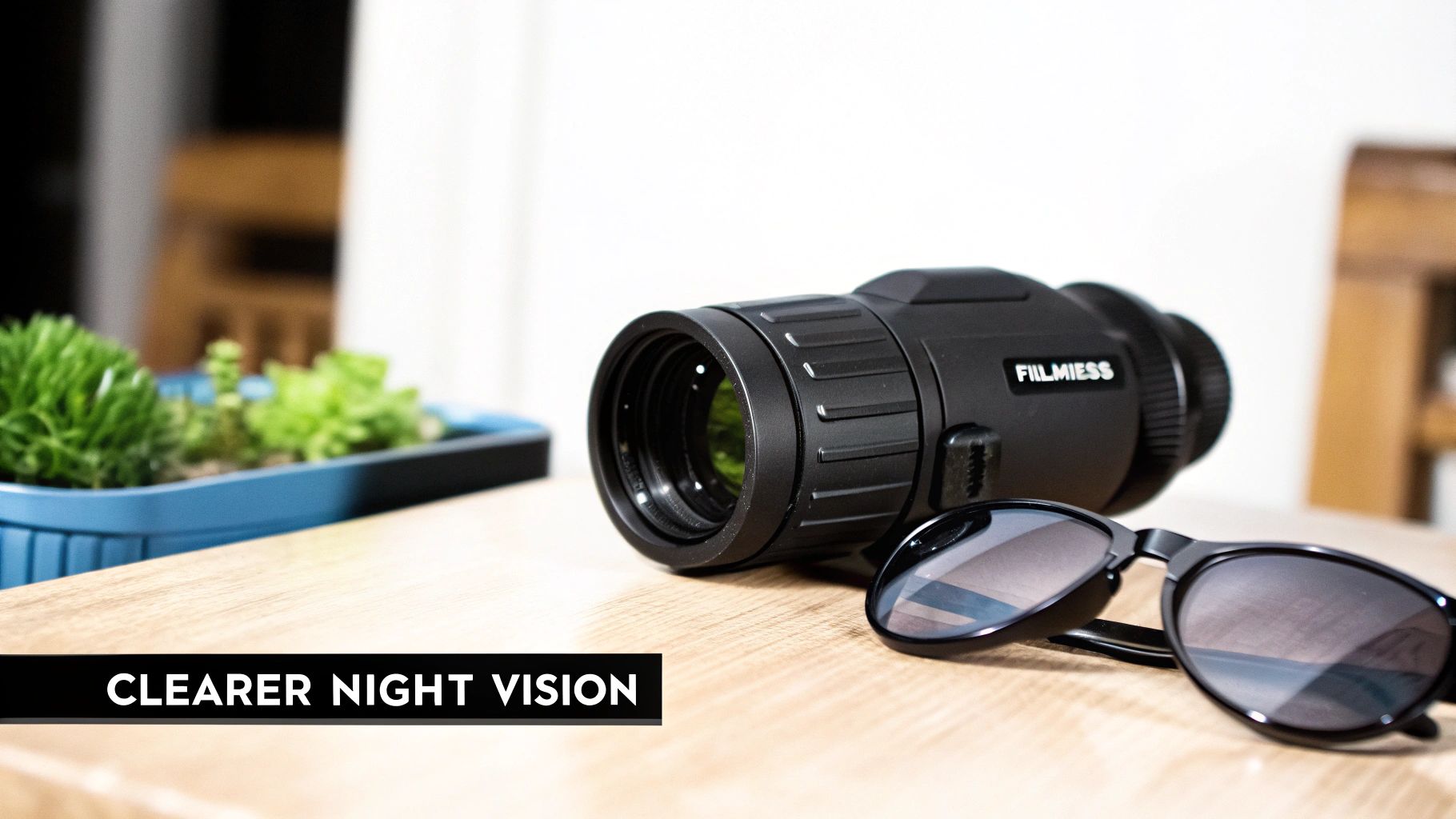
To really get why generation 4 night vision is such a big deal, you have to look inside the image intensifier tube. The real magic is happening at a microscopic level, where two critical pieces of tech—a filmless photocathode and an autogated power supply—work in tandem. The result is an image that’s brighter, sharper, and far more responsive than anything that came before it.
The whole thing starts with the Gallium Arsenide (GaAs) photocathode. You can think of the photocathode as the eyeball of the device; its one job is to catch incoming photons (particles of light) and convert them into electrons. In older Gen 3 tubes, this incredibly sensitive component needed protection, so manufacturers added a thin ion barrier film. It did the job of extending the tube’s life, but it also acted like a permanent, built-in filter, blocking a bit of light.
Generation 4 changes the game by getting rid of that film completely. This "filmless" design lets way more ambient light hit the photocathode, cranking up its sensitivity. What you get is a massive boost in performance in near-total darkness, turning a few stray photons from starlight into a clean, usable image.
Unlocking Clarity with Filmless Technology
The single biggest advantage of ditching that ion barrier is a huge jump in the Signal-to-Noise Ratio (SNR). SNR is probably the most important spec you can look at for night vision. It’s a simple measure of how much good picture ("signal") you're getting compared to the distracting, snowy static ("noise") that creeps in when it's really dark.
A higher SNR translates directly to a cleaner, crisper image with much better contrast. It’s the difference between seeing a fuzzy blob in the woods and being able to clearly identify it as a deer. Because a filmless tube sucks in so much more light, its signal is incredibly strong, which shoves the background noise out of the way and gives you a high-fidelity view.
This was a massive leap forward. When this gated/filmless tech came out in the early 2000s, it delivered up to a 100% improvement in photo response. In practical terms, that means it was capturing twice as many photons under starlight conditions as the best Gen 3 tubes. This not only skyrockets the SNR but also helps prevent bright spots from washing out the image. At the same time, resolution got a huge bump, letting users pick out fine details at ranges over 300 meters in what most would consider pitch-black conditions.
Mastering Dynamic Light with Autogating
The filmless tube gives Gen 4 its power in the dark, but it’s the autogated power supply that lets it handle the real world's messy, mixed-lighting situations. Autogating is basically a smart power management system. It flicks the tube's voltage on and off thousands of times every second—faster than your brain could ever notice.
Picture this: you're moving from a dark alley and suddenly get hit with the glare of streetlights. A standard, non-gated unit would "bloom" or white-out, leaving you blind for a critical second or two.
Autogating stops that from happening. The rapid-fire cycling works like an incredibly fast camera shutter. When a bright light hits, it instantly throttles down the tube's gain. This gives you a few major advantages:
- No More Temporary Blindness: It keeps the image from flaring up, protecting your natural dark-adapted vision.
- Shrinks the Halo Effect: It dramatically reduces the glowing ring (the halo) around light sources, so you can actually see what’s standing next to that streetlight or car headlight.
- Protects Your Investment: It shields the sensitive guts of the tube from getting fried by sudden exposure to intense light.
This isn’t just a safety feature; it's a massive tactical advantage. It means you maintain constant situational awareness, no matter how chaotic the lighting gets. You can get a deeper dive into how this compares to other designs in our detailed comparison of thin-filmed and unfilmed image intensifiers.
In short, the filmless tube gives you the raw horsepower to see in the dark. The autogating gives you the control and finesse to use that power effectively. That one-two punch is what truly defines generation 4 performance.
When you put it all together, these technologies let you gather more information, more accurately. The high resolution, measured in line pairs per millimeter (lp/mm), means you can spot tiny details from further away. And a low Equivalent Background Illumination (EBI) keeps the image itself dark and free from that distracting glow, making it much easier to pick out a camouflaged target against a dark background.
How Generation 4 Shines in the Real World
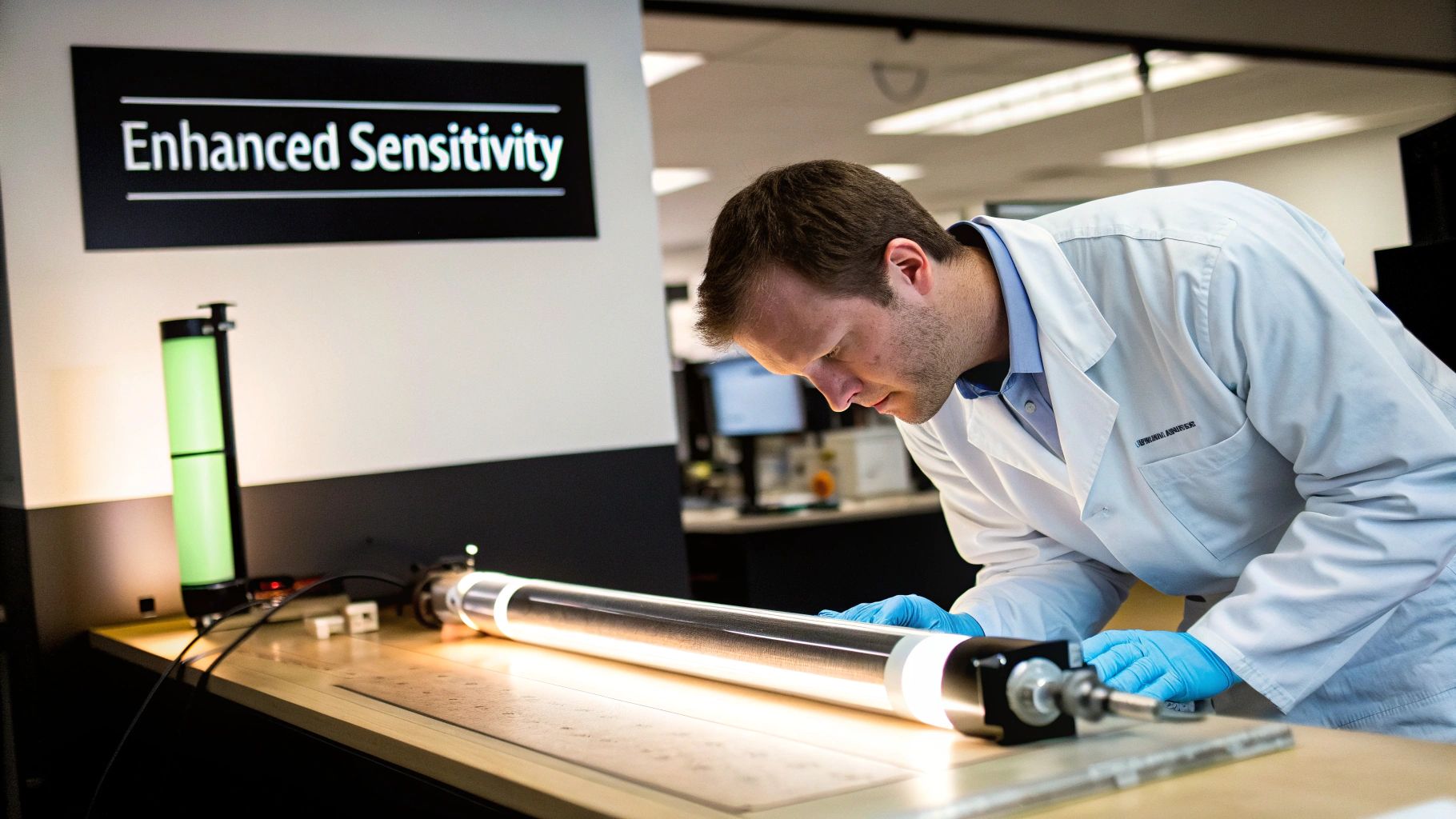
Technical specs on a data sheet are one thing, but the true test of generation 4 night vision is how it performs when everything is on the line. Out in the field, under pressure, is where the filmless tube and autogating technology really show their worth. This isn't just about seeing in the dark; it's about being able to read and react to complex, fast-moving situations with more clarity and speed than ever before.
When you leave the controlled environment of the lab and step into the unpredictable real world, these advanced systems prove why they're a class apart. For anyone whose job depends on clear vision in low light, this is the edge that can make all the difference.
Law Enforcement in Urban Environments
Picture a law enforcement team clearing a building in a city. It's a visual mess—deep, dark corners mixed with sudden bursts of light from street lamps, car headlights, and their own weapon lights. With older night vision, every one of those bright lights creates a massive halo, a bloom of light that could easily hide a threat just feet away.
This is where Gen 4's autogating becomes a lifesaver, literally. As an officer sweeps their light across a room, the system throttles the power in a split second, shrinking that blinding halo down to a tight, manageable ring around the light source itself.
An officer can now see a subject's hands clearly, even when they're standing right next to a bright light. Situational awareness stays high, and the officer isn't temporarily blinded. Seeing through the glare isn't a perk; it's a critical safety feature that leads to faster, better decisions.
The filmless tube’s high signal-to-noise ratio also punches through the darkness in unlit spaces, delivering a crisp, almost static-free image. That means no more second-guessing what’s lurking in the shadows, which translates to less hesitation and a faster, safer operation.
The Hunter's Edge in the Deep Woods
For the serious hunter, the conditions are often as challenging as it gets. Think of a moonless, overcast night in dense timber where ambient light is almost zero. A standard Gen 3 unit might start to struggle here, showing a grainy, "sparkly" image that makes it tough to tell a deer from a tree stump.
A generation 4 system, on the other hand, was built for this. Its incredible light-gathering ability and high SNR produce a picture that’s clean and full of detail.
- Positive Target ID: The hunter can clearly make out the animal's features from a distance, confirming species and size for a safe, ethical shot.
- Navigating Tough Terrain: That enhanced clarity makes it much safer to move through the woods at night, easily spotting trip hazards like fallen logs or ravines.
- Seeing Into Shadows: The system penetrates the deep shadows where game loves to hide, revealing animals that would be invisible to lesser optics.
This level of performance is the result of decades of military development, now refined for broader use. The numbers don't lie: in extremely dark conditions (under 0.001 lux), Gen 4 can achieve S/N ratios over 30:1. That's a huge leap from the typical 20:1 you see in standard Gen 3, and it means getting clear images without needing an IR illuminator that could spook your game.
Military and Security Operations
For soldiers and security professionals, information is survival. A generation 4 device gives them more information, with better clarity, from farther away. During a surveillance mission, an operator can identify threats, weapons, and enemy movements from a much safer distance thanks to the system’s high resolution.
The ability to handle dynamic lighting is just as crucial. Think of a security team at a vehicle checkpoint, constantly dealing with headlights driving straight at them. Instead of the whole scene whiting out, the autogating keeps the image stable, allowing personnel to watch the vehicle’s occupants and their actions without interruption.
This improved performance is a game-changer across a huge range of tasks. You can learn more about the diverse applications of night vision for everything from wildlife observation to home security in our other guides. The bottom line is always the same: when visibility is low and the stakes are high, better technology delivers better outcomes.
Clearing Up the Myths and Navigating the Rules
Like any piece of high-end gear, generation 4 night vision has its share of myths and questions floating around. The leap to filmless technology delivered a stunning boost in performance, but it also gave rise to a few misconceptions that have proven surprisingly sticky. Getting a handle on the truth behind the tech is every bit as important as understanding the legal rules that come with owning it.
This section is all about giving you a straight, honest look at both sides of the coin. We'll dismantle some outdated ideas about tube durability and then walk you through the essential regulations you need to know as an owner. This isn't just trivia; it's the practical knowledge that separates a smart, confident buyer from someone making a risky guess.
Mythbusting: The Truth About Filmless Tube Durability
One of the oldest and most stubborn myths out there is that filmless "Gen 4" tubes are somehow fragile or have a shorter lifespan than their filmed Gen 3 cousins. This idea has its roots in the very early days of the technology, but modern manufacturing and engineering have long since left it in the dust.
The reality? Today’s top-tier filmless tubes are built like tanks. Premier manufacturers like L3Harris and Elbit Systems engineer them to meet brutal military specifications. That means they’re designed from the ground up to handle the same shock, vibration, and harsh environments as any other piece of professional-grade kit you'd trust your life with. In a way, the autogating that makes these systems so effective also doubles as a protective feature, shielding the tube's delicate components from the electrical stress of sudden bright light.
Think of it this way: the lifespan of a modern generation 4 tube is rated for 10,000+ hours of operation. If you used your device for two hours every single night without fail, it would still take you almost 14 years to hit that number. And even then, these tubes don't just blink off; they experience a very slow, predictable decline in performance over an incredibly long service life.
Understanding ITAR and Your Responsibilities as an Owner
Here's a critical point: while owning generation 4 night vision is perfectly legal for U.S. citizens, the technology itself is classified as a defense article. That puts it under the strict control of the U.S. Department of State through a set of rules called the International Traffic in Arms Regulations (ITAR).
ITAR is a body of federal law designed to control the export of defense-related equipment and information. For you, the end-user, this has a few direct, non-negotiable implications:
- No Exporting, Period. You absolutely cannot take, ship, or even mail your Gen 4 device outside of the United States without getting explicit, written permission from the State Department. This includes taking it on an international hunting trip or even just across the border.
- No Foreign Person Access. It is illegal to allow a non-U.S. person to look through or use your ITAR-controlled night vision. This rule applies even if they are physically within the United States.
- Secure It. You are responsible for making sure the device is stored securely where unauthorized individuals, especially foreign persons, cannot access it.
These aren't just friendly suggestions; breaking these rules comes with serious consequences, including massive fines and potential jail time. When you buy a high-end system from a reputable dealer like Superior Tactical, you'll fill out paperwork acknowledging that you understand and will comply with all ITAR restrictions.
This process is here for a reason—it ensures these powerful tools stay in the right hands and protects both you and the seller. It’s a simple but vital part of owning professional-grade equipment responsibly. By understanding these rules, you can enjoy the incredible advantage your gear provides while staying squarely on the right side of federal law.
How to Choose the Right Gen 4 System
Jumping into generation 4 night vision is a serious investment in top-tier performance, but not every device is built the same. The real trick to buying smart is learning how to read a spec sheet like someone who’s been doing this for years. You have to look past the marketing fluff and focus on the hard numbers that tell you exactly what you’ll see in the dark.
Once you know what these core metrics mean, you can pick a device that's actually right for your mission, whether you're hunting hogs, clearing a building, or just keeping an eye on your property. A good spec sheet is the roadmap to a great night vision experience.
Decoding the Critical Spec Sheet Numbers
When you get the data sheet for an image intensifier tube, a few key figures tell you almost the entire story of its performance. These are the numbers that separate a good tube from a truly phenomenal one.
Signal-to-Noise Ratio (SNR): Honestly, this is the most important spec on the sheet. It's a simple measure of how much clean visual information (the "signal") you get compared to the distracting electronic snow or static (the "noise"). A higher SNR, especially 30 or above, gives you a much crisper, cleaner image, which really matters when light is almost non-existent.
Resolution (lp/mm): This tells you how much fine detail the tube can actually resolve, measured in line pairs per millimeter. A higher number, like 64 lp/mm or more, means you can see sharper edges and make out textures, faces, or potential threats from much farther away.
EBI (Equivalent Background Illumination): Think of this as the tube's own built-in "glow" when it's pitch black. A lower EBI, ideally under 2.5, results in a darker background and much better contrast. That makes it easier to spot faint targets that might otherwise blend into the darkness.
Halo: Measured with a value that's hopefully under 1.0, this tells you how well the device handles the bloom around bright lights. A smaller halo is crucial in urban or mixed-light areas because you can see past a streetlight or a car's headlights instead of being totally blinded by them.
If you remember one thing, make it this: prioritize SNR above almost everything else. A high-SNR tube will give you a cleaner, more useful image in the absolute worst lighting conditions, and that’s the whole point of having night vision in the first place.
Matching Specs to Your Mission
The "best" Gen 4 system isn't a single product—it's the one with the right specs for how you plan to use it. A tube that’s incredible for astronomy might be a poor choice for close-quarters work.
For instance, if you’re a hunter out in the deep woods on a moonless night, you need the highest SNR and the lowest EBI you can find. That combination will punch through the darkness and deliver a clean, high-contrast picture so you can be 100% sure of your target.
On the other hand, a law enforcement officer working in a city needs a tube with a fantastic halo value and fast autogating. Their world is full of random, bright lights, and being able to see past them without getting washed out is non-negotiable for staying safe and aware.
Green Phosphor vs White Phosphor
Another big decision is what color image you want to look at all night. This comes down to the phosphor screen inside the tube.
Green Phosphor (P43): This is the classic "night vision green" we all know from movies. It’s incredibly effective, and the human eye is naturally very sensitive to shades of green, which can help in picking out subtle details.
White Phosphor (P45): This gives you a black-and-white image that a lot of people find more natural and less straining on the eyes over long periods. Many feel it offers better contrast and depth perception, which can be a huge advantage.
While white phosphor is definitely the more popular choice today, especially for its perceived clarity, it really boils down to personal preference. Both are exceptionally capable, but the white phosphor units from top-tier makers like L3Harris and Elbit Systems are the current standard for high-performance night vision.
Why Buying from a Trusted Dealer Matters
At the end of the day, where you buy your Gen 4 night vision is just as important as what you buy. A high-spec tube is a major purchase, and you need to work with a shop that will actually stand behind the gear. Here at Superior Tactical, we know our job doesn't end when you click "buy."
Buying from a reputable dealer means you get a hand-selected, high-quality tube without nasty blemishes or performance issues. We provide the full spec sheets for our units so you know exactly what you’re paying for. More importantly, our 10-year warranty and in-house repair services give you real peace of mind. If you ever have a problem, our team is here to provide free diagnostics and expert help to get your equipment back in the fight. That level of support is the final, crucial piece of the puzzle.
A Few Final Questions About Gen 4 Night Vision
Even with all the technical details laid out, you probably still have a few questions rolling around in your head. That's completely normal. The world of high-end night vision is complex, and getting into it means thinking about everything from cost and durability to the legal side of things.
Let's clear up some of the most common questions we get about generation 4 night vision. My goal here is to tackle those practical, real-world concerns so you can feel confident about your next steps.
Is Generation 4 Night Vision Really Worth the Extra Money?
For serious users who find themselves in the worst possible conditions, the answer is an emphatic yes. Look, a high-spec Gen 3 tube is an amazing piece of kit, but "Generation 4" filmless tech gives you a real, tangible edge when the lights really go out.
The magic is in the signal-to-noise ratio (SNR). That’s what gives you a much cleaner, crisper image when there’s virtually no ambient light to work with. On top of that, the massive reduction in halo size is a game-changer in urban environments where you're constantly dealing with stray car headlights and streetlights.
For anyone whose job or passion depends on having the absolute best sight picture in the toughest environments, the jump to Gen 4 is worth every penny. It's the difference between just seeing in the dark and truly owning the night.
Are Filmless Gen 4 Tubes Less Durable?
That's an old myth that just won't seem to die, and it dates back to the very early days of filmless tube development. The truth is, modern "Gen 4" tubes from top-tier manufacturers solved those teething problems a long time ago, thanks to better engineering and autogating.
The autogating itself is a protective feature, flicking the power on and off thousands of times a second to prevent the tube's delicate components from getting fried by bright light. Today's best filmless tubes are built to the same tough military standards as their filmed Gen 3 brothers and are every bit as rugged.
These things are built to last, with most rated for well over 10,000 hours of hard use. They’re designed from the ground up to take a beating in professional, real-world scenarios.
Can a Civilian Legally Own Gen 4 Night Vision?
Absolutely. If you are a U.S. citizen, it is perfectly legal to buy, own, and use Generation 4 night vision inside the United States. But—and this is a big but—these devices are not a new pair of binoculars. They are controlled items under the International Traffic in Arms Regulations, or ITAR.
Understanding ITAR is non-negotiable. These regulations control the export of defense technology to safeguard U.S. national security. As an owner, this places some serious responsibilities on your shoulders:
- No Exporting. Period. You cannot legally take the device out of the country, ship it internationally, or even let a non-U.S. person look through it without explicit permission from the U.S. Department of State.
- Keep It Secure. You are legally responsible for storing the device where non-U.S. persons cannot access it.
Any legitimate dealer will have you sign paperwork confirming you understand these rules. It’s a crucial step that protects both you and the seller. Following ITAR to the letter is a fundamental part of responsibly owning this level of gear.
At Superior Tactical, we don't just sell you a device; we make sure you have the knowledge to use it safely, legally, and effectively. Our team is here to walk you through the entire process and back you up for years to come with our industry-leading 10-year warranty and in-house repair services. Explore our collection of high-performance night vision systems today.
