A Guide to Gen4 Night Vision Technology
When people talk about Gen 4 night vision, they're describing the absolute peak of image intensification technology. It's a huge step up from previous generations. While it's not an official military designation, the term has stuck in the industry to describe advanced tubes built with filmless and autogated technology. These features deliver a massive performance advantage, especially when the light is low and the situation is dynamic.
What Exactly Is Gen 4 Night Vision?
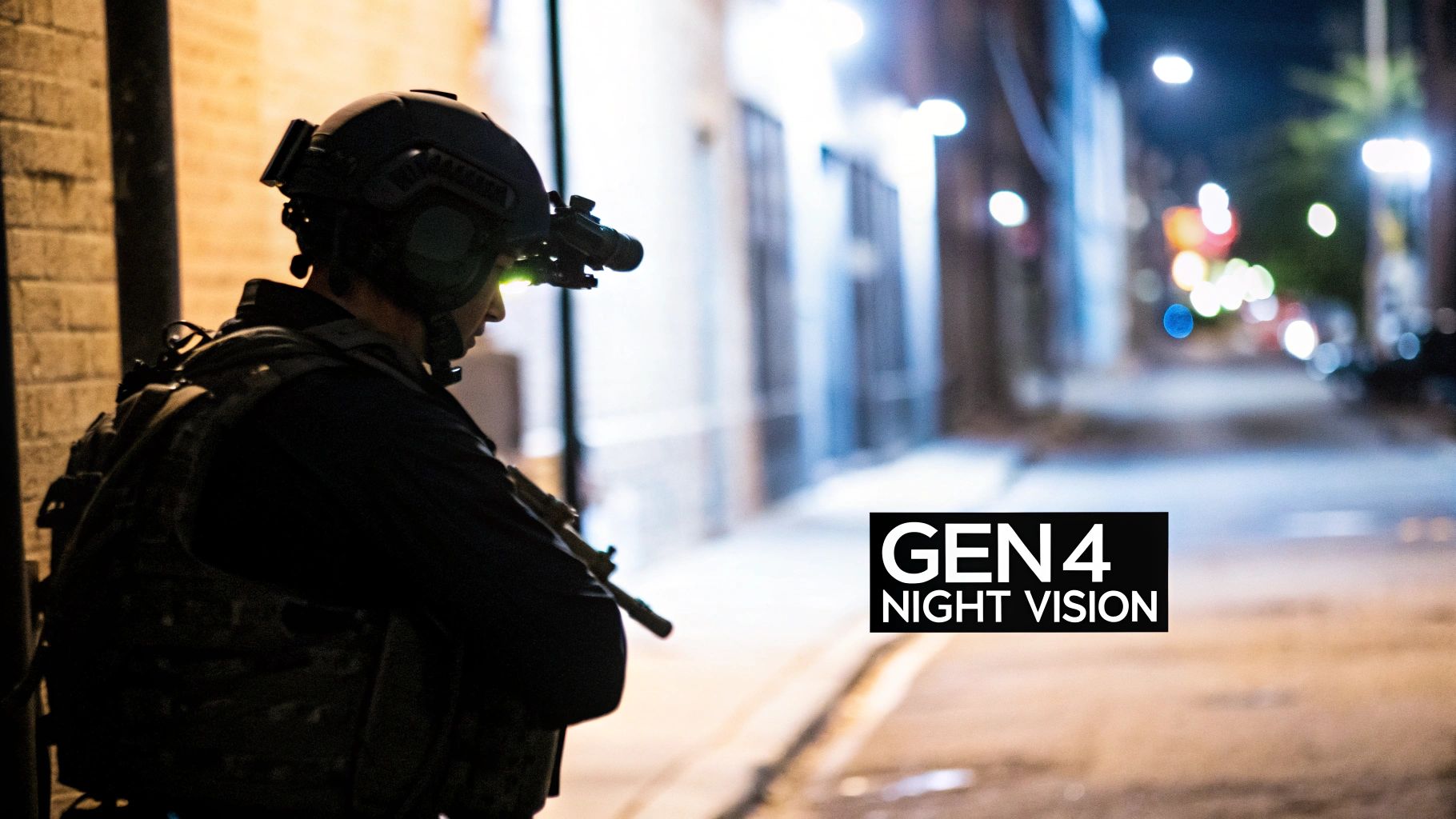
It’s easy to get confused by the "Gen 4" label since the U.S. military never officially adopted it. Think of it less as a formal generation and more as a performance benchmark. The industry uses this term for a specific set of upgrades that pushed Gen 3 tubes past their limits. At the heart of Gen 4 are two game-changing features: a filmless microchannel plate (MCP) and an autogated power supply.
These upgrades were designed to solve the real-world problems that plagued older systems, particularly in environments with sudden, bright flashes of light. The result? A much clearer, sharper, and more reliable night vision experience for the operator.
The Filmless And Autogated Breakthrough
Imagine a standard Gen 3 tube. It has a super-thin protective film over its MCP. This ion barrier is there to extend the tube's life, but it comes at a cost—it slightly dims the image and makes the "halo" effect around bright lights worse.
Gen 4 technology gets rid of that film completely.
By going filmless, the image intensifier tube can suck in a lot more ambient light, which dramatically boosts its sensitivity. In the real world, this means you get a brighter, more detailed picture in the kind of deep darkness where older units would just show you static.
The other half of this powerful combo is autogating. Picture a camera shutter that's flickering open and closed thousands of times every second. That's essentially what autogating does. It lets the system react almost instantly to bright light sources like muzzle flashes, car headlights, or sudden exposure to streetlights.
An autogated power supply does more than just protect the tube from getting fried. Critically, it prevents the user from being temporarily blinded, which is a massive safety advantage. It keeps blooming and halos in check so you can maintain situational awareness when it matters most.
Key Performance Metrics Defined
The tangible benefits of Gen 4 night vision really come into focus when you look at three core performance metrics. These are the numbers that separate a truly elite tube from a standard one.
Photoresponse: This is all about how efficiently the photocathode turns light (photons) into an electrical signal (electrons). A higher photoresponse number means the device is more sensitive and gives you a usable image in near-total darkness.
Signal-to-Noise Ratio (SNR): This is the measure of clean image data (the signal) versus the distracting electronic snow or static (the noise). A high SNR is what gives you that clean, crisp picture, making it far easier to spot and identify what you're looking at.
Resolution: Measured in line pairs per millimeter (lp/mm), resolution is simply the sharpness and detail of the image. The higher the resolution, the more fine detail you can make out, especially at a distance.
Here's a quick look at how these advancements stack up against standard Gen 3.
Gen4 at a Glance: Key Technological Advances
| Technology Feature | Gen 3 (Standard) | Gen 4 (Filmless/Gated) |
|---|---|---|
| Microchannel Plate | Ion Barrier Film | Filmless |
| Power Supply | Non-Gated | Autogated |
| Photoresponse | ~1800 µA/lm | Over 2200 µA/lm |
| High-Light Resolution | ~28 lp/mm | Minimum 36 lp/mm |
| Halo Size | Larger halo effect | Significantly smaller halo |
As you can see, the improvements are substantial across the board. These upgrades, which first emerged in the late 1990s, delivered up to a 100% improvement in photoresponse and tripled the high-light resolution to at least 36 lp/mm. If you want to dive deeper, you can explore more about night vision generations to see just how far the technology has come.
The Road from Starlight Scopes to Modern Optics
To really get why Gen 4 night vision is such a big deal, you have to understand the journey it took to get here. The drive to own the night has been a tactical obsession for almost a hundred years, and every new generation of night vision was created to fix the glaring problems of the last one.
It all started with what we now call Generation 0. The lineage of today's advanced optics traces back to the 1930s, when the German military fielded massive, clunky devices that required a separate infrared spotlight to work. Fast forward to the Vietnam War, and we see the first Gen 1 "Starlight" scopes, which were the first to passively use ambient light—a game-changer for jungle patrols. You can dive deeper into the full history of night vision technology development to see how those early pioneers set the stage.
The Dawn of Passive Night Vision
The biggest weakness of Gen 0 was that active IR illuminator. It was essentially a special flashlight only the scope could see, but it also acted like a giant "shoot me" sign for anyone else with night vision. That critical flaw created an urgent demand for a system that could work passively, just by gathering the faint light already there.
The solution was Generation 1, famously known as "Starlight" technology.
First fielded in the 1960s, Gen 1 was a revolutionary step forward. These devices could amplify existing starlight or moonlight by thousands of times, letting soldiers see without giving away their position. But they were far from perfect and came with their own set of headaches:
- Image Distortion: The view often suffered from a "fish-eye" effect, especially around the edges.
- Low Light Weakness: They needed a decent amount of moonlight to be effective and were practically blind on cloudy, starless nights.
- Blooming: Pointing them at a bright light source would cause the entire image to wash out, temporarily blinding the user.
A Leap in Clarity with Gen 2 and Gen 3
The next major breakthrough came with Generation 2 and the introduction of the Microchannel Plate (MCP). Think of the MCP as a supercharger for light, dramatically boosting the gain to produce a much sharper and less distorted image. This technology made night vision truly viable in a much broader spectrum of low-light scenarios.
Then, in the 1980s, Generation 3 pushed the envelope again. The secret sauce was a new photocathode made from gallium arsenide, a material far more sensitive to light. The result was a massive jump in low-light performance and image resolution, giving operators a clear tactical edge. For decades, Gen 3 was the undisputed king of the hill for military and law enforcement use.
But even as good as it was, Gen 3 had an Achilles' heel in complex lighting. An ion barrier film, added to extend the tube's life, created a halo effect around bright lights and slightly throttled performance—a serious problem in urban settings with streetlights and car headlights.
This is exactly where the story of Gen 4 begins. The real-world frustrations of Gen 3 users in dynamic, light-polluted environments created the demand for something better. The filmless and autogated technology that defines Gen 4 night vision was engineered specifically to solve these problems, delivering clarity and performance when the situation is at its most unpredictable.
Understanding the Technology Inside a Gen 4 Tube
To really get what makes Gen 4 night vision so special, you have to look under the hood. The heart of any night vision device is its image intensifier tube—think of it as the engine. The components inside this tube determine everything you see, from brightness and clarity to overall performance, and Gen 4 pushes these parts to their absolute limit.
At its most basic, a night vision tube grabs whatever tiny amount of ambient light is available, turns those light particles (photons) into electrons, multiplies the hell out of them, and then zaps them back into a visible image on a screen. This whole magic trick is handled by three key players: the photocathode, the microchannel plate (MCP), and an autogated power supply.
The Photocathode and Microchannel Plate
It all starts at the photocathode, a special light-sensitive layer at the very front of the tube. Its only job is to catch incoming photons and kick out electrons in their place. Gen 4 tubes use a ridiculously efficient gallium arsenide photocathode that’s far more sensitive to faint light than older tech, which is why it excels in what feels like total darkness.
Once those electrons are free, they’re rocketed toward the Microchannel Plate (MCP). The best way to picture an MCP is as a paper-thin glass disc that's been drilled with millions of microscopic, angled tunnels. When a single electron flies into one of these tunnels, it slams into the wall and knocks several more electrons loose. This creates a chain reaction, an avalanche of electrons, amplifying the original signal by thousands of times.
This is where the whole "filmless" or "unfilmed" discussion comes in. Most standard Gen 3 tubes have a protective ion barrier film coating the MCP. It does a good job of extending the tube's life, but it also acts as a bouncer at a nightclub door, slowing things down and reducing the number of electrons that get inside.
By removing this film, Gen 4 night vision tubes let a whole lot more electrons flood into the MCP. This unobstructed path cranks up the light transmission, giving you a noticeably brighter image, better performance in super-dark conditions, and a much higher Signal-to-Noise Ratio (SNR).
This chart gives you a quick visual of how we got from clunky early-gen gear to the high-performance tubes we have today.
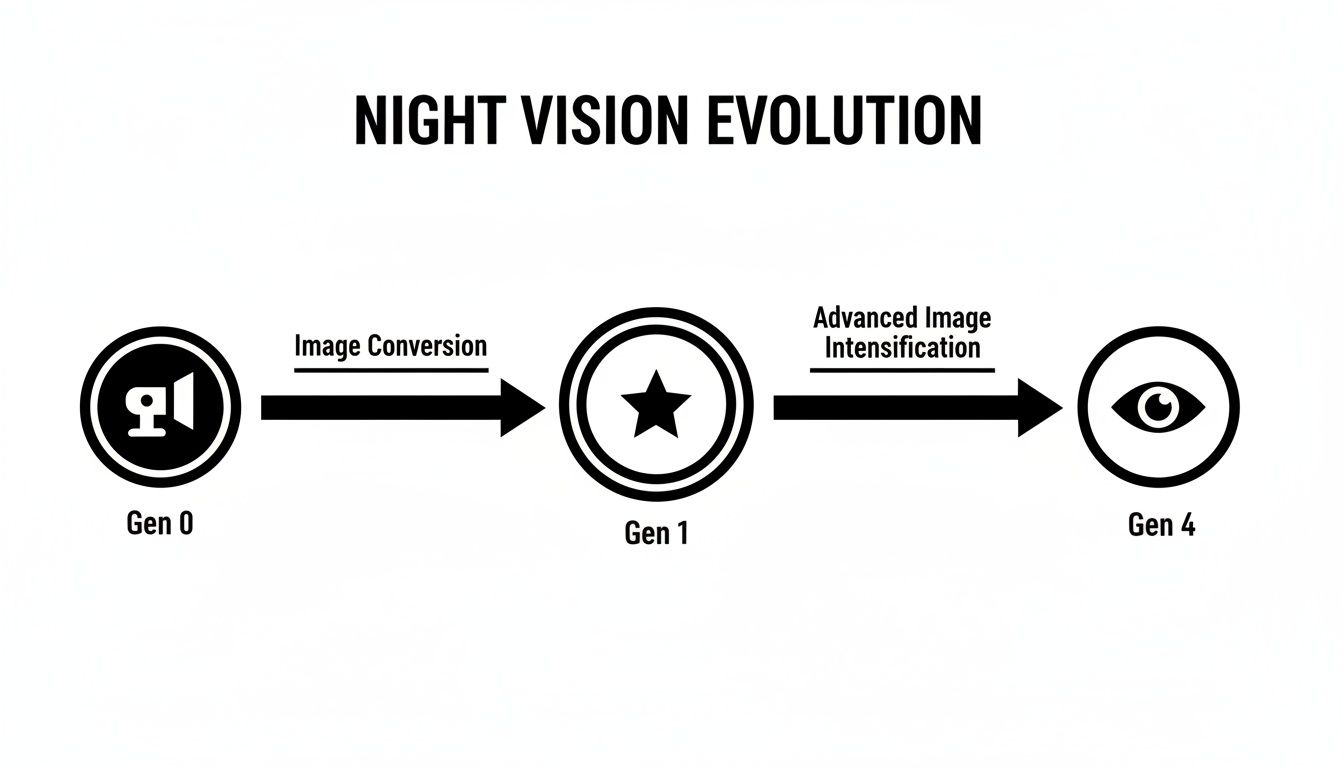
You can clearly see the jumps in technology, with each new generation building on the last to give users a clearer picture when the lights go out.
Decoding Spec Sheet Numbers
When you’re shopping for night vision, the spec sheet is where the tube tells its life story. The two numbers that matter most are the Signal-to-Noise Ratio (SNR) and Resolution, which is measured in line pairs per millimeter (lp/mm).
Signal-to-Noise Ratio (SNR): Think of SNR like the clarity of a radio signal. High SNR is like a crystal-clear broadcast (your image), while low SNR is a bunch of static and fuzz (electronic noise). Gen 4's filmless design is a direct cause of its high SNR, which is often above 30. The result is a much cleaner, less "sparkly" view.
Resolution (lp/mm): This is all about sharpness, just like the resolution of a TV. It’s a measure of how many tiny pairs of lines can be seen in a millimeter of space. A higher number means more detail, which lets you identify targets and navigate terrain more easily. Top-tier Gen 4 tubes often hit resolutions of 72 lp/mm or higher.
Grasping the filmless vs. filmed difference is key because it's directly tied to these performance metrics. If you want to dive deeper, our article on the comparison between thin-filmed and unfilmed tubes in night vision breaks down exactly why going filmless is such a big deal.
Autogating: The Secret to Dynamic Lighting
The last piece of the Gen 4 puzzle is the autogated power supply. This is the smart tech that saves both the tube and your eyesight from sudden, bright flashes of light. An autogated system is constantly flickering the power to the tube on and off, thousands of times every second.
This rapid-fire cycling works like a camera shutter on hyperspeed, automatically managing the amount of light getting amplified. The second you encounter a muzzle flash, car headlights, or a light flipping on, the autogating reacts instantly. It stops the image from blowing out, shrinks the halo effect around bright lights, and protects the tube’s sensitive guts from getting fried.
Most importantly, it means you can keep your eyes on the target without being temporarily blinded—an absolutely essential feature when things get serious.
How Gen 4 Stacks Up Against Gen 3 in the Real World
Data sheets and technical specs are great for comparing numbers, but they don't tell the whole story. The true test of Gen 4 night vision is how it performs when the pressure is on and every second counts. The leap from Gen 3 to Gen 4 isn't just about a crisper image; it's about gaining a real-world advantage when you need it most. This is where features like a high SNR and autogating go from being specs on a page to mission-critical tools.
Let’s set aside the lab numbers and look at how these technologies actually perform in situations where your safety and success hang in the balance. The differences become crystal clear when the environment gets unpredictable.
Dynamic Urban Environments
Picture a police officer clearing a dark, tight alleyway. A standard Gen 3 unit provides good visibility, cutting through the deep shadows. Everything is quiet. Then, a car at the far end of the alley flicks on its high beams, instantly flooding the area with blinding light.
With a typical Gen 3 tube, the image would "bloom" out completely. A massive, bright halo would erupt from the headlights, washing out everything else. For that critical moment, the officer is effectively blind, unable to see a potential threat standing right next to the car.
Now, let's run that scenario back with Gen 4 night vision. The moment those high beams hit, the autogating function snaps into action. It instantly throttles the power to the tube, shrinking that massive halo down to a tight, manageable circle around the light source. The officer isn't blinded. They can still see the vehicle's silhouette and detect movement around it, never losing that vital situational awareness.
That ability to handle sudden, intense light changes without washing out is probably the single most important safety feature of Gen 4. It keeps operators in the fight in chaotic, light-polluted areas where older systems would simply white out.
Low-Light Rural Operations
The advantages of Gen 4 are just as game-changing out in the pitch-black countryside. Think of a hunter scanning a thick tree line on an overcast, moonless night. There's barely any ambient light, pushing any night vision device to its absolute limits.
Under these tough conditions, a Gen 3 unit is likely to produce a "sparkly" or grainy image. That electronic noise, a result of a lower Signal-to-Noise Ratio (SNR), can easily hide the faint outline of an animal against the brush, making a positive ID impossible. You might miss the shot or, even worse, misidentify your target.
This is where a Gen 4 device, with its filmless tube and incredible light sensitivity, really shines. It sucks in what little light is available and, thanks to its high SNR (often above 30), delivers a remarkably clean and sharp picture. That blurry shape against the trees resolves into a clear, identifiable deer. This translates directly to:
- Greater Detection Range: Seeing targets from much farther away.
- Improved Identification: Making a confident, ethical shot every time.
- Safer Navigation: Moving through rough terrain with total clarity.
Positive Identification at a Distance
Whether you're conducting reconnaissance or checking on a strange noise in your backyard, being able to identify a threat from a safe distance is everything. The higher resolution of Gen 4 tubes, often 72 lp/mm or more, gives you a serious edge. That extra sharpness lets you pick out details that would just be a blur through a Gen 3 device.
For example, is that person in the distance holding a shovel or a rifle? That's a critical distinction to make. With Gen 4, you resolve that detail sooner and from further away, giving you precious time to react, de-escalate, or prepare. Knowing the nuances of different low-light systems is crucial, which is why our guide on thermal imaging versus digital and analog night vision is a great resource. In the end, investing in Gen 4 is an investment in clarity, safety, and operational dominance.
Choosing the Right Gen 4 Night Vision System
Investing in a Gen 4 night vision system is a big step. The technology is absolutely incredible, but even the best tube on the planet is useless if it’s sitting in the wrong housing for your mission. The right choice goes way beyond the spec sheet—it’s about thinking hard about how, where, and why you’ll be putting your gear to work.
From the dead quiet of a hunting blind to the fluid, high-stress environment of a security patrol, your specific needs will dictate the perfect setup. Let's walk through the most critical decisions to help you build a complete system that’s locked in with your objectives.
Monocular or Binocular Systems
First thing's first: are you going with a single-tube monocular or a dual-tube binocular setup? This is the biggest fork in the road, and each path has serious advantages for different jobs.
A monocular, like the legendary PVS-14, is the versatile workhorse of the night vision world. With only a single image intensifier tube, it's lighter and more budget-friendly. One of its key strengths is that it leaves one of your eyes free, preserving your natural night vision. This is a huge help for situational awareness and for tasks that require unaided sight, like reading a map or checking your equipment up close.
On the other hand, a binocular system puts a tube in front of each eye. This gives you true stereoscopic vision, which completely changes the game for depth perception. Things like navigating tricky terrain, driving a vehicle, or judging distance to a target become far more natural and less mentally taxing. They are heavier and carry a higher price tag, but for mobility and long-term observation, the immersive view is a massive advantage.
Selecting Your Housing and Lenses
The image tube gets all the glory, but the housing and lenses are every bit as important. Think of the housing as the chassis of a high-performance car—it protects the engine (the tube) and defines how you interact with it. A tough, well-designed housing is non-negotiable for reliability when you're out in the field.
Lens quality is just as critical. Premium glass delivers a crisper, clearer image with better light transmission and minimal distortion. Skimping here is like putting cheap tires on a sports car; you simply won't get the performance you paid for out of your top-tier Gen 4 night vision tube. Investing in superior glass is always money well spent.
Here's the bottom line: a system is only as strong as its weakest link. A world-class filmless tube paired with poor-quality lenses or a flimsy housing will only lead to disappointment and failure when it counts.
Aligning Gear with Your Mission
Your specific mission is the ultimate compass for choosing the right system. A hunter’s needs are a world apart from a law enforcement officer’s, and your gear should reflect that reality.
To make this a little simpler, here’s a quick-glance table to match common activities with the right type of system.
Which Night Vision System Is Right for You
| Primary Use Case | Recommended System Type | Key Advantages |
|---|---|---|
| Hunting | Monocular (e.g., PVS-14) | Lightweight for long treks, preserves an eye for natural aiming, and is cost-effective for static observation. |
| Security/LE | Binocular or Articulating Bino | Superior depth perception for navigating structures, driving, and maintaining full situational awareness. |
| General Navigation | Binocular System | Reduced eye strain over long periods and intuitive movement through challenging terrain. |
This table is a great starting point, but every situation is unique. For a deeper dive into matching gear to your goals, you can learn more about how to choose the right night vision device for your needs in our complete buyer’s guide.
Building a Complete System
Your night vision device is the heart of your setup, but it doesn't work in a vacuum. To actually use it effectively, you need a few other key pieces of gear to build a functional and comfortable system. Assembling your kit is just as important as picking the optic itself.
Here are the key components you'll need to think about:
Helmet and Mount: A good ballistic or bump helmet gives you a stable platform for your night vision. The mount is what connects your device to that helmet, and a solid, reputable mount from a company like Wilcox or Norotos is absolutely critical to prevent wobble and maintain a consistent sight picture.
IR Illuminator/Laser: Night vision needs some light to work. In total darkness—like inside a building with no windows—an infrared (IR) illuminator is essential. For tactical use, an IR laser is a must-have, as it lets you aim your firearm accurately while looking through your NODs.
Counterweights and Comfort: Hanging a device off the front of your helmet will cause serious neck strain over time. A counterweight system on the back of the helmet balances the load, making it dramatically more comfortable for hours of continuous use.
By carefully considering each of these pieces—from the tube and housing to the helmet and accessories—you can build a Gen 4 night vision system that is dialed in for your mission, ensuring you're ready for whatever the night throws at you.
Looking After Your Night Vision Investment
Dropping a serious amount of cash on high-end gen 4 night vision is a big step. Like any precision tool, it needs the right care to keep it running at its peak for years to come. Protecting your gear is more than just keeping the lenses clean; it’s about making sure the sophisticated tech inside is ready to go the second you need it.
The secret to long-term success with night vision is building simple, consistent habits. Good maintenance keeps your device from becoming a very expensive paperweight. It’s about more than just wiping it down—it's about learning to spot the early warning signs that tell you it’s time to call in a pro.
The Essentials of Night Vision Care
You don't need to be an optics technician to keep your gear in prime condition. Just a few basic rules will help you sidestep the most common ways people damage their units and will keep that image intensifier tube going strong.
Cleaning Your Lenses: Always, and I mean always, use a proper lens pen or a fresh microfiber cloth with a good quality lens cleaning solution. First, use a little compressed air to blow off any dust or grit. The last thing you want is to grind a piece of sand into that delicate lens coating. Never grab a t-shirt or paper towel.
Managing Batteries: If you're putting your unit away for a while, take the batteries out. A leaky battery can cause devastating corrosion that is often impossible to fix.
Storing It Right: A hard, padded case is your best friend. Keep it somewhere that doesn't get ridiculously hot, cold, or damp. Throwing a desiccant packet in the case is a great pro-tip to fight off moisture that can cause fogging or internal damage.
Here’s the number one rule you can’t forget: keep the daylight cap on whenever you aren’t using the device. Even a split second of direct sunlight can permanently burn your image intensifier tube, leaving a permanent black spot in your vision that's there to stay.
Knowing When to Call for Backup
Even if you do everything right, things can still happen. The trick is knowing what to look for so you can catch a small problem before it becomes a big, expensive one. If you start seeing black spots that won’t clean off, notice any flickering, or the image suddenly seems dimmer than usual, it’s time to get it checked out by an expert.
This is where having a team like Superior Tactical in your corner really pays off. We offer free in-house diagnostics to figure out exactly what’s going on with your gear. Our technicians have seen it all and can handle anything from a basic tune-up to a major repair, making sure your investment is well protected.
Warranties and Keeping Your Gear Current
A solid warranty is your ultimate safety net. We back our Gen 3 and higher systems with a 10-year warranty because we believe in the gear we sell. That kind of long-term support gives you real peace of mind when you're dealing with such advanced technology.
The world of gen 4 night vision is also constantly moving forward, and your own needs might change, too. When you work with a dedicated shop, you have a direct line for future upgrades. Whether you're thinking about moving from a PVS-14 to a set of binos or want a new housing with better features, we can help you adapt your setup for whatever your next mission or hunt demands.
Your Top Questions About Gen 4 Night Vision, Answered
When you're diving into the world of high-end night vision, a lot of questions come up. It's totally normal. Let's clear the air and get you some straight answers on the most common things people ask about Gen 4 night vision.
Is "Gen 4" an Official Military Classification?
Short answer: no, it isn't. The U.S. military has official designations for Gen 1, Gen 2, and Gen 3, but "Gen 4" never became an official category.
The term was coined by the industry to describe a major leap forward in performance—specifically, image intensifier tubes that are both filmless and autogated. Think of it less as a formal generation and more as a performance benchmark for the absolute best unfilmed Gen 3 tubes out there.
Gen 4 is a name for elite, unfilmed Gen 3 tubes that offer incredible clarity, exceptional low-light sensitivity, and solid protection against sudden flashes of bright light.
What’s the Big Deal With Filmless Technology?
A standard Gen 3 tube has a thin ion barrier film protecting its microchannel plate. It's there to extend the tube's life, but it comes at a small cost—it blocks a tiny bit of light and can make the "halo" effect around light sources more pronounced.
Going filmless rips that barrier out. The result? More light gets in, which gives you a direct performance boost.
- Higher Sensitivity: You get a noticeably brighter image when it's almost pitch black.
- Better Signal-to-Noise Ratio (SNR): The image is cleaner, with less of that distracting electronic "sparkle" or static.
- Improved Clarity: You can see more detail, which is crucial for identifying what you're looking at.
Do I Actually Need Autogating?
If you'll be anywhere with unpredictable lighting, then yes, autogating is a must-have. It’s a game-changer. It works like an incredibly fast shutter, rapidly adjusting the tube's power supply when you're hit with bright lights like street lamps, car headlights, or even a muzzle flash.
This feature does two critical things: it protects the tube from getting damaged, and more importantly, it stops you from being temporarily blinded. It keeps you in the fight and aware of your surroundings when the environment changes in a heartbeat. For any serious user, it's a non-negotiable safety and performance feature of Gen 4 night vision.
At Superior Tactical LLC, we live and breathe this stuff. We focus on getting you the right night vision for your specific needs. Check out our complete lineup of Gen 4 and advanced Gen 3 systems and get the advantage you need to own the night.
