A Complete Guide to the Gen 3 Night Vision Scope
When people talk about a Gen 3 night vision scope, they're referring to the absolute peak of commercially available night vision technology. This isn't a specific brand, but a classification—a performance benchmark built around a gallium arsenide (GaAs) photocathode. This one component is what gives Gen 3 its massive performance advantage over older tech.
Think of it this way: Gen 3 is the top choice for elite military units, law enforcement, and serious hunters for a very good reason. It just works, even when the light conditions are abysmal.
What Exactly Is a Gen 3 Night Vision Scope
Let's use an analogy. You could compare the difference between night vision generations to camera sensors. A cheap point-and-shoot camera might take a decent photo in bright daylight, but it will produce a grainy, unusable mess in low light. A professional DSLR, however, is built with a high-end sensor that can capture a crisp, clear image with very little available light.
That's the kind of leap we're talking about with a Gen 3 night vision scope. It takes incredibly faint ambient light—starlight, a sliver of the moon—and transforms it into a remarkably clear and detailed image. Where older devices struggle and produce a noisy, "sparkly" picture, a Gen 3 unit gives you a clean sight picture that’s usable for identifying targets hundreds of yards away.
The Gold Standard for a Reason
The performance gap between Gen 2 and Gen 3 is so huge that it's become the go-to standard for anyone whose job depends on operating after dark. For these professionals, equipment failure isn't an option, and Gen 3 provides the reliability they need to function in the toughest low-light environments.
So, what makes a gen 3 night vision scope the undisputed champ?
- Superior Image Clarity: We're talking resolutions that often hit 64 line pairs per millimeter (lp/mm) or higher. This means you can pick out fine details—like the difference between a coyote and a stray dog—that would be a blurry guess with lesser equipment.
- Exceptional Low-Light Performance: The gallium arsenide photocathode is ridiculously efficient at converting photons to electrons. This sensitivity lets the scope paint a bright, usable image even on moonless, overcast nights where other devices would be useless.
- Increased Durability and Lifespan: These tubes are built tough. A typical Gen 3 image intensifier is rated for over 10,000 hours of operation, which is often more than double what you'd get from a Gen 2 unit.
The real power of Gen 3 isn't just about seeing in the dark. It’s about having the visual information you need to make critical, confident decisions when visibility is near zero. It’s the difference between guessing and knowing.
Ultimately, opting for a Gen 3 device is an investment in uncompromising performance. In this guide, we'll dive deep into the specs, features, and real-world applications that make this technology the only serious choice for mastering the night.
How Gen 3 Technology Turns Night into Day
Ever wondered how a Gen 3 night vision scope can make pitch-black darkness look like dusk? It’s not magic, but it’s pretty close. The whole process boils down to capturing tiny, invisible particles of light—photons—and amplifying them by an insane amount to create a bright, clear picture for your eye.
The real game-changer in Gen 3 tech is a component called the photocathode. Think of it as the front door for light. In Gen 3 devices, this "door" is made of Gallium Arsenide (GaAs), a material that’s incredibly sensitive to light, especially in the near-infrared part of the spectrum that we can't see. It's wildly efficient at converting those incoming photons into electrons.
Once the photocathode does its job, those electrons are sent to the second key player: the Microchannel Plate (MCP).
The Power of Amplification
The Microchannel Plate is the engine of the whole operation. It’s a tiny glass disc, no bigger than a quarter, but it’s packed with millions of microscopic channels. When an electron from the photocathode zips into one of these channels, it smacks the wall and knocks loose several more electrons. This creates a chain reaction, a cascade that multiplies the original signal by tens of thousands of times.
This massive amplification is what lets you see a clear image from what was originally just a handful of photons. After leaving the MCP, this amplified cloud of electrons hits a phosphor screen, which glows to create the green-tinted image you see through the eyepiece. To get the full play-by-play, check out our deep dive on how night vision works.
The switch to the Gallium Arsenide photocathode back in the late 1980s was a massive leap forward. It boosted light sensitivity by as much as 50-100% over Gen 2 tech and pushed image resolution past 64 line pairs per millimeter (lp/mm). In practical terms, this means you get crystal-clear images at distances well over 300 yards.
The real win with Gen 3 isn't just a brighter view—it's the sheer clarity. You get a sharper, cleaner, more detailed picture that allows for positive target identification and total situational awareness when the stakes are high.
Measuring Performance: What FOM Means for You
So, how do we measure all this performance? The industry uses a metric called Figure of Merit (FOM). It’s not just techy jargon; it’s a straightforward calculation that tells you how well a tube will perform in low light.
The jump in performance from older tech to Gen 3 is significant, and this diagram helps put it into perspective.
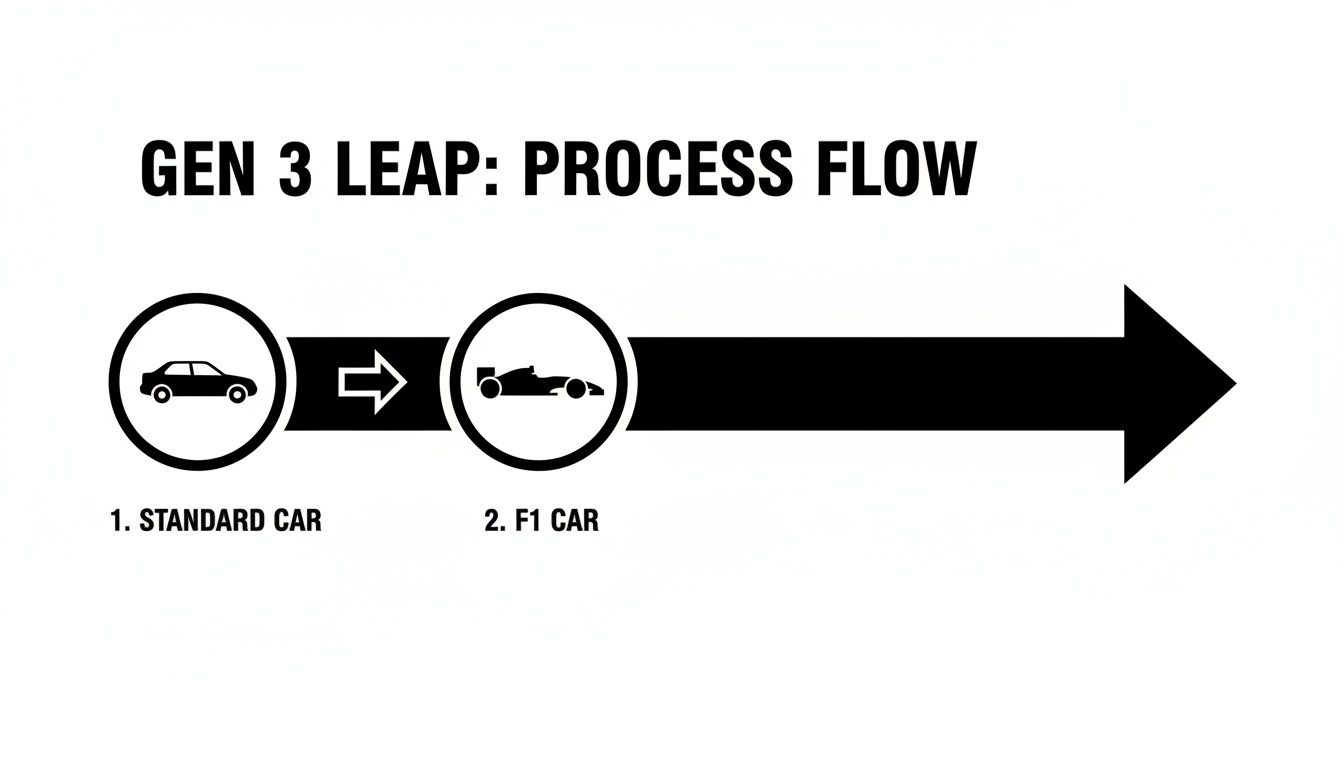
Think of it like going from a reliable family sedan to a finely tuned Formula 1 car. Both are cars, but their performance is worlds apart.
The formula for FOM is simple:
FOM = Resolution (lp/mm) x Signal-to-Noise Ratio (SNR)
Here's what those terms actually mean out in the field:
- Resolution (lp/mm): This is all about detail. A higher number means a sharper, crisper image, which is critical for telling the difference between a coyote and a stray dog at a distance.
- Signal-to-Noise Ratio (SNR): This measures how "clean" the image is. The "signal" is the light you want, and the "noise" is that staticky grain you see on the darkest nights. A high SNR gives you a much smoother, clearer picture with less of that distracting "scintillation."
A high-quality Gen 3 tube will often have a FOM score over 2000. That number is your assurance that you’re getting a premium device that will deliver a sharp, clean image even on a moonless, overcast night in the middle of the woods. It's this powerful combination of a super-sensitive photocathode, an impressive MCP, and top-tier specs that truly lets Gen 3 turn night into day.
Comparing Night Vision Generations
To really get why a Gen 3 night vision scope is considered the top tier, you have to see how it stacks up against everything else. These aren't just minor spec bumps; the differences create a massive gap in real-world performance that can literally mean the difference between success and failure in the field.
The whole history of night vision is a story of making images cleaner, brighter, and more reliable. Each new generation was a direct response to the shortcomings of the last, a steady climb that led to the incredible capability of today's Gen 3 gear.
Gen 1: The Starting Point
First-generation night vision kicked things off back in the 1960s. It was a game-changer for its time, but it had some serious drawbacks. These units are extremely light-hungry and almost always need a built-in infrared (IR) illuminator—basically an invisible flashlight—to see anything at all. In real darkness, they're nearly blind without it.
You can spot a Gen 1 image from a mile away:
- Image Distortion: You get a weird "fisheye" effect, making the edges of the picture blurry and warped.
- Grainy Picture: The view is full of static, or "scintillation," which makes picking out fine details a real chore.
- Short Lifespan: These tubes don't last long, typically petering out after about 1,500 hours of use.
Honestly, while Gen 1 is cheap, it's more of a novelty for backyard plinking than a serious tool you'd bet your life on.
Gen 2: A Major Leap Forward
Generation 2, which showed up in the 1970s, was a huge improvement. The big breakthrough was the Microchannel Plate (MCP), a component that acts like a massive light amplifier. Suddenly, devices could work passively in much darker conditions without screaming "I'm here!" with an IR illuminator.
But Gen 2 isn't perfect. The image quality, while better, still isn't as crisp as what you get from Gen 3. More importantly, its performance really nosedives in extreme low-light situations, like a moonless night under a thick cloud cover. A typical Gen 2 tube has a lifespan of around 2,500 to 5,000 hours—a decent step up, but still less than half of what you can expect from a standard Gen 3 unit.
If you want to dive deeper into the nuts and bolts, our guide to the different night vision generations breaks down all the technical details.
Digital Night Vision: The New Contender
Digital night vision is a whole different animal. It uses a camera sensor, much like the one in your smartphone, instead of an analog image intensifier tube. This is cool because it lets you do things like record video or even use the scope in full color during the day.
The Achilles' heel of digital, however, is its performance when the lights really go out. To see in true darkness, digital scopes have to blast the area with a powerful IR illuminator, making the user a glowing beacon to anyone else wearing night vision. They’re fantastic for things like pest control at a fixed distance, but they just can't compete with the passive, light-gathering power of a gen 3 night vision scope.
Here's the bottom line: In conditions where a Gen 3 scope gives you a clear, detailed image using nothing but faint starlight, a digital device would just show a screen full of static. That's the critical difference for anyone who needs to see without being seen.
Night Vision Generation Performance Comparison
Sometimes seeing it all laid out is the easiest way to understand the differences. This table breaks down the key performance metrics across the different technologies so you can see where each one shines—and where it falls short.
| Feature | Gen 1 | Gen 2 | Gen 3 | Digital NV |
|---|---|---|---|---|
| Image Clarity | Low, with distortion | Good, clear center | Excellent, sharp edge-to-edge | Varies, often pixelated |
| Low-Light Performance | Poor, needs IR | Good, passive capable | Superior, works in starlight | Poor without IR |
| Effective Range | ~75 yards | ~200 yards | 300+ yards | ~150 yards (with IR) |
| Device Lifespan | ~1,500 hours | ~5,000 hours | 10,000+ hours | Varies by electronics |
| Light Source Resistance | Prone to damage | Good resistance | Excellent with auto-gating | Not damaged by light |
Ultimately, what's "best" really comes down to what you're doing. For casual use or short-range observation where staying hidden doesn’t matter, other technologies will get the job done. But for any serious operator—law enforcement, a dedicated hunter, or a search and rescue professional—who needs mission-critical reliability and the absolute best performance in the worst conditions, investing in Gen 3 isn't a luxury. It's essential.
Key Features of Modern Gen 3 Scopes
When you get into high-end Gen 3 gear, you’re not just paying for a better image intensifier tube. You're investing in a suite of advanced features that make the scope genuinely usable in the real world—where conditions are rarely perfect. These aren’t just bells and whistles; they’re critical functions that keep you effective in unpredictable environments.
The two most important advancements you’ll hear about are auto-gating and white phosphor. Let's break down what they actually do and why they matter so much.
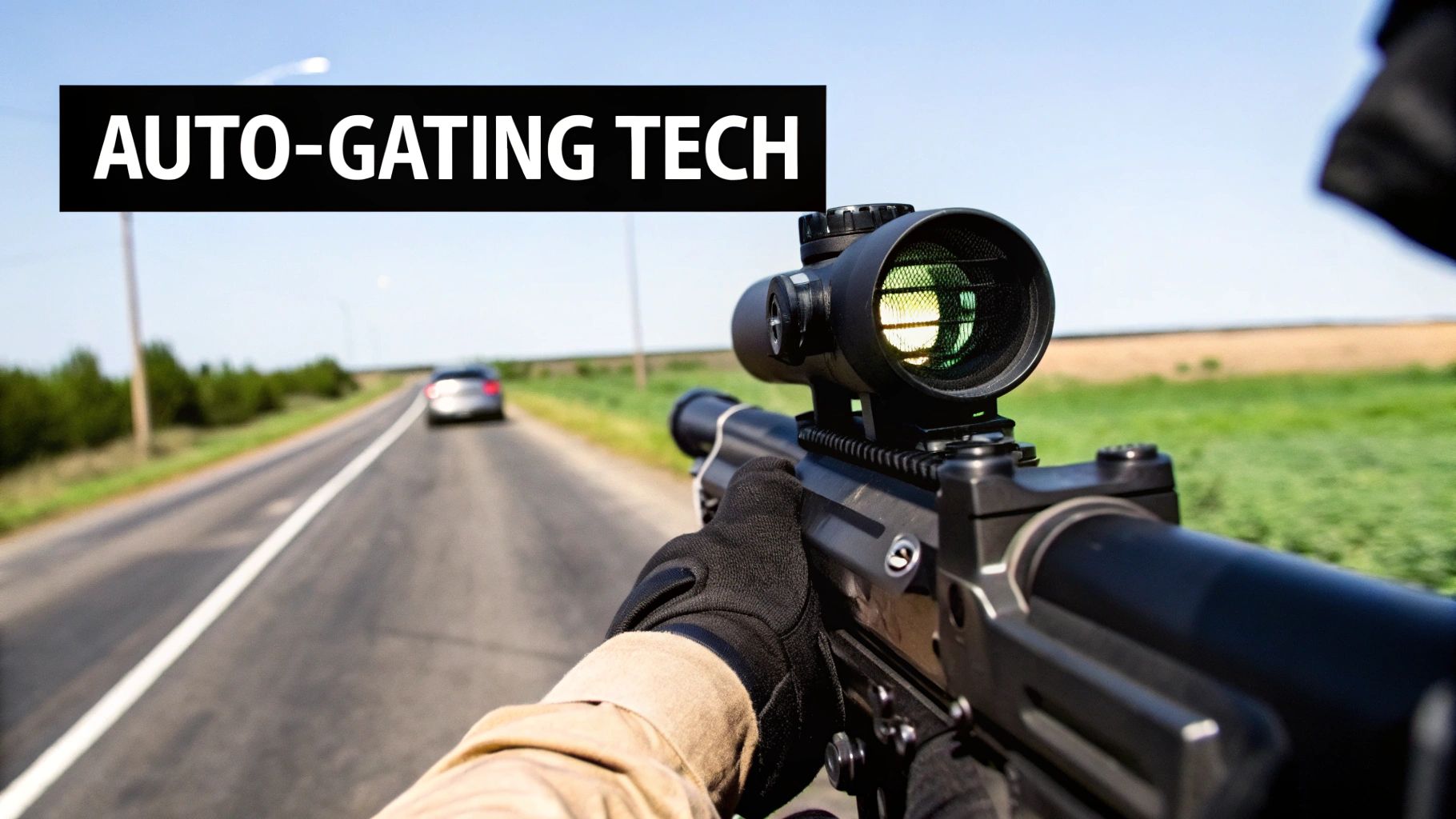
These innovations solve real-world problems, from sudden flashes of light that can blind you, to the headache-inducing eye strain that comes from staring through a scope for hours. Understanding them is the key to seeing why a top-tier gen 3 night vision scope is such a formidable tool.
Auto-Gating for Dynamic Light Conditions
Picture this: you're clearing a dark building and someone opens a door, flooding the hallway with light. Or a car's headlights suddenly sweep across your position. With older night vision, this would create a massive "bloom"—a bright, blinding flare that washes out the entire image, leaving you effectively blind for a critical second or two. This is precisely the problem auto-gating solves.
Think of auto-gating as a super-fast, automatic shutter for the image tube. It's constantly regulating the power, flickering the system on and off thousands of times per second. When a bright light source pops into view, the system instantly throttles back the power to that specific area. This prevents the blooming effect and protects the delicate tube from getting burned.
What this means for you is that you maintain your sight picture and situational awareness through muzzle flashes, strobing lights, or urban street lighting. It's a game-changing feature that ensures you’re never left in the dark by an unexpected burst of light.
Auto-gating is the difference between being temporarily incapacitated by a sudden light and maintaining a clear, tactical advantage. It lets the scope react faster than your own eye can, giving you a consistently clear image when everything is on the line.
The White Phosphor Advantage
For years, the classic green glow was synonymous with night vision. And while green phosphor still works great, the new gold standard for most serious users is white phosphor. Instead of that iconic green hue, it produces a crisp, black-and-white image that looks more like a high-contrast thermal image.
This isn't just about looks; it offers some very real performance benefits, especially when you're looking through the device for a long time. Many operators find that the black-and-white image provides a much greater sense of contrast and detail. This makes it easier to pick out a target against a messy background or distinguish subtle shapes and textures from a distance.
But the biggest advantage is comfort. Staring through a green-tinted monocular for hours on end can cause serious eye fatigue, not to mention that weird green after-image when you finally take the scope away. The brain finds a black-and-white picture much more natural to process, which means you can stay focused longer without the strain.
Here’s why so many are making the switch:
- Reduced Eye Fatigue: The grayscale image is simply less strenuous, which is a massive plus for extended surveillance missions or long nights on a hunt.
- Enhanced Contrast: Users consistently report better depth perception and detail recognition, allowing for faster and more confident target identification.
- A More Natural View: The clean, neutral image just feels less disorienting and more intuitive than the traditional green glow.
While high-quality green phosphor tubes are still incredibly capable, the shift to white phosphor is all about optimizing the operator's endurance and effectiveness. Ultimately, the choice often comes down to personal preference, but the benefits of white phosphor are hard to ignore.
Who Uses Gen 3 Night Vision and Why
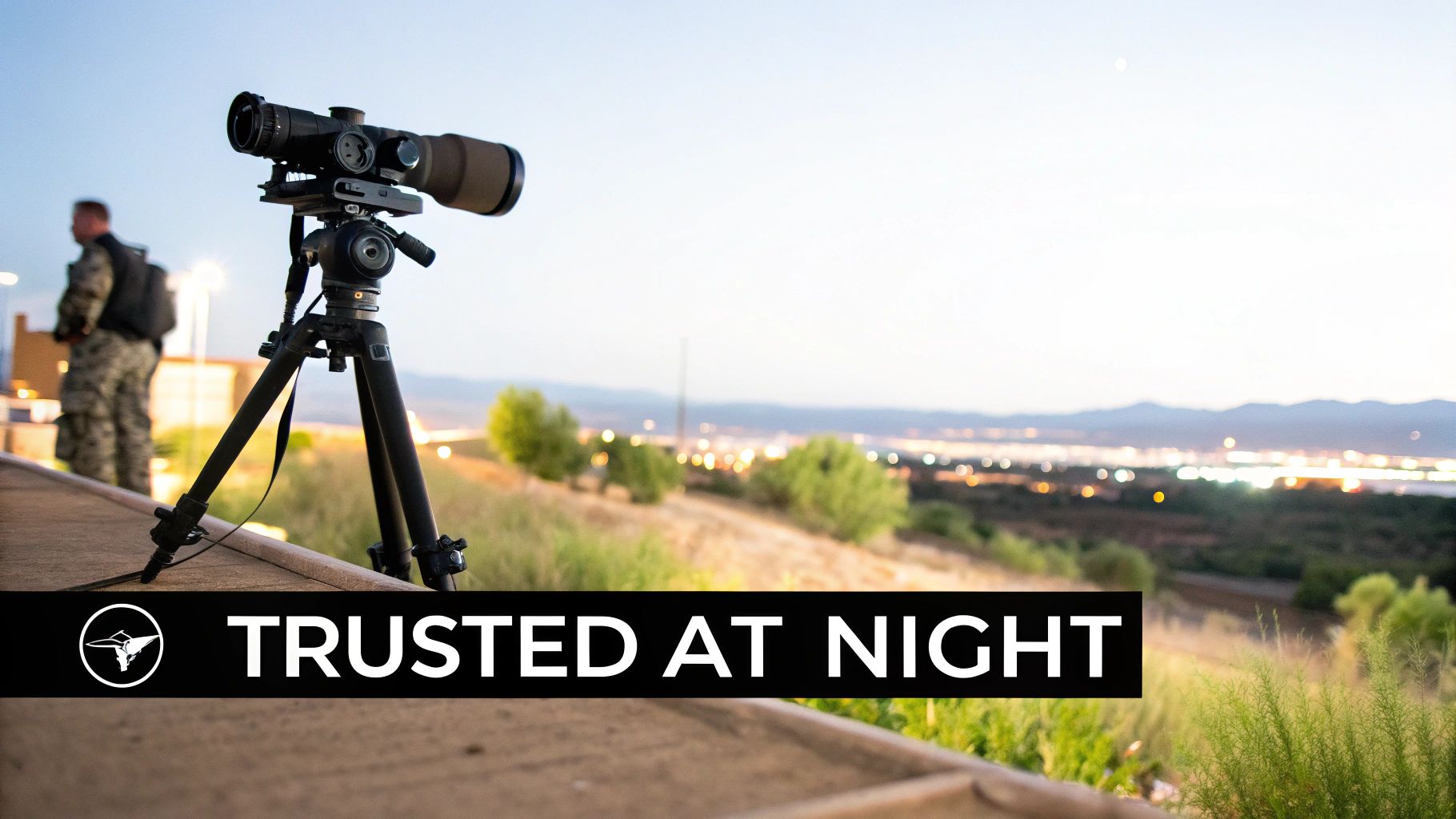
The kind of technology packed into a Gen 3 night vision scope isn't just for show. It's a mission-critical tool for professionals and dedicated enthusiasts who own the night. Its exceptional clarity, unwavering reliability, and stunning low-light performance make it the only choice when equipment failure simply isn't an option.
From tense urban standoffs to the quiet wilderness, different users turn to Gen 3 for the same core reason: to see without being seen, and to do it with absolute confidence. For them, it's not a hobby—it's a fundamental part of staying safe and getting the job done.
Law Enforcement and Tactical Operations
Picture a tactical team establishing a perimeter around a warehouse in some poorly lit industrial park. They have to spot threats, coordinate their movements, and maintain complete situational awareness—all without giving away their position with flashlights. A Gen 3 scope provides the fidelity needed to tell the difference between a firearm and a cell phone at 100 yards, a critical detail that can prevent a tragedy.
This is where features like auto-gating become non-negotiable. If a suspect's car headlights suddenly blast the area, an officer with a Gen 3 device keeps their sight picture clear and usable. Older technology would be completely washed out, rendering them blind. This ability is what allows law enforcement to operate effectively in dynamic urban environments full of unpredictable light sources.
Dedicated Nocturnal Hunters
For anyone who hunts predators like coyotes and hogs, the real action starts long after the sun goes down. Imagine you're tracking a coyote across an open field on a moonless, overcast night. Through a Gen 3 scope, that animal stands out in sharp relief against the terrain, giving you the clarity needed for a clean, ethical shot. A lesser device would just show a blurry, indistinct blob, making positive identification a dangerous guessing game.
This level of performance is what separates a successful hunt from a long, frustrating night. Hunters need to see fine details to accurately judge an animal's size and range. The crisp, high-resolution image you get from a Gen 3 unit delivers that confidence, turning the most challenging conditions into a clear advantage.
The core advantage for any professional user is confidence. Whether identifying a threat or confirming a target, a Gen 3 scope removes the guesswork that plagues lower-tier night vision, enabling decisive action when it matters most.
This level of reliability is also why the technology is built to last. A top-tier gen 3 night vision scope boasts a lifespan of over 10,000 hours, which is double the 5,000 hours of a typical Gen 2 unit. This longevity is achieved through ruggedized image intensifiers and microchannel plates that handle one to two million electron amplifications per second with failure rates under 0.5% in military testing, making it a 20-year investment for professionals. You can find more details on the evolution of this durable technology in our night vision history guide.
Search and Rescue Missions
When someone goes missing in the wilderness, every single hour counts, and search efforts can't just stop when it gets dark. A Search and Rescue (SAR) team equipped with Gen 3 night vision can scan a dark mountainside or dense forest with incredible speed and efficiency. They can spot the faint glint of reflective clothing or a small pocket of body heat from hundreds of meters away—details the naked eye would completely miss.
In these life-or-death scenarios, the superior light-gathering capability of Gen 3 is priceless. It allows teams to cover huge areas quickly, drastically increasing the chances of a successful rescue. The technology’s performance in near-total darkness gives them a powerful advantage against both the elements and the clock.
How to Choose the Right Gen 3 Scope
All the technical specs in the world don't mean much if you can't turn them into a smart purchase. Picking the right Gen 3 scope isn't about chasing the highest number on a data sheet; it’s about finding the perfect match for what you'll actually be doing.
To cut through the noise, start by asking yourself a few simple but crucial questions.
- What’s the mission? A dedicated scope for hunting coyotes under a moonless sky has very different needs from a device used for law enforcement building clears.
- Where will I be using it? Think about your environment. Are you in the deep woods with zero artificial light, or a suburban area with streetlights creating a mixed-light situation?
- What's a realistic budget? Gen 3 is always an investment, but there's a real difference in performance and price across the spectrum.
Being honest with yourself here is the key. It moves you past the marketing slogans and points you directly to the features that will give you an edge in the field.
Making Sense of the Spec Sheet
Once you’ve defined your needs, you can start digging into the numbers that truly matter. The data sheet that comes with a high-quality gen 3 night vision scope tells you everything about the "engine" inside, but you need to know how to read it.
These specs are the DNA of your device—they dictate the brightness, the clarity, and the overall usability of the image you see. For a much deeper dive into how these numbers play out in the real world, check out our guide on how to choose the best Gen 3 Elbit image intensifier tube.
For now, let's focus on the big three:
- Figure of Merit (FOM): This is your at-a-glance performance score, calculated by multiplying Resolution x SNR. A high FOM, often 2000+ on top-tier tubes, is a great sign, but it doesn't paint the whole picture.
- Signal-to-Noise Ratio (SNR): If I had to pick one spec, this would be it. SNR tells you how clean the image is versus how much electronic "snow" or static you'll see. A higher SNR is your best friend on the darkest nights, giving you a crisp, clear view instead of a grainy mess.
- Resolution (lp/mm): Measured in line pairs per millimeter, this is all about sharpness. It determines your ability to spot fine details from far away—absolutely critical for distinguishing a threat from a non-threat.
A classic rookie mistake is getting tunnel vision on FOM. You might see a tube with a sky-high resolution but a so-so SNR. It'll look incredibly sharp under a full moon, but that image will fall apart with static and noise when the light gets really low. The real magic is in the balance.
Why Your Dealer Matters Just as Much as the Device
Finally, where you buy your Gen 3 scope is just as critical as what you buy. This isn't a disposable piece of gear; it's a long-term investment in your capabilities. The right dealer gives you more than just a box—they give you support and confidence.
Look for a partner, not just a seller. You want a company that backs their products with a serious warranty (like our 10-year warranty on Gen 3 systems), has the in-house expertise to handle repairs, and employs people who can actually answer your questions. This kind of support ensures your investment is protected and keeps your gear running for years to come.
Answering Your Questions About Gen 3 Scopes
Stepping into the world of high-performance night vision can feel a bit overwhelming, and it's natural to have a few questions. Now that we’ve covered the core technology, let’s get into the practical side of things. These are the details that truly matter when you’re out in the field.
Are Gen 3 Scopes Even Legal for Civilians?
Yes, absolutely. Here in the United States, it is 100% legal for a civilian to buy, own, and use a Gen 3 night vision scope. No special permits are needed.
The big thing to remember, however, is that you can't take it out of the country. This technology is controlled by the U.S. Department of State under ITAR (International Traffic in Arms Regulations). Trying to ship or carry it across the border without some very serious, hard-to-get licenses is a federal crime. As long as you're buying from a reputable U.S. dealer for use within the U.S., you're good to go.
How Do I Keep My Gen 3 Scope Running for Years?
Good news: these things are built to last. With just a little bit of care, you can easily get the full 10,000+ hour operational lifespan out of your tube. The number one rule, the golden rule, is to always keep the protective day cap on the objective lens when you're not using it. Never point it at the sun. Even a brief moment of direct sunlight can permanently burn the image intensifier tube.
Beyond that, just treat it like any other piece of precision optics:
- Lens Care: Only use a dedicated lens cloth and a proper cleaning solution. Don't use your t-shirt.
- Handling: Try not to drop it or bang it around. While they are rugged, they aren't invincible.
- Storage: Keep it in a cool, dry place. If you're putting it away for a few months, take the batteries out to prevent corrosion.
Does a Higher FOM Score Automatically Mean a Better Scope?
Not necessarily. Figure of Merit (FOM) is a great starting point, but it's not the whole picture. FOM is just a simple math problem: Resolution (lp/mm) multiplied by the Signal-to-Noise Ratio (SNR). And while a bigger number is usually a good thing, how you get to that number is what really counts.
Think of it this way: you could have a tube with a sky-high resolution but a pretty average SNR. On paper, it has a great FOM. In reality, it would give you a super sharp image when there's a bit of moonlight, but it would get snowy and grainy in a hurry when things get really dark.
On the other hand, a tube with a slightly lower FOM but a killer SNR will give you a much cleaner and more usable image in near-total darkness. So, while FOM is a useful spec, always look at the SNR and any cosmetic blemishes to get a true feel for how the device will perform when you need it most.
At Superior Tactical LLC, we don't just sell boxes; we provide the expert guidance you need to select the perfect night vision solution, backed by a 10-year warranty and in-house service. Explore our curated collection of mission-ready Gen 3 optics and accessories today.
