A Complete Guide to Day Night Vision Binoculars
You’re tracking a subject from broad daylight into a shadowed alley, or maybe you're glassing a ridgeline as the last rays of sun dip below the horizon. This is the moment of transition—the exact point where most optical gear fails you. Day night vision binoculars are built specifically for this challenge, giving you a seamless 24/7 view.
They aren't just daytime binoculars with a gimmick. They are a single, rugged unit that delivers crisp, clear views in the brightest sun and then continues to perform as a true night vision system once darkness falls.
Seeing Clearly Around the Clock
With traditional gear, you’re forced to make a choice. Standard binoculars are useless after sunset. A dedicated night vision monocular can be permanently damaged by a sudden exposure to bright light, like a headlight or streetlamp.
These day/night systems eliminate that compromise. They're designed for operators, hunters, and security professionals who can't afford to be caught fumbling with their equipment when the light changes. This all-in-one capability is what sets them apart.
Let's break down the technology that makes this work and what you really need to look for when buying one.
The All-In-One Optical Advantage
The most obvious benefit of a day/night system is pure efficiency. Instead of packing two separate devices—one for day, one for night—you have a single piece of equipment that does it all. This immediately lightens your load and, more importantly, simplifies your workflow.
- Law Enforcement: An officer on a surveillance job can watch a location all day and continue observing into the night without ever breaking line of sight to switch optics.
- Hunters: You can scout a field in the harsh afternoon sun and keep glassing for movement in that same spot long after the sun has set, without missing a beat.
- Security Teams: Guards can monitor a perimeter fence line with one tool, ensuring constant awareness from one sunrise to the next.
The true value of a day/night system isn't just seeing in the dark; it's the ability to never stop seeing. The transition from light to dark is where targets are often lost, and these binoculars eliminate that vulnerability entirely.
To put it simply, these systems offer a powerful combination of benefits that are critical in the field.
Day Night Vision Binoculars At a Glance
The table below gives a quick snapshot of what these devices bring to the table and for whom they are most valuable.
| Feature | Benefit for the User | Primary Application |
|---|---|---|
| 24/7 Operation | A single optic works in any light, from full sun to total darkness. | Surveillance, Hunting |
| Seamless Transition | No need to stop observing or switch gear when light conditions change. | Law Enforcement, Security |
| Reduced Gear Load | Eliminates the need to carry separate day and night optics, saving weight. | Military, Backpack Hunting |
| Built-in IR | Provides illumination in zero-light environments (e.g., inside a building). | Tactical Operations, Pest Control |
Ultimately, the core advantage is uninterrupted observation, which enhances safety, effectiveness, and situational awareness across the board.
Understanding the Technology
So, how do they actually pull this off? Modern systems typically use one of two main approaches.
The first, and increasingly common, method is built around advanced digital sensors. Think of it like a professional-grade digital camera that’s extraordinarily sensitive to light. It can process a bright, sunny image just as easily as it can amplify the tiny amount of available light at dusk. For total darkness, these units feature a built-in infrared (IR) illuminator that floods the area with light that's completely invisible to the naked eye.
The other approach is a true hybrid system. It uses a sophisticated optical path that lets you look through a traditional, crystal-clear glass channel during the day. Then, with the flip of a switch, the light path is redirected through a separate, military-grade image intensifier (I²) tube for true analog night vision. This gives you the best of both worlds: pure optical quality for daytime and powerful image intensification for the night.
How Day/Night Vision Pierces the Darkness
It’s a common question: how can one device see perfectly in bright sunlight and then just as clearly in total darkness? It’s not magic, but rather a clever combination of two different technologies working together. Understanding the distinction between them is the first step in picking the right set of binoculars for your needs.
Most high-end day/night systems rely on one of two approaches: traditional image intensification (the classic green-hued night vision) or modern digital night vision that uses an infrared sensor.
Traditional Night Vision: Image Intensification (I²)
When you think of military or law enforcement night vision, you're likely picturing image intensification, often called I². This is the technology behind most Gen 2 and Gen 3 devices, and it’s all about amplifying existing light.
Think of an image intensifier tube as a supercharger for light. It grabs the tiny, scarce photons from moonlight or starlight and puts them through a powerful amplification process.
- Light Gathering: The main lens pulls in whatever faint ambient light is available.
- Photon-to-Electron Conversion: A photocathode inside the tube converts these light particles (photons) into electrons.
- Amplification: The electrons are shot through a microchannel plate, which acts like a massive multiplier, increasing their number by up to 50,000 times or even more.
- Image Display: These newly amplified electrons then hit a phosphor screen, which lights up to create the bright, detailed image you see through the eyepiece.
This system is entirely passive, meaning it doesn't emit any light of its own. That makes it perfect for situations where staying hidden is non-negotiable. For a more technical breakdown of this process, you can explore our full guide on how night vision technology works.
Digital Night Vision and Infrared Illumination
The other side of the coin is digital night vision. This technology operates more like a highly specialized digital camera. It uses a sensor that's extremely sensitive to both visible light and the near-infrared (IR) spectrum.
During the day, it works just like a normal digital camera or binocular, giving you a crisp, full-color view. As daylight fades, the system cranks up its sensor sensitivity, squeezing every last bit of detail from the dimming ambient light.
The real advantage of a digital system is its ability to work in zero-light conditions. An image intensifier tube needs some light to amplify, but a digital system can bring its own.
This is where the built-in Infrared (IR) Illuminator comes in. Think of it as a powerful flashlight that projects a beam of light totally invisible to the naked eye. The digital sensor, however, sees this IR light perfectly. When you switch on the illuminator, it floods the area with this invisible light, allowing the sensor to deliver a clear black-and-white image, even if you're in a pitch-black basement or a cave with no light source.
The image below gives a great visual of how these optics provide true 24/7 capability, shifting their method as the environment changes.
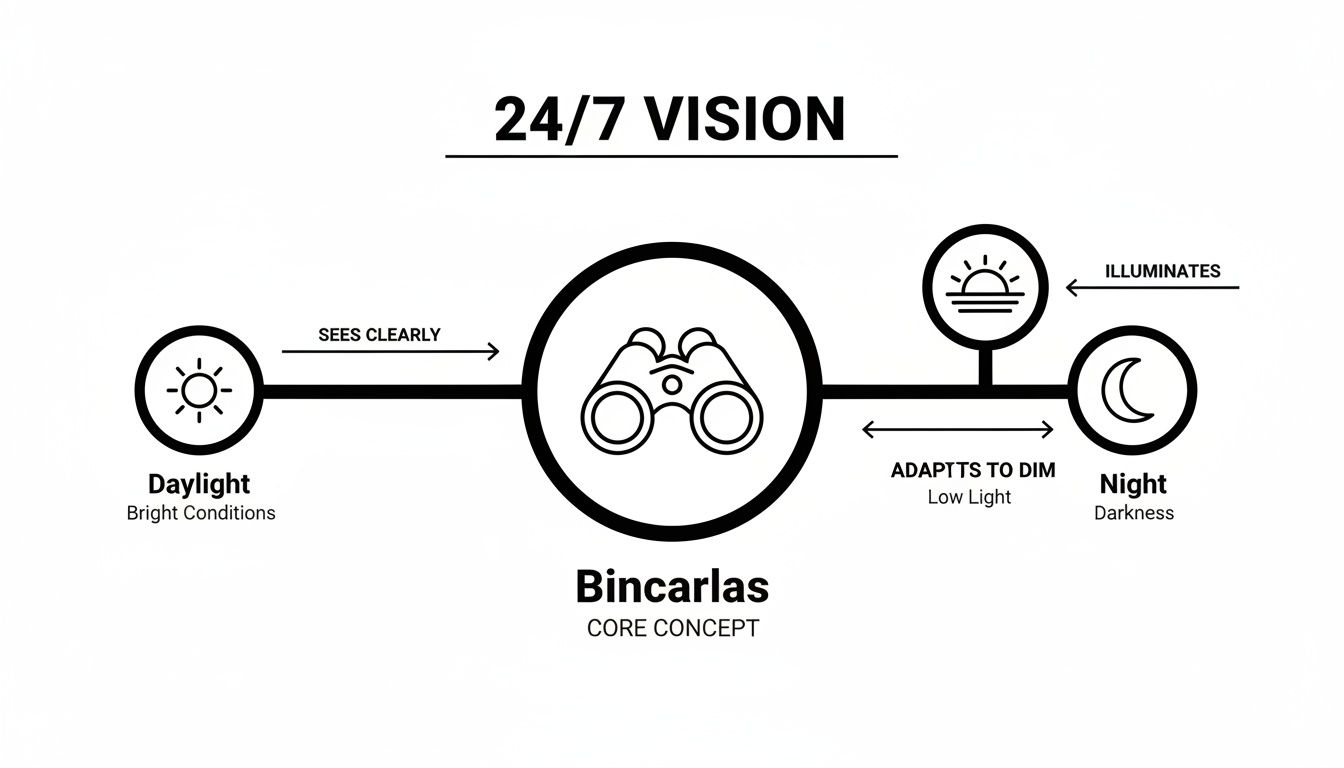
As you can see, a single device can adapt on the fly, using either existing light or its own IR beam to make sure you never lose sight of your target. This blend of light amplification and digital IR imaging is what gives these binoculars their incredible flexibility.
Decoding the Specifications That Actually Matter

When you first start looking at day/night vision binoculars, the spec sheet can feel like a foreign language. All those acronyms and numbers—"lp/mm," "SNR," "Gen 3"—can be intimidating. But these aren't just technical jargon; they're the roadmap to your device's real-world performance.
Getting a handle on these key metrics is what separates a smart purchase from ending up with an expensive paperweight. Let's break down what actually matters so you can read a spec sheet like a pro and know exactly what you’re getting for your money.
Generation: A Quick Guide to Performance Tiers
The first and most important spec you'll see is the Generation, or "Gen." This isn't just marketing fluff. Each generation represents a massive leap in technology, directly impacting what you can see in the dark.
A good way to think about it is like booking a flight:
- Gen 1: This is your economy-class ticket. It gets the job done for casual use, but it's a no-frills experience. You'll often see some image distortion around the edges (a "fish-eye" look) and hear a faint electronic whine.
- Gen 2: Think of this as business class. It’s a huge step up in image clarity, brightness, and how long the tube will last. The view is much cleaner with less distortion, making Gen 2 a great starting point for serious hunters or security work.
- Gen 3: This is first class, and it's the standard for military and law enforcement for a good reason. Gen 3 offers the brightest, sharpest images with outstanding performance even on moonless nights. The difference between Gen 2 and Gen 3 is night and day, literally.
- Digital: This is a whole different mode of travel, like taking a high-speed train instead of a plane. Digital units use a camera sensor, not an intensifier tube. Their big advantage is versatility—they work in full color during the day and can often record video. While they can't quite match a high-end Gen 3 for pure low-light performance, they're fantastic for recreational use.
If you want to go deeper, you can check out our guide on night vision generations and see how they stack up. Nailing down the right generation is your first and most important decision.
Resolution and SNR: The Keys to a Clean Image
Once you’ve settled on a generation, the next two specs to zone in on are resolution and Signal-to-Noise Ratio (SNR). These two work together to determine the actual quality of the image you see through the eyepiece.
Resolution, measured in line pairs per millimeter (lp/mm), is pretty straightforward. It’s all about image sharpness. Think of it like the pixel count on a 4K TV—more line pairs mean more detail. A higher lp/mm lets you distinguish smaller objects at greater distances.
But that's only half the story.
Signal-to-Noise Ratio (SNR) is arguably the single most important number for judging low-light performance. It measures the "signal" (the light that forms the image) against the "noise" (the background fuzz or static you see). A high SNR is like a perfectly clear radio station with no static, giving you a crisp, clean picture.
A tube with high resolution but a low SNR will give you a detailed but "snowy" image that's hard to make out. On the other hand, high SNR with low resolution will look clean but soft and blurry. The goal is to get a tube with high numbers for both, which delivers that sharp, detailed, and beautifully clean image you're looking for.
Magnification vs. Field of View: The Fundamental Trade-Off
Every pair of binoculars, night vision or not, forces you to make a choice between magnification and Field of View (FOV). You can't maximize both. Magnification brings things closer, while FOV determines how wide of a scene you can take in at once.
- Higher Magnification (e.g., 7x, 10x) is fantastic for identification at a distance, like scouting game across a wide-open field.
- Wider Field of View (from lower 3x or 5x magnification) gives you a panoramic view. This is crucial for situational awareness, like scanning a woodline or tracking a moving animal without it disappearing from your view.
You have to decide which is more critical for your intended use. Do you need to see farther or see wider? Your answer will point you toward the right model.
Demand for optics that balance these features has exploded, especially in the tactical world. The global binoculars market is on track to hit $1.81 billion by 2034, with night vision being the fastest-growing segment, driven by defense and security needs. With North America holding a 32.43% market share, this professional demand ensures a strong and competitive market for retailers like us here at Superior Tactical. You can find more on these trends in Fortune Business Insights' report on the global binoculars market.
Choosing the Right Tool for the Mission
When you're looking at low-light optics, it's easy to get lost in the specs. But the first, most important question is always: what do you actually need to do? A great pair of day/night vision binoculars is incredibly versatile, but it's just one tool in a bigger toolbox. Knowing where it fits—and how it compares to thermal imagers or dedicated night vision monoculars—is the key to spending your money wisely.
Each of these technologies gives you a fundamentally different picture of the world. Your mission will tell you which picture matters most.
Night Vision Versus Thermal Imaging
This is the big one. People often lump night vision and thermal together, but they couldn't be more different. The best way to think about it is Detection versus Identification.
Thermal sees heat. Night vision sees light.
A thermal imager creates a picture from tiny differences in temperature. This makes it an absolute monster for detection. Anything warm—a person, a running engine, a recently fired weapon—glows like a beacon against a cooler background. You can spot a deer in dense woods or find someone hiding in the brush instantly, even through light fog or smoke. What you can't do is see much detail.
That's where night vision comes in. It works by amplifying the tiny amount of ambient light available, creating a detailed, recognizable image. This makes it the champion of identification. Once your thermal has spotted a heat signature, you switch to your night vision to see what it is. Is that a person or a coyote? A friend or a threat? Night vision gives you the clarity to make that call.
- Use Thermal For: Pure detection. It’s the fastest way to scan a field or treeline and find any heat signatures that are out of place.
- Use Night Vision For: Positive identification. Once you’ve found something, this is the tool you need to confirm exactly what you're looking at.
For serious operators, using both technologies together is the gold standard. But if you have to choose just one, a high-quality day/night binocular gives you a powerful identification capability that works across a huge range of conditions.
Binoculars Versus Monoculars
Let’s say you’ve settled on night vision. Your next choice is between using one eye or two. A binocular setup, like the ones we’re discussing, offers a huge advantage in depth perception and overall comfort. Using both eyes feels more natural, reduces strain over long stakeouts, and makes it far easier to judge distance and navigate terrain.
On the other hand, a dedicated monocular (like the famous PVS-14) is all about mobility. They're lighter and can be easily mounted on a helmet, leaving your hands free to run a rifle, drive, or work with other gear. If your primary need is moving and doing things in the dark, a monocular is tough to beat. For pure observation, however, binoculars win every time.
Traditional Versus Digital Binoculars
Finally, we have the growing divide between traditional, image-intensified night vision and modern digital systems. You need to know the trade-offs here.
Digital binoculars have a lot of cool factor—they offer full-color daytime viewing and can often record video and snap photos right from the device. For a recreational user or a hunter who wants to capture their experience, these are fantastic features. Their low-light performance is good, but it simply can’t compete with the raw light amplification of a good Gen 2 or Gen 3 image intensifier tube. In a tactical environment where every photon counts, that difference is everything.
You can see this split in the market. Digital binoculars are a rapidly expanding category, projected to become a $1 billion market by 2035, but that growth is mainly coming from the outdoor and recreational crowd in North America. While impressive, it's not the same explosive growth seen in the high-performance tactical space. Retailers like Superior Tactical LLC understand this, stocking top-tier Gen 3 systems for professionals while also offering feature-packed digital options for adventurers. You can dig deeper into these trends by checking out this digital binoculars market report.
Putting It All to Work: Real-World Use Cases
So, we've gone through the technical details and specifications. But what does all of that mean when you’re actually out in the field? The real power of day/night vision binoculars isn't just seeing in the dark—it's about having uninterrupted vision, no matter what the light is doing.
This capability to operate seamlessly from bright sunlight to total darkness bridges a critical gap for professionals and serious enthusiasts alike. It means no more fumbling to switch out optics as dusk sets in, and no more lost opportunities during those crucial twilight moments.
For Law Enforcement and Security
For anyone in surveillance or tactical operations, constant situational awareness is the name of the game. Imagine a team conducting reconnaissance on a building. They can start in the middle of the afternoon, using the binoculars as standard day optics, and never have to look away as the sun goes down. The transition to night vision is seamless, meaning there's no downtime, no gear swapping, and no risk of losing sight of the objective.
This is just as vital for security personnel guarding a large perimeter, like a remote power station or a high-value industrial site.
- Around-the-Clock Monitoring: Guards can scan fence lines and dark corners 24/7 with a single device, spotting potential issues regardless of the time.
- Seamless Shift Changes: When a day shift guard hands over to the night shift, they can use the same optic to brief them on active concerns, pointing to the exact spot without any visual interruption.
- Undetected Observation: Image intensifiers are passive, meaning they don't emit a visible light signature. This is absolutely essential for staying hidden during covert operations.
For the Modern Hunter
Hunters live and breathe by the edges of daylight. Most game animals are most active at dawn and dusk, which are precisely the times when traditional scopes and binoculars become useless. This is where day/night vision provides a massive advantage.
You can spend the late afternoon glassing a field, identifying the exact buck you're after. When the sun dips below the horizon, you don't have to pack it in. You can simply keep watching, confirm your target in the low light, and even track it through the woods in near-total darkness after making a clean shot. It’s a tool that not only boosts success but also supports ethical hunting by making game recovery far more certain.
The ability to go from bright daylight scouting to low-light tracking without ever taking your eyes off the landscape is a fundamental shift. It turns the most challenging hours of the day into your biggest advantage.
Operational and Legal Considerations
Of course, owning technology this powerful comes with a few responsibilities. Top-tier devices, especially Gen 3 models, are typically controlled by International Traffic in Arms Regulations (ITAR), which strictly governs who can buy them and where they can be taken. It’s critical to understand these rules before you make a purchase.
For hunters, it’s just as important to check your local and state wildlife laws. The rules on using night vision for hunting can vary dramatically from one place to another, and it’s always on you to make sure you’re following the law.
The demand for these optics is growing fast. The global night vision device market is projected to be worth $8.9 billion in 2025, and within that, night vision binoculars are expected to command a dominant 39.92% market share by 2026. This growth is largely fueled by military modernization and expanding security needs, showing just how indispensable these tools have become. As a leading supplier, Superior Tactical LLC is focused on getting this equipment into the hands of the professionals who need it most. You can read the full research on night vision devices to get a deeper look at these market trends.
Your Pre-Purchase Checklist for Binoculars

Alright, you’re ready to pull the trigger on a pair of day/night vision binoculars. This is a serious investment, so let's make sure you get it right. This final checklist will help you cut through the noise and choose a unit that will perform exactly how you need it to, when you need it most.
First things first, you have to be brutally honest about your primary mission. What will you actually be doing? Are you running professional surveillance where a positive ID is the whole point? A hunter pushing the limits of legal light? Or are you a homeowner who needs to reliably see what's happening on your property, day or night? Your answer here dictates everything else.
Budget and Performance Tier
Once you know your mission, you can set a realistic budget. Top-tier optics don't come cheap, but your budget will immediately tell you what level of technology is in play. Let's recap what we've covered:
- Digital: A fantastic choice for recreational users, anyone who wants to record their excursions, and for crisp daytime viewing.
- Gen 2: This is where things get serious. It’s a huge leap in performance over older tech and a solid starting point for professional use.
- Gen 3: The gold standard. If you need the absolute best low-light image clarity and performance, this is it.
Your job is to match the performance to the mission. Don't feel pressured into a Gen 3 system if a high-quality digital unit does everything you need. On the flip side, don't try to save a buck on a lesser unit if your job or personal safety is on the line.
Specifications and Support
Now it's time to sweat the small stuff—the specs. Think back to your mission and decide what’s more important: magnification for long-range observation, or a wide Field of View (FOV) for keeping track of your immediate surroundings. Always look at the resolution (lp/mm) and Signal-to-Noise Ratio (SNR) numbers; they are the true measure of a clean, sharp image.
The single most overlooked factor when buying high-end optics is what happens after the sale. A multi-thousand-dollar device is a huge liability without strong a warranty and a clear path for repairs.
This is where you see a retailer's true colors. Make sure the binoculars are backed by a solid warranty. A 10-year warranty, like the one Superior Tactical provides on our Gen 3 devices, is a powerful indicator of quality and gives you real peace of mind. Confirm that the company has in-house repair services and a support team you can actually talk to. That’s what ensures your investment stays ready for action for years, protecting you from accidents and normal wear.
For a deeper dive into vetting vendors, be sure to read our guide on how to buy night vision binoculars online safely.
Answering Your Lingering Questions
Even after diving into the details, you probably have a few questions rolling around in your head. That's perfectly normal. Here are the straight answers to the most common questions we get about day/night vision binoculars, based on years of fielding these exact queries.
Can I Really Use These During the Day? Won't I Fry Them?
Yes, you can absolutely use them in broad daylight. This is one of the biggest misconceptions, usually held by those familiar with older, traditional night vision that could be instantly ruined by sunlight.
Modern digital and hybrid systems are built for this. The digital ones work like a very sophisticated camera, while hybrid models have a dedicated optical channel for daytime use. This completely isolates and protects the sensitive night vision components, so you can transition from day to night without a second thought.
Gen 2 vs. Gen 3: Is It Really That Big of a Deal?
It’s a night and day difference, pun intended. The leap from Gen 2 to Gen 3 is something you feel the second you look through the tubes. Think of it like watching a standard HD TV versus a top-of-the-line 4K OLED display.
- Gen 2: It gets the job done. It's a huge improvement over older tech and is perfectly capable for many casual uses. You can see in the dark.
- Gen 3: This is where you get professional-grade performance. The image is drastically brighter and crisper, with a much cleaner signal. You'll see less of that grainy "static" and be able to pick out fine details, especially when the moon and stars aren't helping you out.
For anyone in law enforcement, security, or serious hunting where positive identification is non-negotiable, Gen 3 is the standard for a reason. It’s not just a small bump in quality; it's a fundamental advantage.
Okay, But How Far Can I Actually See?
This is the million-dollar question, isn't it? The honest answer is: it depends. Your effective range is a moving target based on three things: the quality of your device (Gen, resolution, SNR), the available ambient light, and what you're trying to accomplish.
The pros use what's called the DRI criteria to talk about this:
- Detection: Just spotting a human-sized blob. With a good Gen 3 unit on a decent night, you could do this from over a thousand yards away.
- Recognition: Figuring out that the blob is a person, not a deer. Your range for this might drop to 500-700 yards.
- Identification: Being able to tell if that person is carrying a rifle or a shovel. This requires incredible detail, and you might only be able to do this reliably inside 150-200 yards.
The real value of a high-end device isn’t just seeing "farther"—it’s about getting positive, actionable identification at distances that keep you safe.
Is a Warranty and Good Repair Service Actually Necessary?
One hundred percent. You're not buying a disposable gadget; you're investing in a piece of high-performance, precision-built equipment. Drops happen, electronics can have quirks, and field use is rough.
A solid warranty and a reliable repair service are your safety net. It’s proof that the manufacturer stands behind their product and ensures your very expensive tool doesn't become a paperweight. It’s peace of mind that your gear will be ready when you need it, year after year.
At Superior Tactical LLC, we live by this principle. It's why we back our Gen 3 devices with a 10-year warranty and handle diagnostics and repairs in-house. We're committed to keeping your gear in the fight. Check out our curated selection of field-tested equipment at https://superiortac.com and get the gear you can stake your life on.
