Binoculars Thermal Night Vision: Your Essential Guide to Choosing the Best
When people ask about the difference between thermal and night vision binoculars, it boils down to one simple thing: what they "see."
Thermal imaging sees heat. It picks up on the tiny temperature differences between objects and turns that into a picture. On the other hand, traditional night vision works by amplifying light. It takes whatever minimal light is available—from the moon, stars, or distant city glow—and boosts it thousands of time so you can see.
This means thermal can see in absolute, total darkness, while night vision needs at least a little bit of ambient light to work with.
Seeing Beyond Darkness: The Power Of Modern Optics
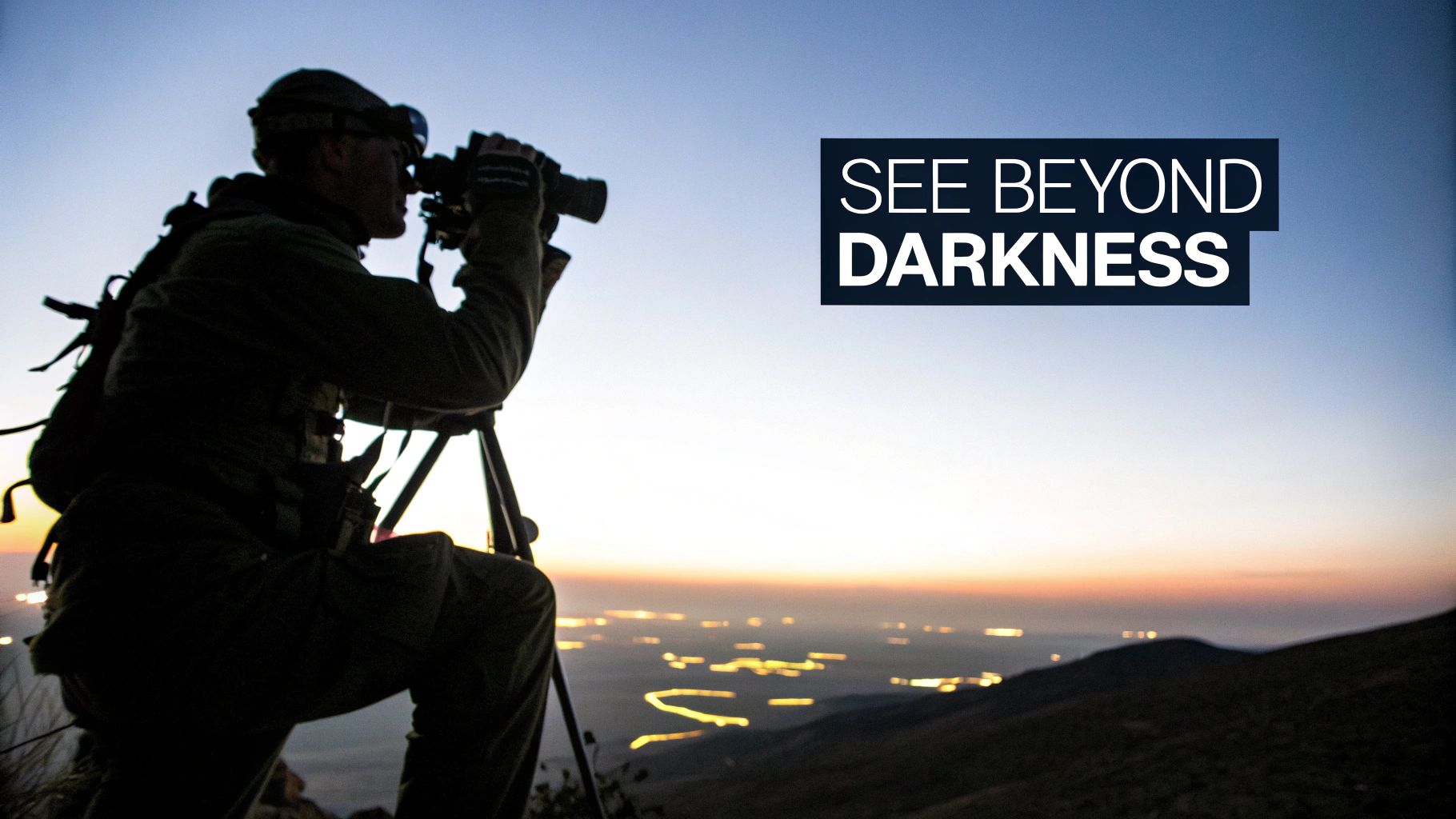
Being able to see what’s hidden in the dark is a game-changer. It’s not science fiction anymore; it’s a real tactical advantage delivered by today’s optical technology. While both thermal and night vision let you operate without light, they get there in completely different ways.
Here’s a good way to think about it: Night vision is like a super-powered amplifier for your eyes. It takes the faintest whispers of light and turns up the volume until you get a clear, visible image.
Thermal imaging is totally different. It doesn't care about light at all. Instead, it sees the invisible world of heat energy that everything gives off, painting a picture that lets you spot a warm body against a cool background.
The Core Distinction: Detection vs. Identification
Getting a grip on this difference is the key to using these tools effectively.
The number one strength of thermal binoculars is detection. Because they see heat, they can instantly pick out a person hiding in thick brush, behind smoke, or in a pitch-black alley with zero light. You simply can't hide a heat signature.
Traditional night vision, often called image intensification (I²), is all about identification. By amplifying ambient light, it creates a much more detailed and recognizable image. This lets you not only see that there's a person there but also identify their face, read a sign, or see what kind of gear they’re carrying—details a thermal image would blur out.
Key Takeaway: Grab thermal for spotting targets through cover or in total darkness. Go with night vision when you need to identify details and navigate your surroundings, assuming there's at least some light.
Knowing which tool to grab for the job is crucial. Whether you’re a police officer on a late-night call, a hunter tracking elusive game in the fog, or a security pro watching over a property, your choice between thermal and night vision will make or break your effectiveness. For a deeper dive into the tech, our guide on low light innovations breaks down the mechanics even further.
How Thermal and Night Vision Technology Actually Works
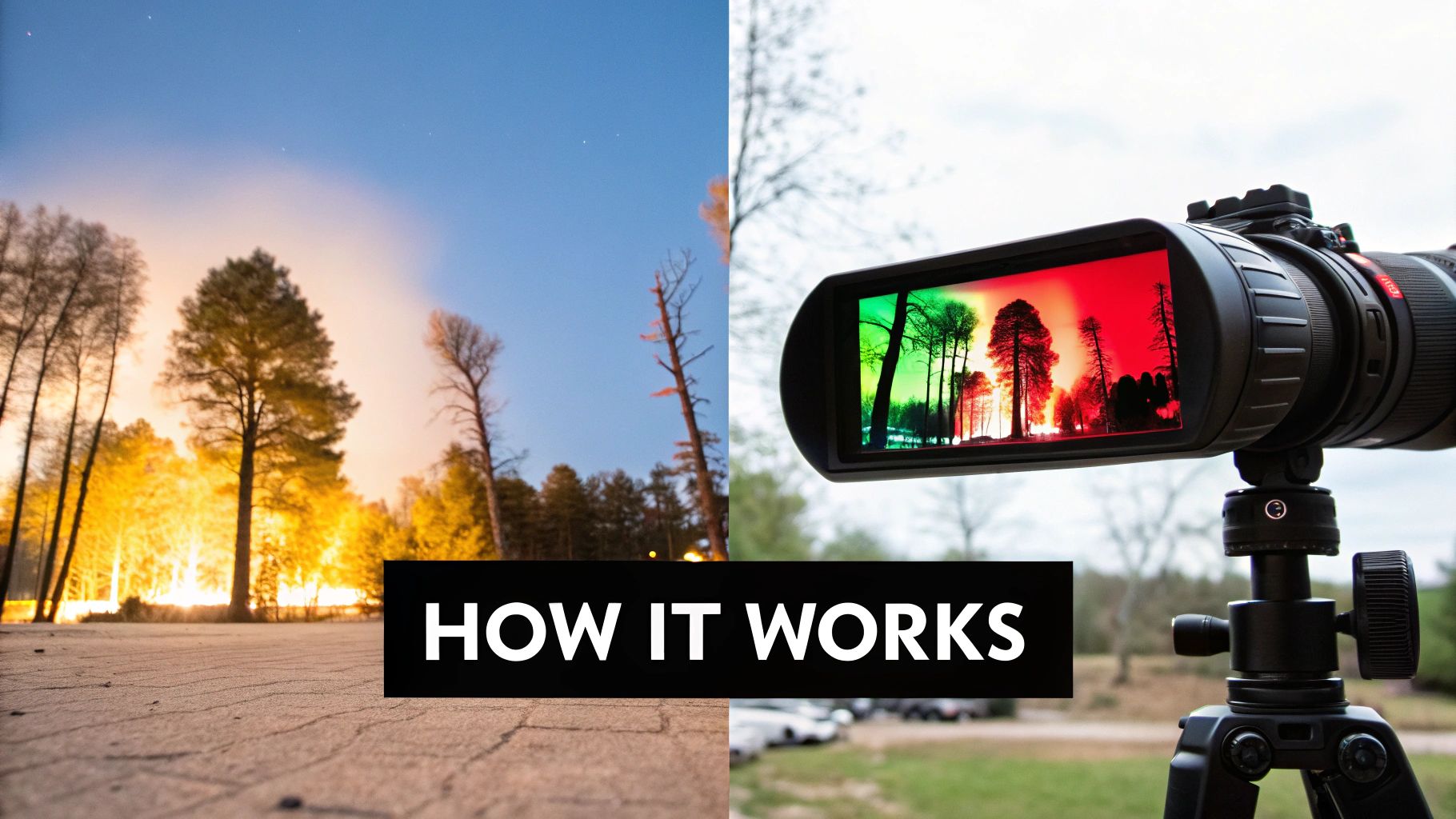
Before you can pick the right tool for the job, you have to get a feel for how each one sees the world. Both technologies let you own the night, but they get there in completely different ways. I like to think of them as two artists tasked with painting the same dark landscape—one uses heat, the other uses light.
Thermal Imaging: Painting with Heat
The thermal artist doesn't need a single drop of light to work. Instead, its canvas is the invisible world of infrared energy, which is just a fancy way of saying heat. Every single object, living or not, is constantly giving off this thermal energy.
Binoculars with thermal night vision use a special lens to gather all that heat and focus it onto a high-tech sensor called a microbolometer.
Think of this sensor as a grid with thousands of tiny, incredibly sensitive thermometers. Each one measures the temperature of what it's looking at, and the device then builds a picture—a thermogram—by assigning different colors or shades of gray to those different temperature readings.
A warm human body will pop as bright white or fiery red against a cool, dark background. This is thermal’s superpower: heat signatures are nearly impossible to hide, even through smoke, fog, or thick brush.
This is exactly why thermal has become such a game-changer in professional circles. In fact, thermal devices accounted for over 41.7% of the entire night vision market in 2022. As the tech gets better and cheaper, it's becoming the go-to for everything from search and rescue to high-stakes tactical ops. You can dig deeper into the data by checking out the research on night vision market trends.
Image Intensification: Turning Whispers of Light into a Roar
Traditional night vision, which the pros call image intensification (I²), is more like an audio engineer for light. It takes the faintest whispers of ambient light—from the moon, the stars, even distant city glow—and cranks up the volume until you can see a clear picture. The one catch? It can't work in total, absolute darkness without a little help from an infrared (IR) illuminator.
Here's how it works: tiny particles of light, called photons, enter the lens and hit a special screen called a photocathode. This screen does one simple job: it converts those photons into electrons.
Those electrons are then shot through a microchannel plate (MCP), which is the heart of the whole system. The MCP is a tiny glass disc packed with millions of microscopic channels. When one electron enters a channel, it bounces off the walls, knocking loose thousands more electrons in a massive chain reaction. It’s a huge amplifier.
Finally, this supercharged flood of electrons slams into a phosphor screen, turning back into visible light. This creates that classic, bright green-hued image we all associate with night vision. If you want to dive deeper into the nuts and bolts, our article comparing thermal, digital, and analog night vision breaks it all down.
Understanding Night Vision Generations
Not all image intensifiers are created equal. The performance of these devices is broken down into "generations," with each one marking a major leap in technology.
Generation 1 (Gen 1): This is the original, old-school tech. It works, but you'll notice some image distortion around the edges (a "fish-eye" effect), and it needs a fair bit of ambient light or a strong IR illuminator to be useful.
Generation 2 (Gen 2): A huge step up. The introduction of the microchannel plate (MCP) made for a much brighter, sharper image with way less distortion than Gen 1. This is a solid middle ground for many users.
Generation 3 (Gen 3): The current gold standard for military and law enforcement. Gen 3 uses more advanced materials that are way more sensitive to light. The result is incredible image resolution and clarity, even on a nearly moonless night where older generations would just show you static.
Getting a handle on these differences is the first step. Thermal sees heat, which makes it the undisputed king of detection. Traditional night vision amplifies light, making it the champion for identifying who or what you're looking at.
Choosing Your Advantage: Thermal vs. Night Vision
This is where the rubber meets the road. Understanding the science behind these technologies is one thing, but knowing which one to trust in a critical moment is everything. The choice between thermal and traditional image-intensifier (I²) night vision isn't just about reading a spec sheet; it's about what works for your specific mission.
Think about a hunter trying to spot a deer across a field covered in thick morning fog. With standard night vision, all he’d see is a wall of gray. But a thermal optic cuts right through the mist, instantly revealing the animal's glowing heat signature. An impossible shot suddenly becomes possible.
Now, picture a SWAT officer clearing a dark warehouse. Thermal might pick up a heat blob behind a stack of pallets, confirming a suspect's presence. But switching to I² night vision, the officer can now see the suspect's face, identify the weapon in his hand, and make a split-second threat assessment with crystal clarity.
These two scenarios get right to the heart of the matter: it's a trade-off between detection and identification.
Detection Power vs. Identification Clarity
Thermal imaging is the undisputed king of detection. Because it sees heat instead of light, it excels at spotting targets that are perfectly camouflaged to the naked eye. A warm-blooded animal or a running vehicle engine simply can't hide its thermal signature.
- Sees Through Obscurants: Thermal cuts through fog, smoke, dust, and even light brush, revealing heat sources hidden from view.
- Works in Total Darkness: It needs zero ambient light. A moonless, overcast night is no different than dusk.
- Exceptional at Range: It's incredibly good at picking up heat signatures from hundreds, or even thousands, of yards away.
Image intensification (I²), on the other hand, is built for identification. By amplifying tiny amounts of ambient light from the moon and stars, it produces a detailed picture that lets you understand your surroundings and make informed decisions.
- High-Detail Images: I² lets you see crucial details like facial features, textures on clothing, individual tree branches, and variations in the terrain.
- Better for Navigation: The natural-looking, detailed view makes it far easier and more intuitive to move through an area at night.
- Critical for Threat Assessment: You can see not just that a threat is there, but what they're holding and what they're doing.
In short: Thermal tells you something is out there. Night vision tells you what it is. That single distinction is the most important factor for anyone operating after dark.
The explosive growth in this field shows just how vital this technology has become. The global night vision device market was valued at USD 8.57 billion in 2023 and is on track to hit USD 12.91 billion by 2028. Thermal imaging is leading the way, commanding a 41.7% market share in 2022, largely thanks to its unmatched ability to detect heat in any conditions. You can dig deeper into these trends in the full night vision device market report.
Head-to-Head Technology Comparison
To really understand the trade-offs, it helps to put these two technologies side-by-side. This table breaks down how each performs in key areas, helping you match the right tool to the right job.
Thermal Imaging vs Image Intensification (I²) Night Vision
| Feature | Thermal Imaging | I² Night Vision (Gen 3) | Best Use Case |
|---|---|---|---|
| Primary Function | Detects infrared energy (heat) | Amplifies ambient light | Detection (finding targets) |
| Environmental Limits | Works in any light condition | Needs some ambient light (starlight/moon) | Identification (recognizing targets) |
| Performance in Fog/Smoke | Excellent; sees right through it | Poor; light scatters off particles | Operations in bad weather or obscured areas |
| Image Detail & Clarity | Lower; shows heat gradients & shapes | High; shows surface details & textures | Seeing what something is, not just that it's there |
| Range Capability | Superior for long-range detection | Good, but limited by available light | Spotting targets at extreme distances |
| Daytime Use | Can be used 24/7 | Damaged by bright light; unusable in day | Surveillance and spotting day or night |
| Navigational Use | Difficult; lacks depth & detail | Excellent; provides natural terrain view | Moving on foot or in a vehicle at night |
Ultimately, the choice comes down to your primary need. If your goal is to find a heat signature—any heat signature—at any time and in any weather, thermal is your answer. If you need to see who or what something is and navigate your environment with confidence, I² night vision is the tool for the job.
The Ultimate Solution: Fusion Technology
But what if you didn't have to choose? The most advanced systems now use fusion technology, which digitally overlays a thermal image on top of a traditional I² night vision image. This gives the operator the best of both worlds in a single, powerful optic.
Imagine looking through a pair of fusion binoculars: you see the crisp, green-tinted night vision landscape, but a person’s heat signature glows bright orange right through a line of bushes. This combined view delivers unparalleled situational awareness by blending thermal’s raw detection power with I²’s identification clarity. While this technology comes with a hefty price tag, for those who need every possible edge, the tactical advantage is unmatched.
How to Select the Right Thermal Night Vision Binoculars
Picking the right pair of binoculars with thermal night vision is a lot like choosing any other specialized piece of gear. You’re making an investment, and the goal is to match the tool to the mission. The wrong choice can be frustrating and ineffective, so the key is to cut through the marketing jargon and understand how the technical specs translate to real-world performance.
Before you even look at a single product, you need to be brutally honest about your primary goal. Are you trying to spot a warm body a thousand yards out, or do you need to positively identify someone in a dark alley? That one question will steer you in the right direction more than anything else.
This decision tree breaks it down to its simplest form: is your priority detection or identification?
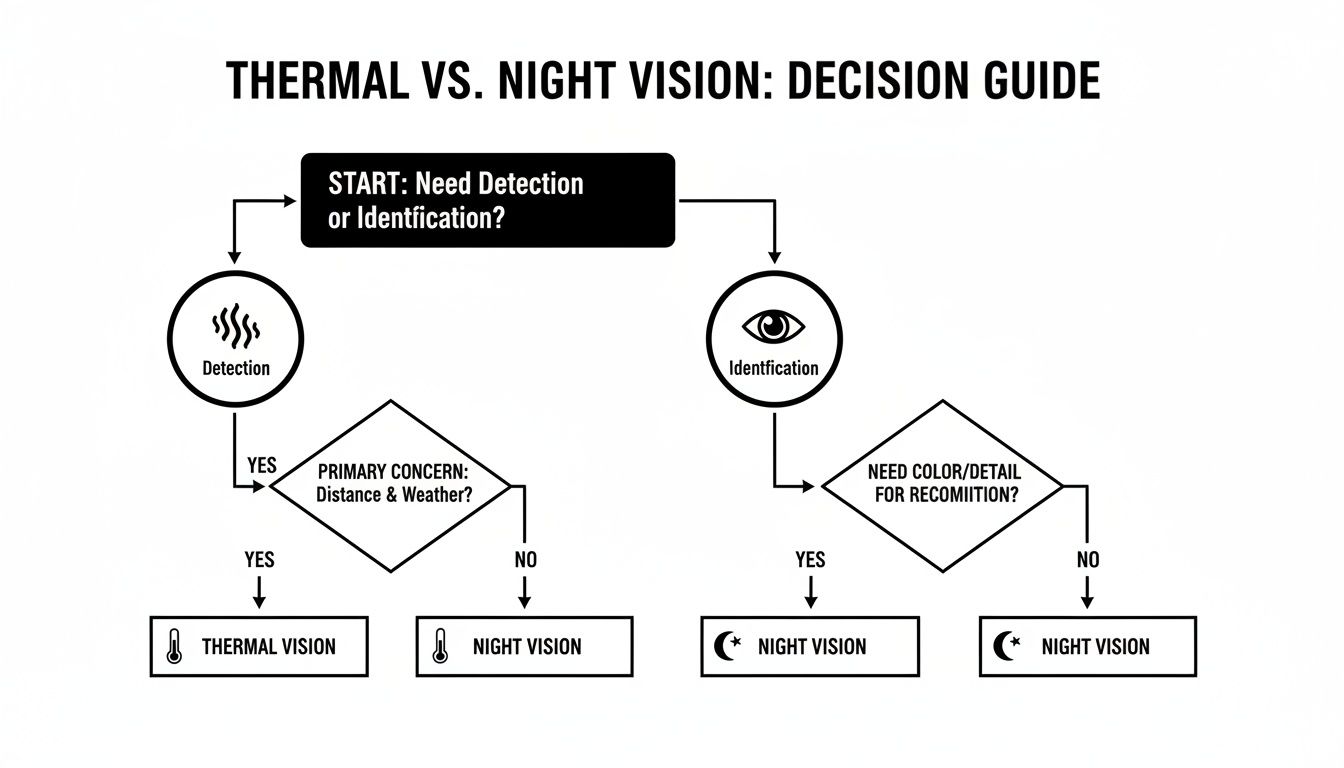
As you can see, thermal is the undisputed king of detection. If you just need to know something is out there, thermal will find it. For identification—knowing what that something is—traditional image-intensified (I²) night vision has the edge. This is the foundational concept to keep in mind.
Decoding Key Thermal Specifications
When you start digging into thermal models, you’ll be hit with a wall of specs. Let's translate the most important ones into what they actually mean for you out in the field.
Sensor Resolution: Think of this as the thermal world’s version of megapixels. More pixels mean a sharper, cleaner picture. A 640×480 sensor will give you dramatically more detail than a 320×240 sensor, which is absolutely critical for identifying targets at a distance.
NETD (Noise Equivalent Temperature Difference): This is a fancy term for sensitivity. Measured in millikelvins (mK), a lower number is better. A sensor with a <25 mK rating can see tiny temperature differences, giving you a crisp image even in tough conditions like fog or high humidity. A <50 mK unit will struggle and look "muddy" in the same environment.
Refresh Rate: This is how many times the screen updates per second, measured in Hertz (Hz). A 60 Hz refresh rate gives you a smooth, real-time video feed that’s perfect for tracking a running animal or a moving vehicle. Anything lower, like 30 Hz, will look choppy and make it tough to follow anything that isn't standing still.
Pro Tip: If you're doing anything dynamic—hunting, security patrols, surveillance—don't even consider a refresh rate below 50 Hz or 60 Hz. Slower rates are only really usable for static observation where neither you nor your target is moving much.
Matching Features to Your Mission
Once you have a handle on the specs, you can start matching them to your specific job. The ideal binoculars thermal night vision for a hog hunter is worlds apart from what a security team needs for port surveillance.
Long-Range Surveillance (Over 800 yards)
For spotting things way out there, you need power and sensitivity.
- High Magnification: Look for a high base optical magnification. You also need a high-resolution sensor so the image doesn't fall apart when you use digital zoom.
- Low NETD: Picking up a faint heat signature at that distance requires an extremely sensitive sensor.
- High Resolution: This isn't negotiable. A 640×480 or even 1024×768 sensor is essential for telling the difference between a deer and a person at range.
Hunting and Wildlife Observation (100-500 yards)
Here, you need a balance of scanning ability and identification detail.
- Wide Field of View (FOV): A wider FOV lets you scan a field or treeline much faster without getting tunnel vision.
- Fast Refresh Rate: Animals move. A 60 Hz rate ensures you can track them smoothly without any motion blur.
- Good Resolution: A 384×288 sensor is a good starting point, but a 640×480 unit will give you the confidence you need for positive identification before taking a shot.
Security and Law Enforcement (Under 200 yards)
In close-quarters environments, durability and awareness are paramount.
- Durability and Weatherproofing: Your gear will get bumped, dropped, and rained on. Look for a high IP rating like IP67, which means it’s fully dustproof and can be submerged in water.
- Wide FOV: Situational awareness is life. A broad field of view is critical for clearing rooms or monitoring a perimeter without blind spots.
- Onboard Recording: The ability to capture video and images isn't a gimmick; it’s a vital tool for evidence gathering and after-action reports.
Lastly, don't get so caught up in the specs that you forget the basics: battery life, warranty, and customer support. A great optic is useless if it's dead. Sticking with a reputable brand with a solid warranty ensures your investment is protected and reliable when it matters most. For a deeper dive into specific models, our dedicated guide on binoculars for night vision is a great place to start comparing the top contenders.
Getting the Most Out of Your Gear: Care, Accessories, and Rules of the Road
A high-performance set of thermal or night vision binoculars isn't just another gadget—it's a serious investment and a critical tool. To make sure it works when you need it most, you have to think beyond the optic itself. We need to talk about the right accessories, proper upkeep, and the legal lines you can't cross.
Outfitting your optics correctly is what turns them from a simple handheld device into a complete system. The right gear doesn't just make life easier; it genuinely extends what you can do in the field.
Essential Add-Ons for Real-World Use
To unlock the full potential of your device, there are a few accessories that are pretty much non-negotiable for serious users.
- Helmet Mounts and Shrouds: For anyone who needs their hands free, a good helmet mount is everything. Whether you’re navigating rough country, driving a vehicle, or handling a firearm, keeping your vision stable and your hands available is a game-changer. A solid mount kills image wobble and keeps you from getting worn out.
- External Power Packs: Onboard batteries are fine for short stints, but they won't last forever. An external battery pack can push your runtime well past 24 hours, which is a lifesaver on multi-day hunts or long surveillance jobs where plugging into a wall isn't an option.
- Protective Cases and Lens Covers: This is expensive equipment, and the glass is its most fragile part. Think of sacrificial lenses as cheap insurance for your main objective lens—they take the scratches and hits so your expensive optics don't have to. And a hard-sided, foam-lined case is your best bet for keeping everything safe during travel.
Keeping Your Gear in Fighting Shape
Consistent care is the single best way to protect your investment. Neglect is the fastest way I’ve seen good optics go bad.
First things first: keep your lenses clean. Always use a dedicated lens cloth or brush and a cleaning solution made for coated optics. Dust and fingerprints don't just look bad; they actively block light and degrade the image you see.
Next, be smart about your batteries. If you're putting the device away for a while, take the batteries out. I've seen battery corrosion completely destroy the electronics inside a unit. For rechargeable gear, don't just leave it on the charger 24/7, as that can slowly kill the battery's lifespan.
A Pro Tip on Storage: When you're not using it, store your gear in a cool, dry place. Tossing a desiccant pack into the case is a great move to suck up any moisture. Extreme heat, cold, and humidity are the mortal enemies of sensitive electronics and optical coatings.
Staying on the Right Side of the Law
Owning this kind of technology, particularly high-end Gen 3+ night vision, comes with real legal responsibilities. The big one for anyone in the U.S. is ITAR, the International Traffic in Arms Regulations.
You absolutely have to understand this. ITAR governs how defense-related equipment, including top-tier night vision and thermal gear, can be handled.
- No International Travel: It is flat-out illegal to take ITAR-controlled devices outside of the U.S. without an official license from the Department of State. That means no taking it on that Canadian hunting trip or shipping it to a buddy overseas.
- Ownership is Restricted: Even within the United States, you can't just hand over your Gen 3+ device to a non-U.S. citizen. The government considers that an "export," and doing it without permission carries severe penalties.
This market is exploding, with projections showing the military night vision sector growing from USD 5.68 billion in 2025 to USD 9.88 billion by 2031. That growth underscores just how sophisticated and tightly controlled this technology is. You can read up on the global military night vision market forecast to see where things are headed.
Bottom line: know the ITAR status of your gear and follow the rules to the letter. It's not worth the risk.
Your Top Night Vision Questions, Answered
After digging into the specs and technology, you probably still have a few questions rattling around. That's completely normal. Investing in a high-end optic is a big decision, and you want to be sure you're getting it right. Let's tackle some of the most common questions we get from professionals and serious enthusiasts to clear up any lingering confusion.
Can Thermal See Through Glass or Walls?
This is easily the number one question we hear, and the answer is a hard no. Thermal imagers work by seeing the heat energy that objects give off. Materials like walls, concrete, and even standard glass are excellent at blocking that infrared energy, making them completely opaque to a thermal camera.
Now, you can’t see through the wall, but a high-quality thermal unit might pick up the faint heat signature bleeding through from someone standing right against it on the other side. Likewise, you won't see inside a car through the windows, but you'll have no trouble seeing the glowing heat from its engine, brakes, and tires.
Is All Night Vision Green?
The iconic green glow is what most people picture when they think of night vision, and for good reason. The human eye is most sensitive to the color green, which allows us to see more detail and causes less eye fatigue over long nights of observation.
But it's not the only option anymore. Many modern units now come with white phosphor tubes that produce a crisp black-and-white image. A lot of operators feel this view is more natural and provides better contrast, which can make it easier to spot details and identify a target. Ultimately, green versus white often boils down to user preference and the specific mission.
Field Tip: Green phosphor is a proven workhorse, great for long-duration surveillance to minimize eye strain. White phosphor often gets the nod for its high-contrast, black-and-white imagery, which many find superior for positive identification.
What’s the Real Difference Between Digital and Analog Night Vision?
This is a critical point to understand. Traditional image intensification (I²) is what we'd call analog. It uses a sophisticated vacuum tube to physically amplify existing light, turning a few photons into a cascade of electrons and then back into a visible image. It's a direct process that, especially in high-end Gen 3 devices, results in a stunningly clear, fluid image with no lag.
Digital night vision operates more like a highly specialized camcorder. It uses a digital sensor (a CCD or CMOS chip) to capture light, then digitally processes that signal and displays it on a tiny screen inside the eyepiece.
- Analog (I²): This is the gold standard for pure low-light performance and clarity. It’s what military and law enforcement teams rely on when performance is non-negotiable.
- Digital: These units can be used in both day and night without risk of damage. They often pack in features like video recording and multiple color palettes and are usually much more affordable. The trade-off is typically lower light sensitivity and sometimes a bit of image lag.
Seriously, How Far Can I Actually See?
This is the million-dollar question, and the answer depends entirely on which technology you're using and the conditions you're in.
When we talk about thermal binoculars, the industry standard is "DRI" ranges—Detection, Recognition, and Identification.
- Detection: This is the absolute maximum distance you can spot a heat blob and know something is there. With a good unit, you could detect a human-sized heat signature at over 2,000 yards.
- Recognition: Here, you can tell what that blob is—a person versus a deer, for instance. This range might be around 800-1000 yards.
- Identification: This is the close-in range where you can determine if that person is a threat or a friendly. We're talking under 400 yards for a positive ID.
For I² night vision, it's all about how much ambient light is available. On a crisp night with a full moon, you can easily identify targets hundreds of yards away. But on a dark, overcast night with no starlight, your effective range shrinks dramatically unless you're using a good IR illuminator to light up the scene.
Can I Use These During the Day?
Here’s another night-and-day difference between the two technologies.
Thermal imaging is a 24/7 tool. Because it sees heat instead of light, it works perfectly fine in broad daylight, at dusk, or in pitch-black darkness. It's actually a fantastic tool for spotting camouflaged targets during the day that the naked eye would miss.
Traditional I² night vision, on the other hand, will be instantly and permanently damaged by bright light. The image intensifier tube is incredibly sensitive. Pointing it at the sun or even a bright streetlight will overwhelm and fry the tube, leaving you with permanent black spots in your image. Always keep the protective day cap on an I² device unless you are in low-light conditions.
Ready to gear up? At Superior Tactical LLC, we don’t just sell boxes; we provide the gear and expertise you need to own the night. We offer a hand-picked selection of the industry's best thermal and night vision optics, all backed by our expert guidance and a 10-year warranty on Gen 3 systems.
Explore our collection and find your tactical advantage today at https://superiortac.com.
