Binoculars infrared night vision: How They Work and Compare
When the sun goes down, your world doesn't have to shrink. But for anyone operating in the dark—from security pros to dedicated hunters—total blackness can be a hard stop. It’s a wall where your effectiveness and even your safety are on the line. That's precisely the wall that infrared night vision binoculars are designed to break through.
Seeing in the Dark With Night Vision Optics
These aren't just gadgets; they are powerful tools that convert an unseen world into a clear, detailed picture, giving you a serious edge when you can't afford to be blind. This guide is built from years of field experience to help you understand this technology from the ground up. We'll skip the dry textbook definitions and give you the practical knowledge to choose and use the right optics for your mission.
And make no mistake, this field is exploding. It’s not just a niche interest anymore. Driven by military contracts and a huge surge in civilian demand, the global night vision market was valued at USD 11.37 billion in 2024. It's on track to hit USD 17.72 billion by 2033. North America is leading the charge with a 39.7% market share, mostly because of defense and law enforcement needs. You can dig deeper into the data on the night vision devices market to see just how fast it's growing.
Why Mastering the Night Matters
Knowing how to use night vision isn't just a cool skill; it’s a core competency for anyone who takes their work or hobby seriously. The power to see what others can't gives you a massive advantage in the field.
- For the Hunter: It’s the difference between an ethical shot on a nocturnal hog and going home empty-handed. It’s about navigating treacherous terrain safely long after sunset and being absolutely certain of your target.
- For Security Personnel: You can scan a two-hundred-acre perimeter with confidence, spot a threat before they even know you're there, and coordinate a response without giving away your position.
- For the Tactical Operator: This is non-negotiable. It’s about silent movement, positive target ID in chaotic situations, and owning the night to maintain total situational awareness.
The real power of infrared night vision isn't just about seeing in the dark. It’s about having the information to make a confident, decisive move when visibility is zero. This guide will give you the foundation to make those calls correctly, every time.
How Infrared Night Vision Technology Works
To truly own the night, you first have to understand the science that makes it possible. When we talk about binoculars with infrared night vision, we’re not dealing with magic. We're talking about two very different, but equally brilliant, ways of seeing in the dark. These technologies don't just amplify what's already there; they completely change how you perceive a world your own eyes can't.
At its heart, all night vision works in one of two ways: it either gathers and multiplies faint traces of light, or it detects the invisible heat that all things give off. Each method has its own playbook, with distinct pros, cons, and best-case scenarios. Let’s break down how these systems turn pitch-black darkness into a clear, usable picture.
Image Intensification: The Light Amplifier
The classic night vision you’ve seen in movies—the kind with the iconic green glow—is called Image Intensification (I²). The best way to think of it is as a supercharged light collector. It takes the tiniest specks of ambient light, like from the moon or stars, and amplifies them thousands of times over.
Here’s how it works: those tiny light particles (photons) enter the lens and hit a photocathode, which converts them into electrons. Those electrons are then shot through a microchannel plate, which is basically a disc packed with millions of microscopic tubes. As the electrons zoom through and ricochet off the walls, they multiply exponentially. This cascade of amplified electrons finally strikes a phosphor screen, causing it to light up and create the bright, detailed image you see.
This technology is incredibly versatile, with applications ranging from professional security and tactical operations to hunting and wildlife observation.
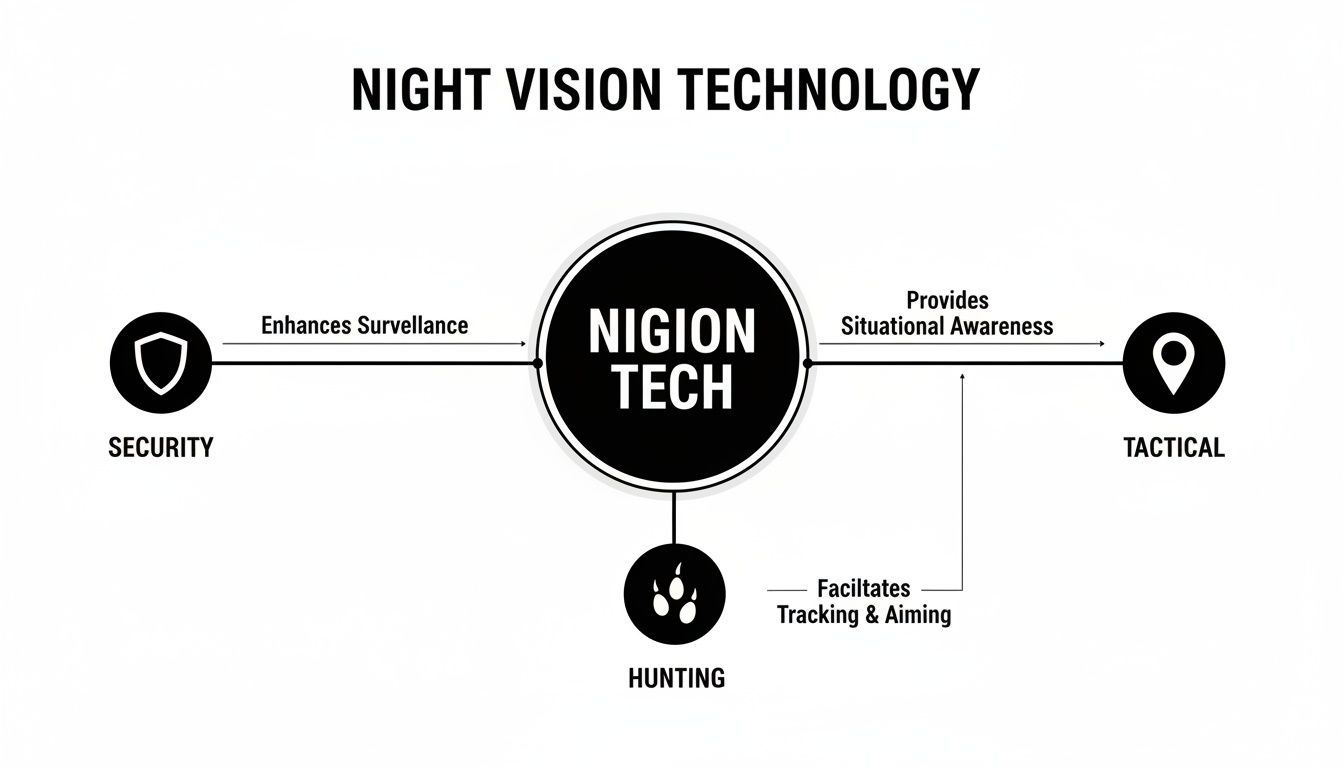
As you can see, the ability to turn darkness into a tactical advantage is crucial for anyone who operates when the sun goes down.
Thermal Imaging: The Heat Detective
The other major player is Thermal Imaging. This technology couldn't be more different from image intensification. It doesn't care about light at all. Instead, it detects heat signatures, or infrared radiation, which is emitted by any object with a temperature above absolute zero—that means everything.
A thermal device is less like a camera and more like a heat-sensing map. A special lens focuses this infrared energy onto a detector called a microbolometer. The sensor measures the temperature of everything in its view and then translates that data into a picture, often called a thermogram. Hotter objects, like a person or a running engine, will glow brightly against a cooler background.
This is what makes thermal so powerful. It needs zero ambient light to work and can cut right through smoke, fog, and foliage that would blind a traditional I² device.
The core difference is simple: Image Intensification amplifies the visible world, while Thermal Imaging reveals an invisible world of heat. They are complementary tools, not just competing ones.
Image Intensifier vs. Digital vs. Thermal Night Vision
To help you decide which path to take, it’s helpful to see these technologies laid out side-by-side. Each has a clear purpose and place in the field.
| Technology Type | How It Works | Best For | Limitation |
|---|---|---|---|
| Image Intensifier (I²) | Amplifies tiny amounts of ambient light (moon, stars) thousands of times to create a visible image. | Navigation, target identification, and high-detail observation where some ambient light exists. | Requires at least some ambient light to function; can be "whited out" by sudden bright lights. |
| Digital Night Vision | Uses a digital sensor (like a camera) to process light, often paired with an IR illuminator. | Budget-conscious users, recording video, and use in mixed or daytime lighting conditions. | Image quality and light sensitivity are generally lower than traditional I² or thermal. |
| Thermal Imaging | Detects differences in heat signatures (infrared radiation) and converts them into a visual image. | Detecting living targets, seeing through smoke/fog/foliage, and operating in total darkness. | Doesn't show surface details like I²; can't see through glass. |
Ultimately, the right choice comes down to what you need to see and under what conditions. An I² unit gives you a natural-looking image for identification, while a thermal unit excels at pure detection.
The Role of Infrared Illuminators
So, what about the "infrared" part of binoculars infrared night vision? This is where an Infrared (IR) Illuminator comes into play, but it’s really only for light-based systems. Think of it as an invisible flashlight.
An IR illuminator projects a beam of near-infrared light that is completely invisible to the human eye but shines like a spotlight to an I² or digital night vision device. In situations with absolutely no ambient light—like inside a building with no windows or on a heavily overcast, moonless night—an illuminator is essential. It floods the area with light that only your gear can see, dramatically boosting your image quality and range.
Thermal devices, on the other hand, are passive. They read the far-infrared heat that’s already being emitted, so they don’t need an illuminator. If you're going the I² route, understanding how to choose the right IR illuminator is key to getting the most out of your investment.
The market for this tech is exploding. One analysis projects the night vision sector, valued at USD 8.57 billion in 2025, will surge to USD 12.91 billion by 2030, growing at a strong 8.5% CAGR. This rapid growth, driven by innovations like fusion technology that can improve image clarity by up to 50%, shows just how critical this capability has become. You can dig deeper into these night vision market trends to see where the industry is headed.
Getting to Grips with Key Night Vision Specs
When you start shopping for infrared night vision binoculars, the spec sheet can feel like a foreign language. It's a wall of numbers and acronyms. But learning to decipher it is the single most important step in getting a tool that works for you, not an expensive piece of gear that ends up collecting dust.
Think of it this way: you wouldn't buy a truck without knowing its engine size or towing capacity. The specs on a night vision device—generation, range, field of view—are exactly the same. They define what it can and can't do when the lights go out.
What Do the "Generations" Actually Mean?
The first and most important spec you’ll run into is the Generation, or "Gen." This isn't just marketing fluff; it's a direct measure of the device's light-amplifying engine. A higher generation means a massive jump in image quality, clarity, and how well it can see in near-total darkness.
- Gen 1: This is your entry point into the world of night vision. These devices are great for casual use where there's still some ambient light, like a full moon or distant city glow. They’re the most affordable, but you'll notice lower image resolution and a much shorter effective range.
- Gen 2: Here’s where things get serious. Gen 2 represents a huge leap in performance by adding a microchannel plate, which is basically a supercharger for photons. The result is a much brighter, sharper image with far less distortion, making it a reliable choice for serious hunters and property security.
- Gen 3: This is the current gold standard. Used by top-tier military and law enforcement units, Gen 3 offers incredible performance even on the darkest, starless nights. You're getting the best light gain (30,000x to 50,000x), the sharpest resolution, and the longest-lasting tubes.
Picking a generation is your foundational decision. While Gen 1 gets you in the game, investing in Gen 2 or Gen 3 gives you a massive return in capability when conditions get tough. For professionals or anyone who can't afford to compromise, Gen 3 is the only way to go, and it's the standard we specialize in at Superior Tactical.
If you want to dive deeper, our complete guide on understanding the differences between night vision generations breaks down exactly what this means for your specific needs.
Detection, Recognition, and Identification Range
You'll see "range" listed on a spec sheet, but it's not one simple number. In the real world, it’s broken down into three crucial benchmarks called the "DRI criteria." Knowing the difference helps you set realistic expectations for what you can actually do at a distance.
Picture yourself scanning a dark field:
- Detection Range: This is the absolute furthest you can see something. At 1000 yards, you might spot a faint heat signature or a moving shape, but you have no idea what it is. It's just a blip.
- Recognition Range: As you get closer, you can start to classify the target. That blip at 1000 yards might become recognizable as a four-legged animal at around 500 yards. You know it's not a person or a vehicle.
- Identification Range: Now you’re close enough to make a positive ID. At 250 yards, you can clearly see that the animal is a whitetail deer and not the coyote you were looking for.
These ranges aren't set in stone. They're heavily impacted by the device's generation, the quality of its lenses, and even the weather.
Magnification, Field of View, and IR Illuminators
Beyond the core tech, a few other specs drastically change how the device feels to use. Magnification and Field of View (FOV) are a classic trade-off. High magnification, like 5x, is great for identifying targets far away, but it dramatically narrows your FOV. You get "tunnel vision," making it hard to scan an area or track a moving object.
On the other hand, a wide FOV (often found with 1x magnification) is essential for situational awareness. It lets you see the bigger picture, navigate terrain easily, and keep your bearings.
Finally, there’s the IR Illuminator. This is your invisible flashlight. When there's absolutely zero ambient light—think deep woods with a heavy canopy or a basement with no windows—an image intensifier has no light to amplify. The IR illuminator solves this by throwing a beam of infrared light that's completely invisible to the naked eye but lights up the scene for your device. It’s a non-negotiable feature for operating in true darkness.
Real-World Uses for Night Vision Binoculars
Spec sheets only tell half the story. The real test of any binoculars infrared night vision system is how it performs when the lights go out and the stakes are high. From a pitch-black forest to a sprawling urban complex, this technology isn't just about seeing in the dark—it's about gaining a decisive advantage.
We're not just talking about hypotheticals. These are grounded examples of how the right features solve critical problems when visibility drops to zero.
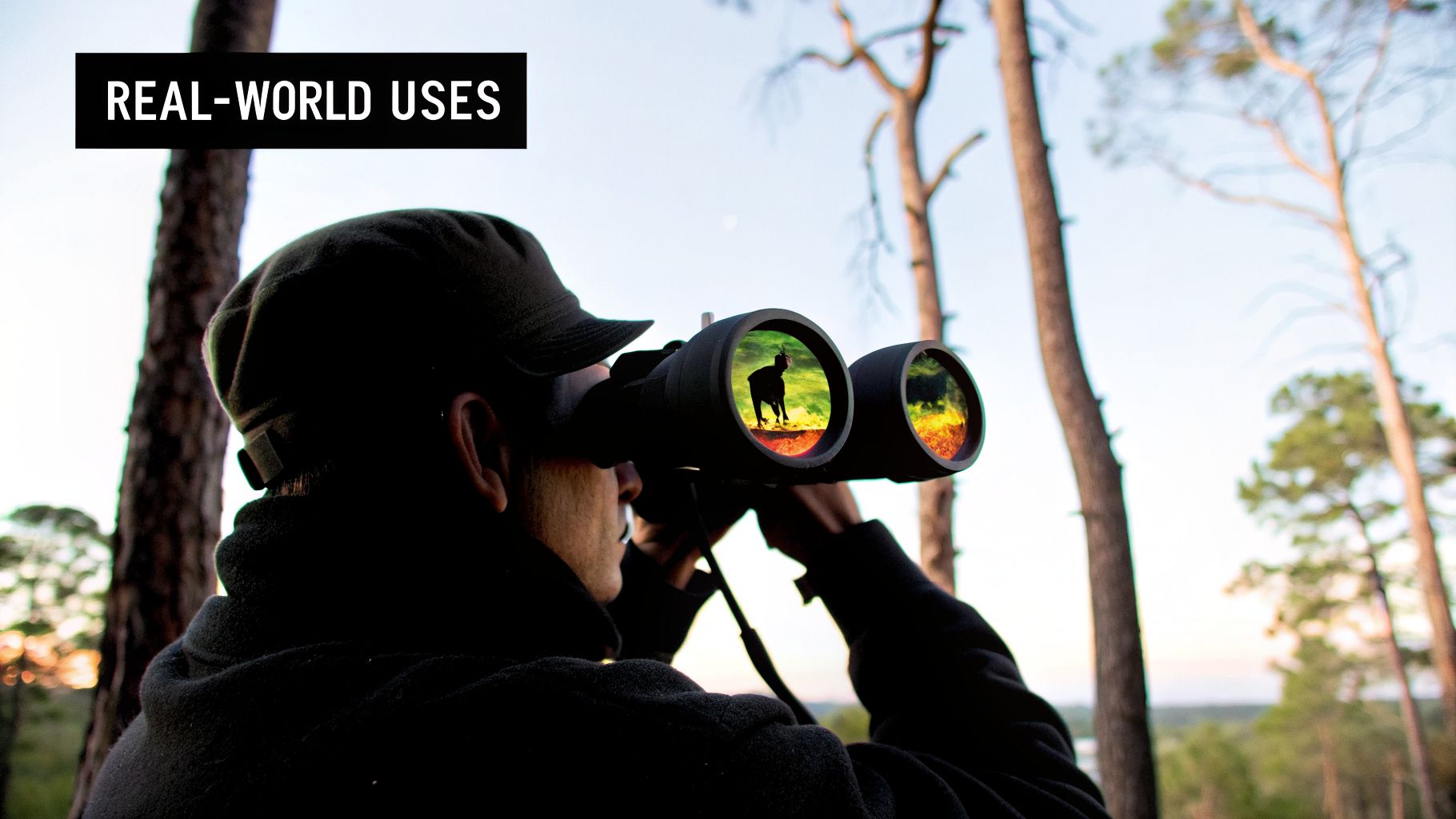
The demand for this advantage is exploding. The infrared market is set to skyrocket from USD 9.2 billion in 2024 to an estimated USD 19.48 billion by 2030. This surge is driven by everything from military modernization to growing civilian security concerns. As these night vision market drivers show, the ability to detect threats beyond 1,000 meters is no longer a niche capability; it's becoming a standard for serious operators.
For the Law Enforcement Operator
Imagine a tactical team moving through a multi-story warehouse. The power's been cut. It's an unfamiliar layout, and every shadow could be a threat. A single-tube monocular, while useful, flattens the world into a disorienting, two-dimensional image. Judging distance becomes guesswork, and moving quickly and safely is a huge challenge.
This is where true dual-tube night vision binoculars become mission-essential. The stereoscopic vision they offer brings back natural depth perception. Suddenly, an officer can move with confidence, instinctively tell the difference between a harmless stack of boxes and a concealed threat, and maintain crucial awareness of where their teammates are. Having proper depth perception isn't a luxury; it’s the line between a smooth operation and a disastrous miscalculation.
For the Dedicated Hunter
Picture a hunter tracking invasive feral hogs through thick woods well after sunset. To the naked eye, the landscape is just a wall of black. Even with a standard image-intensified (I²) device, the dense foliage can easily camouflage an animal that's standing perfectly still.
This is a perfect job for thermal. A thermal unit doesn’t need any ambient light; it sees heat. As the hunter scans the brush, the hog's body heat pops, glowing brightly against the cooler background. Thermal cuts right through the visual noise of leaves and branches, pinpointing the animal’s exact position for a clean, ethical harvest. It’s a prime example of using technology for detection over simple identification.
The lesson is clear: The right tool is the one that directly counters the specific challenges of your environment. An I² device shows you the scene, but a thermal device can show you what’s hiding within it.
For the Security Professional
Think about a security team responsible for a massive, unlit industrial site that covers hundreds of acres. Trying to patrol the whole perimeter is impossible, and conventional cameras are blind in the dark. The real problem is how to cover maximum ground with minimal manpower.
This is where high-end thermal binoculars prove their worth. From a single, elevated vantage point, one operator can effectively monitor miles of fence line.
- Long-Range Detection: A quality thermal unit can spot the heat signature of a person from over a mile away, giving the team an incredible early warning advantage.
- All-Weather Performance: Unlike image intensifiers, which struggle in bad weather, thermal punches through light fog, smoke, and rain. Surveillance remains effective, no matter the conditions.
- Reduced False Alarms: Thermal makes it easy to distinguish between a stray animal and a human intruder. This lets the team focus their response on real threats instead of chasing shadows.
In every one of these scenarios, the gear is matched to the mission. It’s about understanding how the specs translate to success on the ground. The right pair of infrared night vision binoculars isn't just an accessory—it’s a genuine force multiplier.
How to Choose the Right Night Vision Gear
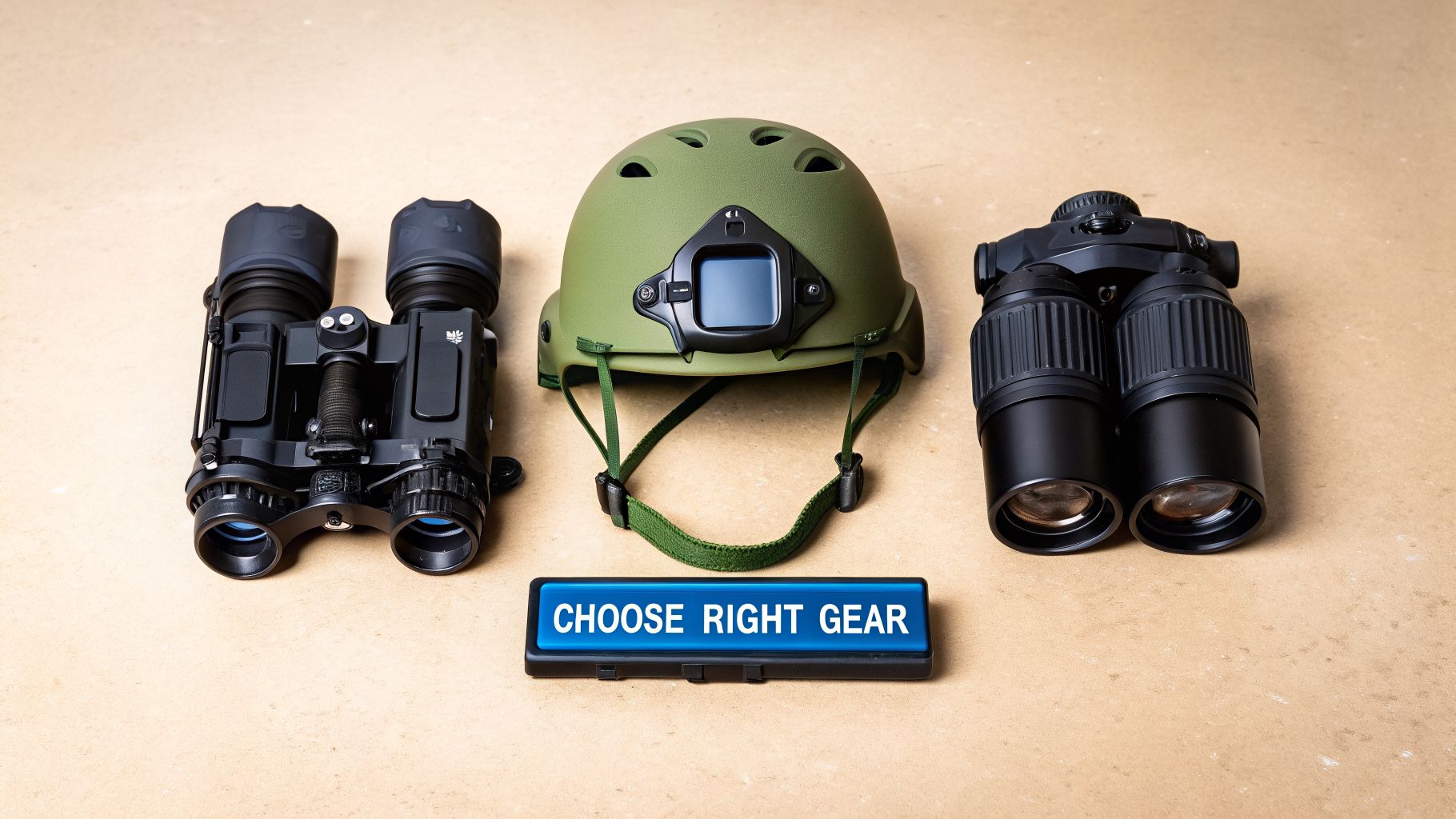
Alright, let's cut through the noise. Deciding on the right pair of infrared night vision binoculars can feel like a final exam you didn't study for. We’ve covered the tech, the specs, and the jargon—now it’s time to put that knowledge to work and make a smart purchase.
Think of this as your practical, no-nonsense checklist. By answering a few simple questions, you can cut right to the chase and find the gear that actually fits what you need to do.
Define Your Primary Mission
First things first: you need to be brutally honest about what you're really going to be using this gear for. The perfect device for a hog hunter is a terrible choice for someone clearing buildings. Your "mission" is the single most important factor that will guide your decision.
- Hunting: Here, the game is all about detection and identification. You need to spot that heat signature in the brush and then be able to tell if it's a coyote or your neighbor's prize-winning pig. Thermal is king for pure detection, but a crisp Gen 2+ or Gen 3 image intensifier is often what you need for that positive ID.
- Security & Surveillance: Your world revolves around standoff distance. The goal is to see a threat long before it sees you. This mission pushes you toward thermal binoculars with serious magnification or top-tier Gen 3 systems that can spot a human-sized target from over 1,000 meters out.
- Navigation & Tactical Use: When you’re moving in the dark, situational awareness and depth perception are everything. This is where helmet-mounted dual-tube goggles are the undisputed champs. Their 1x magnification and true stereoscopic vision let you move fast and navigate obstacles without feeling like you’re looking through a toilet paper tube.
Once you lock down your primary use, the right technology almost chooses itself.
Assess Your Operational Environment
Next, where are you going to be? The environment you operate in can make or break your gear's performance. A unit that shines in the open desert can feel useless in a humid, dense forest.
It’s not just about "Can I see?" The real question is, "What's in my way?" An image intensifier needs a line of sight, but thermal can often punch through smoke, fog, and foliage. That's a game-changing difference.
Think about these common scenarios:
- Open Country (Deserts, Fields): You’re scanning long distances, so you need high magnification and a long detection range. High-end thermal and Gen 3 I² both work great, but you have to be mindful of atmospheric conditions. Heat shimmer, or mirage, can play tricks on any optic.
- Dense Woods & Foliage: This is thermal's home turf, plain and simple. Thick brush can easily hide something from an image intensifier, but a thermal unit will light up an animal's heat signature right through the leaves.
- Urban & Mixed Environments: This is a tricky one. You'll face a mix of pitch-black alleys and sudden light pollution from streetlights or cars. A Gen 3 device with autogating is your best friend here, as it protects the tube from bright flashes while giving you elite performance in the deep shadows.
Align Your Budget with Performance Tiers
Night vision is an investment, plain and simple. Your budget is going to be a huge factor, so it’s critical to have realistic expectations for what your money can buy. Trying to get top-tier performance on a shoestring budget is a recipe for frustration.
| Budget Tier | Expected Performance & Technology | Best For |
|---|---|---|
| Entry-Level ($500 – $1,500) | Digital Night Vision, Gen 1 I² | Casual backyard use, short-range pest control, or just dipping your toes into the world of night vision. |
| Mid-Tier ($1,500 – $4,000) | High-Quality Digital, Gen 2 / Gen 2+ I² | Serious hunters and landowners who need reliable gear that gets the job done without the professional-tier price tag. |
| Professional-Tier ($4,000+) | Gen 3 I², High-End Thermal | Law enforcement, military operators, and anyone whose safety or success absolutely depends on having the best possible performance. |
For those looking at professional-grade equipment, remember that these systems are built to last. That’s why warranty and service matter so much. At Superior Tactical, we stand behind our Gen 3 units with a 10-year warranty and provide in-house diagnostics and repairs to make sure your investment is protected for the long haul.
If you’re still wrestling with these choices, our full guide on how to choose the right night vision device breaks it down even further.
Legal, Warranty, and Support Considerations
Last but not least, let's talk logistics. Before you hit that "buy" button on a serious pair of binoculars infrared night vision, especially Gen 3 systems, you need to know about ITAR (International Traffic in Arms Regulations).
- ITAR: These are strict federal regulations. In short, Gen 3 devices cannot be exported or even taken outside the U.S. by anyone without the proper licensing. Any legitimate dealer will require proof of U.S. citizenship to sell you one.
- Warranty: Good night vision isn't cheap. A solid warranty is your insurance policy against defects. Don't settle for anything less than multi-year coverage from a reputable source.
- Support & Repairs: What happens if something goes wrong down the road? Knowing you have access to reliable service can mean the difference between a long-lasting tool and an expensive paperweight. It’s an easy detail to overlook, but a crucial one.
By walking through this checklist, you can stop feeling overwhelmed and start feeling confident. You'll be ready to pick out the perfect night vision setup for your specific mission.
Common Questions About Infrared Night Vision
Even after you’ve wrapped your head around the technology, dropping serious money on a high-quality optic naturally brings up a few last-minute questions. Getting straight answers to these common sticking points is the final step toward buying and running your gear with complete confidence. Let's tackle some of the most frequent questions we hear about binoculars infrared night vision.
Can I Use Night Vision During the Day?
This is a big one, and getting it wrong can be a very expensive mistake. When it comes to traditional image intensifier (I²) night vision—everything from Gen 1 to Gen 3—the answer is an absolute no. Pointing one of these at the sun or another bright light source will fry the tube, causing permanent damage. Think of it like staring at the sun with your naked eye, but a thousand times worse for the device.
Digital night vision is a different story. It’s generally safe for daytime use, but you’ll find the picture isn't great since it's built for low-light work.
Thermal imagers are the real 24/7 champs. Because they see heat signatures instead of light, they work just as well in broad daylight as they do in pitch-black darkness.
Green Phosphor or White Phosphor?
This is all about what you prefer to see through the eyepiece. There's no right or wrong answer here, just what works best for your eyes and your mission.
- Green Phosphor: This is the classic, iconic “Predator” look you see in movies. It's been the standard for decades and is a proven, reliable workhorse.
- White Phosphor: A more recent development that gives you a crisp black-and-white image. Many operators, myself included, find that white phosphor offers superior contrast and detail. This can make a huge difference in reducing eye fatigue during long nights of observation.
While neither is technically superior, the improved clarity of white phosphor has made it a go-to choice for serious users who spend hours behind their optic.
Key Takeaway: The choice between green and white is up to you, but the rule about daytime use isn't. Protect your investment by never, ever exposing a traditional image intensifier tube to bright light.
Is a License Needed for Gen 3 Devices?
We get this question all the time. For a U.S. citizen buying and using the device inside the United States, you need no special license to own a Gen 3 unit.
However, this technology is heavily controlled under ITAR (International Traffic in Arms Regulations). This means it is a federal crime to take these devices out of the U.S., ship them internationally, or sell them to a non-U.S. citizen without an explicit government export license. Any legitimate seller will require you to prove your U.S. citizenship before finalizing the sale.
At Superior Tactical LLC, we specialize in professional-grade night vision and thermal optics to make sure you're ready for whatever the dark throws at you. Our team is here to offer no-nonsense advice and we back our Gen 3 systems with a 10-year warranty and expert in-house repair services. Explore our collection of tactical optics and accessories today.
