The Best Low Light Binoculars of 2026 A Complete Guide
Let's clear up a common misconception right away: the best low light binoculars aren't always night vision. For those crucial hours at twilight, dawn, or deep in the woods under a heavy canopy, a pair of high-quality optical binoculars will often give you a better, more detailed image.
True night vision gear is a different beast entirely. It's built for seeing in near-total darkness, where the available ambient light is just too faint for even the best glass to work with.
Deciding Between Low Light Optics and Night Vision
Choosing the right tool for the job comes down to one simple question: are you trying to enhance the light you have, or see where there's virtually none? Your answer points you directly to either traditional optical binoculars or an image-intensified night vision system.
Think of traditional low-light binoculars as passive light-gathering machines. They work by collecting every last bit of faint light from the environment—moonlight, starlight, the last glow of a sunset—and focusing it into your eyes. Their performance is all about the physics of glass.
Key Factors for Optical Binoculars
For a hunter tracking game at last light or a law enforcement officer on surveillance in a poorly lit alley, optical quality is everything. It all boils down to a few key specs:
- Objective Lens Diameter: Big lenses are your friend here. A 50mm or 56mm objective lens acts like a wider bucket, catching far more light than smaller lenses and producing a much brighter image.
- Exit Pupil: This is the diameter of the beam of light that leaves the eyepiece and enters your eye. For low-light work, you want an exit pupil between 5mm and 7mm to match your eye's naturally dilated pupil in the dark, ensuring no precious light is wasted.
- Lens Coatings: This is a huge factor. Top-tier, fully multi-coated lenses are non-negotiable. They prevent light from reflecting off the glass surfaces, pushing light transmission to over 95% in the best models.
A great low-light binocular is designed to give you an image that is brighter, sharper, and richer in detail than what your naked eye can see. It accomplishes this by mastering the physics of light, not by electronically generating an image.
Night vision devices, on the other hand, are active systems. They take in minuscule amounts of light through an objective lens and then use a powered image intensifier tube to multiply that light thousands of times. This process creates the familiar green or white-phosphor image we associate with night vision. It's the only way to see when there's almost no ambient light to begin with.
To make the choice clearer, it helps to see the core differences side-by-side.
Optical Low Light vs Night Vision At a Glance
The table below breaks down the fundamental differences between these two technologies, helping you decide which path is right for your needs.
| Attribute | Low-Light Binoculars (Optical Glass) | Night Vision Binoculars (Image Intensification) |
|---|---|---|
| Operating Principle | Gathers and concentrates existing ambient light. | Amplifies minimal ambient light electronically. |
| Best Use Case | Dawn, dusk, deep woods, and overcast conditions. | Moonless nights, dark interiors, and near-total darkness. |
| Image Quality | Natural color, high resolution, and excellent depth perception. | Monochromatic (green/white), potential for noise or "scintillation." |
| Daytime Use | Yes, performs exceptionally well during the day. | No, daylight will permanently damage the intensifier tube. |
| Power Source | None required. | Batteries are required to power the intensifier tube. |
Ultimately, your decision rests on the environment you'll be in. If there is some light to work with, even if it's faint, superior optical glass will almost always give you a better-quality image with natural color and depth. If you're facing true darkness, then night vision is the only tool for the job.
How Low Light Binocular Technology Actually Works
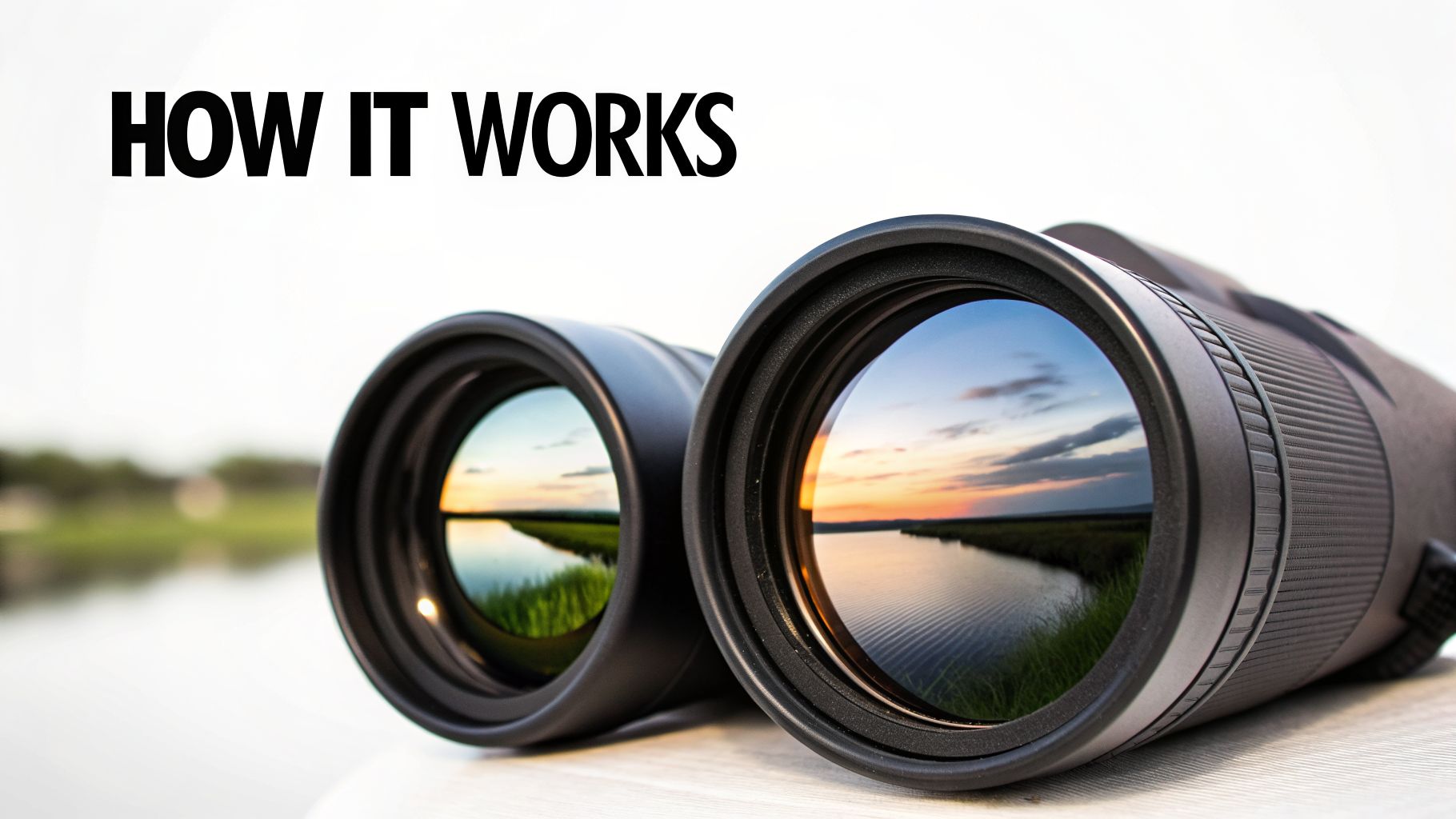
When you’re trying to pick out the best low light binoculars, it’s easy to get lost in marketing jargon. What you really need is a solid grasp of the physics—the principles that separate a crisp image at dusk from a fuzzy, useless one. It all boils down to a game of photons and how effectively your gear can capture every last one.
At the heart of it all is the binocular's ability to gather light. That job falls to the objective lens, the big lens at the front. Think of it as a bucket in a rainstorm; a bigger bucket catches more water. Likewise, a larger objective lens grabs more ambient light, which is why you'll see premier low-light binoculars boasting 50mm or even 56mm objectives.
But gathering light is just the first step. You have to get that light to your eye efficiently, and that’s where things get interesting. This is where the exit pupil becomes the most important number you've never heard of.
The Critical Role of Exit Pupil and Eye Adaptation
The exit pupil is that little disc of light you see floating in the eyepiece when you hold the binoculars at arm's length. The math is simple: Objective Lens Diameter ÷ Magnification. So, for an 8×56 binocular, you get a 7mm exit pupil (56 ÷ 8 = 7).
Why does this matter? As the light fades, the pupils in your own eyes dilate to let more light in, typically opening up to somewhere between 5mm and 7mm. For the brightest possible view, you want the binocular's exit pupil to be at least as large as your eye's pupil. This ensures the entire column of light gathered by the objective lens makes it into your eye.
An exit pupil of 7mm is the gold standard for anyone serious about low-light observation. It’s a guarantee that every bit of precious light your binos collect is delivered straight to your fully dilated pupil, wasting nothing.
On the other hand, a model with a small exit pupil, which is common in compact or high-magnification glass, will feel dim in low light. It’s like trying to get a drink through a coffee stirrer—the flow of light is just too restricted.
Lens Coatings and Light Transmission Explained
Even with huge objective lenses, a surprising amount of light gets lost. It bounces off the multiple glass surfaces inside the binoculars and never reaches your eye. This is where high-quality lens coatings become absolutely essential.
- Coated: A single anti-reflective layer on just one lens surface. Better than nothing, but barely.
- Multi-Coated: Multiple layers on at least one lens surface. It’s an improvement, but not what you want for serious work.
- Fully Multi-Coated (FMC): Multiple layers of advanced coatings on all air-to-glass surfaces.
For any real low-light application, don't settle for anything less than Fully Multi-Coated optics. These sophisticated coatings can boost light transmission from a dismal 60% in uncoated optics to over 95% in a top-tier model. That single spec makes a world of difference in brightness and clarity. For a deeper look into the science, you can find more on how these coatings are evolving among the latest low light innovations on our blog.
Prism Systems: Porro vs. Roof
The final piece of the puzzle is the prism system, the internal engine that flips the image right-side up. The design of this system has a direct impact on light efficiency. Your two choices are Porro and Roof.
Porro Prism Binoculars
You can spot these by their traditional, zig-zag shape where the eyepieces are closer together than the objective lenses.
- Advantage: The light path is simpler, making Porro prisms naturally more efficient at transmitting light. They can deliver incredible brightness without the expensive coatings required by roof prisms, making them an excellent value for pure optical performance.
- Disadvantage: They're bulkier, heavier, and often less waterproof and durable than roof prism designs.
Roof Prism Binoculars
These feature a straight, streamlined housing. They are more compact, ergonomic, and popular in modern designs.
- Advantage: Their slim, tough construction and internal focusing mechanism make them the go-to for tactical operators and anyone who's hard on their gear.
- Disadvantage: To match the brightness of a good Porro prism, roof prisms need extremely advanced (and costly) dielectric and phase-correction coatings. Without them, performance in low light suffers noticeably.
For most field professionals, the ruggedness and ergonomics of a top-quality, fully multi-coated roof prism binocular make it the clear winner. But if you’re doing most of your observation from a fixed position and your only concern is maximum brightness for your buck, a Porro prism model is tough to beat.
Gaining the Edge with Night Vision Binoculars
Even the world's best low-light binoculars have their limits. They are masters at gathering existing light, but once twilight gives way to true darkness, there's simply no light left to gather. When the sun is gone and you absolutely have to see what’s out there, you have to move beyond passive glass and into active image intensification.
That’s where night vision comes in. Unlike a standard binocular that just funnels available light to your eye, a night vision device takes the faintest traces of ambient light—from the moon, stars, or even distant city glow—and electronically multiplies it by the thousands. An image intensifier tube turns that amplified light into a crisp image on a phosphor screen, letting you operate in conditions that would otherwise leave you completely blind. This is the technology that separates seeing at dusk from owning the night.
It’s no surprise that this capability is in high demand. Night vision binoculars are one of the fastest-growing categories in the optics world. In fact, market analysis projects that by 2026, night vision will account for a massive 39.92% share of the entire binocular market. You can dig into the full binocular market analysis to see just how quickly this technology is being adopted by professionals and serious enthusiasts alike.
Understanding Night Vision Generations
Not all night vision is the same. The technology is broken down into "Generations" (Gen), and each one represents a major leap in performance. Getting this right is the first step in choosing a device that won’t let you down.
Generation 1 (Gen 1): This is your entry point. Gen 1 is affordable and a huge step up from the naked eye, but it comes with tradeoffs. You'll notice significant image distortion, almost a "fish-bowl" effect, around the edges. They also need a good amount of ambient light or an active infrared (IR) illuminator to be truly effective.
Generation 2 (Gen 2): Here’s where things get serious. Gen 2 devices introduce a micro-channel plate (MCP), which dramatically boosts light amplification. The result is a much brighter, cleaner image with far less distortion. For many demanding users, a high-quality Gen 2+ system hits the sweet spot between performance and price.
Generation 3 (Gen 3): This is the gold standard, period. Used by military and law enforcement units across the globe, Gen 3 tubes use a gallium arsenide photocathode that is incredibly sensitive to light. This delivers the cleanest, brightest, and sharpest images possible, allowing you to see clearly in near-total darkness, often without any IR support.
For any serious tactical, security, or hunting role where identifying a target is non-negotiable, Gen 3 night vision is the benchmark. The clarity and low-light performance are simply in another league, giving you a decisive advantage when everything is on the line.
Measuring Performance with Figure of Merit (FOM)
So how do you compare two different Gen 3 devices? The industry uses a spec called Figure of Merit (FOM). It’s a simple calculation: the tube’s resolution (measured in line pairs per millimeter, or lp/mm) multiplied by its signal-to-noise ratio (SNR).
A higher FOM score means the device is better at resolving details in the dark. For instance, a basic Gen 3 unit might have a FOM around 1800. High-end white phosphor tubes, on the other hand, can easily exceed 2400 FOM. For a professional user, that higher number translates directly to identifying a threat from a greater distance.
Green Phosphor vs. White Phosphor
The last piece of the puzzle is the color you see through the eyepiece. The debate between classic green and modern white phosphor often comes down to personal preference and how you intend to use the device.
Green Phosphor (P43)
This is the iconic "night vision green." The human eye is very sensitive to the green spectrum, making it a logical choice for decades. High-quality green phosphor tubes still offer outstanding performance and are typically more budget-friendly. However, some people find that looking at a green screen for hours can cause eye fatigue.
White Phosphor (P45)
This newer technology produces a black-and-white image that feels more natural to the human eye. Many operators report less eye strain during long surveillance stints and find that the black-and-white view provides better contrast, making it easier to pick out shapes and textures. This performance usually comes at a higher price, but for those spending hours behind the glass, it’s often worth it.
Ultimately, a top-tier green unit will still outperform a mediocre white phosphor one. But for professionals who need the absolute best low light binoculars for after-dark work, the reduced eye strain and enhanced detail of white phosphor make it the go-to choice.
Matching the Right Binoculars to Your Mission
Let's get one thing straight: there's no single "best" pair of low-light binoculars. The right tool depends entirely on your mission. What works for a hunter glassing a field at dusk is useless for an officer on a moonless night.
Before you even look at specs, you have to define what you're trying to do. Are you spotting, identifying, or just moving through the dark? How far away is your subject? Most importantly, how much ambient light will you actually have? The answers will point you toward the right tool, whether that's world-class optical glass or advanced night vision.
Scenario 1: Law Enforcement Surveillance
An officer is running surveillance from a vehicle, watching a subject about 75 yards away in a classic urban setting. It’s a poorly lit area—some light spills from streetlamps and windows, but deep shadows hide everything. The mission is simple: get a positive ID and see exactly what they're doing.
Best Bet: A top-tier set of 8×56 or 7×50 optical binoculars. We're talking about glass with fully multi-coated lenses and a massive 7mm exit pupil. In this environment, there's just enough ambient light for high-end optics to work their magic, gathering and amplifying it to create a stunningly bright, clear image. You get natural color and depth perception, which is absolutely critical for a positive ID.
Alternative: A Gen 2+ or basic Gen 3 night vision monocular. It will certainly turn night into day, but that green or white-and-black image can make it tougher to distinguish fine details. Is that a blue or black jacket? What's that facial tattoo? Good glass might give you a better answer here. But if the subject steps into a pitch-black alley, that NVD is the only thing that will work.
Scenario 2: Hunting at Dawn and Dusk
Picture this: you're in a tree stand, scanning a treeline as the last bits of legal shooting light disappear. A deer could step out anywhere from 50 to 200 yards away. You need to spot movement, identify the animal (is it a buck or a doe?), and be 100% sure it's a legal target before you even think about taking a shot.
Best Bet: Premium 8×56 or 10×50 Porro prism binoculars. For the money, nothing beats the sheer brightness you get from a quality Porro prism design—their simpler light path is just more efficient. For static glassing from a stand, they're perfect. An 8x magnification gives you a nice wide field of view for scanning, and those big objective lenses are like light buckets.
Alternative: A high-end roof prism binocular in a similar size, like an 8×56. They might not be quite as bright as a Porro at the same price, but they are almost always tougher, more waterproof, and more compact. If you’re hard on your gear, that’s a big plus. Night vision usually isn't the play here; the image quality from good glass at the edges of daylight is far better for judging an animal's specific features.
Expert Insight: For making a positive ID at 100 yards when it's truly dark—think moonless and overcast—nothing can touch Gen 3 night vision. The power to resolve fine detail without any visible light is a capability that the best optical glass simply cannot provide.
This decision tree helps map out the technology path you should be on, depending on the light you have and the job you need to do.
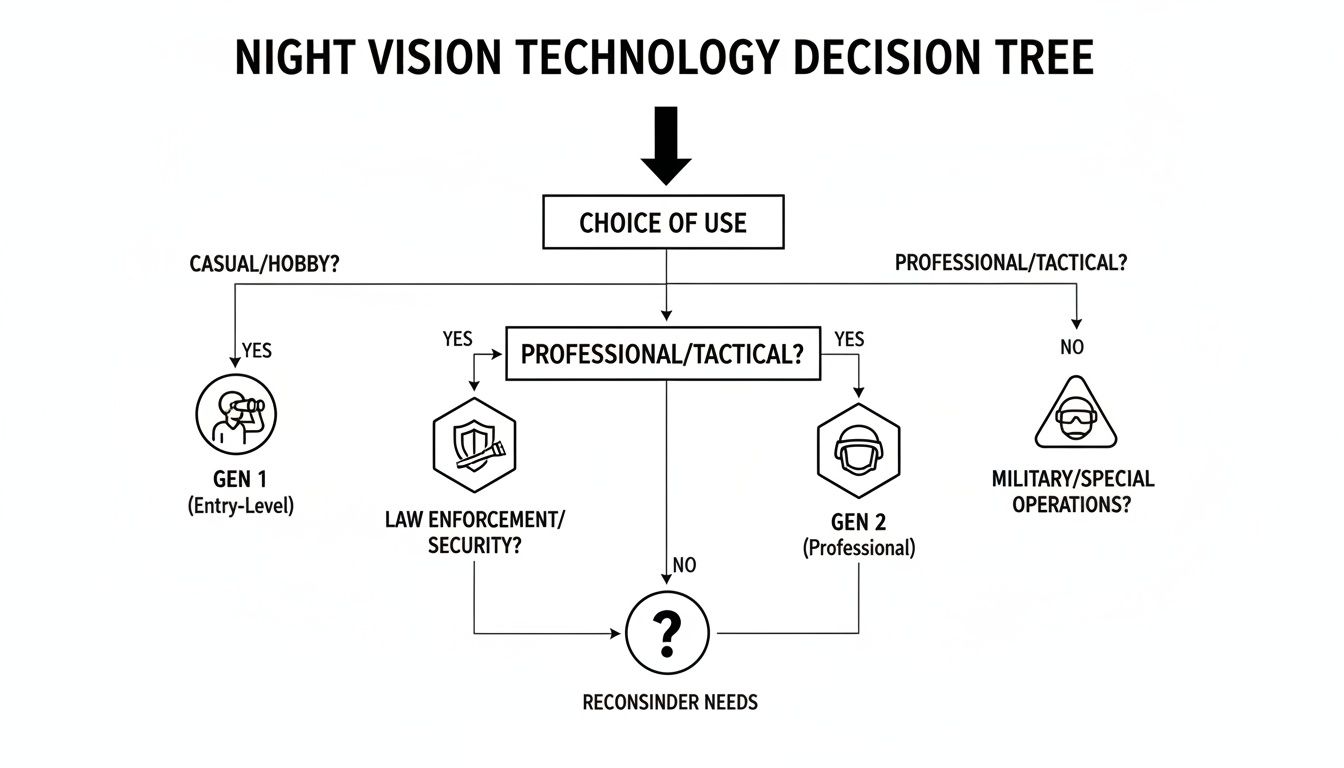
As you can see, the moment ambient light disappears, the conversation for any serious professional work shifts decisively toward image intensification.
Scenario 3: Perimeter Security in Total Darkness
A security professional is watching over the fence line of a huge, remote facility. It's a textbook "total darkness" scenario: no moon, heavy cloud cover, and zero artificial light. The job is to spot any breach along a perimeter that stretches for hundreds of yards.
Best Bet: A dual-tube Gen 3 night vision goggle. In this situation, your high-dollar optical binoculars are just dead weight. A dual-tube (binocular) system is critical because it gives you depth perception, which you need for moving and judging distance in the dark. Go for high-FOM Gen 3 white phosphor tubes for the cleanest possible image and to reduce eye fatigue over a long, dark shift. You can see a range of top-tier night vision and thermal binoculars built for exactly these kinds of demanding roles.
Alternative: A high-quality Gen 3 monocular used in tandem with a handheld thermal imager. This is an incredibly powerful combo. The thermal is a detection machine, instantly picking up a heat signature against a cold background from a long way off. Once you have a heat blob, you switch to the night vision monocular to get a detailed image and identify exactly what it is.
By matching the gear to the mission, you ensure your equipment is a powerful asset, not a frustrating liability. Making a smart choice based on these real-world scenarios is the only way to guarantee you have the advantage when the lights go out.
Alright, let's move from theory to gear. We’ve covered the science behind seeing in the dark; now it’s time to look at the tools that actually get the job done. I'm going to walk you through some of the best low-light binoculars and night vision systems out there, breaking them down by mission so you can find the right fit for what you do.
Modern binocular design has come a long way, especially with advancements in lens coatings and prism technology. You'll see a lot of roof prism binoculars on the market—they currently hold a 40% share and are expected to hit 58.34% by 2026. This trend is all about packing serious optical power into a more compact and lightweight body. It’s a significant shift in design philosophy, which you can read more about in this compact binocular market projection from intelmarketresearch.com.
Best in Class Optical Low Light
For those critical minutes at dawn and dusk when the world is draped in shadow, you need pure optical performance. The goal here is simple: gather every last photon and deliver a bright, crisp image with true-to-life color. These picks do just that.
Steiner Nighthunter 8×56
There's a reason the Nighthunter is a legend. Its Porro prism design is just inherently better at getting light to your eye compared to most roof prism models. The result is an image that is stunningly bright.
- The Edge: Steiner's claim of 96% light transmission isn't just marketing fluff. In the field, these pull in light like nothing else in their class, giving you a clear view when others are packing it in.
- Best For: Stationary work. Think hunting from a blind or running surveillance from a fixed position where their size and weight aren't a hindrance.
- Heads Up: The individual-diopter focus is rock-solid for scanning distant ridgelines, but it can be slow if you need to constantly re-focus on objects at varying, closer distances.
Vortex Optics Diamondback HD 10×50
This is a true workhorse optic. The Diamondback HD line strikes an incredible balance between solid performance, rugged construction, and price. For low-light use, the 10×50 configuration is a sweet spot, giving you enough magnification and light-gathering ability in a durable, fog-proof package.
- The Edge: You get fantastic clarity and color for the money, and it’s all backed by Vortex’s no-questions-asked lifetime warranty. You can use and abuse it with confidence.
- Best For: An all-arounder. It’s a perfect choice for hunters, wildlife watchers, and anyone who needs one reliable binocular that won't quit when the sun goes down.
If you're serious about performance in twilight, don't compromise. You need a big objective lens (50mm or more) paired with a wide exit pupil (at least 6mm). This combination is what physically allows the maximum amount of light to pour into your eyes right when you need it most.
Professional Duty Night Vision
When ambient light is completely gone, the best glass in the world is useless. This is where image intensification takes over. For law enforcement, security pros, and serious preparedness, these systems aren't just tools; they're the standard.
Superior Tactical PVS-14 Gen 3 Monocular
The PVS-14 is the Swiss Army knife of night vision. You can use it as a handheld spotter, mount it on a helmet for hands-free movement, or even clip it behind a red dot for night-time shooting. Its versatility is unmatched.
- The Edge: Our Gen 3 white phosphor units deliver high Figure of Merit (FOM) ratings. That means you get a sharp, high-contrast image that’s easier on the eyes over long periods.
- Best For: Anyone needing a multi-role NVD. It's the go-to for patrol officers, security teams, and civilians who need one device to handle navigation, observation, and identification. We stand behind our Gen 3 units with a 10-year warranty.
Operator-Grade Dual Tube Systems
When you absolutely cannot afford to misjudge distance or lose a sliver of situational awareness, dual-tube goggles are the only way to go.
Superior Tactical BNVD-1431 Gen 3 Goggles
This is a rugged, articulating goggle that gives you true stereoscopic vision. That depth perception is non-negotiable for driving vehicles, moving over rough terrain, or operating in tight spaces in complete darkness.
- The Edge: The ability to perceive depth drastically improves your mobility and safety. Plus, the articulating pods let you flip one or both tubes up and out of the way, so you can instantly switch between NODs and your naked eye.
- Best For: The gold standard for tactical units, high-level security, and any user who demands peak performance and complete situational awareness for complex nighttime missions.
Ultimately, picking the right system comes down to a realistic assessment of your needs. Are you trying to stretch the last few minutes of daylight, or do you need to own the dead of night? The gear above represents proven, field-tested solutions that will give you a decisive advantage.
Keeping Your High-Performance Optics in Fighting Shape
Your premium optics are a serious investment, whether it's a top-tier pair of low-light binoculars for the hunt or a Gen 3 night vision device for professional duty. Keeping this gear in peak condition isn't just a good idea—it's absolutely critical for ensuring it works when you need it most. A little care goes a very long way.
It's no surprise that the global market for quality binoculars is expected to be worth $2.59 billion by 2026. As more people rely on this kind of advanced glass, knowing how to properly maintain it is key to making that investment last. You can dig into the numbers yourself in the latest binoculars market report.
Lens Cleaning and Protection
The magic behind your optic's low-light performance lies in its specialized lens coatings, but they are surprisingly fragile. Whatever you do, never reach for a t-shirt, paper towel, or any kind of harsh chemical.
- Get the Grit Off First: Start with a blower bulb or a very soft lens brush to gently puff away any loose dust or sand. If you start wiping right away, you're just grinding those abrasive particles into the lens and its coatings, causing permanent scratches.
- Use the Right Tools: Next, put a few drops of a dedicated lens cleaning fluid onto a clean microfiber cloth. Don't spray it directly on the lens.
- Wipe the Right Way: With the damp cloth, wipe the lens in a slow, circular motion, starting from the center and working your way out. This pushes any leftover debris to the edge of the lens instead of smearing it around.
Pro Tip: Those lens coatings are incredibly thin, measured in nanometers. They're what manage light transmission and reduce glare. Using the wrong cleaning methods can strip them away, permanently dimming the image and turning your high-dollar optic into a mediocre one.
Storage and Pre-Flight Checks
How you store your gear is your best defense against moisture, fungus, and bumps and drops. When you’re not using your optics, keep them in their case in a cool, dry place. The absolute worst place to leave them is in a vehicle, where wild temperature swings can wreck the internal seals.
Before heading out, always run a quick function check:
- Focus: Does the main focus wheel and the diopter ring turn smoothly? Any grinding or binding is a red flag.
- Collimation: Look through the binoculars at something far away. You should see one, clean, single image. If you're seeing double or the image looks like a figure-8, the prisms are out of alignment and need professional service.
- Seals: Check for any fogging on the inside of the lenses. This means the nitrogen purge has failed and your weatherproofing is compromised.
While you can handle basic cleaning, some problems demand an expert. If you’re dealing with collimation issues, internal dust, or a failed seal, it's time to send it to a professional. Trying to fix it yourself can often do more harm than good. You can learn more about when to call in the pros by reading about common gear issues and how repairs can help.
Frequently Asked Questions About Low Light Optics
Getting into high-end optics brings up a lot of questions. Whether you're looking at your first pair of the best low light binoculars or thinking about a professional-grade system, you need solid answers. Here are a few of the most common queries we get.
A great pair of low-light binoculars will absolutely work during the day. In fact, they often produce a brighter, crisper image than many standard binoculars. The real warning is for digital and image-intensified night vision: NEVER use them in daylight. You’ll permanently fry the internal intensifier tube, which is why they always come with a protective day cap. Only take it off in the dark.
What Does Exit Pupil Mean For Low Light Performance?
Exit pupil is one of the most critical numbers for low-light performance. You find it by dividing the objective lens diameter by the magnification. For example, a classic 7×50 marine binocular has a 7.1mm exit pupil (50mm ÷ 7x).
Think of it this way: in the dark, your own pupil expands to about 5-7mm to let in as much light as possible.
A large exit pupil is vital because it creates a beam of light wide enough to fill your dilated pupil. If the exit pupil is smaller than your eye's pupil, you're essentially wasting the light the optic gathered, resulting in a dimmer view.
Are There Legal Restrictions On Owning Night Vision?
For civilians in the United States, owning most night vision is perfectly legal, including Gen 1, Gen 2, and Gen 3 devices. The main legal issue you need to be aware of is ITAR (International Traffic in Arms Regulations).
These federal rules strictly control the export of Gen 3 and other high-performance systems. You cannot take them out of the country or send them to a non-U.S. citizen without a government license. Anything you buy from a reputable U.S. dealer is legal to own and use here, but the responsibility for complying with export laws falls squarely on you.
At Superior Tactical, we provide the mission-critical gear you need, from high-performance Gen 3 night vision to rugged optical systems, all backed by expert support and a comprehensive warranty. Explore our full catalog of tactical optics and accessories at https://superiortac.com.
