Your Guide to the Best Budget Night Vision Scope
When you're shopping for a night vision scope without an unlimited budget, you’re looking for the sweet spot. That perfect balance between a clear image, a useful detection range, and solid IR illumination is what separates a good buy from a paperweight. For most people, that sweet spot is a modern digital scope.
It’s all about getting the performance you need for your situation—whether that’s hunting hogs or keeping an eye on your property—without dropping the cash required for military-grade hardware.
A Practical Guide to Affordable Night Vision
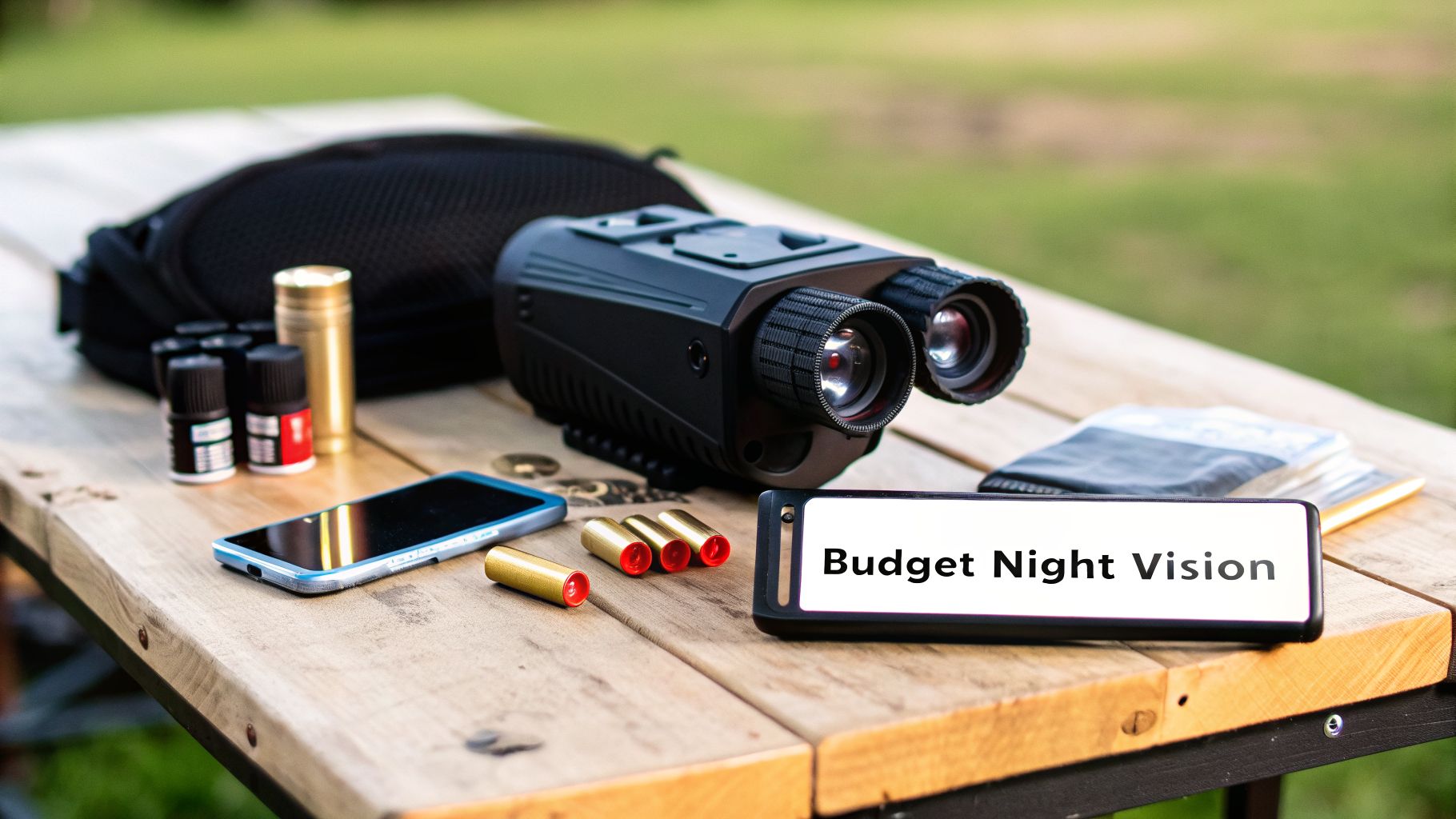
Let's cut right to it. The "best" budget night vision scope is simply the one that gives you the clearest picture for your specific mission without draining your bank account.
Think of it like smartphone cameras. Not long ago, they were a novelty, but now they deliver incredible performance that rivals professional gear from just a decade ago. The same thing has happened with digital night vision, and at Superior Tactical, we believe that mission-ready gear shouldn't be out of reach for anyone.
This guide is built from hands-on experience to help you understand the trade-offs and choose with confidence. The civilian market for this tech is exploding. In fact, projections show that after 2025, about 40% of all night vision sales will be to hunters and preparedness-minded folks, thanks almost entirely to affordable digital scopes.
You can now find scopes with performance that rivals older Gen 2+ technology for under $800—that's a price drop of over 30% from what you would have paid back in 2015.
What Really Matters in a Budget Scope
When you're sorting through the options, don't get lost in the marketing hype. Focus on these three core factors:
- Digital Clarity: This comes down to the sensor's resolution. It’s the difference between spotting a blurry blob and confidently identifying a coyote.
- Detection Range: This is how far out you can spot movement. A good budget scope needs a practical range that matches how you'll actually use it.
- IR Illuminator Power: The built-in infrared (IR) light is your best friend in total darkness. A powerful IR is non-negotiable for moonless nights or deep woods.
Nailing the balance between these three is how you find a truly effective low-cost night vision scope.
At Superior Tactical, our philosophy is simple: provide gear that's both mission-ready and accessible. We stand behind our equipment with a 10-year warranty and expert support because we believe your investment should last.
To get started, this table breaks down the most important features and what they mean in practical terms.
Quick Guide to Choosing a Budget Night Vision Scope
| Feature | What to Look For in a Budget Scope | Why It Matters |
|---|---|---|
| Technology | Digital sensor over analog (Gen 1) | Offers better clarity, recording, and durability for the price. |
| Resolution | At least 1080p (1920×1080) sensor | Higher resolution means a sharper, more detailed image for target identification. |
| Detection Range | 200-400 yards is a realistic sweet spot | This covers most hunting and surveillance scenarios without paying for extreme range. |
| IR Illuminator | An adjustable, 850nm illuminator | An 850nm IR provides the longest range, and adjustability helps prevent washout up close. |
| Battery Life | 4-6 hours of continuous use | You need enough power to last through an entire night's activity without a mid-hunt swap. |
| Durability | Weather-resistant (IPX4 or higher) and recoil-rated | Your scope must withstand the elements and the shock from your firearm to be reliable. |
This table gives you a solid foundation. Keep these points in mind as we dive deeper into each one, and you'll be well on your way to choosing a scope that works for you.
Digital vs. Analog: What Your Budget Actually Buys You
When you first start looking at night vision, you'll immediately run into two terms: "digital" and "analog." It can be a real headache trying to figure out which is the right call for a budget-friendly scope, especially with all the talk about different "Generations" of analog tech still floating around.
Let's cut through the noise with a simple comparison.
Think of old-school analog night vision like a broadcast TV from the 1970s. The most common budget option, Gen 1, gives you an image, but it’s a bit like watching that old TV in a snowstorm. You get a lot of static, what we call scintillation, and the picture is often grainy and distorted around the edges. It works, but it needs a good bit of moonlight or a strong IR illuminator to be genuinely useful.
Modern digital night vision, on the other hand, is like today's 4K smart TVs. It uses a digital sensor and a processor—just like the camera in your phone—to create a crisp, clean image on a built-in screen. This tech has improved so dramatically that it’s now the undeniable winner for anyone looking for serious performance without breaking the bank.
The Rise of Digital Dominance
For a long time, high-end analog systems (Gen 3 and up) were the peak of night vision performance. The problem? Their massive price tags kept them exclusively in the hands of military and law enforcement. Digital technology completely flipped the script, allowing manufacturers to build scopes with fantastic clarity and features for a fraction of the cost.
It's a common myth that any "Gen" scope is better than a digital one. The truth is, a quality digital scope made today will run circles around a new consumer-grade Gen 1 analog scope in almost every category—image clarity, durability, and features. Digital processing cleans up the visual noise, giving you a much clearer picture for identifying what you're looking at.
This is why you see digital scopes loaded with features like video recording, multiple reticles, and even full-color daytime modes. These are things that are simply impossible with a traditional analog tube. If you want to dive deeper into the nuts and bolts, you can learn more about the differences between thermal, digital, and analog night vision in our full guide.
Setting Realistic Budget Expectations
So, what kind of performance can you really expect for your money? Let's be realistic: a $500 digital scope won't go toe-to-toe with a $4,000 military-grade Gen 3 unit. Those high-end analog tubes are incredibly sensitive and can practically see in the dark with almost no help from an IR illuminator.
But here’s the crucial part: that same $500 digital scope will absolutely blow a similarly priced Gen 1 analog device out of the water. You get a cleaner image, better identification capabilities, and a far more versatile tool. For most of us, that’s more than enough power.
With a quality budget digital scope, you can realistically expect:
- Positive ID out to 150 Yards: You'll be able to confidently tell a coyote from a deer or a hog from a log at common hunting distances.
- Effective Property Surveillance: You can easily monitor your property and identify any two- or four-legged visitors with clarity.
- Day and Night Versatility: Many digital scopes double as full-color daytime optics, so you don’t have to swap rifles or scopes when the sun comes up.
For anyone trying to get the most out of their money, the choice is clear. Modern digital night vision gives you superior performance, more features, and better durability than the outdated and overpriced analog alternatives in the same price range. It has finally made effective night vision an accessible tool for everyone, not just operators with massive budgets.
What to Look for on the Spec Sheet
When you start shopping for a budget night vision scope, the spec sheets can feel overwhelming. Manufacturers love to highlight impressive-sounding numbers, but only a handful of them truly impact what you’ll see when the sun goes down. Let's cut through the noise and talk about what really matters.
The night vision market is exploding right now, which is fantastic news for us. It’s expected to jump from $500 million in 2025 to $950 million by 2033. All that competition means we’re seeing incredible features in budget-friendly gear. Digital scopes under $300 are now boasting 1080p resolution and hitting detection ranges of 200 meters—performance that would have cost a fortune just a few years ago.
This image really helps break down the difference between the old-school analog tech and the digital systems that are common today.
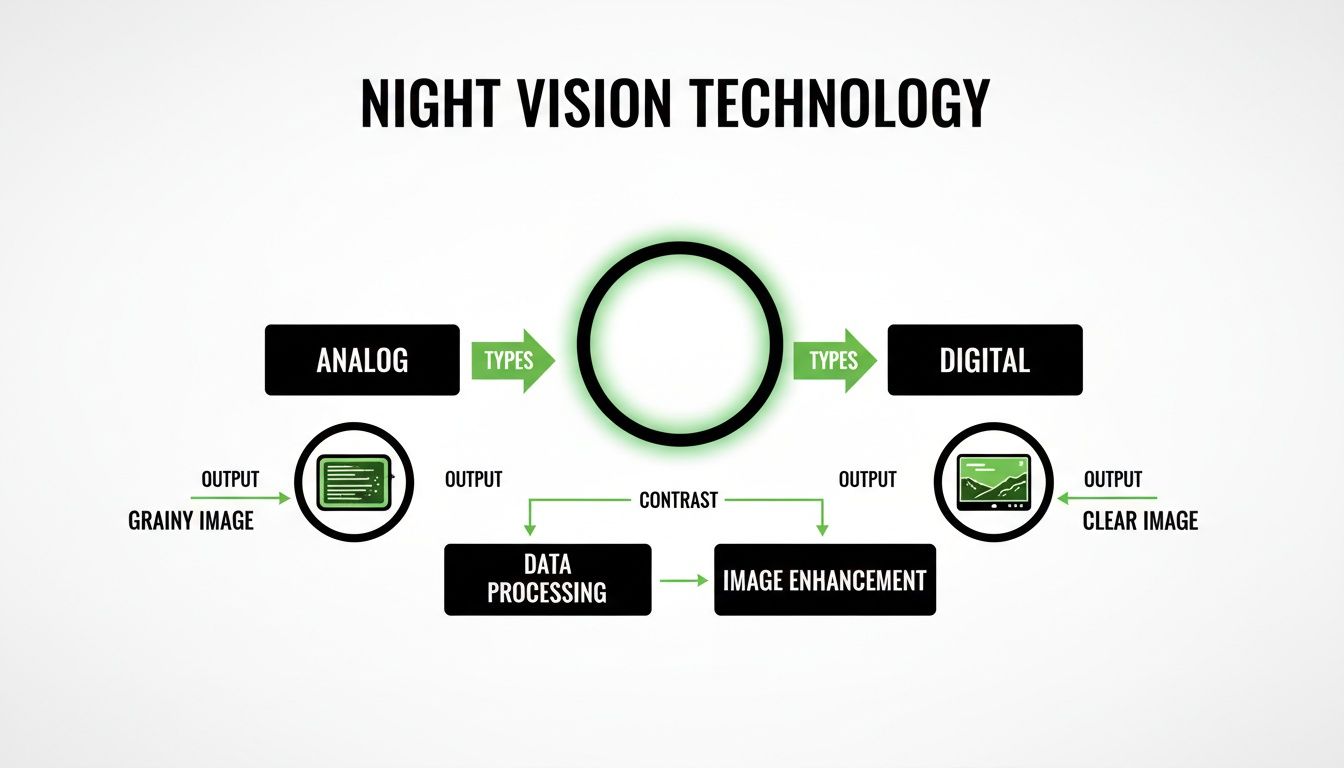
Simply put, digital night vision uses a sensor to capture light and display a crisp image on a screen, much like a video camera. Analog just amplifies existing light, which is why it often looks grainy.
Resolution: Your Key to Clarity
Think about resolution just like you would on a TV or a digital camera. Low resolution might show you a fuzzy, four-legged blob in the distance. High resolution lets you see it’s a coyote, not your buddy’s retriever that got loose. For night vision, resolution is everything.
On a budget-friendly digital scope, you shouldn't settle for less than a 1920×1080 pixel sensor, which you'll usually see marketed as 1080p or Full HD. This is the sweet spot, giving you enough detail for positive identification out to 200 yards or so. Anything less, and you’re just guessing what’s out there.
Field of View: Seeing the Whole Picture
Field of View, or FOV, is how wide your window to the world is. A narrow FOV is like looking through a toilet paper roll—you can focus on one small spot, but you have no idea what’s happening around it. A wide FOV is like looking through a panoramic window.
It’s all about a trade-off, and it's tied directly to magnification:
- High Magnification: Narrows your FOV. It’s perfect for zooming in on a stationary target but makes it tough to scan a field or track something on the move.
- Low Magnification: Widens your FOV. This gives you great situational awareness but provides less detail on things way out there.
The right choice comes down to your primary use. A hunter might want more magnification to place a precise shot, while someone watching over their property will benefit from a wider view. If you want to get a better handle on how magnification and other numbers work, our guide on what scope numbers mean is a great place to start.
Detection vs. Identification: The One Thing You Must Understand
If you only remember one thing from this guide, make it this. Marketers love to plaster huge “detection ranges” on the box, but that number is almost useless without its counterpart: identification range.
Detection Range is the absolute maximum distance where the scope can register a flicker of movement or a heat signature. You can tell something is there, but you have no clue what. It’s just a few shimmering pixels on the screen.
Identification Range is the distance where you can confidently identify what that something is. That’s the point where you can tell a hog from a deer, or a person from a large post. This is the number that actually matters for safe and ethical use.
A scope might have a flashy 600-yard detection range, but if its identification range is only 150 yards, that's your true effective distance. Always, always look for the identification range. It’s the spec that ensures you can act responsibly and effectively in the dark.
Matching the Right Scope to Your Mission
Alright, you’ve got a handle on the specs and the technical jargon. Now for the most important part: figuring out what you’re actually going to do with this thing. A scope’s features are just a list on a box until they help you solve a problem in the real world.
The best budget night vision for a hog hunter taking 150-yard shots is worlds apart from what a homeowner needs to keep an eye on their back fence. This is where we stop talking theory and get down to business. Let's look at the most common jobs people have for their night vision and nail down the features you can't afford to compromise on.
For the Hunter Tracking Hogs and Predators
When you’re out in the field, it all comes down to two things: positive target identification and making an ethical shot. You have to be absolutely certain that shape in the shadows is a coyote and not the neighbor’s German Shepherd. For that, clarity and magnification are your best friends.
You’ll want to lean toward a digital scope that puts its money into the sensor quality, even if that means a slightly narrower field of view. A scope with a 1080p sensor is really the floor here; it’s the minimum you need for the kind of detail that lets you confidently identify game inside 200 yards.
Your must-have features are:
- Optical Magnification: Start with a solid base optical magnification, something in the 3x or 4x range. This brings the target closer without the grainy pixelation you get from digital zoom. Think of digital zoom as a bonus, but your true clarity for the shot comes from the glass.
- Multiple Reticle Options: Animals don't always stand still in front of perfectly-contrasted backgrounds. Having a few different reticles to choose from lets you pick one that pops, ensuring you never lose your aim point.
- One-Shot Zero: This feature is a game-changer. It saves you a ton of time, frustration, and ammo when sighting in your rifle. Get on paper, fire one shot, adjust, and you're good to go.
- Recoil Resistance: This isn't negotiable. Make sure the scope is rated to handle your rifle's caliber. A scope that loses zero after every shot is just an expensive, frustrating paperweight.
For this kind of work, a scope like the Sightmark Wraith 4K Mini is a great example of getting it right. The 4K sensor gives you incredible detail for identification, while its design feels just like a traditional riflescope, making it rugged and familiar for field use.
For the Property Owner Securing the Perimeter
If your main goal is keeping tabs on your property, the mission changes completely. You're not trying to thread a needle at 100 yards; you're trying to gain broad awareness. You need to see as much as possible, spot movement, and ideally, have a record of whatever happens.
Here, you should prioritize a wide field of view (FOV), solid battery life, and easy-to-use video recording. High magnification becomes secondary to being able to scan a large yard or a long fenceline without feeling like you're looking through a straw.
Let's be honest, the most important feature for surveillance is reliable recording. If something happens on your property, having clear video to show law enforcement is everything. Look for scopes with a simple "one-touch" record button and support for big SD cards.
Key features for property surveillance:
- Wide Field of View: A lower base magnification, like 2x, will give you a much wider picture. This is perfect for monitoring big areas without having to constantly pan the scope back and forth.
- Video Recording: Onboard recording is essential. A model that captures at 1080p or 4K will give you footage that’s actually useful.
- Long Battery Life: You can’t have your eyes go dark at 3 AM. Look for scopes that promise 6+ hours on a charge or, even better, can be plugged into an external USB power bank for all-night vigils.
For the Tactical Enthusiast and Trainer
For those using night vision in tactical training or home defense scenarios, the priorities shift again to durability, quick-handling, and seamless integration with your firearm. Your scope needs to be tough enough to get bumped around, lock onto a standard Picatinny rail without budging, and feel like a natural part of your rifle.
It's a good time to be in the market. The night vision industry is expected to grow by USD 211.7 million between 2023 and 2028, and a lot of that growth, driven by brands like Sightmark, is happening in the accessible, budget-friendly space. This means today's affordable scopes offer 300-yard detection ranges and battery life that's 20% better than older tech, making them a legitimate option for serious training. You can read the full analysis from Technavio to see how these market trends are benefiting shooters.
For this use case, focus on:
- Rail Compatibility: The scope absolutely must have a solid mount for a Picatinny rail. A quick-detach (QD) mount is a huge plus for versatility.
- Durability and Weatherproofing: Look for an IP rating of at least IPX6, which means it can handle a serious downpour. A tough, metal housing is a must.
- Compact Form Factor: A heavy, clunky scope can throw off the balance of your rifle, making it slow and awkward to handle. A lighter, more compact unit is always better for dynamic drills or long training sessions.
By thinking hard about your primary mission first, you can cut through the marketing hype and find the budget night vision scope that's perfectly suited for the job you need it to do.
Essential Accessories for Peak Performance
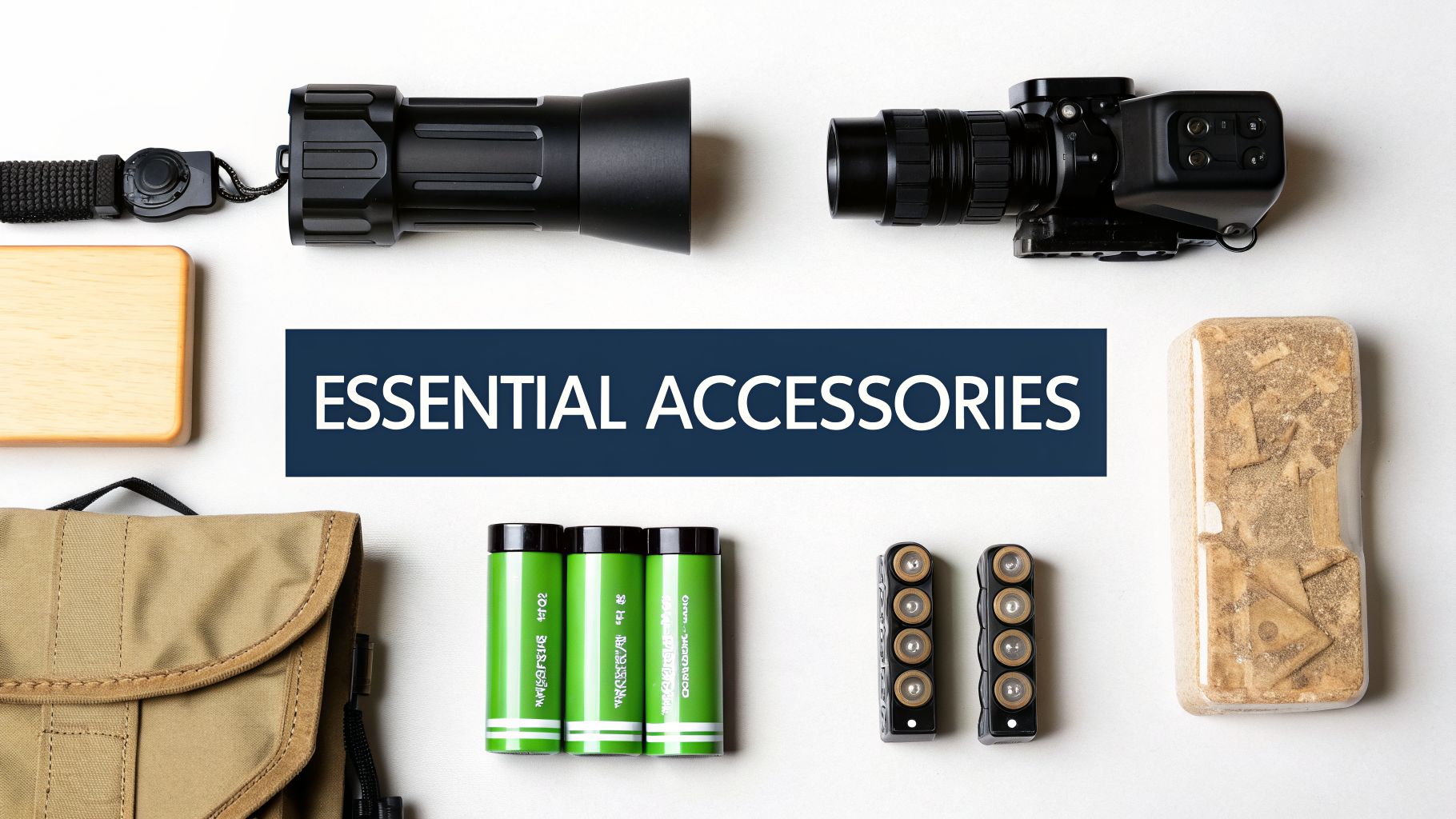
Getting your hands on a great budget night vision scope is a huge win, but your work isn't done just yet. To really get every ounce of performance out of that optic, you’ve got to think about the gear that supports it. It's like buying a high-performance car—you wouldn't cripple it by running on bald, budget tires.
The same logic applies directly to your night vision setup. The right accessories, especially an external IR illuminator and a solid power plan, are what take your optic from just "good enough" to genuinely impressive. These pieces work as a team to stretch your vision, sharpen the image, and make sure your gear never quits on you.
The Power of an External IR Illuminator
Your digital night vision scope almost certainly came with a built-in infrared (IR) illuminator, which is essential. But you should think of that built-in IR as your car's low-beam headlights. It's great for close-up work and moving around in familiar territory. But what about when you need to see what’s way down that dark, empty field?
This is exactly where an external IR illuminator proves its worth. It’s the high-beam, off-road light bar for your scope. A dedicated, powerful illuminator can throw a focused beam of infrared light much farther and wider than any tiny built-in unit can, giving your scope a massive performance boost.
An external illuminator will:
- Extend Identification Range: This is the game-changer. A strong IR beam provides the scope's sensor with more light, turning a distant, fuzzy blob into a target you can clearly identify.
- Improve Image Quality: More IR light means a brighter, cleaner picture with far less of that grainy digital noise. The difference is most dramatic on moonless nights or in dense woods with zero ambient light.
- Provide Flexibility: Many external illuminators let you adjust the beam focus and power levels. This allows you to switch between a wide floodlight for scanning an area and a tight spotlight for zeroing in on something far away.
Think of it like this: your scope's sensor is starved for light. It can get by on a little, but feeding it a ton of light with a quality external IR illuminator lets it perform at its absolute peak. You'll push your budget scope to its absolute limits.
Smart Power Management Strategies
A world-class optic is nothing more than dead weight if the battery dies at the worst possible moment. Digital scopes are power hogs—their bright screens and processors are thirsty, and running the IR illuminator on high drains them even faster. Managing your power supply isn't just a suggestion; it's a critical part of your setup.
When it comes to keeping your scope running, you've got three main battery types to consider, each with its own set of trade-offs.
| Battery Type | Pros | Cons |
|---|---|---|
| CR123A | Great power density, very long shelf life, and works well in the cold. | Can be expensive and harder to find; usually not rechargeable. |
| AA | Cheap, available absolutely everywhere, and plenty of rechargeable options. | Weaker performance in cold weather and shorter runtime than CR123As. |
| Rechargeable Packs | Cost-effective in the long run, designed for your specific optic, often chargeable via USB. | Higher upfront cost and you might need a spare for all-night use. |
For most people using a budget night vision scope, a combination of rechargeable AA batteries and an external USB power bank is the sweet spot. This setup gives you the best mix of cost, convenience, and runtime, allowing you to stay out all night without worrying about the internal batteries dying.
Just keep a decent power bank in your pack, connect it to the scope’s USB port, and you’ll have reliable power for hours on end.
Your Pre-Purchase Checklist and Long-Term Care
So, you’ve done the research and narrowed down your options. Hitting that "buy" button might seem like the finish line, but think of it more as the starting point. Before you commit, a quick final check can mean the difference between a tool you can count on and a serious case of buyer's remorse.
A great deal isn't just about the initial price tag. It's about knowing the scope will work with your gear and that you’ll have someone to call if things go sideways. This is where you separate a good purchase from a great investment.
The Final Go/No-Go Checklist
Take a minute to run through these questions. Answering them honestly will confirm you've covered all your bases and are picking the right scope for what you actually do.
- What’s my absolute maximum engagement distance? Be real with yourself here. Are you trying to identify a coyote at 150 yards, or just keeping an eye on your property line from 50 yards out?
- Is this scope compatible with my firearm? Double-check that recoil rating against your rifle’s caliber. Just as important, make sure the mounting system matches your rail setup.
- Does this fit my operational needs? Think about weight, battery life, and overall toughness. Can it handle a long, cold night in a deer stand or a rainy evening on patrol?
- Who do I call if something goes wrong? A scope without a solid warranty or accessible customer support is a major gamble, no matter how low the price.
This last sanity check helps you avoid expensive mistakes and ensures you’re getting a piece of equipment you can truly depend on.
The Value of Post-Purchase Support
That low price can look mighty appealing, but a true bargain comes with solid support long after you’ve opened the box. This is where a retailer who knows their stuff adds incredible value, turning a simple transaction into a real partnership.
When you invest in night vision, you're not just buying a product; you're buying into a system. That system includes the people who stand behind it. At Superior Tactical, we back our Gen 3 gear with a 10-year warranty, free diagnostic services, and expert support because we believe your equipment should be mission-ready for life.
You just can't put a price on that kind of peace of mind, especially when you're using sophisticated electronics in rough environments. Knowing you have access to in-house repairs and expert advice means your gear spends more time in the field and less time collecting dust on a shelf.
Simple Maintenance for Long-Term Reliability
Keeping your scope running for years to come is pretty straightforward. A few good habits will go a long way in protecting your investment.
First thing's first: always keep the lens cap on during the day. Digital scopes are more forgiving than analog tubes, but pointing them at the sun is still a great way to damage the sensor over time. Just treat it like the lens on a high-end camera.
When you're done for the night, give the body a quick wipe-down with a soft, dry cloth to get rid of any dirt or moisture. For the lenses themselves, stick to a dedicated lens pen or a clean microfiber cloth to avoid scratches that will permanently mess up your image quality. And if you plan on storing the scope for a while, remove the batteries—this simple step prevents nasty corrosion from a leaky battery.
Frequently Asked Questions About Budget Night Vision
Even after you've done your homework, a few key questions always seem to pop up right before you pull the trigger on a new scope. That's perfectly normal. Let's tackle some of the most common ones we hear from folks looking to get into affordable night vision.
Can You Use a Digital Night Vision Scope During the Day?
You bet. In fact, this is one of the biggest selling points of a digital system. Think of it less like a traditional, sensitive night vision tube and more like a specialized digital camera.
Unlike old-school analog scopes (Gen 1-3) that can be fried by a blast of bright light, digital scopes are built for it. They have a "day mode" that functions just like a normal full-color riflescope. This is a huge practical advantage—it means you can head to the range, sight in your rifle in broad daylight, and then hunt with that exact same setup later that night. No swapping optics, no re-zeroing.
How Important Is the IP Waterproof Rating?
For any piece of gear that’s going to see the outdoors, the IP rating is more than just a number on a spec sheet—it’s a promise of durability. When you see a rating like IP67, it tells you exactly how ready that scope is for the real world.
Let's quickly translate that code:
- The first digit (6) is for dust protection. A '6' means the housing is completely sealed. Fine dust, sand, and grit from the field can't work their way inside and foul up the electronics.
- The second digit (7) covers water resistance. A '7' rating certifies that the scope can survive being completely submerged in up to a meter of water for 30 minutes.
So what does that mean for you? It means you don't have to panic and pack it in when a sudden storm rolls through. It means a slip into a creek or an accidental drop in a muddy puddle won't destroy your investment. It’s a direct measure of how tough the scope really is.
Is a Dedicated Scope Better Than a Clip-On?
This is a classic "it depends" scenario, boiling down to a choice between a purpose-built tool and a more flexible system. The right answer really depends on your current rifle setup and what you want to achieve.
A dedicated night vision scope is designed from the ground up for one job. It mounts directly to your rifle as the primary optic, and because it’s a single, solid unit, it tends to be more rugged and hold its zero better. There are simply fewer moving parts and connection points that can shift your point of impact.
On the other hand, a clip-on system attaches in front of your existing daytime scope. The huge plus here is versatility. You get to keep using that high-quality day scope you love and already have zeroed, simply adding night vision when you need it. The trade-off is often a bit more weight, a more complex setup, and the potential for a slight shift in zero.
For most people looking for a reliable, no-fuss solution, a dedicated digital scope is the simplest and most effective path to getting into night hunting.
At Superior Tactical, our goal is to get you outfitted with gear that works for your specific needs. Whether you're set on a dedicated scope or are curious about a more flexible setup, our team is here to help. Check out our full collection of optics and accessories at https://superiortac.com.
