Your Guide to the Ballistic Helmet Level IIIA in 2026
A ballistic helmet level iiia provides crucial head protection against the most common handgun rounds you’re likely to face in a dangerous encounter. It’s a specialized piece of gear, engineered to stop everything from a 9mm to a potent .44 Magnum, all while keeping the weight manageable.
Unpacking Level IIIA Protection
When you see a helmet rated at "Level IIIA," that’s not just marketing speak. It’s a specific performance benchmark established by the National Institute of Justice (NIJ). This designation is a guarantee that the helmet has been tested and proven to stop a specific range of threats, making it the standard for law enforcement, security personnel, and prepared citizens.
But here's the critical part: you have to understand what it doesn't do. A lot of people hear "ballistic" and think it means "bulletproof" against any and all firearms. That's a dangerous assumption. Level IIIA armor is designed specifically for handgun threats, and it is absolutely not rated to stop rifle fire.
What It’s Designed to Stop
The primary job of a Level IIIA ballistic helmet is to defeat the kind of handgun rounds most often encountered in close-quarters and urban settings. It’s been rigorously tested to handle some surprisingly powerful ammunition.
The official NIJ standard certifies Level IIIA protection against these specific rounds:
- .357 SIG Full Metal Jacket (FMJ) rounds, which are known for their high velocity.
- .44 Magnum Semi-Jacketed Hollow Points (SJHP), a notoriously heavy-hitting caliber.
- By extension, it reliably stops nearly all lesser handgun rounds, including the common 9mm, .40 S&W, .45 ACP, and .38 Special.
The technology behind these helmets has come a long way. Most now weigh under 1.5 kilograms, a huge benefit for anyone wearing one for an extended period. This balance of solid protection and low weight is why Level IIIA has become the go-to standard for so many operators.
Let's put the protection capabilities of a Level IIIA helmet into a simple, clear format.
Level IIIA Helmet Protection At a Glance
This table breaks down what a standard NIJ Level IIIA helmet is rated to stop and, just as importantly, what it is not.
| Threat Type | Specific Rounds (Rated to Stop) | Specific Rounds (Not Rated to Stop) |
|---|---|---|
| Handgun | .357 SIG FMJ, .44 Magnum SJHP, 9mm, .40 S&W, .45 ACP | Not Applicable |
| Rifle | Not Applicable | 5.56x45mm, 7.62x39mm, 7.62x51mm / .308 |
As you can see, its strengths are squarely in the handgun category. Understanding this distinction is fundamental to using body armor correctly and safely.
What It Is NOT Designed to Stop
Managing expectations is a matter of life and death when it comes to protective gear. The advanced composite materials in a Level IIIA helmet are simply not thick or dense enough to absorb the massive kinetic energy delivered by a rifle round. This is a non-negotiable fact of physics.
This diagram offers a great visual summary of where a Level IIIA helmet fits in the protection hierarchy.
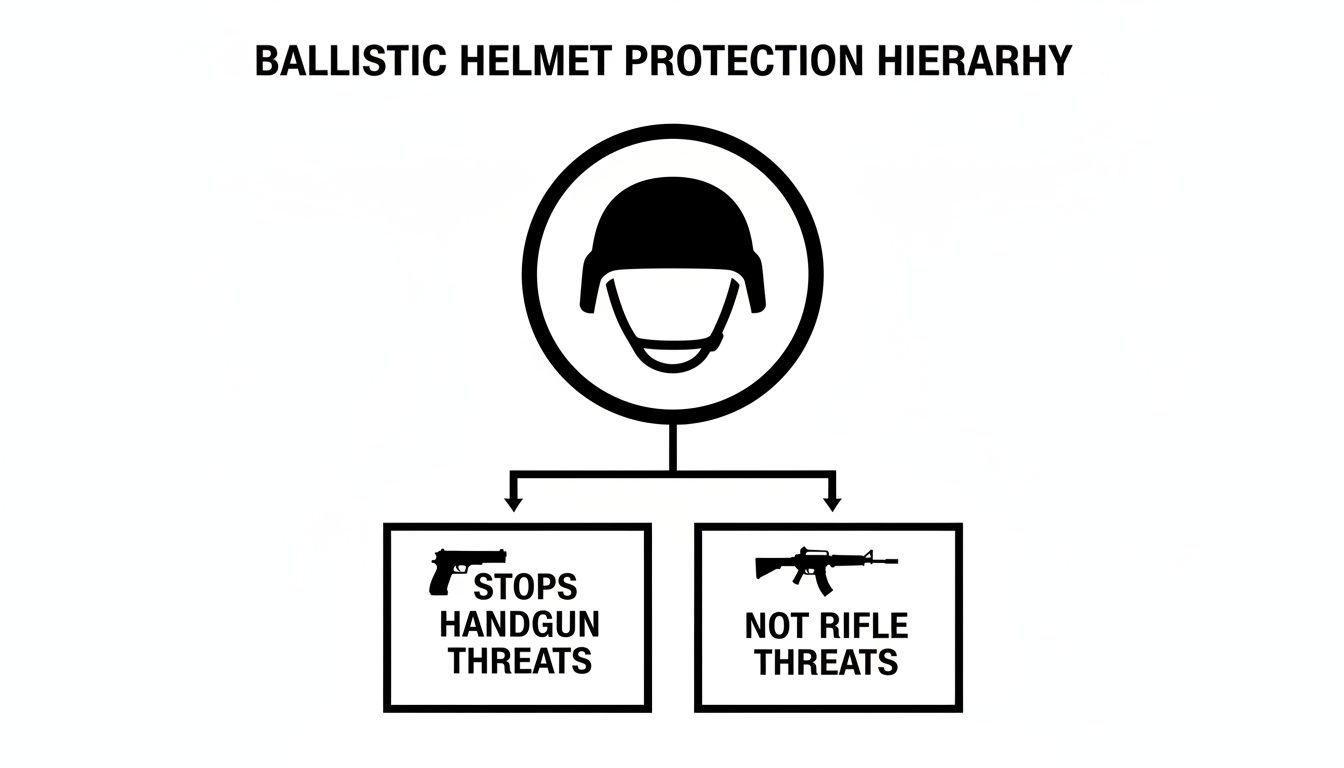
It clearly shows that while the helmet is an excellent defense against handgun threats and fragmentation, it was never intended to stand up to rifle fire. It excels at its job, but you can’t ask it to do a job it wasn’t built for. Of course, not all head protection needs to be ballistic; our guide explains how a tactical bump helmet serves a different but equally important purpose.
To be perfectly clear, a ballistic helmet level iiia will NOT stop common rifle calibers, including:
- 5.56x45mm (from AR-15s)
- 7.62x39mm (from AK-47s)
- 7.62x51mm / .308 Winchester (from battle rifles)
These rounds carry far too much energy and will penetrate a Level IIIA helmet. Always match your protection level to the most likely threat you'll face.
Who Actually Needs a Level IIIA Helmet?
So, who is a Level IIIA ballistic helmet really for? Knowing the technical specs is one thing, but understanding the practical, real-world applications is what will tell you if it’s the right piece of gear for your needs. This isn't just a piece of armor; it's a specialized tool, and its true value shines in the hands of the right user.
For law enforcement officers, from the patrol car to the SWAT van, a Level IIIA helmet is often standard issue for a very good reason. The most common threats they face on the street are from handguns. This helmet provides that critical layer of protection against the calibers they are most likely to run into, buying them precious seconds to react and gain control of a situation.
It all comes down to a smart compromise. The helmet offers solid protection against common handgun rounds and deadly shrapnel without bogging an officer down with so much weight that it causes fatigue during a long standoff or slows them down during a dynamic entry.
The Professional Operator: Law Enforcement and Security
For professionals whose lives depend on their gear, a helmet has to do more than just stop bullets. It needs to work with them. A Level IIIA helmet often serves as the central mounting point for all the other tools an operator needs to be effective.
Think about a SWAT team clearing a dark building. The helmet is the foundation holding their night vision, comms, and lights. In that moment, its ability to integrate that gear is just as vital as its ability to stop a round.
This marriage of protection and function is exactly why security professionals gravitate toward them. Whether you're on a close protection detail for a high-profile client or working in an unstable region overseas, you need headgear that’s light enough to wear all day but tough enough to handle the worst-case scenario. A ballistic helmet level iiia hits that sweet spot, keeping you agile and aware without skimping on essential protection from pistols and fragmentation.
Military and Specialized Units
The military’s heavy investment in this technology says it all. While some missions might call for heavier or lighter protection, the Level IIIA helmet has become a mainstay, especially for urban warfare and counter-terrorism units. The numbers back this up: the military sector is projected to account for 39.5% of a global bulletproof helmet market valued at $1.86 billion by 2026. That market is forecast to hit $2.71 billion by 2033, a clear sign of the growing need to protect personnel from ballistic and blast threats without sacrificing performance. You can dig into more of the data on this expanding market over at Coherent Market Insights.
The Prepared Citizen and Avid Hunter
You don't have to be a professional operator to find a ballistic helmet level iiia incredibly useful. For responsible citizens thinking about home or property defense, a helmet plays a couple of key roles. It provides crucial protection from ricochets and fragments, which are a major, unpredictable danger in the tight confines of a home.
But for many, the real magic is how it turns into a stable, hands-free platform for night vision. Suddenly, it’s not just armor—it’s a powerful tool that gives you unmatched situational awareness when the lights go out.
That same advantage is a game-changer for anyone who hunts at night. A helmet gives you:
- A rock-solid mounting platform: Your night vision or thermal scope stays perfectly still, freeing up your hands for precise scanning and targeting.
- Hands-free movement: You can navigate rough terrain in total darkness with your rifle ready and your hands free to climb or carry other gear.
- Impact protection: It also doubles as a hard hat, protecting your head from the inevitable bumps, scrapes, and falls that happen in the woods after dark.
For hunters and homeowners, the helmet is less about surviving a gunfight and more about gaining a massive tactical advantage. It’s about seeing more, doing more, and staying safe—proving its value is defined not just by what it stops, but by what it allows you to do.
Decoding Helmet Materials: Aramid vs. UHMWPE
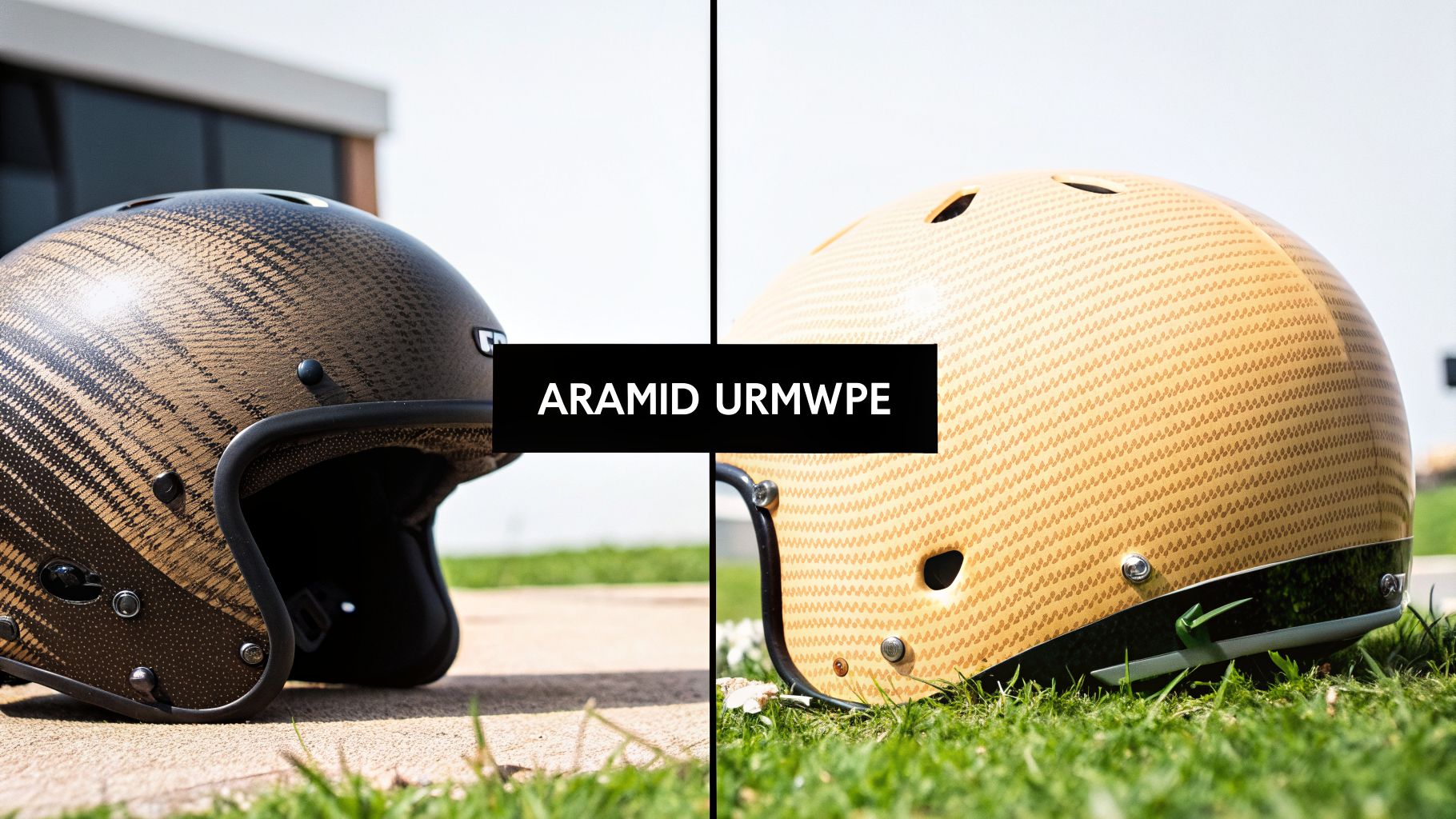
When you pick up a ballistic helmet level iiia, you’re holding a marvel of material science. It’s not just a hard hat; it's a precisely engineered system designed to stop a bullet in its tracks. The protective power comes from one of two incredible composite materials: Aramid fibers or Ultra-High Molecular Weight Polyethylene (UHMWPE).
Knowing what sets these two materials apart is the first step in choosing the right helmet. Each one has a completely different philosophy for defeating a ballistic threat.
The Aramid Method: A High-Tech Catcher's Mitt
Aramid, which most people know by the brand name Kevlar®, functions like a super-strong, dense net. When a bullet hits an Aramid helmet, the tightly woven fibers absorb the impact and "catch" the projectile.
The material is designed to flex just enough to spread that sudden, violent energy across the entire helmet shell. This rapid dispersal is what prevents penetration. It's a battle-proven approach that has been trusted on the front lines for decades.
The UHMWPE Method: Lighter, Harder, and Smarter
UHMWPE, sold under names like Dyneema® or Spectra®, plays the game differently. Instead of just catching the bullet, its goal is to shatter it on impact. The material is incredibly slick and rigid, causing the projectile to deform and break apart as the force is deflected across the shell's surface.
This unique property allows UHMWPE helmets to be significantly lighter while still meeting the same strict NIJ Level IIIA standards. For anyone who wears a helmet for hours on end, that weight savings is a game-changer. You can see how this lightweight philosophy is put into practice with premium gear like the innovative Team Wendy helmet systems.
The choice between Aramid and UHMWPE really boils down to a classic trade-off: Aramid brings a legacy of performance and better heat resistance, while UHMWPE offers a massive advantage in weight savings, which means less fatigue and better mobility.
Both materials deliver exceptional protection, but their unique properties make them suited for different users and environments. Let’s break down how they stack up.
Aramid vs. UHMWPE: The Head-to-Head Comparison
| Feature | Aramid (e.g., Kevlar®) | UHMWPE (e.g., Dyneema®) |
|---|---|---|
| Main Advantage | Time-tested performance and superior resistance to high heat. | Extremely lightweight, boosting comfort and reducing user fatigue. |
| Weight | Heavier than UHMWPE, but still offers manageable all-day wear. | Typically 15-30% lighter than a comparable Aramid helmet. |
| Ballistic Response | Absorbs and "catches" impact energy through fiber delamination. | Shatters the projectile and disperses energy across a rigid surface. |
| Heat Resistance | Excellent stability in high-temperature environments. | Can be sensitive to extreme heat, which may affect long-term integrity. |
| Cost | Generally more affordable, making it a popular and effective option. | Higher price point due to more complex manufacturing processes. |
At the end of the day, there isn't one "best" material—only the best one for your mission. If you anticipate working in extreme heat or if budget is the top priority, an Aramid helmet is an excellent and reliable choice.
But if you need to stay agile and minimize neck strain over long deployments, the investment in a lighter UHMWPE helmet pays for itself in comfort and performance. Understanding how these materials work helps you choose a ballistic helmet level iiia based on sound engineering, not just a spec sheet.
Choosing the Right Fit and Accessories
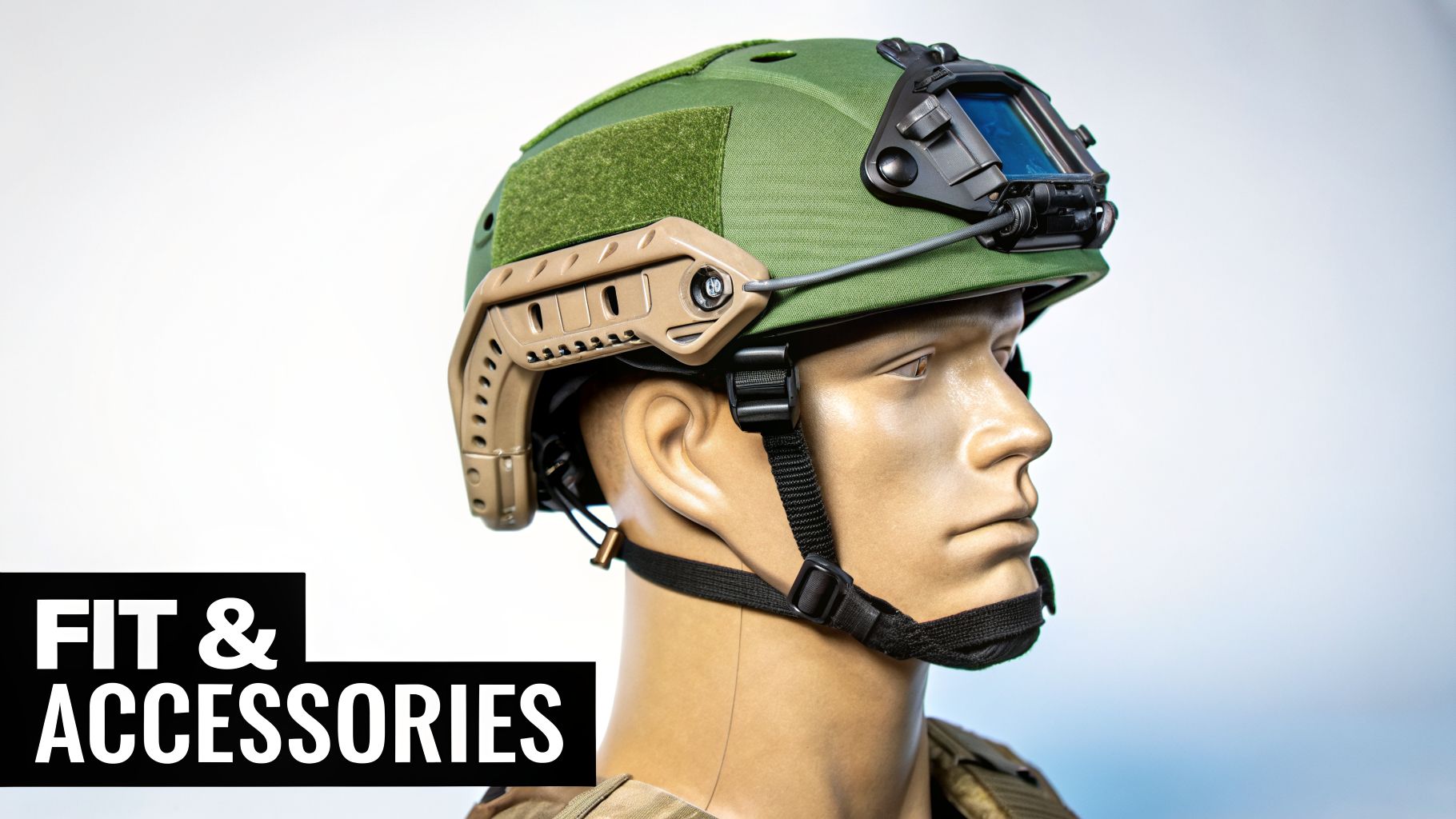
You can have the most advanced ballistic materials in the world, but they're worthless if the helmet doesn't fit properly. A wobbly or uncomfortable helmet isn't just an annoyance; it's a dangerous distraction that can compromise your awareness and your safety. Your ballistic helmet level iiia has to feel like an extension of your own body—stable, comfortable for hours on end, and ready to serve as the command center for your essential gear.
Think of the helmet shell as the armor plating on a tank. The suspension and retention system is the chassis and suspension that connects it all to the crew. If that connection is weak, the entire platform is useless.
Finding Stability with Suspension and Retention Systems
What really makes a helmet comfortable and stable are its guts—the internal suspension system. In the world of modern helmets, this generally boils down to two main approaches: classic pad systems and modern dial liners. Each gets you to a secure fit, just by a different route.
A pad system is all about customization. It uses a set of modular foam pads that you can move around inside the helmet shell, attaching them with Velcro. This lets you get the fit just right, eliminating hot spots and ensuring even pressure all around. It's like having a helmet tailored specifically to the unique shape of your head. It takes some initial tweaking, but the result is a perfectly molded fit.
On the other hand, you have the dial liner system, made famous by brands like Team Wendy and Ops-Core. This design features an adjustable band that wraps around your head, which you can tighten or loosen with a knob on the back. It's as quick and easy as adjusting a baseball cap, which is a massive advantage when you need to gear up fast or make minor adjustments in the field.
So, which is for you?
- Pad Systems: Unbeatable for a truly custom fit, especially if you have an odd-shaped head or struggle with pressure points. They also tend to allow for great airflow.
- Dial Liners: The champion of speed and convenience. The ability to get a rock-solid fit with a quick, one-handed twist is invaluable for dynamic movement.
Ultimately, it's a trade-off between a truly personalized fit and on-the-fly adjustability. A well-configured system of either type will give you the stability you need to run a full loadout without your helmet flopping around.
A helmet that shifts forward and obstructs your vision when you drop into a prone position is a critical failure. Proper fit, achieved through a well-adjusted suspension system, ensures your gear works with you, not against you.
Turning Your Helmet into a Mission Command Center
Today’s ballistic helmet level iiia is much more than a brain bucket; it’s a platform. It's designed from the ground up to integrate the tools you need to own the night and communicate effectively, and this is all made possible by its shroud and rails.
The shroud is that mount on the front of your helmet. Its entire purpose is to provide a solid base for your night vision device (NVD). Skimping here is a bad idea. A quality shroud, like a Wilcox L4, gives you a dependable, wobble-free interface so your expensive optics stay put. A flimsy one is just asking for trouble.
The accessory rails, which are usually based on the popular ARC (Accessory Rail Connector) standard, run along the helmet's sides. These are the docking stations for the rest of your kit.
Common gear you'll see mounted on rails includes:
- Headsets: For clear, integrated comms with the rest of your team.
- Illuminators: IR lights that work like a flashlight for your NVDs.
- Strobes: For friendly identification (IFF) or emergency signaling.
- Cameras: To record footage for evidence or after-action reviews.
When you're choosing a helmet, you have to think of it as the foundation for your entire headborne system. Make sure the rails and shroud are built to handle the gear you actually plan to use. By focusing on a great fit and solid accessory integration, you're not just buying armor—you're investing in a system that makes you more effective. Our complete selection of ballistic helmet accessories has everything you need to build out your ideal setup.
Understanding Ballistic Testing and NIJ Standards
That "NIJ IIIA" label on your helmet is more than just a marketing term. It's a promise—a guarantee backed by a grueling, highly specific testing process. When you see that rating, you know the helmet has been through the wringer in a lab to prove it can stop serious handgun threats. It’s what separates a piece of life-saving equipment from a simple plastic shell.
Think of it less like a simple pass/fail test and more like a car crash safety rating. The testers aren't just looking to see if the bullet gets through. They are meticulously measuring what happens to the helmet, and by extension your head, at the violent moment of impact.
The NIJ 0106.01 Standard
The rulebook for this process is the National Institute of Justice (NIJ) Standard 0106.01. This document lays out the exact procedure for evaluating a ballistic helmet level iiia. To earn the certification, a helmet has to take multiple hits from specific ammunition at very high speeds.
For a Level IIIA rating, the helmet must defeat two key threats:
- A .357 SIG Full Metal Jacket (FMJ) bullet traveling at around 1,470 feet per second.
- A powerful .44 Magnum Semi-Jacketed Hollow Point (SJHP) moving at roughly 1,400 feet per second.
This isn't just a matter of shooting it once in the front. The tests involve multiple shots to different areas—the front, back, sides, and crown—at various angles to hunt for any potential weak spots. The helmet only passes if it stops every single round from penetrating.
More Than Just Stopping a Bullet
Here’s something many people don't realize: stopping the bullet is only half the job. All the incredible energy from that impact has to go somewhere, and it gets transferred directly into the helmet. This causes the material to bulge inward, a dangerous effect called backface deformation (BFD).
If the backface deformation is too great, the helmet itself can cause a catastrophic injury, even without the bullet getting through. The blunt force trauma alone can be fatal. This is why the NIJ is so strict about measuring BFD.
During testing, the helmet is fitted onto a head-shaped block of clay. After a shot, technicians carefully measure the depth of the dent pushed into the clay. If that indentation is deeper than the NIJ's limit—a measurement carefully chosen to represent a survivable level of trauma—the helmet fails. Period. It's a critical part of the test that ensures the helmet doesn't just block a round but also manages the impact energy well enough to keep you alive.
Why NIJ Certification Is a Non-Negotiable
In the world of personal protection, consistency is everything. The NIJ standard provides a reliable, repeatable benchmark that every manufacturer has to meet, which lets you compare different helmets with genuine confidence. While some agencies like the DEA or military special operations have their own unique testing standards, the NIJ’s is the most recognized and trusted for law enforcement and civilian use.
Ultimately, choosing a helmet certified to NIJ standards from a reputable brand is the only way to be certain you're getting a product with proven, life-saving performance. It's the difference between buying verified protection and just crossing your fingers.
How to Maintain Your Ballistic Helmet
A ballistic helmet level iiia is a serious investment in your personal safety, but it's not a "set it and forget it" piece of gear. Think of it like a firearm or any other piece of life-saving equipment—it needs regular attention to perform reliably when everything is on the line.
Thankfully, taking care of your helmet isn't difficult. A little routine maintenance goes a long way in preserving the integrity of its advanced materials and maximizing its lifespan. It’s the simple stuff that prevents catastrophic failure, just like changing the oil in your truck.
Performing Routine Inspections
First things first, you need to get in the habit of giving your helmet a good once-over. Do it regularly, and always make a point to check it thoroughly after it’s been dropped or taken a hard knock.
You’re looking for any sign of damage to the outer shell. Get it under a good light and check for:
- Cracks or Fractures: Pay close attention. Even a hairline fracture is a serious problem that can compromise the helmet’s entire structure.
- Dents or Gouges: Deep impacts can crush and weaken the ballistic fibers hiding just beneath the surface.
- Delamination: Look for any peeling, bubbling, or separation of the composite layers. The edges of the helmet are a common spot for this to start.
If you spot any of these issues, the helmet’s integrity is questionable at best. It’s a major red flag, and that helmet should be retired from duty immediately. Don't risk it.
After checking the shell, inspect the guts of the helmet—the suspension system, pads, and chin strap. Make sure all the parts are there, look for any rips or tears in the webbing, and confirm that adjustment dials or buckles are working smoothly.
Cleaning and Proper Storage
Keeping your helmet clean isn't just about avoiding grime; it's about protecting the materials from breaking down. Your pads and liner soak up sweat, dirt, and oils, which can degrade them over time. Most modern pads are easy to remove—just hand-wash them with some mild soap and water, let them air-dry completely, and pop them back in.
Storage is just as important as cleaning. Never leave your helmet baking in a car trunk on a summer day or sitting out in direct sunlight. UV radiation and extreme heat are the mortal enemies of ballistic fibers.
The right way to store your helmet is in a cool, dry place, shielded from sunlight and harsh chemicals. A dedicated helmet bag is a smart purchase; it protects the helmet from getting banged up or scratched during transport and keeps it ready to go.
Understanding Helmet Service Life
Every ballistic helmet has an expiration date, and it’s there for a reason. Manufacturers typically state a service life of 5-10 years for the shell. This isn’t a marketing ploy to get you to buy a new one. It's based on the simple fact that the Aramid or UHMWPE fibers slowly and naturally degrade over time.
Even a helmet that looks brand new on the outside will lose some of its stopping power as it ages. Adhering to the manufacturer's recommended service life is a non-negotiable part of responsible ownership. Once it hits that expiration date, retire it. It’s the only way to be certain your gear will do its job.
Answering Your Top Questions About Level IIIA Helmets
Once you've gotten your head around the technical specs, a few practical questions always seem to pop up. It's completely normal. Let's tackle some of the most common ones we hear from people just like you, so you can move forward with total confidence.
Are Level IIIA Helmets Legal for Civilians?
Let's get the big one out of the way first: Yes, in the United States, it is generally legal for a law-abiding civilian to purchase and own a ballistic helmet level iiia and other body armor. The key federal restriction is that you cannot be a convicted felon.
That said, a few states have their own quirks and specific regulations. It’s always your responsibility to know the laws where you live. A quick check of your state and local statutes is a smart final step before you click "buy."
Owning gear to protect yourself is a right for most citizens. But being a responsible owner means knowing the specific rules in your area. This way, you're covered without accidentally stepping over a legal line.
Can I Use a Ballistic Helmet for Airsoft or Paintball?
You could, but it would be like driving a tank to the grocery store—total overkill and not very comfortable. A ballistic helmet level iiia is built to stop bullets, which makes it much heavier and hotter than a simple "bump" helmet.
Those non-ballistic bump helmets are designed specifically for things like airsoft. They offer great protection from trips, falls, and impacts while being significantly lighter and more breathable, which makes a huge difference when you're running around all day.
How Much Should I Expect to Pay?
The price tag on a Level IIIA helmet really depends on what it’s made of, the cut, and the name behind it. You can find a solid, certified Aramid helmet for around $400.
If you're looking for the lightest possible option with all the bells and whistles, a high-end UHMWPE helmet from a premium brand can push past $1,500. It all comes down to balancing what you need with what you want to spend.
At Superior Tactical LLC, our job is to stock gear that's been proven to perform when it counts. We've hand-picked a range of helmets and accessories for every need and budget. Take a look at our collection and find the right setup for your mission. Learn more at https://superiortac.com.
