
Auto Focus Binoculars: How auto focus binoculars Work and How to Choose
Let's be honest, the term "auto focus binoculars" is a bit of a misnomer. It probably brings to mind tiny motors and complex sensors, like what you’d find in a high-end camera lens. But for most of the rugged, reliable field optics we're talking about, the reality is far simpler and, frankly, more dependable.
What Auto Focus Really Means for Binoculars
Right out of the gate, let’s clear up this common point of confusion. The vast majority of binoculars marketed as "auto focus" don't have any electronics at all. They operate on a clever, robust optical principle more accurately called focus-free or permanent focus.
So, how does it work? These binoculars are built without any external focus wheel. Instead, they are permanently focused at the factory for everything beyond a certain distance—usually from about 40-50 feet out to the horizon.
Think of it this way: when you glance out a window to look at a distant mountain, you don't manually adjust your eyeballs. Your eyes’ lenses do that work for you, naturally and instantly. Focus-free binoculars are designed to take advantage of that same incredible ability. The optics get the image sharp, and your own eyes handle the final, split-second fine-tuning.
This elegant solution offers some serious advantages, especially in tactical, hunting, or law enforcement scenarios where every second counts.
- Instant Target Acquisition: There's zero delay. You raise the binos, and the image is immediately clear. This is an absolute game-changer when you're trying to track a moving subject or react to a situation that's unfolding fast.
- Idiot-Proof Simplicity: No focus wheel means nothing to fumble with under stress. It's a grab-and-go system that anyone on a team can use effectively, regardless of their experience with optics.
- Built Like a Tank: Fewer moving parts means fewer things that can break. By eliminating the external focusing mechanism, these binoculars are inherently tougher and more resistant to the bumps, drops, and rough weather that are just part of the job.
The whole point of a focus-free design is to remove a failure point and a time-wasting step. By presetting the focus for distance, the optic becomes a true extension of your vision, letting your eyes do what they do best.
This "always ready" performance is what really defines this category of binoculars. It’s a purely mechanical solution that delivers instant clarity and rock-solid reliability when you can't afford anything less. With that foundation set, let's see how this approach stacks up against more traditional focusing systems.
How Different Binocular Focusing Systems Compare
Now that we’ve pulled back the curtain on "auto focus" being a focus-free mechanical design, let's put it in the ring with the other two heavyweights: the classic Center Focus and the tough-as-nails Individual Focus. Each design has its own turf, built for specific missions and environments. Picking the right one is all about matching the tool to the job.
The Three Main Contenders
Most people are familiar with Center Focus binoculars. You know the type—they have that big wheel right in the middle. A quick turn adjusts both barrels at the same time. It’s a beautifully simple and fast system, perfect when you're tracking something that’s constantly changing its distance from you, like a buck moving through timber.
Then you have Individual Focus. You don't see this as often on consumer models, but it's standard issue for most military and marine optics. Here, you set the focus for each eye separately. The major payoff? These things are built like a tank. With fewer external moving parts, they have far better weatherproofing and can take a serious beating.
And that brings us back to Focus-Free, the system that powers most so-called auto focus binos. As we covered, they’re permanently set to keep everything sharp from a medium distance (say, 40 feet) all the way to the horizon. No knobs, no wheels. You just lift them to your eyes, and your brain does the rest.
This concept map breaks down exactly how your eyes and brain team up to do the heavy lifting, giving you that crisp, clear image instantly.
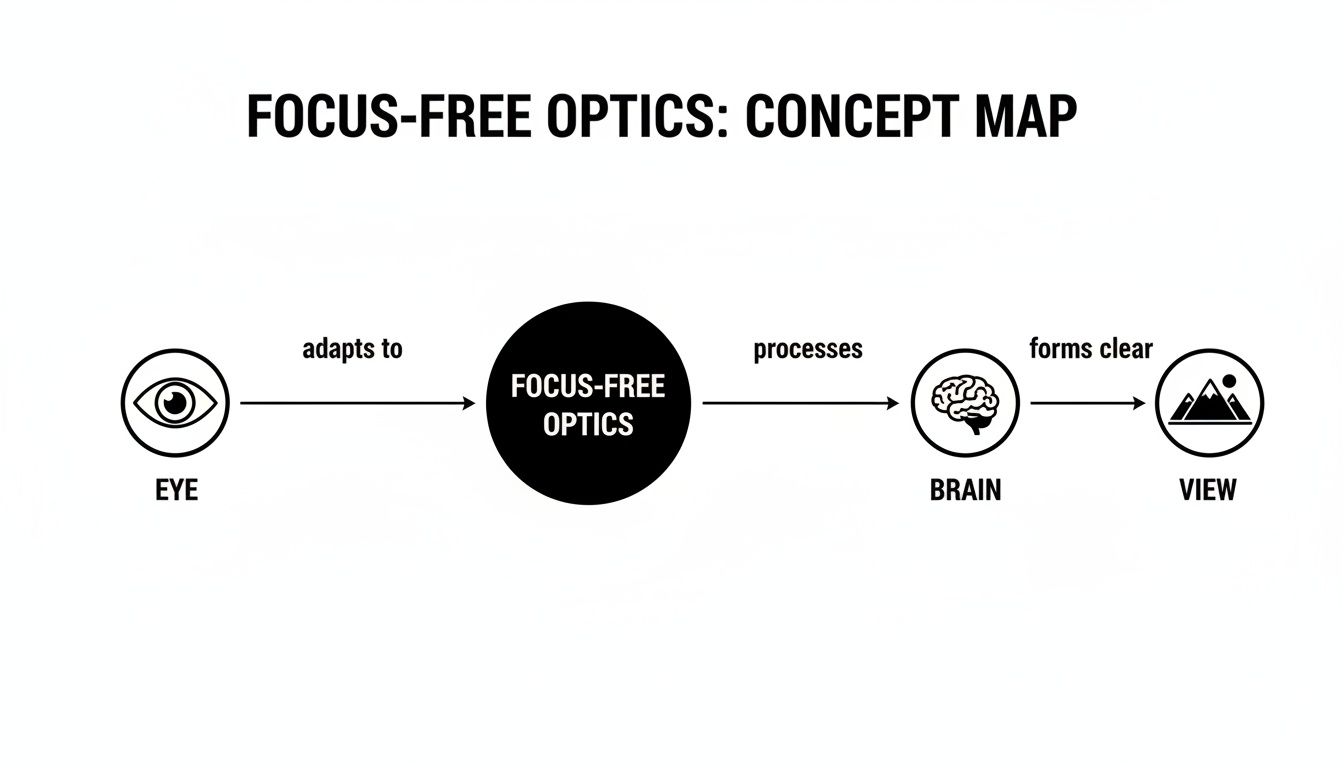
As you can see, the genius of the system is its simplicity. It outsources the work from the gear to your own natural abilities.
Binocular Focus Systems Compared
To really nail down which system is right for you, it helps to see their strengths and weaknesses laid out side-by-side. One is for precision, one is for pure durability, and the third is built for speed.
A law enforcement officer running surveillance from a vehicle will appreciate the grab-and-go speed of a focus-free pair. But a hunter trying to judge a trophy bull at 300 yards versus one at 800 yards is going to need the fine-tuned control of a center focus wheel.
This table cuts right to the chase.
| Focus System | How It Works | Best Use Case | Pros | Cons |
|---|---|---|---|---|
| Center Focus | A single wheel adjusts both barrels together for variable distances. | General purpose, birdwatching, hunting in varied terrain. | Fast for changing distances, precise close-up focus. | More moving parts, less durable, can lose waterproofing over time. |
| Individual Focus | Each eyepiece is focused independently and then set. | Military, marine, and astronomical use where targets are at a distance. | Extremely rugged, excellent weather sealing, holds focus setting. | Very slow to adjust for targets at different distances. |
| Focus-Free | Permanently focused for medium-to-long distances. | Sporting events, tactical surveillance, open-field hunting. | Instant focus, simple to use, highly durable with no external parts. | Cannot focus on close objects, can cause eye strain with prolonged use. |
The demand for optics that deliver instant clarity is growing. In fact, the global binoculars market jumped by USD 140.93 million between 2021 and 2026, largely driven by users in hunting, law enforcement, and outdoor recreation who can't afford to waste a second. This need for speed in dynamic situations mirrors the demands of night vision users. If you're curious how these principles apply after sundown, check out our practical guide to binoculars for night vision.
The key takeaway is simple: there is no single "best" focusing system. The superior choice is the one that minimizes friction and maximizes efficiency for your specific operational context—be it precision, durability, or speed.
In the end, your mission dictates the gear. For fast-paced scenarios where targets pop up at a distance without warning, the speed of auto focus is tough to beat. For methodical observation across a wide depth of field, center focus is still the gold standard. And for absolute reliability in the worst conditions imaginable, the pros stick with individual focus.
When Auto Focus is the Right Call for Tactical Ops
In the field, success often boils down to split-second decisions. Whether you're scanning a ridgeline, keeping eyes on a perimeter, or trying to pick a target out of a crowd, how fast you acquire and ID your subject is everything. This is exactly the kind of high-stakes environment where so-called "auto focus" binoculars really earn their keep.
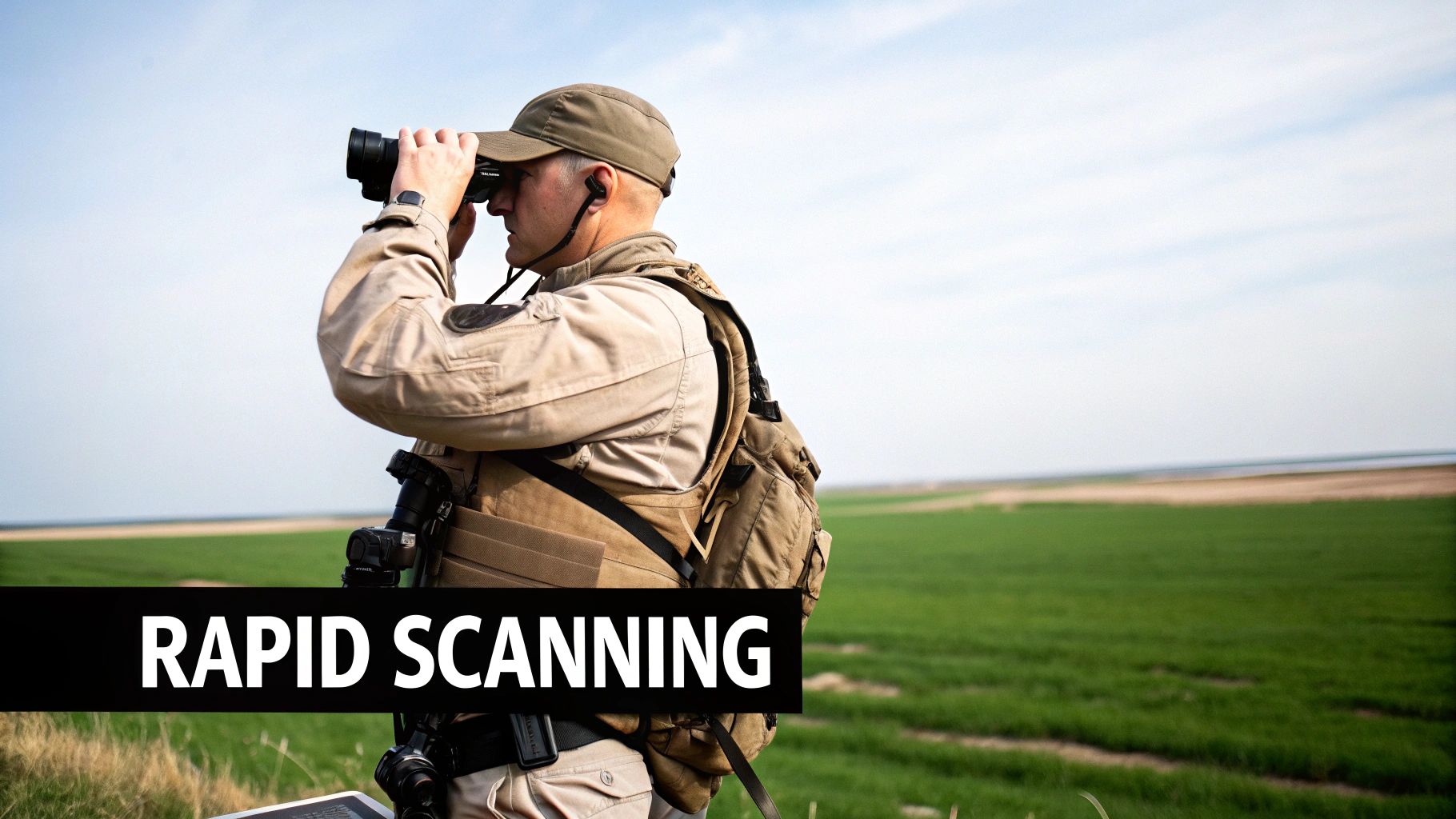
The number one advantage is pure, unadulterated speed. Think about a traditional center-focus system. There's always a slight delay. You bring the binos up, find your target, then your fingers have to find and dial that focus wheel. Even for a seasoned operator, that process costs you time—time you may not have.
Focus-free designs completely remove that step. The instant the binoculars hit your eyes, the image is sharp. That immediate clarity gives you a massive tactical leg up, speeding up threat identification and boosting your overall situational awareness. You're spending less brainpower fussing with gear and more on reading the situation.
Ideal Scenarios for Grab-and-Go Glassing
The "always-on" clarity of these optics makes them a perfect match for dynamic situations where targets pop up at a distance without any warning. Another huge plus is their simple, rugged construction. With no external focus wheel, there are fewer moving parts to fail and fewer ways for water, dust, and grime to get inside. That inherent toughness is a godsend for gear that gets used hard.
Think about these real-world applications:
- Open-Country Hunting: When you're glassing wide-open terrain for game, you’re constantly raising and lowering your optics. A focus-free pair lets you scan different distances across a field or down a canyon without fiddling with the focus, which cuts down on fatigue and lets you spot movement much faster.
- Law Enforcement Surveillance: An officer monitoring a large, chaotic area like a protest or a packed stadium needs to scan faces quickly. The grab-and-go nature means they can acquire and identify a person of interest instantly, no fumbling required.
- Maritime Operations: Out on the water, everything is moving—you, your vessel, and your target. Getting an immediate, stable view without having to chase focus is invaluable for spotting other boats, channel markers, or hazards.
The rule of thumb is simple: in any scenario where your targets are consistently beyond 40-50 feet and speed is a higher priority than tack-sharp focus on nearby objects, an auto focus system gives you a distinct operational edge.
This blend of speed and reliability hasn't gone unnoticed. The optics world is constantly evolving, with the digital binocular segment alone projected to grow at a 7.6% CAGR from 2025-2032. As manufacturers integrate this tech with night vision and other sensors, it directly answers the call from law enforcement and hunters who need gear that just works, no matter the conditions. You can dig into the numbers yourself in this comprehensive binoculars market report.
Knowing the Tactical Trade-Offs
That said, these binoculars aren't a silver bullet. You have to understand the trade-offs that come with the "always sharp" design. There are two big limitations every operator needs to be aware of.
First, you give up all close-focus capability. Because the optic is permanently set for distance viewing, you physically cannot get a sharp image on anything inside that minimum range, which is usually around 40 feet. If your mission requires you to identify details on a nearby object or person, a center-focus model is your only real option.
The second thing to consider is potential eye strain. Your eyes are doing the final bit of fine-tuning, and if you’re glassing for hours on end from a static OP, that can lead to fatigue. For a long, static surveillance mission, an individual or center-focus system that you can dial in perfectly and lock might be a more comfortable choice.
In the end, choosing auto focus binoculars is a tactical decision. It’s about matching the tool to the mission. They absolutely excel in fast-paced scenarios where durability and instant target acquisition are the name of the game. But for missions that demand close-up detail or long, comfortable observation, a traditional focusing system is probably the smarter play.
Your Tactical Checklist for Choosing the Right Pair
Picking the right pair of auto focus binoculars isn't just about getting the sharpest image. It's about matching the tool to the mission. The numbers stamped on a set of optics can look like a foreign language, but they each tell a critical part of the story.
This checklist will help you cut through the technical jargon and translate those specs into real-world tactical advantages. It's about looking past the marketing hype to find a pair of binos that won't let you down when the stakes are high.
Decoding the Numbers: Magnification and Objective Lens
The first numbers you’ll always see on a pair of binoculars—like 7×50 or 10×42—are the most important. They’re a snapshot of the optic's power and its ability to gather light.
- The first number is the magnification. So, a 7x binocular makes an object appear seven times closer than it does to your naked eye. Simple enough.
- The second number is the objective lens diameter in millimeters. This is the big lens at the front, and its size determines how much light the binos can suck in.
You'll often hear guys debating between 7×50 vs. 10×42. The 7×50 setup, a classic for marine use, gives you a wider field of view and a more stable image, which is great when you're on the move. Plus, those big 50mm lenses are fantastic in low light. On the flip side, a 10×42 pair gets you "closer" to the target but has a narrower view and is tougher to hold steady.
Exit Pupil: The Key to Low-Light Performance
A big objective lens is great, but the exit pupil is what truly defines performance when the sun goes down. If you hold the binoculars away from your face and look into the eyepieces, the exit pupil is that little circle of light you see.
The math is easy: just divide the objective lens diameter by the magnification. For a 7×50 pair, the exit pupil is 7.1mm (50 ÷ 7). For a 10×42 pair, it's just 4.2mm (42 ÷ 10).
So why does that number matter so much? In the dark, a healthy human pupil dilates to about 5-7mm. If your bino's exit pupil is smaller than your eye's pupil, you're starving your eye of light. If it matches or exceeds it, you're getting every bit of available light, making the image at dawn and dusk dramatically brighter.
A binocular with a 7mm exit pupil delivers nearly 2.5 times more light to your eye than one with a 4.2mm exit pupil. This isn't a small difference; it's the operational advantage that can help you identify a threat in the twilight when others can't see a thing.
Essential Comfort and Awareness Specs
Beyond the main numbers, a few other specs will make or break your experience during long hours of observation. Getting these wrong leads to eye strain, headaches, and a serious drop in situational awareness.
Eye Relief
This is the sweet spot—the perfect distance from the eyepiece to your eye where you can see the entire picture, edge to edge. If you wear glasses or ballistic eye pro, this is non-negotiable. Look for "long eye relief" of at least 16mm so you don't have to jam the eyepieces into your glasses.
Field of View (FOV)
Usually written as a width in feet at 1,000 yards (like "390 ft @ 1000 yds"), FOV tells you how much landscape you can see at once. A wide FOV is critical for scanning a field or tracking a moving target. It lets you find what you're looking for faster and helps you keep track of what's happening around you. Our comprehensive tactical gear checklist details other essentials that pair well with high-quality optics.
Ruggedization: Build Quality That Survives the Field
In our world, gear failure is not an option. The physical construction of your binoculars is every bit as important as the glass inside. Here's what to look for to make sure your investment can take a beating.
- Weatherproofing: It needs to be waterproof and fog-proof. Period. This is done with O-ring seals to keep water out and a nitrogen or argon gas purge to prevent the lenses from fogging up internally when the temperature plummets.
- Chassis Material: The body is usually aluminum, polycarbonate, or magnesium. Magnesium gives you the best strength-to-weight ratio (but you'll pay for it), while polycarbonate is lighter and still very tough.
- Rubber Armor: That grippy rubber coating isn't just for looks. It gives you a solid hold, even with gloves or in the rain, and adds a crucial layer of shock absorption for inevitable bumps and drops.
Demand for high-performance optics, especially those with auto focus and solid mounting options, is surging. The market is projected to hit USD 6.38 billion by 2030, a testament to how much professionals in tactical, hunting, and even astronomy fields value gear that is both efficient and tough as nails. This growth confirms what we already know: investing in durable, reliable optics is a top priority for any serious operator. To see the data yourself, you can explore the full report from Research and Markets.
Keeping Your Optics Mission-Ready
Your optics are a lifeline, and you need them to perform without fail. Keeping your auto-focus binoculars in top shape isn't complicated, but it's absolutely critical for the clarity and reliability you count on, whether you're tracking game or on a tactical deployment. Neglect is the quickest way to turn a precision instrument into a paperweight.
A little routine care goes a long way. The single most important thing you can do is protect the lenses—scratches, smudges, and dirt are the usual suspects when image quality starts to suffer. Let's walk through how to do it right.
The Right Way to Clean Your Lenses
First rule: never, ever use your shirt. It seems harmless, but even tiny dust particles on the fabric act like sandpaper, grinding away at the delicate coatings that cut glare and maximize light. Once those coatings are damaged, your low-light performance is shot.
Here's a simple process you can trust in the field:
- Clear the Debris: Before you touch the lens, get rid of any loose grit. A blast of compressed air or a gentle sweep with a soft lens brush will do the trick. Skipping this step is how scratches happen.
- Use the Right Solution: Lightly mist a proper lens cleaning solution onto a cloth or use a dedicated lens wipe. Never spray solution directly on the lens—you don't want excess liquid seeping into the housing.
- Wipe Smart: With a clean microfiber cloth, wipe from the center of the lens outward in a gentle circular motion. This pulls any remaining grime away from the middle of your view.
A word of warning: stay away from household cleaners. Windex, rubbing alcohol, and other harsh chemicals will strip the anti-reflective coatings right off your lenses, permanently ruining them. Always use a solution designed specifically for coated optics.
Smart Storage and Pre-Mission Checks
How you put your binoculars away matters just as much as how you clean them. After you're back from the field, let them air dry completely before putting the lens caps on. Storing them wet is an invitation for internal fogging or even mold.
Before you head out, do a quick "collimation check" to make sure the barrels are still aligned. Just focus on something distant and defined, like a telephone pole. Cover one eye, then switch to the other. The image shouldn't jump or split. If you're seeing double, they're out of alignment and need to be serviced by a pro.
This kind of regular upkeep is fundamental to keeping your gear ready for action, no different than maintaining more complex equipment. For a deeper dive into this principle, check out our guide on the maintenance and care of a PVS-14 night vision monocular.
So, Are Auto Focus Binoculars Right for You?
Choosing the right pair of binos always boils down to one thing: an honest look at what you’ll be doing with them. We've broken down how auto focus binoculars work, and their "focus-free" design is all about speed and simplicity. The big win is that you never have to touch a focus wheel for anything far away.
That instant clarity makes them a phenomenal tool for specific, fast-paced scenarios. Think about scanning for mule deer across a wide-open basin, tracking a moving vehicle from an overwatch position, or trying to spot a boat on the horizon. In those moments, you just need to get eyes on target—now. These binos cut out the fumbling.
When to Stick with Tradition
But there’s no free lunch. That speed comes at a price, and the trade-off is close-range performance. Most auto focus models simply can't resolve a clear image on anything closer than about 40 feet.
This is a deal-breaker for a lot of folks. For instance, these binos wouldn't work for:
- Birdwatchers: Identifying a warbler in a bush 20 feet away is impossible without a center focus wheel. You need that fine-tuning capability.
- LE/SWAT Teams: Clearing a building or ID'ing a threat across the street demands crystal-clear focus at close to medium ranges, something a focus-free design just can't deliver.
- Hunters in Thick Timber: While great for glassing open country, a hunter trying to pick out a tine in the brush at 50 yards needs the precision of a manual focus system.
Here's the bottom line: Auto focus binoculars are masters of one specific job—delivering instant, good-enough clarity on distant targets. They sacrifice the ability to focus up close for unmatched speed and rugged simplicity.
If your world demands grab-and-go speed for long-distance observation, an auto focus system is a powerful ally. But if your mission profile includes detailed work at varying ranges, a traditional center-focus binocular is still the top dog.
Common Questions, Answered
Even after getting the basics down, you probably still have a few questions rattling around. Let's tackle some of the most common ones we hear from operators and hunters in the field.
Do Auto Focus Binoculars Work in The Dark?
Not by themselves, no. Standard focus-free binoculars still need some ambient light for your eyes to work with, just like any other conventional optic. In total darkness, they won't see a thing.
However, they pair exceptionally well with night vision gear. You can, for example, run a PVS-14 monocular behind one of the eyepieces. The focus-free design actually becomes a huge advantage here, since you only have to worry about focusing the NVG, not fiddling with two separate focus controls. It streamlines the whole setup.
As for the rare electronic auto-focus models, they would need an active infrared (IR) illuminator to function in zero-light conditions.
Can I Use Auto Focus Binoculars with Glasses?
Absolutely, but you have to pay close attention to one key spec: eye relief. This is the sweet spot—the distance from the eyepiece lens to your eye where you can see the full picture.
For anyone wearing prescription glasses or protective eyewear, "long eye relief" isn't a luxury, it's a necessity. We recommend looking for a minimum of 16mm to avoid that frustrating "looking through a keyhole" effect.
If the eye relief is too short, the edges of your view will get cut off, shrinking your field of view and compromising situational awareness. Always check this number before pulling the trigger on a purchase.
Are They Better Than Image Stabilized Binoculars?
That’s like asking if a hammer is better than a screwdriver. They’re different tools for different jobs.
Auto focus binoculars are all about speed. They're designed so you can snap them to your eyes and immediately identify what's downrange without wasting precious seconds on a focus wheel. Think rapid target acquisition.
Image-stabilized (IS) binoculars, on the other hand, are all about clarity at high power. Their job is to cancel out the shakes and vibrations that turn a 12x or higher magnification view into a blurry mess. Their whole purpose is stability.
While a few high-end digital models try to do both, they tend to be heavy, complex, and expensive. For most tactical and hunting work at common 7x or 10x magnifications, a simple and rugged focus-free system offers far more practical benefits.
At Superior Tactical LLC, we live and breathe mission-ready optics. From battle-proven night vision to dependable binoculars, we’ve got the gear you need to get the job done. Explore our collection of high-performance tactical optics and find your next advantage.
