Your Guide to Finding an Affordable Night Vision Scope
Let's be honest, the term "affordable night vision scope" can feel like a contradiction. For years, the idea of owning quality night vision meant shelling out thousands for military-grade equipment. That world is long gone.
Thanks to incredible advancements in digital imaging, what was once the exclusive domain of special forces is now a realistic option for hunters, homeowners, and tactical enthusiasts. This guide is here to cut through the marketing fluff and show you how to find real value in a crowded market.
Finding Quality Night Vision Without Breaking the Bank
Diving into the night vision world for the first time can be daunting. It’s a sea of technical jargon, confusing "generations," and price tags that can make your eyes water. But here’s the good news: the landscape has completely shifted. The goal isn't to spend a fortune; it's to make a smart, informed purchase that actually fits what you need to do.
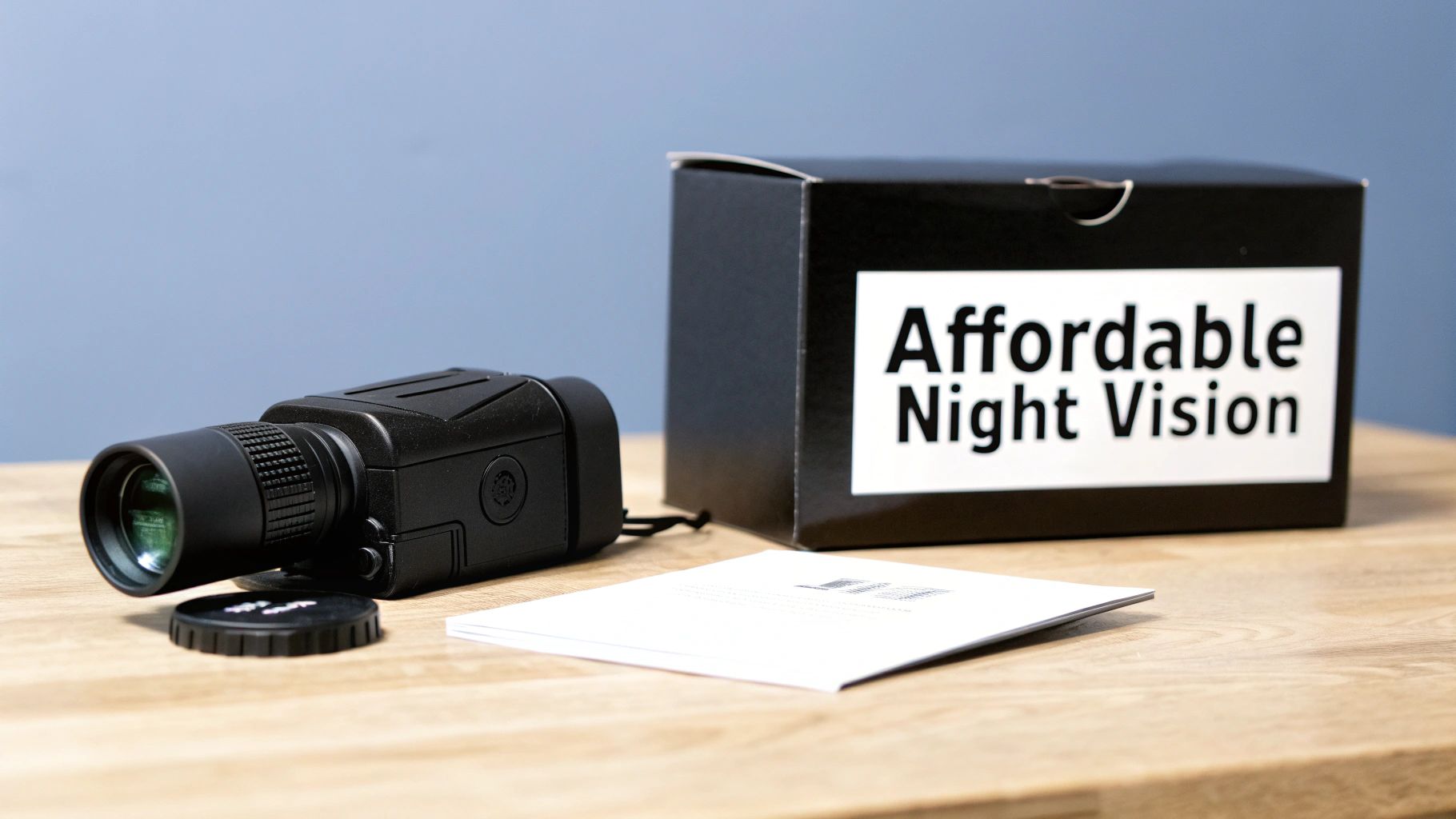
The market for this gear is absolutely booming. It's projected to grow from USD 7.93 billion in 2025 to a massive USD 16.94 billion by 2032. That explosion isn't just from military contracts; it's driven by huge demand from regular folks—especially hunters and law enforcement—who need reliable performance without the government-level budget.
Our mission is to arm you with the knowledge to pick a scope that punches well above its weight class. We'll focus on the critical choices you’ll need to make, such as:
- Technology Choice: Do you go with a modern digital sensor or a traditional image intensifier tube? We'll break down the pros and cons of each.
- Performance Metrics: Why do resolution and detection range matter more than almost anything else for identifying targets clearly?
- Essential Accessories: You'll quickly learn why a good IR illuminator—whether built-in or external—is non-negotiable when the lights go out completely.
An "affordable" scope isn’t just the one with the lowest price. It’s the one that delivers the absolute best performance-per-dollar for your specific job, whether that’s clearing a field, tracking a hog, or keeping an eye on your property line.
Before we get into the nitty-gritty, this table provides a quick overview of what you'll find in the budget-friendly night vision space.
Affordable Night Vision At a Glance
| Night Vision Type | Typical Price Range | Best For |
|---|---|---|
| Digital Scopes | $300 – $1,200 | Hunting, property security, and beginners needing robust, simple operation. |
| Gen 1 Analog Scopes | $400 – $900 | Casual observation and short-range use where some image distortion is fine. |
| Used/Surplus Gen 2/3 Scopes | $1,500 – $3,000+ | Serious users wanting higher performance without paying for a brand-new unit. |
This table gives you a starting point, but the real value comes from understanding why these options fit certain roles.
By breaking these concepts down into simple terms, you can stop focusing on brand names and start paying attention to the specs that actually matter in the field. To get a head start on the financial side of things, our guide on budgeting for night vision and finding the right balance is a great resource.
Let's equip you with the practical knowledge to find a scope that offers the clarity, reliability, and capability you need without emptying your wallet.
Digital vs. Analog: How Night Vision Actually Works
To find the best affordable night vision scope, it helps to peek under the hood and understand what's actually happening inside the device. At its core, night vision technology takes two very different routes to turn a pitch-black scene into a clear, visible image. Those two paths are analog and digital.
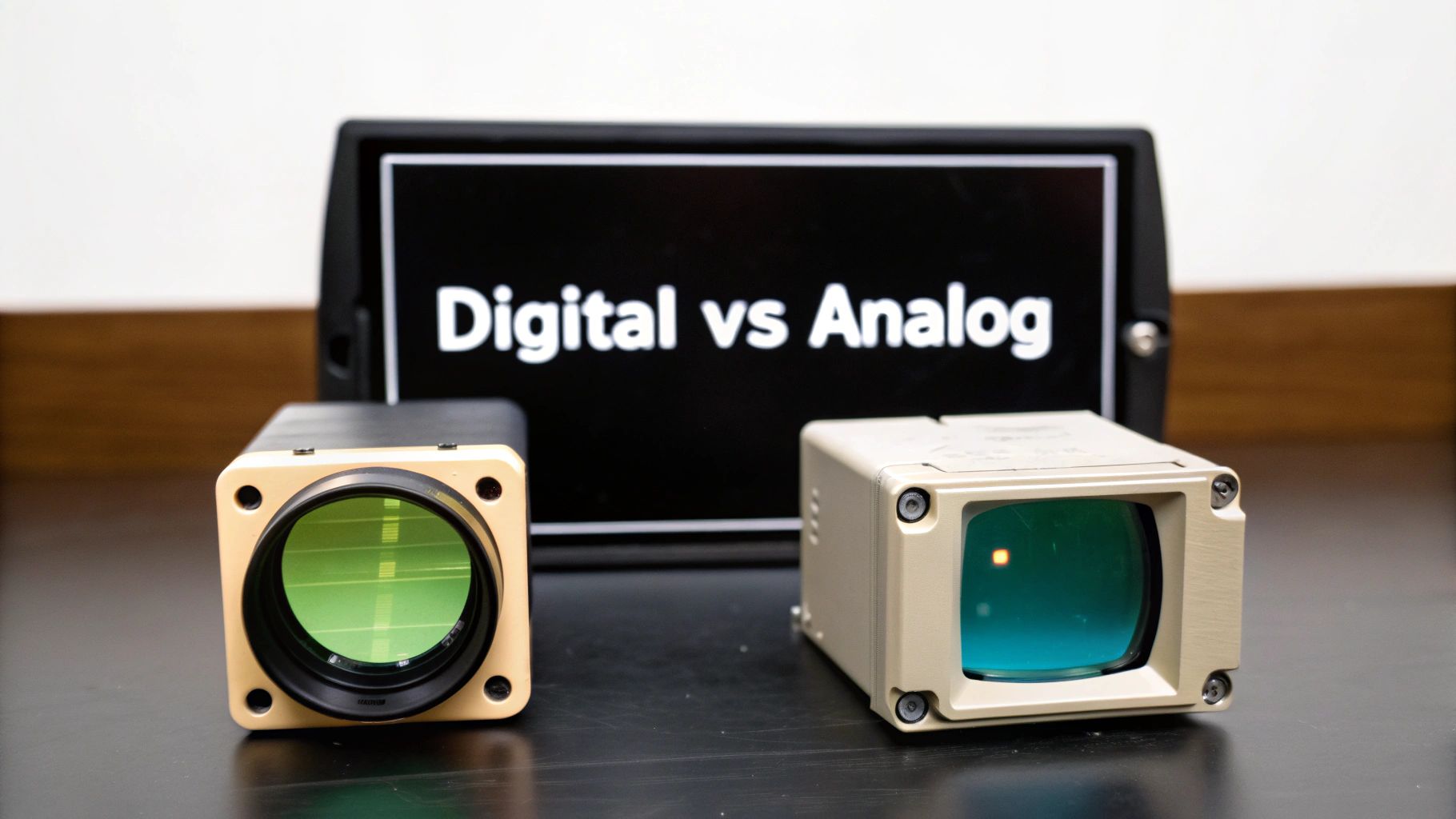
The Analog Approach: Image Intensifier Tubes
Traditional analog night vision—the kind you see broken down into "Generations" like Gen 1 or Gen 2—is basically a powerful light amplifier. It hinges on a critical component called an image intensifier tube that scoops up minuscule amounts of ambient light from sources like the moon or stars.
Think of this tube as a microphone, but for light. It gathers faint light particles (photons) hitting the lens, converts them into electrons, and then rapidly multiplies those electrons thousands of times over. Finally, it projects them onto a phosphor screen, creating that classic, glowing green image most of us recognize.
- Pros: Extremely sensitive in low light, delivering crisp images with very little help. Higher-end Gen 2 and Gen 3 units are legendary for their clarity and performance.
- Cons: Can be permanently damaged by sudden bright light. It's also significantly more expensive and almost never includes modern perks like video recording.
The Digital Revolution: Camera-Like Sensors
Digital night vision works on a completely different principle, one that's much closer to the camera in your smartphone. Instead of an intensifier tube, it relies on a highly sensitive electronic sensor—usually a CMOS (Complementary Metal-Oxide-Semiconductor) sensor—to capture light.
This sensor collects the incoming light and immediately converts it into a digital signal. From there, an internal processor cleans up and enhances that signal before displaying it on a tiny screen you look at through the eyepiece. And because the whole process is digital, it opens the door to a ton of extra features.
One of the biggest wins for digital tech is the ability to manipulate the image. This is why so many affordable scopes today can switch between black-and-white, the classic green, and even special full-color modes for twilight conditions.
This technology is the single biggest reason night vision has become so accessible. Advances in digital imaging have made today's scopes 40-50% cheaper than they were just a decade ago. This price drop has put powerful tools in the hands of everyone from hunters to law enforcement, where some studies have even shown a 35% reduction in incidents for patrols equipped with night vision.
Why Digital Dominates the Affordable Market
For just about anyone shopping for an affordable night vision scope, digital is the way to go. The manufacturing is far more cost-effective, and the components are tougher and completely immune to damage from bright light.
While a top-tier analog system still has the edge in near-total darkness, a modern digital scope—especially when paired with its built-in IR illuminator—delivers incredible clarity for the price. If you want to dive deeper, you can explore these technologies further by checking out our guide on the differences between thermal, digital, and analog night vision.
Ultimately, this digital shift means you no longer need a military-sized budget to own the night. You get a tough, reliable device packed with modern features like video recording and multiple color palettes, all without breaking the bank.
Getting a Handle on the Specs That Matter
When you first start looking at night vision scopes, the product pages can feel a bit like reading a different language. You're hit with a wall of technical jargon and acronyms, but only a handful of these specs truly define how the scope will perform when you're actually out in the field.
The trick is to learn what these key numbers mean for you and what you plan to do. Let's cut through the marketing noise and translate the essential specs into plain English.
Resolution: The Key to a Clear Picture
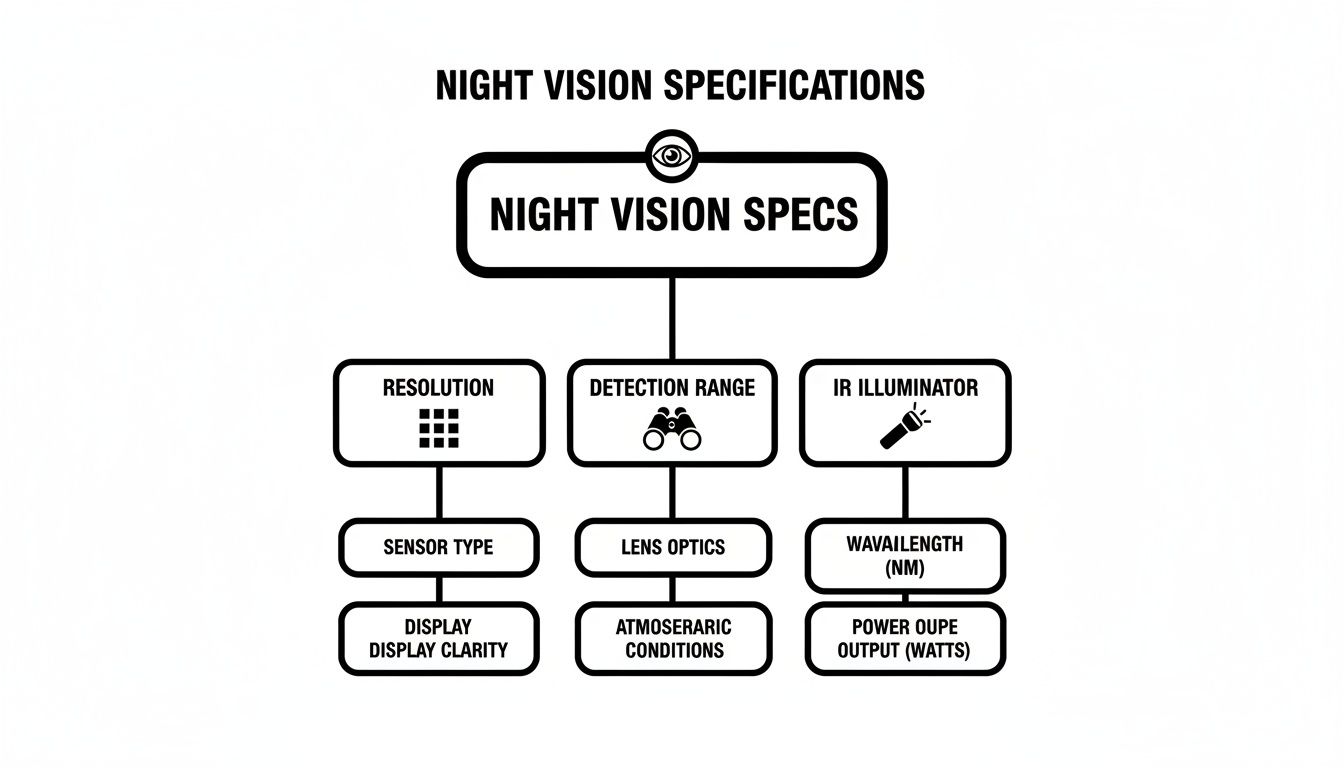
Think of resolution as the raw detail in the image you see through the scope. For digital scopes, this is measured in pixels (like 1920×1080), while traditional analog tubes use line pairs per millimeter (lp/mm). The higher the number, the sharper and crisper the image.
It's the difference between seeing a blurry, four-legged shape at 100 yards and being able to clearly identify it as a coyote, not the neighbor's dog. Honestly, resolution is probably the most critical spec because it dictates your ability to identify a target, which is a world away from just detecting that something is there.
Detection vs. Identification Range: A Critical Difference
These two terms get thrown around a lot, often together, but they describe two very different capabilities. Getting this straight is non-negotiable.
- Detection Range: This is how far out the scope can register a heat signature or movement. You’ll know something is out there, but you won’t have a clue what it is.
- Identification Range: This is the distance at which you can confidently tell what that "something" is—a hog, a deer, or another person. This is the number that really matters.
A budget scope might brag about a "500-yard detection range," but that's just marketing fluff if the identification range is only 75 yards. You have to match the scope's real-world identification range to the distances you'll actually be shooting or observing from.
A scope's true value isn't just in seeing far—it's in understanding what you're seeing. Always look past the flashy detection numbers and focus on the practical identification distance.
The IR Illuminator: Your Invisible Flashlight
Here’s a hard truth: no night vision device can see in pure, absolute darkness. They all need a little bit of light to work with. That's where the Infrared (IR) Illuminator comes in. It's essentially a flashlight that projects a beam of light invisible to human and animal eyes.
This invisible beam lights up the entire area in front of you, bouncing off objects and feeding a bright, clear scene back to your scope's sensor. For any affordable scope, particularly digital ones, a good IR illuminator is absolutely essential. Most budget-friendly models have one built-in, but bolting on a more powerful, external IR illuminator is single-handedly the best upgrade you can make to push your usable range out significantly further.
The market for affordable infrared night vision is exploding, changing the game for everything from hunting and security to wildlife observation. These scopes, even those under $2,500, can amplify the tiniest bit of ambient infrared light by up to 40,000 times, turning what looks like pitch-black darkness into a clear, visible scene. This technology has become a massive asset for law enforcement and search-and-rescue teams, as pointed out in recent industry analysis. You can read more about these advancements in night vision technology to see just how far things have come.
What to Expect at Every Price Point
Let’s be honest: when you're shopping for an affordable night vision scope, what you get for your money changes drastically from one price bracket to the next. Knowing what to expect at each level is the key to making a smart buy and not ending up disappointed. We can break the market down into three main tiers to see what your budget really gets you in terms of performance.
Generally, the three big specs that improve as you spend more are resolution, detection range, and the quality of the built-in IR illuminator.
Think of it as a pyramid—good resolution is the foundation for a truly useful image, and everything else builds on that.
H3: Entry-Level Scopes Under $500
At this price, you're looking at introductory digital night vision. These are fantastic tools for shorter-range jobs where you don't need to count the whiskers on a coyote from 200 yards out. The features are basic, and the image quality is functional but won't blow you away.
- Performance: You can count on getting a clear ID on a target out to about 50-75 yards. You might detect movement a little further out, but a positive ID gets tricky. The built-in IR illuminators are usually just enough for this range.
- Best For: Perfect for backyard pest control, checking on animals in a small pasture, or just seeing what’s making noise in the woods behind your house. They get the job done for close-quarters stuff.
These are the workhorses for your immediate area. They give you a massive leg up over your own eyes but aren't built for long-distance precision.
H3: Mid-Range Scopes From $500 to $1,200
This is the sweet spot for a lot of people. You get a serious jump in performance and features without having to take out a second mortgage. Image clarity gets a whole lot better here, mainly due to better sensors and glass, which makes these scopes way more versatile.
You'll start seeing higher resolutions (often 1080p), stronger built-in IR illuminators, and cool extras like video recording. The build quality gets tougher, too, so you can mount them on higher-caliber rifles without worrying.
- Performance: Reliable identification distances stretch out to 150-250 yards, making them incredibly effective for most common hunting situations.
- Best For: This is the go-to category for most hog or coyote hunters, ranchers with larger properties, and anyone who needs a durable, high-performing scope for regular use after dark.
This price point is where an "affordable night vision scope" truly becomes a capable tool for serious applications. The investment here pays dividends in clarity, range, and overall reliability in the field.
H3: High-Value Prosumer Scopes From $1,200 to $2,500
Once you step into this bracket, you're getting performance that starts to give older, way more expensive analog (Gen 2) gear a run for its money. These scopes often pack premium 4K sensors, top-notch glass, and processors that can pull a crisp image out of very little light, even at a distance.
Here, you can expect advanced features like recoil-activated video, Wi-Fi streaming to an app on your phone, and much cleaner user interfaces. These units are built tough for harsh conditions and offer the best long-range ID you can get in the digital market, often pushing clear visuals out to 300 yards and beyond.
To help you visualize the trade-offs, here’s a quick comparison of what you get at each budget level.
Affordable Night Vision Price Tiers Compared
| Price Tier | Key Features & Performance | Ideal Use Cases |
|---|---|---|
| Under $500 | Basic digital sensors, 50-75 yard ID range, simple controls, onboard IR for short distances. | Backyard pest control, close-range varmint hunting, casual wildlife observation. |
| $500 – $1,200 | 1080p sensors, 150-250 yard ID range, video recording, improved durability and recoil resistance. | Hog and coyote hunting, ranching, property security, serious nocturnal enthusiasts. |
| $1,200 – $2,500 | 4K sensors, 300+ yard ID range, premium glass, advanced features like Wi-Fi and recoil-activated video. | Long-range hunting, professional pest management, serious preppers, high-value security needs. |
Ultimately, choosing the right tier comes down to matching the scope’s capabilities with your realistic needs. A $400 scope is a great tool for a 50-yard shot, but it's the wrong tool for a 200-yard shot, and vice-versa.
Matching Your Scope to Your Mission
Figuring out the "best" affordable night vision scope is a lot like asking what the "best" vehicle is. The answer is, it depends on what you're doing with it. A farmer needs a pickup truck, not a sports car. The same logic applies here—the right scope has everything to do with the job you need it to do.

Starting with your mission saves you from two common mistakes: overspending on features you'll never use, or worse, getting stuck with a scope that fails when you need it most. By thinking through how you’ll actually use the device, you can zero in on the specs that really matter for your budget.
For the Modern Hunter
Hunters have a unique set of needs. It's not just about seeing a warm blob in the dark; you need to make a positive identification at a distance to ensure a safe and ethical shot.
- Recoil Rating: This is non-negotiable. Your scope has to be built to withstand the kick of your specific rifle caliber. A scope that can't hold zero is nothing more than a very expensive paperweight.
- Reticle Options: Having multiple reticle patterns and colors is a huge advantage. It lets you pick a crosshair that won't get lost against the background or your target.
- Identification Range: Pay close attention to this spec. You need to be certain the scope can give you a clear, identifiable image at or beyond your typical engagement distance.
For Security and Professional Use
When your job or safety is on the line, durability and reliability trump everything else. Law enforcement, security contractors, and property owners need gear that just plain works, every single time.
For professionals, reliability is the most important feature. A scope's ability to withstand harsh conditions and maintain a long battery life often outweighs raw image quality or extra bells and whistles.
The priorities here shift to things like a rugged, weatherproof housing and a long-lasting battery (or the ability to connect an external power pack). Simple, intuitive controls are also key for acquiring a target quickly under stress. In this world, toughness and simplicity win.
For Preparedness and Recreation
This is where versatility really shines. For the recreational shooter, prepper, or tactical enthusiast, features that might be considered extras for other users become major selling points.
This is the category where you'll want to look for features like built-in video and audio recording to capture your shots or document what's happening. Many of these scopes also have Wi-Fi streaming that connects to a smartphone app, which is incredibly useful for letting a friend act as a spotter.
For the preparedness crowd, these tools have moved from the realm of elite military gear to practical essentials. In fact, affordability is the main driver behind an estimated 70% of civilian adoption, making once-unobtainable low-light tech accessible to everyone. If you're interested in the data, you can find in-depth market analysis on night vision trends that shows just how mainstream these devices have become.
When you define your mission first, you cut through all the marketing noise and find a scope that’s truly built for you.
Why Warranty and Support Are Non-Negotiable
Let's be blunt: a great price on a night vision scope is worthless if the unit dies and you're left holding a paperweight. When you're shopping for budget-friendly gear, post-purchase support isn't just a nice "extra"—it's one of the most important parts of your investment. It's what keeps your gear in the fight.
These devices are sophisticated pieces of technology, and like any complex instrument, sometimes things go wrong. A good warranty is your safety net against a lemon right out of the box, but that's just the beginning. The real mark of a company you can trust is one that offers in-house diagnostics and repair services. That shows they don't just sell the gear; they understand it inside and out and are committed to keeping it running.
A warranty protects you from a faulty product, but dedicated support protects your entire investment. It’s the difference between a one-time transaction and a lasting partnership that keeps your gear performing for years.
When you inevitably have a question or run into a problem, that's when you'll truly appreciate solid customer service. For guys in law enforcement, security contractors, or firearm dealers, reliable support is a must-have. When uptime is critical, you need a partner who can provide in-house repairs and wholesale options—it's no surprise some support programs see 90% customer satisfaction in low-light reliability. If you're curious about the industry's scale, you can learn about the night vision device market and its growth.
This is what really separates a reputable retailer from a faceless online seller. To see why this is so critical, you can learn more about common night vision issues and how repairs can help and protect your investment for the long haul.
A Few Final Questions About Affordable Night Vision
Even after going through all the specs and price points, you probably have a couple of questions still rattling around in your head. That’s perfectly normal—in fact, it’s a good sign. It means you’re taking this investment seriously.
Let’s tackle some of the most common questions we get from folks looking to buy their first (or next) affordable night vision scope. The goal here is to iron out any last bits of uncertainty so you can pull the trigger on a purchase with total confidence.
Can Digital Night Vision See in Complete Darkness?
Yes, but it needs a little help. Digital night vision absolutely requires an infrared (IR) illuminator to function in true, pitch-black darkness. Just think of an IR illuminator as a high-powered flashlight, but its beam is completely invisible to the naked eye (both human and animal). To your scope's digital sensor, though, that IR light is as bright as day.
Most budget-friendly digital scopes come with a built-in IR that’s decent enough for shorter distances. But honestly, one of the single best upgrades you can make is adding a more powerful, external IR illuminator. That one accessory can easily double your effective identification range.
What’s the Real Difference Between a $400 and a $1,500 Scope?
When you boil it down, you're paying for image clarity, detection range, and durability. A $400 scope is going to get the job done for basic tasks inside 100 yards, like clearing pests out of the garden. The image will be functional, but not exactly crisp.
That jump to $1,500 is a big one, and you feel it immediately. You're getting a much higher-resolution sensor (think 1080p or even 4K), better glass, and a far more powerful IR illuminator that lets you clearly identify targets out to 200-300+ yards. The build quality is also night and day—it's built to handle more recoil and rougher use, and you'll get features like video recording and longer battery life.
How Important Is the Warranty on a Night Vision Scope?
It’s not just important; it's critical. Especially when you're shopping in the more affordable end of the market. These scopes are complex pieces of electronics, and a solid warranty is your safety net against any defects right out of the box.
But it goes deeper than that. Buying from a real, reputable shop means you have a place to turn to for support, troubleshooting, and repairs down the line. That's what gives your gear longevity and provides genuine long-term value, which is something you'll never get from a random third-party seller online.
At Superior Tactical LLC, we don't just move boxes. We stand behind every piece of gear we sell with in-house expertise and a promise to keep you ready for whatever comes next. Check out our hand-picked selection of reliable night vision optics and tactical accessories at https://superiortac.com.
