Your Guide to Buying a Low Cost Night Vision Scope
A low cost night vision scope isn't about settling for less; it's about smart, accessible technology. We're primarily talking about high-quality digital and Generation 1 devices that open up the night without the military-grade price tag. Think of it like this: a reliable pickup truck gets the job done for most people, while a Formula 1 car is built for a very specific, high-stakes purpose. Both are effective, but one offers incredible everyday value.
What a Low Cost Night Vision Scope Really Means
When you hear "low cost" in the night vision world, it's easy to think "cheap" or "ineffective." That's not the case at all. Instead, it describes a specific and highly capable tier of optics designed for folks who don't need—or want to pay for—the absolute peak of military technology. A budget-friendly scope gives you powerful vision in low-light and even no-light situations, perfect for hunting, keeping an eye on your property, or just exploring after dark.
You can get all of this without dropping the thousands of dollars required for a top-tier Gen 3 system. The technology has come a long way, bringing capabilities once reserved for elite special forces into the hands of everyday users. For most practical applications, a quality digital or Gen 1 unit is more than enough to spot a coyote at 150 yards or navigate a pitch-black trail.
Understanding the Tiers of Night Vision
The secret to a smart purchase is knowing where your money is going. Night vision is broken down into a few distinct technology tiers, and each comes with its own performance level and cost.
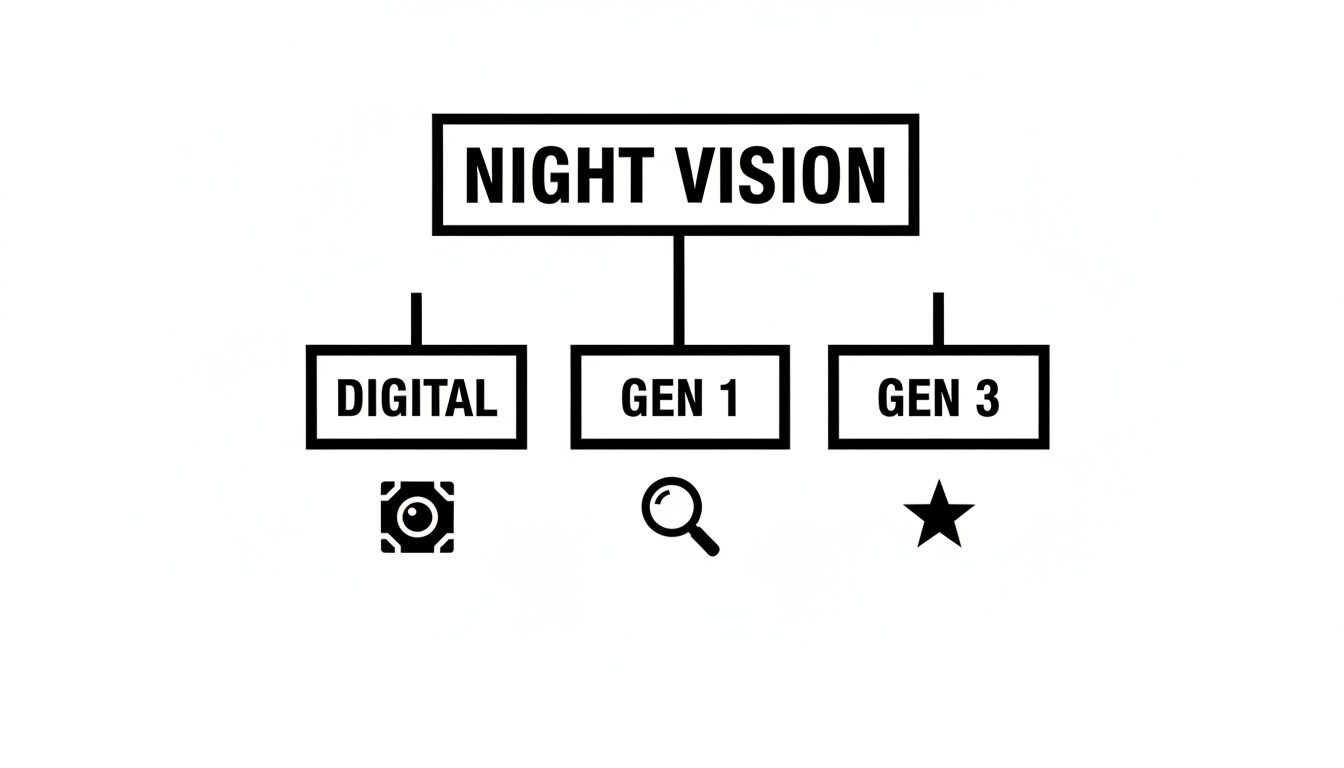
As you can see, affordable options like Digital and Gen 1 form the foundation of the market, offering a gateway into the world of night vision. Gen 3 sits at the top, representing the pinnacle of performance and, naturally, cost.
To make this even clearer, here's a quick breakdown of what you can expect from each technology tier.
Night Vision Technology Tiers at a Glance
| Technology Type | Typical Price Range | Best Use Case | Key Limitation |
|---|---|---|---|
| Digital NV | $200 – $1,000 | Entry-level hunting, backyard observation, recording | Relies heavily on IR illumination, can have image lag |
| Gen 1 | $400 – $1,200 | Short-range varmint hunting, property surveillance | "Fish-eye" distortion at edges, requires some ambient light |
| Gen 2 | $1,500 – $3,500 | Serious hunting, tactical applications, navigation | Higher cost, can be sensitive to bright light exposure |
| Gen 3 | $3,000+ | Professional security, military, advanced tactical use | Very expensive, subject to ITAR export restrictions |
This table helps put the cost-to-performance ratio into perspective, showing that "low cost" options provide a ton of capability for their price point.
Market Growth and Accessibility
This newfound accessibility is shaking up the industry. The global night vision scope market is on track to grow at a powerful CAGR of 11.2% from 2025 to 2031, all because of the demand for affordable and reliable gear. This shift means a hunter or a security-conscious homeowner can now pick up a capable scope for well under $1,000—a piece of equipment that would have set them back over $5,000 just a decade ago.
At Superior Tactical LLC, we firmly believe that reliable night vision shouldn't be out of reach. Our whole mission is to cut through the noise and give you straightforward, honest advice. We'll help you find a scope that truly fits your needs and your wallet, because we’ve seen firsthand how the right gear can completely change the game after dark.
In the end, choosing a low-cost night vision scope is about finding that perfect balance between price and performance. For anyone just getting started or with specific, non-critical needs, the value you get from today's affordable optics is simply outstanding. A smart choice starts with understanding what your money can do for you, a subject we dive into in our guide to budgeting for night vision and finding the right balance.
Decoding the Tech Specs on a Budget
Stepping into the world of night vision can feel like you’re trying to learn a whole new language. You see terms like "resolution," "gain," and "objective lens" plastered all over product pages, and it’s easy to feel overwhelmed. But here’s the secret: understanding these core ideas is what separates a smart purchase from a disappointing one, especially when you're trying to find a great low-cost night vision scope.
Let’s cut through the jargon.
Think of it this way: you don't need to be a mechanic to understand why horsepower and torque matter in a truck. It's the same deal here. You don’t need an engineering degree to figure out what specs will let you spot a coyote at 150 yards versus just seeing a blurry blob. This guide will arm you with the confidence to look at two different models and know exactly what you’re paying for.
The Foundation: Generations and Image Quality
The first and most important spec to understand is the generation. This tells you what kind of core technology is inside the unit, and in the budget-friendly world, you'll really only run into two types: Digital and Generation 1.
- Digital Night Vision: This is modern tech that uses a digital sensor, just like the camera in your phone. It’s tough, can be used in daylight without getting damaged, and often comes with cool perks like video recording. The image quality, though, is almost entirely dependent on a good built-in IR illuminator.
- Generation 1 (Gen 1): This is the classic analog "tube" technology. It’s fantastic at amplifying existing ambient light, but it’s not perfect. You’ll often see some distortion around the edges of the image—a "fish-eye" effect. It gives you a more natural view of the night but can be damaged by exposure to bright light.
Next up is resolution, which is measured in line pairs per millimeter (lp/mm). This is simply a measurement of how sharp and clear the image is. More line pairs mean a crisper, more detailed picture. A good low-cost scope will typically be in the 30-40 lp/mm range, which is more than enough to identify targets out to 100-150 yards.
Think of resolution like the pixel count on a TV. A 4K screen shows incredible detail compared to an old standard-def tube television. With night vision, higher lp/mm means you can tell the difference between a hog and a deer from a real distance.
Amplifying the Night: Gain and IR Illuminators
While resolution gives you clarity, gain gives you brightness. Gain is just the measure of how much the scope amplifies the available light from the moon and stars. It’s like the volume knob on your radio; turning it up makes a faint signal loud and clear.
On most low-cost night vision, especially digital models, the gain is handled for you automatically. But what happens when there’s no light to amplify—like on a moonless night in a dense forest? That's where the Infrared (IR) Illuminator becomes your best friend.
An IR illuminator is basically an invisible flashlight. It bathes the area in infrared light that your naked eye can’t see, but your scope can. The vast majority of budget scopes come with one built-in, which is a massive win for performance in total darkness. The power of that illuminator is what really dictates your effective range.
The Optics: Objective Lens and Field of View
The actual glass on the front of your scope is critically important. The objective lens is the big one that gathers light, and its size is measured in millimeters (like 50mm). A larger objective lens pulls in more light, which usually translates to a brighter, clearer image. The tradeoff? A bigger lens makes for a heavier, bulkier scope.
Finally, you have the Field of View (FOV). This tells you how wide of a picture you can see at once, measured either in degrees or in feet at 100 yards. A wide FOV is great for scanning an open area or finding your way in the dark, giving you better awareness of your surroundings. A narrower FOV usually comes with higher magnification, helping you zero in on something far away. A 40-degree FOV is a pretty standard and useful benchmark for general-purpose use.
Once you get a handle on these specs, a confusing product page suddenly turns into a straightforward comparison sheet. If you're interested in options that work well in both day and night, you can explore how these specs translate to different units in our guide on digital binoculars for night vision. By grasping these fundamentals, you can pick out a great low-cost night vision scope from a trusted brand like Sightmark, knowing it has the right stuff to help you own the night.
Choosing Between Digital and Analog Night Vision
When you first dip your toes into the world of affordable night vision, one of the first big questions you'll hit is: digital or analog? It’s a lot like choosing between a modern digital camera and a classic film camera. Both can take a great picture, but they get there in fundamentally different ways, and the right choice really boils down to what you plan on doing once the sun goes down.
Think of digital night vision as a specialized camera. It uses a CMOS sensor—the same kind of tech in your phone or a high-end security camera—to convert light into a digital signal. That signal then gets displayed on a tiny screen you look at through the eyepiece. This approach makes it tough, flexible, and usually easier on the wallet.
Analog, on the other hand, is the classic night vision technology most people picture. It relies on an image intensifier tube, which in the more budget-friendly world will be a Generation 1 or sometimes a basic Gen 2 tube. This tube physically amplifies existing light particles (photons), creating that iconic green-hued, direct view of the night.
The Digital Advantage: Versatility and Durability
The biggest selling point for digital night vision is its incredible flexibility. Since it's essentially a camera, you can point it at the sun without a second thought—it won't get damaged. Many models are built for 24/7 use, seamlessly transitioning from a full-color daytime mode to a crisp black-and-white or green-phosphor view at night.
This makes a digital scope a fantastic all-in-one option, especially for hunters or property owners. Plus, digital units are often loaded with features that analog systems just can't match.
- Video and Photo Recording: Want to capture proof of that coyote on your property or relive a successful hunt? Most digital scopes make it as easy as pressing a button.
- Wi-Fi Connectivity: You can often stream the live view to a phone or tablet. This is a game-changer for a spotter in a hunting blind or for training purposes.
- Customizable Reticles: Tired of the same old crosshair? Digital scopes often let you cycle through different reticle styles and colors to find what works best for you.
And because they don’t have fragile glass intensifier tubes, digital scopes are built like tanks. They can handle the recoil from high-powered rifles without flinching. Their only real dependency is a good IR illuminator, as they aren't as sensitive to faint ambient light as analog tubes. In true darkness, a digital scope paired with a powerful IR is an awesome tool.
The Analog Edge: Passive Performance and Natural Views
While digital brings the modern bells and whistles, analog holds a powerful ace up its sleeve: passive performance. Analog Gen 1 and Gen 2 tubes are incredibly good at gathering and amplifying even the faintest traces of ambient light from the moon and stars. This means you can often get a clear, usable image without ever turning on an IR illuminator.
This is a huge tactical advantage. An active IR illuminator might be invisible to the naked eye, but to anyone else using night vision, it screams like a spotlight. For any situation where staying unseen is critical, analog is usually the way to go.
There's also something to be said for the view itself. Looking through an analog scope feels more immediate and natural. There's no screen, no digital processing, and no lag—you're seeing a directly intensified version of the real world. This can seriously reduce eye strain over long nights of observation and gives you a much better "feel" for your surroundings.
A Side-by-Side Comparison
| Feature | Digital Night Vision | Analog Night Vision (Gen 1/2) |
|---|---|---|
| Daytime Use | Yes, completely safe and often has a color mode. | No, can be permanently damaged by bright light. |
| Recording | Yes, most models offer video and photo capture. | No, not an inherent feature of the technology. |
| Durability | High, solid-state tech withstands recoil well. | Moderate, intensifier tubes can be sensitive to shock. |
| IR Dependency | High, needs an IR illuminator in very dark conditions. | Low to Moderate, excels at amplifying ambient light. |
| Image Appearance | Clean, sharp digital display (often black & white). | Classic green phosphor, can have some edge distortion. |
| Best For | Hunting, recording, multipurpose day/night applications. | Covert observation, natural viewing, pure night use. |
This whole conversation is possible because of a major shift in the optics market. As strategic reports show, the rise of digital and fused technologies is driving prices down while keeping performance high. The digital day/night scope market alone has ballooned to $8.03 billion and is climbing. This is partly thanks to military modernizations since the 2010s that helped slash unit costs by 40-50%, allowing agencies to equip up to 70% more units for the same budget. You can read the full research about night vision scope trends to see how these market forces are at play.
So, what's the final word? It really comes down to your priorities. If you want a rugged, all-in-one device with modern features like recording and the ability to use it day or night, digital is a no-brainer. But if your focus is on pure nighttime performance, a natural view, and the ability to operate undetected without an IR beam, a quality analog scope will be your best friend in the dark.
Real World Performance and Practical Tradeoffs
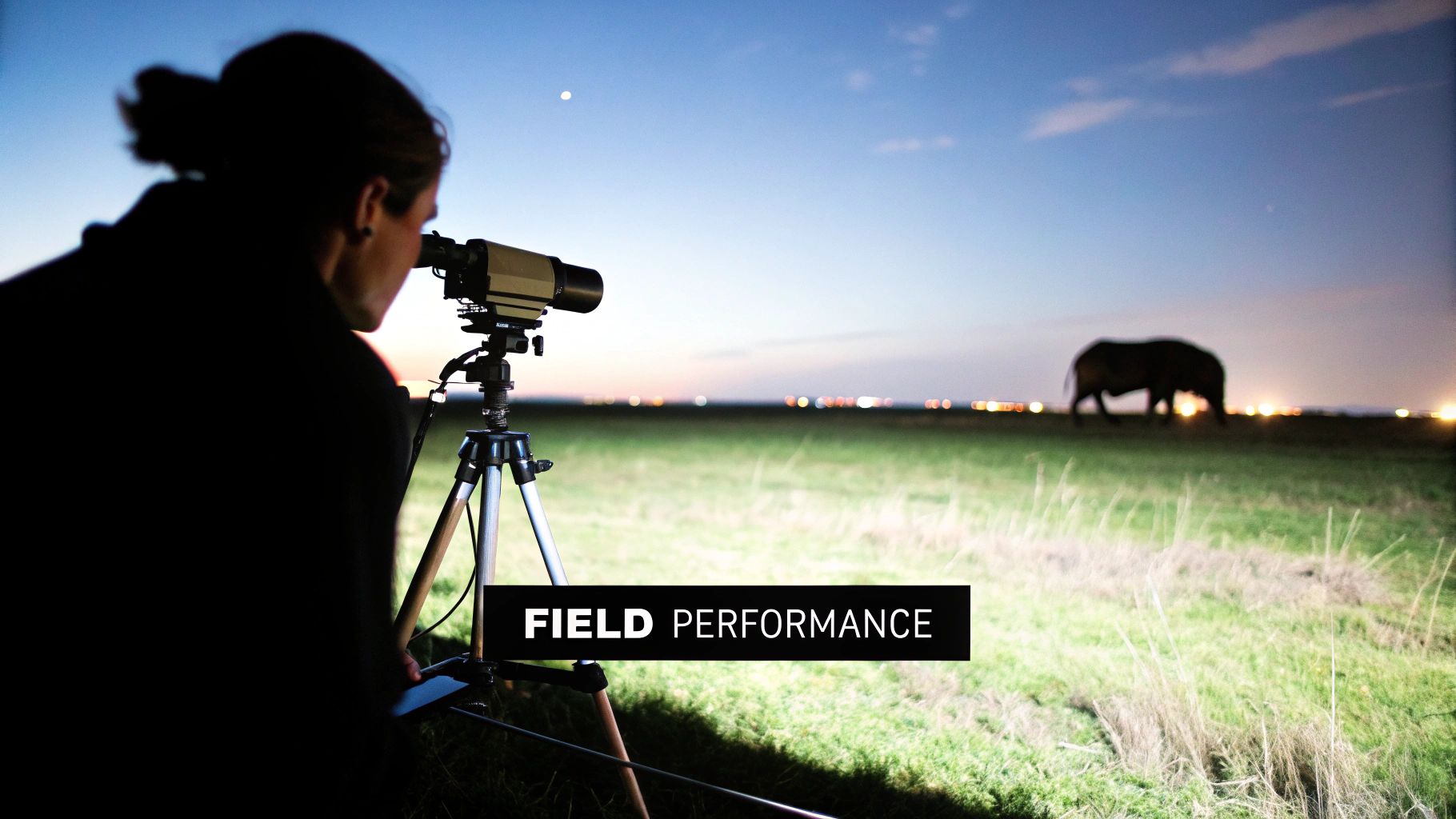
Specs on a product page are one thing, but how a budget-friendly night vision scope actually performs in the field is a whole different ballgame. This is where the rubber meets the road, and getting a handle on the real-world tradeoffs will help you line up your expectations with what your wallet can actually deliver.
So, let's translate those numbers into what you'll actually see. We'll walk through a few common scenarios to see what works, what falls short, and which features go from "nice to have" to "absolutely essential" depending on what you're trying to do.
Scenario 1: The Varmint Hunter
Picture this: you're out on your property trying to manage a coyote or hog problem. Your main job is to positively identify a target at a responsible shooting distance, say somewhere between 75 and 150 yards. You need enough clarity to tell the difference between a coyote and the neighbor's golden retriever.
For this kind of work, a few things are non-negotiable.
- Sufficient Resolution: You need at least 30-40 lp/mm resolution (or the digital equivalent). Anything less, and you’ll be playing a guessing game with shadows past 50 yards.
- A Capable IR Illuminator: Most budget scopes, especially the digital ones, really depend on their IR illuminator. A built-in one might get you to 100 yards, but a powerful, external illuminator is the single best upgrade you can make to push your ID range to that critical 150-yard mark.
- Weapon-Mount Durability: The scope has to be rated for the recoil of your rifle. Period. A scope that can't hold zero is nothing more than a very expensive paperweight.
In this context, features like video recording are cool, but they don't help you with the core task. The biggest tradeoff here is range; you’re not going to be making 400-yard shots like you could with a top-tier Gen 3 unit. But you will be absolutely effective within the typical distances for pest control.
Scenario 2: The Homeowner
Now, let's switch gears to a homeowner who wants to keep an eye on their property line, which is about 50 to 100 yards away. The goal isn't precision shooting—it's situational awareness. You want to detect movement and identify potential threats.
For this use case, the priorities are a bit different.
A wide Field of View (FOV) becomes way more important than high magnification. A standard 40-degree FOV lets you scan your whole backyard at a glance, so you don't feel like you're looking through a toilet paper tube. This is critical for catching movement on the edges of your vision.
For property surveillance, a digital scope is often the clear winner. Its ability to handle mixed lighting—like a porch light suddenly flipping on—is a huge plus over an analog tube that could get damaged by the bright light. And that recording feature? It just went from a "nice-to-have" to a "must-have" for gathering evidence if you ever need it. The main limitation is that you'll be detecting shapes at 100 yards but likely won't get a positive ID until they're closer, around 50 yards.
Scenario 3: The Airsoft Player
Finally, think about an airsoft or milsim player trying to navigate a dark course. The distances here are short, usually under 50 yards. The main goals are just moving around, spotting opponents, and not tripping over roots.
Here, the tradeoffs are completely different.
- Lightweight Design: A heavy scope is a huge drag when you're running around. A compact, lightweight monocular is almost always a better choice than a clunky rifle scope.
- 1x Magnification: This is one case where magnification is actually a bad thing. A 1x view keeps you from getting disoriented and preserves your natural depth perception, which is vital for moving quickly and safely in the dark.
- Passive Capability: An analog Gen 1 scope can be a fantastic choice here. Because it can work off ambient light without a glowing IR illuminator, it helps keep your position hidden from other players who are also using night vision.
The practical compromise is image quality. You’ll have to live with the grainy image and classic edge distortion of a Gen 1 tube. But in return, you get a lightweight, stealthy tool that’s perfect for close-quarters navigation. In this role, a low-cost night vision scope gives you a massive advantage over anyone still fumbling with a flashlight.
How to Spot a Bad Deal and Avoid Low Quality Optics
Diving into the market for a low-cost night vision scope can be tricky. For every solid, budget-friendly unit out there, you'll find a dozen cheap knock-offs just waiting to disappoint an unsuspecting buyer. Learning to spot the red flags is the most important skill you can develop to make sure your money goes toward a real tool, not a cheap toy.
The biggest giveaway is an outrageous claim. If you see a seller advertising a device with “Gen 4 Military Performance” for $300, you should be more than skeptical. Real, high-performance night vision costs thousands for a reason—the technology inside is complex and expensive to produce. If a deal looks too good to be true, it almost certainly is.
Another major warning sign is the flood of unknown or unbranded products. These mystery optics pop up on massive online marketplaces with no clear manufacturer, no warranty, and absolutely no customer support. Buying one is a gamble, and the odds are definitely not in your favor.
Key Red Flags to Watch For
To protect yourself, keep a sharp eye out for these common warning signs. A few minutes of due diligence now can save you a world of buyer's remorse later on.
- Vague or Missing Specs: A legitimate seller will be upfront with key specifications like resolution, generation (or digital sensor type), and the power of its IR illuminator. If the product description is all marketing fluff with no hard numbers, that’s a problem.
- No Clear Warranty or Return Policy: A company that stands behind its products will offer a clear warranty and a reasonable return window. If a seller is evasive about their policies, they probably know their gear won't hold up.
- A Pattern of Bad Reviews: Look for trends in customer feedback. A few negative reviews are normal for any product, but if you see a chorus of buyers complaining about blurry images, poor performance, or things breaking, listen to them.
The Value of a Trusted Retailer
This is exactly why buying from a specialized, reputable retailer like Superior Tactical LLC makes all the difference. Instead of just dumping hundreds of unvetted products online, a dedicated dealer actually curates their inventory. They only stock brands that meet a certain standard, like Sightmark, which means they've already done the first round of quality control for you.
Peace of mind is a feature you can't find on a spec sheet. Knowing you have access to expert support, a solid warranty, and a team that actually understands the gear is just as valuable as the optic itself. This ensures you get a lasting tool, not a disposable gadget.
When you buy from an expert source, you're not just getting a box in the mail; you're getting a partner. Have a question about what scope fits your rifle? Need help getting the most out of your new device? You can talk to someone with real, hands-on experience. That kind of support is invaluable, especially when you're just getting into night vision. This expertise is crucial whether you're evaluating a scope or trying to understand the top features to look for in a quality night vision monocular.
The Market Is Improving
The good news is that the affordable optics market is getting better all the time, driven by real innovation. In fact, the thermal night vision scope market was estimated at USD 1.2 billion in 2024 and is projected to hit USD 2.30 billion by 2033. This growth is thanks to advancements in lightweight designs, better batteries, and new features like image stabilization. These improvements have helped slash entry-level prices from over $4,000 to under $800 in just a few years. You can find more insights on the thermal and night vision market on marketsizeandtrends.com.
Ultimately, avoiding a bad deal comes down to doing your homework and choosing where you buy from carefully. By recognizing unrealistic promises and prioritizing reliability and support, you can confidently find a low-cost night vision scope that will serve you well for years to come.
Making the Right Choice with Superior Tactical
You've done the hard part. You now know what separates a good budget unit from a bad one and how to match the tech to what you actually do out there in the dark—whether that's tracking hogs, keeping an eye on your property, or just exploring the night. The difference between a digital scope and a traditional analog unit isn't just jargon anymore; it's a practical choice you're ready to make.
But picking the right gear is only half the battle. Who you buy it from matters just as much, especially when you're trying to get the most bang for your buck. That's where we at Superior Tactical LLC come in. We've spent over a decade in this field, and we don't just move boxes—we help people own the night, confidently.
Why Trust Us With Your Purchase?
When you decide to buy a low cost night vision scope from our shop, you're not just getting a piece of equipment. You're getting a team of experts in your corner who are committed to making sure you're happy with your gear long after you've opened the box.
Here’s what that actually looks like:
- We Only Sell What Works: We've seen it all, and we refuse to stock the junk. Every single optic on our site is there because we’ve vetted it and know it performs reliably. This saves you the headache of sorting through cheap knockoffs that will inevitably fail when you need them most.
- Honest, Practical Advice: Forget the confusing tech specs and sales pressure. Our team will give you straight answers to your questions. We're here to help you find the right scope for your specific situation, not to upsell you on features you'll never use.
- Support That Doesn't Disappear: Our relationship doesn’t end when your card is charged. We stand by everything we sell. Knowing you have a real person to call for help is the kind of peace of mind that makes a good investment a great one.
We believe getting into night vision shouldn't be intimidating. Our job is to give you more than just a tool; it's to give you the confidence that you made the absolute best choice for your money.
Now, go ahead and explore our hand-picked selection of budget-friendly night vision scopes. If you have any questions at all, just reach out. We're here to be your partner in finding that perfect low cost night vision scope you can count on for years to come.
A Few Common Questions
Diving into the world of affordable night vision can feel a bit overwhelming, so let's clear up some of the most common questions we get from folks just starting out. Getting these answers straight can make all the difference in choosing the right gear.
Can I Use a Low-Cost Night Vision Scope During the Day?
This is probably the single most important question to ask, and the answer comes down to what’s happening inside the scope. It’s the fundamental difference between the two types of budget-friendly night vision.
- Analog (Gen 1): Absolutely not. Think of an analog tube like a very sensitive eye that can be permanently blinded by bright light. Even a quick look at a bright scene without the protective day cap on can fry the image intensifier tube for good.
- Digital: You bet. A digital scope is essentially a specialized camera, so it’s perfectly safe to use in broad daylight. In fact, many digital models have a full-color daytime mode, which makes them incredibly versatile tools you can use around the clock.
What’s the Real-World Range of an Affordable Scope?
Marketing materials love to throw around big numbers, but let's talk about what you can actually expect in the field. For most budget-friendly digital and Gen 1 scopes, your detection range—where you can notice that something is out there—is going to be about 100 to 200 yards on a decent moonlit night.
Your identification range, which is being able to clearly tell if that something is a coyote or your neighbor's dog, is much shorter. You're realistically looking at about 50 to 100 yards. Be skeptical of any low-cost optic claiming performance that sounds too good to be true, because it probably is.
Do I Really Need a Separate IR Illuminator?
Most budget scopes come with a built-in IR illuminator—think of it as a flashlight that only your scope can see. It's usually good enough for close-range stuff, like scanning your property or hunting inside 75-100 yards.
But here’s a pro tip: adding a more powerful, external IR illuminator is hands-down the best upgrade you can make to an affordable night vision setup. It will dramatically extend your range and brighten up the image, especially on those pitch-black nights with no moon.
Is It Legal to Own Night Vision?
Good news. For a U.S. citizen buying and using night vision inside the United States, there are generally no federal restrictions. You can legally own Gen 1, digital, and even top-tier Gen 3 devices.
That said, there are a couple of things to keep in mind:
- Hunting Laws: Every state has its own rules. Some might restrict the use of night vision or thermal optics for hunting certain animals, so always check your local regulations before you head out.
- Export Laws: U.S. night vision technology is strictly controlled by ITAR (International Traffic in Arms Regulations). This is a big reason why you should always buy from a trusted, U.S.-based retailer like Superior Tactical LLC, ensuring everything is above board.
At Superior Tactical LLC, our mission is simple: to give you straight answers and gear you can count on. Check out our hand-picked selection of night vision optics and get the expert advice you need at https://superiortac.com.
